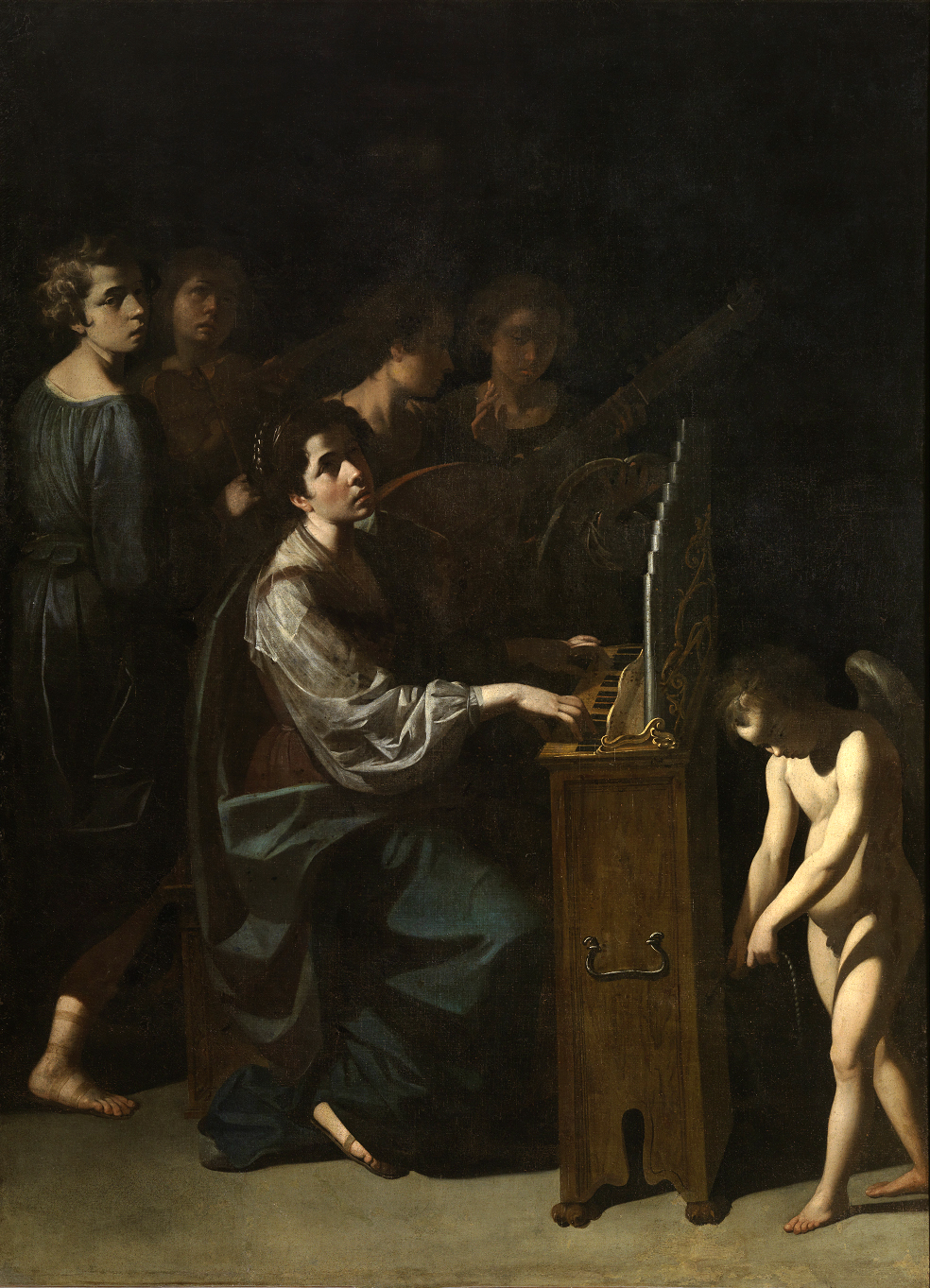
Carlo Sellitto (1580–1614) was among the first generation of Neapolitan painters to respond to the example of Caravaggio, whose presence in Naples transformed the city’s artistic culture during the opening years of the seventeenth century. Although his career was cut short by his death at the age of thirty-four, Sellitto had established a flourishing workshop, secured important religious commissions and achieved considerable success as a portraitist. Yet the surviving paintings represent only a fraction of his documented production, while the attribution of several others remains disputed. His artistic development must therefore be reconstructed from incomplete evidence, in which archival discoveries and the reassessment of individual works have played an essential part.
The extent of Sellitto’s professional success emerges more clearly from the financial records examined by Christopher R. Marshall. His altarpieces could command between 200 and 300 ducats, placing them among the more expensive paintings produced in Naples, while smaller pictures intended for private collections averaged around 50 ducats. An inventory compiled after his death in 1614 reveals the prosperity he had achieved: his household contained expensive furnishings, musical instruments and numerous paintings, while his estate was valued at nearly 2,000 ducats. The bed alone was assessed at 118 ducats, equivalent to several years’ rent. These figures offer a striking indication of the financial rewards available to a successful painter in early seventeenth-century Naples, and establish Sellitto’s considerable standing within its artistic economy.
Portraiture was an important source of Sellitto’s income, and his clients included members of the Neapolitan aristocracy and the Spanish viceregal administration. Marshall’s examination of the posthumous inventory reveals eight portraits for which payment was still outstanding. One had brought the artist nothing beyond the initial deposit, while another, depicting the viceroy’s secretary, was accompanied by a note suggesting that payment would require patience and tactful negotiation. The executors of Sellitto’s estate continued to pursue these debts, receiving the final payment for a portrait of the viceroy only two years after the artist’s death. Such details provide a vivid picture of the business of portraiture, in which prestigious commissions did not necessarily guarantee prompt payment.
One of the few surviving paintings associated with this activity is the Portrait of Adriana Basile as Saint Cecilia, which Ferdinando Bologna attributed to Sellitto in 1991. The identification of the sitter as Adriana Basile, the celebrated Neapolitan singer known as the “divina Andreana”, is supported by comparisons with other likenesses and by the musical notation she holds, although it is not established by a contemporary document. The proposed date, shortly before Basile’s departure for the court of Vincenzo Gonzaga in Mantua in May 1610, also accords with records of portraits of Neapolitan women commissioned from Sellitto for the duke’s collection. The painting offers a valuable glimpse of the naturalism and individual characterisation that contributed to the painter’s reputation as a portraitist. An illustration is available in the Wannenes gallery article.
Biography and Artistic Formation
Carlo Sellitto was born in Naples and baptised on 10 July 1580 in the parish of San Giovanni Maggiore. He was the second of six children of Sebastiano Infantino, a painter and gilder from Montemurro in Basilicata, and Lucente de Senna, a Neapolitan. His father had adopted the surname of his own mother, Margherita Sellitto, which Carlo also used. After receiving his earliest instruction in the family workshop, the young painter collaborated with Girolamo Imparato, at the age of fifteen, on a painting of the Madonna commissioned by Alfonso de Herrera, Bishop of Ariano. He subsequently entered the workshop of Giovanni Antonio Ardito, an apprenticeship confirmed by testimony given at Sellitto’s marriage in 1613.
Sellitto’s personal life is documented in some detail. He was initially engaged to Claudia, the daughter of the Flemish painter Loyse Croys, but broke off the arrangement shortly before the wedding. He subsequently formed a relationship with Porzia Perrone, who was separated from her husband, Mario Pianese. The couple lived together for approximately three years, but could not marry until Pianese’s death towards the end of 1612. Their marriage took place on 30 March 1613. Sellitto’s close connection with the Croys family lends weight to the widely accepted belief that he trained in the Flemish painter’s workshop, although direct documentary confirmation of the apprenticeship has not been found.
Sellitto’s early artistic formation took place within the late Mannerist culture of Naples, where painters of Italian and Northern European origin worked alongside one another. His earliest surviving religious paintings reflect this varied environment. The Madonna of the Rosary with Saints at San Chirico Raparo, probably dating from the first years of the seventeenth century, has been associated with the Flemish painters Dirck Hendricksz and Aert Mijtens, as well as the more naturalistic devotional painting of Fabrizio Santafede. The Madonna of the Angels with Saints Francis and Anthony at Lauria reveals affinities with Francesco Curia and Girolamo Imparato. These works demonstrate Sellitto’s familiarity with different strands of Neapolitan painting, including approaches to religious expression and the representation of figures that were already moving beyond the conventions of late Mannerism.
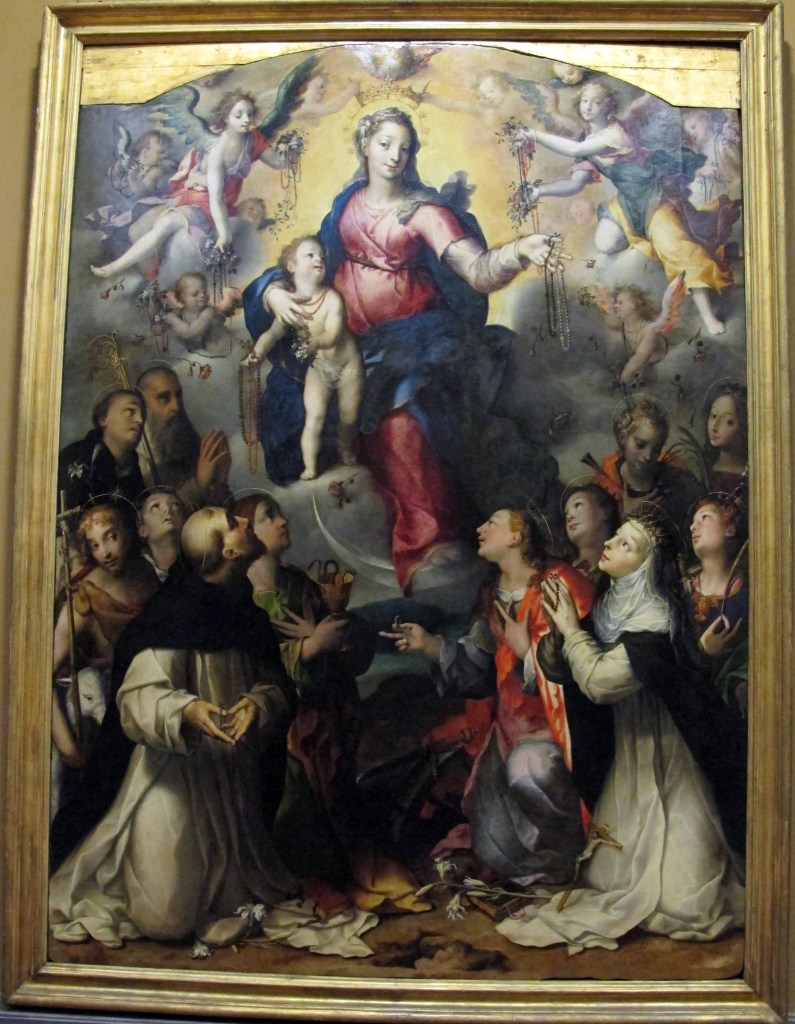
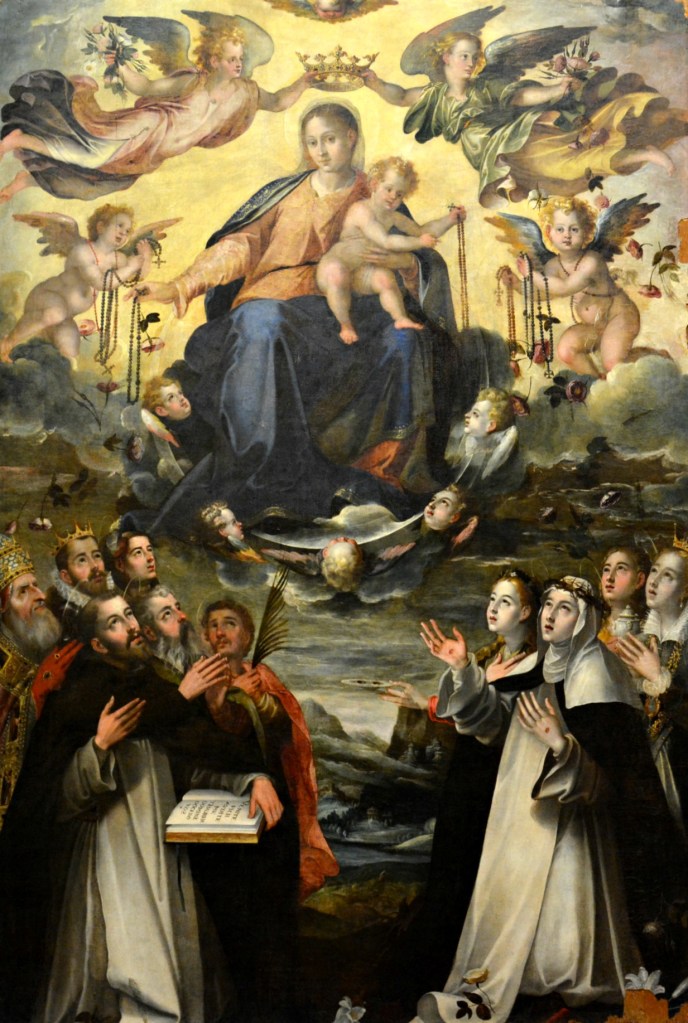
The signed Madonna del Suffragio in the church of San Luigi Gonzaga at Aliano provides further evidence of the complexity of Sellitto’s development. Although its religious composition retains elements of late Mannerist design, the half-length portrait of the donor displays a direct engagement with observed reality. Ferdinando Bologna drew attention to the portrait’s striking realism, suggesting a comparison with the early work of Velázquez. A comparable concern with physical appearance can be found in Saint Bruno Praying before the Crucifix, now in Strasbourg, a painting whose attribution to Sellitto has nevertheless been disputed. Its treatment of the saint’s ageing face and hands combines close observation with a concentrated use of light. These paintings suggest that Sellitto’s engagement with Caravaggio developed within an artistic culture already receptive to naturalistic representation, rather than replacing an exclusively Mannerist approach.
From Mannerism to Caravaggism
An important stage in Sellitto’s development is represented by his work for the Curtoni chapel in the original church of Sant’Anna dei Lombardi in Naples. The chapel was granted on 24 December 1607 to three brothers of Bergamasque origin, Annibale, Giovanni Domenico and Pietro Curtoni, who commissioned a decorative programme devoted to Saint Peter. The surviving paintings include The Delivery of the Keys and Saint Peter Saved from the Waters, generally dated to around 1610–12. The programme also included a circular Martyrdom of Saint Peter, subsequently identified in the collection of the Ospedale Sant’Anna in Como. Following the collapse of the original church’s roof in 1798, the Lombard confraternity moved to the neighbouring church of Santa Maria di Monteoliveto, which inherited the name Sant’Anna dei Lombardi and now houses the two larger canvases. The original church was eventually demolished after the earthquake of 1805. The commission placed Sellitto in a setting of considerable artistic significance, since Caravaggio had also worked in the original church, producing three paintings for the Fenaroli chapel, including a Resurrection of Christ, all of which are now lost.
The two surviving paintings from the Curtoni chapel reveal Sellitto’s increasingly confident response to Caravaggio’s naturalism. In The Delivery of the Keys, Christ and Saint Peter occupy the foreground, while the apostles behind them contribute to the narrative through their gestures and exchanged glances. Saint Peter Saved from the Waters presents a different episode from the apostle’s life, in which Christ intervenes to rescue Peter as he begins to sink. In both compositions, the figures retain something of Sellitto’s Mannerist formation in their solid, almost cylindrical construction and the angular folds of their draperies. Yet their physical presence is strengthened by the treatment of illumination, which gives greater depth to the forms and establishes their relationships within the surrounding darkness. Giuseppe Porzio draws attention to the relative composure of Sellitto’s figures, contrasting their stability and expressive restraint with the more strained anatomical forms and emphatic gestures sometimes found in Battistello Caracciolo’s paintings.
The circular Martyrdom of Saint Peter, originally painted for the vault of the Curtoni chapel, has been identified by Federico Maria Giani in the collection of the Ospedale Sant’Anna at Como. Its identification is strongly supported by historical descriptions and inventories documenting the painting’s removal from the original church and its subsequent history. The composition depicts the preparations for Peter’s crucifixion, with particular emphasis on the physical exertions of the figures fastening him to the cross. Giani draws attention to the two young men with exposed backs in the foreground, whose muscular forms had already attracted the admiration of earlier commentators and reveal affinities with Battistello’s treatment of similar subjects. Sellitto nevertheless approaches the scene through a different arrangement of light and colour. In place of the enveloping shadows of the other two paintings, he employs successive passages of half-light and a restrained palette of earth and flesh tones, relieved by accents of white, red and green.
Designed to be viewed from a distance in the chapel vault, the Martyrdom contains passages of considerable refinement. Giani particularly admires the construction of the heads through distinct planes of light and shadow, together with the subtle variations of illumination across beards, hands and folds of skin. He also acknowledges certain limitations in the recession of the figures into depth and some less carefully resolved passages, while recognising that losses and later repainting complicate the painting’s assessment. Nevertheless, he finds in the work an expressive force that establishes its importance as an early achievement of Neapolitan naturalism. The recovery of the Martyrdom has made it possible to reconsider three paintings conceived for the same decorative programme, illuminating a decisive stage in Sellitto’s development when, in Porzio’s assessment, his artistic language attained a more complete and independent character.
The Adoration of the Shepherds, painted in 1612 for Santa Maria del Popolo agli Incurabili in Naples, provides a further point of reference for Sellitto’s developing naturalism. Its documented date is especially valuable, although the painting has suffered from earlier restoration and has a complicated attributional history. Long regarded as an early work by Battistello Caracciolo, it was subsequently restored to Sellitto’s oeuvre. Nicola Spinosa supports this attribution through comparisons with The Delivery of the Keys and Saint Charles Borromeo. The figures acquire greater solidity through a more graduated treatment of light, which also helps to unify the composition. Barbara Savina draws attention to the kneeling shepherd on the right, whose head recalls that of Saint Peter in The Delivery of the Keys, and to similarities in the treatment of the cherubs. These correspondences suggest that Sellitto was developing a recognisable repertory of figures and facial types, adapted to different religious subjects. The painting thus provides evidence of his increasingly accomplished response to Caravaggio, while its attributional history illustrates the difficulty of distinguishing Sellitto’s work from that of Battistello during the formative years of Neapolitan Caravaggism.
The Late Religious Paintings
Sellitto’s Saint Charles Borromeo, painted for the chapel of Francesco Antonio Amitrano in Sant’Aniello a Caponapoli, belongs to the final phase of his career. The commission followed the canonisation of Charles Borromeo in 1610, when devotion to the reforming Archbishop of Milan received renewed impetus. The painting presents the saint kneeling in prayer before a crucifix on an altar, accompanied by a young attendant. Light entering from the left illuminates the attendant’s face and gives substance to the saint’s figure, while the architectural setting establishes a clear spatial arrangement. Vincenzo Pacelli regards the painting as a significant advance beyond the Curtoni chapel decorations, noting the greater coherence of its forms and illumination. Rather than relying principally on strong contrasts of light and shadow, Sellitto gives the devotional encounter a quiet intensity through the saint’s absorbed expression and the measured organisation of the composition. The painting retains the directness associated with Caravaggio’s naturalism, but its clarity and restraint have also encouraged comparisons with the classicising tendencies of Guido Reni.
The Saint Cecilia, painted in 1613 for the church of Santa Maria della Solitaria and now in the Museo di Capodimonte, offers a revealing connection between Sellitto’s artistic and musical interests. The painting was commissioned within the circle of the musicians of the royal chapel, among whom Giovanni Maria Trabaci, an organist and composer, played a prominent part. Sellitto’s association with this milieu was not confined to his professional activity. The inventory compiled after his death records an organ, a harpsichord and several stringed instruments among his possessions, while his connections with the Flemish painter Loyse Croys brought him into contact with a circle that included the composer Jean de Macque. The choice of Saint Cecilia, patron saint of music, therefore had a personal as well as a devotional resonance. The painting represents her at an organ, accompanied by angels, her face turned upwards in an expression of spiritual absorption. The subject recalls Raphael’s celebrated Ecstasy of Saint Cecilia in Bologna, an influential Renaissance interpretation of the saint’s association with music, although Sellitto gives the scene a different character through his treatment of the figures and illumination.
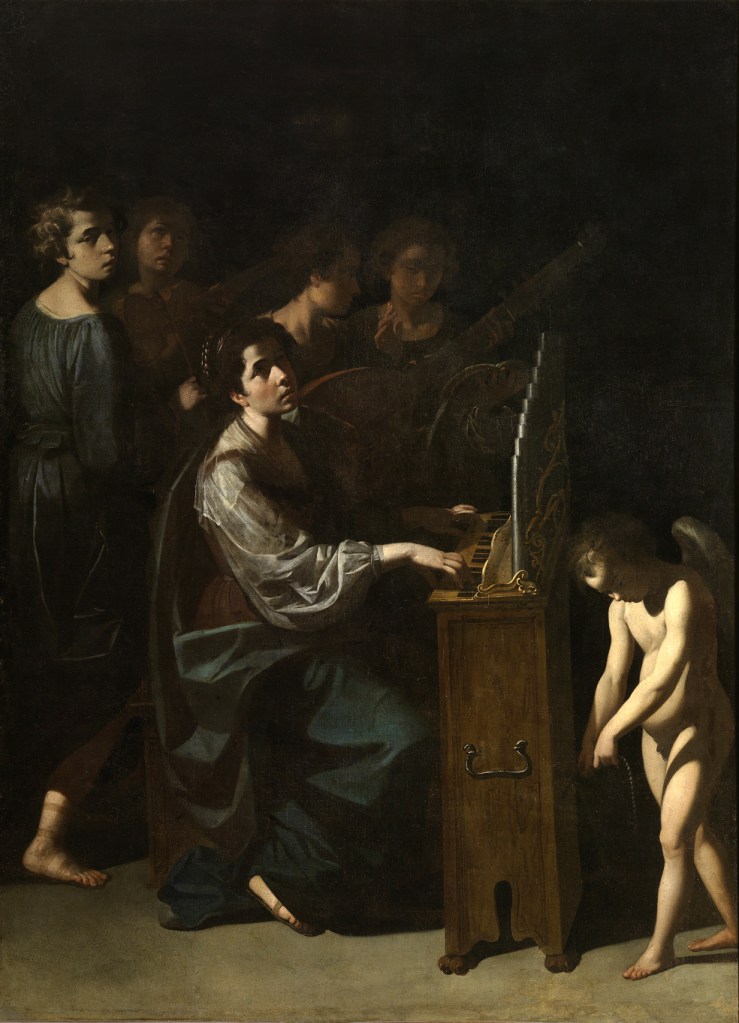
In Saint Cecilia, Sellitto’s handling of light and form reaches a new level of refinement. The sharply defined folds of the draperies and the geometric construction of the figures retain affinities with Battistello Caracciolo, but the illumination produces a more delicate interplay of solid forms and softened contours. Vincenzo Pacelli draws attention to the modelling of the figures and the careful observation of reflective surfaces, while Barbara Savina emphasises the gentle expression of the saint and the softly illuminated faces of the accompanying angels. The painting brings together the physical immediacy of Caravaggesque naturalism and a more lyrical conception of religious experience. Its combination of accomplished drawing, controlled illumination and emotional tenderness gives it a distinctive place among Sellitto’s surviving works.
Among Sellitto’s final religious paintings, The Vision of Saint Candida in the Brancaccio chapel of Sant’Angelo a Nilo, Naples, reveals a further development of his artistic language. The altarpiece represents Saint Candida Iuniore, a figure venerated locally, in a vision accompanied by angels, including one bearing a crown. Its warm, enveloping illumination differs from the more emphatic contrasts of light and darkness associated with Sellitto’s earlier response to Caravaggio. As with Saint Charles Borromeo, the painting suggests an affinity with the classicising tendencies of Guido Reni, whose presence in Naples in 1612 may, as Gianluca Forgione proposes, have influenced Sellitto’s development. The combination of naturalistic observation with a gentler conception of religious expression suggests how Sellitto was adapting the lessons of Caravaggio to a wider range of artistic possibilities shortly before his premature death.
The Reconstruction of Sellitto’s Oeuvre
The reassessment of Sellitto’s work has continued to bring paintings into consideration that substantially enlarge our understanding of his artistic range. Among the most significant is Saint Francis Receiving the Stigmata, attributed to him by Giuseppe Porzio and recorded in a private collection. Augusto Russo regards the painting as a powerful example of Sellitto’s response to Caravaggio, placing it stylistically close to the Curtoni chapel decorations of around 1610–12. Its importance lies in the intensity with which the new naturalism is assimilated, suggesting a more direct engagement with Caravaggio’s example than is apparent in some of Sellitto’s documented commissions. Porzio has likewise emphasised its quality, regarding it as one of the notable achievements of Neapolitan painting before the arrival of Jusepe de Ribera. Although its attribution rests on scholarly assessment rather than documentary proof, the painting provides an important point of reference in reconsidering the extent and character of Sellitto’s contribution to early Neapolitan Caravaggism.
The attribution of Salome and Herodias Presenting the Head of Saint John the Baptist to Herod, in a private collection, offers a further example of the difficulties involved in reconstructing Sellitto’s oeuvre. Gianni Papi has proposed that the painting belongs to Sellitto, extending the range of subjects associated with the artist beyond his surviving religious commissions. Reviewing Papi’s research, Sheila Carol Barker found the attribution sufficiently persuasive to suggest that an almost identical composition in York Art Gallery, England, might also be by Sellitto. The relationship between these two versions remains uncertain, but their recognition has opened a further line of enquiry into the painter’s production and the possible circulation of compositions within his workshop.
The Saint Lucy in the Museo Regionale di Messina presents another unresolved attributional question. Ferdinando Bologna proposed that the painting was by Sellitto, an identification supported, though not conclusively established, by a document recording the sale of a Saint Lucy by the artist to the Duke of Nocera. Donatella Spagnolo, writing in the museum’s guide (page 62), draws attention to the intensity of the saint’s expression and the gesture of her left hand against her breast. She also records Francesca Campagna Cicala’s alternative interpretation, which associates the painting’s classicising qualities and chiaroscuro modelling with the manner of Massimo Stanzione and proposes a considerably later date, around 1640–50. The case illustrates the complex interplay between documentary evidence and connoisseurial judgement in reconstructing Sellitto’s oeuvre, where the identification of individual paintings remains open to competing interpretations.
The Workshop and Artistic Commerce
The inventory compiled after Sellitto’s death reveals a workshop whose activities extended well beyond the execution of commissioned paintings. Christopher R. Marshall identifies a substantial stock of pictures, including devotional works, copies after established masters and paintings by other artists, some of whom appear to have worked as Sellitto’s assistants or associates. The commercial character of the enterprise is illustrated by a transaction recorded in 1603, when Sellitto sold Giovanni Battista Ròta a Christ Bearing the Cross after Bassano for twenty ducats. Remarkably, Ròta stipulated that the painting should not be copied again, evidently wishing to secure a degree of exclusivity for a picture that was itself a reproduction. Six years later, however, he returned to Sellitto to commission another copy. Such transactions reveal a painter operating simultaneously as artist, workshop director and dealer, supplying a clientele whose interests encompassed both original compositions and reproductions of admired works.
The range of paintings held in Sellitto’s workshop is equally revealing. Marshall records ten landscapes associated with Filippo Napoletano, four large and six smaller pictures, alongside other works attributed to the same artist, including a Saint Lucy, a Saint Charles Borromeo and a copy after Titian. Their presence suggests that Sellitto maintained a professional relationship with a painter whose speciality enabled him to supply pictures beyond his own principal areas of activity. The inventory also included nine unattributed still lifes, five of which were sold during the year following his death, and paintings of animals, including a substantial canvas that fetched fifteen ducats. These were genres increasingly attractive to collectors, although their production cannot necessarily be attributed to Sellitto himself. Rather, the evidence points to a commercially adaptable establishment in which paintings by different hands and in different genres could be brought together for sale.
The organisation of Sellitto’s workshop was more complex than a conventional arrangement of master and apprentices. Christopher R. Marshall identifies several painters whose work appears in the posthumous inventory, including Giovanni Matteo Arciero, Bartolomeo Principe and Francesco Abbenante. Arciero had been associated with Sellitto for some three years by 1614 and received a payment of fifty ducats in 1612, suggesting a professional relationship rather than an ordinary apprenticeship. The inventory also provides evidence of compositions being replicated within the workshop. A portrait of the viceroy had been copied, while Abbenante’s Saint Anthony reproduced a painting commissioned from Sellitto for San Nicola alla Dogana. These examples suggest an establishment in which assistants and associates could undertake independent work while drawing upon the master’s compositions. Sellitto’s success depended not only upon his abilities as a painter but also upon his capacity to organise the labour of others and respond to the varied demands of his clientele.
The circumstances surrounding Sellitto’s Christ on the Cross, formerly in Santa Maria in Cosmedin at Portanova, Naples, provide an especially revealing example of the problems created by his premature death. Commissioned by Fabrizio de Sangro, Duke of Vietri, the painting was already in progress when a payment was recorded on 23 August 1613. A further payment was made to Sellitto’s heirs on 18 February 1615, suggesting that the work may have remained unfinished when he died in October 1614. Nicola Spinosa has drawn attention to its possible dependence upon a composition by Marcello Venusti derived from Michelangelo, while the landscape background has been tentatively associated with Filippo Napoletano. If accepted, this latter suggestion would provide an instance of collaboration between Sellitto and a specialist painter whose work is independently documented in his workshop. The painting was included in the exhibition devoted to Sellitto in 1977 but was subsequently stolen and has not been recovered.
Sellitto’s standing among Neapolitan painters is further demonstrated by a prestigious commission received in 1613 from the governors of the Pio Monte della Misericordia. He was engaged to paint The Liberation of Saint Peter from Prison for one of the chapel’s altars, where Caravaggio’s celebrated Seven Works of Mercy had occupied the high altar since 1607. The subject represented the charitable duty of visiting and assisting prisoners, one of the institution’s principal concerns. Sellitto’s death in October 1614 prevented him from fulfilling the commission, which was subsequently entrusted to Battistello Caracciolo. Battistello completed the painting in 1615, receiving a payment of one hundred ducats. The episode provides a fitting conclusion to the intertwined careers of the two painters, whose responses to Caravaggio had developed alongside one another during the formative years of Neapolitan naturalism. It also demonstrates the professional recognition Sellitto had achieved by the end of his short career.
For photographs and catalogue records of paintings by Carlo Sellitto, see the Fondazione Federico Zeri photographic archive.
Donate to Inner Surfaces here.
Bibliography
Barker, Sheila Carol, review of Davanti al naturale: Contributi sul movimento caravaggesco a Napoli, edited by Francesca De Luca and Gianni Papi, Renaissance Quarterly, 71, no. 3 (2018), pp. 1065–66.
Forgione, Gianluca, ‘Sellitto, Carlo’, in Dizionario Biografico degli Italiani, vol. 91, Rome: Istituto della Enciclopedia Italiana, 2018.
Giani, Federico Maria, ‘Il “Martirio di San Pietro” di Carlo Sellitto da Sant’Anna dei Lombardi a Napoli all’Ospedale Sant’Anna a Como’, Prospettiva, no. 184 (October 2021), pp. 83–88.
Marshall, Christopher R., Baroque Naples and the Industry of Painting: The World in the Workbench, New Haven and London: Yale University Press, 2016.
Pacelli, Vincenzo, catalogue entries 2.232–2.234, in Civiltà del Seicento a Napoli, Naples: Electa Napoli, 1984, pp. 446–450.
Pacelli, Vincenzo, La pittura napoletana da Caravaggio a Luca Giordano, Naples: Edizioni Scientifiche Italiane, 1996.
Papi, Gianni, ‘Novità per Carlo Sellitto’, in Francesca De Luca and Gianni Papi (eds.), Davanti al naturale: Contributi sul movimento caravaggesco a Napoli, Milan: Officina Libraria, 2017, pp. 7–21.
Porzio, Giuseppe, Carlo Sellitto 1580–1614, Naples: Arte’m, 2019.
Porzio, Giuseppe, Pittura a Napoli intorno a Caravaggio, 1606–1610, Naples: Arte’m, 2026.
Russo, Augusto, ‘Sulla prima ora del caravaggismo a Napoli’, in Maria Cristina Terzaghi (ed.), Caravaggio Napoli, Milan: Electa, 2019, pp. 80–91.
Savina, Barbara, ‘Carlo Sellitto (Napoli 1580–1614)’, in Alessandro Zuccari (ed.), I caravaggeschi: Percorsi e protagonisti, vol. 2, Milan: Skira, 2010, pp. 667–677.
Spagnolo, Donatella, ‘Santa Lucia’, in Caterina Di Giacomo (ed.), MuMe: Museo Interdisciplinare Regionale di Messina, Messina: Regione Siciliana, 2017, p. 62.
Spinosa, Nicola, Pittura del Seicento a Napoli: Da Caravaggio a Massimo Stanzione, Naples: Arte’m, 2010, pp. 390–391.

