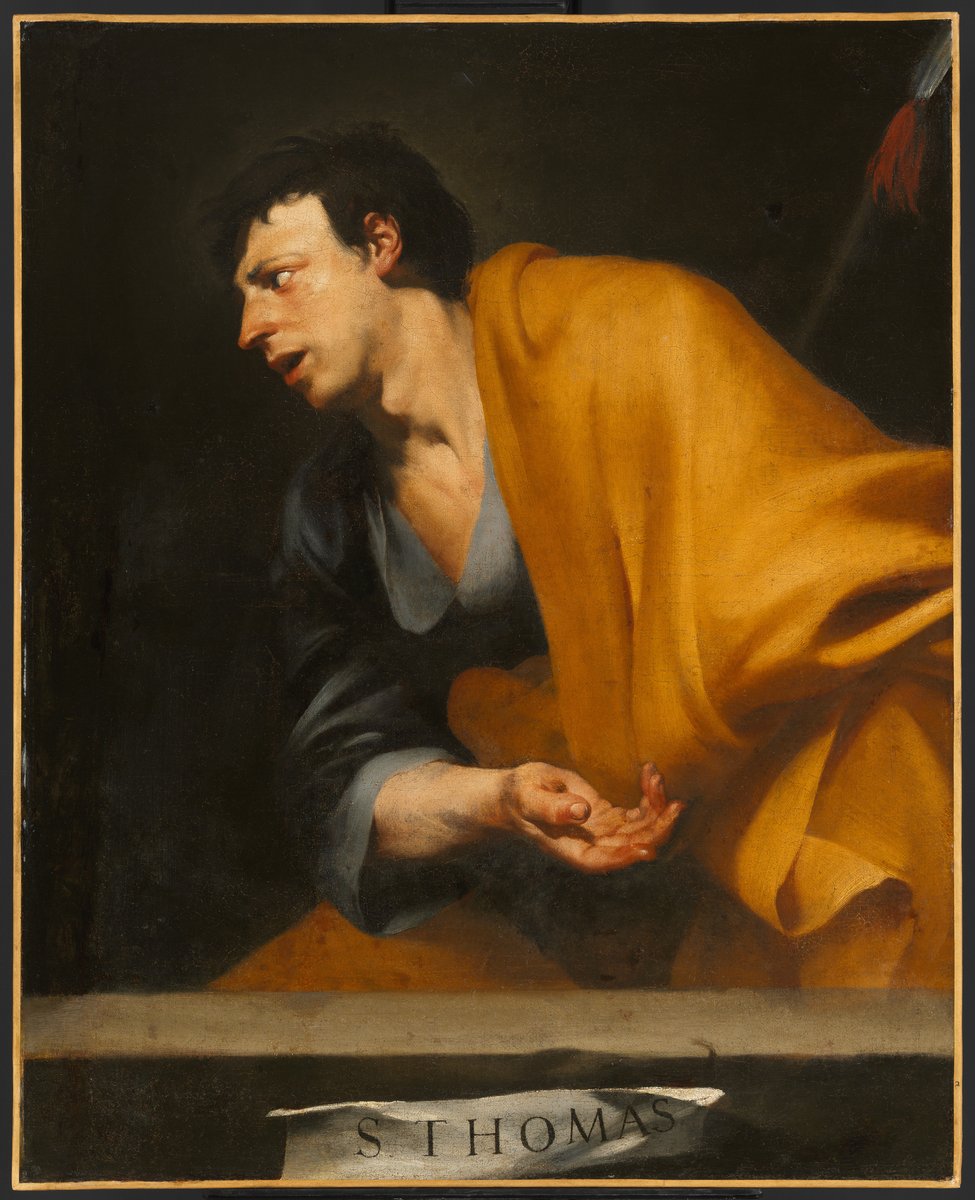
Jusepe de Ribera (1591–1652), the Spanish painter who established his career in Naples and became one of the foremost exponents of Caravaggesque naturalism, spent part of his youth in Parma. His presence there has long been known from early accounts of his life. In a letter of 1618, Ludovico Carracci referred to a Spanish painter associated with the school of Caravaggio who had painted a Saint Martin in Parma and enjoyed the protection of Mario Farnese. A few years later, Giulio Mancini described Ribera’s journey through northern Italy and the jealousy he supposedly aroused among the painters employed by the Duke of Parma. Luigi Scaramuccia, writing in 1674, described an imaginary visit to frescoes attributed to the young Spaniard in Parma, which his fictional visitors initially mistook for the work of Correggio.
These accounts offered intriguing but incomplete evidence of an episode in Ribera’s early career. A firmer chronological basis emerged in 1980, when Michele Cordaro published a manuscript reference to a payment made to Ribera on 11 June 1611 for the Saint Martin and the Beggar, originally commissioned for the church of San Prospero. The painting had been removed to France in 1803 and subsequently disappeared, although copies and engravings retained something of its composition. Cordaro’s discovery established a documented connection between Ribera and Parma at a crucial stage in the painter’s development.
The implications extended beyond biography. Parma was the city of Correggio and Parmigianino, while its early seventeenth-century artistic culture was shaped by the legacy of the Carracci and the patronage of the Farnese court. Ribera’s presence raised questions about his exposure to these traditions and their possible contribution to his subsequent painting. It also invited closer examination of the relationships between the young Spaniard and the artists working in Parma during the same years. Yet with so little of his local production surviving, the evidence remained open to competing interpretations.
The documentary and literary record suggests that Ribera’s activity in Parma was more extensive than the surviving evidence might indicate. Viviana Farina identifies three public commissions, of which the best documented is the lost Saint Martin and the Beggar. Another altarpiece, representing the Assumption of the Virgin with Saints Cosmas and Damian, formerly stood in the church of San Quintino. Like the Saint Martin, it was taken to France during the Napoleonic occupation and subsequently disappeared. Giulia Cocconi also investigates a painting of the Holy Spirit with Saints John the Baptist and John the Evangelist, associated with the Cornazzani family’s chapel in the church of the Ascension. Beyond these ecclesiastical commissions, inventories provide evidence of paintings attributed to Ribera in private collections, including a Christ at the Column and a Saint Agatha, both apparently owned by the Musoni family. There are also early reports of frescoes painted by Ribera in the church of Santa Maria Bianca, although the reliability of this testimony has been questioned. Taken together, these records suggest a substantial body of work produced during a relatively brief stay, almost all of which has disappeared or remains unidentified.
One direction of inquiry has been to consider what Ribera might have absorbed from the artistic traditions of Parma, above all from Correggio. Gabriele Finaldi has explored this possibility in proposing an attribution to Ribera of a small Lamentation over the Dead Christ in the Museo di Capodimonte, Naples. The painting, whose Correggesque qualities contrast with Ribera’s more familiar manner, was already attributed to him in a Farnese inventory of 1680. Finaldi also identifies correspondences with compositions and figure types found elsewhere in Ribera’s work. More recently, Giulia Cocconi has subjected the early testimony concerning Ribera’s supposedly Correggesque frescoes at Santa Maria Bianca to closer scrutiny. Although the church was undergoing restoration during his stay, documents indicate that its demolition had begun by 1658, well before Luigi Scaramuccia published his account in 1674. His account is framed as an imaginary visit, and no contemporary evidence confirming Ribera’s authorship has been found. The possibility that Ribera experimented with Correggio’s manner on the scale of a fresco project remains intriguing, but difficult to substantiate.
An image of the painting, together with details of its restoration, can be found on the Capodimonte website (under “Descrizione degli interventi con raccolta chiusa”, select the third entry, “Compianto su Cristo deposto”).
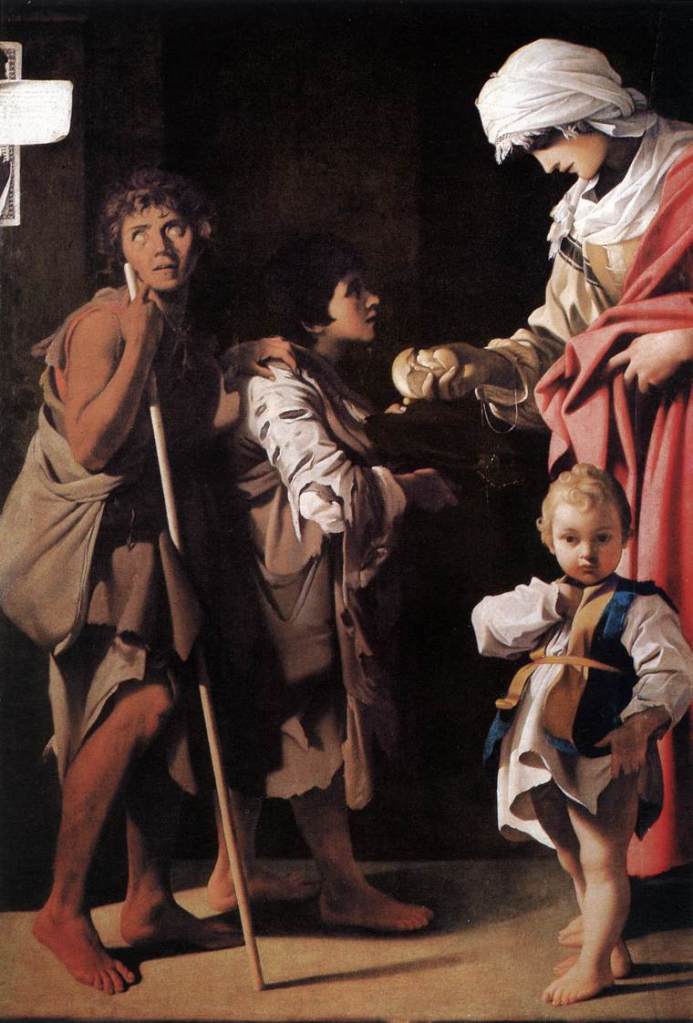
The lost Saint Martin and the Beggar has generated a considerable network of artistic comparisons, made possible by the surviving copies and engravings. Gabriele Finaldi has traced affinities with the work of Caravaggio, Orazio Gentileschi and Guido Reni, suggesting that Ribera had already developed a sophisticated understanding of contemporary Roman painting. Xavier F. Salomon, in a comparison subsequently discussed by Viviana Farina, has identified a resemblance between the beggar in the Saint Martin and Ribera’s early Saint Thomas in Budapest. Giulia Cocconi has pursued another possibility, proposing that Bartolomeo Schedoni’s Charity to the Blind, painted in 1611 and now in the Museo di Capodimonte, reflects a close acquaintance with Ribera’s altarpiece. She draws attention especially to the treatment of the beggars, their poses and bare feet. Cocconi’s suggestion raises the possibility that Ribera’s influence was already being felt among the painters of Parma.
Several painted copies and engravings retain the composition of Ribera’s lost Saint Martin and the Beggar. These are reproduced and discussed in Giulia Cocconi’s doctoral thesis (2020, pp. 331–334), available through the University of Parma’s online repository.
There are, however, reasons to reconsider the assumption that Ribera arrived in Parma primarily as a young painter seeking instruction. Viviana Farina has argued that he probably spent a substantial period in Rome before his documented appearance in the city in 1611. Drawing on Gianni Papi’s research into Ribera’s early paintings, she questions whether the considerable body of work attributed to his Roman years could have been produced entirely between 1612 and his departure for Naples in 1616. A period of activity in Rome before the Parma visit would help resolve this chronological difficulty. It would also suggest that Ribera had already acquired considerable experience of Caravaggio’s innovations before encountering the artistic traditions of Emilia.
The early accounts of his reception in Parma lend some support to this interpretation. Giulio Mancini describes the jealousy aroused among established painters when a powerful patron apparently sought to secure the young Spaniard’s services. This patron is generally identified as Mario Farnese, Duke of Latera, whose protection may have helped Ribera obtain commissions in the city. Although Mancini’s account cannot be accepted in every detail, it suggests that Ribera was regarded as a potential rival rather than simply a visiting student. In his correspondence of 1618, Ludovico Carracci praised the judgement of the Spanish painter associated with Caravaggio’s school, adding, with a touch of self-deprecating humour, that he would have to be on his guard against such formidable competition. Seen in this light, Ribera’s stay in Parma invites consideration of a different direction of influence: the effect his presence may have had upon the work of other painters.
Cocconi’s doctoral research at the University of Parma, subsequently developed in her 2022 book “Convenir nella maniera del Caravaggio”: Pittori e committenti tra Parma e Roma (1610–1622), places Ribera among painters who brought recent Roman experience to the Farnese duchy. Drawing on archival records of commissions, collections and patronage, she traces an artistic environment in which Ribera worked alongside figures such as Giovanni Lanfranco and Sisto Badalocchio, and in which his work may have affected painters including Bartolomeo Schedoni and Leonello Spada.
Considered alongside Farina’s arguments, this research directs attention towards the influence Ribera may have exerted upon artists working in Parma and its wider artistic circle. The evidence is fragmentary, and the proposed relationships vary in their degree of plausibility. However, within the limits of this essay, paintings by Ludovico Carracci, Leonello Spada and Giovanni Lanfranco offer an opportunity to examine some of these possibilities more closely.
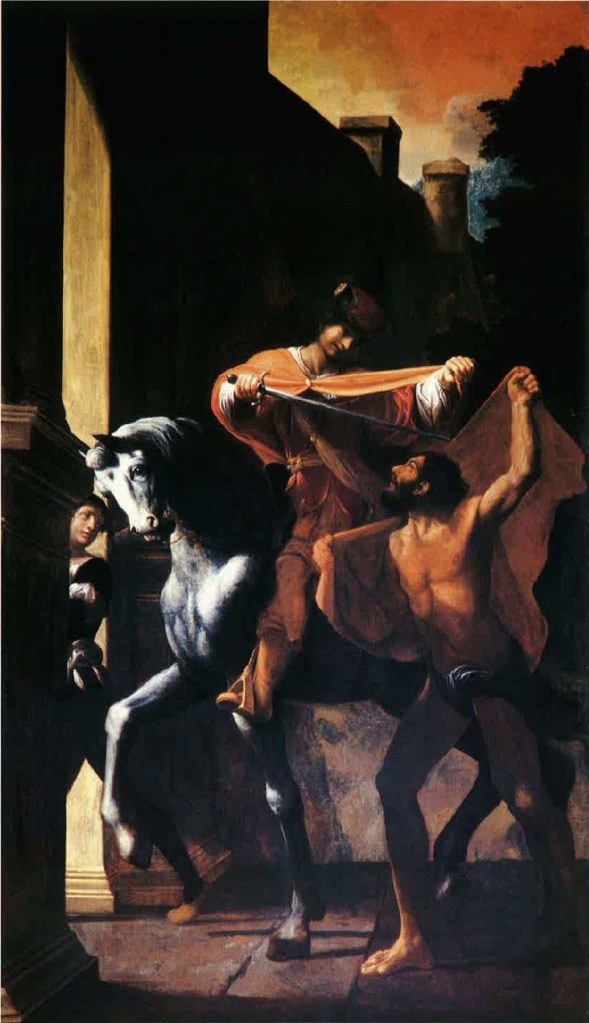
One possibility concerns Ludovico Carracci’s Saint Martin and the Beggar, painted for Piacenza Cathedral. The painting had previously been dated between 1609 and 1613, but Alessandro Brogi proposed a later date, around 1614. Accepting this chronology, Viviana Farina has suggested that Carracci may have drawn upon his recollection of Ribera’s treatment of the same subject, completed in Parma in 1611. The proposal is striking because it reverses the more familiar assumption that the young Spaniard would have looked to the established Emilian master for instruction. Carracci’s admiration for Ribera, expressed in his correspondence of 1618, lends some plausibility to such an exchange, although it cannot establish that one painting directly influenced the other.
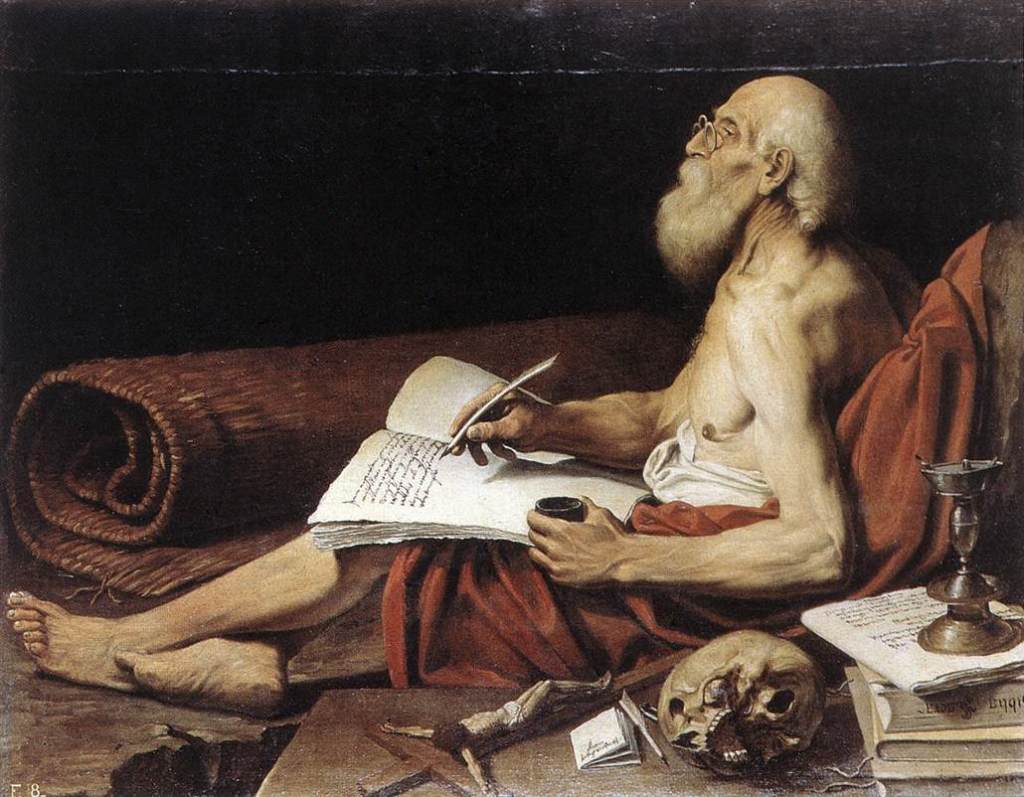
A different possibility emerges from Giulia Cocconi’s examination of Leonello Spada’s Saint Jerome Writing, painted around 1612–14 for Cardinal Maffeo Barberini and now in the Galleria Nazionale d’Arte Antica, Rome. Cocconi identifies pronounced affinities with Ribera’s manner, in both the saint’s pose and the handling of the composition. These similarities have an interesting history. Although the painting was correctly recorded as Spada’s in a Barberini inventory of 1623, it was attributed to Ribera in an inventory of 1730, and its authorship remained confused long afterwards. Cocconi suggests that Spada may have studied an early painting of Saint Jerome by Ribera in Parma, where several works of that subject were subsequently recorded in private collections. No such prototype has been securely identified, but the proposed connection raises the possibility that Spada had encountered Ribera’s work before developing his own treatment of the subject.
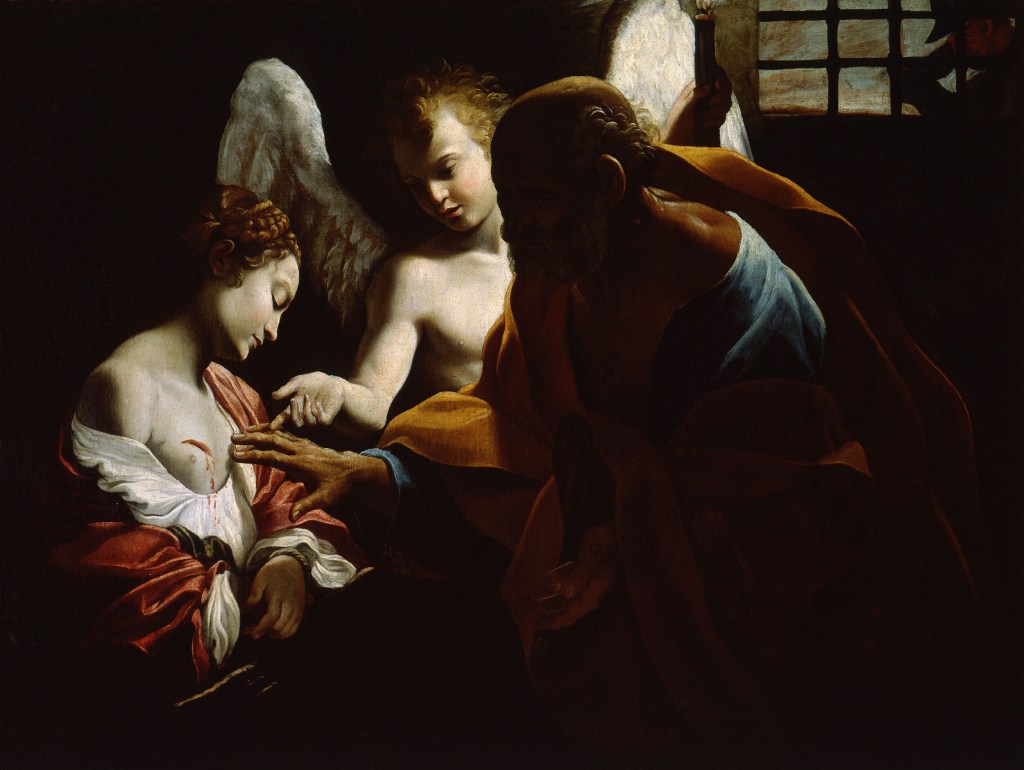
A more tentative connection concerns Giovanni Lanfranco’s Saint Agatha Visited in Prison by Saint Peter and an Angel, painted in Rome around 1613–14 for a patron from Parma, probably Pier Maria Dalla Rosa, and now in the Complesso Monumentale della Pilotta, Parma. Cocconi draws attention to an inventory of 1642 recording a painting of Saint Agatha attributed to Ribera in the collection of the Musoni family, whose members had connections with the painter during his stay in Parma. She suggests that this lost work may have been executed before Ribera’s departure in 1612. Both paintings were apparently conceived in a horizontal format, and Cocconi raises the possibility that Lanfranco remembered the earlier composition when undertaking his own treatment of the subject. The absence of Ribera’s painting, or even a surviving copy, makes direct comparison impossible. Nevertheless, the proposal gains some interest from Lanfranco’s later correspondence, in which he expressed admiration for Ribera’s work.
None of these proposed relationships can be regarded as conclusive, and the disappearance of so much of Ribera’s Parma production places obvious limits on what can be established. Yet the evidence assembled by Farina and Cocconi suggests that his stay deserves to be understood as more than an episode in a young painter’s artistic education. Ribera arrived in a city whose traditions offered him much to study, but he may also have brought with him a knowledge of contemporary Roman painting and an artistic confidence that made an impression on his contemporaries. His encounter with the painters of Emilia may therefore have involved a more reciprocal exchange than the familiar account of his journey in search of Correggio would suggest. The direction of influence remains uncertain, but it need not always have been towards Ribera.
Donate to Inner Surfaces here.
Bibliography
These are the sources. Any errors are mine.
Cocconi, Giulia, «Convenir nella maniera del Caravaggio»: Pittori caravaggeschi a Parma (1610–1622), doctoral thesis, Università degli Studi di Parma, academic years 2016–2019 (PhD awarded 2020).
Cocconi, Giulia, «Convenir nella maniera del Caravaggio»: Pittori e committenti tra Parma e Roma (1610–1622), Rome, Campisano Editore, 2022.
Cordaro, Michele, ‘Sull’attività del Ribera giovane a Parma’, Storia dell’arte, nos. 38–40 (1980), pp. 323–326.
Farina, Viviana, Al sole e all’ombra di Ribera: Questioni di pittura e disegno a Napoli nella prima metà del Seicento, vol. I, Castellammare di Stabia, Nicola Longobardi Editore, 2014.
Finaldi, Gabriele, ‘“Se è quello che dipinse un S. Martino in Parma…”: Ancora sull’attività del giovane Ribera a Parma’, in Nicola Spinosa (ed.), Il giovane Ribera tra Roma, Parma e Napoli, 1608–1624, Naples, Artem, 2011, pp. 17–29.

