Manet, Painter of Things
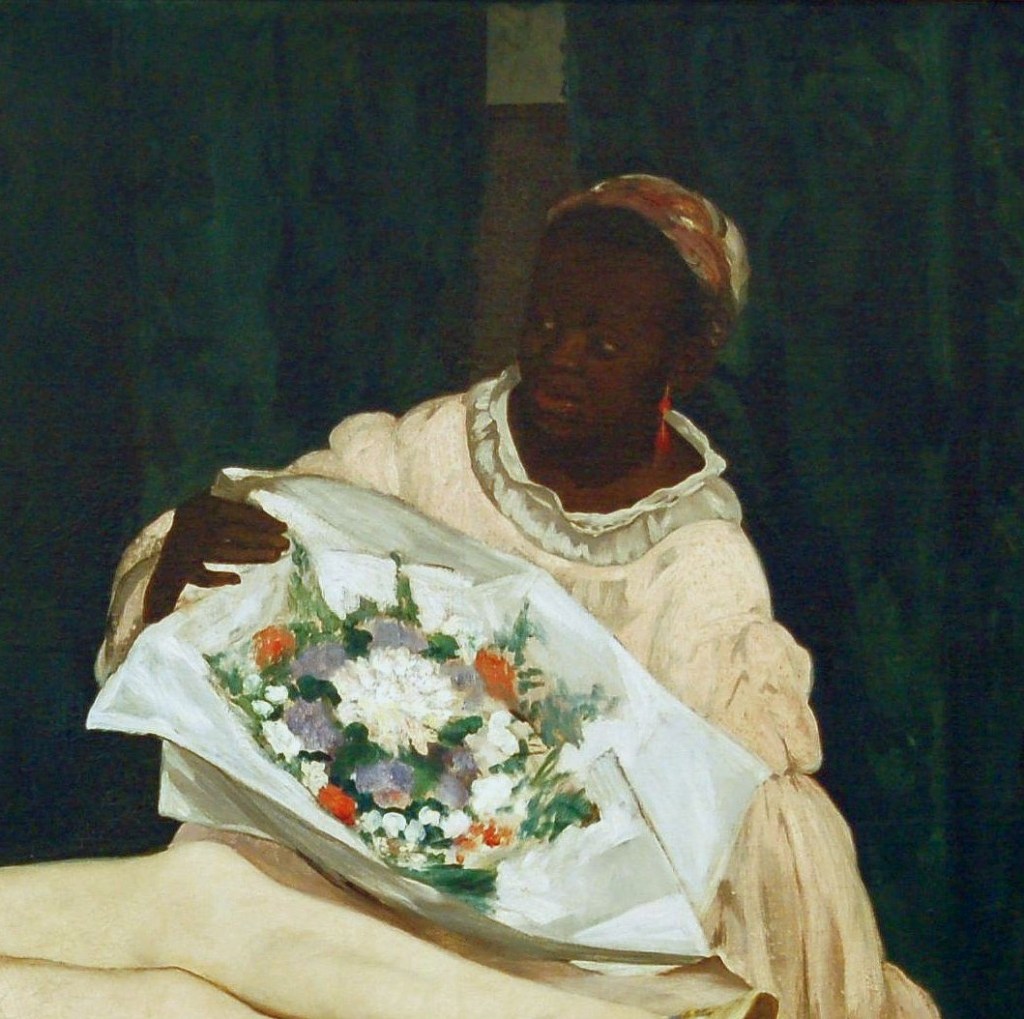
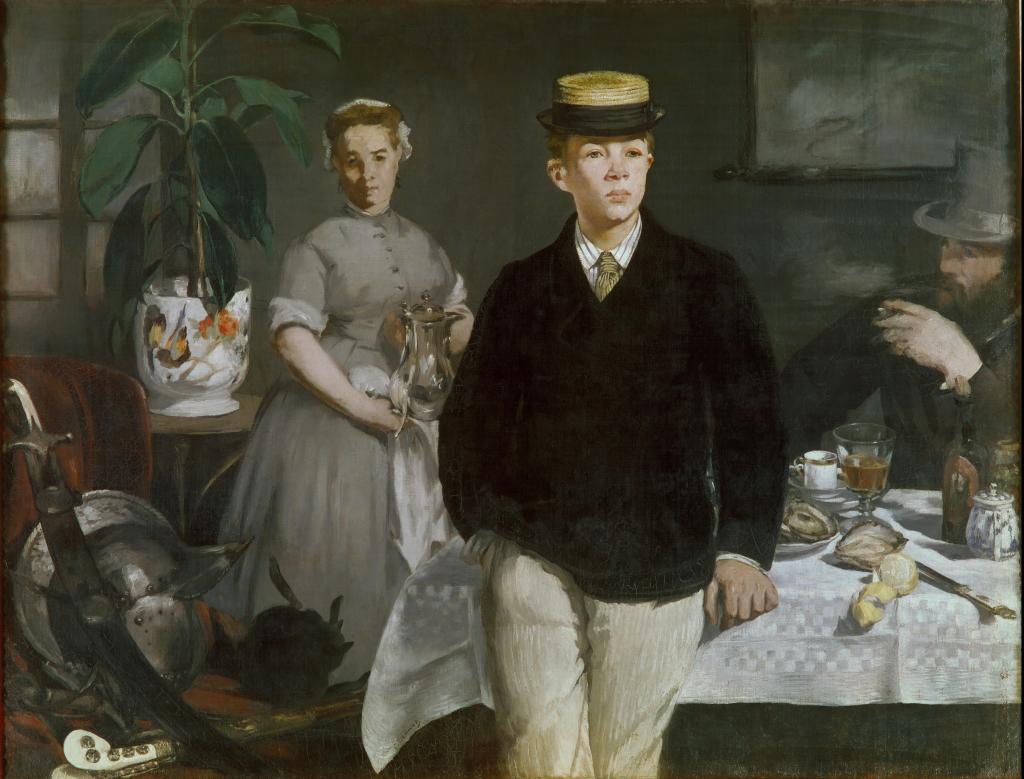
Still life occupies a substantial place in Manet’s work. Henri Loyrette counts seventy-eight still lifes among the 430 paintings catalogued by Denis Rouart and Daniel Wildenstein, approaching a fifth of the total. The proportion is striking for an artist so closely associated with modern life and the human figure. Still-life objects also appear within some of his best-known figure paintings, from the bouquet in Olympia to the objects assembled on the table in The Luncheon. Still life was therefore not a late diversion adopted when illness restricted Manet’s movements, but a persistent element of his art.
Even critics who disliked Manet’s figure paintings were often willing to praise his ability as a painter of objects. This was not necessarily a great concession. Still life remained low in the traditional hierarchy of genres, so skill in painting inanimate things could be acknowledged without granting Manet the qualities expected of a painter of the human figure. In 1867 Zola observed that even Manet’s most determined opponents admitted that he painted objects well. The response to The Luncheon shows the same tendency: its still-life elements could attract admiration even when the human figures and their relationship to one another caused difficulty.
Portrait of Théodore Duret of 1868 provides a particularly revealing example of the way still life could enter Manet’s portraiture. Duret later recalled that the portrait had initially been painted almost entirely in greys. Although he himself regarded it as successfully finished, Manet remained dissatisfied and began adding objects. He placed beside Duret a stool with a garnet-coloured upholstered top. He then put a light-green paperback beneath it, followed by a lacquer tray on the stool holding a carafe, a glass and a knife. Finally he added a lemon on top of the glass. Duret was struck by the fact that this whole still-life group had emerged during the painting process rather than having formed part of the original conception.
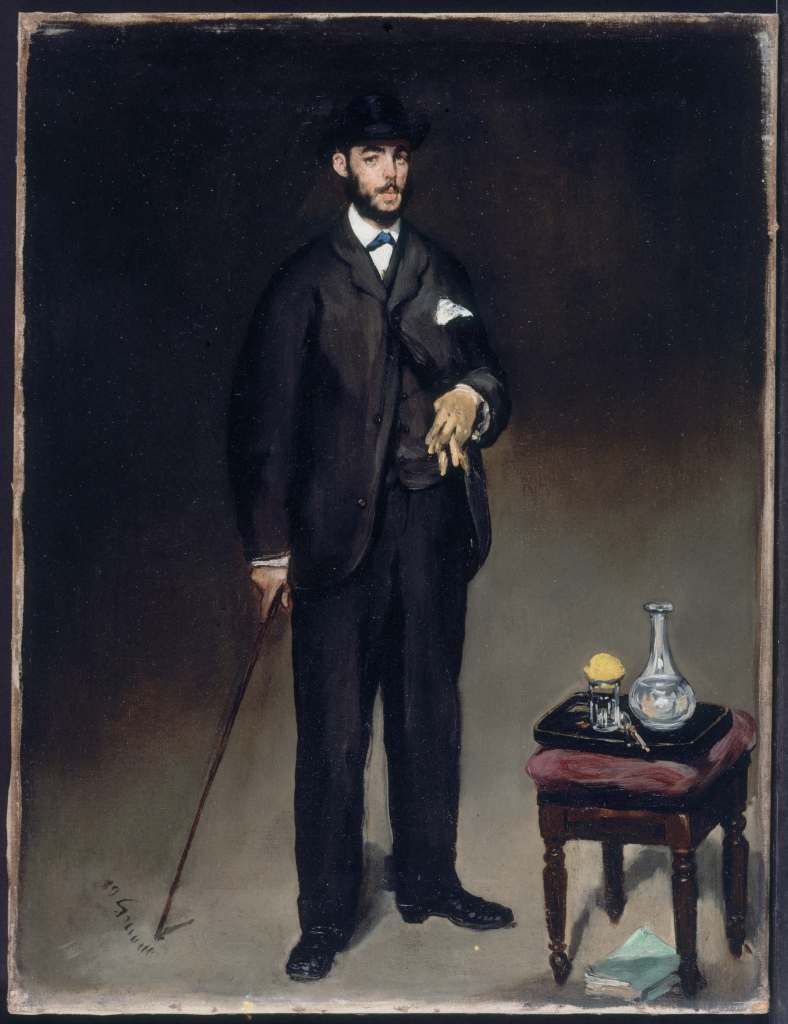
Duret understood these additions in terms of Manet’s response to colour. The predominantly grey portrait had not satisfied him, and the still life introduced a series of distinct colour notes into the composition. His recollection also shows that the group was developed incrementally. Manet did not begin with a fixed arrangement and reproduce it. He added one element after another until the portrait had acquired the chromatic relationships he wanted. The still life was therefore part of the construction of the portrait itself, rather than an accessory attached to an already completed design.
Still life gave Manet a field in which he could concentrate on the placing of objects and on colour, texture and form without the narrative demands of figure painting. He explored these possibilities throughout his career, both in independent still lifes and within larger compositions. The prominence of the genre in his work was already recognised in his own lifetime, even if critics did not always agree about what that prominence implied.
Chardin and the Rehabilitation of Still Life
Chardin’s reputation rose markedly during the nineteenth century. Théophile Thoré complained in 1845 that the Louvre possessed no painting by him, while Champfleury predicted in the same year that Chardin would eventually be sought after more eagerly than Greuze. The Goncourt brothers gave this revival a more sustained critical form in their study of Chardin, published in the Gazette des Beaux-Arts in 1864. They were interested not simply in his fidelity to objects but in the way colour operated across an entire painting, each tone modified by those around it and repeated elsewhere in altered form. Their account helped establish Chardin as a painter whose achievement could no longer be contained by the low status traditionally accorded to still life.
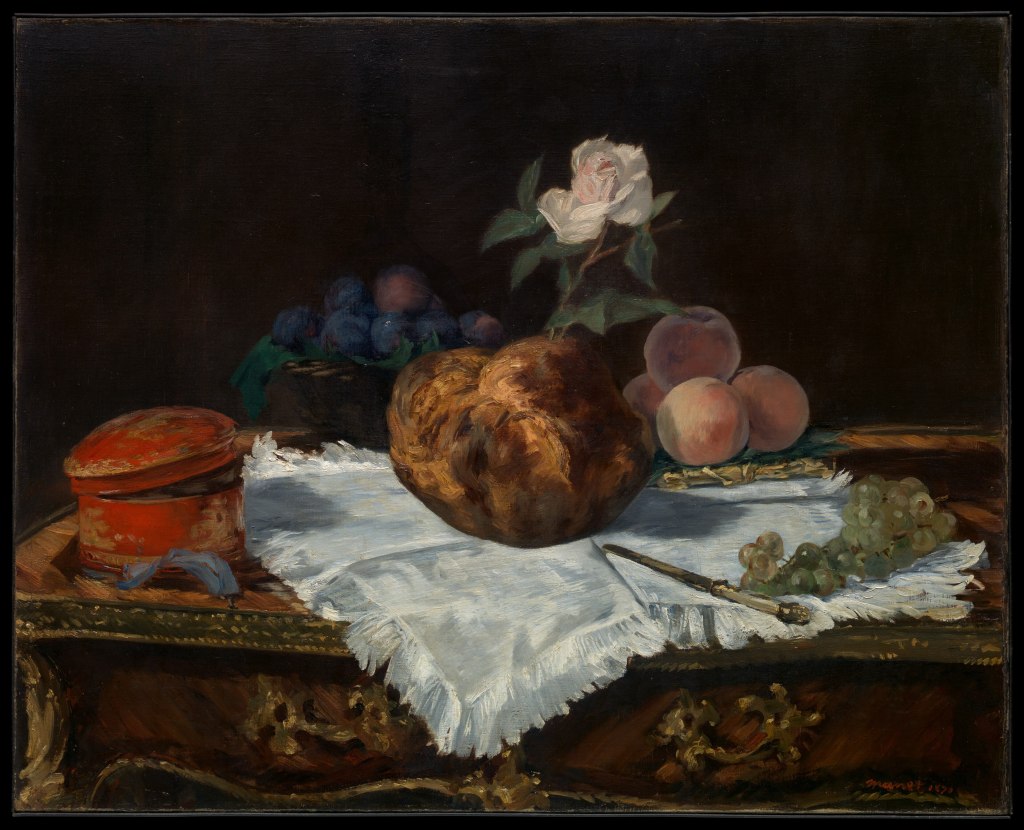
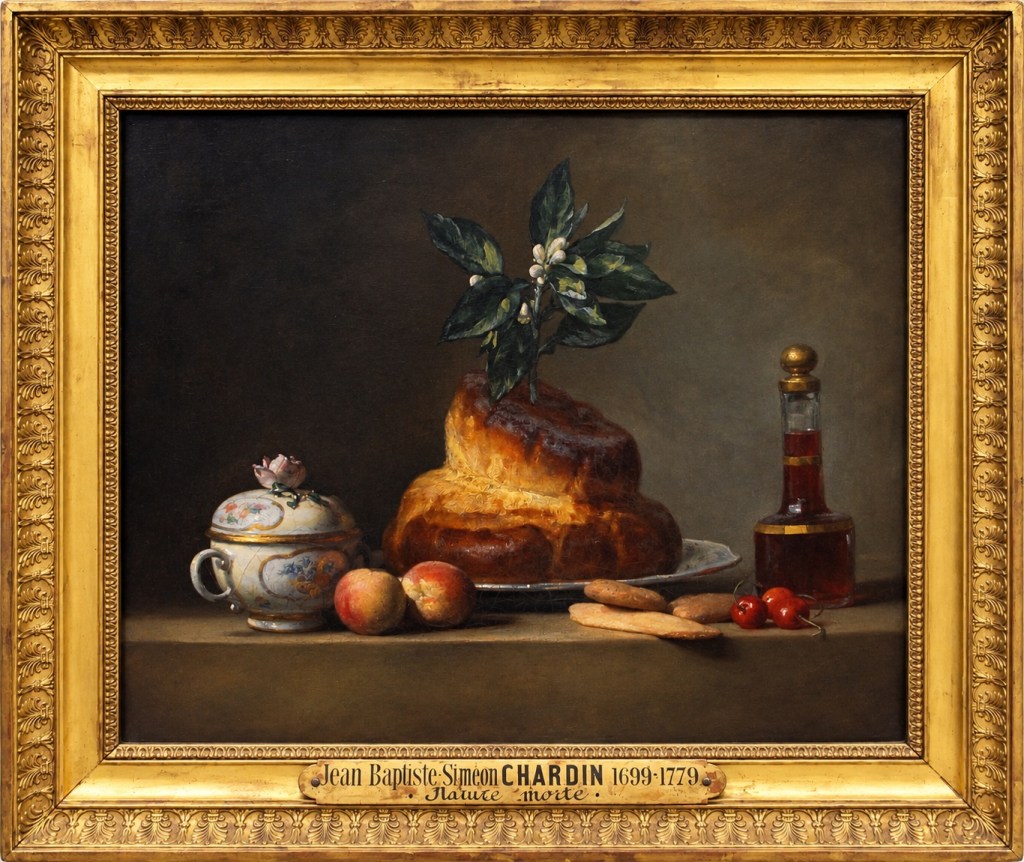
Manet’s engagement with Chardin is well documented. His The Brioche of 1870 followed the arrival in the Louvre, through the La Caze bequest, of Chardin’s painting of the same subject. Manet retained the central brioche crowned with a flower, but surrounded it with stronger chromatic accents and a wider variety of surfaces: a brilliant white napkin, peaches, dark plums, a polished knife and a bright red box.
Chardin’s A Vase of Flowers, painted around 1750–60 and now in the National Galleries of Scotland, offers a suggestive comparison with the flower paintings Manet would produce more than a century later, although there is no evidence that Manet knew this particular work. It is Chardin’s only surviving flower painting, though documentary evidence indicates that he painted others. A blue-and-white Delft vase occupies the centre of the composition, supporting a relatively small bouquet, while fallen flowers lie on the ledge below. The flowers remain identifiable without the botanical precision or illusionistic display associated with much traditional flower painting.
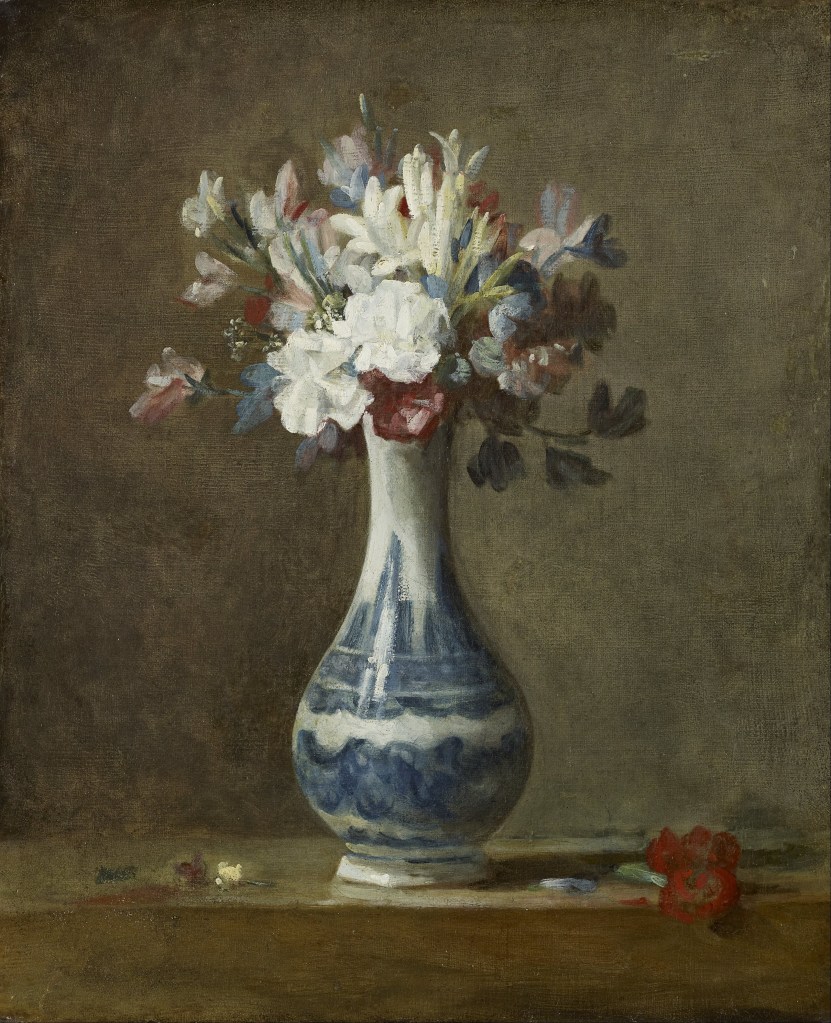
The blue and white of the vase recur among the flowers, while reds, pinks and touches of yellow punctuate the restrained background. Chardin adjusts light and dark around the vessel so that its form remains distinct without becoming sharply detached from its surroundings. Rosenberg and Temperini have drawn attention to the painting’s simplification of form and modelling, qualities that led them to invoke both Manet and Cézanne when discussing it.
Towards the Late Still Lifes
By the 1870s, still life had acquired a stronger critical position than it had held earlier in the century. Charles Blanc, writing on colour, argued that inanimate nature belonged above all to the colourist. The old hierarchy had not disappeared, but still life could increasingly be treated as a demanding test of pictorial judgement rather than simply as a minor genre.
Manet’s own still lifes changed during these years. The larger and more complex arrangements of the 1860s gave way increasingly to smaller compositions in which fruit, vegetables or flowers were isolated against neutral backgrounds and simple supporting surfaces. The number of objects was reduced, while glass, water and reflective surfaces became more prominent. The effect is generally softer and more fragile than in the earlier work.
Loyrette cautions against reading this reduction as a proto-modernist step in which the objects become little more than pretexts for formal experiment. Manet may have narrowed the range of forms within the picture, but he did not relinquish attention to the particular character of the things themselves. Fruit and flowers retain their differing surfaces and densities, while glass and water allow him to explore transparency, reflection and the effects of light passing through translucent material.
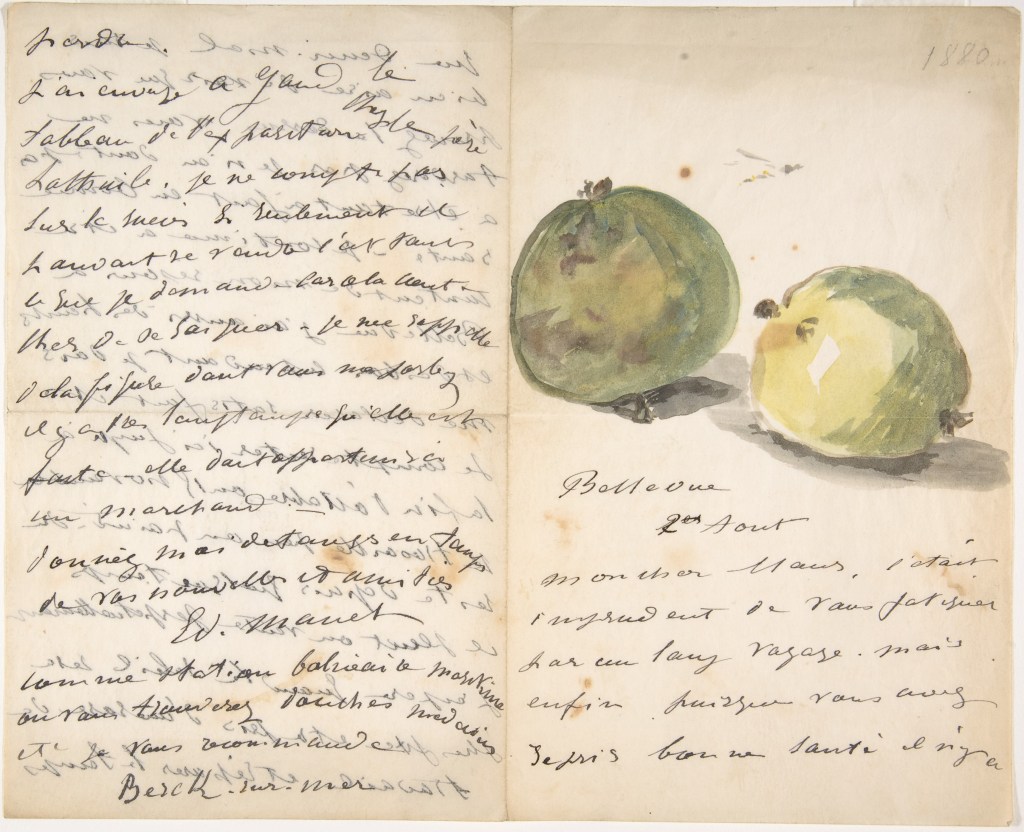
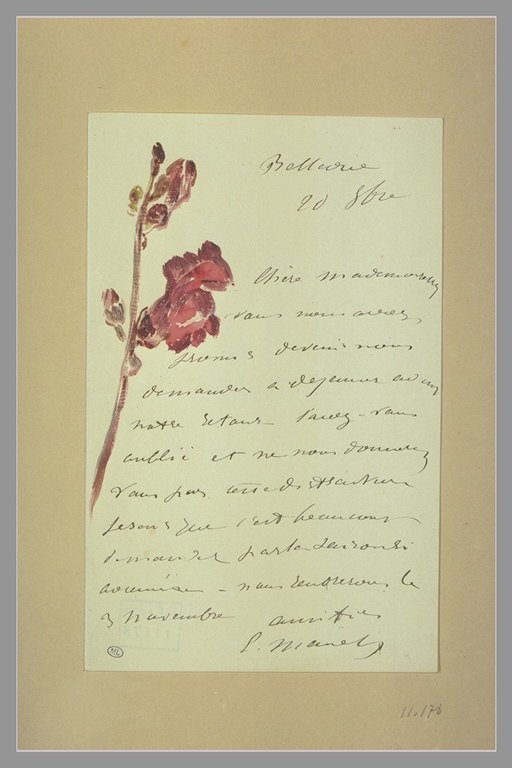
As well as painting flowers in still lifes, Manet also decorated letters with small watercolours of flowers, fruit and other motifs. During his stay at Bellevue in 1880, where he had gone for medical treatment, he sent such decorated letters to friends and acquaintances. At least forty can be dated with some certainty to this period. One letter to the painter Eugène Maus, for example, was embellished with fruit from the garden at Bellevue; others sent to Isabelle Lemonnier carry flowers and foliage. Loyrette connects the lightness and fluidity of these watercolours with the small oils Manet was painting at about the same time.
By the spring of 1882, flowers had become one of Manet’s most persistent subjects. Antonin Proust, Manet’s lifelong friend from their school days, remembered his enthusiasm at the sight of flowers and his declaration that, if he could paint one successfully, he would want to paint them all. Moreau-Nélaton similarly recalled the invigorating effect that lilacs and roses could have upon him. During his illness, bouquets brought by friends and visitors therefore offered more than convenient subjects. They gave Manet something he still intensely wanted to paint.
The Last Flowers
The late flower paintings form a recognisable group. Manet generally placed small bouquets of roses, lilacs and other flowers in glass vessels, against dark or neutral backgrounds and on the pale marble surface that also appears in A Bar at the Folies-Bergère. The repertoire is restricted, but the arrangements vary in density, colour and in the forms of the vases themselves. Transparency becomes a recurrent feature, exposing the stems and water that an opaque vessel would have concealed.
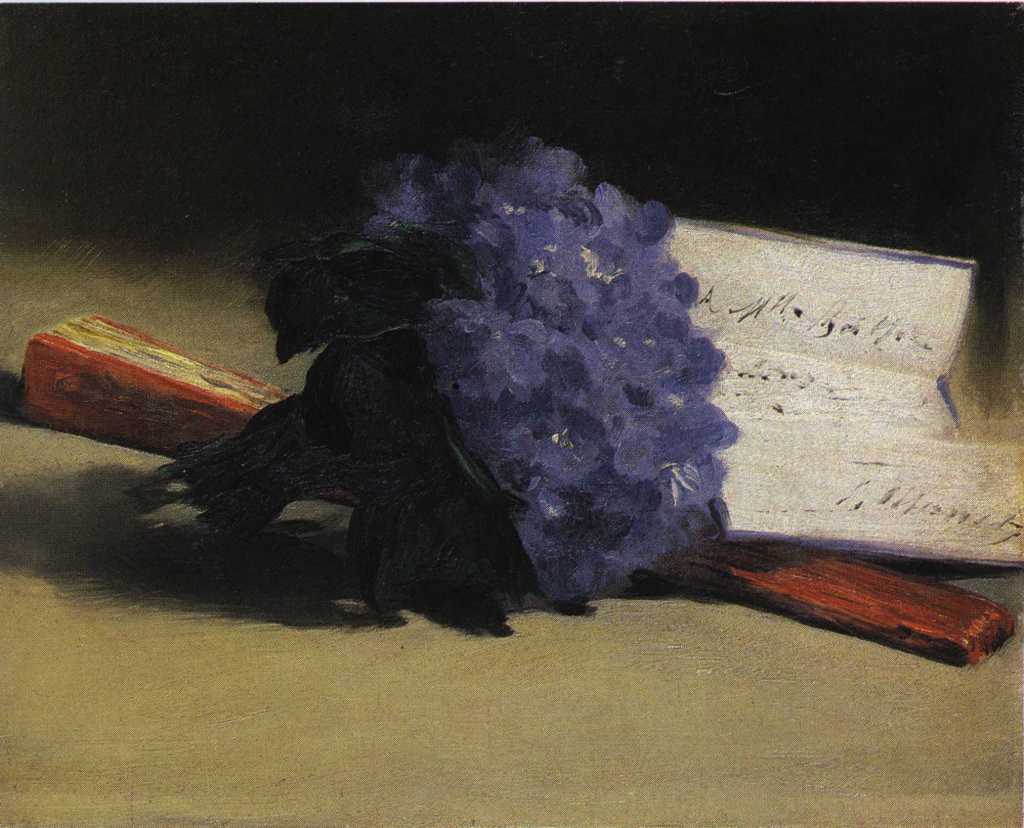
These paintings also belonged to Manet’s social world. During his final illness, friends and visitors brought him flowers, and some of the resulting paintings were themselves given away or dedicated to people within that circle. Flowers in a Crystal Vase, painted in 1882, bears a dedication to Manet’s friend Thomas W. Evans, an American dentist who moved in the highest circles of Parisian society and treated members of the imperial and royal families. The inscription reads: “À mon ami / le Dr Evans / Manet.” A decade earlier, in 1872, Manet had already used a flower painting in this way when he gave Bouquet of Violets to Berthe Morisot. In that work, the violets appear alongside a folded fan and a letter, bringing flowers and other objects of social exchange together within the painting.
Gallery
The following examples offer a representative selection of Manet’s late flower paintings. The notes draw chiefly on the individual catalogue entries in Manet and Modern Beauty, supplemented where useful by other material discussed above.
Moss Roses in a Vase, c. 1882
The compact bunch of small pink roses is pressed tightly into the narrow neck of a wide-bottomed carafe filled with water. The arrangement has an improvised quality: some leaves appear to be coming away from the stems as they are forced through the carafe’s slender neck, while a single rose, apparently one too many for the bunch, has been removed and placed at the lower left.
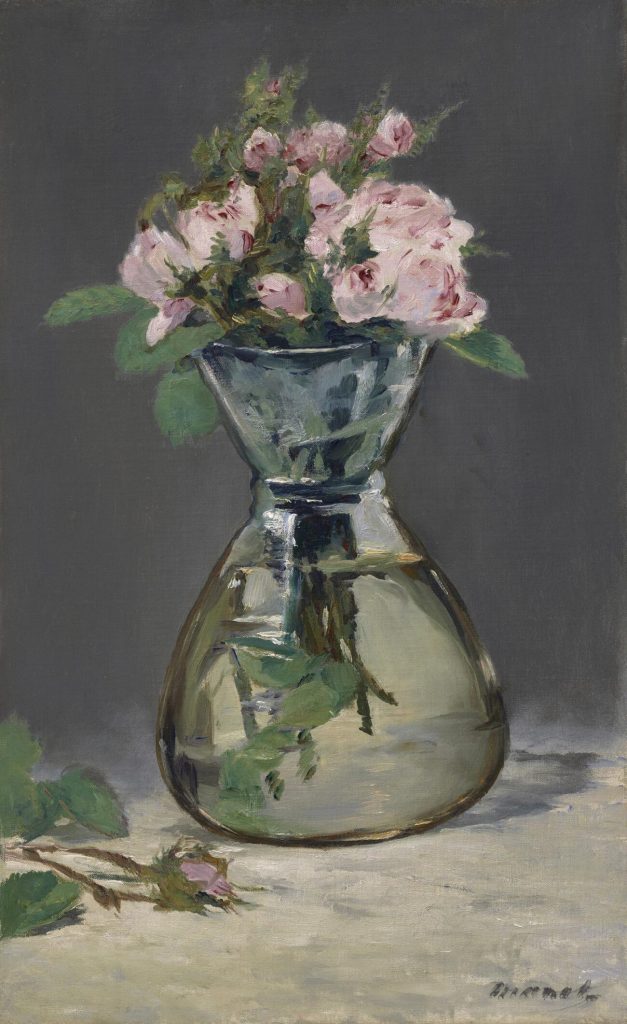
The detached flower introduces a slight asymmetry, echoed by the vase’s tilt to the left. The painting combines formal simplification with a variety of textures and close observation of the thick glass, whose reflections and refractions distort what is seen through it. Neither this particular vase nor this variety of rose appears elsewhere among the late bouquets. Richard Rand has therefore suggested that Manet may have painted the work during the summer of 1882 at Rueil, using a vessel from the rented house and flowers obtained nearby.
Bouquet of Peonies, c. 1882
The red and pink peonies are set in a glass vase on a marble surface against a dark background. The painting is exceptional among Manet’s late flower still lifes in returning to the peonies that had occupied him in 1864–65, and it is the only one to use this particular ovoid vase. Its japoniste decoration includes a small figure in a kimono holding a parasol.
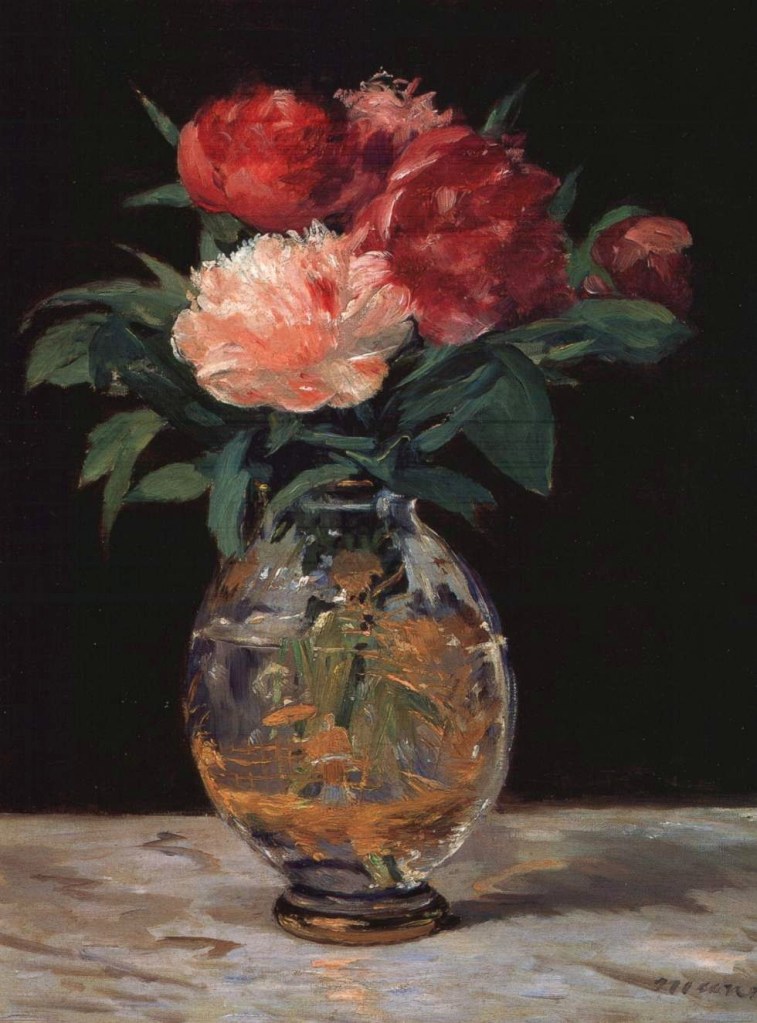
The work also has an unusually well-documented early history. Manet sold it in the summer of 1882, through the collector Charles Ephrussi, to Ephrussi’s cousin Carl Bernstein in Berlin. Bernstein and his wife Felicie were among the earliest German collectors of French Impressionist painting, and their collection had considerable influence on visitors to their Berlin salon. Bouquet of Peonies later passed to the painter Max Liebermann, who acquired it in exchange for a portrait of Bernstein. Its visibility in Berlin helped establish the reputation of Manet’s late flower paintings there. Writing about an 1899 exhibition at the prominent Berlin dealer Paul Cassirer’s gallery, the critic Fritz Stahl singled out the “glowing peonies” and the vase with its gold ornament.
Flowers in a Crystal Vase, 1882
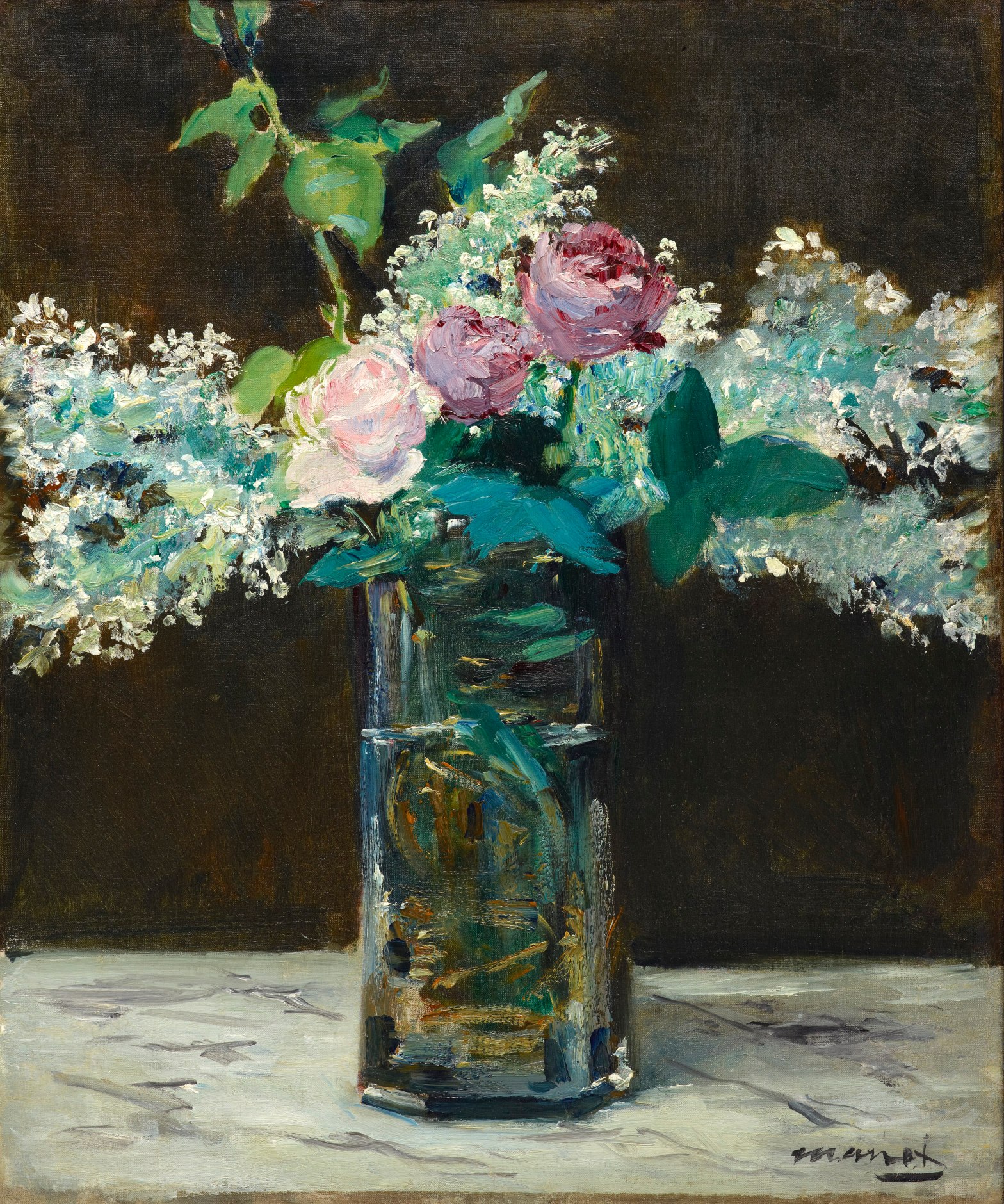
Three pink roses and a spray of white lilacs are arranged in a square-footed crystal vase flecked with floral motifs, a vessel that appears in five other late still lifes by Manet. Set slightly off-centre and turned at an angle, the vase rests on a lustrous dark-grey surface animated by fluid highlights that suggest the veining of marble and, more distantly, recall the surfaces of Manet’s late seascapes. Above it, the grey background gives way to a thinly brushed brown layer, related in the catalogue entry to Manet’s earliest work and his training in Thomas Couture’s studio. Against this subdued setting, the fresh, luminous colour and rich impasto of the flowers stand out strongly.
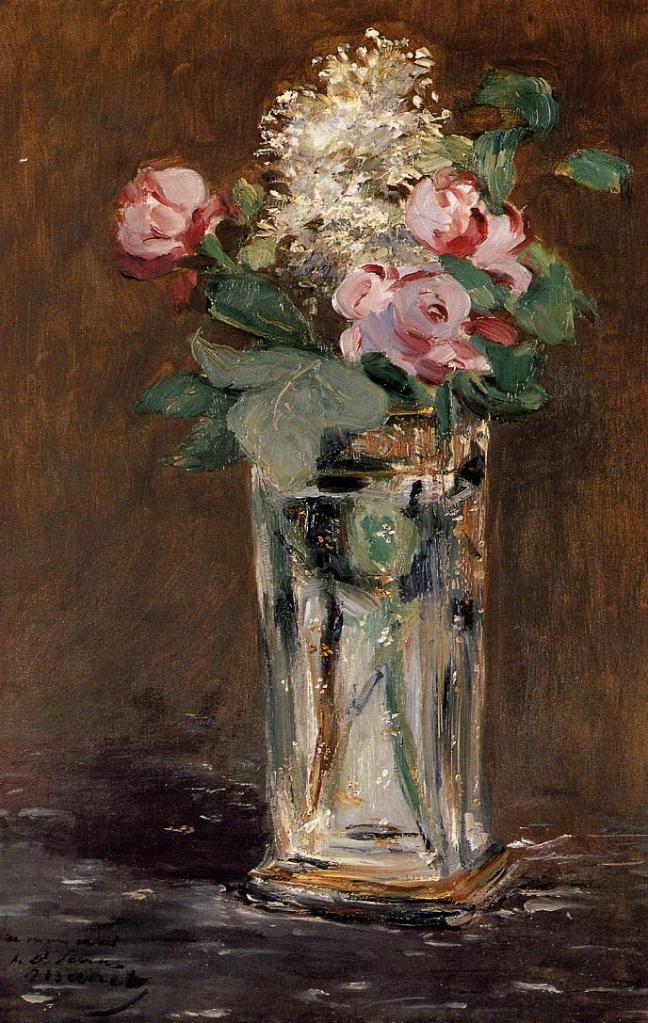
Manet dedicated the painting to his friend Thomas W. Evans, an American dentist who became a prominent figure in Second Empire Paris as dentist to Napoleon III and who amassed a considerable fortune in real estate. Evans was also a protector of Méry Laurent, one of Manet’s closest female friends in his later years, and the entry suggests that it was probably through her that he acquired the painting. Evans later bequeathed it to the University of Pennsylvania School of Dental Medicine, where it remained largely forgotten until its rediscovery and publication in 1979.
White Lilacs in a Crystal Vase, c. 1882
The narrow-format canvas brings together several features characteristic of Manet’s late flower paintings: spring-blooming white lilacs, one of the vases he repeatedly used, and the familiar marble tabletop. Its apparent freshness depends on careful orchestration. Manet balances light against dark, opacity against transparency, and positive form against negative space. Rather than building the image conventionally from a brownish underlayer towards increasingly opaque highlights, he left the areas intended for the tabletop, vase and flowers in reserve. In the upper part of the canvas, a thin, diluted layer of light greenish grey was brushed over the white ground, against which scattered touches of white paint evoke the lilacs with remarkable economy.
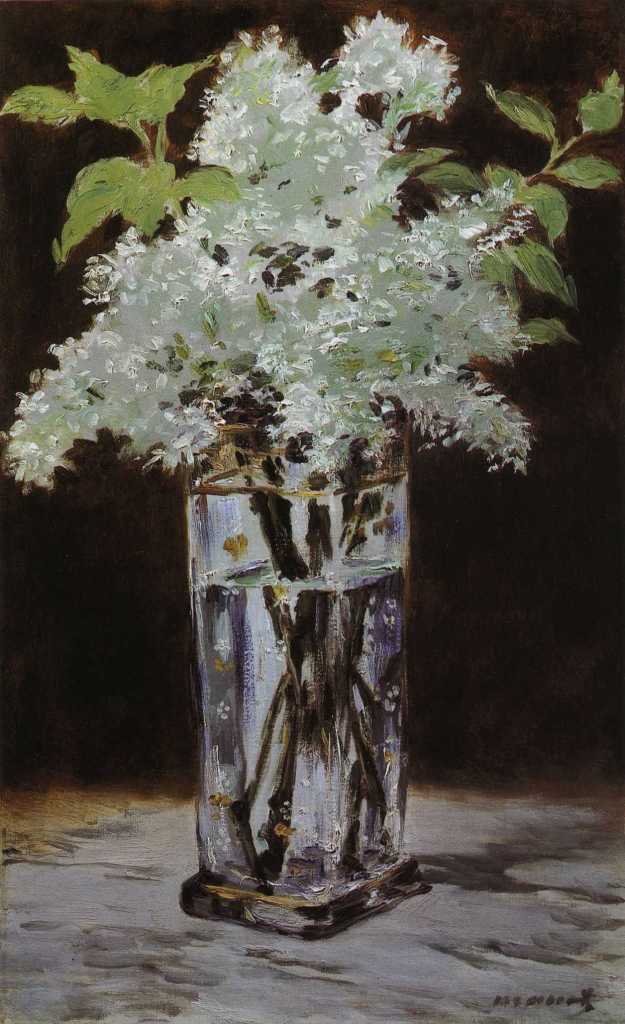
The painting also has a strong connection with Eugène Pertuiset, one of Manet’s most avid collectors. Between 1880 and 1882 Pertuiset bought as many as seventeen works by the artist, including numerous still lifes of fruit and flowers, and this may have been one of the “lilacs” or “flowers” recorded in Manet’s sales book as sold to him in 1882. Before its acquisition by the Nelson-Atkins Museum as part of the Bloch collection gift, White Lilacs in a Crystal Vase had not been seen publicly for many decades.
Roses and Lilacs in a Crystal Vase, c. 1882
Roses and Lilacs in a Crystal Vase combines a luxuriant bouquet of roses and lilacs in one of the crystal vases Manet repeatedly used in his late still lifes.
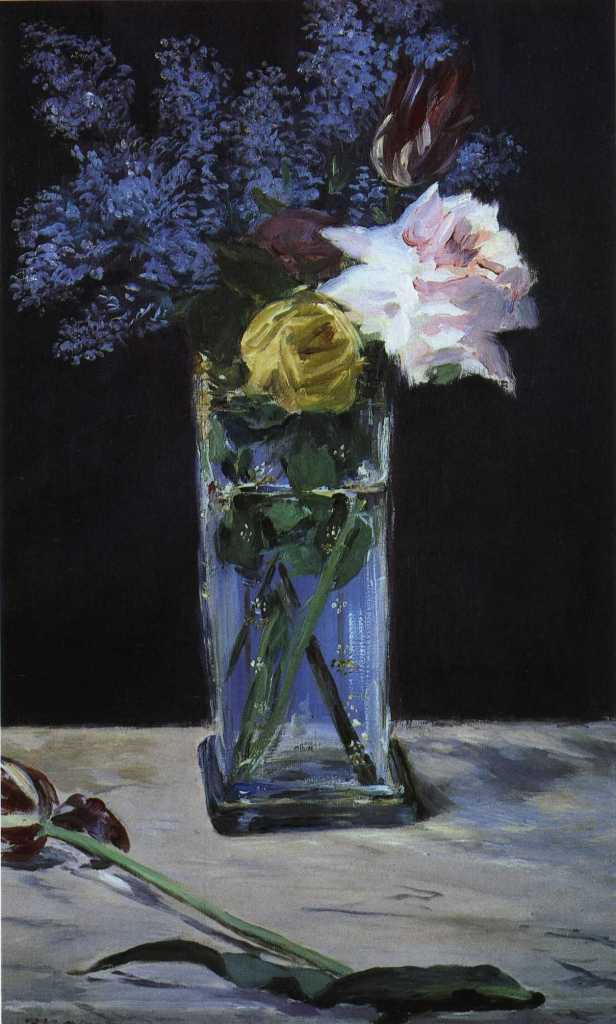
The work may be identifiable with the “flowers” sold by Manet in 1882 for 500 francs to Eugène Pertuiset, one of the most dedicated collectors of his late still lifes. It subsequently belonged to Jean-Baptiste Faure, the celebrated French baritone and an important collector of Manet. When paintings from Faure’s collection were exhibited in Berlin in 1906, critics regarded the late bouquets as a culminating achievement, contrasting their brightness and delicacy with the darker tonalities associated with Manet’s earlier work.
Vase of White Lilacs and Roses, 1883
If Léon Leenhoff’s annotations to a photograph of the work are accurate, Vase of White Lilacs and Roses was Manet’s “second-to-last painting.” The catalogue for the 1884 retrospective assigned it the specific date 28 February 1883, only about two months before Manet’s death. Yet the painting gives little sense of decline. It is gorgeous and exuberant, with three full roses, sprays of bright greenery and an array of lilacs extending across the canvas. The flowers rise from a tall octagonal vase decorated with a sinuous gold dragon motif, more clearly legible on the facing side of the same vase in another painting. Set centrally on the familiar marble tabletop and isolated against a dark background, the bouquet acquires an exceptional iconic force among Manet’s late still lifes.
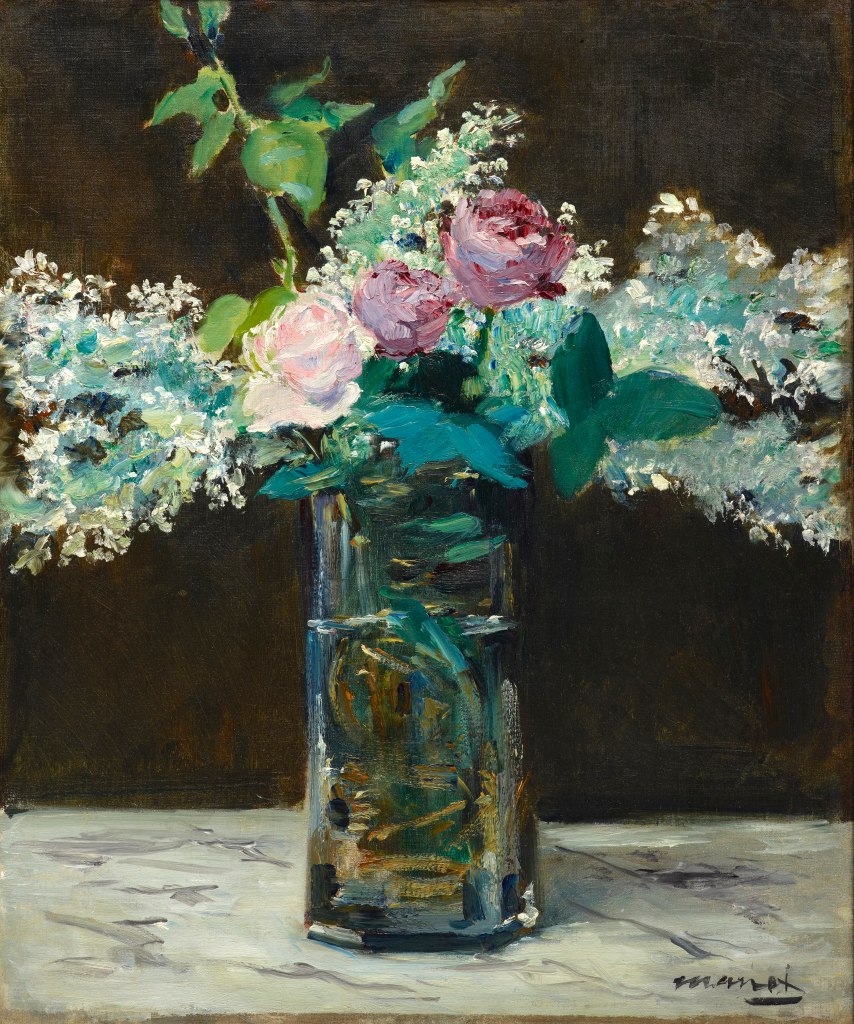
The work also belonged to the network of collectors around Manet’s final flower paintings. Léon Leenhoff, the son of Manet’s wife Suzanne and an important source for the documentation of his work, recorded that Ignace Ephrussi had commissioned vases of flowers from Manet, as had the critic and art historian Louis Gonse, editor of the Gazette des Beaux-Arts in the 1880s. Ignace Ephrussi was the brother of the collector and critic Charles Ephrussi, who had been buying Manet’s work since around 1880. Manet’s sales book records both Gonse and “Ephrussi” buying two bouquets each in 1882. Ignace may have supplied the flowers depicted here and perhaps even commissioned the work, although he apparently did not acquire it. The painting remained in Manet’s possession at his death and was sold at the 1884 studio sale.
Producing these essays requires care, time, research, and resources. Contributions to help sustain this exploration would be greatly appreciated.
Donate to Inner Surfaces here.
Bibliography
Allan, Scott, Emily A. Beeny and Gloria Groom, eds. Manet and Modern Beauty: The Artist’s Last Years. Los Angeles: J. Paul Getty Museum, 2019.
Alsdorf, Bridget. “Manet’s Fleurs du Mal.” In Scott Allan, Emily A. Beeny and Gloria Groom, eds., Manet and Modern Beauty: The Artist’s Last Years, 129–45. Los Angeles: J. Paul Getty Museum, 2019.
Loyrette, Henri. “Manet: The New Painting and Still Life.” In George L. Mauner, Manet: The Still-Life Paintings, 153–68. New York: Harry N. Abrams in association with the American Federation of Arts, 2000.
Mauner, George L. Manet: The Still-Life Paintings. New York: Harry N. Abrams in association with the American Federation of Arts, 2000.
Rosenberg, Pierre. Chardin. Exhibition catalogue, Galeries nationales du Grand Palais, Paris; Kunstmuseum/Kunsthalle Düsseldorf; Royal Academy of Arts, London; Metropolitan Museum of Art, New York. Paris: Réunion des musées nationaux, 1999.
Rosenberg, Pierre, and Renaud Temperini. Chardin: suivi du catalogue des œuvres. Paris: Flammarion, 1999.
Museum and collection entries
Metropolitan Museum of Art, New York. Édouard Manet, The Brioche, 1870.
National Galleries of Scotland, Edinburgh. Jean-Baptiste-Siméon Chardin, A Vase of Flowers, c. 1750–60.
Petit Palais, Musée des Beaux-Arts de la Ville de Paris. Édouard Manet, Portrait of Théodore Duret, 1868.

