Bassano outside Venice: formation and first maturity
Jacopo Bassano’s career was shaped by a productive tension between the Venetian artistic world and the provincial setting in which he chose to remain. Born into a family workshop in Bassano del Grappa, he trained first with his father, Francesco il Vecchio, and then, in the early 1530s, in Venice with Bonifazio de’ Pitati. He returned to Bassano and took over the family workshop after Francesco’s death in 1539. Although he maintained contacts with Venice and worked for Venetian patrons, the greater part of his career unfolded in the terraferma rather than in the lagoon city itself.
The organisation of the Dal Ponte workshop formed an important part of that career. The surviving Libro secondo, the second of four account books and the only one to have survived, records a business in which commissions were undertaken collectively and individual authorship was not normally specified. Different parts of a painting could be distributed according to the skills and availability of those working in the shop. This arrangement preceded Jacopo’s maturity as an independent painter and later provided the structure within which his own sons could participate in an expanding production. By the later sixteenth century Francesco, Leandro and Gerolamo had established workshops in Venice, while Giambattista remained in Bassano and continued the family business after Jacopo’s death.
Jacopo’s early formation also brought him into contact with wider currents of Venetian and north Italian painting, while prints extended that range further. He absorbed these encounters selectively over the course of his career.
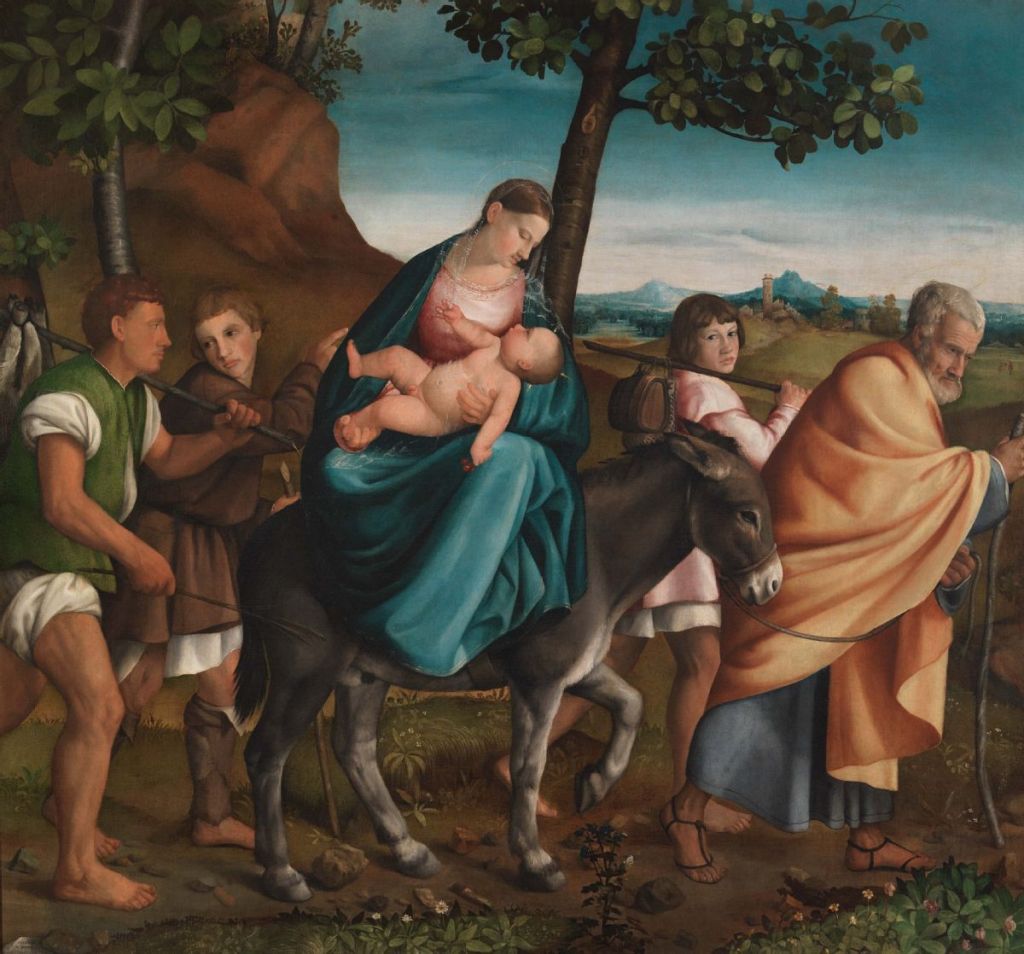
Jean Habert sees the beginnings of that process in the Flight into Egypt in the Museo Civico at Bassano, generally dated to 1534. There, Jacopo combines the Venetian example of Bonifazio de’ Pitati with the closer naturalism Habert associates with Savoldo and Moretto.
Titian provided compositional models to which Bassano would return over many years. In the period after Francesco’s death, Jacopo’s compositions became more animated and his figure style increasingly responsive to the elongated, anti-classical forms associated with Parmigianino. Schiavone contributed supple rhythms and fluid handling, while Tintoretto offered a further stimulus towards pictorial invention and, increasingly, the expressive use of light. Central Italian prints enlarged the repertory of figures and compositional devices available to the workshop.
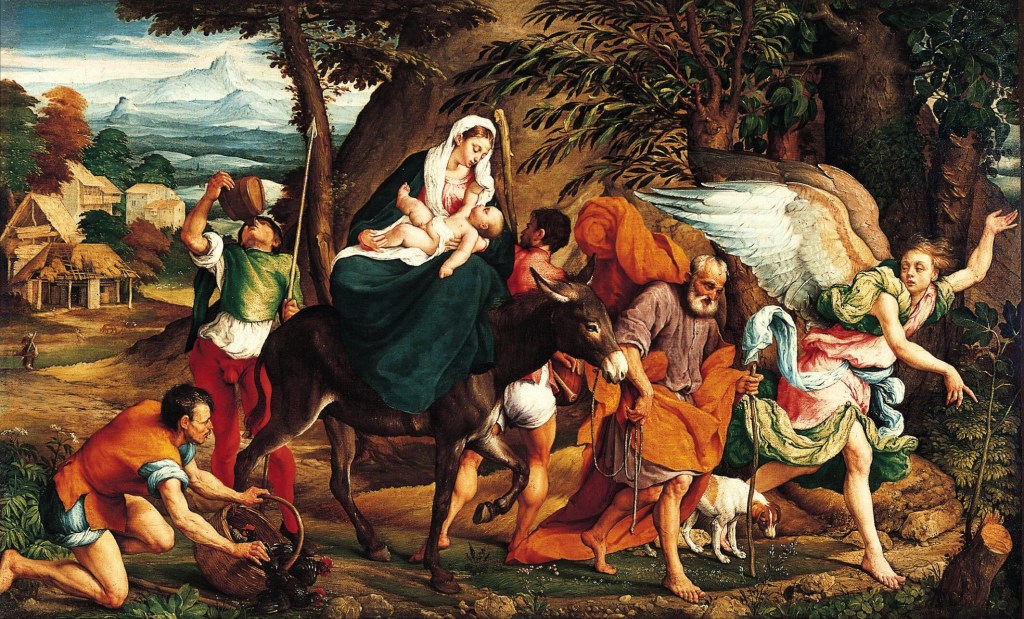
The Flight into Egypt of about 1544–45, now in the Norton Simon Museum, marks what Habert describes as a moment of equilibrium within this development. He regards it as characteristic of Jacopo’s first maturity. The peasant driving oxen, with his straw hat and muscular neck, evokes the countryside around Bassano, while Habert also draws attention to the harmonious arrangement of planes and colours and to the freedom of execution achieved by this stage.
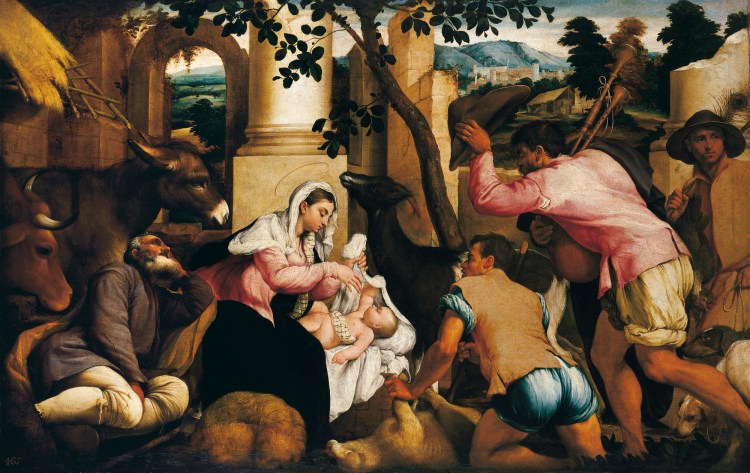
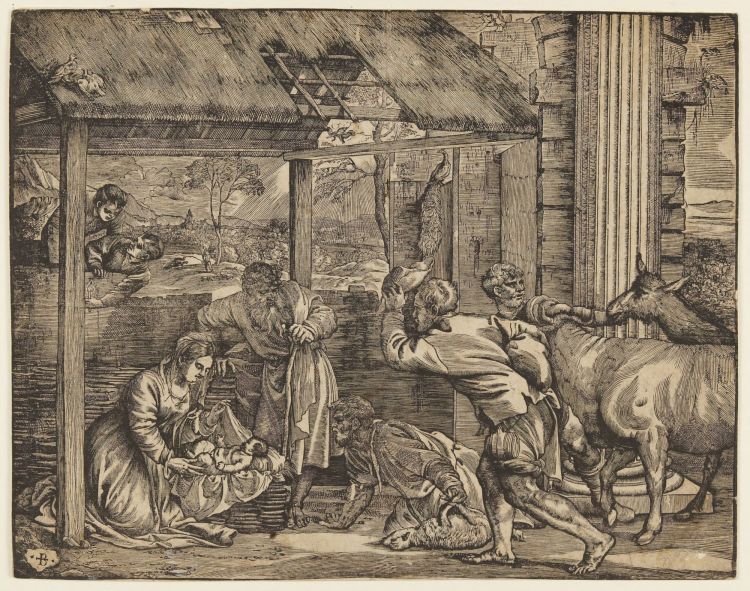
The Adoration of the Shepherds in the Royal Collection, now dated to about 1546, shows more precisely how Bassano used Titian. Its frieze-like arrangement of figures relates to Titian, while a woodcut after Titian’s Adoration of the Shepherds provided the immediate source for several elements, including the Virgin revealing the Child, the column and the procession of shepherds. At the same time, the high viewpoint of the landscape recalls Bonifazio. The result brings together sources from Jacopo’s Venetian formation within a painting already recognised for the direct naturalism that would become an increasingly prominent element of his work.
Portraiture and natural observation
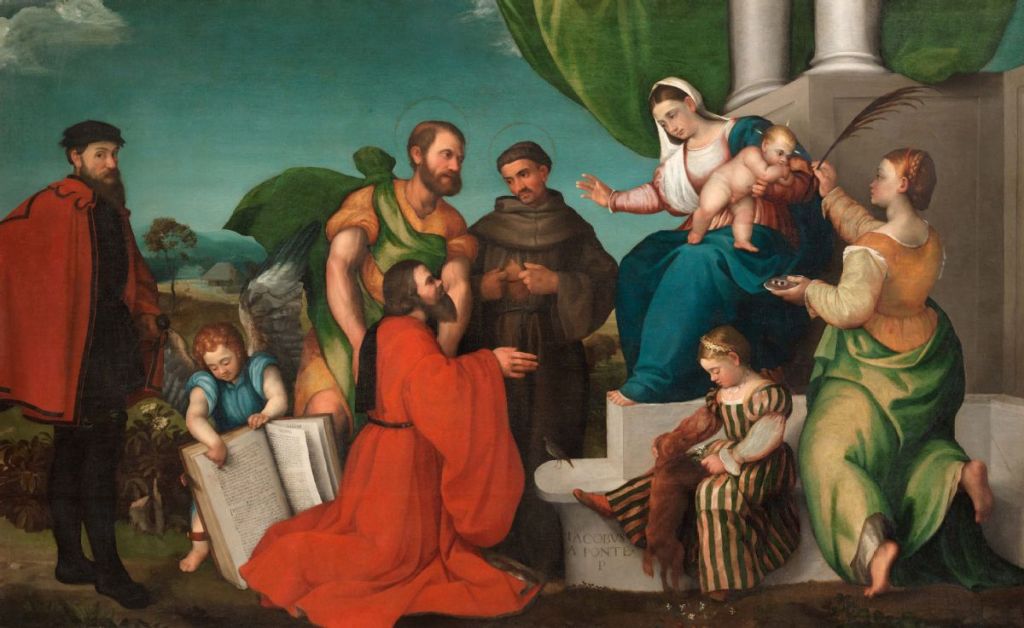
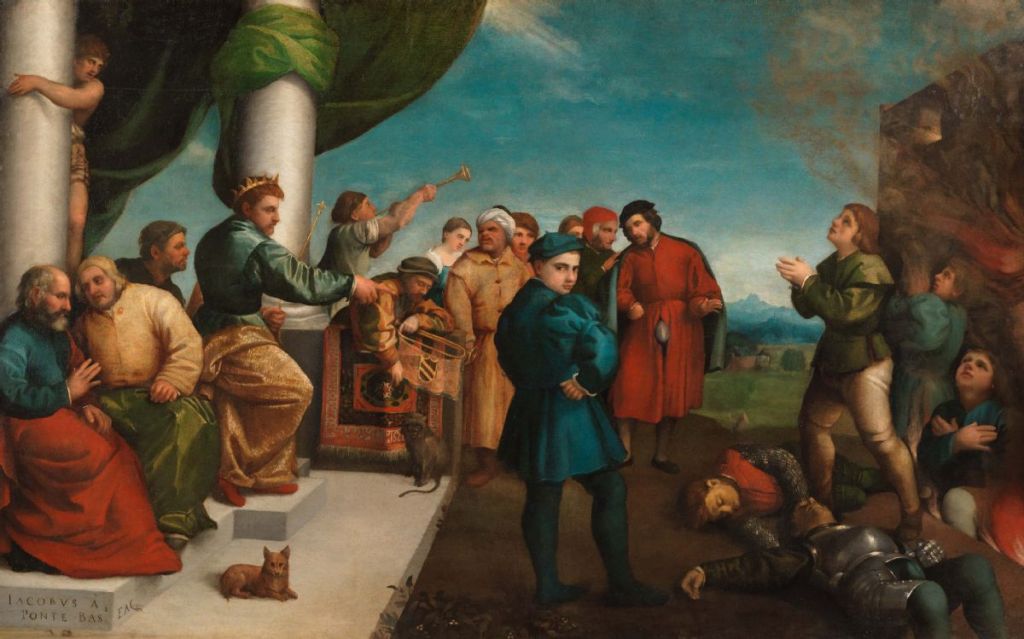
Portraiture offers another way of following Bassano’s development, although the extent of his activity in the field remains difficult to define. William Roger Rearick showed how heterogeneous the group of portraits formerly assembled under Jacopo’s name had become and attempted to reconstruct a smaller autograph corpus from signed works, documentary evidence and portraits embedded within religious or votive paintings. In the mid-1530s, these included likenesses of local office-holders and, in a votive painting of 1536, portraits of the podestà Matteo Soranzo, his daughter Lucia and his brother Francesco, as well as the probable self-portrait inserted into The Three Children Saved from the Fiery Furnace. Rearick saw in these works a directness of observation that remained distinct from the more formal conventions of Venetian portraiture.
The portrait traditionally identified as Francesco Soranzo, now in Nancy, belongs to this early group. Rearick proposed the identification through comparison with Francesco’s likeness in the Soranzo votive painting of 1536, while acknowledging that the sitter’s identity must remain hypothetical. He characterised the independent portrait by its simplicity of format, matt earth colours and unsparing treatment of the sitter.
Jacopo Bassano?, Francesco Soranzo?, c. 1536.
A drawing of a young man in the Louvre, dated 1538, reveals a comparable intimacy and clarity; Rearick tentatively identified the sitter as Jacopo’s younger brother Giambattista.
Jacopo Bassano, Bust of a Young Man
Between 1538 and 1541, when Bassano’s painting became increasingly responsive to Pordenone, Parmigianino and Francesco Salviati, Rearick regarded portraiture as the field in which his underlying naturalism could be seen most clearly. After the early 1540s, however, the surviving evidence becomes much more fragmentary. He accepted only a very small number of portraits from the following two decades, leaving a long gap in the reconstruction of Jacopo’s activity as a portraitist.
The Prelate in the Museum of Fine Arts, Boston, which Rearick dated to about 1570, belongs to a much later stage. The identity of the sitter is unknown. The setting is reduced to a minimum and attention concentrated on the head; Rearick describes fluid brushwork and liquid impasto, while the plum-coloured vestments and black beretta provide the principal accents of colour. Compared with the earlier portraits, the handling has become freer and the presentation more concentrated.
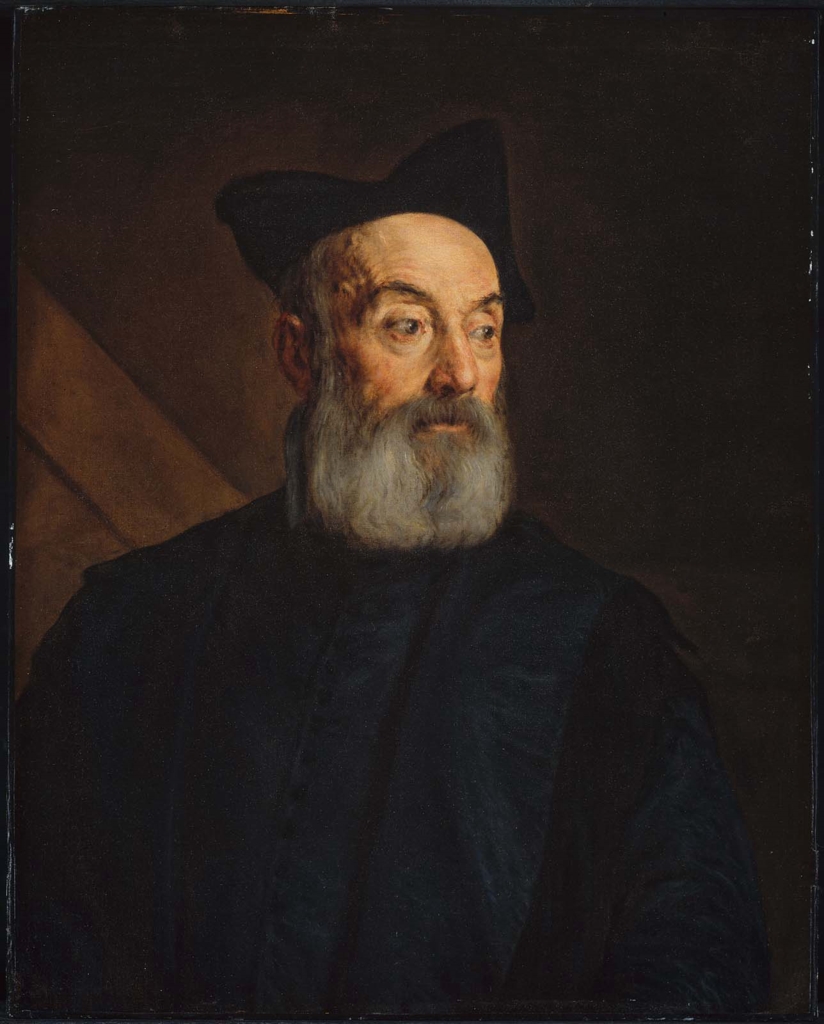
In Rearick’s reconstruction, these changes anticipate the still greater simplicity of the Elderly Man in Vicenza, which he regarded as an example of Jacopo’s late portrait style.
Animals as subjects: Two Hunting Dogs Tied to a Tree
Bassano’s interest in animals became one of the most recognisable features of his work. In Two Hunting Dogs Tied to a Tree, painted around 1548–50 and now in the Louvre, that interest is given unusual independence. The painting was commissioned in 1549 by the Venetian nobleman Antonio Zantani, showing that such subjects already formed part of Jacopo’s work for private patrons beyond Bassano.
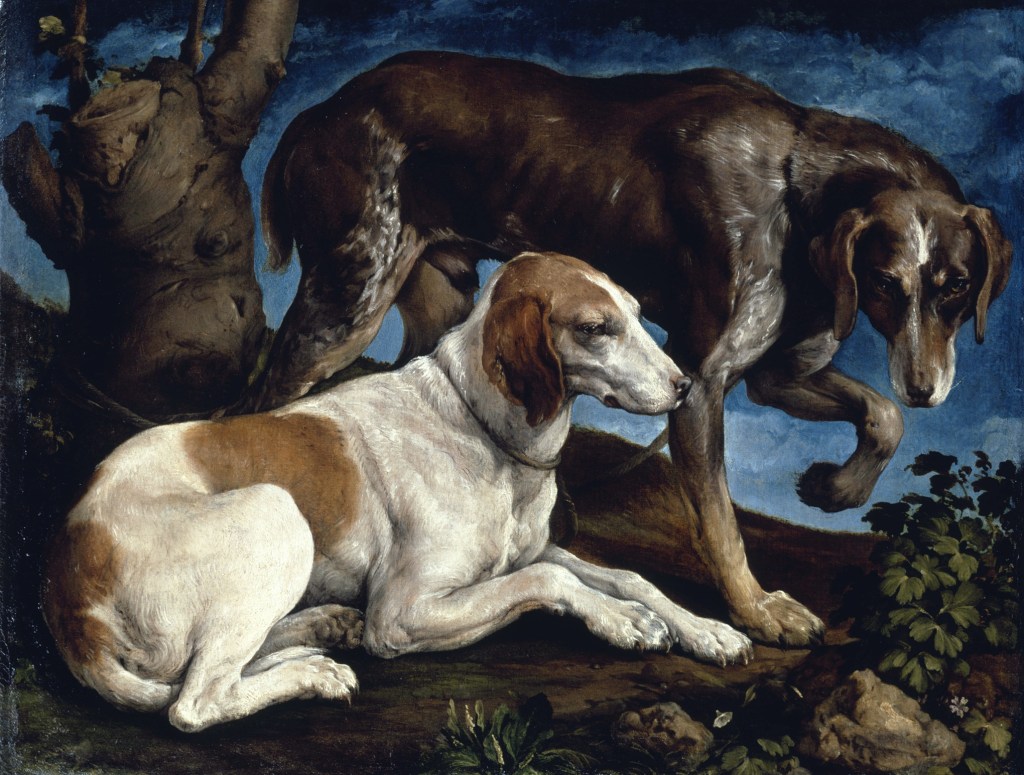
Jean Habert treats the picture as a decisive statement of Bassano’s animal painting because the dogs are no longer subordinate to a religious narrative. The subject marks a shift in emphasis rather than a new concern. Animals had appeared repeatedly in Jacopo’s earlier compositions, but here close observation has been detached from narrative and made sufficient in itself.
The importance attached to this aspect of his work was already apparent to contemporaries. Vasari wrote in 1568 that paintings by Bassano containing many kinds of animals were dispersed through Venetian collections and highly esteemed there. Three years later Rocco Benedetti praised him as miracoloso in pingere cose pastorali, while Raffaello Borghini later singled out the skill with which he made animals and household objects appear natural. Animal painting had become closely bound to the wider pastoral identity for which Bassano was increasingly known.
Light and the approach to the biblical pastoral
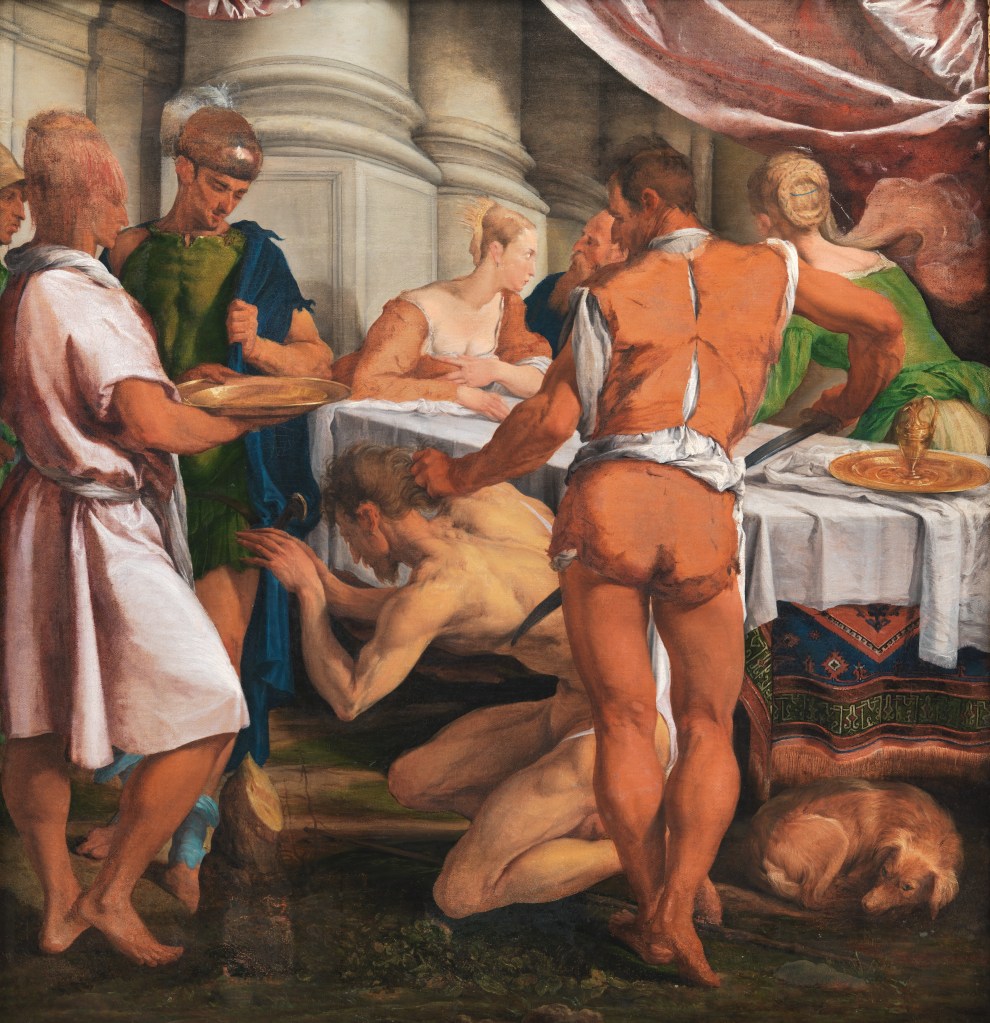
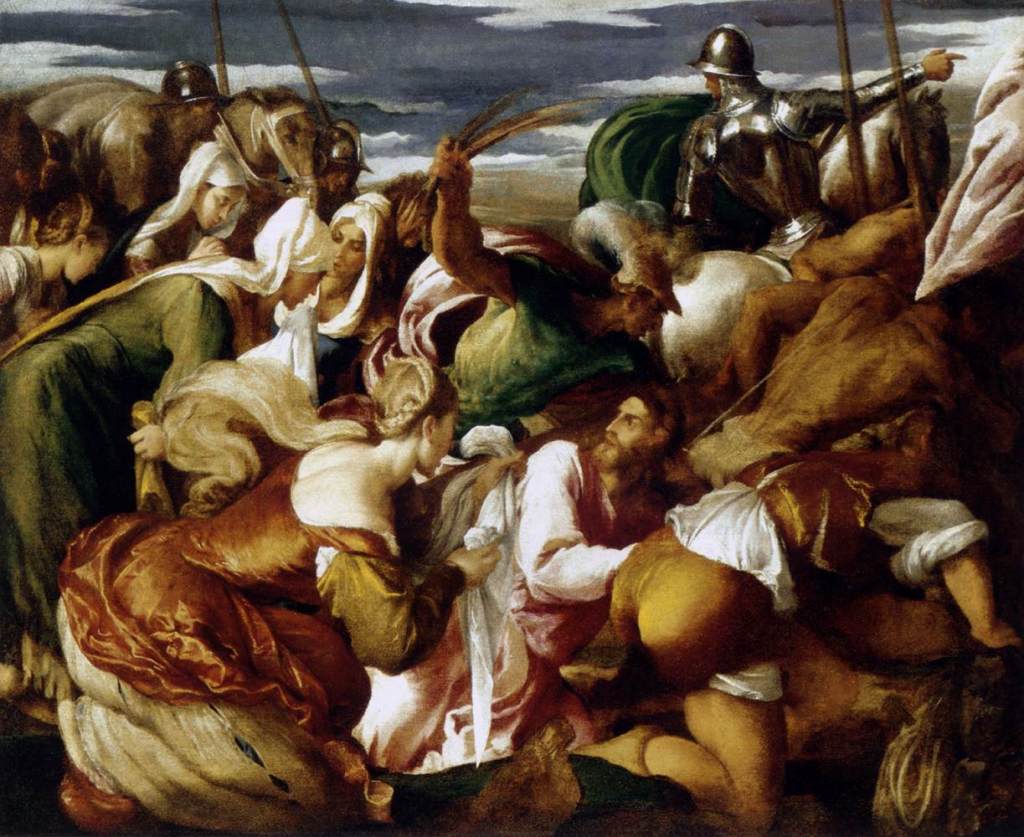
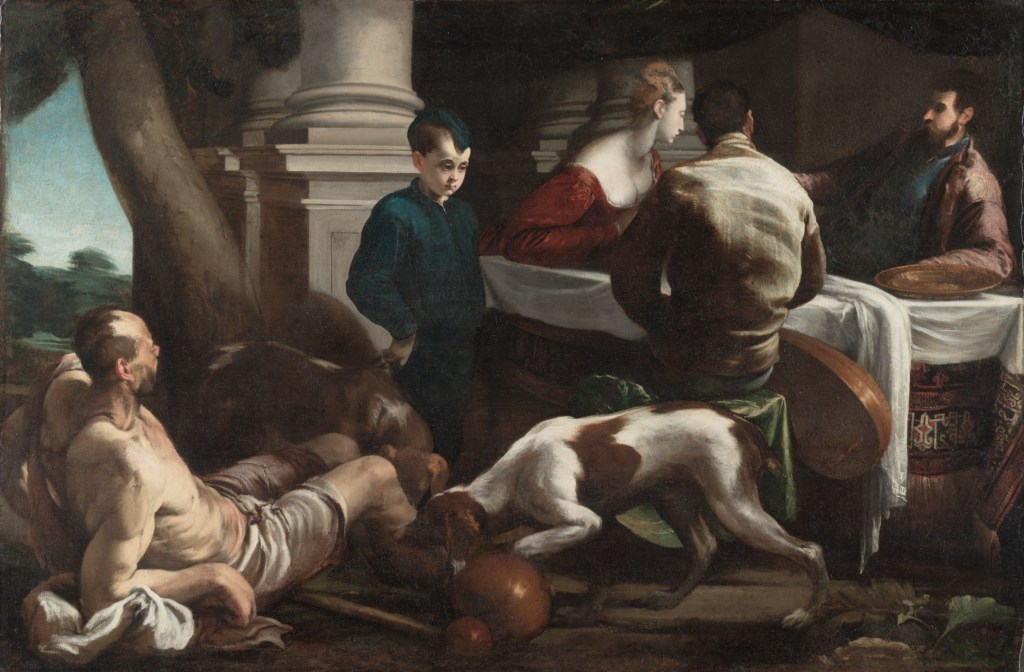
During the first half of the 1550s, light assumed a more active role in Bassano’s painting. Tintoretto was one stimulus behind this development. His example offered a model of light as a dramatic and spatial force: strong chiaroscuro, abrupt illumination and unstable pictorial space could heighten the action of a scene. In the Beheading of Saint John the Baptist, about 1551, now in Copenhagen, Habert notes the conjunction of Mannerist invention with restrained, dissonant colour. The Way to Calvary in Budapest, about 1552, and Dives and Lazarus in Cleveland, about 1553, continue this investigation; in the latter, luminous contrasts intensify and the shadows deepen within a heavier, muted atmosphere.
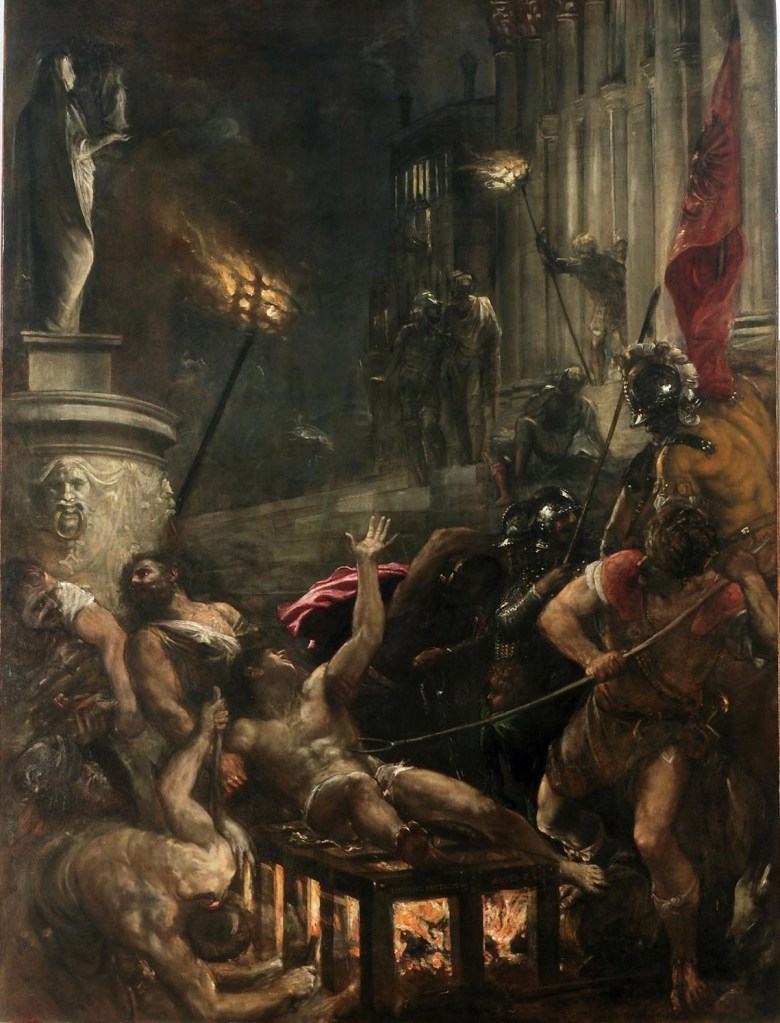
Titian’s example was different. Bassano had responded to his work throughout his career, but in Titian’s later paintings colour, broken handling and darkness could combine to create mood and atmosphere rather than simply sharpen dramatic contrast. The Martyrdom of Saint Lawrence, painted around 1558 for the Gesuiti in Venice, provided an important model of this kind. Bassano drew on both possibilities: from Tintoretto, a more forceful organisation of light and shadow; from Titian, a more atmospheric and poetic conception of illumination, in which twilight or darkness could determine the emotional tenor of the whole painting.
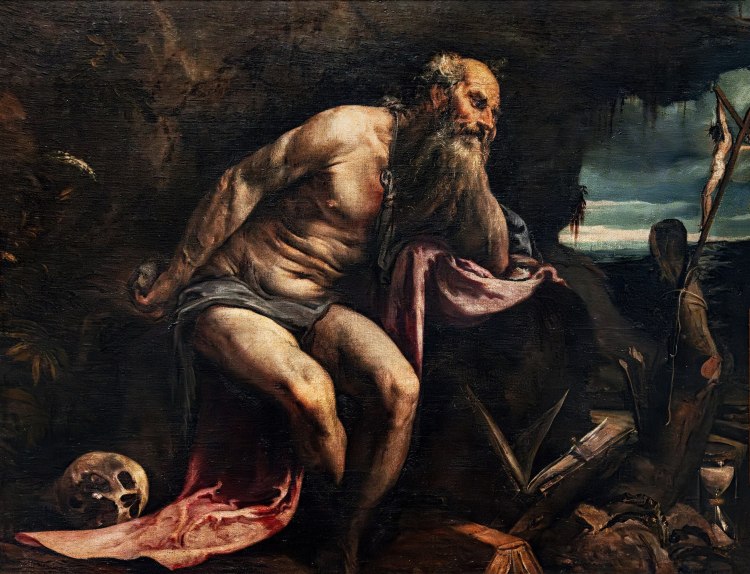
This concern became increasingly his own. Kirsi Eskelinen has stressed Bassano’s attention to different times of day, from morning and afternoon to twilight and night, and notes that he could repeat a composition under changed conditions of illumination. By the early 1560s such effects could become subtle. Alessandro Ballarin described the filtered light of Saint Jerome Meditating, about 1563, with its suggestion of the humidity of the cave, as an instance of Bassano’s “impressionism”.
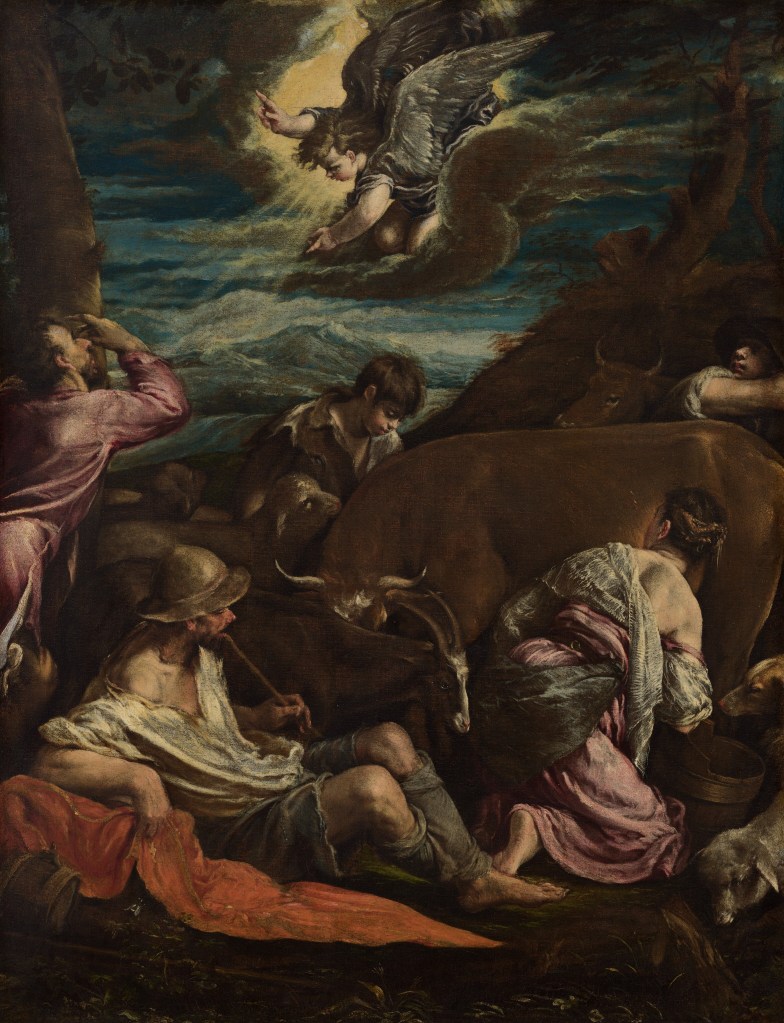
The Annunciation to the Shepherds in Washington, dated about 1555–60, shows these experiments entering the pastoral mode that would soon become central to Bassano’s work. Habert sees a shift here from the more emphatic artifices of Mannerism towards a greater role for landscape, chiaroscuro and figures drawn from country life. The kneeling shepherd seen from behind, with the soles of his feet exposed, became one of the motifs subsequently repeated by Jacopo and his workshop. Claudia Caramanna notes that elements from the composition were borrowed for an illustration of the story of Judah and Tamar in Gabriele Simeoni’s Figure del Vecchio Testamento (Venice, 1574), evidence that Bassano’s pastoral inventions were already circulating beyond the workshop.
The biblical pastoral
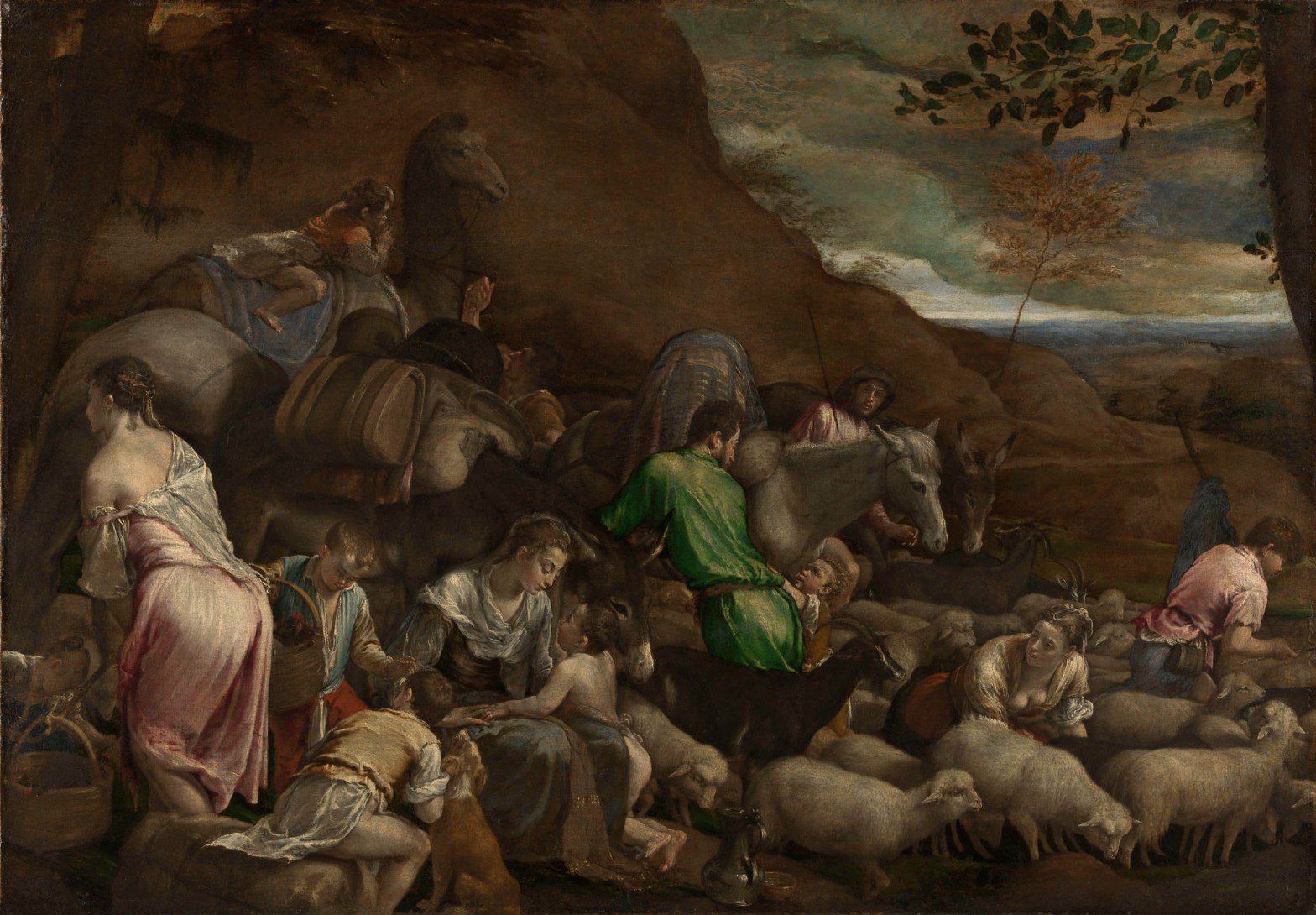
By about 1560 Bassano had begun to formulate the type of painting on which much of his later reputation would rest. Kirsi Eskelinen treats The Journey of Jacob at Hampton Court, painted around 1560–61, as an early example. Its pastoral conception was indebted to Titian’s drawings, including the Arcadian Landscape with Shepherds in the Albertina, and more broadly to the Giorgionesque tradition from which Titian’s own pastoral imagery had developed. Biblical narrative was now being placed within a landscape conceived not merely as setting but as an essential part of the subject.
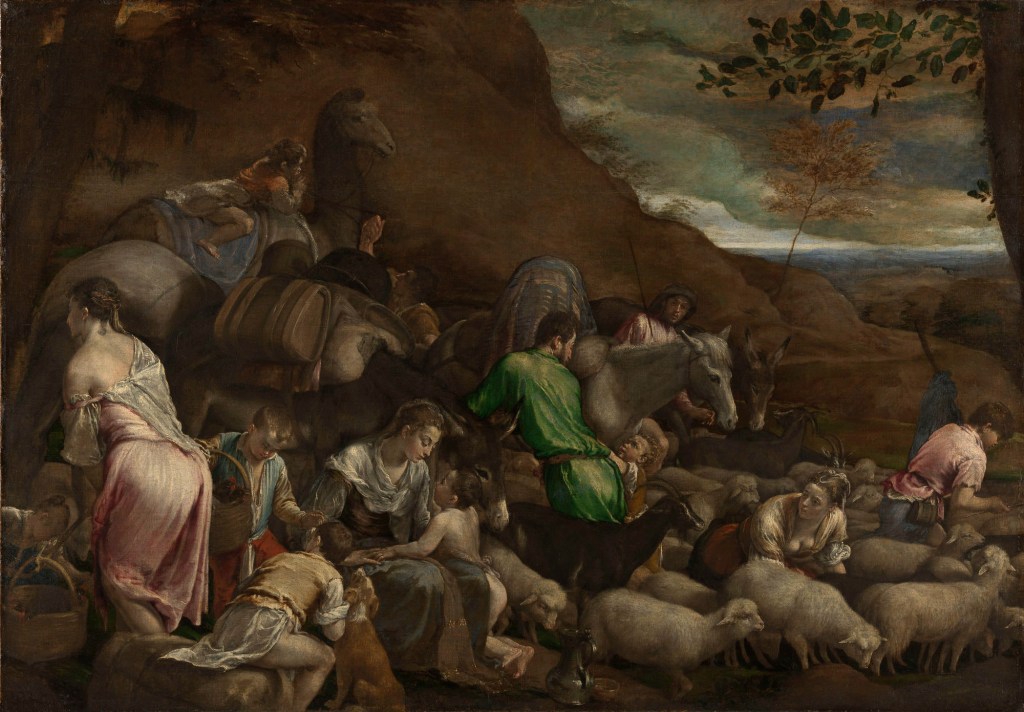
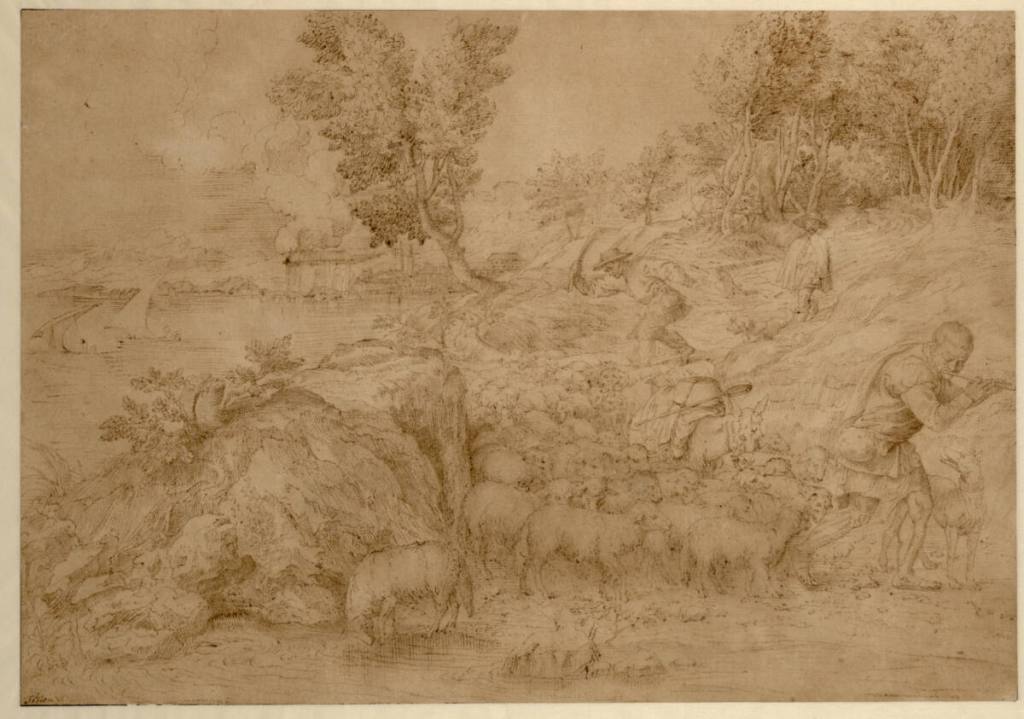
Claudia Caramanna defines the new biblical-pastoral formula by the relocation of Scripture into the countryside around Bassano, sometimes with Monte Grappa itself appearing on the horizon. In works such as Meeting of Jacob and Rachel at the Well and Moses Striking Water from the Rock, the principal biblical action occupies a relatively small part of the composition while shepherds and animals dominate the foreground. This redistribution could make the narrative difficult to identify. Caramanna notes that paintings of this kind were consequently described in contemporary records simply as pictures filled with animals rather than by their biblical subjects.
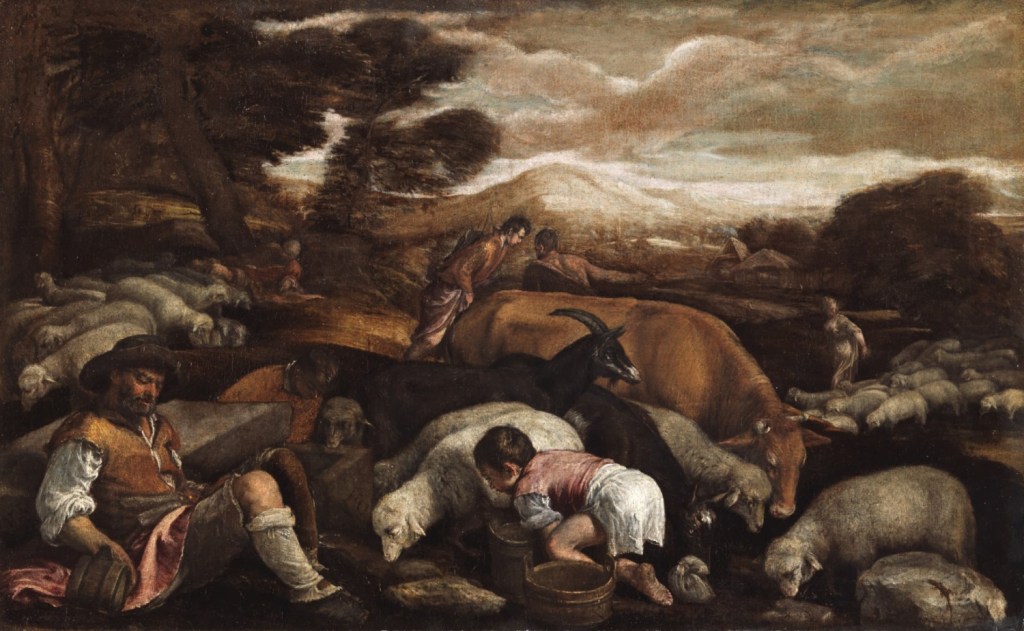
The pastoral mode also altered Bassano’s relation to an older Venetian tradition. Giorgione and the young Titian had associated landscape with an Arcadian ideal, but Bassano brought that inheritance into contact with the observed world of the terraferma. Eskelinen suggests that the appeal of these paintings may have been connected with the culture of the Venetian villa, pastoral poetry and the idealisation of rural life. Their country setting was therefore neither straightforward genre painting nor simply a decorative background to sacred history. The biblical event and the rhythms of rural existence were allowed to coexist within the same pictorial field.
Caramanna argues that the pastorals made Bassano’s work readily recognisable within Venetian artistic culture. Their success also encouraged repetition and variation by the workshop, a development that became increasingly important once Jacopo’s eldest son, Francesco, and his other sons entered the family enterprise.
From workshop success to an international market
During the 1570s Bassano’s market widened considerably. Claudia Caramanna shows that Jacopo was no longer dependent on commissions from patrons with whom he had direct contact. Paintings also moved through merchants and intermediaries, allowing the workshop to reach collectors beyond the Venetian mainland.
One of the clearest documents concerns Spain. In 1574 Diego Guzmán de Silva, the Spanish ambassador in Venice, sent Philip II a Journey of Jacob by the celebrated painter from Bassano. The king was evidently unfamiliar with Jacopo’s work, but received the painting favourably. Caramanna regards the episode as the beginning of a sustained Spanish interest in Bassano paintings. Two years later, correspondence from Madrid referred to merchants bringing paintings by “Bassano” into Spain, where his skill in depicting animals was noted and the value of the works discussed.
Demand also spread within Italy. By the later 1570s Jacopo’s paintings were entering aristocratic collections beyond the Veneto, including that of Paolo Giordano I Orsini, Duke of Bracciano, while works were also circulating through dealers in Rome. The geographical reach of the workshop had therefore become far greater than Jacopo’s own place of residence might suggest.
By the end of the decade, Bassano’s work was also reaching patrons of increasingly high rank. Cardinal Ferdinando de’ Medici acquired numerous paintings by Bassano from 1578 onwards, while Jacopo was working on a group of paintings for the Bohemian chancellor Wratislaw von Pernstein. In 1587 the Dutch traveller Aernout van Buchell described him as the leading painter of his day and recorded a large cycle of the Months of the Year at Bassano.
This expansion coincided with increasing collaboration between Jacopo and his sons. Rearick and Ballarin substantially revised the older belief that Jacopo had largely handed production over to the family during the 1570s. Instead, he continued to devise and execute autograph works while directing a workshop capable of supplying a much broader market.
Late experimentation: the Baptism of Christ
The Baptism of Christ in the Metropolitan Museum, painted around 1590, provides strong evidence of continuing invention in Bassano’s final years. The work belongs to what Rearick and Ballarin described as his “fifth and last manner”. Andrea Bayer, Michael Gallagher and Silvia Centeno’s 2013 article, “Jacopo Bassano’s Baptism of Christ,” combines technical examination of the painting with a reassessment of Jacopo’s late style.
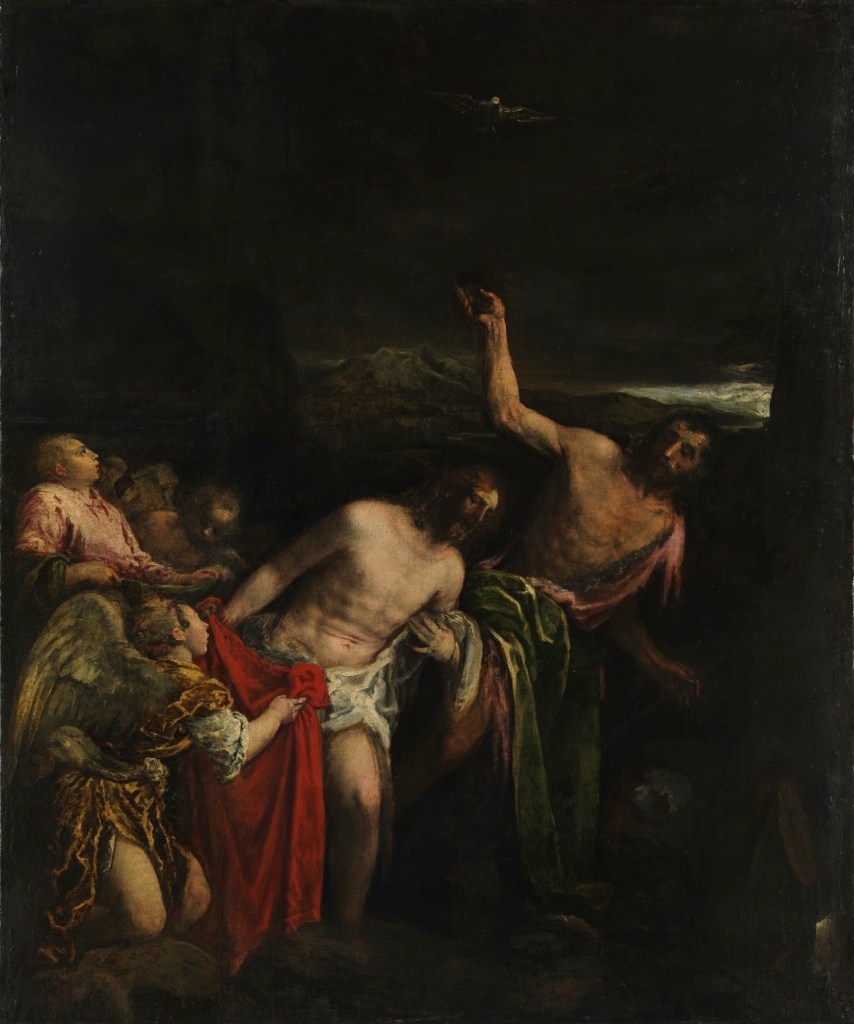
The painting was prepared over a dark ground. X-radiography reveals none of the lead-white brush drawing found in comparable paintings by Tintoretto, raising the possibility that Jacopo developed the composition more directly on the prepared canvas. The investigation also revealed extensive changes during execution. The Baptist’s raised arm was repositioned, and changes were made to Christ’s head and to the fall of the baptismal water. Important aspects of the composition therefore seem to have remained open during the painting process.
The technical evidence also suggests a closer relationship between drawing and painting in Bassano’s late practice. The emphatic dark lines used to correct and anchor forms on the canvas have close parallels in his later black-chalk and coloured-chalk drawings, where repeated strokes and concentrated passages of colour establish or revise the figure with comparable directness. The article therefore supports Zampetti’s suggestion that functions once carried out in preparatory drawing could increasingly be transferred to the canvas itself. In the Baptism, revision was not simply a preliminary stage but part of the act of painting.
The degree of finish is equally revealing. An inventory made after Jacopo’s death in 1592 recorded about 192 works in the workshop, sixty-five of them described as sbozzate. A Baptism of Christ appears among them and has usually been identified with the Metropolitan painting, although Carlo Corsato has questioned that identification. Ridolfi later described a Baptism retained by Jacopo’s descendants as non finita. The 2013 study distinguishes between passages that remained unfinished and Jacopo’s deliberate use of abbreviated handling. The dark ground allowed relatively few strokes to establish colour, light and form, while fuller attention could be concentrated on passages carrying greater emotional weight.
The article compares this selective finish with Titian’s late non finito. The relationship is suggestive rather than mechanical. Titian’s late paintings offered a precedent for allowing exposed ground, broken handling and uneven degrees of finish to contribute to expression rather than treating them simply as signs of incompletion. In the Baptism, Bassano’s earlier interest in atmosphere and illumination is joined to a freer manipulation of the material surface.
The painting also belongs to a group of late works connected with nocturnal imagery, including Passion scenes. Drawing on Paolo Berdini, the article relates Christ’s bent posture and suffering expression to the Passion and to the theological association of baptism with Christ’s death and resurrection. It also connects the nocturnal setting with the Paschal Vigil, whose liturgy included baptism, and with the rising sun visible on the horizon. The late Baptism therefore provides a fitting endpoint to Bassano’s career: his concern with light, his continuing dialogue with Titian and his willingness to rethink pictorial finish remained active almost to the end.
Conclusion
Across a long career, Bassano continually enlarged the possibilities of his art. Venetian models, workshop practice, close observation, landscape, animals and changing effects of light were absorbed into an increasingly distinctive pictorial language. The biblical pastorals brought him his widest recognition, but they did not define the limits of his later work.
The Baptism of Christ shows that invention continued into his final years. Its revisions, dark preparation and selective finish reveal a painter still testing how colour, light and handling could carry meaning. Bassano’s achievement lies in that sustained capacity to adapt and renew his practice without losing the naturalism that remained central to it.
Producing these essays requires care, time, research, and resources. Contributions to help sustain this exploration would be greatly appreciated.
Donate to Inner Surfaces here.
Bibliography
Bayer, Andrea, Michael Gallagher and Silvia Centeno. “Jacopo Bassano’s ‘Baptism of Christ’.” Artibus et Historiae 34, no. 68 (2013): 83–103.
Caramanna, Claudia. “From the Venetian Countryside to the European Courts: The Success of Jacopo Bassano and His Workshop.” In Hanna-Leena Paloposki, ed., Jacopo Bassano: Renaissance Painter of Venetian Country Life. Brussels: Mercatorfonds, 2024, pp. 35–46.
Eskelinen, Kirsi. “Introduction: Jacopo Bassano – Renaissance Painter of Venetian Country Life.” In Hanna-Leena Paloposki, ed., Jacopo Bassano: Renaissance Painter of Venetian Country Life. Brussels: Mercatorfonds, 2024, pp. 7–9.
Habert, Jean, and Catherine Loisel Legrand. Bassano et ses fils dans les musées français. Les dossiers du musée du Louvre 55. Paris: Réunion des musées nationaux, 1998.
Paloposki, Hanna-Leena, ed. Jacopo Bassano: Renaissance Painter of Venetian Country Life. Brussels: Mercatorfonds, 2024. Exhibition catalogue, Sinebrychoff Art Museum, Finnish National Gallery, Helsinki, 19 September 2024–12 January 2025.
Rearick, W. R. “The Portraits of Jacopo Bassano.” Artibus et Historiae 1, no. 1 (1980): 99–114.
Online museum information
Musée du Louvre, Paris. Collections database.
Museum of Fine Arts, Boston. Collections database.
National Gallery of Art, Washington. Collections database.
Norton Simon Museum, Pasadena. Collections database.
Royal Collection Trust. Online catalogue.
The Metropolitan Museum of Art, New York. Collection database.

