The Senses as a Subject
When Gregorio and Mattia Preti painted their first Allegory of the Five Senses in Rome during the 1630s, they were taking up a subject with a long history. Sight, hearing, smell, taste and touch had been represented individually and in cycles since the Middle Ages, and by the sixteenth century the Five Senses had become established as an independent allegorical theme. Their meanings were never entirely stable. The senses could be avenues to knowledge, but also routes through which temptation entered the mind. They could be ordered hierarchically, with sight and hearing generally occupying the higher positions, or associated with love, physical pleasure and desire. As Carl Nordenfalk observed, Renaissance representations could condemn sensual folly while taking evident pleasure in the world of ‘wine, women and song’.
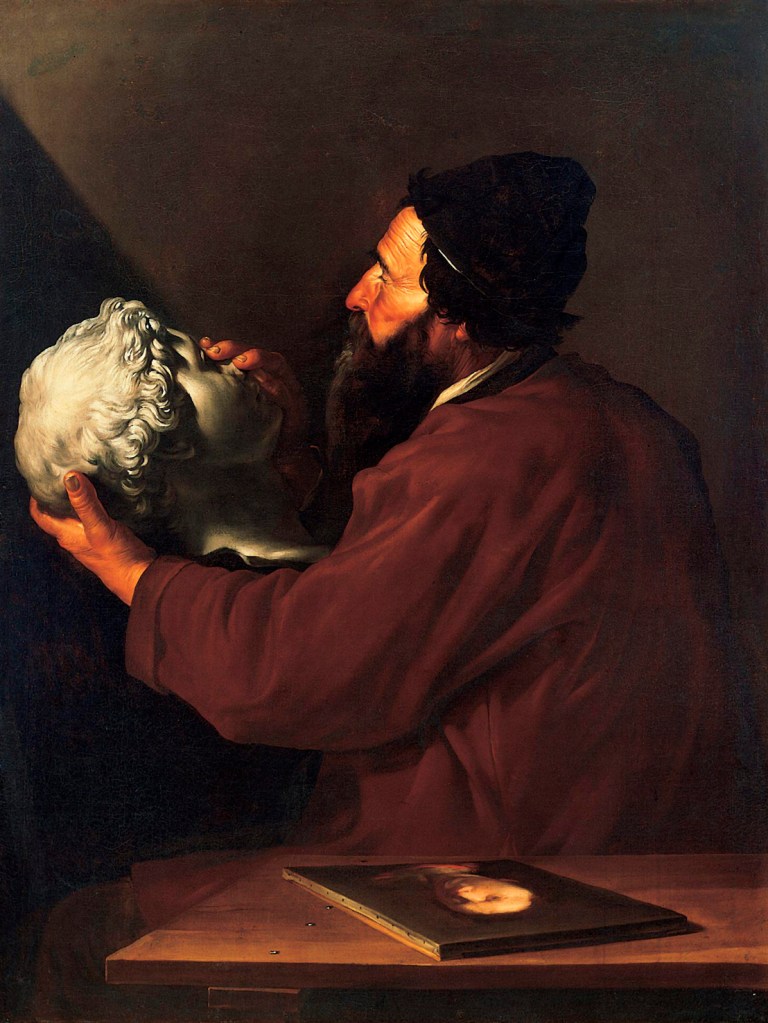
By the early seventeenth century, painters had begun to detach the subject from conventional personification. Jusepe de Ribera’s series of the Five Senses, painted in Rome around 1615, substituted individual men engaged in sensory activities for allegorical figures supplied with attributes. Ribera was an important precedent for the Pretis, but his paintings also indicate the intellectual possibilities of the subject in the Rome they inherited. Hannah Joy Friedman has situated the series within contemporary discussions of the relation between sensation and judgement. In an Aristotelian tradition, il sentire, the reception of sensory impressions, could be distinguished from l’intendere, the work of understanding them. Concepts such as gusto, giudizio and prudenza similarly allowed physical perception and intellectual discernment to intersect in the language of art. Friedman consequently describes Ribera’s series as multivocal. The senses supplied material for reflection and conversation rather than a single proposition about the reliability of experience.
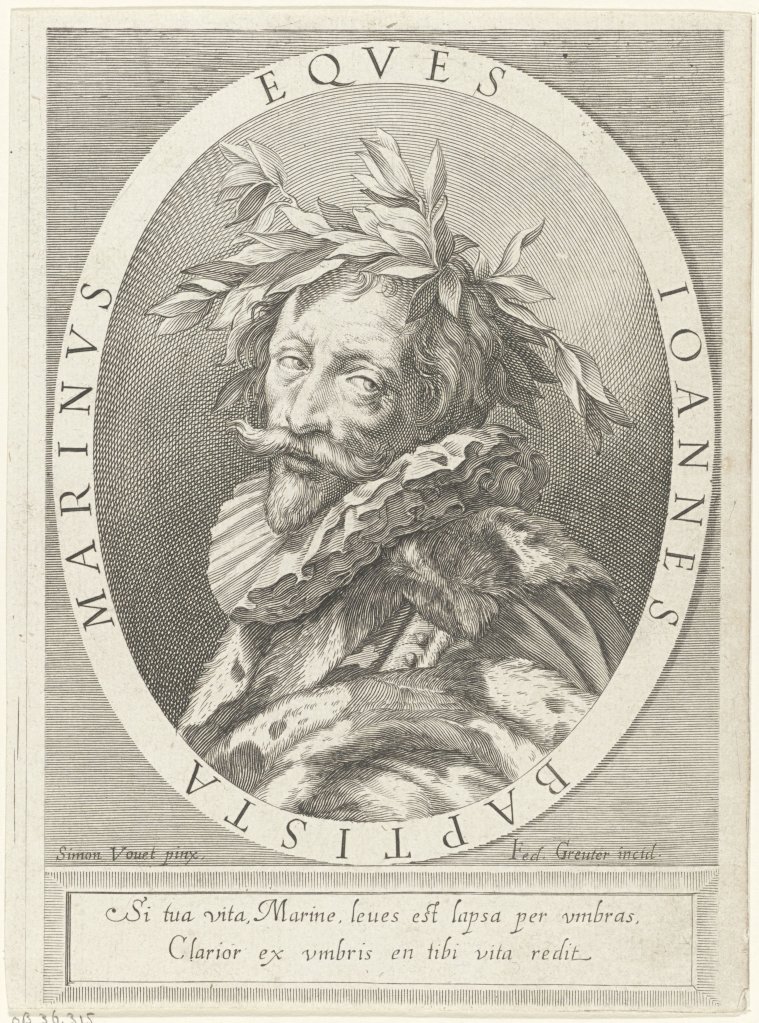
A comparable ambiguity runs through Giambattista Marino’s L’Adone, published in Paris in 1623 and one of the most extravagant literary monuments of the Italian Baroque. Sensuous description, material beauty and erotic attraction repeatedly absorb the reader’s attention, while the poem places these pleasures within moral and allegorical structures that ask them to be interpreted. Sofie Kluge has described the resulting tension between absorption in sensory experience and the attempt to pass beyond it towards another order of meaning. Marino would become relevant to interpretations of the Pretis’ first treatment of the Five Senses, but the wider context is already suggestive. Pleasure in the sensible world could coexist with uncertainty about what the senses disclose.
The two large paintings on the subject produced by Gregorio and Mattia Preti belong to this tradition while dispensing almost entirely with the appearance of formal allegory. The senses are embodied instead in music, eating and drinking, smoke, physical contact and acts of looking. Both pictures present gatherings of contemporary figures rather than assemblies of personifications. Their immediate pictorial ancestry also lies in the Caravaggesque world of concerts, gaming and convivial scenes, a repertory developed in Rome by painters such as Bartolomeo Manfredi. The earlier Preti painting, now in Turin, remains close to this Caravaggesque world. When the brothers returned to the subject on a far greater scale some years later, the pleasures of sensory experience had acquired a more complicated setting.
Turin: An Early Experiment
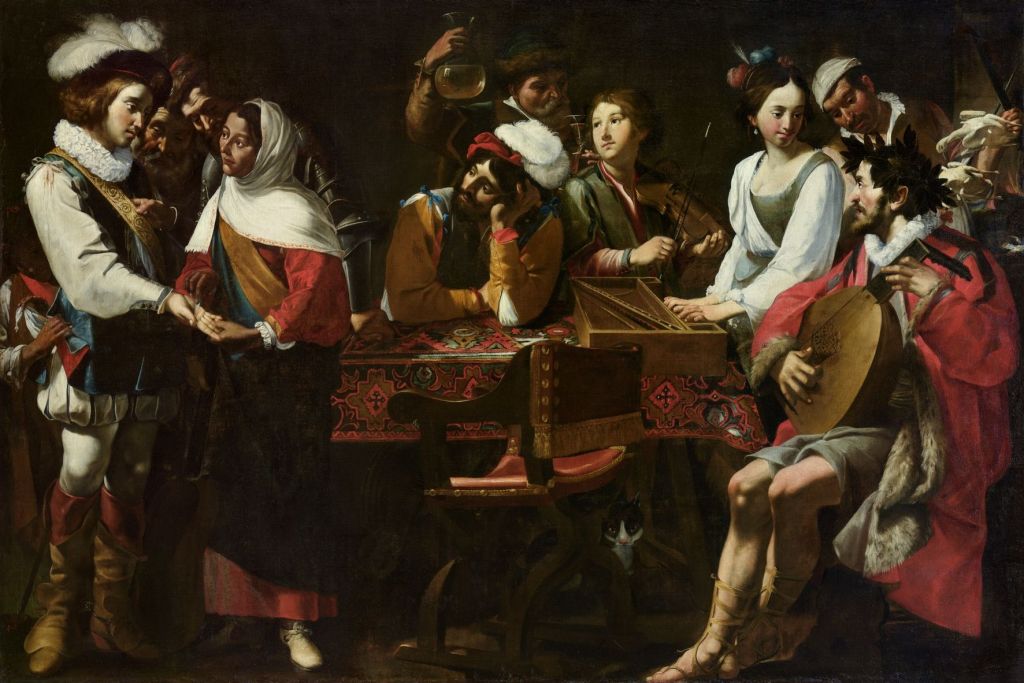
The earlier of the two paintings, now in the Pinacoteca dell’Accademia Albertina in Turin, was probably painted between 1630 and 1635. Its attribution has had a complicated history. Entering the collection as a Caravaggio in 1830, it was subsequently assigned to Mattia Preti and, for a period, to the Flemish Caravaggist Theodoor Rombouts. It is now regarded as a collaboration between Gregorio and his younger brother. The Albertina assigns the overall invention and most of the execution to Gregorio, with Mattia responsible for more limited passages, including the laurel-crowned poet at the right.
The painting presents its incidents across the width of a tavern interior. At the far left, a fortune-teller reads the palm of an elegantly dressed young man while a boy reaches towards his purse; two armed men behind them have noticed what is happening. Near the centre, a bearded man in a broad, red, feathered hat rests his head heavily on one hand. Beyond him an innkeeper raises a wine flask and a young violinist plays. The right half is dominated by music: a young woman turns from the keyboard of a spinet towards a mature, laurel-crowned man who sings as he plays the lute. At the extreme right, another figure tends a spit. The episodes are connected by the table that runs across the composition, but they retain something of the independence of adjoining genre scenes. The Albertina aptly describes their organisation as paratactic.
The five senses are woven into these activities rather than embodied as personifications. Music supplies an obvious reference to hearing; wine and food engage taste and smell; the handling of the young man’s palm gives touch a narrative form. Sight is implicated more diffusely in a painting constructed around looking, deception and recognition. Even the attempted theft at the left depends upon a contrast between what one figure fails to see and what others have noticed. The precise distribution of the senses is not entirely transparent, and the Albertina itself cautions that the genesis and meaning of the work remain difficult to reconstruct.
Nor are the five senses necessarily its only organising scheme. The young man in the conspicuous red hat assumes the traditional attitude of the humor melancolicus, his head supported by his hand. Yuri Primarosa has proposed that the other three temperaments may also be distributed among the figures: the armed men representing the choleric temperament, the young client of the fortune-teller the phlegmatic, and the singing poet the sanguine. The possibility adds another classificatory system to the apparently casual life of the tavern. Sensation, temperament and behaviour overlap within the same gathering.
The picture remains close to the Caravaggesque culture in which both brothers had developed. The Albertina describes the painting as a relatively late, almost nostalgic recovery of this post-Caravaggesque world. Manfredi had helped to turn Caravaggio’s example into a repertory adaptable to conversations, games and convivial scenes, the Manfrediana methodus described by Sandrart. Here that language has been expanded across a canvas almost three metres wide, allowing the brothers to combine several familiar kinds of genre painting within a single allegorical construction.
The laurel-crowned musician at the right introduces a more specific possibility. An older catalogue tradition identified him as Torquato Tasso, accompanied by figures interpreted as Eleonora d’Este and the Duke of Ferrara. The Albertina now offers a different identification: the musician may be Giambattista Marino, citing his physiognomic resemblance to known portraits of the poet. The proposal remains tentative, but the broad face, moustache and pointed beard do recall Marino’s established portrait type. If the identification is accepted, his presence would be apposite in a painting devoted to sensory experience. As mentioned earlier, Marino’s L’Adone, published in 1623, gives sustained attention to the senses and to the unstable relation between sensual pleasure and knowledge.
Primarosa has pursued the connection further, reading the Turin painting in relation to the Epicurean elements of Marino’s poem. On this account, the senses provide a stage on the route towards knowledge rather than merely a set of temptations to be overcome. It would be hazardous to make the possible portrait carry the whole interpretation, or to treat the painting as an illustration of L’Adone. Yet the Marino identification would place a contemporary poet of sensory experience within the very pleasures the allegory represents: music, wine, food, touch and sociability.
The brothers returned to the subject some years later in the immense canvas now in Palazzo Barberini. Some of the earlier painting’s vocabulary remained available to them, and technical examination has shown that a figure initially planned for the centre of the later composition recalled the melancholy figure in Turin. But the second painting was conceived on a different scale, both physically and pictorially. Its crowded Caravaggesque inheritance was absorbed into a broader Roman Baroque language, while the relation between pleasure, perception and knowledge became more explicit and less secure.
Rome: The Barberini Allegory
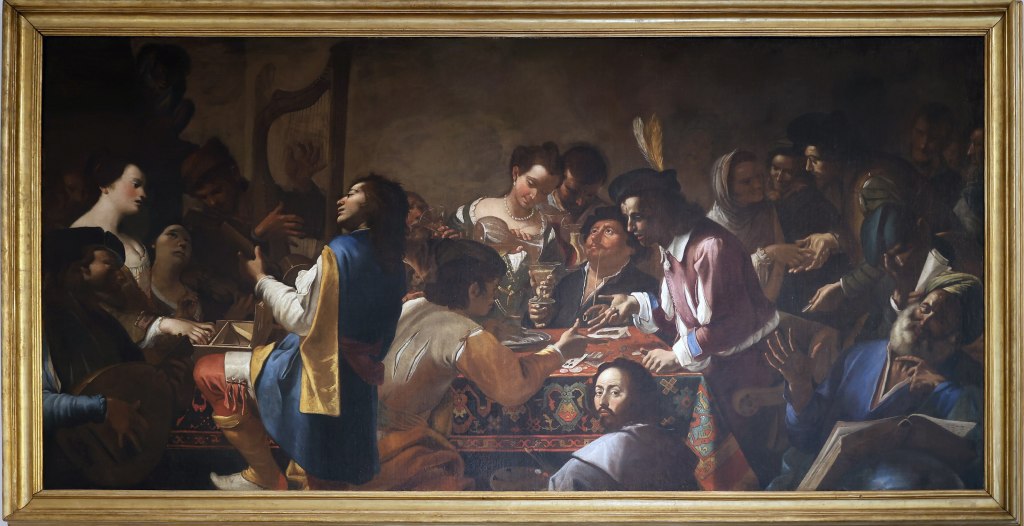
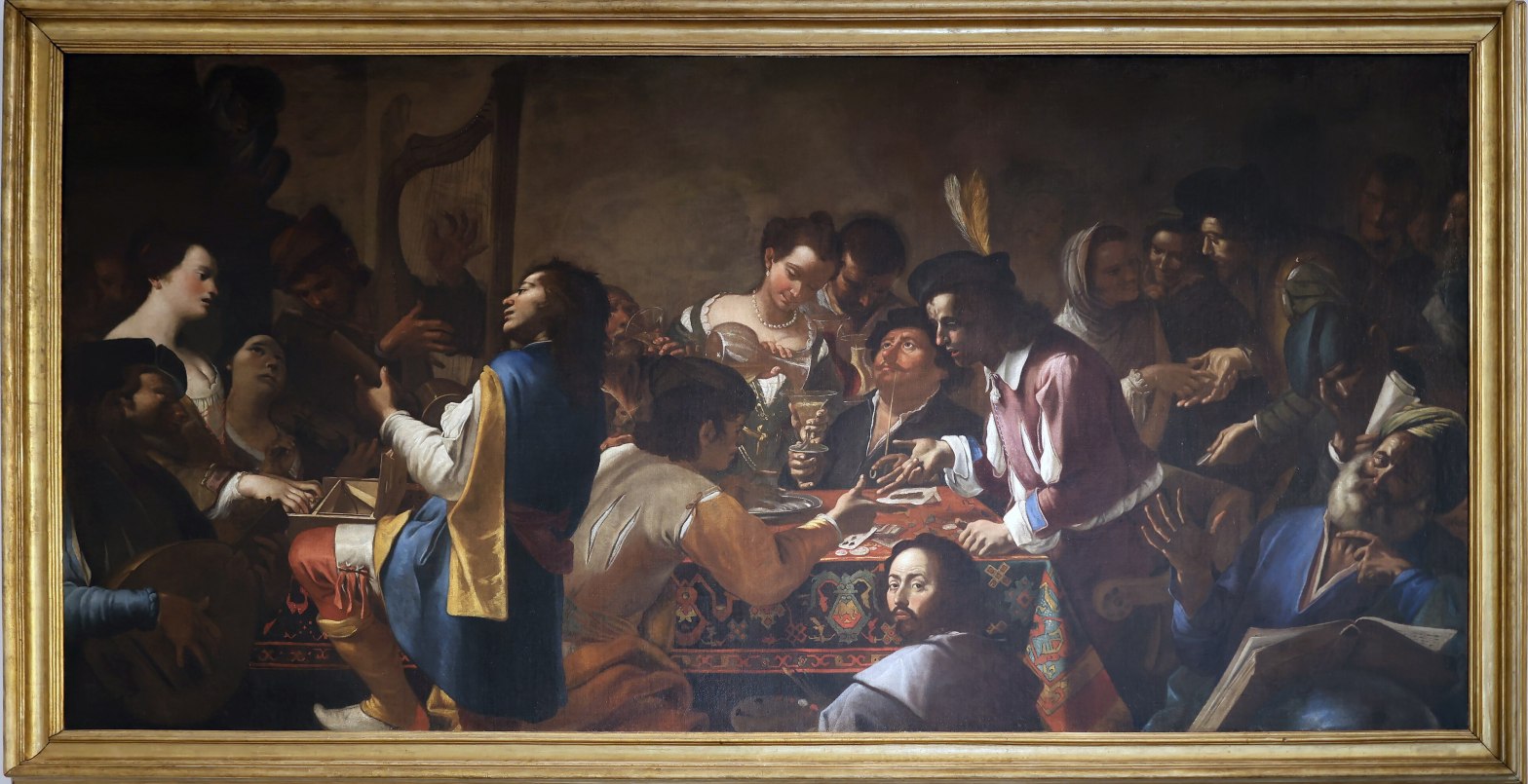
When Gregorio and Mattia returned to the Five Senses, they did so on a different scale. The Allegory of the Five Senses now in Palazzo Barberini measures approximately 175 by 363 centimetres and contains more than twenty life-size figures. Primarosa dates it to the early or mid-1640s, when the brothers were still working in close contact in Rome. Its dimensions suggest that it was conceived for a large aristocratic interior, probably high on the wall of a double-height room. The painting is recorded in the Barberini collections later in the seventeenth century, although the identity of its original patron remains uncertain.
Primarosa has proposed Taddeo Barberini, Prince of Palestrina, the lay nephew of Urban VIII. He regards Taddeo as a more plausible recipient than his brothers, Cardinals Francesco and Antonio Barberini, for a work so emphatically profane in subject, dominated by music, drinking, gambling and other sensory pleasures. Taddeo’s marriage to Anna Colonna also offers a possible route to the Preti brothers. Anna was the daughter of Filippo I Colonna and the Calabrian heiress Lucrezia Tomacelli, giving the connection an additional regional resonance for two painters themselves born in Calabria. The Preti brothers maintained links with both the Barberini and Colonna families. The evidence for Taddeo’s patronage is circumstantial, but the suggestion places the painting within the secular culture of a princely household rather than an ecclesiastical setting. Later Barberini inventories had already lost sight of its allegorical structure: in 1686 it was described simply as a long painting containing people playing, singing, gambling, drinking and cheating their companions.
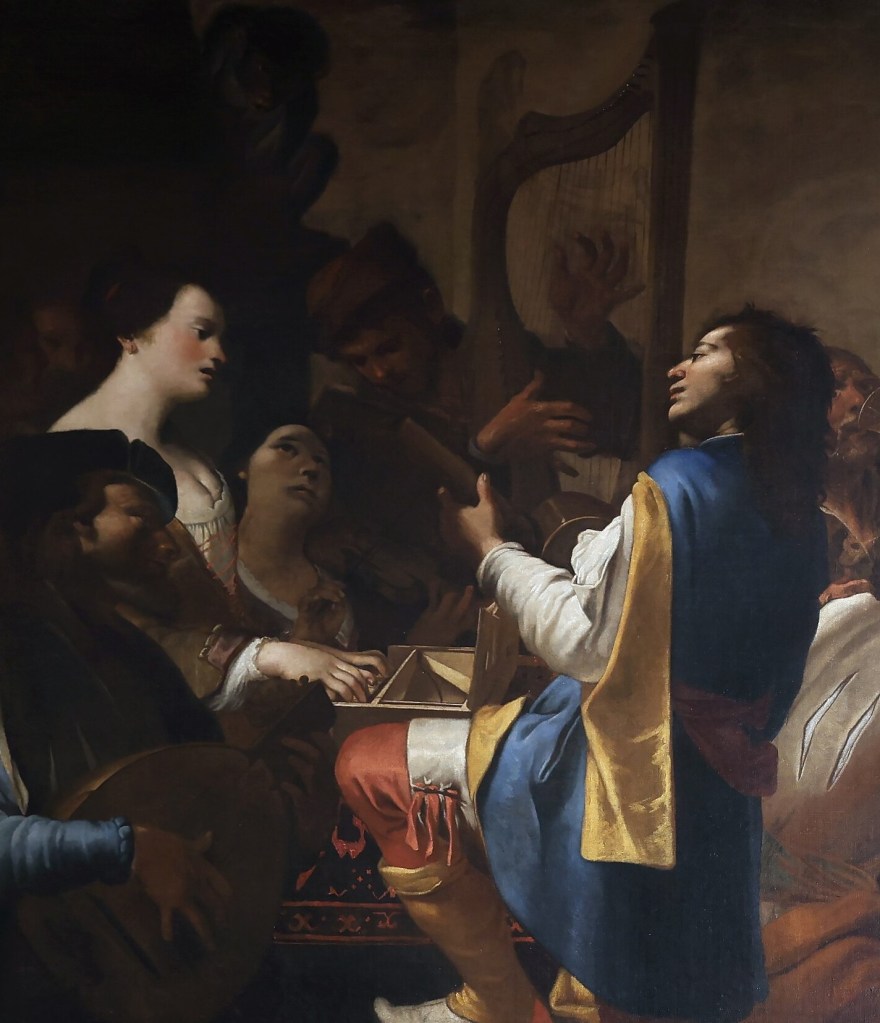
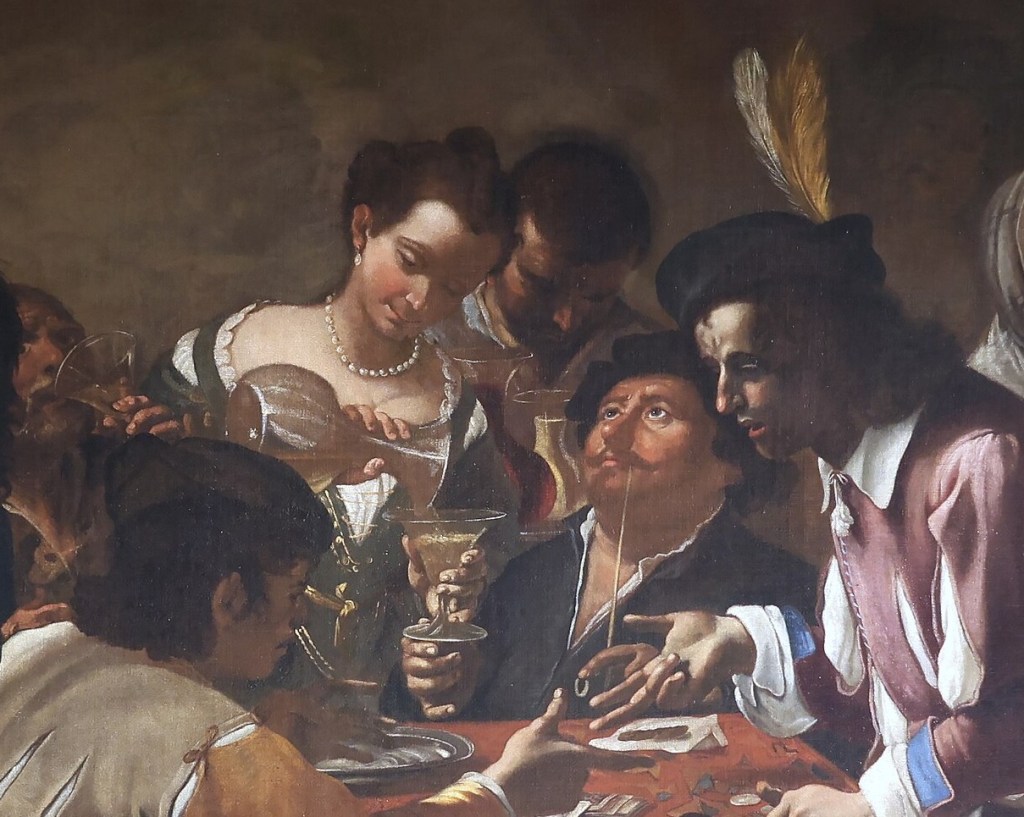
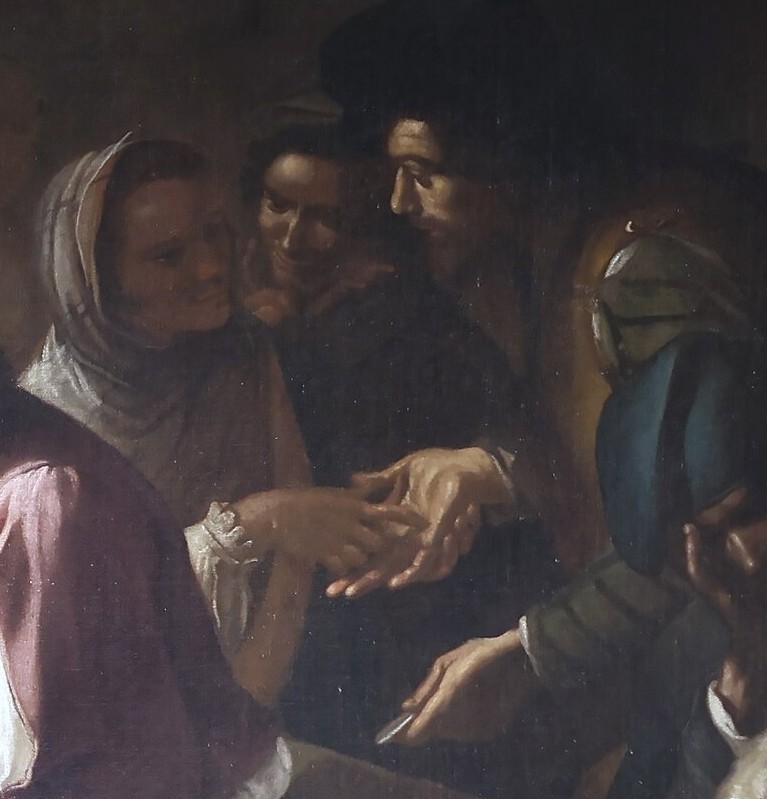
That description catches something of the picture’s immediate effect. The five senses have again been embedded in contemporary behaviour, but the episodes are more numerous and more densely entangled than at Turin. At the left, a group of musicians establishes hearing. Towards the centre, drinking and the serving of wine evoke taste, while a pipe smoker supplies smell. On the right, a fortune-teller takes the hand of her client, bringing touch into the familiar Caravaggesque encounter between palm-reader and victim. Sight occupies a different position. At the lower edge of the composition a painter turns towards the spectator with palette and brushes, making the production of the picture itself part of its allegory.
Primarosa identifies this painter as Gregorio rather than Mattia. Earlier readings had favoured the younger and eventually far more famous brother, but technical examination has strengthened the case for Gregorio. Radiography revealed beneath alterations to the face a considerably older man, with wrinkles around the eyes and forehead and a greying beard, difficult to reconcile with Mattia’s age at the time. The identification also changes the relationship between the brothers within the picture. Gregorio does not merely participate in its execution: as the personification of sight, he places the painter among those who exercise the senses and turns directly towards the viewer who is doing the same.
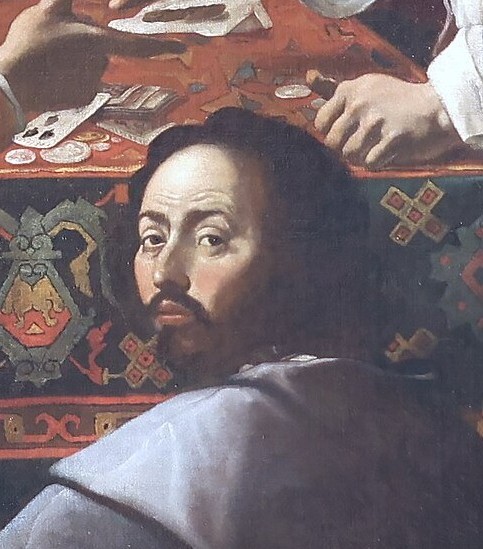
The painting emerged from a process far less orderly than its eventual organisation suggests. Radiography and restoration have revealed extensive changes beneath the surface. Figures were moved, suppressed or introduced after neighbouring passages had already been completed. The harp was originally shown the wrong way round, with its vertical column towards the player, and was subsequently rotated through 180 degrees into a plausible playing position. The standing guitarist at the left was added over existing figures, helping to separate the musical gathering from the adjoining activities. Near the centre, the brothers abandoned a man resting his head upon his hand, a motif that recalls the melancholy figure in the Turin Allegory. At least ten figures appear to have been removed during the development of the composition. Rather than transferring a completely resolved design to the canvas, Gregorio and Mattia seem to have discovered much of its final structure through painting.
One of the suppressed figures is more suggestive than a compositional adjustment. Behind the morra player and the fortune-teller, the brothers had completed a grinning man wearing an asinine headdress before covering him entirely. Morra was a fast hand game in which players simultaneously displayed fingers while calling the anticipated combined total. Primarosa interprets the erased figure as a kind of saltimbanco, his donkey-like cap signifying the folly of humanity enslaved to vice and the enticements of the senses. In the original conception he would have appeared amid drinking, gambling and tobacco smoke as a grotesque commentary upon the pleasures enacted around him. His removal simplified the visible scene, but the fact that he had once occupied it indicates that the moral ambiguity of sensory pleasure entered the painting during its making rather than being supplied retrospectively by interpretation.
Technical examination has also allowed Primarosa to distinguish the brothers’ contributions more closely. He assigns Gregorio his own portrait and much of the central group, including the old drinker, the host, the serving woman, the pipe smoker and the standing gambler in the feathered hat. Mattia worked extensively across the lateral portions, including several of the musicians at the left and much of the fortune-telling group at the right. At points their work meets within a single incident. In the wine-serving episode, Primarosa attributes the glass and the serving woman’s hand to Gregorio, painted rapidly and economically, while the more carefully modelled hand of the drunken smoker belongs to Mattia. On a canvas of this width the brothers could have worked simultaneously in different areas, revising one another’s solutions as the composition developed.
The style has also moved beyond the more immediate Caravaggesque inheritance of the Turin picture. The subjects of music, gambling, drinking and fortune-telling still belong to the world disseminated through Manfredi and the Roman followers of Caravaggio, but Primarosa resists placing the later painting simply within the Manfrediana methodus. He detects instead the broader influence of Guercino and Lanfranco, together with the crowded secular compositions of Angelo Caroselli and the painter conventionally known as Pseudo-Caroselli. The change is less a rejection of Caravaggism than an expansion of its vocabulary. Familiar genre motifs have been incorporated into a more populous and expansive form of Roman Baroque painting.
The Barberini Allegory was therefore both a return and a reconstruction. Gregorio and Mattia revisited a subject they had treated together a decade earlier, retaining some of its figures and its language of contemporary sensory life. But the process recorded beneath the surface shows them testing how much that earlier vocabulary could contain: adding and removing figures, separating episodes, changing emphases and finally organising a mass of individual actions into a continuous field. At the far right, two ancient philosophers would give that field a further dimension.
Pleasure, Folly and Knowledge
At the far right of the Barberini Allegory, Heraclitus and Democritus shift the meaning of the picture beyond the immediate pleasures of music, food, drink, gambling and touch. The pair had long been represented as contrasting responses to the human condition: Heraclitus weeping over the instability and misery of the world, Democritus laughing at its vanity and folly. Their presence introduces a reflective register into a composition otherwise populated by people absorbed in what they are doing.
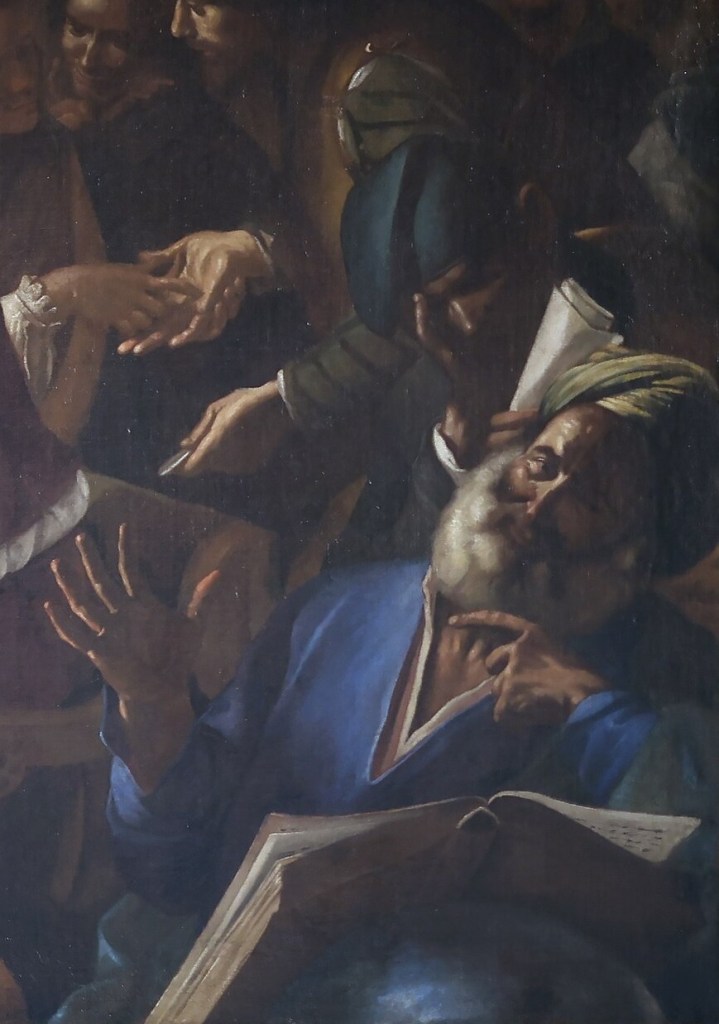
Primarosa gives particular weight to Democritus. He rests a book on a terrestrial globe and opens one hand so that all five fingers are visible. The gesture brings the number of the senses into the philosopher’s own body, while the globe extends his attention from the tavern-like gathering before him to the world at large. Democritus was also associated with a distinction between sensory appearances and a more reliable order of knowledge accessible to the intellect. The senses are therefore not rejected, but their authority is limited. They supply experience without guaranteeing its correct interpretation.
The implications reach back across the whole painting. The smoker, drinkers, musicians, gambler and fortune-teller are not merely illustrations of five physiological faculties. They occupy a world in which sensory experience is pleasurable, socially absorbing and potentially deceptive. The erased saltimbanco with his asinine headdress would have made the association with folly more explicit, but its removal did not eliminate the problem. Democritus can laugh at the spectacle because pleasure and foolishness coexist within it. Heraclitus supplies the darker counterweight, responding to the transience and instability of the same world.
As we saw earlier, seventeenth-century discussions of the senses could distinguish sensory experience from the judgement brought to bear upon it. Friedman finds this distinction at work in Ribera’s Five Senses, while Marino’s L’Adone allows the attractions of the sensible world to coexist with structures that invite their interpretation. The senses remain indispensable, but they are not self-validating.
The difference between the Turin and Barberini paintings can be understood within this framework. The earlier work allows sensory experience to spread across a convivial Caravaggesque gathering with comparatively little resistance. If the laurel-crowned musician is indeed Marino, the association strengthens Primarosa’s reading of the painting in relation to the more affirmative, Epicurean aspects of L’Adone. The later picture is less willing to leave the pleasures of the senses to themselves. Its scale has increased, its pictorial language has broadened and its intellectual structure has become more conspicuous.
Gregorio and the two philosophers occupy a slightly detached position within this crowded field of activity. Most of the other figures are absorbed in music, drinking, gambling, conversation or touch; these three turn their attention beyond the immediate business of the scene. Gregorio looks directly towards the spectator, while Heraclitus and Democritus assume the role of observers of the human spectacle around them. Their detachment introduces another distinction into the painting, between immersion in sensory experience and reflection upon it. The spectator occupies an unstable position between the two: looking at the painting means participating through the very faculty whose powers and limitations it explores.
The Barberini Allegory moves beyond an enumeration of sight, hearing, smell, taste and touch. It asks what follows from their exercise. Sensation produces pleasure, information and contact with the world, but it can also produce error, distraction and folly. The painting offers no simple hierarchy in which reason defeats the senses, nor does it condemn the pleasures it depicts with such evident visual relish. Its tragicomic range depends upon holding those possibilities together. In Primarosa’s reading, this is the world of Heraclitus and Democritus at once: comic and melancholy, sensuous and sceptical, absorbed in appearances while conscious that appearances are not enough.
Producing these essays requires care, time, research, and resources. Contributions to help sustain this exploration would be greatly appreciated.
Donate to Inner Surfaces here.
Bibliography
These sources were consulted. Any errors are mine.
Friedman, Hannah Joy. ‘Jusepe de Ribera’s Five Senses and the Practice of Prudence.’ Renaissance Quarterly 74, no. 4 (2021): 1111–61.
Kluge, Sofie. ‘Troubled Ascent Towards Perfection: The Myth of Amor and Psyche in Giovan Battista Marino’s L’Adone.’ MLN 128, no. 1 (2013): 103–23.
Marini, Maurizio. ‘Equivoci del caravaggismo 2: A) Appunti sulla tecnica del “naturalismo” secentesco, tra Caravaggio e “Manfrediana methodus”; B) Caravaggio e i suoi “doppi”. Il problema delle possibili collaborazioni.’ Artibus et Historiae 4, no. 8 (1983): 119–54.
Nordenfalk, Carl. ‘The Five Senses in Late Medieval and Renaissance Art.’ Journal of the Warburg and Courtauld Institutes 48 (1985): 1–22.
Primarosa, Yuri. ‘Il talento e il mestiere. Nuova luce sull’“Allegoria dei cinque sensi” di Mattia e Gregorio Preti.’ In Il trionfo dei sensi. Nuova luce su Mattia e Gregorio Preti, edited by Yuri Primarosa, 11–34. Rome: De Luca Editori d’Arte, 2019.
Museum and Collection Entries
Pinacoteca dell’Accademia Albertina di Belle Arti, Turin. ‘Gregorio Preti & Mattia Preti: Concerto con scena di buona ventura (Allegoria dei cinque sensi).’

