Still life occupied an ambiguous position in seventeenth-century Dutch painting. It was admired for the extraordinary skill with which painters could reproduce the sheen of metal, the transparency of glass, the texture of fruit or bread and the fall of light across a table, yet in theoretical accounts it remained low in the hierarchy of genres. History painting was associated with intellect, invention and the representation of the human figure; still life could seem closer to craft because of its dependence on observation and technical skill. Collectors did not necessarily share that prejudice. Accomplished still lifes could command high prices, and painters developed increasingly specialised forms of the genre.
One of the forms already well established in Haarlem when Claesz arrived was the breakfast piece. Painters arranged cheeses, bread, fruit, nuts, vessels and other foods across a table viewed from above. Objects were generally kept distinct from one another, colours remained relatively bright, and the high viewpoint allowed each item to be clearly seen. Such paintings could evoke abundance and well-being, but they could also encourage reflection on moderation, transience and the uses of material pleasure. These meanings were not necessarily exclusive.
Pieter Claesz entered this tradition after moving from Flanders to Haarlem in the early 1620s. His earliest paintings retain clear links with an older generation of still-life painters, particularly Floris van Dijck, Nicolaes Gillis and Floris van Schooten. Martina Brunner-Bulst gives Van Dijck a central place among these precedents. Van Dijck belonged to an early generation of Haarlem still-life painters. Their work drew on Antwerp precedents, including Osias Beert and Clara Peeters. His stay in Rome around 1600 may also have exposed him to the greater weight and presence given to still life in Caravaggio’s work. By the time Claesz arrived in Haarlem, Van Dijck had already established a recognisable form of the genre in paintings dated between 1610 and 1622.
Floris van Dijck: Still Life with Cheese, c. 1615
Van Dijck’s Still Life with Cheese in the Rijksmuseum belongs to the earliest phase of Dutch breakfast painting. The table is heavily laden. Fruit, bread, nuts, vessels and three large cheeses are distributed across white and reddish damask cloths, while the elevated viewpoint enables the eye to move over the entire display. Although the table is crowded, relatively little overlaps. Each object retains its identity.
This clarity is one of the painting’s principal pleasures. The cheeses, porcelain, pewter, stoneware, fruit and textiles offer different surfaces for the painter to describe. Light catches a vessel, passes across the cut surface of cheese, settles on grapes and apples, and reveals the weave of the cloth. Jan Piet Filedt Kok described the painting as characteristic of the earliest Dutch still-life tradition, with its relatively varied palette, high viewpoint and limited overlap. He also situated the type within a tradition that developed from Antwerp painters such as Osias Beert and Clara Peeters and was then extended in Haarlem by Van Dijck and his contemporaries.
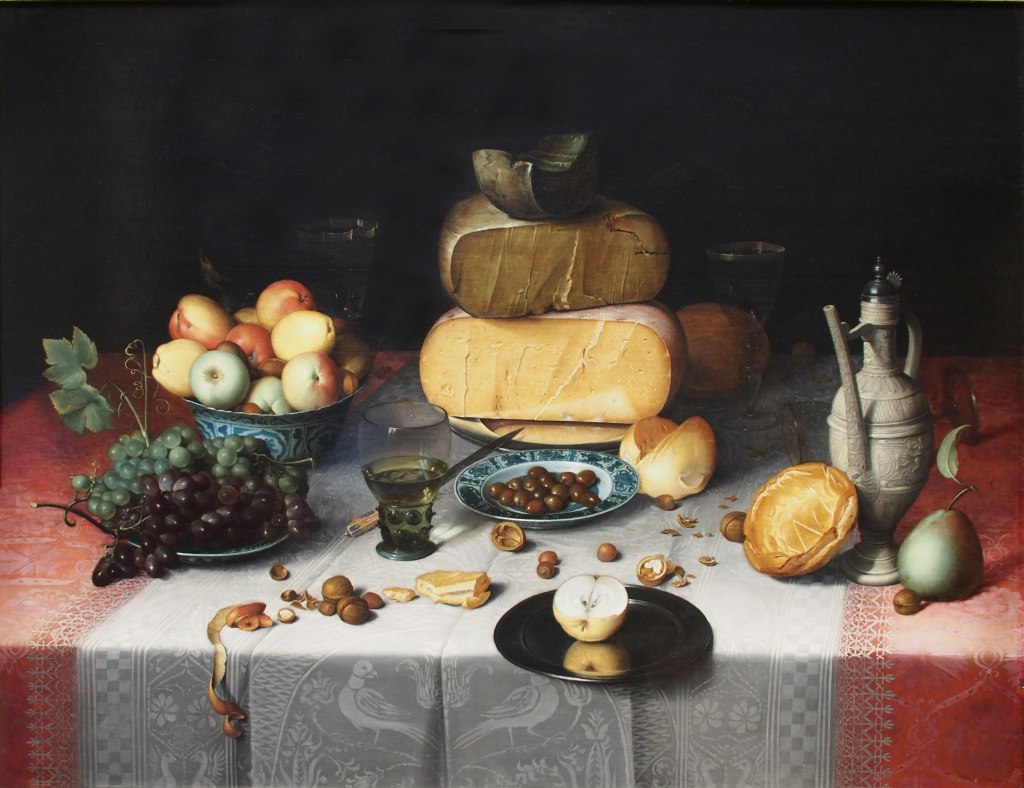
The composition is nevertheless carefully staged. An apple peel hangs over the front of the table, while a pewter plate with half an apple seems precariously balanced near the edge. These recurring Van Dijck motifs give the image a small degree of instability within an otherwise orderly display. The result is neither a literal record of a meal nor an accidental accumulation of food. It is a constructed abundance.
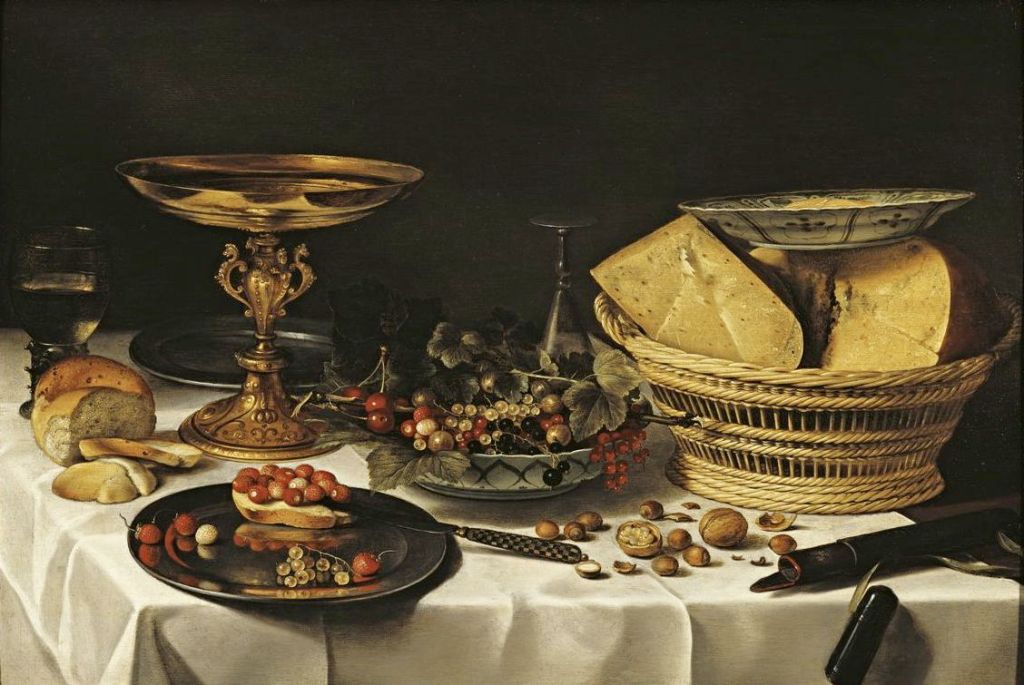
Pieter Claesz: Breakfast Piece with a Tazza, Fruit and Cheese in a Basket, c. 1623–24
Claesz’s early breakfast piece remains unmistakably within this world. Cheese, fruit, bread, nuts, porcelain, metalwork and glass still occupy a white-covered table. The basket of cheese immediately recalls the type established by Van Dijck, and the painting retains a degree of chromatic richness that Claesz would later reduce.
Yet the organisation has changed. The objects are more tightly connected. The basket of cheese dominates the right side, while the fruit, tazza, porcelain dish and scattered nuts form a denser network across the table. There is less sense of individual objects being presented one by one for inspection. Instead, the eye is encouraged to follow diagonals and relationships between forms.
This process can already be seen in Claesz’s earliest surviving works. Brunner-Bulst notes that he began to lower the viewpoint, bring the objects closer to the viewer and use the table edge more actively to establish depth. She also distinguishes his treatment of objects from the more meticulous descriptive manner of some older painters. In Claesz, material presence increasingly depends on the behaviour of light across surfaces.
That difference is significant. The attraction of the painting still lies partly in its convincing description of things, but those things are beginning to participate in a stronger pictorial unity. The image is no longer simply a display of abundance. Composition itself is becoming one of its subjects.
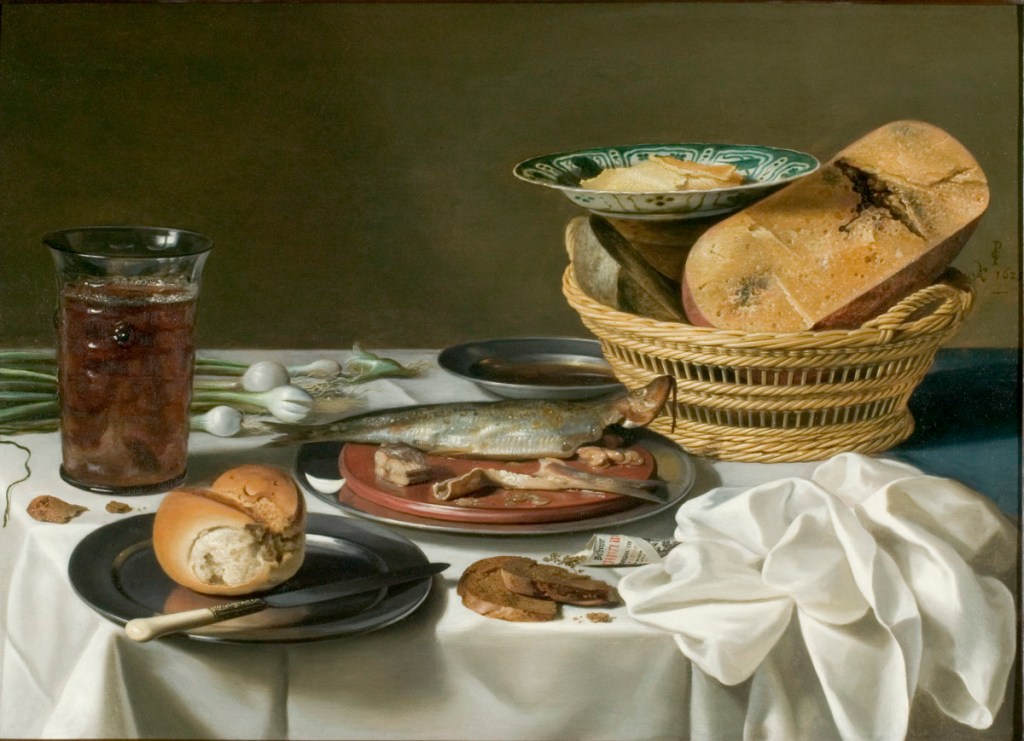
Pieter Claesz: Breakfast Piece, 1625
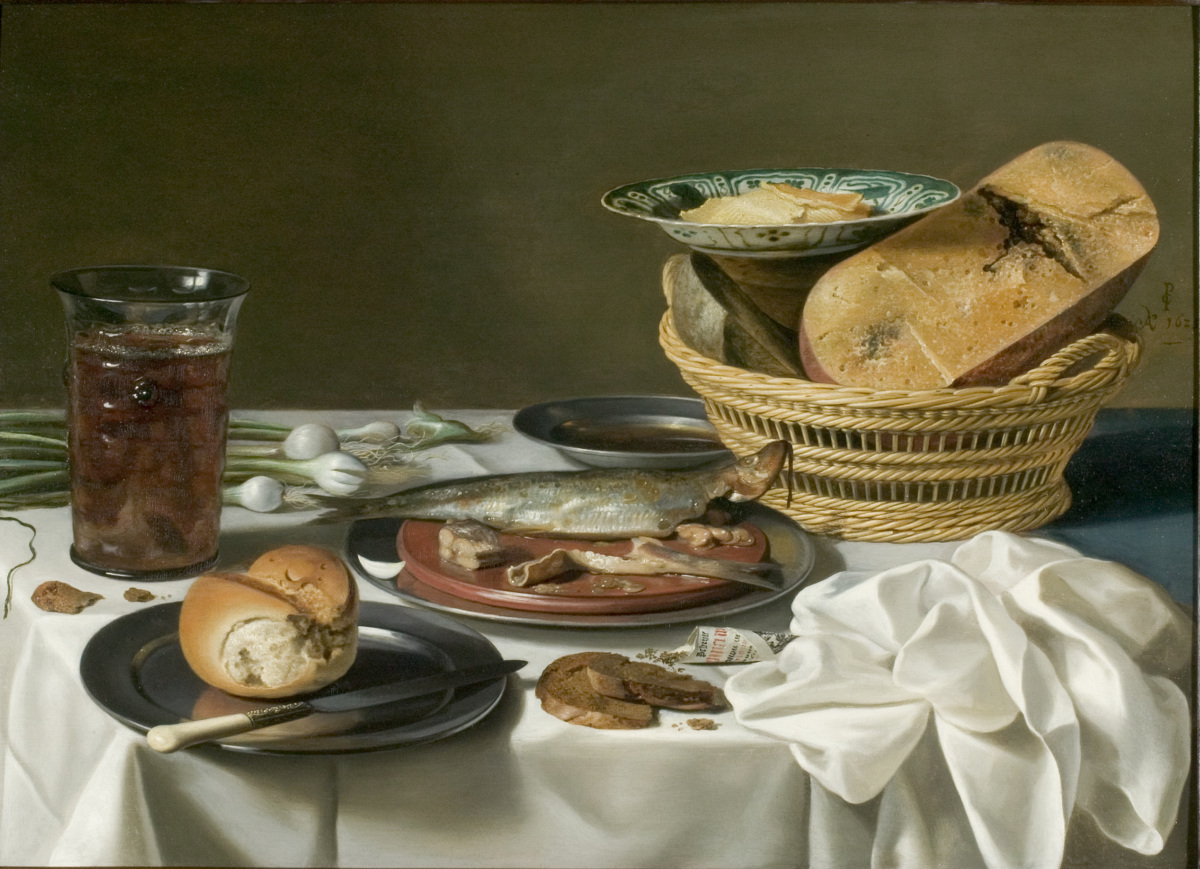
The Breakfast Piece of 1625 makes the change more apparent. The ingredients are modest: old cheese in a basket, herring, spring onions, bread, beer and a white cloth. The display is smaller and more concentrated. The dark background is quieter, the colour range narrower, and the objects occupy the table with greater compositional economy.
Claesz was moving at this time towards the tonal still life for which he became best known. Brunner-Bulst describes the works around 1625 as increasingly reduced in both the number of objects and the range of colour. Cool greys or warm browns predominate, while brighter colours are used sparingly. The result is a more intimate pictorial field in which light binds objects together rather than merely revealing them individually.
The comparison with Van Dijck is instructive. Both painters use food, vessels, cloth and a dark ground, but the purpose of the arrangement has shifted. Van Dijck allows the viewer to survey an abundant table from above. Claesz increasingly compresses that visual world. Bread, fish, cheese, glass and cloth become less a catalogue of distinct things than a set of relationships between shape, tone, reflection and texture.
The development is not a rejection of the earlier Haarlem tradition. Claesz retains its objects, its tabletop setting and its fascination with the visual presence of food and vessels. What changes is the degree of concentration. Within a few years, he had begun to turn the breakfast piece from an ordered display into a more unified meditation on material things and the light that makes them visible.
Producing these essays requires care, time, research, and resources. Contributions to help sustain this exploration would be greatly appreciated.
Donate to Inner Surfaces here.
Bibliography
Books and exhibition catalogues
Biesboer, Pieter, Martina Brunner-Bulst, Henry D. Gregory and Christian Klemm. Pieter Claesz: Master of Haarlem Still Life. Exhibition catalogue, Frans Hals Museum, Haarlem; Kunsthaus Zürich; National Gallery of Art, Washington. Zwolle: Waanders Publishers, 2004.
Goedde, Lawrence O. “A Little World Made Cunningly: Dutch Still Life and Ekphrasis.” In Arthur K. Wheelock Jr. and Ingvar Bergström, eds., Still Lifes of the Golden Age: Northern European Paintings from the Heinz Family Collection. Washington, DC: National Gallery of Art, 1989.
Wheelock, Arthur K., Jr. “Still Life: Its Visual Appeal and Theoretical Status in the Seventeenth Century.” In Arthur K. Wheelock Jr. and Ingvar Bergström, eds., Still Lifes of the Golden Age: Northern European Paintings from the Heinz Family Collection. Washington, DC: National Gallery of Art, 1989.
Wheelock, Arthur K., Jr., and Ingvar Bergström, eds. Still Lifes of the Golden Age: Northern European Paintings from the Heinz Family Collection. Washington, DC: National Gallery of Art, 1989.
Online catalogue entries
Filedt Kok, Jan Piet. “Floris Claesz. van Dijck, Still Life with Cheese, c. 1615.” In Jonathan Bikker, ed., Dutch Paintings of the Seventeenth Century in the Rijksmuseum Amsterdam, vol. I: Artists Born between 1570 and 1600. Amsterdam: Rijksmuseum, 2007, no. 55.
Christie’s. Pieter Claesz, Breakfast Piece with a Tazza, Fruit and Cheese in a Basket, c. 1623–24. Old Masters Evening Sale, London, 7 July 2022, catalogue entry.

