In 1824, when William Blake began his illustrations to Dante’s Divine Comedy, he was sixty-six and entering the last three years of his life. His health was declining and his finances remained precarious, but this was not a period of artistic withdrawal. He was completing the engravings to the Book of Job, and the younger artist John Linnell, one of his closest friends and supporters, was looking for a further project that could provide him with an income. The circumstances of the Dante commission are not entirely clear. An early account presents Linnell proposing the work when Blake wondered how he could repay the financial help he had received, but G. E. Bentley Jr. cautions that the reported conversation sounds invented. What is certain is that Linnell continued to advance Blake money and supplied the large folio volume in which the Dante designs were developed.
The relationship was more than a conventional arrangement between artist and patron. Linnell had met Blake in 1818 and, during Blake’s final decade, helped to secure commissions, introduced him to younger admirers and provided financial assistance. He later stated that the money advanced for the Dante drawings was intended to relieve Blake when he had no other resources. He calculated the total at £130, a sum he regarded as small in relation to the value of the work. Any expectation of financial return must have been remote. Bentley describes the projected series as an undertaking of “gargantuan, uncommercial proportions” and “a labour of love and visionary survival for Blake”. The large intaglio engravings would have been expensive both to produce and to print. He calls the undertaking “an act of visionary temerity” and judges Linnell’s prospect of financial gain to have been “effectively nil”.
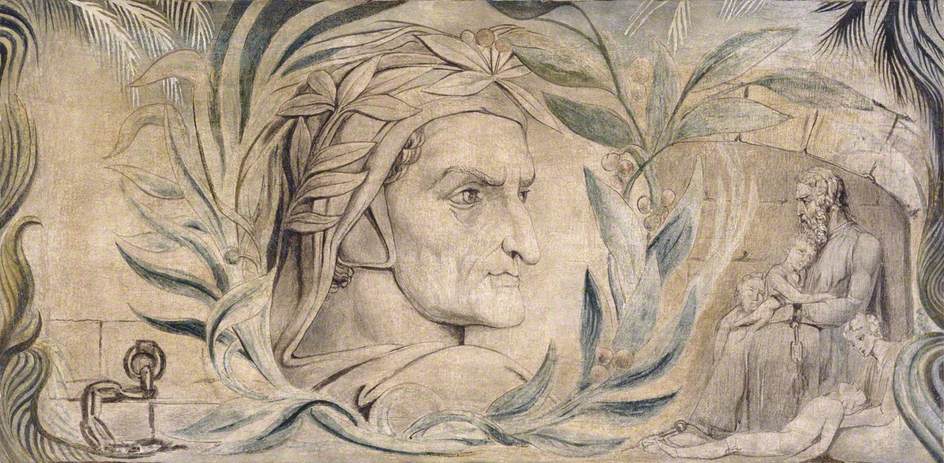
Blake had known Dante long before 1824. Around the turn of the century he had annotated Henry Boyd’s translation of the Inferno, and William Hayley had commissioned from him a portrait of Dante for his library. He also knew visual responses to the poem by artists in his circle. Henry Fuseli treated Dantean subjects, while John Flaxman’s celebrated series of outline illustrations, designed in the 1790s and published in 1802, offered a sustained interpretation of the Commedia. Dante also occupied an exceptional place in Blake’s conception of imaginative authorship. In The Marriage of Heaven and Hell, contrasting originating genius with merely derivative production, Blake argued that a man of “mechanical talents” might produce ten thousand volumes from Paracelsus or Jacob Boehme, but from Dante or Shakespeare “an infinite number”. The point is not that the mechanical imitator becomes more inventive in the presence of greater writers, but that the imaginative abundance of Dante and Shakespeare is so great that it can sustain an apparently limitless quantity of derivative work. In Blake’s metaphor, that creative plenitude belongs to the original writers; the imitator, as he immediately adds, merely “holds a candle in sunshine”.
The late commission therefore brought Blake back to a writer whom he had admired for decades, but under conditions that demanded a more sustained engagement with the poem. He worked with Henry Francis Cary’s The Vision; or, Hell, Purgatory, and Paradise, the complete translation that had done much to establish Dante among British readers during the early nineteenth century. He also possessed an Italian edition of the Commedia, published by the Sessa brothers with the commentaries of Cristoforo Landino and Alessandro Vellutello and illustrated with woodcuts. Already in his late sixties, Blake taught himself enough Italian to follow Dante in the original, although accounts differ about precisely when and how rapidly he acquired it. Cary remained an important guide. Blake was therefore moving between Dante’s Italian, an English translation embedded in Romantic literary culture, and an earlier printed tradition in which poem, commentary and image already occupied the same book.
Samuel Palmer remembered visiting Blake in October 1824 and finding him at work in bed, surrounded by books. Palmer’s later claim that Blake produced almost the entire sequence during a fortnight of illness is difficult to reconcile with the evidence of Blake’s continued work over the following years, but his recollection conveys something of the intensity with which the project impressed those around him. Blake’s own letters are more revealing. In June 1825, while ill enough to distinguish between what he could manage in bed and what required him to be up, he wrote that he could still draw and was “going on with Dante & please myself”. The following year, during another period of poor health, he reported that “Dante goes on the better which is all I care about”. On 25 April 1827, less than four months before his death, he told Linnell: “I am too much attachd to Dante to think much of any thing else.”
At Blake’s death in August 1827 the undertaking remained unfinished. He had made 102 watercolours in different states of completion: seventy-two devoted to the Inferno, twenty to the Purgatorio and ten to the Paradiso. Hell plainly occupied him at length, and several infernal episodes generated repeated treatments. The surviving distribution does not, however, tell us what the completed series would have looked like. Blake’s final intentions are unknown, and death interrupted the work before its eventual extent became clear. The smaller group of Paradiso drawings nevertheless contains some of the most ambitious and luminous images in the sequence.
What survives, then, is the record of an engagement that was both prolonged and unfinished. For nearly three years Blake lived with the poem, its translations and its earlier visual forms, returning to it while illness increasingly restricted other kinds of work. The watercolours remained designs towards a projected printed work, and that unfinished status is important to the way they look. They stand between drawing, painting and printmaking: between the immediacy of pigment on paper and the stronger linear articulation that engraving would eventually have demanded.
Blake’s Dante drawings occupy a distinctive place within his practice. He was an engraver by training and conviction, and line remained fundamental to the way he conceived form. His own writings repeatedly insist on firm, determinate contour, and the surviving Dante sheets show how strongly that linear discipline continued to organise the figures even when colour became more expansive. Yet the watercolours also depend upon effects that engraving could not reproduce in the same way: transparent washes, changes in density, touches of opaque colour and the luminosity of the paper itself.
The surviving drawings reveal something of Blake’s working procedure. He generally established the composition first in pencil or black chalk, laid in watercolour washes, and then returned with pen and ink to strengthen and clarify forms. In more developed sheets he added dry or point-of-brush work, sponged pigment back, scratched into the surface and introduced touches of gum or glair. Individual drawings vary greatly in finish. Some remain close to the initial scaffolding of pencil and chalk; others have been worked into complex surfaces in which transparent colour, ink and exposed paper continually interact. Linnell supplied Blake with high-quality Dutch paper for the series, and in the lighter designs the quality of that support becomes visually significant. Blake does not always cover the sheet. At points, the untouched paper itself becomes part of the image, supplying areas of illumination rather than merely receiving colour.
These effects should not be understood simply as temporary colouring for images whose real destination was print. Linnell appears to have envisaged the designs as the basis of a substantial engraved series, and Blake was still working seriously on the plates during the last months of his life. But the relation between watercolour and engraving was not one of simple transfer. John Beer distinguishes between the immediacy available to Blake in drawing and watercolour and the different expressive force that engraving could give to line. The two stages answered different needs. Watercolour allowed Blake to establish atmosphere, light, spatial relation and chromatic intensity with a freedom unavailable to line engraving; the projected plates would have translated those inventions into another graphic language.
Colour itself participates in Blake’s response to Dante. The 2019 Tate catalogue edited by Martin Myrone and Amy Concannon draws attention to the way Blake varies the atmosphere of the three realms. Hell is claustrophobic and unstable, marked by darkness, fire and violent illumination; Purgatory opens onto mountain landscape, changing weather and the passage of day and night; Paradise is increasingly distinguished by brilliant illumination and prismatic colour.
The Vestibule of Hell and the Souls Mustering to Cross the Acheron establishes one end of this range. The episode comes early in the Inferno, before Dante and Virgil cross the Acheron. Dante encounters the souls of those who lived without praise or blame, together with the angels who took neither side in the rebellion against God. In the poem the place is defined as much through sensation as through topography: confused cries, lamentation, darkness, movement and physical torment. Blake cannot reproduce sound or bodily discomfort directly, and he does not attempt to convert every one of Dante’s details into a pictorial equivalent. Instead, he concentrates much of the oppressive force of the episode into the handling of the sheet.
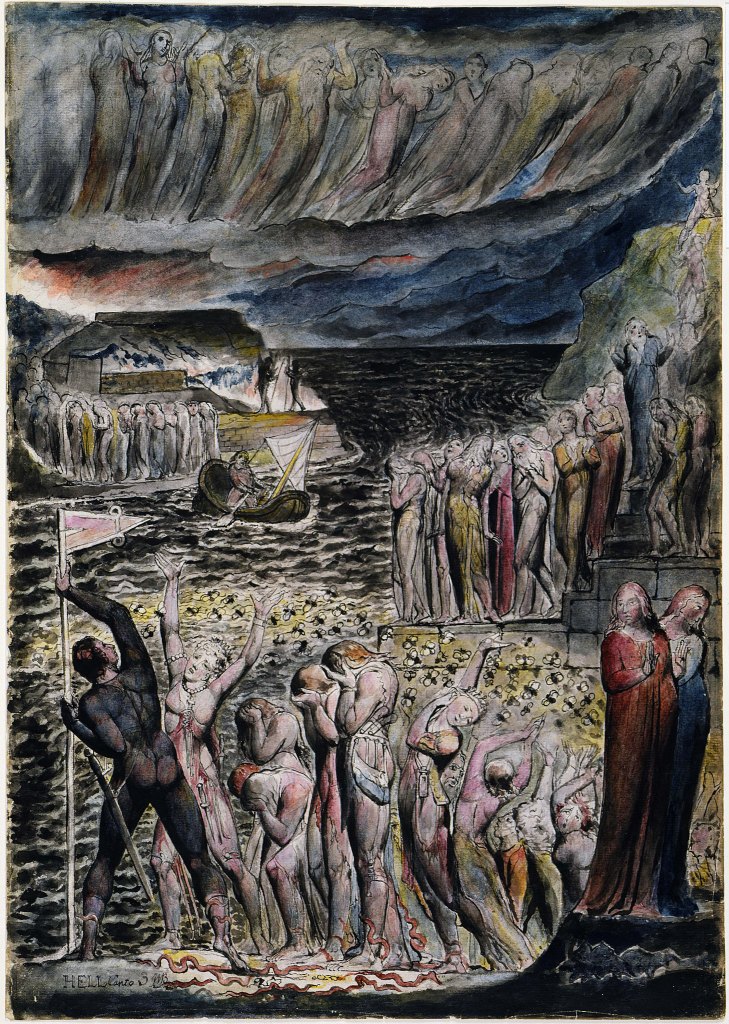
The watercolour is dominated by sombre browns, greys and blacks, with muted passages of blue, red and ochre. Pigment is worked heavily across much of the surface, while the close accumulation of bodies restricts any sense of open space. The souls move across and into one another rather than occupying clearly separated positions. Dante describes them as naked, but Blake clothes them in elaborate garments. Cathy Leahy has suggested that this alteration introduces associations of worldly power and social status into a group defined by its refusal to take a moral position. The change is characteristic of Blake’s method: he can remain close to the structure of Dante’s episode while altering a detail in a way that redirects its emphasis.
From this dark beginning the chromatic character of the series changes markedly. When Dante and Virgil leave Hell and enter Purgatory, Blake opens the compositions to light, space and atmosphere. The movement up the mountain brings increasing attention to the sun, moon and stars, and the watercolours become progressively more luminous and prismatic. In The Lawn with Kings and Angels, Dante describes a valley rich in coloured flowers and grass through comparisons with emeralds, cochineal, silver and gold. Blake does not reproduce the setting literally, but answers it with greens, yellows and blues, touched with red. Near the summit of Purgatory, in Dante at the Moment of Entering the Fire, colour becomes richer and more iridescent still.
NGV: The Lawn with Kings and Angels
Calè’s discussion of this progression links Blake’s changing use of colour directly to Dante’s own language. Near the summit of Purgatory, fire increasingly ceases to function merely as an instrument of punishment and becomes a medium of purification and transformation. Calè describes a movement from shadow towards flame. In Paradiso, Dante turns still more insistently to colour and light as ordinary description begins to fail him. Flames, blazing comets, circles, spheres, dance and geometrical motion become ways of approaching experiences that resist straightforward verbal representation. At certain points the poem itself acknowledges the inadequacy of language before colours and visions too intense to express.
For Blake, that difficulty opens another possibility. Calè argues that watercolour allows him to take up, through pigment and transparency, what Dante cannot fully convey through words. In the designs for Paradiso XXIV–XXVI, coloured spheres become a principal means of visualising Dante’s heavenly metaphors. Dante and Beatrice appear within or beside overlapping zones of blue, pink, red and other colours; saints approach within spheres or flames of light; intersecting washes mingle without losing their translucency. Luminosity itself becomes a means of suggesting increasing spiritual radiance.
There are smaller anticipations of this chromatic imagination within the poem. In Purgatorio XI Dante meets the manuscript illuminator Oderisi da Gubbio, who acknowledges the superiority of Franco Bolognese by saying that the pages painted by Franco “laugh” more, più ridon le carte. The phrase gives colour and illumination an almost animate quality, as if the painted page itself had become brighter and more alive.
We should be careful not to oversimplify Blake’s use of colour into a simple code in which darkness signifies spiritual error and brightness spiritual truth. Hell contains violent light as well as darkness, and the varying state of completion of the watercolours complicates any rigid progression. What changes across the series is the range of visual means Blake brings to Dante’s journey. Density, openness, fire, translucence and prismatic colour allow him to respond differently as the poem moves from physical confinement towards forms of experience that are increasingly difficult to describe.
By the time Beatrice appears, Blake has already established a visual language in which colour can do more than describe appearance. It can register atmosphere, purification, radiance and the difficulty of giving visible form to spiritual experience.
By the end of Purgatorio, Dante has reached the Earthly Paradise at the summit of the mountain. Virgil’s work as guide is almost over, and the poem begins to reorganise itself around Beatrice. Before she speaks, however, Dante stages her arrival as a ceremonial vision. Matilda, the mysterious woman of the Earthly Paradise, often identified with Matilda of Tuscany, directs his attention across the river Lethe towards an approaching procession whose imagery draws heavily on Ezekiel and Revelation. Butlin notes that Blake follows this basic sequence closely, with Dante looking across the river as Matilda turns him towards what is coming.
At the centre of the procession is a triumphal chariot drawn by a griffin. The hybrid creature combines lion and eagle and, in Dante’s Christian allegory, signifies the two natures of Christ, human and divine. Around it are further figures drawn from biblical and theological tradition. The three women associated with the chariot represent Faith, Hope and Charity, while the four living creatures evoke the Evangelists. Beatrice therefore does not enter simply as the beloved woman of Dante’s earlier life. She appears within a ceremonial order that gives her spiritual and ecclesiological authority before she has spoken a word.
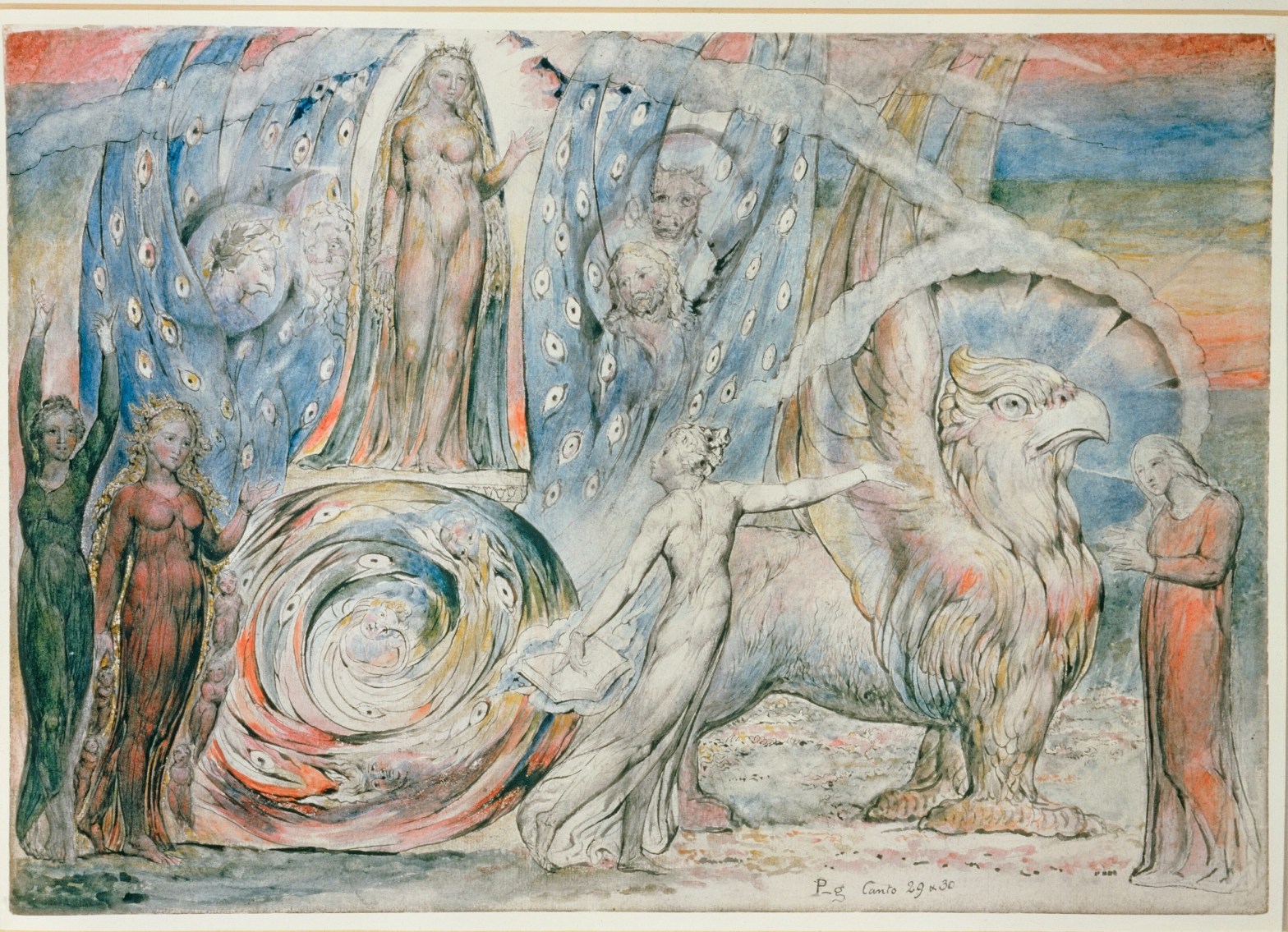
Blake’s Beatrice on the Car, Matilda and Dante takes up this moment before the encounter becomes personal. Dante and Matilda remain separated from the procession by the Lethe, while Beatrice is still seen at a distance within the wider ceremonial structure. The composition occupies a threshold. Dante has not yet entered Paradise, and Beatrice has not yet addressed him, but the authority that will govern the next stage of the journey is already coming into view.
Dante prepares that arrival through light and colour. The procession is preceded by seven luminous forms whose brilliance is compared to trees of gold, while their trails of light extend backwards through the air. The visual richness culminates in Beatrice herself. In Purgatorio XXX she appears through a cloud of flowers, with a white veil, a green mantle and a garment the colour of living flame. White, green and red therefore enter the scene before Dante fully recognises her, and colour becomes part of the process by which her presence is disclosed.
Blake gives that language a material form. In the watercolour the untouched white of the paper remains conspicuous, working with pen-and-ink outlines and the coloured radiance of the procession to produce a glittering, almost weightless field. The 2019 Tate catalogue draws attention to the way the exposed paper and rainbow light of the torches contribute to this effect. Here that luminosity is no longer a general feature of Purgatory. It belongs to the particular drama of Beatrice’s arrival.
The procession is crowded with figures and emblems, but Blake retains enough of Dante’s structure for its meaning to remain recognisable: the chariot, the griffin, the attendant women, the biblical creatures and Beatrice’s elevated position all remain in place. What he does not do is reduce the scene to a simple portrait of Beatrice. She is presented through the visual language of authority, procession and revelation.
British Museum: Beatrice on the Car, Matilda and Dante
Dante’s first response to her, however, is not doctrinal but personal. Even before he sees her face clearly, the old force of her presence returns. The poem describes the revival of the love that had overwhelmed him in youth, and Dante instinctively turns towards Virgil as a frightened child might turn towards its mother. But Virgil has disappeared. The guide who has brought Dante through Hell and Purgatory is removed at the moment when Beatrice assumes her place.
Blake’s watercolour retains that sense of distance and transition. Dante is still a spectator, looking towards a vision whose full meaning has not yet been disclosed. Beatrice belongs first to the procession and only then to him. In the following design, that relation changes sharply. Blake brings the chariot closer, turns Beatrice towards Dante and transforms the ceremonial encounter into a confrontation.
In the next watercolour, Beatrice Addressing Dante from the Car, the distant ceremonial vision becomes immediate. Dante now stands close to the chariot, at the extreme right of the composition, while Beatrice turns towards him from above. Virgil has gone. The emotional dependence that surfaced at Beatrice’s arrival therefore has nowhere else to go: Dante must meet her rebuke directly.
The relevant passage in Purgatorio XXX is severe. Beatrice identifies herself and confronts Dante with the course his life has taken since her death. His repentance is not directed towards Beatrice as an end in herself, but towards the desires and attachments that diverted him from the spiritual path. Dante lowers his eyes in shame, while Beatrice’s manner is compared to the stern authority of a mother before an awe-struck child. The reunion is therefore not consoling. It is an encounter with memory, judgement and the demand for moral recognition.
Blake keeps that basic relation intact. Beatrice stands above Dante and raises one hand as she addresses him. The chariot, griffin, theological virtues and Evangelists preserve the fundamental structure of Dante’s pageant, even though Blake alters its emphasis. Schütze stresses how closely Blake follows the poem at this point and cautions against treating the whole design as though Dante’s narrative had simply been replaced by Blake’s mythology.
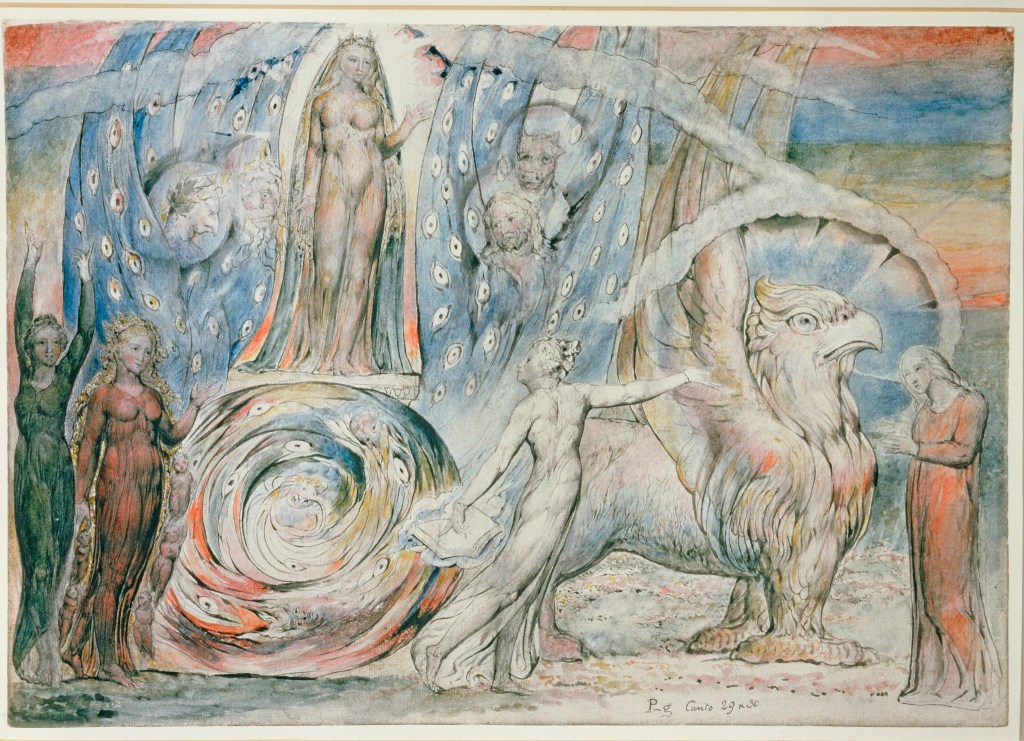
At the same time, the changes Blake does make are conspicuous. Dante gives Beatrice an olive wreath; Blake crowns her in gold. Her body is also more insistently present, the thin drapery leaving the form beneath clearly visible.
The surrounding imagery sharpens the ambiguity. Faith, dressed in white, points towards a book suspended in vapour, while the wheel of the chariot has become an enormous swirling vortex. Butlin regarded these changes as deliberate and interpreted the scene as showing Dante submitting not simply to Beatrice but to the mystery and authority of the Church. He associated Beatrice with the Female Will and with Vala in her fallen forms as Rahab and the Whore of Babylon.
Those names need some unpacking. In Blake’s mythology, Vala can represent fallen Nature, material generation and the seductions of a world taken as sufficient in itself. Rahab is one of the forms through which that condition becomes associated with institutional religion and, ultimately, with the biblical Whore of Babylon. The point is not that the feminine is intrinsically corrupt. Blake can also imagine the female in redeemed form, most powerfully in Jerusalem, who embodies an awakened and immortal condition rather than confinement within Nature and generation.
The vortex belongs to the same field of meanings. Blake has not merely stylised the chariot wheel. He has transformed it into one of the dominant forms in the composition. In Blake’s imagery the vortex can mark a passage between eternity and the created world; Butlin connects it with this function in Milton. Lister presses the symbolism further, interpreting the vortex-wheel as part of the fallen generative order and reading the book at its edge as a restrictive Book of Law. Without accepting every part of that decoding, the visual emphasis is difficult to ignore. The book, the wheel and Beatrice’s elevated position gather questions of doctrine, embodiment, mediation and authority into the same area of the image.
Raymond Lister extends the Blakean reading much further. He identifies Beatrice with Vala, the attendant women with other female emanations of Blake’s Zoas, the four creatures with the Zoas themselves, and the five infants beside the red figure with the five senses. The attraction of the reading is its coherence: almost every conspicuous feature finds a place within Blake’s symbolic system. Its danger is that the Dantean structure can disappear beneath it.
Much of what looks strange in the watercolour is already strange in Dante. Leo Damrosch points out that the procession itself contains the twenty-four elders, the living creatures with eye-filled wings and the elaborate symbolism of the chariot. Blake does not need to import an alien visionary language in order to make the episode extraordinary. David Fuller’s distinction between illustration, interpretation and correction is useful here, because the series moves between all three.
What Blake seems to alter most decisively is not Beatrice’s identity but the balance of forces around her. She remains the woman who recalls Dante to the path he has abandoned and who will guide him into Paradise. Yet she is also made more bodily, more regal and more closely implicated in the language of Church, doctrine and mediation. The gold crown replaces the olive wreath; the exposed body sits within a field of generative and institutional symbolism; the vortex occupies the lower field beneath her, complicating any simple image of spiritual ascent.
That does not make the watercolour a caricature. Butlin himself called it exquisite and glowing. Beatrice remains commanding and visionary, not grotesque. Blake’s response is more difficult than simple rejection. He can preserve the splendour of Dante’s conception while introducing signs that make its structure of authority unstable.
The next design, The Harlot and the Giant, changes the terms of the sequence abruptly. The chariot that had carried Beatrice now becomes the centre of a grotesque vision of corruption. In Purgatorio XXXII Dante describes the vehicle undergoing a succession of violent transformations: an eagle descends upon it, a dragon attacks it, and it develops seven heads and ten horns. A woman then appears upon it, accompanied by a giant. The allegory turns from Beatrice’s rebuke of Dante towards the history of the Church and its entanglement with worldly power.
The woman is the Whore of Babylon, drawn from the Book of Revelation, while the giant represents secular power, conventionally associated here with the French monarchy. Dante’s immediate historical target is the corruption of the Church and, more specifically, the period in which the papacy became entangled with French political interests during the so-called Babylonian Captivity at Avignon. Butlin reads Blake’s watercolour within this same framework of Church and Empire.
Blake nevertheless sharpens the ecclesiastical character of the image. The heads emerging from the transformed chariot are crowned, and the most prominent wears a papal tiara. Schütze sees this as characteristic of Blake’s method: rather than replacing Dante’s allegory, he can intensify an anti-institutional implication already present within it. The papal tiara makes the identification of corruption with Church authority visually harder to evade.
The relation to the preceding image is more difficult. Butlin interprets the Harlot with her serpentine coils as a parody of Beatrice and her chariot. Read in that way, The Harlot and the Giant seems to confirm the suspicions raised by Beatrice Addressing Dante from the Car. The same vehicle on which Beatrice had appeared now carries the biblical image of corrupted religion. The movement from one design to the next appears to expose what was already latent in the earlier scene.
But the sequence should not be made too neat. The transformation is already Dante’s: in Purgatorio XXXII the same chariot that had carried Beatrice is subjected to corruption and becomes the vehicle of the Whore of Babylon. Blake is therefore working within a structure supplied by the poem, even when he sharpens its implications. Schütze’s caution is useful here. Blake often follows Dante closely while redirecting particular details, and the presence of Blakean symbolism does not mean that Dante’s narrative has disappeared beneath it.
The tree introduces a further complication. Butlin argues that Dante treats it as an emblem of justice and obedience within an ideal political order, whereas Blake effectively identifies it with the Tree of the Knowledge of Good and Evil. He also reduces Beatrice’s attendants from seven to three and identifies the remaining figures as the Daughters of Beulah or Memory. Beulah is not simply a realm of evil in Blake, but a state of dream and repose that can become spiritually limiting if consciousness remains there rather than passing into fuller imaginative vision. Memory carries a related suspicion: Blake repeatedly opposes inherited or retrospective knowledge to the immediate activity of Imagination.
On this interpretation, Blake pushes beyond Dante’s criticism of a Church corrupted by historical circumstance. Corruption begins to look less like an accident that has befallen the institution and more like something bound up with structures of law, authority, inherited forms and fallen knowledge themselves.
That is the strongest form of Butlin’s argument, and it returns us to Beatrice. If the Harlot is understood as a grotesque counterpart to her, then Blake’s earlier changes to Beatrice, the gold crown, the vortex, the book and the heightened sense of bodily presence, take on a darker retrospective cast. Yet the later image cannot simply cancel the earlier one. Beatrice remains the figure who guides Dante into Paradise, and Blake continues to treat her with visual splendour.
What the sequence seems to put under pressure is not Beatrice alone, but the structures through which spiritual authority is mediated. The Harlot and the Giant makes Blake’s distrust of institutional religion joined to temporal power explicit. The unresolved question is whether Beatrice herself is implicated in that corruption, or whether Blake is exposing the danger that spiritual authority may become compromised when it hardens into doctrine, institution and worldly power.
That question of mediation becomes clearest in Dante Adoring Christ, one of Blake’s designs for Paradiso XIV. Dante has reached the sphere of Mars, where the blessed form a great cross of light and Christ appears within it. In Dante’s poem the Cross remains the governing form: moving lights travel along it, and the vision is accompanied by celestial harmony.
Blake makes a striking alteration. He removes the Cross itself. Christ remains recognisably cruciform, with his arms extended, but he is no longer fixed to the object of the Crucifixion. Dante kneels alone beneath him. Beatrice, who has guided him through Paradise, is absent.
Cathy Leahy suggests that Blake may therefore be showing Dante worshipping Christ without the mediation of the Church. G. E. Bentley Jr. makes a closely related observation, singling out the absence of Beatrice, whom he describes here as a representative of the Church: Dante approaches Christ directly.
After the hieratic and ecclesiastical trappings surrounding Beatrice, the difference is pronounced. There is no chariot, book, hierarchy of attendant figures or institutional emblem between Dante and Christ. The composition is reduced to an encounter between the kneeling poet and the radiant figure above him.
The omission of the Cross is equally suggestive. Blake retains the cruciform shape of Christ’s body but removes the material structure to which it is attached in Dante. The emphasis shifts from the instrument of execution towards Christ as radiant, spiritual and resurrected presence. The shimmering and wavering strokes of translucent colour correspond to Dante’s description of moving lights and heavenly harmony, while giving the figure an immaterial, visionary form.
The image therefore offers a different model of spiritual relation from those examined in the preceding designs. Beatrice had appeared through procession, doctrine, allegorical figures and the chariot of the Church; the Harlot revealed how such forms could become entangled with temporal power. Here almost all of those mediating structures have disappeared. Dante confronts neither an institution nor an intermediary, but Christ.
Blake gave direct expression to this ideal of spiritual immediacy. In April 1827, while the Dante project still occupied him and only a few months before his death, he wrote to George Cumberland of leaving behind “the Delusive Goddess Nature & her Laws” and entering “The Mind in which every one is King & Priest in his own House”. The formulation closely matches the direction of Dante Adoring Christ: spiritual authority no longer depends upon an external hierarchy, but upon direct relation to the divine.
Blake can therefore accept the exuberance of Dante’s vision without accepting the theological codification or institutional structures through which that vision is organised. In Dante Adoring Christ, the relation is stripped back to its essential form: Dante, vision and the resurrected Christ.
Producing these essays requires care, time, research, and resources. Contributions to help sustain this exploration would be greatly appreciated.
Donate to Inner Surfaces here.
Bibliography
These are the sources for the essay. Any errors are mine.
Beer, John. William Blake: A Literary Life. London: Palgrave Macmillan, 2005.
Bentley, G. E. Jr. The Stranger from Paradise: A Biography of William Blake. New Haven and London: Yale University Press, 2001.
Blake, William. William Blake’s Writings. Edited by G. E. Bentley Jr. Vol. 2, Writings in Conventional Typography and in Manuscript. Oxford: Clarendon Press, 1978, pp. 1667–68.
Butlin, Martin. William Blake. Exhibition catalogue. London: Tate Gallery, 1978.
Damon, S. Foster. A Blake Dictionary: The Ideas and Symbols of William Blake. Revised edition. Hanover, NH: University Press of New England for Brown University Press, 1988.
Damrosch, Leo. Eternity’s Sunrise: The Imaginative World of William Blake. New Haven and London: Yale University Press, 2015.
Dante Alighieri. The Vision; or, Hell, Purgatory, and Paradise. Translated by Henry Francis Cary. 2nd ed. 3 vols. London: Taylor and Hessey, 1819.
Fuller, David. ‘Blake and Dante’. Art History 11, no. 3 (1988): 349–373.
Hamlyn, Robin, and Michael Phillips, eds. William Blake. London: Tate Publishing, 2000.
Lister, Raymond. The Paintings of William Blake. Cambridge: Cambridge University Press in association with The Pevensey Press, 1986.
Myrone, Martin, and Amy Concannon, eds. William Blake. London: Tate Publishing, 2019.
Schütze, Sebastian, and Maria Antonietta Terzoli. William Blake: Dante’s Divine Comedy: The Complete Drawings. Cologne: Taschen, 2017.
Lectures and institutional sources
Calè, Luisa. ‘Blake and Dante’. Lecture for the Blake Society, 18 May 2021.
Leahy, Cathy. ‘The Divine Comedy and William Blake Watercolours’. National Gallery of Victoria and Dante Alighieri Society Melbourne, 2021. YouTube talk hosted by Mary Marcuccio.
British Museum. Collection records for William Blake’s Dante watercolours.
National Gallery of Victoria, Melbourne. Collection records and curatorial material for William Blake’s Dante watercolours.
Tate, London. Collection records and interpretative material for William Blake’s Dante watercolours.

