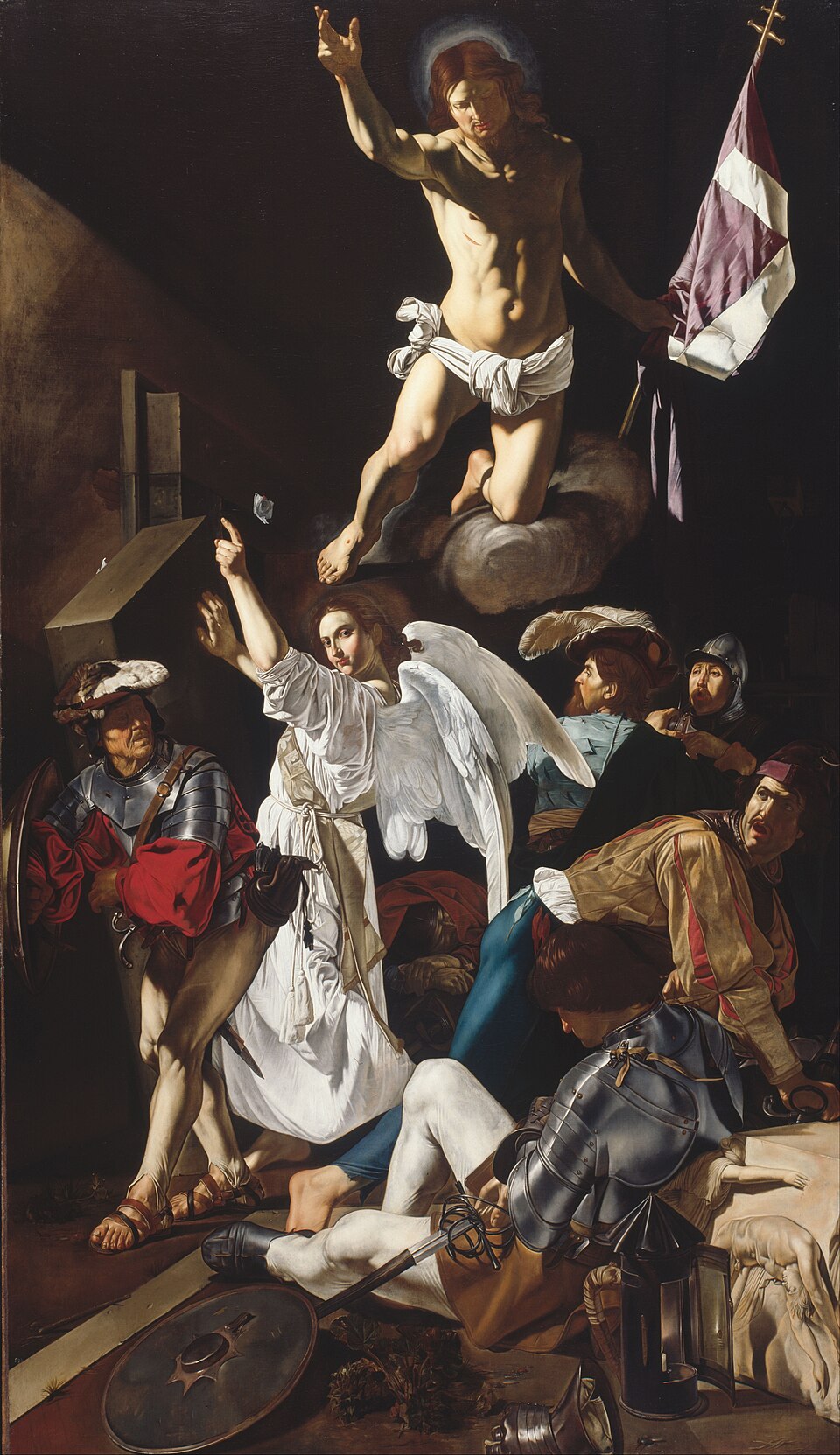
Cecco del Caravaggio remains one of the most elusive figures in the immediate wake of Caravaggio. He is usually identified with Francesco Boneri, or Buoneri, probably from Bergamo, and is repeatedly described as a painter unusually close to Caravaggio, perhaps even active around him as a model. The documents remain sparse, and the name itself is part of the problem: “Cecco del Caravaggio” is less a stable civic identity than a nickname attaching the painter to another, far more famous artist. Yet the obscurity is not total. His Resurrection, painted in 1619–20 and now in the Art Institute of Chicago, gives his career a firm documentary centre. It is the only painting by him for which the circumstances of commission and early reception can be reconstructed in detail.
The painting was made for Piero Guicciardini, the Medici representative in Rome, who was arranging the decoration of his family chapel in Santa Felicita in Florence. Guicciardini commissioned altarpieces from a number of Roman painters working in the Caravaggesque orbit: Gherardo delle Notti, Spadarino and Francesco Boneri. From September 1619 Boneri was to receive monthly payments on account of a large painting; the final balance was paid in June 1620. But in October of that year, when the paintings by Spadarino and Gherardo delle Notti were sent to Florence, the third work did not satisfy the patron. A document of 19 October 1620 names the rejected painter as “Francesco del Caravaggio”, evidently referring back to Boneri and providing a documentary link with Cecco. The subject is clarified by a later payment to Antonio Tempesta for a replacement altarpiece showing the Resurrection. On this basis, strengthened by the matching dimensions, Gianni Papi identifies the Resurrection now in Chicago with the painting rejected by Guicciardini.
The rejection is one of the most suggestive facts about the picture. It is tempting to imagine a straightforward failure, but that is not what the painting itself suggests. Papi’s account points instead to excess: an uncompromising naturalism, a bodily and material insistence that may have made the work unsuitable for Guicciardini’s Florentine chapel. The painting seems to have passed rapidly into another kind of life, possibly entering the collection of Scipione Borghese, where a work described as a Resurrection by Cecco del Caravaggio appears in an inventory of the 1620s. Later evidence points towards the Barberini orbit before the painting reached the modern market. The pattern recalls Caravaggio’s own career, in which paintings difficult to assimilate in ecclesiastical settings could become objects of intense collectorly desire.
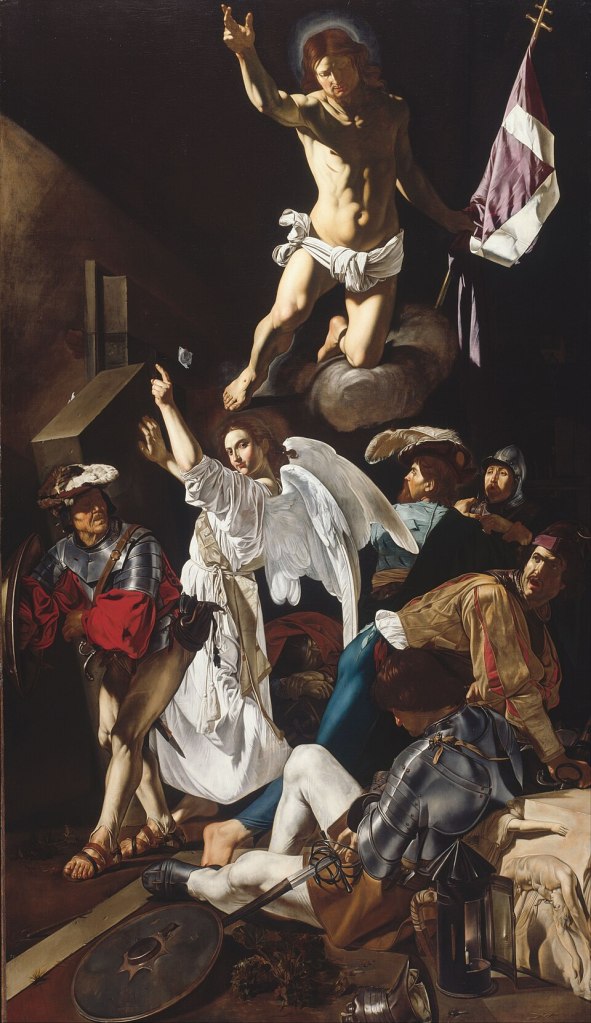
At more than three metres high, the Resurrection is a large and imposing canvas, and its scale is inseparable from its oddity. Cecco has not given the event a serene or triumphant clarity. The risen Christ appears above the soldiers, almost naked, with a white drapery at his loins, a banner in his left hand and his right hand raised in blessing. Below him, a winged angel in dazzling white supports or gestures beside a great slab from the tomb, points upward and looks outward towards the viewer. Around the angel are the guards, thrown into confusion. Their terror responds to the angel, not to Christ. None of the figures below seems to perceive the risen body above them.
This is one of the painting’s most unsettling inventions. Matthew’s Gospel describes the earthquake, the descent of the angel, the rolling away of the stone, the angel’s shining appearance and the guards’ fear. Cecco draws on that account, but he does not arrange it as a lucid sequence of sacred narrative. The angel has not yet calmly seated himself on the stone. The women have not arrived at the tomb. The soldiers are caught in a moment of fear and bewilderment, yet the central miracle is strangely beyond their awareness. The viewer sees more than the figures in the picture. The event is split between the lower world of bodily reaction and the upper appearance of Christ.
The lower part of the painting is almost congested with things: armour, shield, gauntlet, sword, lantern, stone, fragments of tomb architecture and a carved marble block. These objects press towards the viewer with a hard, bright, almost forensic clarity. In his catalogue entry on the Resurrection, Papi sees Boneri’s hyperrealism pushed to an extreme; in his essay “La cerchia di Caravaggio” he characterises the same tendency as a “formidabile lucidità” and an “esasperato naturalismo”, almost an iperrealismo ante litteram. Fried’s emphasis on the painting’s sharp-focus realism belongs to the same perception. Cecco’s naturalism has little softness. It fixes on surfaces, edges, joints, textures and exposed bodies. Metal, skin, fabric and stone are rendered with a precision that clarifies and estranges at once.
This aspect of Cecco’s style is not simply derived from Caravaggio. Papi’s broader account links Cecco both to Caravaggio and to Savoldo. From Caravaggio come the drastic light, the sacred naturalism, the boldness of iconographic invention and the refusal of graceful idealisation. From Savoldo, Papi sees Cecco absorbing a Lombard taste for detailed surfaces, luminous fabrics, reddish flesh tones, carefully modelled limbs and an archaic or early-sixteenth-century richness of costume. The result is a Caravaggism of unusual hardness: antique, sensual, exact, sometimes pitiless in its exposure of bodies and things.
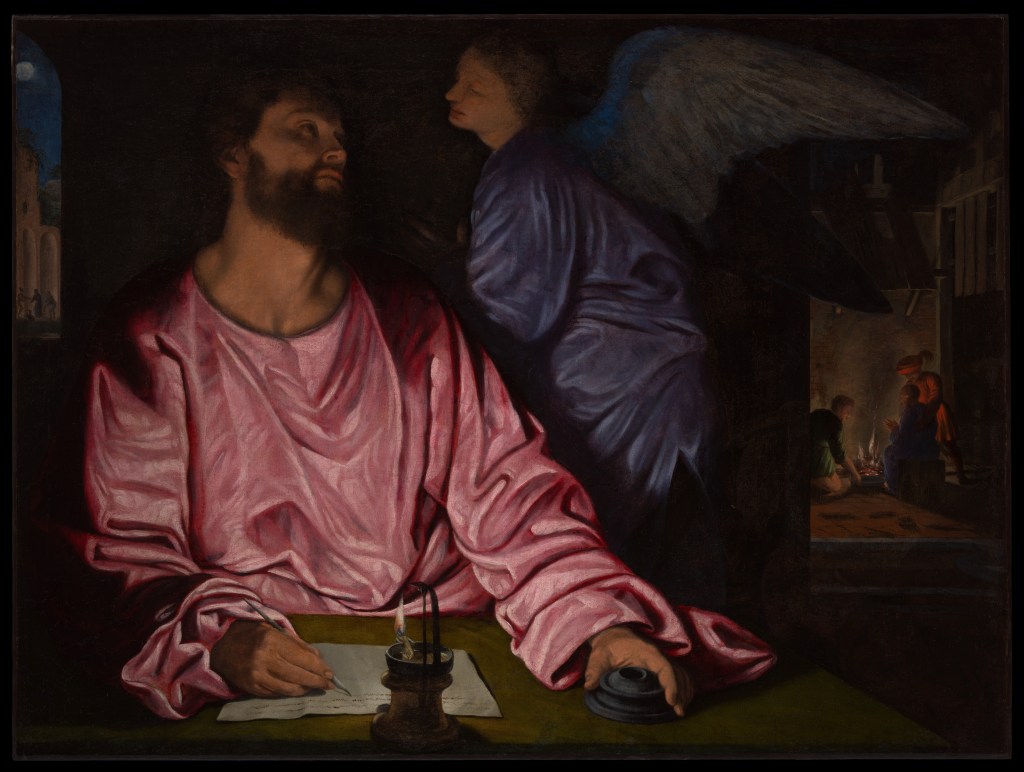
(Credit: The Metropolitan Museum of Art).
The picture is also full of memories of Caravaggio. Some are local and object-like. Fried points to the lantern in the foreground, which recalls the lantern held by the Caravaggio-like figure in the Taking of Christ. The small mullein plant near the shield recalls a plant in Caravaggio’s Saint John the Baptist with a Ram. The sleeping figure beneath the angel’s wing and the foreground soldier sunk in sleep recall Caravaggio’s lost Agony in the Garden. In this reading, Cecco’s painting is saturated with allusion, but the allusions do not amount to pastiche. They are personal, artistic and retrospective, as if the painting were haunted by Caravaggio’s works and by Cecco’s own relation to them.
The larger compositional references are perhaps more important for the general reader. Papi sees the deepest precedent in Caravaggio’s Martyrdom of Saint Matthew in San Luigi dei Francesi, with its explosive movement and centrifugal energy. Fried accepts the connection and presses it further, seeing Cecco’s risen Christ as recalling not so much the saint as the nearly naked executioner in Caravaggio’s painting. That is a disturbing comparison, but it suits the unease of Cecco’s image. Christ’s body is triumphant, yet its almost exposed physicality pulls it towards the world of violent corporeal action below.
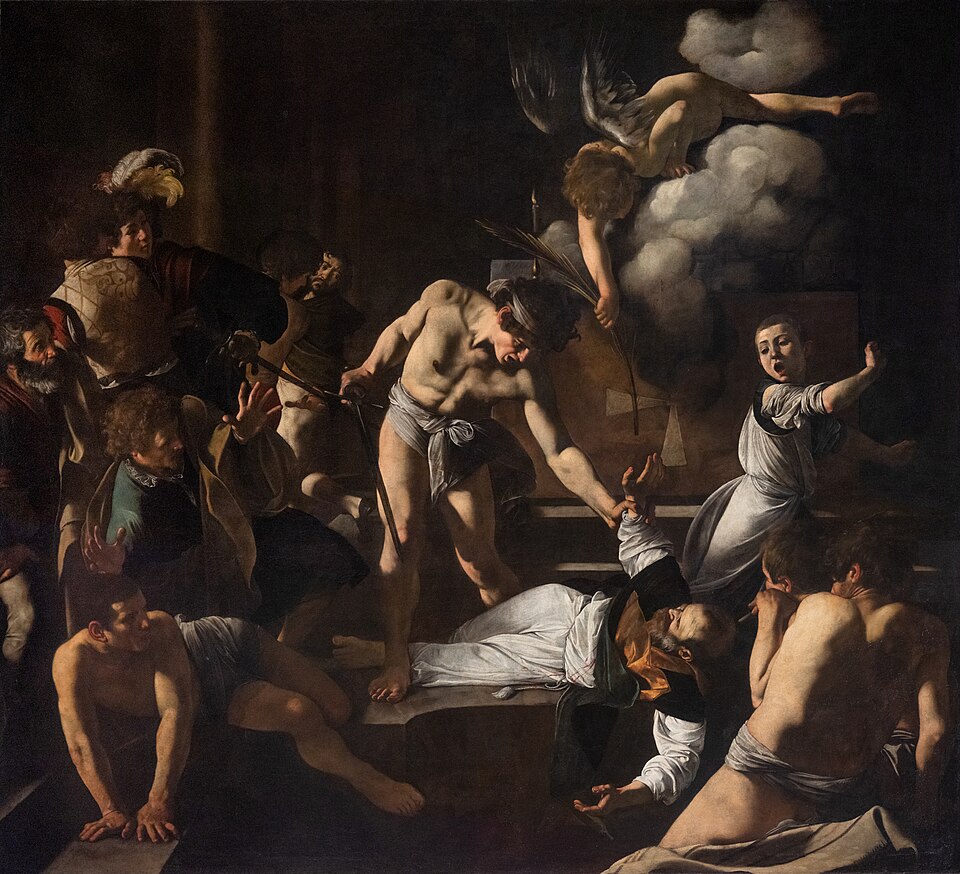
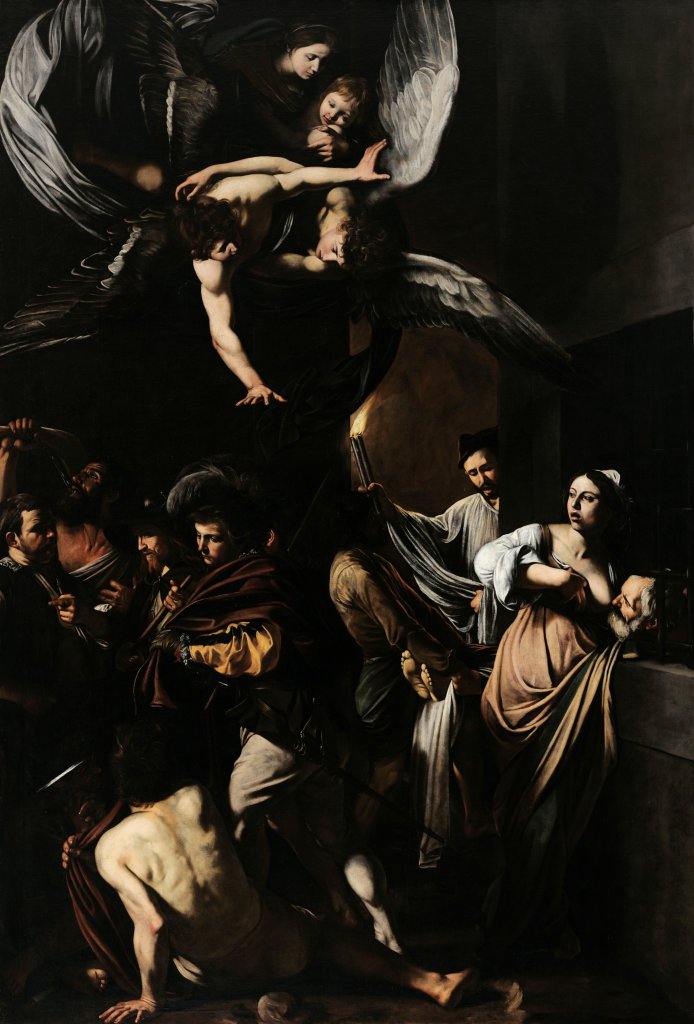
(Credits: Wikipedia).
Fried also brings in Caravaggio’s Seven Works of Mercy. The relevance is not a direct quotation of a single figure, but a mode of composition: abrupt juxtapositions, crowded actions, and a divine presence above a compressed field of human bodies. Fried then turns to Caravaggio’s lost Neapolitan Resurrection, known only through early descriptions, which suggest a thin, suffering Christ walking out of the tomb among sleeping guards. Cecco may have known or remembered this work, especially in the handling of the foreground soldier and the tomb structure, but the connection cannot be proved. It is better understood as a suggestive possibility than as a source. What can be said more securely is that the Chicago painting looks back to Caravaggio’s Roman breakthrough while seeming to register, at least indirectly, the starker naturalism associated with his Neapolitan works.
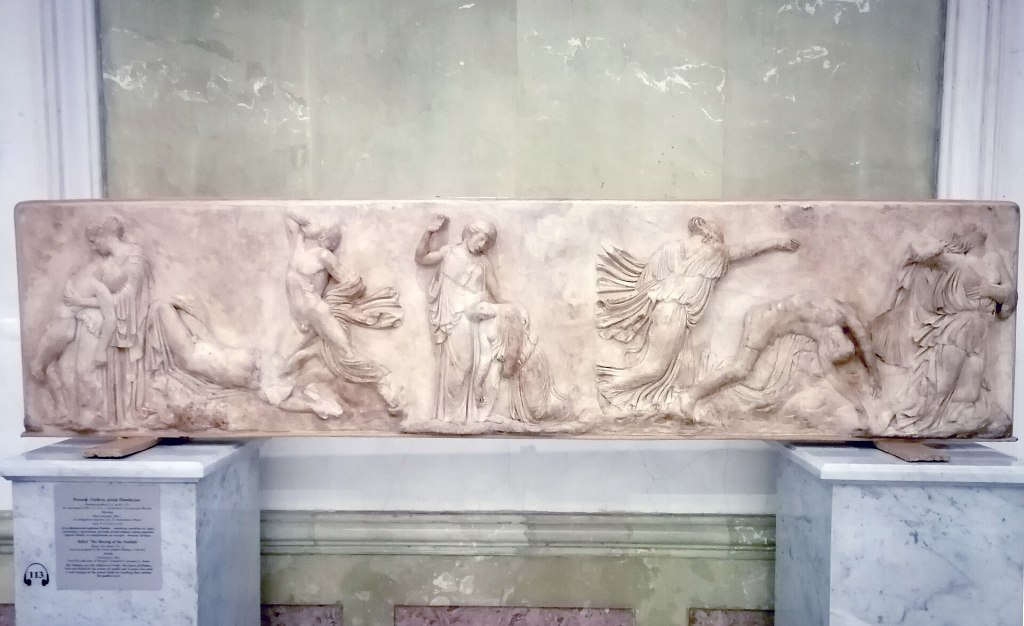
One of the strangest details lies in the lower right foreground. Cecco has included a marble block carved with a relief of the Niobids. Fried identifies the source as a Roman copy after a Greek original, showing the killing of Niobe’s children by Apollo and Artemis. The relief includes a youthful male nude, head down, apparently dead, with a grieving female figure nearby. In a Christian painting of the Resurrection, this is an extraordinary insertion: a pagan image of death and grief, brilliantly visible in the foreground, rendered with the same clarity as the armour, lantern and stones of the tomb.
(Credit: Wikimedia Commons).
The Niobid relief does several things at once. It introduces a register of antiquity into Cecco’s image and intensifies the painting’s meditation on death at the moment of Christ’s victory over death. It also places a cold, carved image of grief where the women of the Gospel narrative are absent. Mary Magdalene and the other Mary have not yet arrived; the Virgin is nowhere present; no living feminine grief softens the scene. Fried develops this absence through reference to Hegel’s discussion of Mary and Niobe in the Aesthetics: Niobe’s grief, deprived of living inwardness, turns to stone, while Mary’s grief remains the expression of a living soul. In Cecco’s painting, that distinction is given a disturbing visual form. At the threshold of the Resurrection, grief appears not as compassion, lament or maternal sorrow, but as a fragment of pagan marble.
Fried’s analysis is most compelling when it helps one see how unstable the painting is. The central opposition between address and absorption turns on the angel and the sleeping soldier. The angel looks out at the viewer with almost violent directness. Around him, the other soldiers are all reaction, while the sleeping soldier remains inward and inaccessible. His bare right hand grips the sword as if beginning to draw it from the scabbard, while the removed gauntlet beside him gives the gesture a strange deliberateness. The action makes little narrative sense: the soldier does not see the miracle, does not respond to the angel, and yet his body continues to perform. Fried connects this to the bodily labour of painting itself, understood as a prolonged act in which the painter’s hand works before the finished image is fully detached and seen from outside. Even without pressing the theory too far, the visual effect is powerful. Cecco sets three kinds of vision against one another: a miracle the guards do not see, an angel who looks directly at us, and a sleeper who sees nothing while his body acts.
The painting’s hyperrealism does not clarify the event. It makes it stranger. The soldiers’ expressions are precise, yet difficult to interpret. The tomb architecture is sharply present, yet hard to understand. The stone slab seems to open on nothing. The foreground objects are rendered with almost excessive attention, yet their accumulation complicates rather than settles the narrative. The whole image has what Fried calls a frozen, disjointed quality. It is as if a sacred event has been stopped at an impossible instant, each surface caught in brilliant focus, while the meaning of the whole remains unresolved.
This helps explain Guicciardini’s rejection without reducing it to reserve or bad taste. The painting is not simply violent, nor merely naturalistic. Its difficulty lies elsewhere. It offers a Resurrection without devotional ease: a Christ who rises beyond the comprehension of the witnesses, a foreground crowded with armour, sword, lantern, stone and tomb, and an antique fragment set at the foot of the miracle. Its brilliance is inseparable from its difficulty: Cecco pushes Caravaggio’s naturalism beyond dramatic immediacy into something lucid, brittle and disconcerting.
The Chicago Resurrection therefore stands as more than a documented anchor for Cecco’s career. It shows what Caravaggism could become in the hands of a painter formed in close proximity to Caravaggio, but not bound by simple repetition of his master’s inventions. The painting looks back to Caravaggio with unusual intensity, but not by simple quotation. It recalls the dramatic compression of the Roman chapel paintings, the nocturnal density of the Seven Works of Mercy, and perhaps even the lost Resurrection known only through later descriptions. Yet Cecco’s answer is colder, sharper and more exposed. Sacred figures are given the density of bodies and objects; stone, armour, flesh and light press against one another with almost uncomfortable clarity. In his hands, the Resurrection becomes not a resolution but a drama of incompatible presences: a miracle taking place before witnesses who sleep, recoil or stare without comprehension.
[Producing these essays requires care, time, research, and resources. Contributions to help sustain this exploration would be greatly appreciated.]
Donate to Inner Surfaces here.
Bibliography
Fried, Michael. After Caravaggio. New Haven and London, 2016.
Papi, Gianni, ed. Caravaggio e caravaggeschi a Firenze. Exhibition catalogue, Galleria Palatina and Galleria degli Uffizi, Florence, 22 May–17 October 2010. Florence, 2010.
Papi, Gianni. “La cerchia di Caravaggio.” In Storia della civiltà europea, edited by Umberto Eco, 2014.

