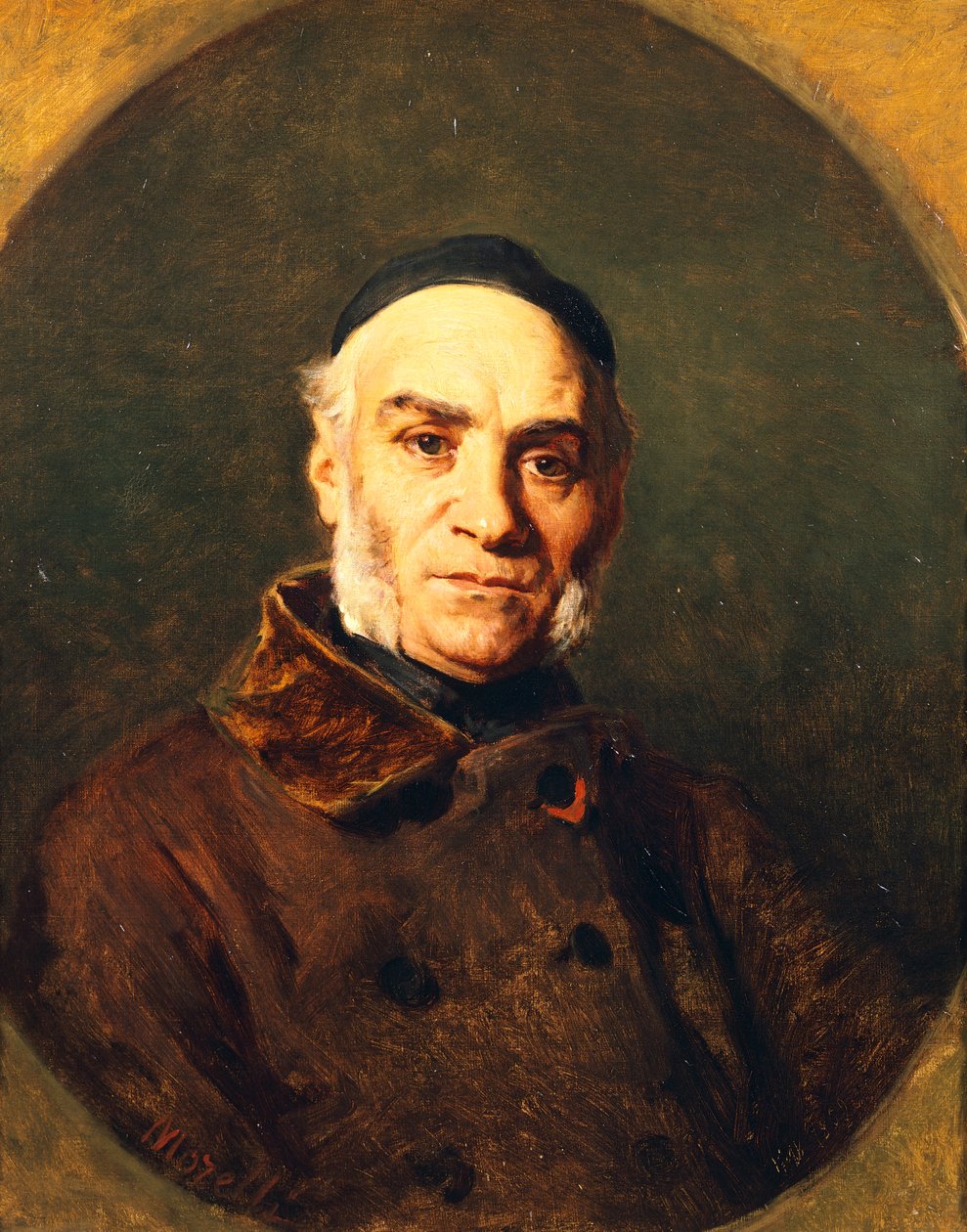
Portrait of Giacinto Gigante, Domenico Morelli (1826–1901), oil on canvas, Museo Nazionale di San Martino, Naples.
Born in Naples in July 1806 to Gaetano Gigante and Anna Maria Fatati, Giacinto Gigante grew up in an artistic household. Around 1801, his parents had married and had eight children, four of whom died young. The surviving children were Giacinto, Ercole, Achille, and Emilia (born 1809), all of whom became painters like their father. Gaetano died in Mergellina, where he had always lived, on 23 September 1840, aged seventy.
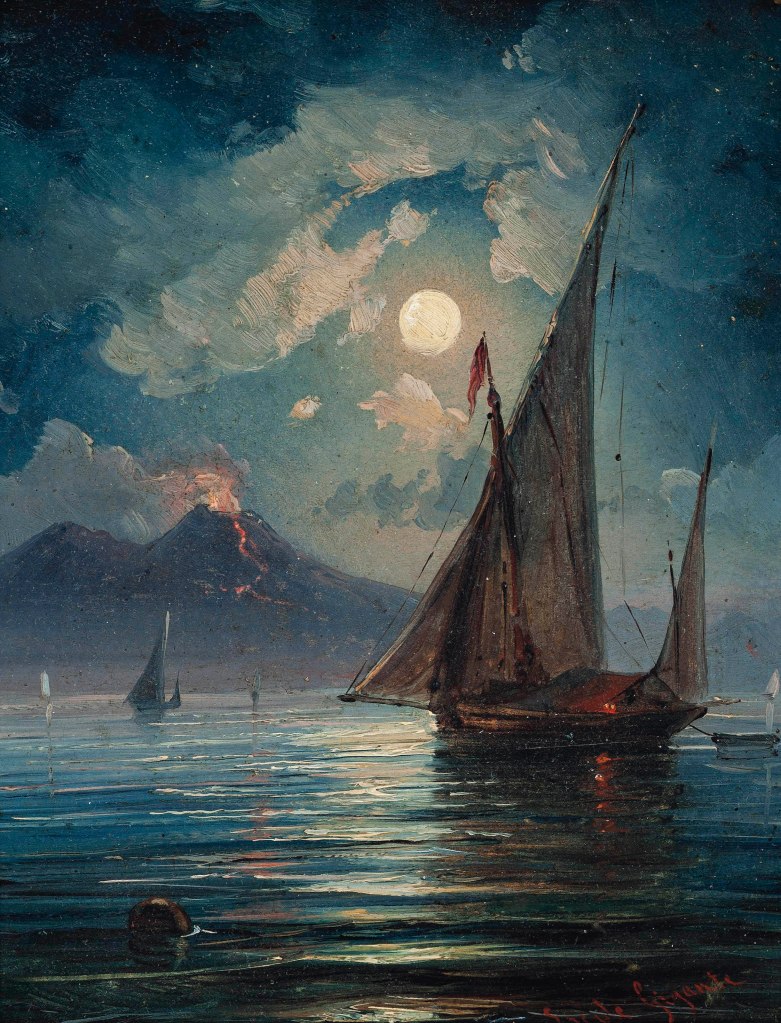
Vessels before Vesuvius at night. Sotheby’s.
Around 1818, Giacinto received his first painting lessons from his father, producing landscapes and portraits. Among these is the oil Vecchio pescatore seduto (Talamo collection, Cava dei Tirreni), which bears his signature and the inscription, “This sailor was the first figure I painted from life in 1818.”
Gaetano Gigante (Naples, c. 1770–1840) was trained at the Reale Accademia del Disegno under Giacinto Diano (1731–1803). Diano, a pupil of Francesco de Mura, merged Roman classicism with the Neapolitan decorative tradition. Gaetano’s formation placed him firmly within the late Neapolitan academic tradition, still marked by Baroque narrative habits and an interest in classical clarity and staged composition. The earliest works securely attributed to him belong to his maturity and are largely frescoes and religious commissions executed between the late 1810s and early 1820s. These works display ordered figure alignment, theatrical space, and long, receding perspectives leading to distant vanishing points, in line with eighteenth-century vedutismo.
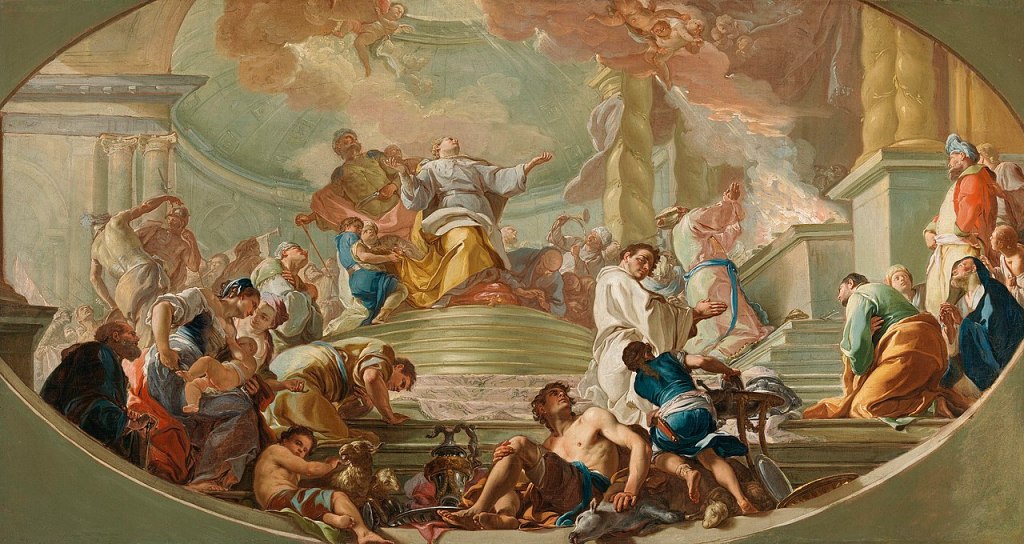
(Credit: Wikimedia Commons).
In his mature production, Gaetano devoted increasing attention to genre scenes and popular festivals, usually in small or medium format for exhibition and sale. Figures, streets, and architecture were carefully arranged to structure the scene, whether in lateral compositions, as in La festa della Vergine di Loreto a Napoli (oil on canvas, 104 × 270 cm, Palais Fesch, Ajaccio), or in deep, receding perspective, as in Via Toledo dalla Piazza dello Spirito Santo (1837). Gaetano’s work bridged religious decoration and early nineteenth-century genre painting, marking him as a transitional figure whose professional and pictorial environment provided a platform from which Giacinto could cultivate his emerging modern sensibility.
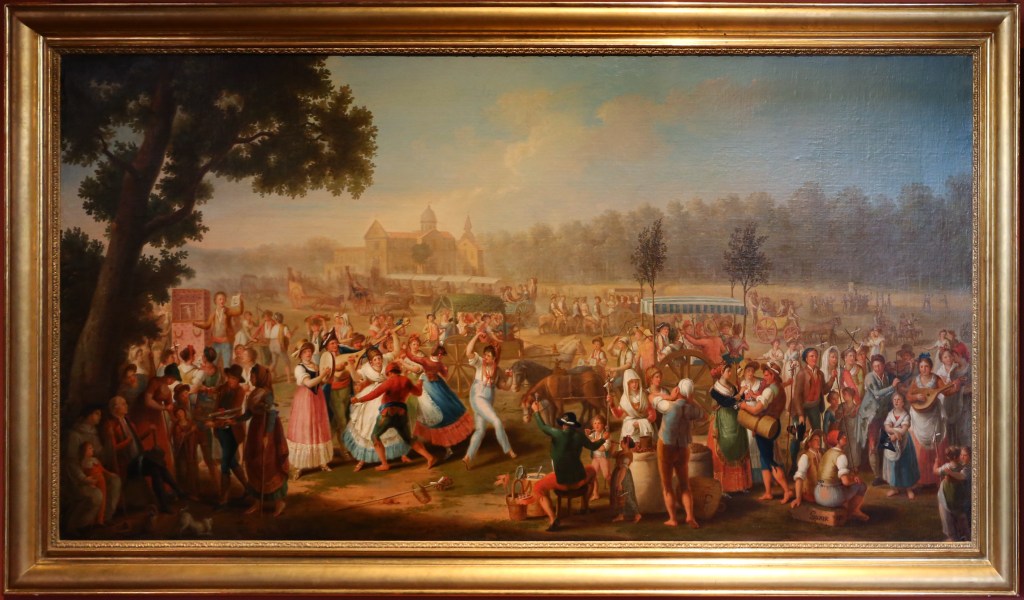
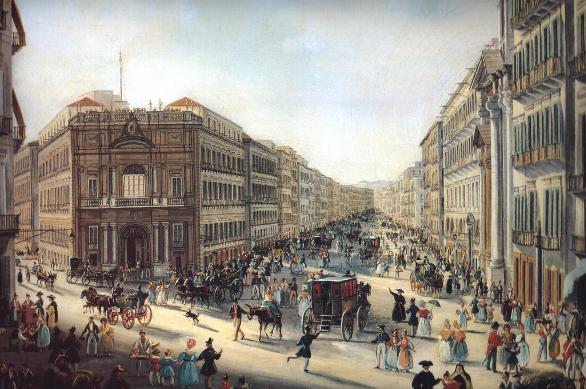
(Credit: Wikimedia Commons).
Giacinto studied privately with the German painter J.W. Hüber (1787–1871), who specialised in conventional academic landscapes. After Hüber left Naples, he trained under Anton Sminck van Pitloo (1790-1837) at Vico del Vasto in Chiaia. Pitloo’s poetic approach to landscape painting, shaped by British influence and painters such as Johan Christian Dahl (1788–1857), as well as lessons absorbed from Corot (1796–1875), was central to Giacinto’s early development. Here he explored the Neapolitan and Campanian countryside directly from nature and met Achille Vianelli (1803–1894), whose sister Eloisa he married in 1831.
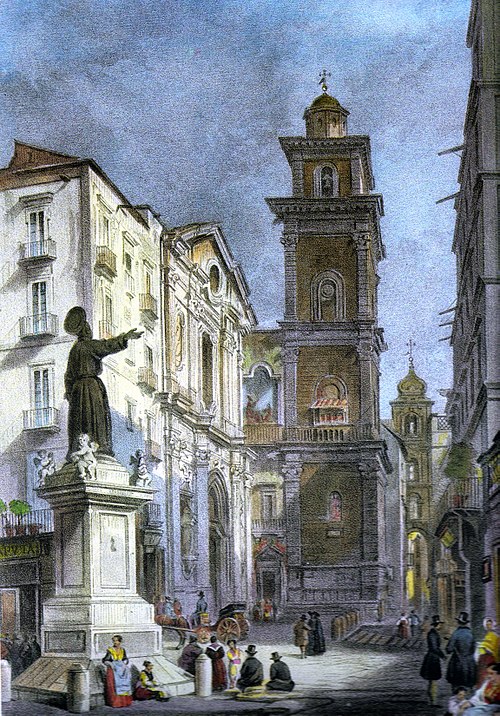
(Credit: Wikipedia).
In the 1820s, Gigante gained experience at the Royal Printing Office, learning engraving techniques and the use of the camera lucida to depict reality precisely. He often traced outlines on paper, then transferred these drawings onto watercolour paper to apply washes. Works from this period include Naples from the Grotto of Posillipo (1820) and Views of Ischia and Capri (1822 to 1823).
In 1824, under Pitloo’s guidance, he painted his first oil, Lago Lucrino (Naples, Museo di San Martino). The work is characterised by a rich, dense touch, sometimes broad, sometimes fine and compact, and reflects a northern taste for capturing the immediate impression of reality rather than the seventeenth-century Neapolitan landscape tradition or eighteenth-century vedutismo. Although not officially enrolled, he was awarded a second-class prize in the landscapes category by the Royal Institution of Fine Arts that year. Around 1826 to 1827, he registered at the Royal Institute of Fine Arts to compete for the first-class prize and obtain exemption from military service. Between April and May 1826, he worked in Rome for the painter and dealer Johann Jakob Wolfensberger (1797–1850), and in the same year participated in the Exhibition of Fine Arts at the Bourbon Museum with four watercolours, now lost.
By the late 1820s and early 1830s, Gigante was producing illustrations for major publications. Between 1829 and 1830, he worked on Viaggio pittorico nel Regno delle Due Sicilie, collaborating with Vianelli, Carelli, Fergola, and Marinoni, contributing original lithographs including Lake Lucrino and The Remains of the Temple of Venus at Baia, along with views of Pompeii, Posillipo, and Santa Chiara.
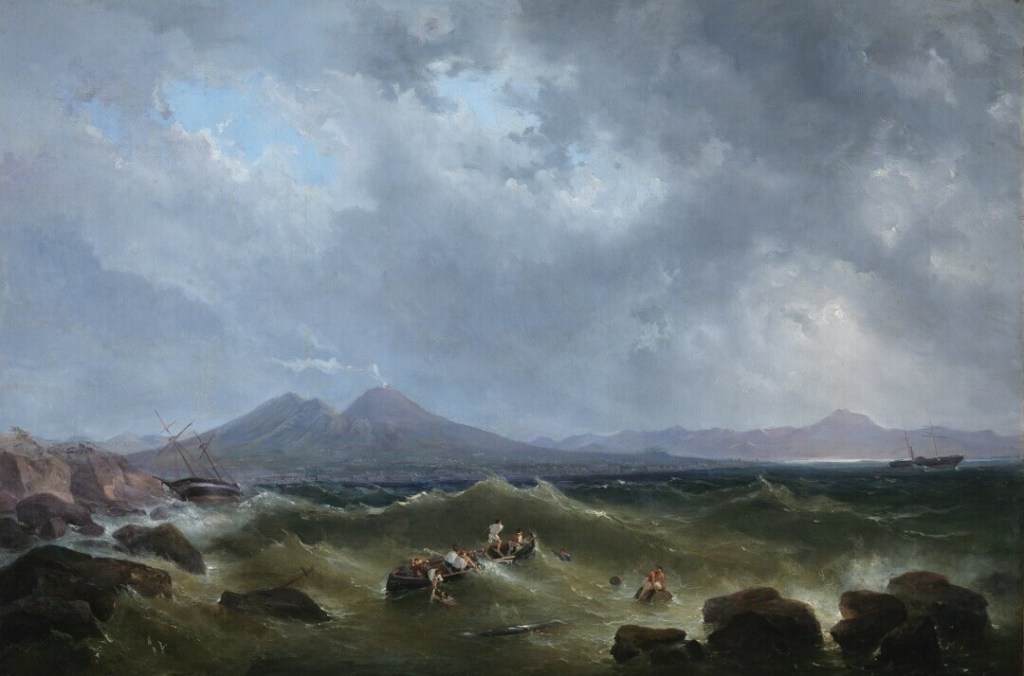
For the second and third volumes (1831 to 1832), he provided further views and subjects for lithography. In 1832, he contributed 100 drawings to Esquisses pittoresques et descriptives de la ville et environs de Naples, many based on Pompeii, and produced numerous watercolours of Capri and Pompeii, including Grotta Azzurra (1832), Capri dalla salita di Anacapri, Il Portico dei Teatri, and La Casa dei Capitelli Colorati (1835), in which intensified perspectival arrangements enhance contrasts of light and shadow.
His career gained momentum around his marriage to Eloisa Vianelli in 1831. From 1835, he received commissions from Russian aristocrats in Naples, some now held at the Museum of Capodimonte, including views of villas, San Martino, and the Bay of Naples. After 1835, he increasingly revised seventeenth-century Neapolitan landscape painting and assimilated features of Pompeian frescoes, informed by repeated excursions to Pompeii. His study of earlier Neapolitan masters included works such as Variations, a deliberate copy of a painting by Micco Spadaro in the Correale Museum in Sorrento. Between 1844 and 1850, his landscape painting was strongly influenced by Turner.
Connections through Schedrin at the Russian embassy brought him commissions in Naples and beyond. Some of these works are now in the Hermitage in St. Petersburg, including Landscape (1839), Sorrento (1842), and Monastery in the Mountains (1862). In 1846, he accompanied the Tsarina to Palermo, producing an album of Sicilian views and the oil painting The Amphitheatre of Taormina.
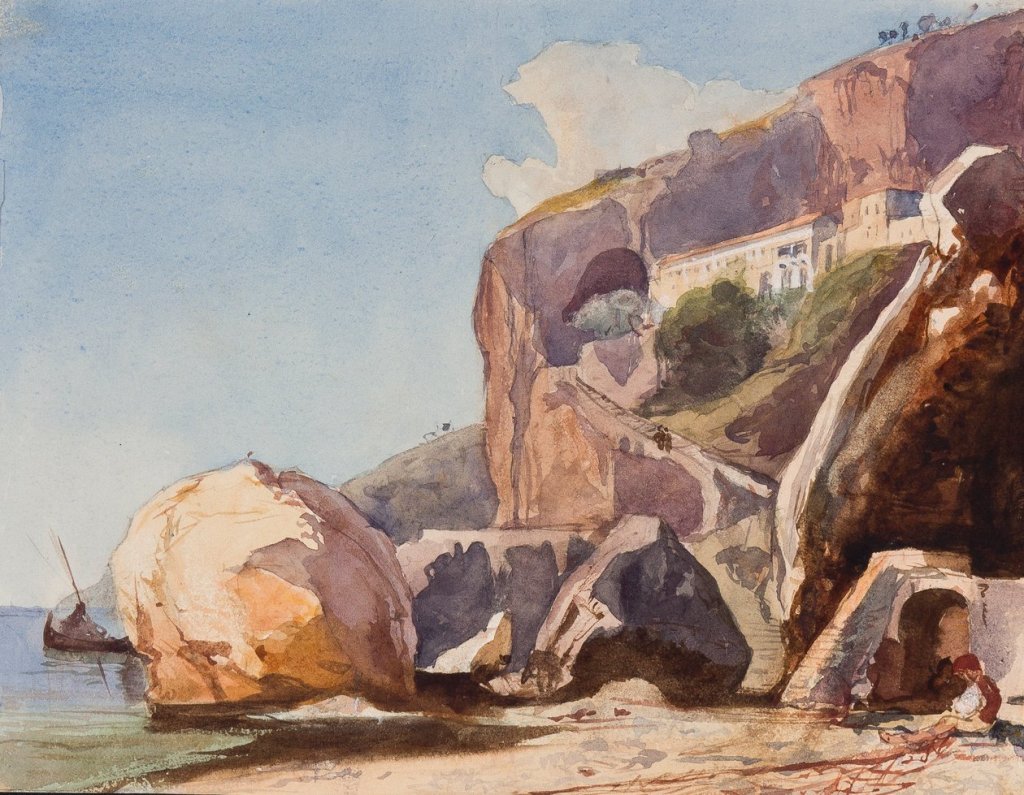
(Credit: Meister Drucke).
From 1850, he received commissions from the Bourbon court, producing drawings of Gaeta for Archduchess Maria Teresa in Vienna. In 1851, he gave drawing lessons to the young princes, and in 1852 he accompanied the royal family to Caserta, Ischia, and Gaeta.
After Pitloo’s death from cholera in 1837, Gigante became the leading figure of the Posillipo School. In the same year, he moved into his teacher’s house at Vicoletto del Vasto. Thanks to Russian commissions, in 1844 he purchased an estate on the Vomero slopes, Villa Salute, where from 1846 he brought together his large family.
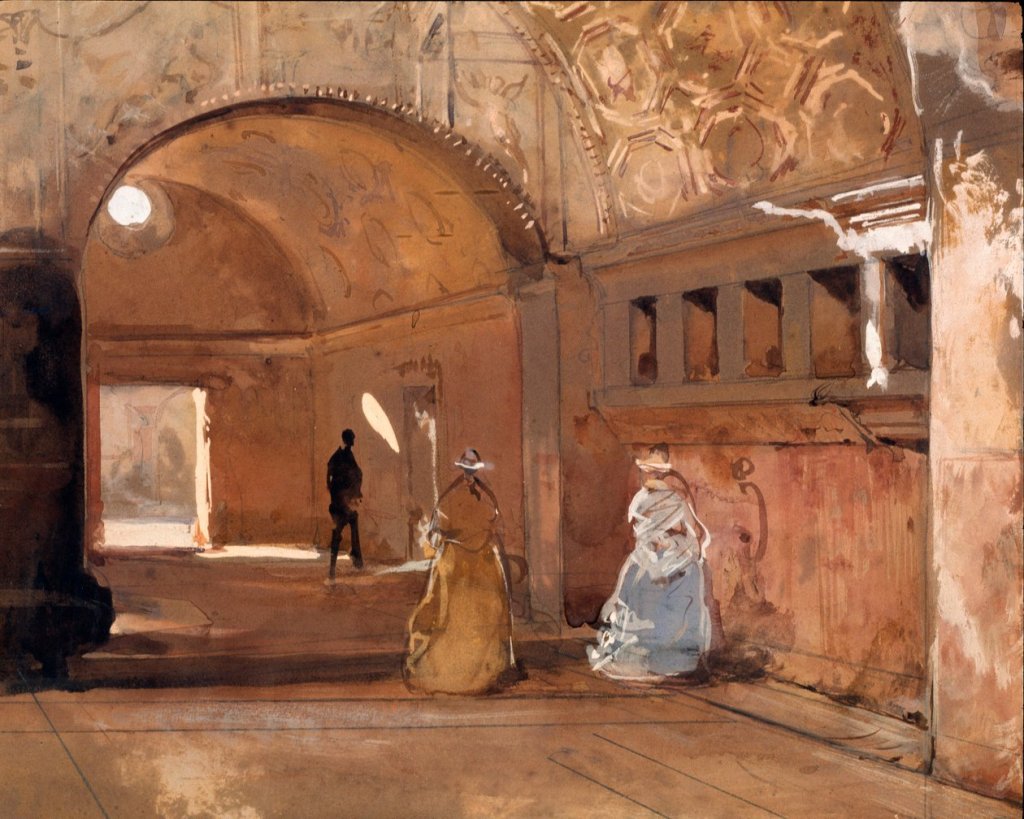
Between 1855 and 1860, he returned to one of his early themes, Pompeii, producing watercolours and sepia studies in which he attempted to capture the encaustic colours of Roman painting, as seen in Via dei Sepolcri and Casa di Castore e Polluce .
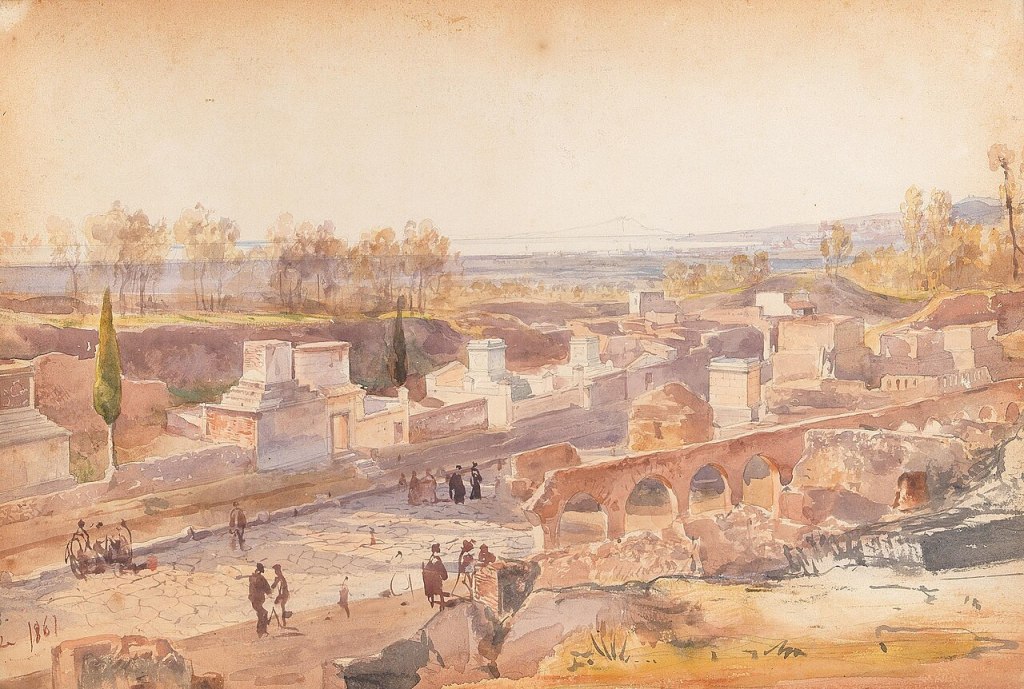
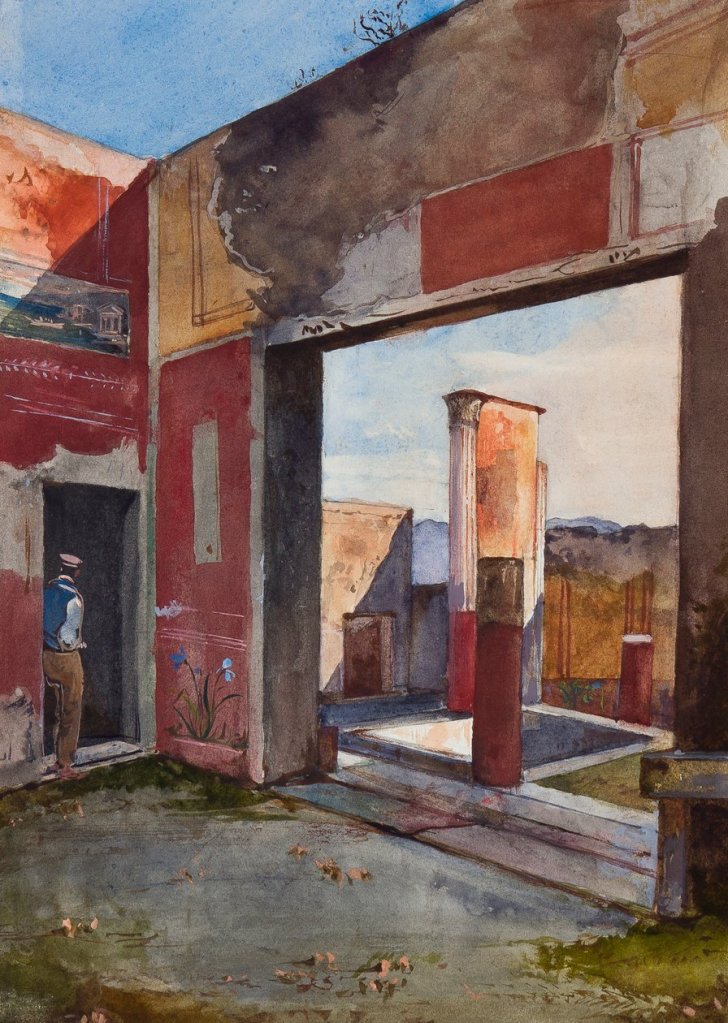
After the unification of Italy in 1860, his focus shifted from open landscapes to church interiors and figure studies. He painted monastic views such as S. Maria Donnaregina and worked on episodes of a more romantic character, including a sketch for L’ingresso di Garibaldi a Napoli. In the same year, Victor Emmanuel II commissioned him to paint the interior of the Duomo of Naples, Cappella di S. Gennaro al Duomo durante il miracolo del sangue, completed in 1863 (Museo di Capodimonte). He exhibited this work at the Exposition Universelle in Paris in 1867, travelling there in person, and returned in 1869. The painting was praised for its complex perspective, with commentators praising Gigante as a watercolourist without equal in Italy. Also, around 1860, he began organising earlier material, enriching previous drawings with notes and additional graphic or painted details.
Gigante died in Naples on 29 November 1876.
Giacinto Gigante – selected works
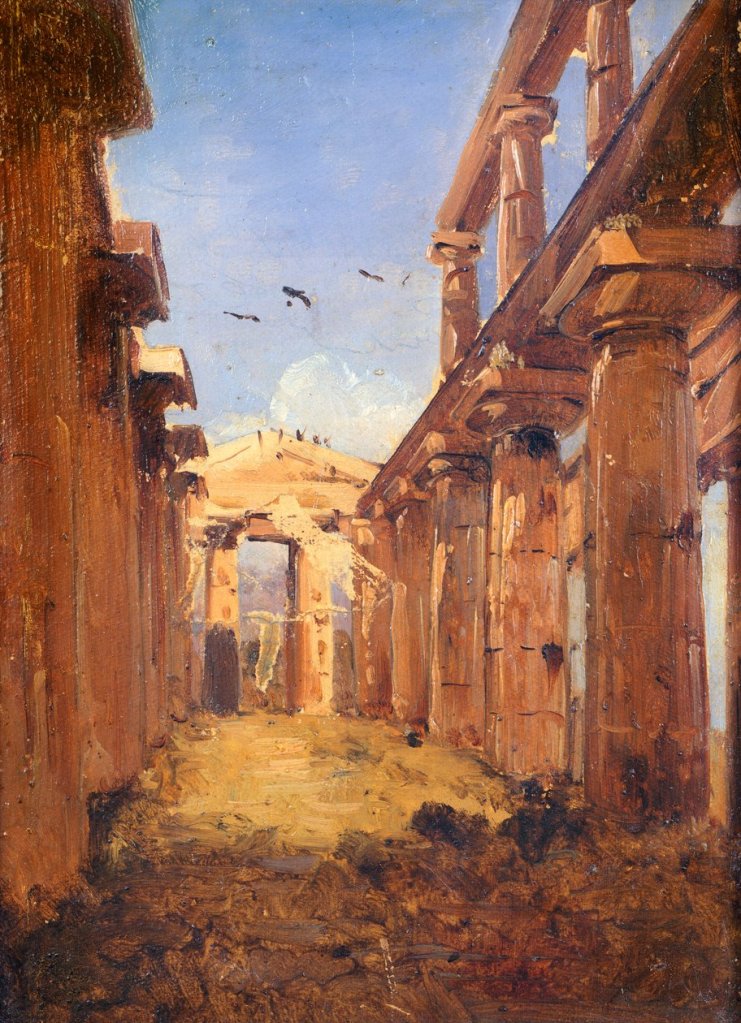
The Temple of Neptune at Paestum (ca. 1844)/ Tempio di Nettuno a Paestum.
(Credit: Wikimedia Commons).
The Temple of Neptune at Paestum (ca. 1844) is rendered with rapid, lively brushstrokes, dappled with touches of light that lighten the architectural mass. This vitality, however, is grounded in careful study, as evidenced by the preparatory drawing of the same dimensions, inscribed: “the Temple of Neptune seen at about midday.”
The viewpoint is shifted slightly to the left, creating an asymmetrical rhythm in the composition. On the left, the columns are closely aligned, producing a sense of mass and slightly darker shadow, while on the right they are more open, allowing light and space to emerge. Through and between the architectural forms, glimpses of southern blue sky and drifting clouds appear, and the earth below is rendered in warm golden tones where the sun breaks through, contrasting with the cooler brown of the shaded areas.
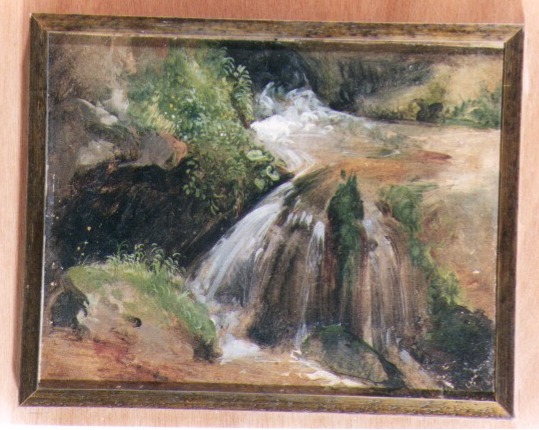
Cascade in a Gorge / Acqua di Forra (1844).
(Credit: Catalogo generale dei Beni Culturali).
Following Sergio Ortolani’s gloss, in Acqua di Forra Gigante captures the vivacity of a flowing scene with rapid, incisive brushwork, conveying movement, freshness, and the cool, watery quality of the landscape. The atmospheric colour palette, recalling the shadowed tones of the Neapolitan Seicento, is freed from strict form and distilled into a single, fluid, sonorous play that emphasizes the rhythm and life of water in nature. The painted forms come alive independently of narrative content, experienced and transformed through the artist’s own lyrical perception. The work anticipates a study of nature in which form and colour take precedence over narrative, foreshadowing approaches soon to emerge across Europe.
Villa Minutolo (post 1852).
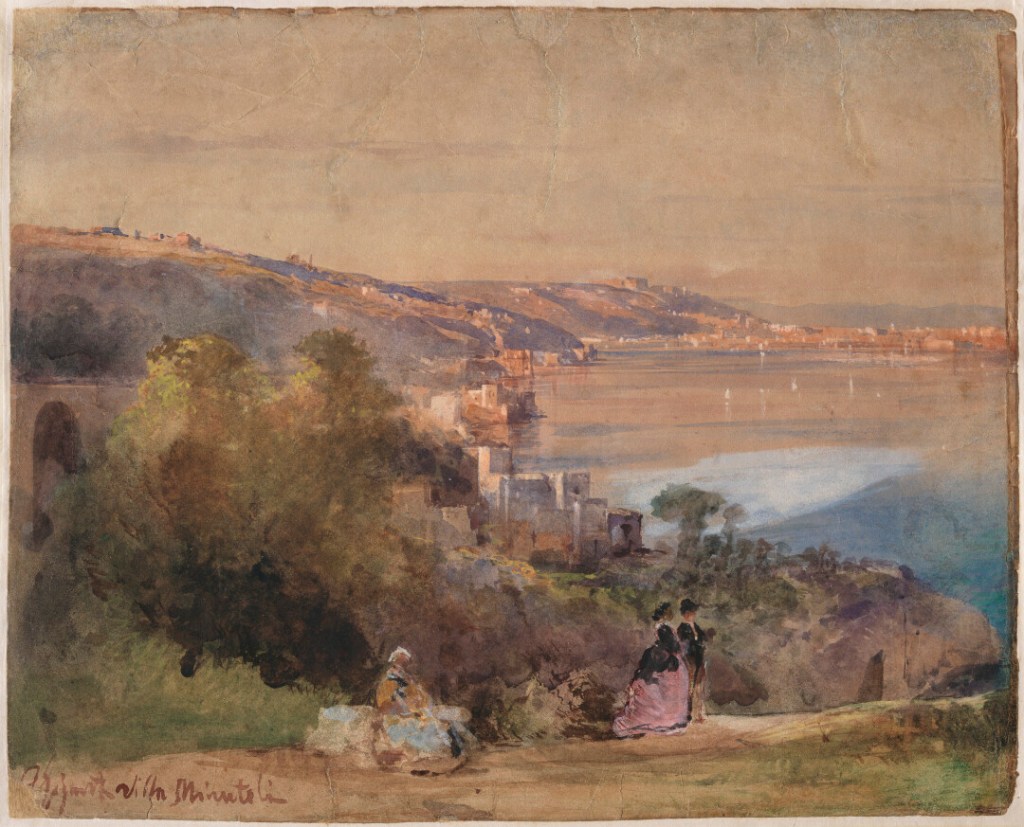
(Credit: Gallerie d’Italia, Napoli).
In Villa Minutolo, on the promontory of Posillipo, amid luxuriant vegetation, gardens and vineyards, the noble villas of the Neoclassical period rose in profusion. Not far from the spot where this watercolour was made, near Villa Graven, Gigante had already worked on his celebrated view of the Gulf of Naples, commissioned by Count Potocki, the Russian ambassador to Naples, in 1845. The View of Villa Minutolo can therefore be plausibly dated to the years between 1845 and 1850. The prospect itself was already well established: the view was popular with foreign artists of the previous century and had long been a favoured location, not just for Gigante but for visiting painters more generally.
Two distinct planes of light and colour give the painting both its charm and its sense of depth. The distant town is rendered in more transparent tones, pale blues and soft yellows, while the foreground is built from a denser mixture of greens that partially merge the forms of the trees. Gigante was particularly adept at conveying the sensation of light through contrasts in the delicacy of colour, together with subtle steps in tone.
In this view the handling of colour feels strikingly modern, even as the composition retains something of the traditional. The prospect over the Gulf is, in itself, a conventional motif, one Gigante painted many times; yet the silhouettes of the figures walking along the roadside are here suggested with the lightest touch of the brush. These small figures introduce flashes of colour and light that contrast with the darker bulk of the hillside and foliage, and they also serve to articulate and delimit the near foreground.
Il Giardino inglese a Caserta (ca.1854).
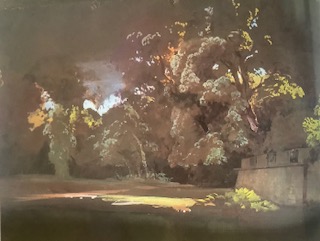
(Credit: author’s photograph).
In The English Garden at Caserta, Gigante sets aside the precise, realist approach in favour of a more Romantic and lyrical vision. The landscape is not recorded as it exists in nature, but transformed through the artist’s own perception, expressed with a keenly personal sensibility. Atmosphere, colour, and light dominate the composition, and the rapid, incisive technique, often combining watercolour with tempera, reflects the immediacy of his creative response, giving shape to the scene as it unfolds within his own consciousness.
Sunset in the countryside around Caserta/ Tramonto di Caserta (1857).
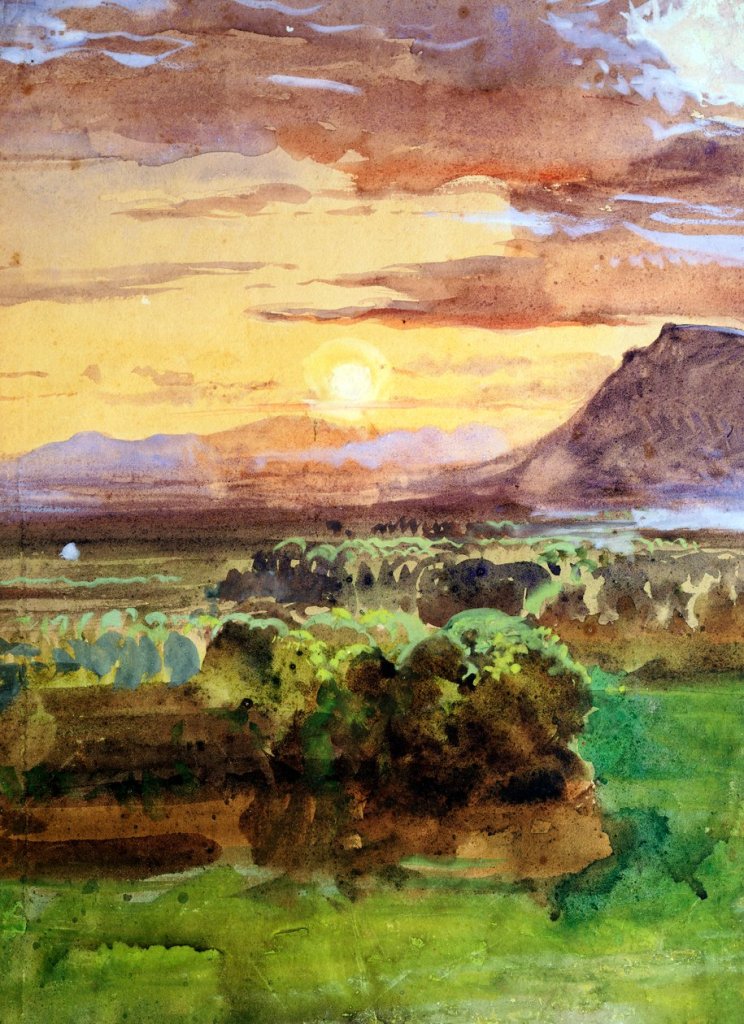
(Credit: Meister Drucke).
In a similar spirit to the preceding work, Gigante here moves beyond realistic representation, transforming the Caserta landscape into a visionary scene. Light and colour assume primacy, with the watercolour itself becoming an act of creation, where forms and atmosphere emerge from the artist’s expressive perception rather than merely from objective observation.
La marinella (ca.1857)
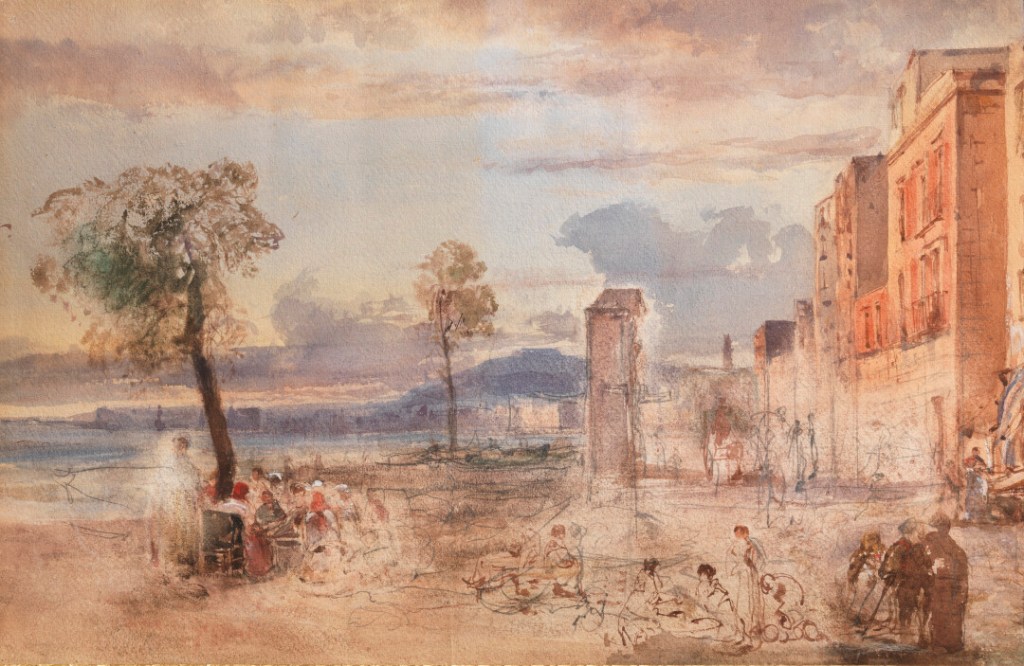
(Credit: Gallerie d’Italia, Napoli).
What is immediately striking about Gigante’s view of La Marinella is its refusal of the conventional. This is not a prospect chosen from the standard repertory of Grand Tour viewpoints, nor one of the commercially codified angles favoured by earlier illuminist landscape painters working in gouache. Instead, Gigante adopts a distinctly modern position, organised around a central perspective that draws the eye back towards Vomero Hill, with Castel Sant’Elmo anchoring the distance.
The conception of the Chiaia district is correspondingly romantic rather than topographical. Buildings are bathed in a soft rose-coloured light, but many are only partially realised. Figures in the foreground and centre are sketched rather than finished: calligraphic pencil lines remain visible, and some forms seem on the point of dissolving back into the atmosphere from which they emerge. On the left, beneath a tree, a small group is touched with colour in brief, almost casual splashes, while elsewhere definition gives way to suggestion.
The most fully articulated passages are held together chromatically: the trees on the left, which establish depth, and the stepped recession of rooftops to the right, where colour is used sparingly to mark spatial intervals. Sea, hill and cloud are handled in a restrained range of grey, violet and grey-blue, rising into cloudscapes brushed with pale rose. At the centre of the composition there is an expanse that is scarcely more than breathed onto the paper: a zone of light, atmosphere and hesitation.
The result is a work with strong underlying structure but an elusive surface. Shape is present, but it is constantly threatened by dissolution. La Marinella feels less like a finished “view” than a mysterious and poetic encounter with place.
Cave with Bathers (1858)/ Grotta con Bagnanti
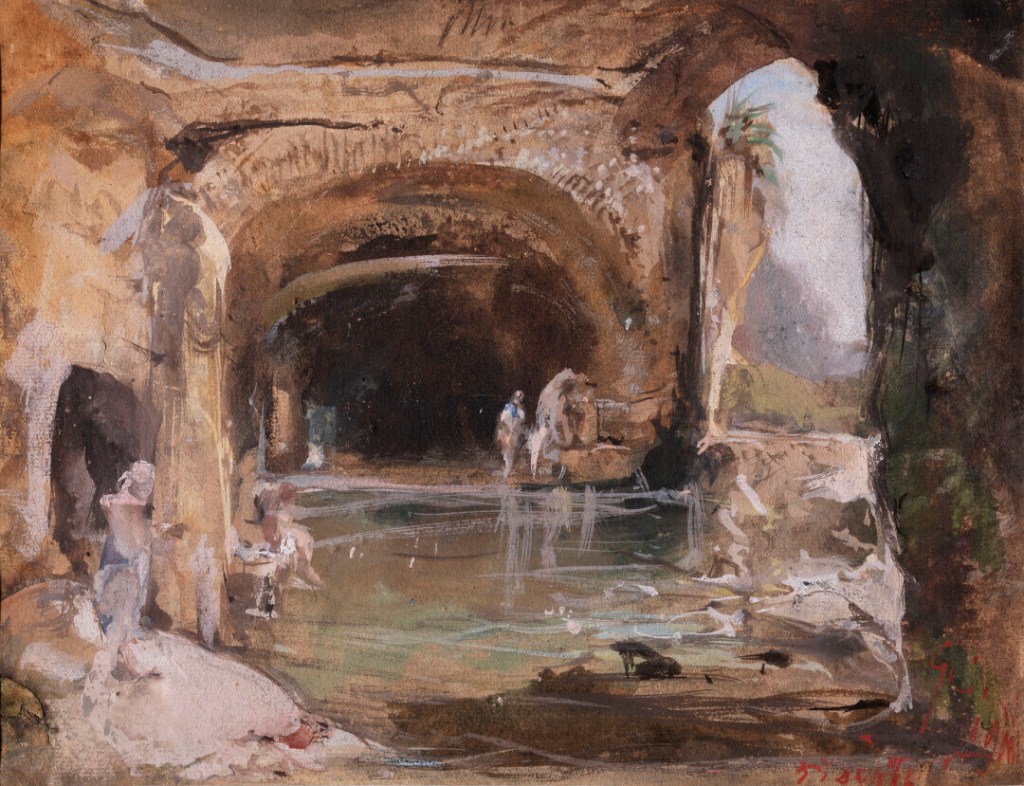
Grotta con Bagnanti (1858), tempera on paper, 21 x 27cm, Gallerie d’Italia, Napoli.
Giacinto Gigante’s Cave with Bathers takes as its subject the cave beneath Palazzo Donna Anna, associated with Donna Anna Carafa of Stigliano. The painting is a Romantic transposition of the site rather than an accurate, topographical depiction. There is little descriptive attention to the actual cave entrance of the palazzo itself. Instead, Gigante imagines the space from within, transforming the physical location into a visionary interior.
Seen from inside the cave, the light entering from outside alters the appearance of the rock. The calcareous walls become white in the illumination and, using white lead, Gigante turns patches of them into something resembling marble. A figure on the left and another in the background appear to have almost lost their material substance; they are phantom-like, mysterious presences rather than solid bodies. The atmosphere is distinctly unreal.
This mood is likely influenced by the legends attached to the place, which was traditionally believed to be inhabited by the spirits of those killed by Queen Giovanna d’Angiò. The work dates from around 1858, within the period 1856–1860, and represents one of the high points in Gigante’s interpretation of landscape, moving beyond his earlier, more juvenile studies.
Technically, the painting makes strong use of white lead (biacca), contributing to the luminous abstraction of the cave interior and creating the transformation of rock into light, and vision.
Napoli vista dalla Conocchia (c. 1840–1860)
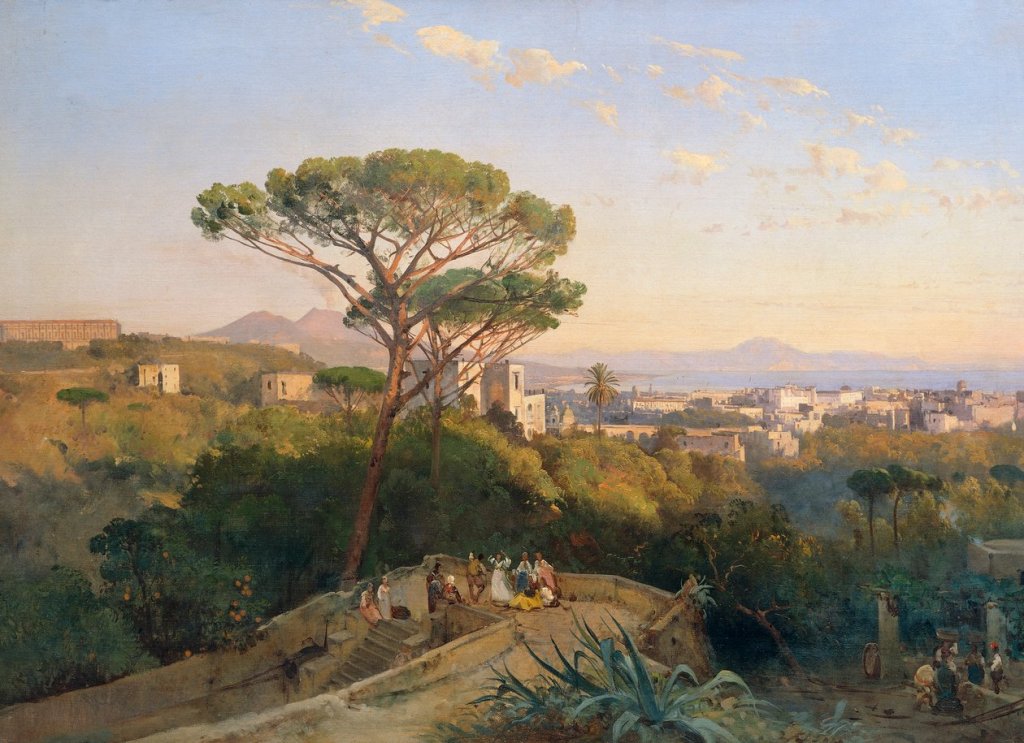
(Credit: Wikimedia Commons).
Following Rosanna Muzii’s interpretation, View of Naples from the Conocchia, concentrates all the qualities of Gigante’s mature work: his gift for framing landscape, his mastery of the pictorial medium, and his capacity for poetic and emotional suggestion. The result is a work of exceptional visual beauty, in which technical means are never displayed for their own sake but absorbed into a language of high expressive intensity.
As noted by Domenico Morelli:
“It is a healthy, sincere painting, without artifice, and vivid like enamel. A fine sky at sunset, barely furrowed by a few clouds, stretches over the tranquil sea, while the distant mountains and houses turn pink against cobalt half-tones. A curtain of arboreal masses rises, crowned by bold crests of pines. In the foreground, as if modelled by the declining sun against the turquoise sky, a slope animated by various, almost indistinct figures rises from the valley below, while the first grey-bluish waves of the vapours of the imminent evening begin to climb.”
Muzii also points to Gigante’s refined sense of tonality across his work: the delicate colour harmonies of the watercolour of the Caracciolo Chapel, the robust tonal structure of the interior of San Giovanni a Carbonara, and the masterful play of light in the Pompeian Baths. Together, these works reveal an artist capable of uniting close observation with lyrical transformation.
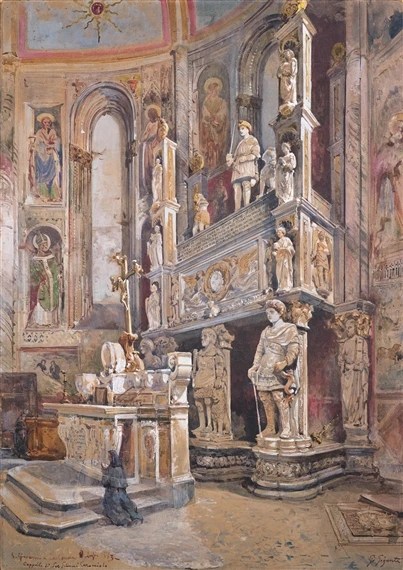
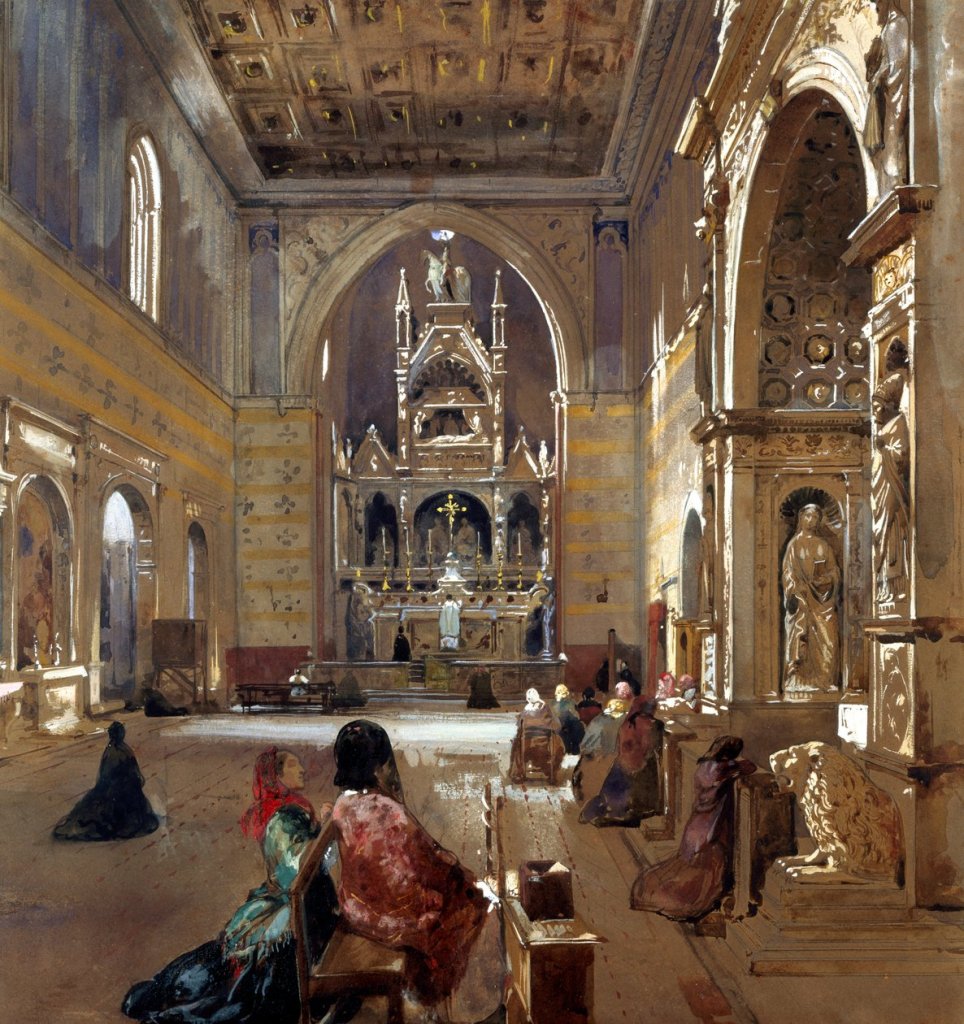
La cappella del tesoro di San Gennaro (1863).
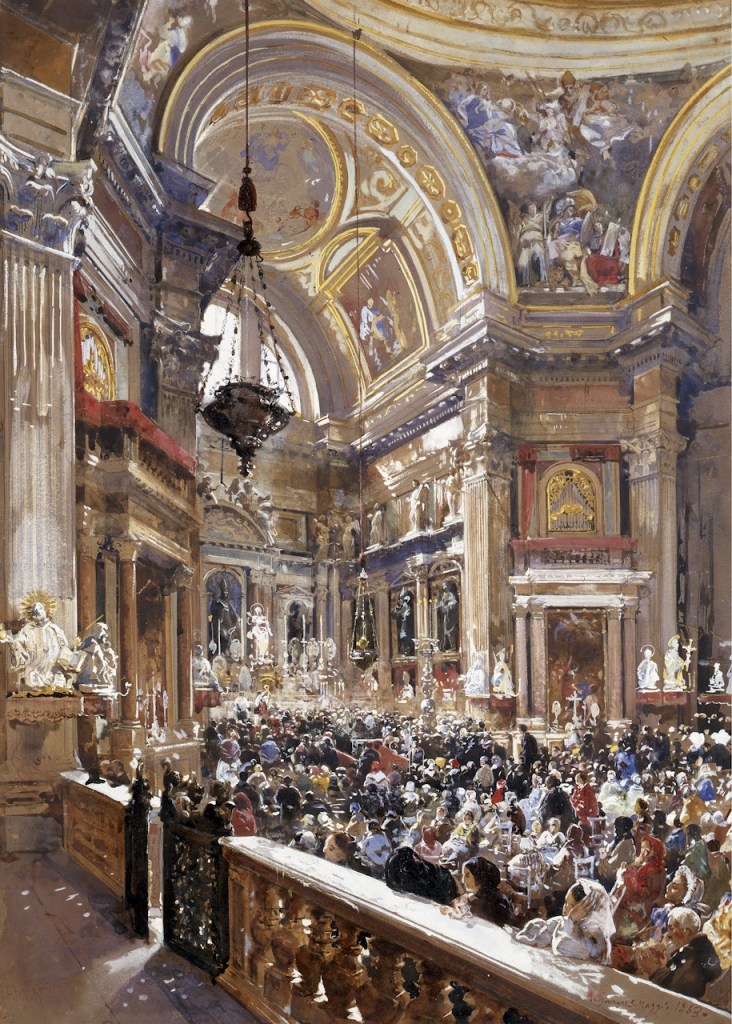
La cappella del tesoro di San Gennaro (1863), watercolour, tempera and white lead on paper, 72 × 52 cm, Museo di Capodimonte.
Following the interpretation of Mariaserena Mormone, the vitality and spatial dynamism of the Chapel of the Treasury of San Gennaro mark a high point in Gigante’s late manner. The miracle of the liquefaction of the saint’s blood, so central to Neapolitan religious life, remains an event of intense popular engagement, and likely motivated Gigante’s choice of this distinctly local subject, perhaps also as a gesture of homage to the recently installed Savoy monarchy.
Now elderly and increasingly devoted to interior scenes rather than plein-air observation, Gigante constructs a strongly asymmetrical composition, emphasized by the oblique line of the balustrade that draws the eye toward the high altar on the left. The congregation is densely packed and rendered in rapid touches of colour, while the rich decorative setting, stuccoes, gilded frames, paintings, silver and bronze sculptures, and candelabra, creates a vibrant, animated surface. These many elements are unified into a choral yet dynamic vision through the integration of light and colour.
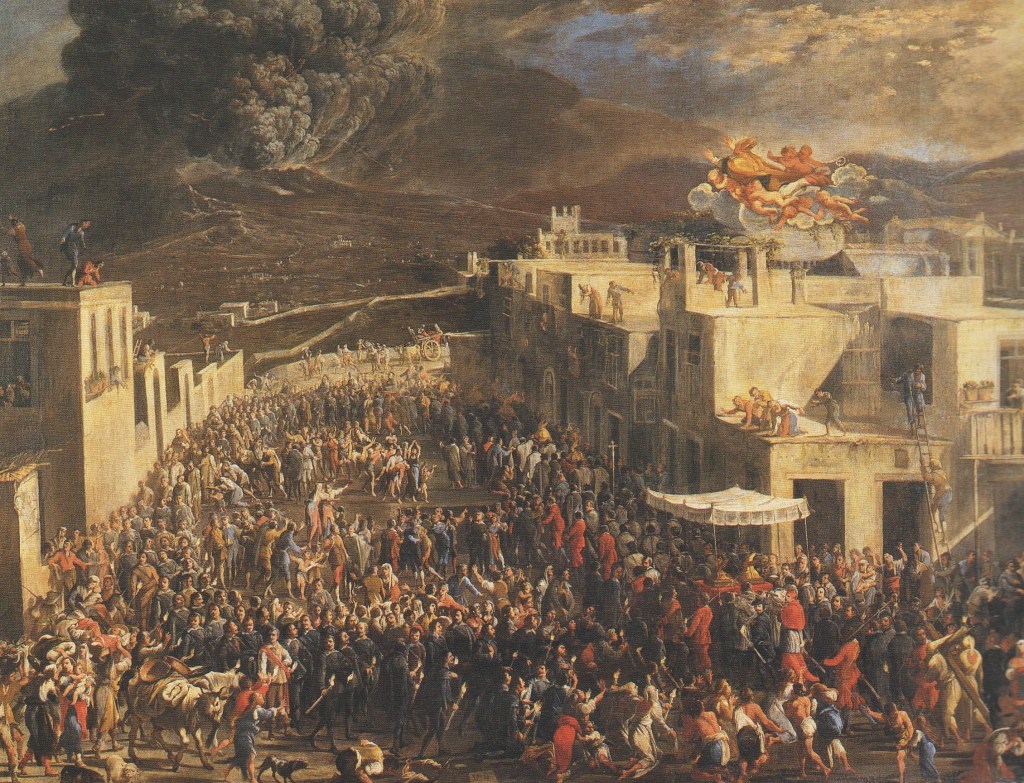
As Mormone notes, an echo of seventeenth-century Neapolitan painting can be sensed, particularly of Micco Spadaro’s Procession for the Eruption of Vesuvius, in the animated movement of the crowd, where individual figures dissolve into collective energy. The asymmetry of the space mirrors the emotional tension of the faithful, transforming the scene into a charged, theatrical moment of shared devotion.
The Maidservant’s House (Casa delle Ancelle) at Donnaregina (c.1865).
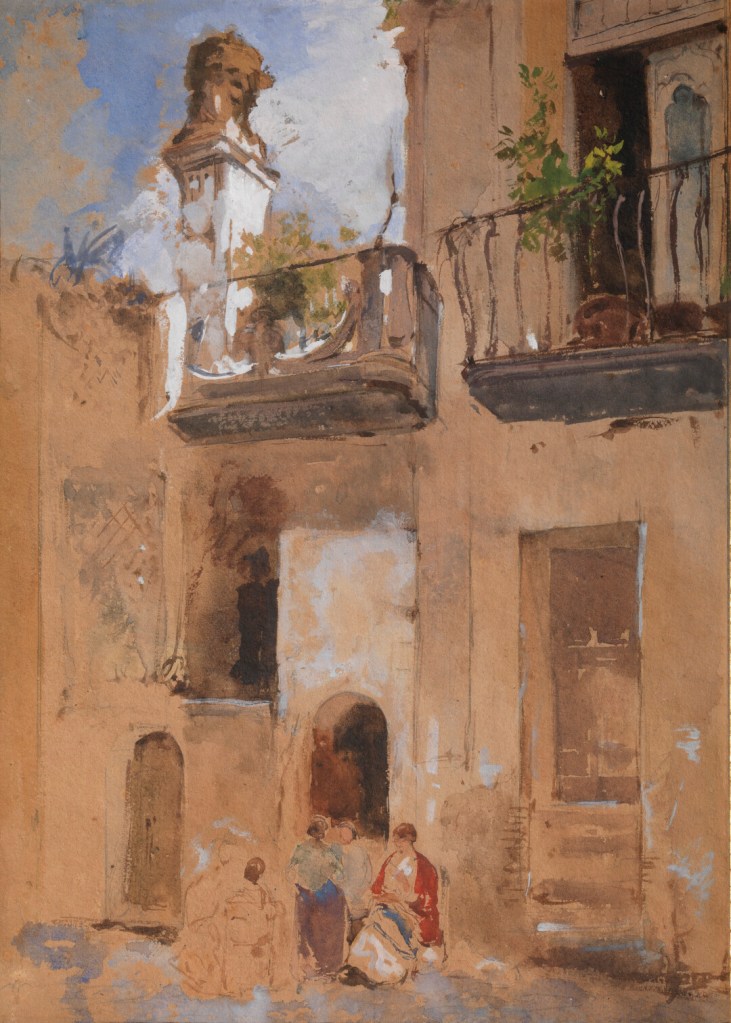
(Credit: Gallerie d’Italia, Napoli).
Giacinto Gigante’s The Maidservant’s House at Donna Regina dates from around 1865. From about 1861 onwards, Gigante largely ceased producing landscapes painted directly in the open air, apart from a few studio works in pencil, pen, or pencil and wash. After 1860 his studies increasingly focus on praying figures, monks, genuflecting attitudes, and the ecclesiastical surroundings of San Lorenzo and Donnaregina.
In this work, the maidservant’s house is not presented within an expansive architectural landscape with open perspective. Instead, the scene is seen from close range and in an enclosed way. It feels less like a city view and more like an intimate architectural fragment, almost like the corner of a small courtyard, where space is compressed and attention is drawn to surfaces and edges rather than to distant buildings.
Attention is focused on a few distinctively Baroque details: the balconies and a visible shutter, which punctuate the flat planes of the architecture. Depth is conveyed through the dark accents that mark the doorways and recesses of the house.
Gigante creates strong effects of light through flashes of white on the sunlit terrace and along the wall, whose colour has faded in places. Although the composition is nearly monochrome overall, the paint handling is rich and subtle. The mixed technique of watercolour with tempera reveals itself only in carefully judged contrasts: the blue of the sky set against the pinkish tones of the buildings, and the touches of green foliage on the right-hand balcony.
The figures of the women introduce bright notes of colour and movement, absorbed in their everyday work in the sunlight. The economy of means in this painting is matched by a high level of technical confidence. Gigante allows the underlying drawing to remain visible without any sense of incompletion, demonstrating a rare mastery of watercolour as both a descriptive and expressive medium. The work is closely related to an analogous subject in the Correale Museum in Sorrento.
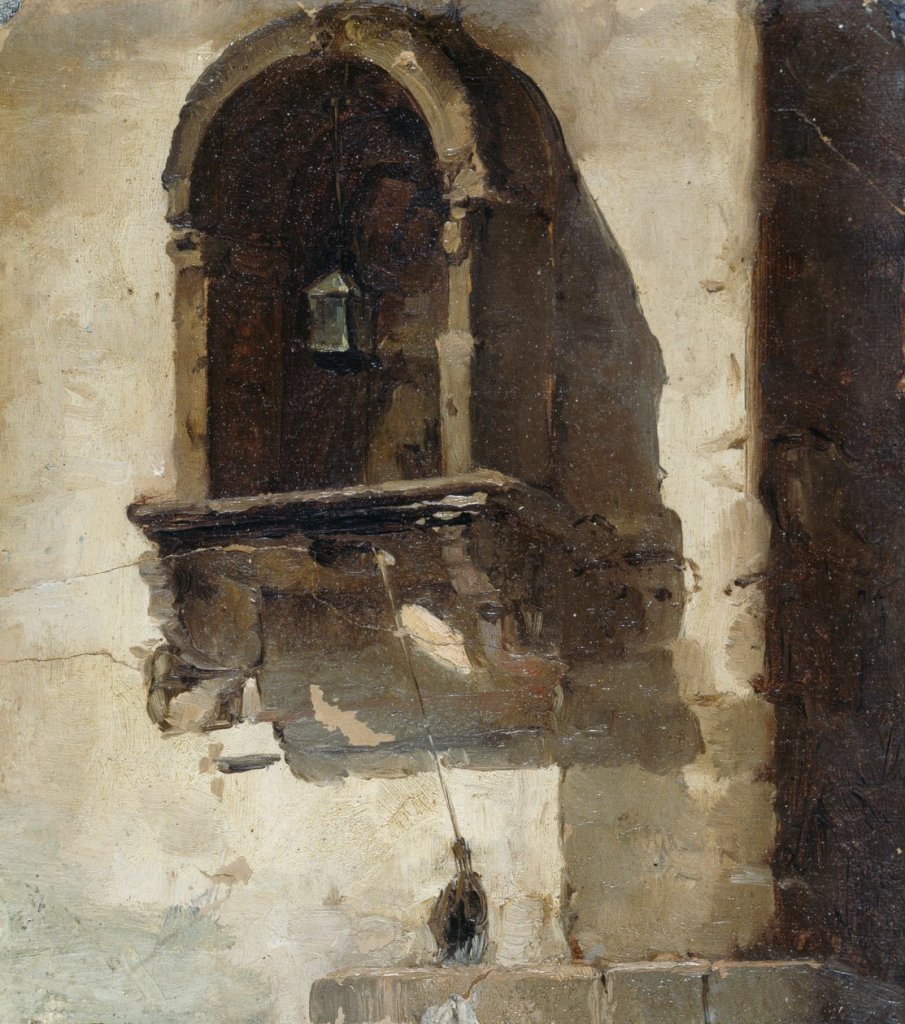
Having explored a confined corner of a courtyard, we can look at Gigante capturing an even more fragmentary subject: a tabernacle. There is something strikingly modern about this quietly encountered scene; though seemingly modest, it demonstrates a masterful handling of light, shade, and texture, imbuing the uninhabited space with a quietly observed, evocative presence.
(Credit: Lombardia Beni Culturali).
Commentaries on Giacinto Gigante from Causa and Ortolani.
[These extracts are translated from primary texts in: Capobianco, F., et al. I colori della Campania: Omaggio a Giacinto Gigante. Naples, 2006 and Martorelli, Luisa, ed. Giacinto Gigante e la scuola di Posillipo. Naples, 1993.]
Sergio Ortolani – speaking of Gigante’s work of around 1845 and 1850.
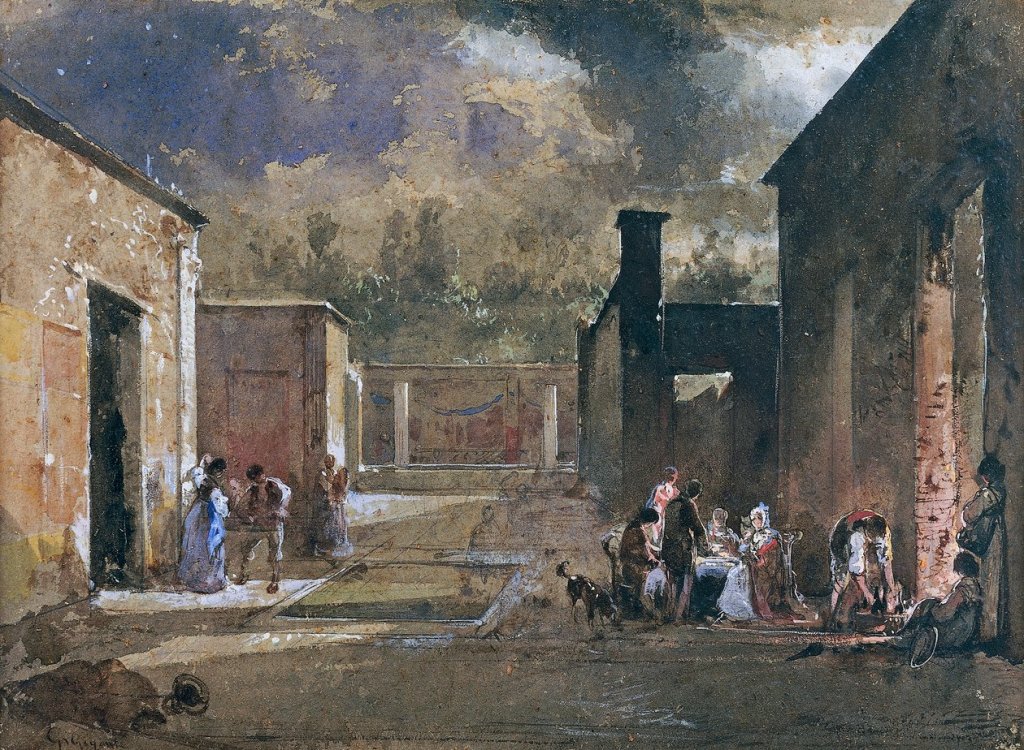
The vibration of light is rendered so unstable that it seems to decompose and recompose reality in its own way, perpetually; and I do not know what strange, hallucinatory aspect the images acquire, their enchantment all the more piercing for being precarious, mutable, and truly fleeting. It is a dream: a fleeting blink of the eye, and the world has changed its face. Yet there is no greater magician than Don Giacinto. Even when the image is more true to life, it remains fabulously unreal. So it is in this Cena a Pompei, [Una notte nella casa di Sallustio a Pompei] where night shadows and moonlight transform the genre scene into one of those landscapes one has glimpsed in a dream. And even in the loving, solar vision of Casarlano near Sorrento, from 1850, the whole georgic essence of summer and of these Virgilian lands is there: under a relentless wash of sun, the force of trees, and what seems like the very rasping song of cicadas, emerges that wild southern air, where enthusiasm borders on dismay at so much eruption and natural joy. And sometimes, blind dismay takes over.
Tragic is the macchia of the Anfiteatro di Pozzuoli, with its possessed ruin and the immense elemental darkness of the oak, or the vast 1865 watercolour of the secluded Giardino delle Monache di Donnaregina: truly deserted landscapes, emptied of human presence. Even more irregular and strange is the ascent of houses and caves in Cava dei Tirreni, as if a drunken god had laid hands upon them. Better than man, in his ordinary gestures or in the rhythm with which he measures an imagined world, only he [Gigante] has been able to sing this ecstatic and painful emptiness of humanity in its imagining, these great strokes of nature, this fantastical madness of the Phlegraean land.
Raffaello Causa – describing Gigante’s work from the period 1845-1850.
They come into being now, in the years around 1845–50. The newest and most admirable works, happy pages of a deeply felt, wholly inward intensity, authentic high points of nineteenth-century art in Naples, still carry within them a lurking danger, that of an all too easy decorative mode, poised between the scenic and the sentimental. But Gigante reacts with sudden flights of genius, through dazzling syntheses and incisive abbreviations.
Yet he will soon abandon this state of fully achieved expressive happiness and become sombre and brooding, drawn into a process of interiorisation that excludes any appeal to external elements, just as it refuses every concession to pleasing effects of colour or of layout. The ties of blood with the veduta, with his veduta, which had already begun to blur and were then reduced to simple points of reference, are broken for ever: vision must be regenerated from within, a simple spiritual moment to be translated into an expressive form. Light must be conquered each time anew, through a precise qualification of space and atmosphere. In this final phase, watercolour and mixed technique reach a completeness of astonishing effectiveness, handled with the audacity of oil painting, renouncing all delicacy of transparency and all elegance of touch.
Late-Romantic crisis pours itself out in a sudden liberation of line and of the “macchia”. Many sheets reveal a brusque, defiant non-finito, with a colouring without complacency, at times dissonant, yet entirely inward-turned, like a painful confession, a hopeless autobiographical testimony, results of great modernity, difficult to set against the contemporary experience of landscape painting in Italy, including even the only apparently more up-to-date experiments of the School of Resina and of the Macchiaioli.
Raffaello Causa on the final phase of Gigante’s work.
The discontent and dark humour of the old Gigante are concentrated in moments of rare expressive candour, introspective analyses that first seek to come to terms with the subject depicted, the painterly material, and the narrative of his latest compositions. In anticipation and often unrecognizable, by this point we are beyond the history of The Posillipo School. The landscape alone, this happy fable, is no longer sufficient to express the new imperatives of Romanticism. New paths must be explored, and here Gigante engages in an experience entirely novel for him.
Perhaps under the influence of analogous experiments attempted by painters in other Italian centres, he turns to interior painting: the interiors of churches, where nature no longer intrudes with the aggression of atmospheric light or the colours of the rainbow. Everything appears more controlled, framed within the perspectival schema that must establish the rule, a rule from which there can be no deviation.
Thus is born the major series of his late works, accompanied by a large production of figure studies, as if for the first time Gigante truly observes a humanity no longer included merely to complete the composition, anonymous extras for pastoral idylls or crowded city scenes. These are figures of worshippers in prayer, officiating priests, prostrate nuns. Few brushstrokes suffice to capture, with utmost clarity, the problems of humanity, of solitude, and of old age. Yet within these church interiors, Gigante produces works of prodigious technical skill, extraordinarily complex, which seem to reveal the ambition of an unequal struggle with the historical precedents of Panini.
[Producing these essays requires care, time, research, and resources. Contributions to help sustain this exploration would be greatly appreciated.]
https://donorbox.org/inner-surfaces-resonances-in-art-and-lterature-837503
Bibliography and acknowledgments.
For the glosses on individual pictures, I have relied most on the Bank of Naples catalogue of 1985 and the work of Mariaserena Mormone and Rossana Muzii in Capobianco, F., et al. I colori della Campania: Omaggio a Giacinto Gigante. Naples, 2006.
Any errors in this introduction are mine alone: the secondary sources used are listed below.
Briganti, G., et al. In the Shadow of Vesuvius: Views of Naples from Baroque to Romanticism, 1631 to 1830. Naples, 1990.
Capobianco, F., et al. I colori della Campania: Omaggio a Giacinto Gigante. Naples, 2006.
Caputo, Rosario. La pittura napoletana del primo Ottocento. Naples, 2021.
Causa, Raffaello. La scuola di Posillipo. Naples, 1967.
Causa, R., et al. The Golden Age of Naples: Art and Civilization under the Bourbons, vol. 1. Detroit (Detroit Institute of Arts), 1981.
De Rosa, E., ed. L’Ottocento negato. Naples, 1991.
Martorelli, Luisa, ed. Giacinto Gigante e la scuola di Posillipo. Naples, 1993.
Olson, R., ed. Ottocento: Romanticism and Revolution in 19th-Century Italian Painting. Philadelphia.
Picone Petrusa, M., Dal Vero: Il paesaggismo Napoletano da Gigante a De Nittis (Torino, 2002).
Sisi, Carlo, ed. La pittura di paesaggio in Italia: L’Ottocento. Milan, 2003.
Spinosa, N., ed. Art Treasures of the Banco di Napoli. Naples, 1985.
Links:
Carolina Brook’s biography of Gigante for Treccani: https://www.treccani.it/enciclopedia/giacinto-gigante_(Dizionario-Biografico)/
 Inner Surfaces