Ludovico Carracci (1555–1619) and his younger cousins, the brothers Agostino (1557–1602) and Annibale (1560–1609), played a decisive role in the renewal of Italian painting in the closing decades of the sixteenth century. Their reaction against the conventions of late Mannerism was founded upon the direct observation of nature and a critical reassessment of the achievements of the great Renaissance masters. In the early 1580s they established an academy in Bologna, subsequently known as the Accademia degli Incamminati, in which drawing from life and the development of artistic invention occupied a central place.
The decoration of Palazzo Fava in Bologna provided the three painters with their first major opportunity to work together. Their early frescoes on the piano nobile include the story of Europa, painted by Agostino and Annibale, and the cycle devoted to Jason and Medea, in which all three collaborated. The decoration of the palace was subsequently extended to include episodes from Virgil’s Aeneid, painted by Ludovico and other Bolognese artists. Completed in 1584, the Jason cycle comprises eighteen narrative scenes interspersed with monochrome figures of classical deities imitating sculpture. The present essay focuses on two successive episodes towards the end of this cycle: Medea Casts a Spell and The Rejuvenation of Aeson.
The patron of the frescoes was Count Filippo Fava, whose marriage in 1579 to Ginevra Orsi, a member of one of Bologna’s leading families, had brought him a substantial dowry of 4,500 scudi. The commission appears to have come about through Antonio Carracci, the father of Agostino and Annibale, a tailor with connections among the Bolognese nobility. According to Carlo Cesare Malvasia, the young painters were prepared to undertake the work for a modest fee in order to establish their reputations. On the basis of this account, Clare Robertson questions whether a literary adviser would have been employed to devise the iconographic programme.
As Robertson observes, relatively few mythological paintings had been commissioned in Bologna during the 1560s and 1570s. Part of the Carracci’s renewal of painting arguably lay in their reconsideration of subject matter that had received comparatively little attention in the preceding decades. Robertson suggests that the brothers’ early interest in secular and mythological subjects, first manifested in the Palazzo Fava decorations, may have influenced their subsequent pursuit of court patronage, which offered greater scope for artistic invention. This development would culminate in their work for Cardinal Odoardo Farnese in Rome.
The principal early literary source for the Palazzo Fava commission is Malvasia’s Felsina pittrice, published in 1678, almost a century after the completion of the Jason cycle. Although Malvasia’s account provides invaluable information about the circumstances of the commission, the collaboration between the three painters and the conception and reception of the frescoes, aspects of his testimony have been called into question by modern scholars.
Luigi Spezzaferro, while accepting that the introduction of the Carracci to Filippo Fava through their family connections may have a basis in historical fact, questions Malvasia’s account of the patron’s role. According to Malvasia, the choice of subject was left to the painters, who were given considerable freedom to exercise their ingenuity. Spezzaferro suggests that, in assigning responsibility for the choice and development of the narrative to the Carracci, Malvasia effectively obscures the contribution of the patron, whose family had a distinguished intellectual tradition. Fava may have participated in the initial choice of subject without determining the detailed elaboration of the iconographic programme.
Malvasia’s account of the division of labour between the three painters is also problematic. Ludovico is credited with supplying numerous sketches, arranging the compositions and correcting and improving the work, while Annibale undertook much of the actual painting and Agostino concentrated on the monochrome representations of the deities. Robertson observes that this allocation of responsibilities conforms rather neatly to established categories of Renaissance art theory and reflects Malvasia’s partiality towards Ludovico. She nevertheless considers his emphasis on collaboration perceptive.
Less satisfactory is Malvasia’s interpretation of the cycle as a moral allegory in which Jason represents the courageous man who attains virtue, symbolised by the Golden Fleece, with the assistance of reason, personified by Medea. While this interpretation accords with an established tradition of reading classical mythology in an exemplary light, it does not adequately account for the more troubling aspects of the narrative. Gail Feigenbaum draws attention to the recurrent theme of deception and to the alternately benevolent and destructive purposes to which Medea directs her magical powers. Andrea Emiliani and Spezzaferro, in turn, seek to understand the choice of subject within the intellectual culture of late sixteenth-century Bologna.
For the decoration of an aristocratic residence, the expedition of the Argonauts offered an exemplary narrative of courage, perseverance and ingenuity, but the success of Jason’s enterprise depended upon the intervention of a figure who carried strongly negative associations in Renaissance literature. Medea’s reputation for cruelty, betrayal and infanticide was well established, although Jason’s own conduct was not beyond reproach. As Maria Luigia Pagliani points out, the sixteenth-century mythographer Marco Antonio Tritonio classified Medea among the cruel and Jason among the ungrateful, the latter having abandoned the woman to whom he owed his success.
Emiliani sees a more positive dimension to the powers embodied by Medea. He interprets the expedition of the Argonauts as an adventure involving exploration, knowledge and the overcoming of formidable obstacles. Human ingenuity and physical strength encounter in Medea the hidden forces of magic, through whose assistance the hero ultimately triumphs. He situates this encounter within the intellectual culture of the late Renaissance, when the boundaries between natural magic, philosophy and scientific enquiry were still fluid. Natural magic could be understood not as a violation of the natural order but as a means of investigating and harnessing its hidden forces.
Spezzaferro draws attention to an earlier mythographical interpretation in Natale Conti’s Mythologiae, in which Jason represents the wise man versed in medicine, while Medea embodies counsel and the ingenuity through which a desired result is achieved. He argues that the theme of deception runs throughout the Jason narrative, enabling the protagonists to accomplish both beneficial ends and terrible crimes. He relates this to a principle underlying Renaissance medical science, according to which knowledge of the laws governing nature enabled the wise man to manipulate its processes and obtain results more favourable than those that nature would have produced if left to follow its own course.
Understood in these terms, the appeal of the myth need not have depended upon an entirely positive assessment of its protagonists. Its interest may have resided as much in the possibilities and dangers of human knowledge as in the heroic achievements of Jason.
In seeking to establish a connection between these intellectual preoccupations and the circumstances of the commission, Spezzaferro draws attention to the medical and philosophical traditions of the Fava family. Filippo’s father, Anton Francesco Fava, was a physician who held from 1545 to 1570 the prestigious chair of philosophy at the University of Bologna formerly occupied by Pietro Pomponazzi. His successor, Federico Pendasio, was himself connected to the family through the marriage of his son Cesare, a physician and philosopher, to Filippo’s daughter Caterina. Spezzaferro suggests that the Fava household probably remained a meeting place for individuals sharing these intellectual interests.
The intellectual tradition represented by Pomponazzi, who sought natural explanations for apparently supernatural phenomena in his De incantationibus, lends historical specificity to Emiliani’s discussion of natural magic. Both Emiliani and Spezzaferro also refer to the thought of the physician and philosopher Girolamo Cardano, whose intellectual concerns encompassed both the beneficial applications of natural knowledge and its attendant dangers. Through the family’s association with Pier Donato Cesi, one of Cardano’s principal protectors, Spezzaferro identifies a possible connection with the Fava household. Although there is no direct evidence that these philosophical positions informed the conception of the frescoes, the family’s intellectual traditions provide a plausible context for the prominence accorded to magic, rejuvenation and the transformation of nature within the cycle.
No single classical text accounts for all the episodes represented in the Jason cycle. Among the literary sources identified by scholars are Pindar’s Odes, the Argonautica of Apollonius Rhodius and Valerius Flaccus, and Ovid’s Heroides and Metamorphoses. Robertson argues, however, that a relatively limited range of readily accessible texts would have sufficed for the elaboration of most of the programme: Ovid’s Metamorphoses, including Giovanni Andrea dell’Anguillara’s Italian translation, and the mythographical handbooks of Natale Conti and Vincenzo Cartari, the latter providing many of the attributes of the monochrome deities. Emiliani additionally proposes Giambattista Giraldi Cinzio’s poem Ercole, published in 1557, as a possible source for the earlier episodes of the cycle. The two scenes under consideration, however, derive from Book VII of Ovid’s Metamorphoses.
The adventurous character of the narrative afforded the young painters exceptional opportunities for pictorial invention. Malvasia conveys something of the richness of these possibilities in his enumeration of harbours, rivers and seas, mountains, plains and woodland, combats with monstrous creatures, dances, marriages, funerals, sacrifices and magical ceremonies. For Robertson, the essentially pictorial character of the selection of episodes lends support to the hypothesis that the Carracci themselves elaborated the programme. The narrative allowed them to demonstrate their abilities in a remarkable variety of pictorial situations, including the representation of nocturnal scenes, the depiction of the nude and the arrangement of figures in complex groups. She draws attention to their command of pictorial space and their ability to maintain narrative clarity despite the large numbers of figures involved. Federico Barocci has plausibly been suggested as a source of inspiration for the depiction of movement through ambitious poses. Robertson also identifies a possible debt to Michelangelo’s sculpture in Annibale’s figure of Bacchus.
The frieze format presented its own challenges. The narrative unfolds in a clockwise sequence around the four walls, the individual scenes conceived as quadri riportati, separated by monochrome representations of classical deities. As Feigenbaum observes, the incorporation of several successive incidents within individual compartments required the painters to translate a temporal sequence into a spatial arrangement. Variations in figure scale, the use of architectural settings and the placement of subsidiary episodes in the distance enabled them to accommodate considerable narrative complexity within the confines of the frieze.
The surviving preparatory drawings testify to the importance attached to the development of pictorial ideas, encompassing compositional sketches, studies of individual figures and groups, studies from life and squared modelli. All three painters participated in the process of invention, developing and refining one another’s ideas. This extensive preparation did not, however, preclude a considerable degree of spontaneity in the execution of the frescoes. Robertson suggests that the painters worked rapidly, incising the essential elements of their compositions directly into the wet plaster rather than employing full-scale cartoons. In both Medea Casts a Spell and The Rejuvenation of Aeson, Feigenbaum notes abundant evidence of deep incisions, from which the painters departed freely during the application of the paint. The freedom of execution may help to account for the youthful freshness that Emiliani recognises in the cycle.
Such collaboration leads Feigenbaum to question the adequacy of conventional methods of attribution when applied to the Palazzo Fava frescoes. The identification of the hand responsible for the execution of a fresco does not necessarily establish responsibility for its invention.
The two scenes under consideration illustrate these difficulties. While the attribution of The Rejuvenation of Aeson to Ludovico has met with broad agreement, opinion has been divided over the authorship of Medea Casts a Spell. Among those who have attributed the latter to Ludovico are Denis Mahon, Emiliani and Robertson, while Norberto Gramaccini and Alessandro Brogi have argued in favour of Annibale. Notwithstanding this difference of opinion, the two frescoes invite consideration together, both for their narrative continuity and for the contrasting representations of Medea that they offer.
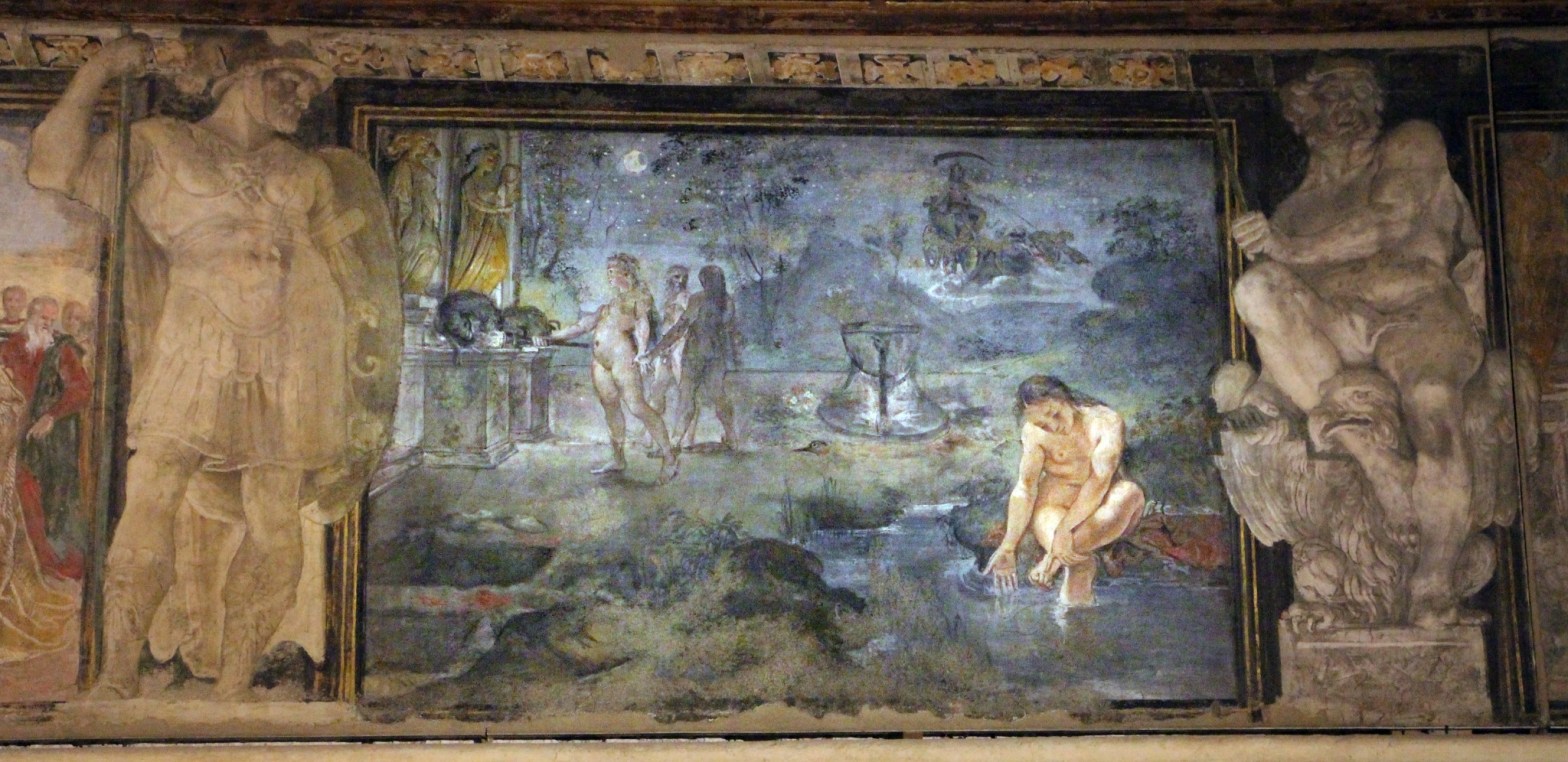
Medea Casts a Spell, the sixteenth scene of the cycle, depicts the preparations undertaken by Medea for the rejuvenation of Jason’s aged father, Aeson. In Book VII of Ovid’s Metamorphoses, Jason asks Medea to prolong his father’s life by transferring some of his own years to him. Medea rejects this proposal but undertakes to restore Aeson’s youth with the assistance of Hecate. Under a full moon, she leaves the palace alone, performs her ritual ablutions and invokes the powers upon which her magic depends. She subsequently travels across Thessaly in a chariot drawn by winged dragons, gathering the ingredients necessary for her preparations. On her return, she erects altars to Hecate and Hebe, the goddess of youth, and performs a series of sacrificial rites.
Several successive moments of Ovid’s narrative are brought together within the nocturnal landscape of the fresco. As Gramaccini explains, Medea appears three times: seated beside the water in the foreground, travelling in her dragon-drawn chariot in the distance and standing before the sacrificial altars. He identifies the two pits as receptacles for the blood of the sacrificial animals and offerings of milk and honey. Yet the water beside which Medea sits has the poetic appearance of a moonlit pool.
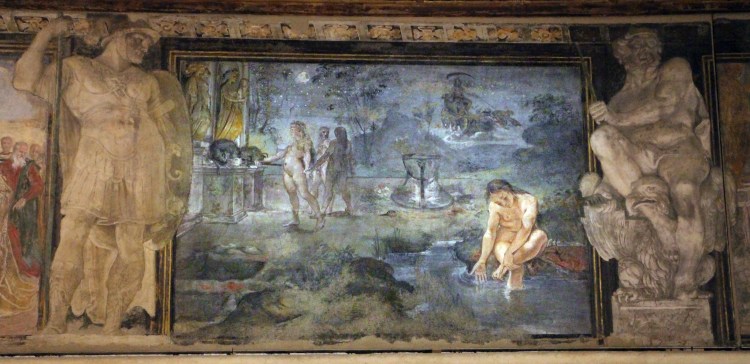
For Gramaccini, the most compelling element of the composition is the seated figure. The painter departs here from Ovid’s account of Medea invoking the gods, an action depicted in René Boyvin’s engraving of 1563. Instead, the scholar sees in the fresco an attempt at psychological characterisation, interpreting the figure as a young woman contemplating her own destiny in the reflections of the water. The solitude and nakedness of Medea reveal the vulnerability of a figure whose extraordinary powers cannot exempt her from the workings of fate. He sees a special significance in the moment chosen for this representation, when the heroic achievements of Jason and Medea are drawing to a close and the tragic part of their story is about to unfold.
Feigenbaum similarly draws attention to the youthfulness and introspection of the figure, whose apparent unawareness of the spectator lends the representation an intimate character. The poetic effect of the scene owes much also to the treatment of the landscape, with its grassy banks, moss and reeds illuminated by the moon. The originality of the figure was recognised by Emiliani, who described it as the first modern female nude in Italian art. Reviewing the 1984 Bologna exhibition, Emil Maurer was reminded of the painting of Courbet and Manet.
Despite the apparent immediacy and naturalness of the figure, Gramaccini identifies its artistic origins in an antique sculpture known as the Ninfa alla spina, now in the Uffizi. A drawing in the Holkham Hall sketchbook, a Renaissance album of studies of antiquities, documents the presence of the sculpture in Rome towards the end of the fifteenth century, while a piece of marquetry at San Michele in Bosco establishes the currency of the motif in early sixteenth-century Bologna. He considers small Renaissance bronzes the most likely means by which the antique model became known to the painter. One such example is the Seated Nymph attributed to Giovanni Paolo Fonduli in the Wallace Collection.
For Gramaccini, the originality of the figure lies in the transformation of an inherited classical model through the direct study of nature. The study of antique sculpture and drawing from life were already established features of academic practice, but the Carracci challenged the conventional hierarchy that privileged the ideal forms of antiquity over those encountered in everyday experience. In the figure of Medea, the classical prototype has been invested with a physical individuality and psychological presence that distinguish it from conventional representations of the mythological nude.
Between Medea Casts a Spell and The Rejuvenation of Aeson stands a remarkable monochrome representation of Jupiter, bearing a thunderbolt and lance and accompanied by an eagle. Its illusionistic qualities were celebrated by Lucio Faberio in his funeral oration for Agostino Carracci, in which he recalled how spectators had climbed up to touch the painted figure, so convincing was the imitation of sculpture.
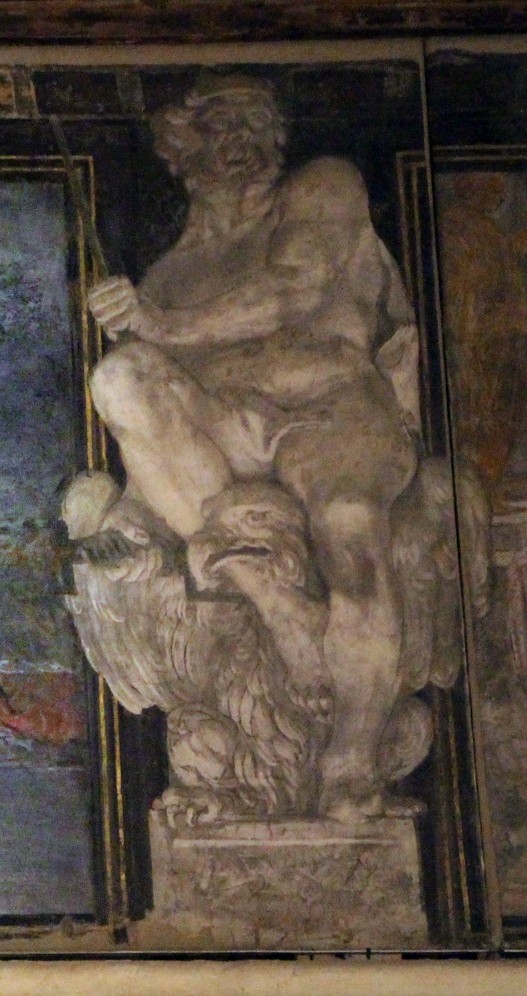
The three deities framing and separating the two narrative scenes are also of iconographic significance. Pagliani suggests that Mars, represented in armour and bearing a lance and shield, evokes the strength and violence that characterise this part of the narrative. Jupiter, as sovereign of the gods, exercises a power over life and death, past and future, comparable to that which Medea exercises in the rejuvenation of Aeson. Saturn, who follows the second scene, is represented as an old man carrying a child on his shoulders, an allusion to his devouring of his own children for fear of being supplanted. Pagliani relates this figure to the theme of usurpation that underlies the adventures of Jason and culminates in Medea’s revenge upon Pelias.
In The Rejuvenation of Aeson, the seventeenth scene of the cycle, the magical preparations of the preceding episode culminate in the restoration of Aeson’s youth. Having induced a profound sleep in the old man, Medea cuts his throat, allowing his blood to drain away before introducing the potion she has prepared. Ovid describes the transformation that ensues: the whiteness of Aeson’s hair and beard disappears, his wrinkles vanish and his body recovers the vigour of his youth.
In contrast to the expansive landscape of the preceding fresco, this scene has a more disciplined compositional structure, reinforced, as Feigenbaum observes, by the wall running parallel to the picture plane. Aeson lies with his head hanging down from the bed, while Medea performs the operation. The cauldron containing the potion, together with a ladle and pieces of firewood, form part of the apparatus of the scene. Feigenbaum relates the ambitious foreshortening of Aeson’s figure to the numerous studies of the human body in similarly demanding poses associated with the life-drawing sessions of the Carracci academy.
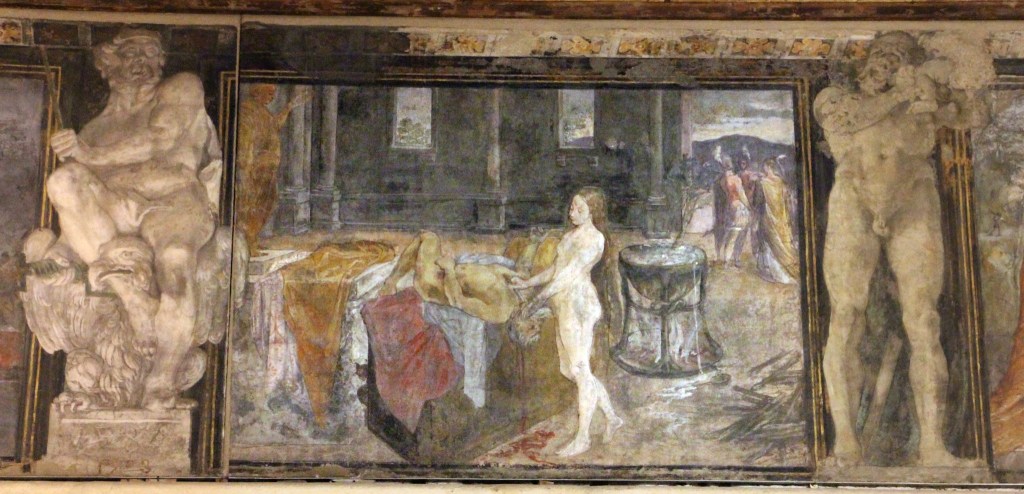
Feigenbaum draws attention to the disconcerting contrast between the violence of Medea’s action and the composure with which she performs it. The youthful figure of the naked sorceress goes about her task in an almost domestic, matter-of-fact manner. Emiliani, meanwhile, draws attention to the extraordinary suspense of the scene.
He brings the two frescoes together in a striking juxtaposition of the cosmos lucidly explored through magic on the night of Medea’s enchantments and the slow anatomical dissection of Aeson. The movement from the nocturnal landscape to the immediate physical reality of the human body finds a parallel in the Renaissance conception of the relationship between macrocosm and microcosm. The knowledge Medea acquires through her exploration of nature enables her to intervene in its processes and reverse the effects of ageing.
Equally compelling is the contrast between the two representations of Medea herself. In the first fresco, the young woman seated beside the water appears vulnerable and absorbed in contemplation; in the second, she exercises her extraordinary powers with remarkable assurance. Together they reveal different aspects of her character without diminishing her mystery. It is in the imaginative and psychological possibilities of the classical narrative, as much as in the formal innovations of the frescoes, that the originality of the Carracci’s achievement resides.
Donate to Inner Surfaces here.
Bibliography
These are the sources. Any errors are mine.
Emiliani, Andrea, ‘Le Storie di Giasone: invenzione e forma’, in Bologna 1584. Gli esordi dei Carracci e gli affreschi di Palazzo Fava, exhibition catalogue (Bologna: Nuova Alfa Editoriale, 1984), pp. XVII–XXIV.
Feigenbaum, Gail, catalogue entries 4–5, in Andrea Emiliani (ed.), Ludovico Carracci, exhibition catalogue, Bologna and Kimbell Art Museum, Fort Worth (Milan and New York: Electa/Abbeville, 1994), pp. 8–10.
Gramaccini, Norberto, ‘La Médée d’Annibale Carracci au Palais Fava’, in Les Carrache et les décors profanes. Actes du colloque de Rome (2–4 octobre 1986) (Rome: École française de Rome, 1988), pp. 491–519.
Malvasia, Carlo Cesare, Felsina pittrice. Vite de’ pittori bolognesi, 2 vols. (Bologna: Tipografia Guidi all’Ancora, 1841; first published 1678).
Mazza, Angelo (ed.), Palazzo Fava. Palazzo delle Esposizioni. Gli affreschi / The Frescoes (Santarcangelo di Romagna: Maggioli, 2019).
Ovid, Metamorphoses, Book VII.
Pagliani, Maria Luigia, ‘Per l’esegesi del ciclo di Giasone’, in Bologna 1584. Gli esordi dei Carracci e gli affreschi di Palazzo Fava, exhibition catalogue (Bologna: Nuova Alfa Editoriale, 1984), pp. 253–273.
Robertson, Clare, The Invention of Annibale Carracci (Milan: Silvana Editoriale, 2008).
Spezzaferro, Luigi, ‘I Carracci e i Fava: alcune ipotesi’, in Bologna 1584. Gli esordi dei Carracci e gli affreschi di Palazzo Fava, exhibition catalogue (Bologna: Nuova Alfa Editoriale, 1984), pp. 275–291.

