We have previously encountered the work of Dosso Dossi (c. 1486–1542) on Inner Surfaces in essays devoted to Apollo and Daphne and Jupiter Painting Butterflies. Born Giovanni Luteri, Dosso was among the leading painters of the Ferrarese Renaissance. His artistic formation was closely associated with Venetian painting, especially Giorgione and Titian, but it was at the court of Alfonso I d’Este, where he was employed from 1514, that he developed his distinctive pictorial language. His paintings combine rich colour, imaginative invention and an affinity with the literary culture of Ferrara, notably the poetry of Ludovico Ariosto.
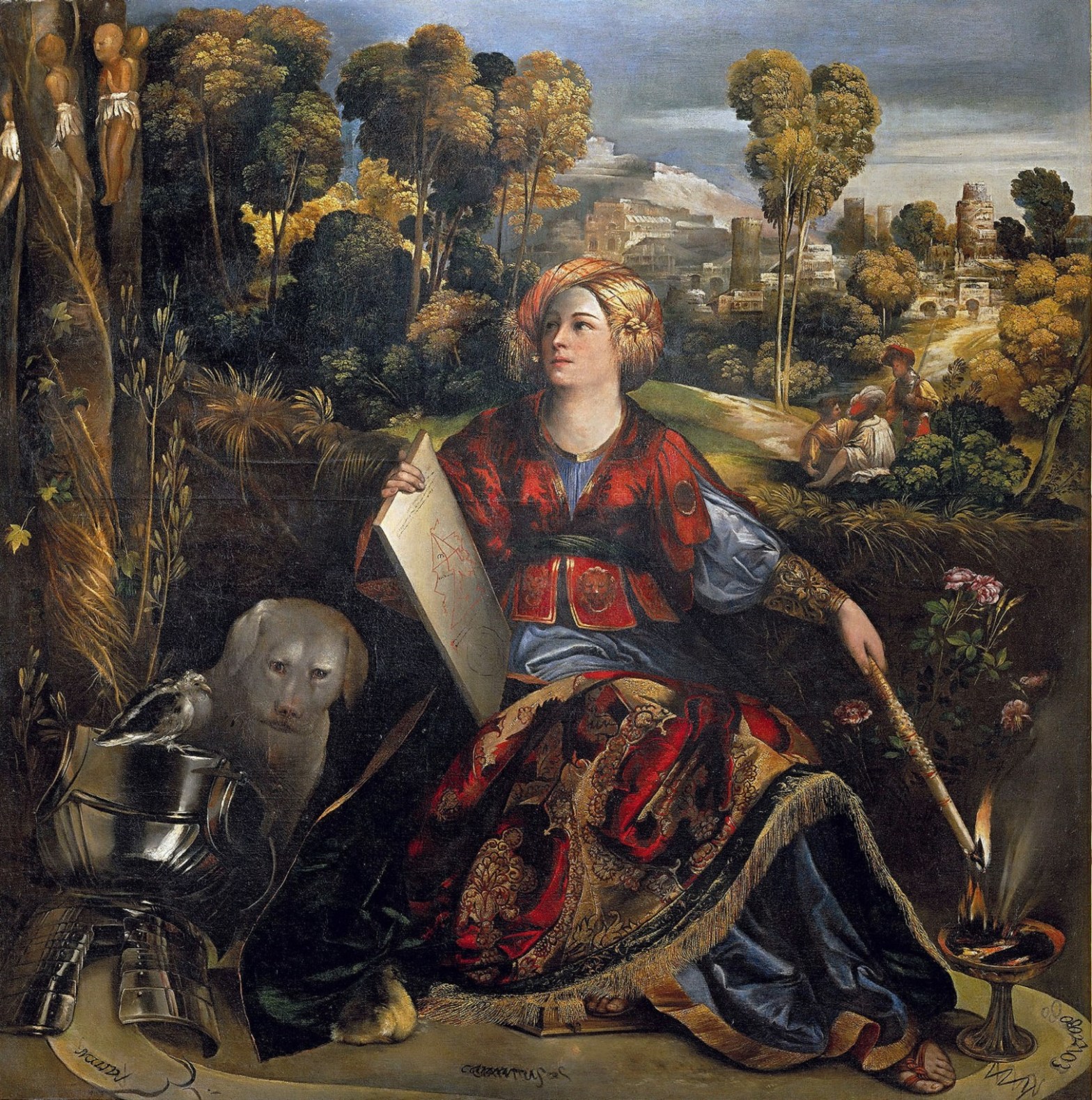
Dosso’s Melissa, an oil painting on canvas measuring 176 × 174 cm, is held in the Galleria Borghese in Rome. Its precise date is uncertain, although most scholars place it in the second half of the 1510s, around 1518, a dating also adopted by the Galleria Borghese. Other proposed dates extend into the early 1520s.
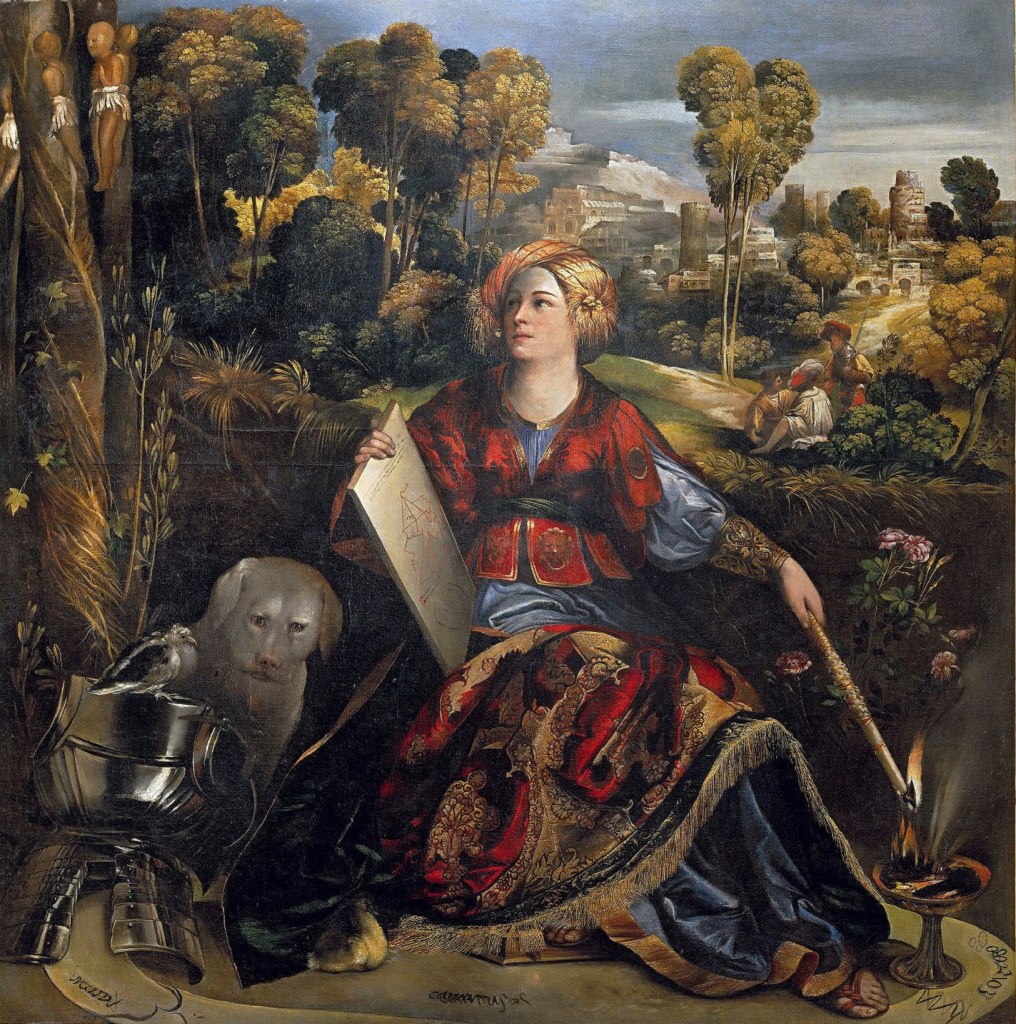
The painting is dominated by a richly dressed female figure seated in a wooded landscape. In her right hand she holds a tablet inscribed with strange geometric symbols, while in her left she carries a torch lowered towards a smoking brazier. She sits within a magic circle, marked with pseudo-Kabbalistic inscriptions, which extends across the lower edge of the composition towards the viewer’s space. To the left of the composition, a large dog emerges from the shadows beside an abandoned breastplate and two birds. Above them, small human-like figures hang from a tree. In the background, three figures appear to be engaged in conversation, with buildings visible in the distant landscape.
The painting’s original destination and commission are undocumented, although it is generally believed to have been made for the Este court and subsequently transferred to Rome. By 1650 it was in the Borghese collection, where Jacopo Manilli described it as a woman performing enchantments. An inventory of 1693 similarly identified the figure as a maga, noting her torch, the dog and other figures, while an inventory of 1765 recorded further details, including the discarded armour and a bird perched above it. Only in an inventory of around 1790 was the enchantress explicitly named Circe, an identification that persisted through the nineteenth century. In 1900, however, the art historian Julius von Schlosser proposed that she was Melissa, the benevolent enchantress of Ludovico Ariosto’s Orlando Furioso. Schlosser’s interpretation gained considerable support during the twentieth century, although the identification has never been universally accepted.
The possible connection with Ariosto’s Orlando Furioso opened new avenues for interpreting the painting, as did the results of an X-radiographic examination undertaken in preparation for the major Dosso Dossi exhibition of 1998. The radiograph revealed that Dosso had originally painted a fully armoured figure on the left, leaning upon a lance and looking towards the enchantress. This figure was subsequently painted out and replaced by the dog, discarded armour, birds and other details visible today. Vincenzo Farinella has proposed that the original composition represented an episode from the third canto of the Orlando Furioso, in which Melissa encounters Bradamante, disguised as a male knight, in the cave of Merlin. There, within a magic circle, Bradamante learns that she and her future husband, Ruggiero, will become the ancestors of the Este dynasty, whose illustrious descendants Melissa reveals to her in a procession of spirits. Farinella identifies the vanished figure as Bradamante and suggests that Dosso subsequently revised the painting to incorporate references to another episode, in the eighth canto, in which Melissa reverses the enchantments of Alcina, a sorceress who seduces knights and transforms them into animals, plants or stones. Melissa restores these victims to human form. In this reading, the magic circle retains its association with the earlier episode, while the animals, abandoned armour and magical objects evoke the later one. The finished painting would thus bring together two distinct moments in Ariosto’s poem, presenting a synoptic image of Melissa’s role as protector of the Este dynasty rather than an illustration of a single episode.
Giancarlo Fiorenza offers a different interpretation, questioning the identification of the enchantress as the benevolent Melissa. He suggests that the armoured figure revealed by X-radiography might instead represent Astolfo, one of the knights seduced by Alcina in Ariosto’s Orlando Furioso. The knight’s absorbed gaze and relaxed posture could suggest submission to the sorceress’s powers rather than an encounter with a protective magician. Fiorenza also considers the landscape in relation to Alcina’s enchanted garden, where apparent beauty conceals captivity and the loss of freedom. The three soldiers in the background, apparently at leisure rather than engaged in heroic activity, contribute to this reading. Such details, together with elements that resist a precise correspondence with Ariosto’s text, complicate attempts to identify a single narrative episode. For Fiorenza, the painting’s ambiguity is closely connected with Dosso’s ability to create a compelling pictorial illusion.
Christopher S. Wood goes further in questioning whether the enchantress represents Melissa, Alcina or even a character from Ariosto’s poem. For Wood, the uncertainty has a wider significance, reflecting a relationship between magical illusion and pictorial representation. Just as enchantment transforms appearances, painting possesses the power to create convincing illusions. As Wood observes, a non-devotional image need not specify precisely what it represents. Its capacity to suggest meanings without resolving them becomes part of its imaginative freedom.
Mauro Lucco approaches Dosso’s inventiveness from a different perspective, emphasising the artist’s humour, fantasy and delight in playful invention. Lucco describes Dosso as an improviser rather than an illustrator: «non è mai un illustratore, quanto piuttosto un improvvisatore». He could compress or expand a narrative, rearrange its episodes and introduce unexpected details. Even when working from a recognisable literary text, «la libertà della messa in scena è totale». Lucco sees this freedom throughout Dosso’s work, accompanied by a lively sense of comedy that could temper the seriousness of a subject. In the Borghese painting, he likens the relationship between the original and revised compositions to a cinematic sequence: the enchantress appears to have performed her spell, causing the armoured figure to disappear and leaving his armour behind. Lucco calls this an «invenzione straordinaria e giocosa», an imaginative transformation that brings Dosso’s painting close to the narrative inventions of Ariosto.
The richness of Melissa also reflects the remarkable range of artistic influences upon which Dosso could draw. His Venetian formation is apparent in the painting’s colour and its treatment of landscape, recalling Giorgione and Titian. Peter Humfrey has compared the enchantress’s facial type with the clothed woman in Titian’s Sacred and Profane Love, while the dog in the left foreground has been connected with Dürer’s engraving of Saint Eustace. The three soldiers in the background, with their broad, feathered hats, have also been related to the appearance of German Landsknechts. Farinella places the landscape within a wider northern tradition, invoking Dürer and Altdorfer alongside the Venetian painters. Christopher S. Wood, meanwhile, identifies the engraved sibyls of Baccio Baldini and Michelangelo’s Sistine sibyls among the models for the enchantress. This accords with Farinella’s broader assessment of Dosso as one of the few Italian painters of his generation capable of assimilating Michelangelo’s example into his own artistic language without being overwhelmed by it.
Dosso’s attention to individual details is equally striking. The enchantress’s richly coloured garments, with their elaborate patterns and fringed borders, contrast with the metal of the abandoned armour. The dog is painted with remarkable attention to its fur and whiskers, while the two birds, flowers and surrounding vegetation receive similarly careful treatment. The small human-like figures suspended from the tree are among the composition’s most curious inventions. Their precise significance remains uncertain: they have been associated with magical practices, while other interpretations connect them with the souls of knights subjected to enchantment. Such details contribute to a painting in which the principal figure shares the spectator’s attention with a wealth of subsidiary objects and natural forms.
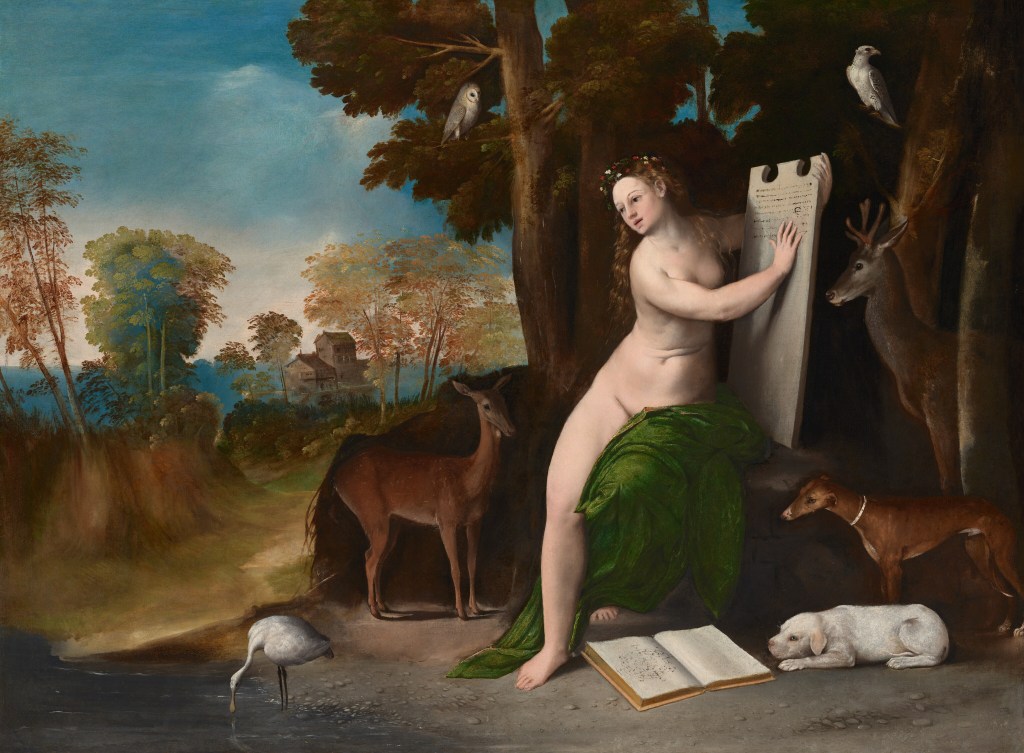
The identity of Dosso’s enchantress seems likely to remain a subject of debate. Even if we dismiss the identification with Circe on the grounds that the sorceress is treated so differently in Dosso’s painting in Washington, we still face the difficulty that the subject of the Washington picture is itself not securely identified. The comparison therefore offers less certainty than it might initially promise. Perhaps the continuing difficulty of identifying the Borghese enchantress is not simply a problem awaiting resolution, but part of what makes the painting so compelling.
Donate to Inner Surfaces here.
Bibliography
These are the sources. Any errors are mine.
Farinella, Vincenzo, ‘Melissa’, Museo nazionale, RAI Radio 3, 1 August 2015.
Fiorenza, Giancarlo, Dosso Dossi: Paintings of Myth, Magic, and the Antique (University Park, PA: Pennsylvania State University Press, 2008), pp. 104–110.
Herrmann Fiore, Kristina, catalogue entry on Dosso Dossi’s Melissa, in Jadranka Bentini and Sergio Guarino (eds.), Il museo senza confini. Dipinti ferraresi del Rinascimento nelle raccolte romane (Milan: Federico Motta, 2002), pp. 132–134.
Humfrey, Peter, catalogue entry on Dosso Dossi’s Melissa, in Andrea Bayer (ed.), Dosso Dossi: Court Painter in Renaissance Ferrara, exhibition catalogue (New York: Metropolitan Museum of Art, 1998), pp. 114–118.
Lucco, Mauro, ‘La magia di Dosso Dossi’, la Repubblica of the Arts, online essay, probably 1998 (publication date unconfirmed).
Wood, Christopher S., ‘Countermagical Combinations by Dosso Dossi’, RES: Anthropology and Aesthetics, nos. 49–50 (Spring–Autumn 2006), pp. 151–170.

