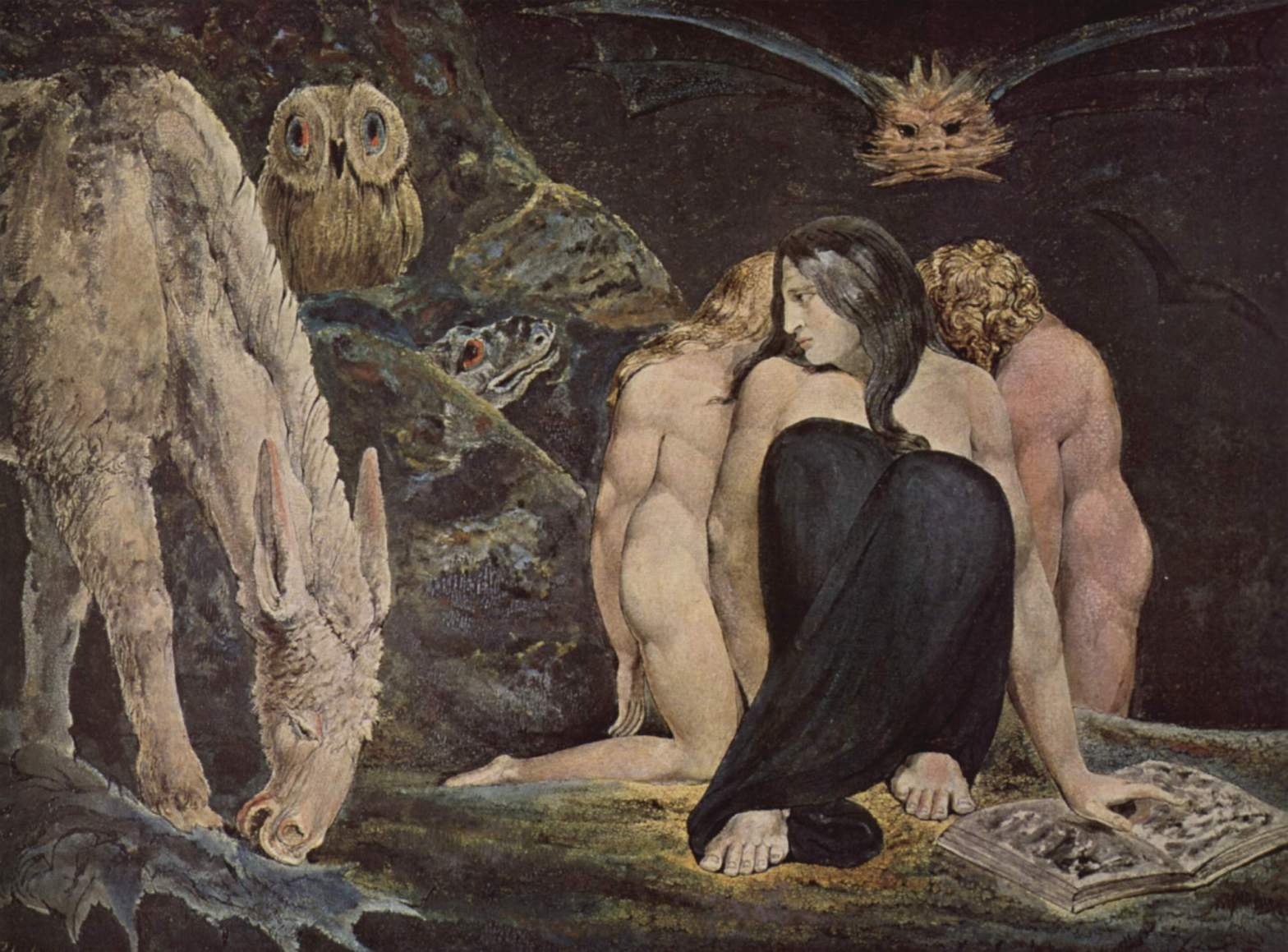
William Blake’s large colour print traditionally known as Hecate, or The Triple Hecate, was made around 1795 as part of a group of twelve large colour-printed designs. Three impressions survive, in the Tate, the Huntington and the National Galleries of Scotland. No title by Blake is known, and the designation Hecate appears to have entered the work’s history only later. The National Galleries of Scotland now exhibits its impression as The Night of Enitharmon’s Joy (formerly called ‘The Triple Hecate’), reflecting a change in interpretation rather than the recovery of an original title.
The central woman has been identified at different times as Hecate, Enitharmon, Medea and Jealousy. The traditional title encouraged viewers to connect the nocturnal setting, the animals and the open book with Hecate, the ancient goddess associated with witchcraft, crossroads and the night. Yet Blake’s composition does not closely follow the usual iconography of the triple goddess, who was commonly represented with three heads or faces, or as three bodies turned in different directions. Here, two youthful figures bend inward beside a seated woman who faces more directly out of the composition.
For much of the twentieth century, the image was interpreted within the larger structure of Blake’s mythology. Anthony Blunt treated the large colour prints as a coherent meditation on the Fall and its consequences. In his account, Hecate represented superstition and priestly authority, one expression of the restrictive order associated with Urizen. Blunt also noted an older Shakespearean strand of interpretation, linking the design either with Macbeth or with Puck’s closing speech in A Midsummer Night’s Dream, though he thought the resemblance to either text slight. Martin Butlin retained much of Blunt’s philosophical framework, relating the open book and the threefold human grouping to Blake’s ideas of the fallen or ‘Vegetative’ world. He also suggested that the design may have been conceived as a pendant to Pity, basing the pairing partly on similarities of signature and colour, while allowing the Shakespearean associations to remain part of the picture’s critical history rather than treating them as secure identifications. Butlin nevertheless warned against turning Blake’s recurrent figures and motifs into a fixed symbolic code. A figure or object might carry associations drawn from Blake’s mythology without being reducible to a single identity or meaning.
Gert Schiff shifted the identification, arguing that the seated woman was Enitharmon, one of the principal figures in Blake’s own mythology. In Europe: A Prophecy, Enitharmon presides over a long period in which religion, sexual restraint and social law become instruments of repression. Christopher Heppner looked instead towards the classical story of Medea. Medea is a sorceress who, after Jason abandons her for another woman, takes revenge by killing their children. Heppner was interested especially in the moment before the murders, when maternal attachment and the desire for vengeance remain in conflict. This suspended moment had attracted other eighteenth-century artists, including James Barry and George Romney, and offered a dramatic structure in which a powerful woman confronts the fate of two vulnerable young figures.
Heppner did not treat Blake’s image as a straightforward illustration of the myth. The two younger figures appear to be a boy and a girl, whereas Medea’s children were conventionally represented as two sons. He therefore draws attention to Erasmus Darwin, the physician, natural philosopher and poet, whose The Loves of the Plants includes a version of the Medea story in which the children are described as a boy and a girl. For Heppner, that variant makes Blake’s sexually differentiated pair less anomalous, while also allowing the Medea narrative to be transformed. The younger figures can suggest not only children subject to an older woman’s power, but the beginnings of an independent relation between male and female youth. Medea’s jealousy and vengeance can then acquire a broader significance, becoming an image of possessive authority acting against a younger generation and the possibility of its own emotional and erotic life.
Medea therefore functions in Heppner’s reading less as a concealed identity than as a narrative structure that Blake may have adapted. The seated woman, the two young figures and the sense of an impending ritual act can be accommodated within the Medea story, while Medea’s identity as a sorceress helps to account for the image’s occult associations. The book, the altered sexes of the younger figures and Blake’s own concerns then shift the image away from literal illustration. Heppner himself leaves the proposal hypothetical. There is no inscription or other surviving evidence that fixes the subject as Medea. The value of the comparison lies instead in the way the myth provides a loose narrative framework through which several features of the image can be read, while Blake’s alterations keep the subject open.
Blake’s large colour prints occupy a space between printmaking and painting. Broad areas of water-based colour, bound with animal glue and gums, were applied to a matrix and transferred to paper under relatively light pressure. Once the impression had dried, Blake worked back into it with pen, ink and watercolour, sharpening forms, reinforcing passages and modifying what the printing process had produced. The final image was therefore neither a conventional print nor a painting reproduced by mechanical means. It emerged through a sequence of painting, transfer and hand-finishing.
Viscomi’s reconstruction of Hecate makes that process tangible. A surviving preliminary drawing, made at about half the scale of the finished design, appears to have served as the basis for the image. Blake then enlarged the composition onto a prepared millboard matrix, probably reinforcing the principal outlines before painting the surface broadly in colour. The characteristic mottling and reticulation visible in the finished impressions were not simply painted effects. They arose in part from the physical separation of paper and matrix as the wet colour was transferred. An element of spontaneity therefore entered at the moment of printing: Blake could prepare the conditions for such effects, but could not determine their precise form. The resulting impression then became something to which he could respond, strengthening, clarifying or altering what the transfer had produced.
The surviving impressions show how variable the process could be. Blake could take more than one pull from a single application of colour, with a second impression receiving less pigment and requiring more extensive finishing. Viscomi identifies the Huntington and Edinburgh impressions of Hecate as first and second sequential pulls. The Tate impression belongs to a separate printing session, made after Blake returned to the matrix and repainted it. Its renewed saturation and finish accord with that reconstruction.
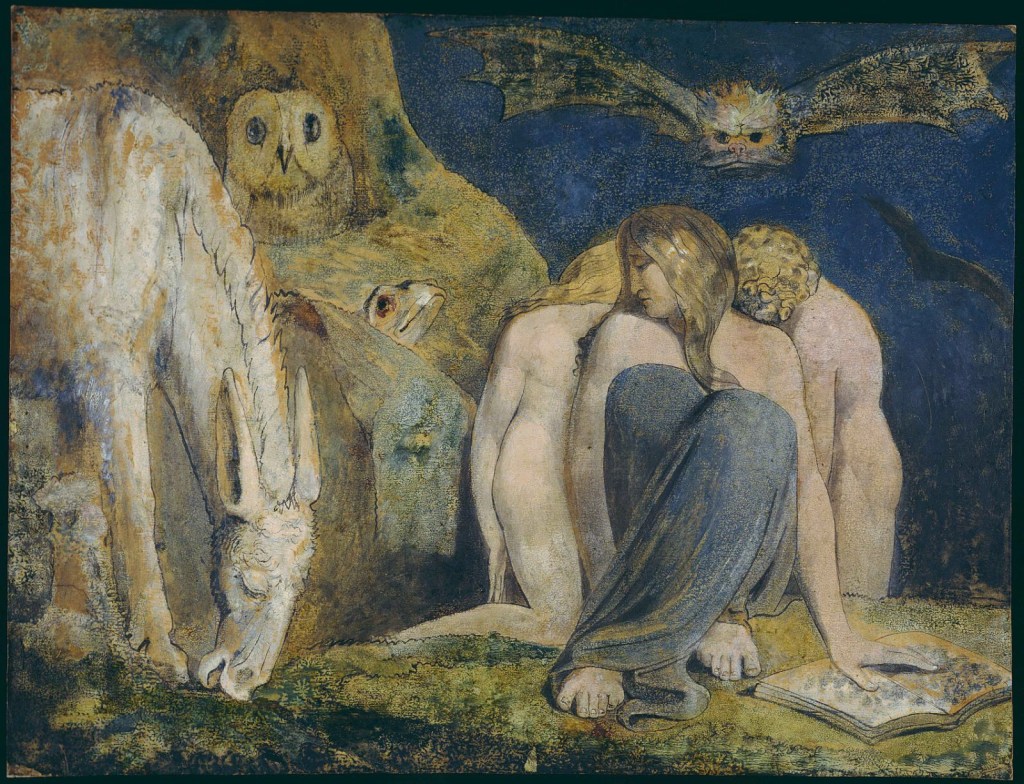
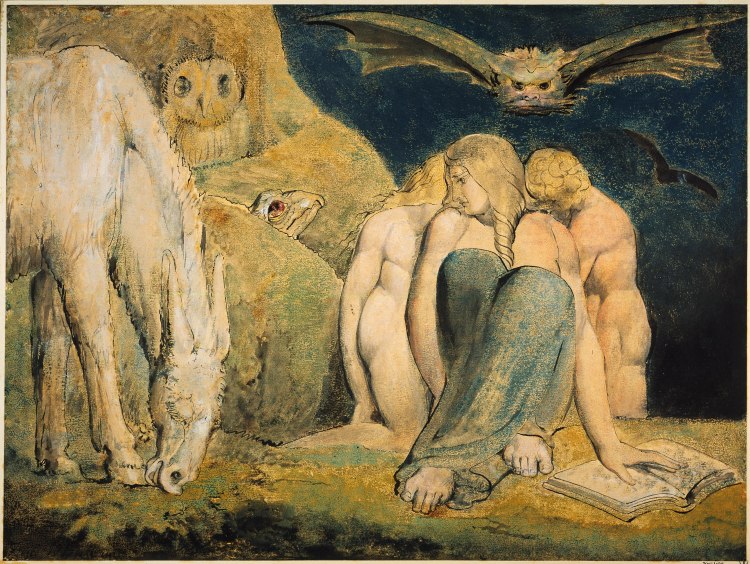
Each impression was consequently an individual object, shaped by the amount and behaviour of the transferred colour and by Blake’s subsequent decisions. Repetition did not produce exact duplication. The same design could emerge differently through successive acts of painting, transfer, separation and hand-finishing, with unforeseen effects generated in the printing process and then absorbed into the finished work.
The material character of the large colour prints also invites comparison with Blake’s own language of material existence, because these works give palpable form to processes of generation, limitation and physical being. In A Blake Dictionary, S. Foster Damon treats ‘Vegetative Existence’ as a condition of material and mortal life: bodily process, generation and existence confined within the natural world. To ‘vegetate’, in this sense, is not simply to belong to plant life, but to enter a world of physical form and limitation. Damon is careful to show that matter itself is not simply evil. The vegetative world is the world of generation, mortality and material process, but it can also contain beauty, vitality and living form.
Damon associates opacity in Blake with a loss of translucence, a condition in which material form no longer reveals spiritual or imaginative reality. Contraction similarly describes existence fixed within bounded form, while expansion belongs to a freer and less restricted state. These oppositions are conceptual rather than a ready-made guide to the appearance of individual works: it would be reductive to identify every dark or dense passage with a fallen condition. Even so, they offer a way of thinking about the physical presence of Hecate. Compared with Blake’s more transparent watercolours and linear designs, its compressed grouping, heavy bodies, darkened setting and dense accumulation of colour give material form an insistent presence.
The human group is both compact and difficult to resolve. The central woman sits with one leg crossed over the other, her body heavily draped below the waist and exposed above it. Her right arm hangs loosely, while the left extends towards the open book. Heppner describes her expression as inward and emotionally withdrawn. The direction of her gaze, however, varies across the surviving impressions and is better considered separately. Her pose is not one of collapse. She remains the dominant figure in the composition, larger than the two younger figures and physically placed between them and the viewer.
The younger pair are harder to read. Their smaller scale, softer bodies and differing physical characteristics led Heppner to identify them as a girl and a boy, probably adolescent rather than infant. Both incline their heads and bodies inward, but their gestures do not disclose a single clear emotion. They may suggest shame, grief, submission or dependence, yet none of those states is securely fixed by the image. Their closeness to one another also gives them a degree of separateness from the seated woman, as though they occupy a private emotional space within the larger group.
That ambiguity extends to the woman’s relation to them. She can be read as the source of their distress, especially if the image is approached through Heppner’s Medea hypothesis or through readings centred on repression and possessiveness. But the composition also allows a less adversarial possibility. Her body partly shields the younger figures from direct view, and their proximity to her can suggest dependence as much as subjection. The image does not force us to choose cleanly between authority and protection, or between threat and shelter.
The group is therefore held together by physical closeness but divided by attention. The younger figures turn inward and downward; the woman is more frontally exposed to the viewer. Their bodies form a single cluster, but their psychological directions do not coincide. That lack of alignment helps explain why the scene can sustain several narratives without settling into one.
The woman directs an explicit gesture towards the open book. Earlier interpretations associated it with Urizen’s Book of Brass. In Blake’s mythology, Urizen embodies the impulse to impose fixed laws and restrictive order upon human existence, and his book contains the commandments through which that order is enforced. Such an identification would therefore make the book in Hecate an emblem of law and constraint. Heppner is more cautious. Rather than assuming that the object must be Urizen’s book, he concentrates on what the woman appears to be doing with it.
For Heppner, a woman with the attributes of a sorceress directing attention towards an open book suggests a performative act, perhaps an invocation or spell. The book would then belong to an action taking place within the scene rather than functioning simply as an emblem placed beside the figure. This also contributes to the sense that the bowed younger figures may be waiting upon something whose outcome has not yet been disclosed.
The gesture is not identical in the three surviving impressions. In the Tate version the index finger is slightly raised and more clearly articulated as a pointing gesture towards the book. In the Huntington and Edinburgh impressions the hand appears instead to hover above it, with less sense of a definite indication. The difference is small but perceptible. In the Tate, the gesture gives the woman’s relation to the book a greater purposefulness without determining what either the book or the action signifies.
The animals and nocturnal creatures surrounding the human group have often encouraged a darker reading of the image. Heppner notes the owl, the ass, the small reptilian creature and the bat-like familiar, but he does not treat them as a single symbolic chorus. He connects the owl, reptilian creature and familiar with associations of darkness, witchcraft, envy, deceit or malignancy, whereas the ass appears elsewhere in Blake in neutral narrative settings and here simply lowers its head to feed.
The creatures also differ in the kinds of attention they bring to the scene. The ass remains absorbed in its own activity. The owl watches. The reptilian head emerges between the rocks, while the bat-like creature hovers above the group. Together they make the setting uncanny, but not uniformly threatening.
The owl has a more specific resonance in Blake’s work. Damon notes that Blake repeatedly reverses its classical association with wisdom, using the bird instead in contexts of false wisdom, unbelief and ominous night. That history makes the owl in Hecate harder to regard as merely decorative. At the same time, Blake’s recurrent symbols do not function as fixed equivalents, so the owl’s presence here cannot simply be translated into a single meaning.
Damon’s account of vegetative existence gives these otherwise varied creatures a common conceptual setting. They differ in function and appearance, but all belong to a world of embodiment, generation, instinct and material limitation. The human figures are visually distinct from them, not least in their chromatic treatment and in the psychological weight carried by their poses and expressions, yet they inhabit the same enclosed nocturnal order. If the composition is understood as an image of fallen existence, the animals help to define the world in which that human drama takes place: one governed by material life and constraint rather than freedom or expansion.
The three surviving impressions do not simply repeat the same image. Differences of colour, finish and definition alter the psychological emphasis of the scene. In the Huntington and Edinburgh impressions, the central woman appears more withdrawn. Her gaze is directed more clearly downwards. The younger figures remain bowed and inward, and the composition as a whole feels less sharply directed.
The Tate impression has a harder and more concentrated presence. The woman’s gaze is slightly higher and less despondent, while the stronger definition of her profile and features gives her face greater firmness. She appears less passive and less like a figure overcome by the world she inhabits. Her gaze may even align approximately with the reptilian head emerging between the rocks, introducing a possible line of attention across the composition.
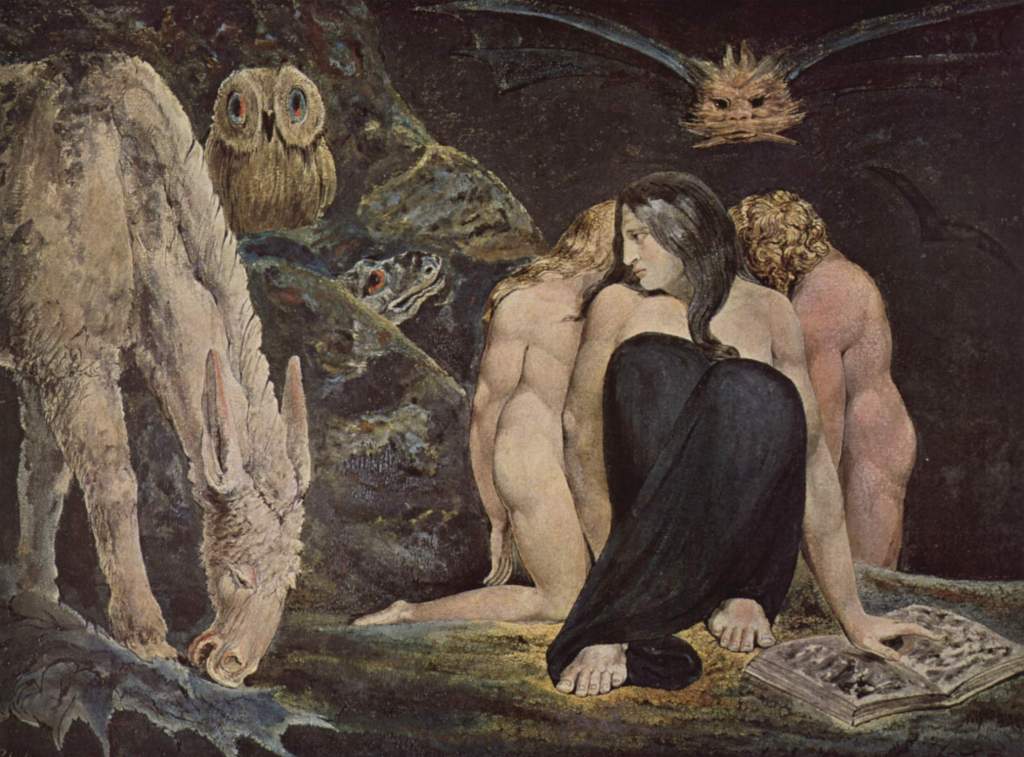
The stronger linear definition of the Tate impression is present throughout the image, but is especially evident in the three human figures, whose musculature and contours are more clearly articulated, giving them greater physical presence. The saturation of colour reinforces that effect. Blake’s own writings assign line a high status. In the Descriptive Catalogue published for his 1809 exhibition, he defended firm, determinate outline as fundamental to artistic form and invoked Raphael, Michelangelo and Dürer among the masters who exemplified this principle. In the Tate Hecate, line, colour and finish combine to give the composition a greater sense of conviction and resolve.
The picture can now be approached less as a problem of identification than as an image of a condition. The bowed younger figures, the open book, the woman’s authority and the surrounding creatures repeatedly return the composition to restriction and arrested possibility, to a world in which action seems constrained rather than freely unfolding.
Yet the figures are not simply passive within this world. The central woman retains beauty, composure and, especially in the Tate impression, a degree of agency. The closeness of the younger pair may suggest an emerging emotional or erotic relation, but their bowed heads and inwardness qualify any sense of desire with shame, modesty or restraint. The image therefore does not oppose constraint to freedom in any simple way; whatever possibility the younger figures carry remains muted and unresolved.
The large colour prints occupy a distinctive place in Blake’s work because they stand independently of an accompanying text. Butlin argued that some of their meanings have to be sensed rather than intellectually recovered, and saw them as the moment when “Blake the artist finally breaks free of Blake the writer”.
John Beer approaches Blake’s imagery from a related direction. Symbols and inherited motifs do not carry fixed meanings but acquire their force through context, relationship and contrast. Meaning emerges from the design as a whole rather than through the decoding of its separate parts. Damrosch’s observation that Blake seeks “to rouse the faculties to act” completes the point: the viewer is invited to perceive and connect rather than merely to identify.
The achievement of Hecate lies in the precision with which Blake can evoke a condition without closing it into a proposition. The image is materially dense, psychologically charged and visually coherent, yet it remains open to more than one account of what its figures are undergoing. Its ambiguity is not a lack of meaning, but one of the means by which meaning remains active.
Producing these essays requires care, time, research, and resources. Contributions to help sustain this exploration would be greatly appreciated.
Donate to Inner Surfaces here.
Bibliography
These are the sources. Any errors are mine.
Beer, John. William Blake: A Literary Life. Basingstoke and London: Palgrave Macmillan, 2005.
Blake, William. The Complete Poetry and Prose of William Blake. Edited by David V. Erdman, with commentary by Harold Bloom. Newly revised edition. Berkeley: University of California Press, 1982.
Blunt, Anthony. The Art of William Blake. London: Oxford University Press, 1959.
Butlin, Martin. William Blake. London: Tate Gallery Publications, 1978.
Damon, S. Foster. A Blake Dictionary: The Ideas and Symbols of William Blake. Providence, RI: Brown University Press, 1965.
Damrosch, Leo. Eternity’s Sunrise: The Imaginative World of William Blake. New Haven and London: Yale University Press, 2015.
Heppner, Christopher. Reading Blake’s Designs. Cambridge: Cambridge University Press, 1995.
Schiff, Gert. ‘The Night of Enitharmon’s Joy: Catalogue Entry’. Edited by Morton D. Paley. Blake/An Illustrated Quarterly 36, no. 1 (Summer 2002), pp. 38–39.
Viscomi, Joseph. William Blake’s Printed Paintings: Methods, Origins, Meanings. London: Paul Mellon Centre for Studies in British Art, 2021.
Online collection records
National Galleries of Scotland. William Blake, The Night of Enitharmon’s Joy (formerly called ‘The Triple Hecate’). Collection record.
The Huntington Library, Art Museum, and Botanical Gardens. William Blake, The Night of Enitharmon’s Joy. Collection record, accession no. 000.126.

