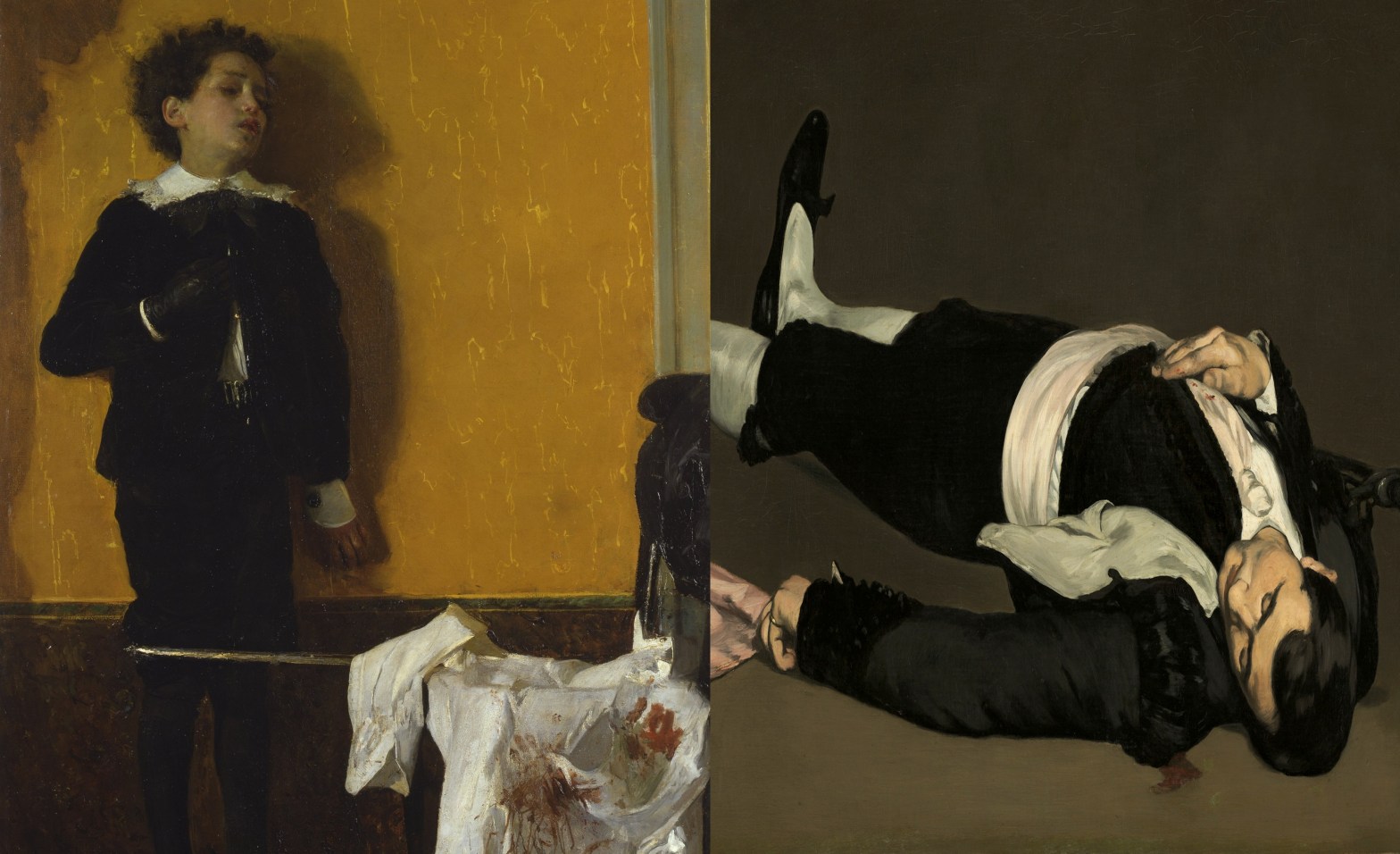
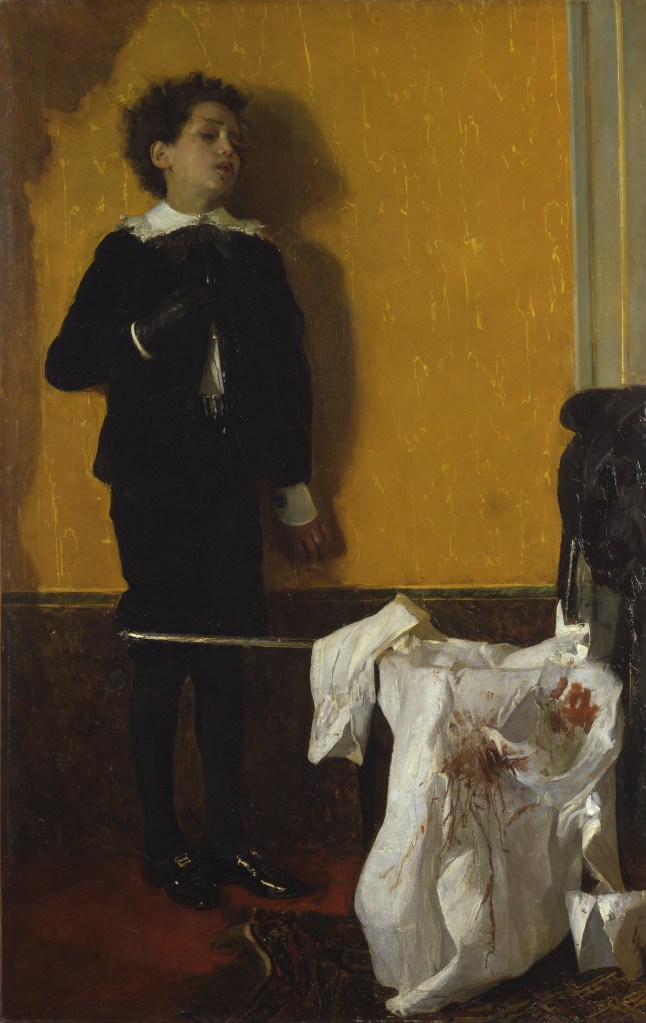
At first glance, Antonio Mancini’s Dopo il duello (1872) and Édouard Manet’s Dead Toreador (c. 1864; exhibited independently as L’Homme mort in 1867) appear to belong to quite different pictorial worlds. Mancini’s painting centres on the frightened reaction of a child confronted with the aftermath of a duel, while Manet’s image presents the body of a fallen matador isolated from the spectacle of the bullfight. The two works might therefore seem to address entirely different artistic concerns. Yet there is something to be gained by placing them side by side. Both paintings engage with forms of violence that were socially sanctioned within nineteenth-century culture: the duel and the bullfight. Each belonged to elaborate codes of honour or spectacle that combined ceremony with brutality and persisted within societies that increasingly regarded such traditions with ambivalence.
During the nineteenth century such practices often attracted artists for their dramatic content, but perhaps also because they appeared to preserve forms of behaviour that lay outside the increasingly regulated structures of modern society. Rituals such as duelling or bullfighting seemed to belong to an older world of honour, instinct and personal impulse, one that had not yet been entirely absorbed into the disciplined rhythms of bourgeois and industrial life. For artists and writers alike, these traditions could appear to offer authenticity. They offered the opportunity to portray scenes in which individual passion or courage was expressed in its most immediate form. Yet this attraction was inseparable from a corresponding unease. The same actions that promised a more authentic human experience also exposed the persistence of violence beneath the surface of modern civilisation.
What is striking here, however, is that neither artist represents the act itself. In both works the violence lies outside the frame. Mancini shows only the traces of the duel and the shocked reaction of a witness, while Manet presents the still body of the torero after the spectacle has ended. The two paintings therefore approach violence not through action but through its consequences.
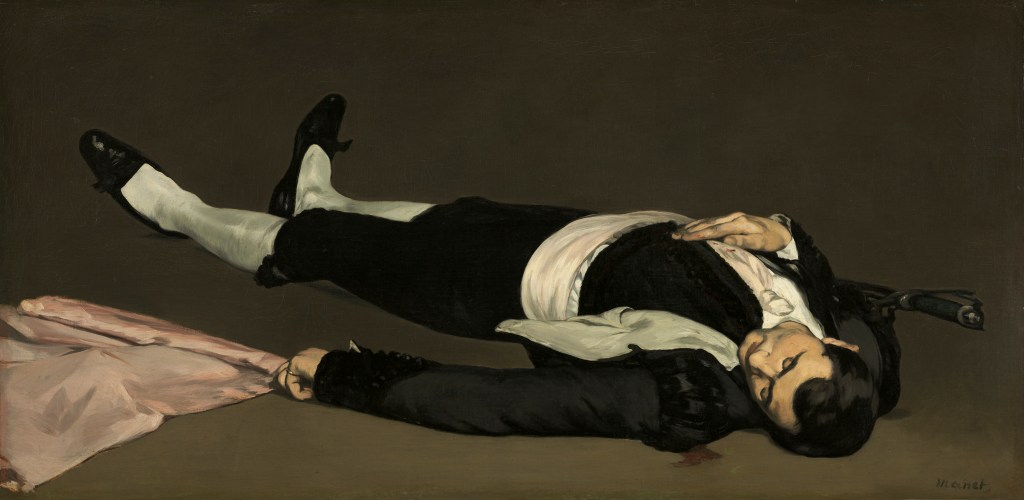
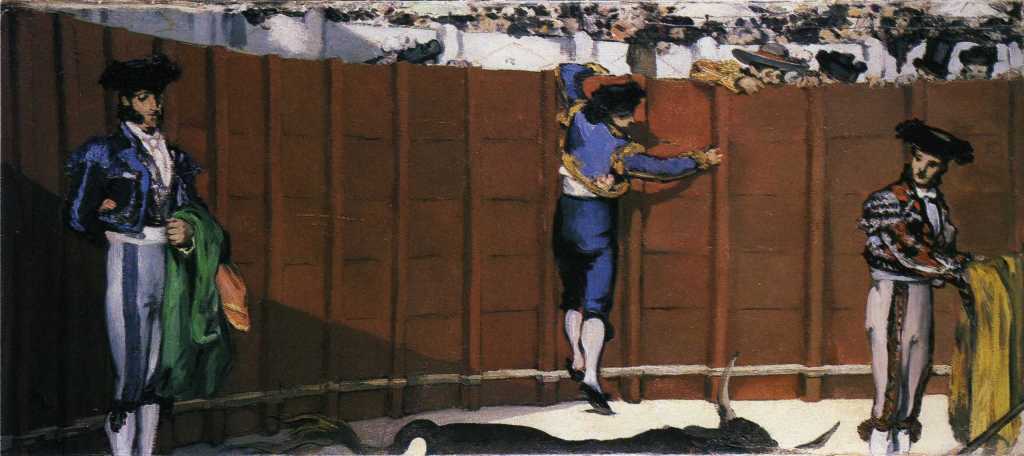
The apparent composure of Manet’s fallen matador, whose sobriety of line and colour gives the figure an almost classical stillness, belies the troubled history of its creation. The figure originates in a larger composition exhibited at the Salon of 1864 under the title Episode d’une course de taureaux, painted at the same time as The Dead Christ with Angels. The bullfight scene provoked ridicule from critics and the public, who objected to its awkward perspective and the disproportionate scale of its figures, declaring that it was evident Manet had never witnessed a bullfight. In fact, he did not see one until travelling to Spain in 1865, and bullfighting itself was prohibited in Paris under the Second Empire; the scene therefore appears to have been constructed largely from written descriptions and visual sources, including prints such as Francisco de Goya’s Tauromaquia (a set of thirty-three prints created between 1815 and 1816).
Dissatisfied with the reception of the painting, Manet subsequently cut the canvas apart. Two principal fragments survive: the figure he referred to as L’Homme mort, now known as Dead Toreador, and another section of the corrida now in the Frick Collection in New York. Technical examination and X-radiography have confirmed that both fragments once formed part of the same canvas and that the composition underwent numerous revisions even before it was exhibited. From an original narrative composition of about 126 × 168 cm, Manet isolated the fallen matador and reworked it into a canvas of roughly 76 × 150 cm, thereby transforming an anecdotal bullfight scene into a far more concentrated and monumental image. At his independent exhibition of 1867 he emphasised its broader significance by giving it the title L’Homme mort.
The pose of the fallen matador has long been associated with a painting then attributed to Diego Velázquez representing a dead soldier, formerly in the Pourtalès collection in Paris and now in the National Gallery, London (A Dead Soldier). The critic Théophile Thoré first suggested that Manet had borrowed the figure from this work, a suggestion vigorously rejected by Charles Baudelaire. The attribution of the painting to Velázquez has since been abandoned, and it is now generally regarded as the work of an unknown Italian artist of the seventeenth century, possibly of the Neapolitan school. Its stark naturalism, sombre tonality, and vanitas imagery belong to the Caravaggesque tradition of the Baroque.
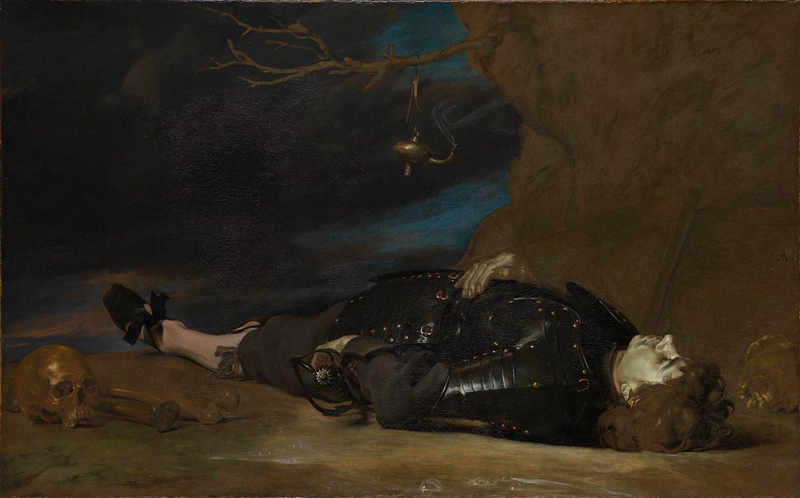
A Dead Soldier
17th century
Oil on canvas, 104.8 x 167 cm
Bought, 1865
NG741
https://www.nationalgallery.org.uk/paintings/NG741
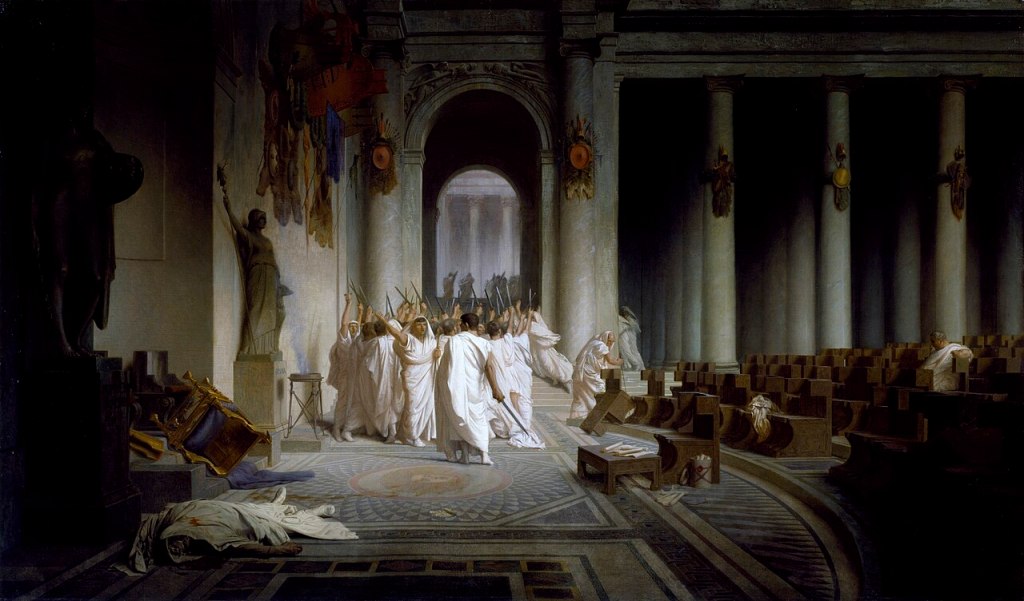
The compositional relationship between the two works is nevertheless striking. In both, the body lies diagonally across the picture surface in a strongly foreshortened pose, the limbs loosely extended and the figure presented in isolation against a relatively neutral ground. Whether known from the original painting or from a widely circulated photograph, the image may well have provided a visual precedent for Manet. Other comparisons have been proposed, including Gérôme’s The Death of Caesar, which offers a visual analogue in its treatment of the fallen figure, albeit within a fully articulated historical scene, or one of Jean Gigoux’s illustrations for Gil Blas de Santillane. The fallen torero, however, ultimately belongs to a broader tradition of the dead warrior.
Stripped of the spectacle of the corrida and presented in isolation, Manet’s fragment transforms the matador into a stark and archetypal image of the fallen combatant. His treatment also recalls a pictorial device associated with Velázquez himself: the placement of figures within an indeterminate spatial field that resists precise narrative definition. In Dead Toreador, the absence of the arena, the crowd and the bull produces a similar effect. The figure lies in a suspended pictorial space from which the original narrative context has disappeared. The spectacle of the corrida collapses into a single visual fact: the presence of the body.
More broadly, the painting retains something of the tonal gravity and restraint associated with seventeenth-century Spanish and Italian painting. The dark ground, the controlled palette, and the isolation of the figure recall a Seicento tradition in which the human body is presented with a sober and unembellished intensity. Yet in Manet this inheritance is transformed. The metaphysical and religious frameworks that once sustained such imagery have receded, leaving behind a form of pictorial seriousness detached from its original explanatory structures. What remains is an austere presentation of the body, at once historically inflected and unmistakably modern.
Anne Coffin Hanson, in her study of Manet’s engagement with the modern tradition, notes the frequent juxtaposition of The Dead Toreador with Rue Transnonain, le 15 avril 1834, Honoré Daumier’s lithograph of the aftermath of a massacre carried out by government troops in Paris in April 1834, in which political violence is embedded in a precisely defined circumstance. She concludes, however, that the comparison ultimately fails, above all because of Manet’s suppression of narrative particularity. The figure is no longer anchored to an identifiable circumstance, nor does it function, as it would in academic painting, as part of a larger historical sequence.
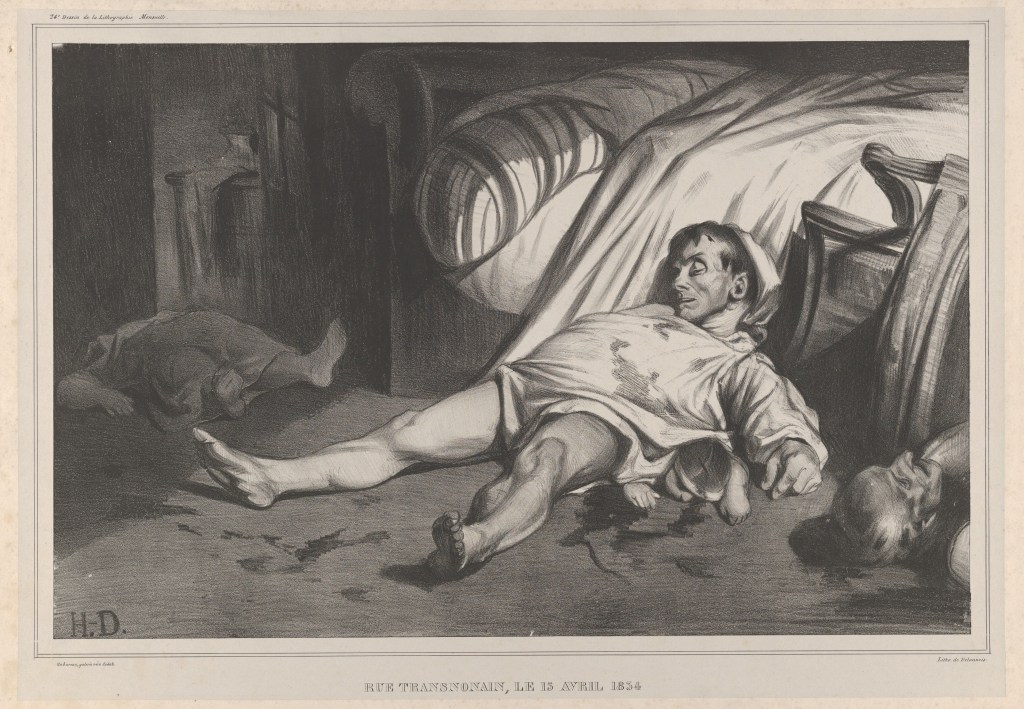
Rue Transnonain, le 15 Avril, 1834, August–September 1834
French,
Lithograph; image: 11 1/4 x 17 3/8 in. (28.6 x 44.1 cm) sheet: 14 5/16 x 21 11/16 in. (36.4 x 55.1 cm)
The Metropolitan Museum of Art, New York, Rogers Fund, 1920 (20.23)
http://www.metmuseum.org/Collections/search-the-collections/365806
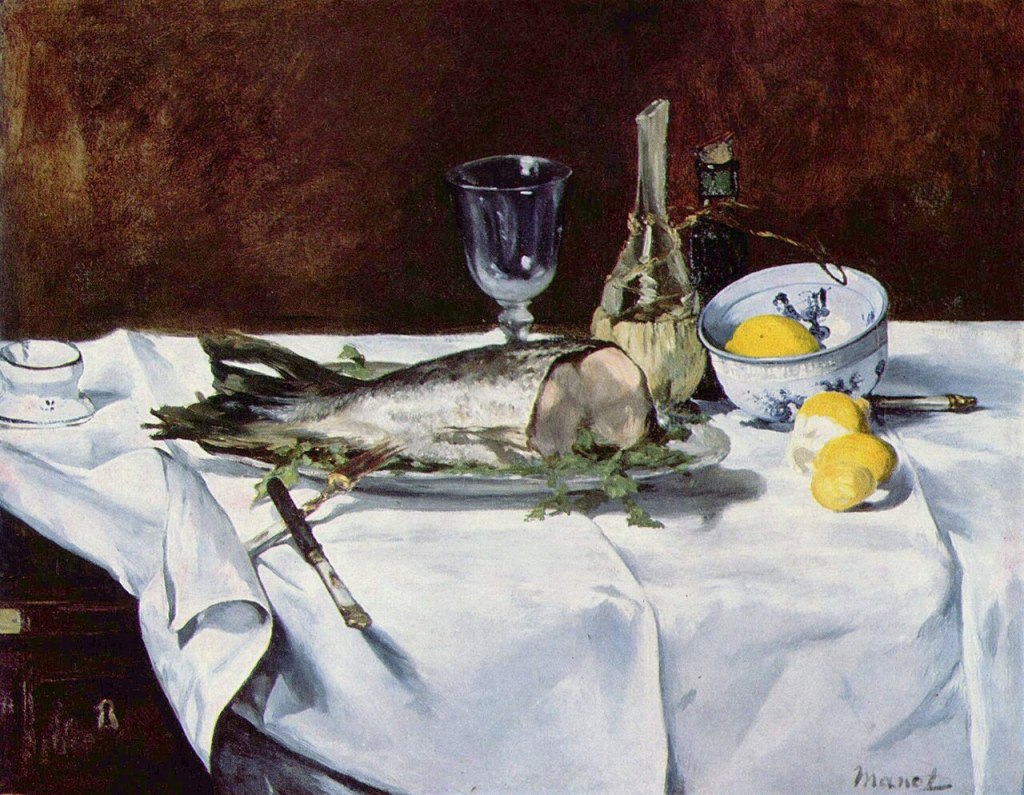
As Linda Nochlin observed, this isolation removes Manet’s work from any larger metaphysical structure. Death is presented simply as a visual fact. The painting functions almost like a still life: the term nature morte might apply as readily to the fallen matador as to one of his contemporary studies of dead fish. In both cases the subject simply stands alone: the ‘torero is defined by his costume and a discreet patch of blood, as is the salmon by his scales and his parsley.’
A remark made by Charles Baudelaire in his essay on Eugène Delacroix can be used to illuminate the figure of the Dead Toreador from another angle. Baudelaire observed that a well-drawn figure may inspire a pleasure entirely independent of the subject it represents. ‘The limbs of a martyr being flayed alive or the body of a nymph in a swoon,’ he wrote, ‘provided they are skilfully drawn, offer a species of pleasure in which the nature of the subject counts for nothing.’ What gives the figure its power is the pattern it traces in space. In Manet’s painting, the fallen torero possesses precisely this kind of formal clarity. The compositional elegance of the figure and his exquisitely rendered costume seem almost detached from the violence it implies. At the same time the calmness of the image deflates the theatrical heroism of the bullfight. The pageantry of courage and ritual ends not in dramatic triumph but in an austere silence.
Emily Beeny, in her article “Christ and the Angels, Manet, the Morgue, and the Death of History Painting?”, sharpens this shift by situating Manet’s work within the conditions of modern spectatorship. In the mid-1860s, when Manet exhibited both Christ and the Angels and the Dead Toreador, the Salon and the Paris morgue existed in uneasy proximity as sites of public display. The industrial age, combined with the Haussmannisation of Paris, attracted labour in from the rural regions and saw an increase in the number of accidental deaths.
After death by drowning, there was a long list of ways in which the vulnerable and hapless could meet their end: ‘crushing by carriages, falls from high places, collapses, scaldings, machine explosions, and railway accidents, suffocations by smoke, harmful effects of gas, smotherings in crowds, lightning, poisoning, drunkenness, and cold.’ Beyond this, ‘of the 2,851 adults received at the morgue between 1853 and 1863, almost half were suicides.’ The clean line of modernity had a brutal edge.
Mortality on an industrial scale required a state-of-the-art response. It was not merely a question of dealing with the number of corpses but of establishing their identity; this was difficult, as many were strangers to the city. So the Paris morgue, as it rose, ‘was modern, ample, well lit, and well ventilated. It included autopsy rooms, sanitation facilities, administrative offices and accommodation for twenty-four-hour surveillance personnel.’ With a theatrical twist, there were also enormous green curtains, which would be drawn across the display room’s window every time a fresh display of bodies was being installed.
Of course, many of those who visited were not there to identify someone lost. There were the curious, who found themselves subject to other types of seeing, including, as Dickens wrote in 1863, ‘a much more general, purposeless, vacant staring … like looking at a waxwork, without a catalogue, and not knowing what to make of it.’
With all this in mind, we can see how contemporary Manet’s toreador would have appeared. Against the academic tradition, which treated the body as a rhetorical vehicle of moral and narrative meaning, Manet presents his figure as a stark, material presence, stripped of expressive agency. This also ran parallel with Émile Zola’s emerging naturalism—most notably in Thérèse Raquin (1867), where human behaviour is conceived in terms of physical and nervous response rather than moral interiority—producing a form of vision uninflected by moral meaning, in which the viewer confronts the body as sheer “there-ness”—intensely visible yet resistant to interpretation.
In Mancini’s Dopo il duello, the focus shifts from the body itself to the reaction it provokes. Mancini abandons the quiet domestic atmosphere of many of his child subjects and instead depicts the model Luigi Gianchetti, known as Luigiello, petrified with fear at the edge of some unnamed melodrama. A blood-stained white shirt and the emerging point of a sword indicate the tragic aftermath of a duel. The scene is presented with the boy’s trauma at its heart, and it is all the more harrowing for that. The boy’s innocence and lack of agency elicit more sympathy than the more expected depiction of an adult facing the consequences of his choices. As it is, the adult victim remains unseen. There is an ominous shadow on the wall, but who has cast it, and whether it signifies the possibility of consolation or menace, is unknown.
The boy’s formal dress plays a crucial role in this configuration. The elegant black suit and lace-trimmed collar place him uneasily within the ceremonial world of adult honour, the very sphere to which the duel belongs. The sober costume, which recurs in other works for which Luigiello served as model, does not belong to the child’s real-life poverty, but to the staged space of the studio.
The formal clothing might suggest that he had been prepared—encouraged, even—to witness the unfolding of the duel, as if he were dressed smartly for the event, only to be exposed to the bloodiness of an adult world that should have sheltered him. There is also the fact that he has one gloved hand and one left bare, a small detail that nonetheless draws our attention. This is a motif that appears elsewhere in Mancini’s work and, as such, may simply reflect the inclusion of a bravura touch—something he knew he could execute well. It also accords with the ritualised gestures of duelling: the gauntlet is closely associated with a duel. To a viewer, this too might suggest the poignant possibility of childlike emulation of, and aspiration towards, the adult world—one that will meet with cruel disillusionment.
The emotional tenor of the painting recalls the expressive world of the Neapolitan Seicento. The event unfolds within a shallow interior space and is organised around a restrained but expressive palette. The boy’s black suit, echoed by the dark tonality of a chair and by areas of shadow, contrasts sharply with the blood-stained white shirt draped over its back. The silver blade of the sword provides a narrow linear accent. Behind the figure rises an amber-coloured wall bordered to the right by a celadon-toned vertical plaster band. The strong shadow cast upon the wall suggests the presence of an unseen adult figure beyond the frame, intensifying the emotional tension of the scene. The identity of this off-stage presence remains ambiguous, just as the precise circumstances of the duel are left undefined.
The stark contrasts of black and white, the use of amber and red, and the dramatic deployment of shadow evoke a pictorial language in which affect is intensified through colour and light. We have a sensibility of Seicento gravity, combined with the setting and mood of a nineteenth-century melodrama. There is something of the Neapolitan tradition here, but Mancini does not attempt to reproduce the complex narrative structures of seventeenth-century painting; instead, he isolates and condenses its emotional charge.
This sensibility is not confined to Dopo il duello alone, but also appears in a work of the preceding year, Vestire gli ignudi (1871). This drawing was executed as a prize-winning academic exercise at the Accademia di Belle Arti di Napoli and, arguably, it encapsulates the same tension between inherited pictorial gravity and modern immediacy. Like Dopo il duello, it occupies a fascinating but elusive position between historical modes of representation and contemporary experience. It retains something of the moral seriousness and intensity of the seventeenth century while translating these into a modern moment.
Manuel Carrera has suggested a connection between Mancini’s Vestire gli ignudi and Caravaggio’s Seven Works of Mercy. Such a connection is persuasive, provided it is understood in ethical and emotional terms, rather than a statement about artistic form. Of course, Mancini does not engage directly with Caravaggio’s complex multi-figure construction, but he does isolate a single act of charity and renders it with a directness closer to nineteenth-century social observation. The affinity lies in a shared moral premise: the insistence that poverty and exposure demand recognition.
In this respect, Vestire gli ignudi translates a theological act of mercy into a contemporary human encounter, focused on the immediacy of a child in need. For Mancini, such subject matter would also have been personally immediate; he grew up in conditions of hardship. The act of charity, though framed within an academic exercise, also carries experiential urgency. This aspect of Mancini’s formation is discussed in more detail elsewhere on Inner Surfaces, in Antonio Mancini – Hunger and Fame (La fame e la fama).
Carrera also notes the existence of Caravaggio’s legendary status in Naples beyond the field of painting. He refers to the staging in the early 1850s, at the Teatro San Ferdinando, of a drama entitled Michelangelo da Caravaggio by Luigi Marta. This suggests a broader Neapolitan context in which Caravaggio could be reimagined in explicitly dramatic terms. Such forms of popular theatre would have been shaped by melodrama, a mixture of seriousness and sensationalism: a world very close to Dopo il duello.
In The Melodramatic Imagination, a study of French melodramatic traditions, Peter Brooks describes melodrama as a post-Revolutionary mode in which gesture, posture, and tableau serve to make moral and emotional truth immediately visible. Against the classical theatre of the seventeenth century, in which meaning was primarily articulated through speech, melodrama shifts emphasis toward the visual and the physical. The stage becomes a space in which action is repeatedly arrested in composed configurations, conveying emotional participation with an immediacy that transcends language.
This emphasis on tableau points to a broader nineteenth-century visual logic shared with academic history painting, in which figures are arranged into expressive groupings designed to communicate narrative and affect with force. In part, melodrama emerges from a growing mistrust of language, already articulated by Denis Diderot and Jean-Jacques Rousseau. At moments of intense passion, language falters: what moves us are cries, broken phrases and the visible signs of the body in action.
Melodrama is thus structured by a paradox. It seeks to make meaning explicit, yet repeatedly stages situations in which meaning cannot be fully articulated. This tension is embodied through the inclusion of mute characters in some melodramatic plays, whose inability to speak might be emblematic of innocence unable to defend itself. Thus meaning exists as an urgent presence, yet is blocked from expression.
Seen in this light, Dopo il duello may be understood as a kind of mute image. The boy’s fear and shock are intensely present, yet resist narrative clarification or verbal articulation. The figure appears theatrically staged within a confined but solitary domestic space, producing a compressed, almost unreal tableau in which emotion is concentrated rather than resolved.
If, as Peter Brooks suggests, melodrama fixes meaning in moments of arrested gesture, this logic—already apparent in the late eighteenth and early nineteenth centuries—extends into a wider nineteenth-century visual culture encompassing theatre, print, and painting. Scenes of crisis are repeatedly rendered as immediately graspable arrangements of bodies, in which gesture carries the burden of meaning, and narrative is condensed into a single instant. Gérôme’s Suite d’un bal masqué (The Duel After the Masquerade) offers one instance: the duel itself is withheld, and the aftermath is presented through the disposition of figures. In this aftermath of violence, we see a wounded Pierrot who, presumably in a lovelorn state, has entered an arena for which he is wholly unsuited. We witness the consequences: Pierrot, supported, seems gravely wounded, while, after an easy victory, his adversary withdraws indifferently, already engaged in conversation about something else.
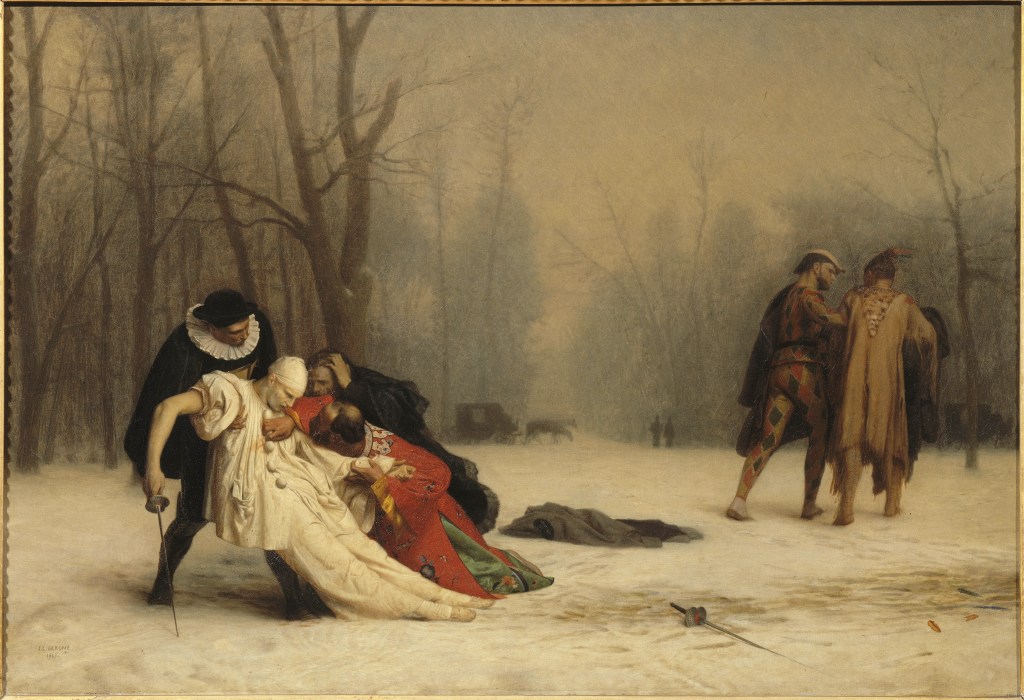
Mancini’s image, though stripped of overt theatrical framing, operates within the same economy of expression. The body is the primary vehicle of sense, and the scene is felt at once in its intensity, even as its full meaning remains even more remote than that of Gérôme’s Pierrot.
Children were, of course, essential to nineteenth-century literary melodrama. This theme is explored in Martha Vicinus’ study ‘“Helpless and Unfriended”: Nineteenth-Century Domestic Melodrama’. Vicinus observes that, while the uncertainty of industrial and social change could be counterbalanced by life in the domestic sphere, this refuge could also become a place of instability. When the struggle between good and evil, stability and instability, enters the home, it is naturally the children who are most vulnerable to neglect and exploitation. At the same time, in literary narratives, they represent both fragility and endurance. Their suffering exposes moral failure and, in itself, condemns the guilty. What is more, in the Manichaean world of literary melodrama, the child’s suffering reveals an indestructible example of virtue. In this genre, they are ‘preternaturally wise and innocent’: they know and suffer beyond their years, but become emotional and moral saviours within the narrative.
Manet’s and Mancini’s paintings share a peculiar modernity in their tragic atmosphere. Both evoke the emotional intensity traditionally associated with tragedy, but there is no firm anagnorisis, either for the subject or for the viewer. In both cases, the meaning expected by tradition is absent. We are left in a moment of silent suspense; we are given a cropped frame and a frozen narrative. We may not need an Aristotelian term for the uncanny silence, the mysterious voicelessness that follows devastation or error. It is perhaps the most articulate message available.
[Producing these essays requires care, time, research, and resources. Contributions to help sustain this exploration would be greatly appreciated.]
https://donorbox.org/inner-surfaces-resonances-in-art-and-literature-837503
Bibliography
All errors are mine. The sources for this essay are as follows.
Baudelaire, Charles, Selected Writings on Art and Literature, trans. P. E. Charvet, London, 1972.
Beeny, Emily A., ‘Christ and the Angels: Manet, the Morgue, and the Death of History Painting?’, Representations, 122.1 (2013), 51–82.
Brooks, Peter, The Melodramatic Imagination, New Haven and London, 1976 (1995 edn).
Cachin, Françoise, Charles S. Moffett and Juliet Wilson-Bareau, Manet 1832–1883, exhibition catalogue, Paris, Galeries nationales du Grand Palais; New York, Metropolitan Museum of Art, New York, 1983.
Carrera, Manuel, ‘La pittura di Antonio Mancini e il collezionismo internazionale con nuovi documenti e un’opera ritrovata’, in Antonio Mancini, Vincenzo Gemito, ed. Manuel Carrera, Fernando Mazzocca, Carlo Sisi and Isabella Valente, Milan, 2023.
Cecchi, Dario, Mancini, Turin, 1966.
Davis, John A., Italy in the Nineteenth Century, Oxford, 2000.
Eagleton, Terry, Sweet Violence: The Idea of the Tragic, Oxford, 2003.
Hanson, Anne Coffin, Monet and the Modern Tradition, New Haven and London, 1977.
Hiesinger, Ulrich W., Antonio Mancini: Nineteenth-Century Italian Master, Philadelphia, 2007.
Nochlin, Linda, Realism, London, 1971.
Nochlin, Linda, Misère: The Visual Representation of Misery in the Nineteenth Century, London, 2018.
Antonio Mancini, Vincenzo Gemito, ed. Manuel Carrera, Fernando Mazzocca, Carlo Sisi and Isabella Valente, Milan, 2023.
Virno, Cinzia, Antonio Mancini, Catalogo ragionato dell’opera: La pittura a olio, 2 vols, Rome, 2019.
Vicinus, Martha, ‘“Helpless and Unfriended”: Nineteenth-Century Domestic Melodrama’, New Literary History, 13.1 (Autumn 1981), 127–143.
 Inner Surfaces