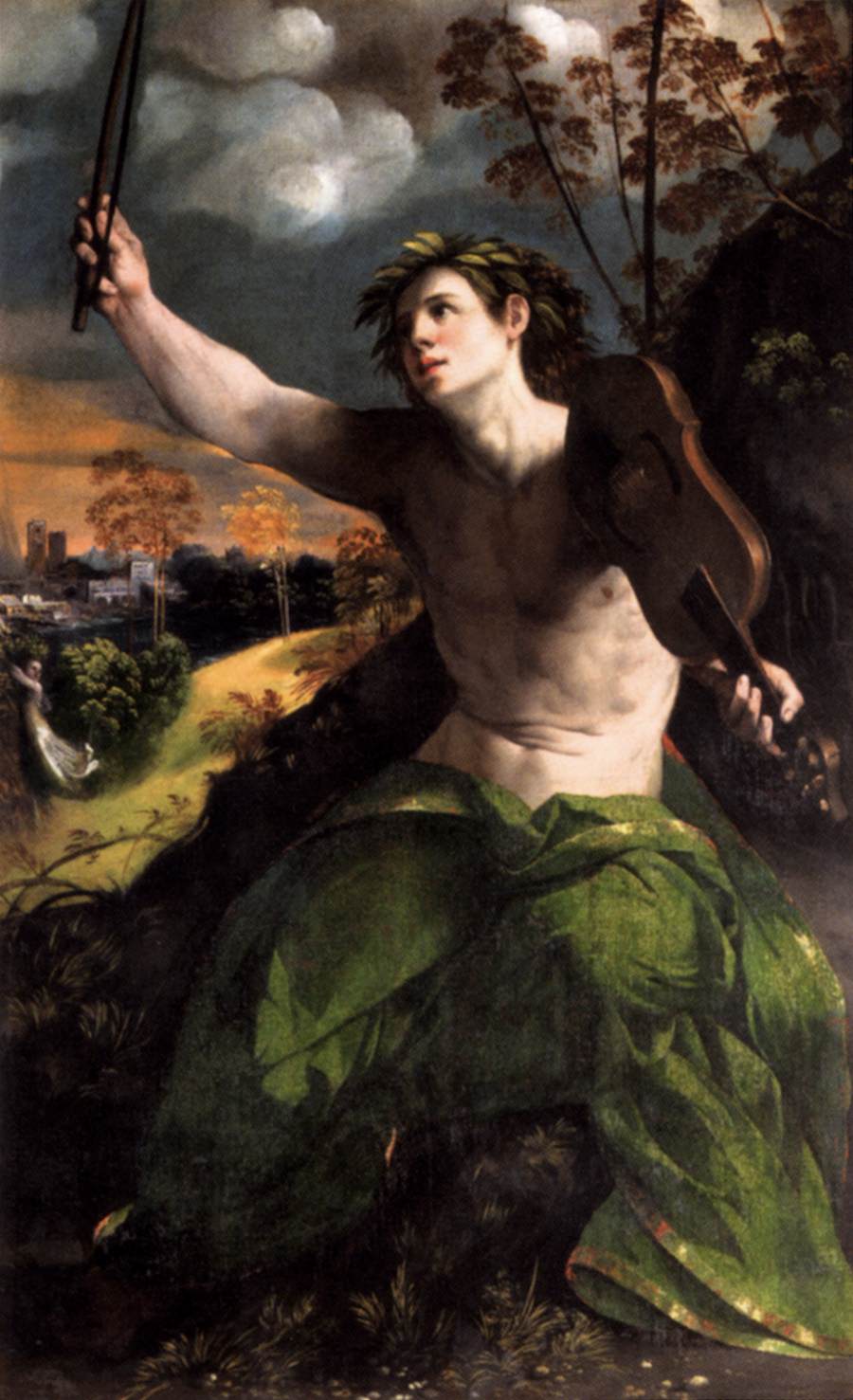
Dosso Dossi, Apollo (c. 1524–1525), oil on canvas, 191 × 116 cm, Galleria Borghese, Rome.
“Dosso also knew how to add to his interpretations a certain wit, a sense of contrast, a boldness, that has led him to be associated with Ariosto and the Orlando Furioso. But his visions—enchanted and mysterious, dense with necromantic smoke—’are less a parallel than an Ariostesque reverberation’: absorbed into a fantasia kindled by colour within an Edenic geography already sublimated through the senses, in a manner that anticipates the later Guercino. His inclination toward enchantment, toward the magical and the marvellous, constantly tends to transform reality into an irreversible mystery, the setting into a place without boundaries.”
Jadranka Bentini.
Peter Humfrey, in a catalogue entry for Dosso Dossi’s Apollo, notes that “with the exception of the Borghese inventory of 1693, inventories of the 17th, 18th, and early 19th centuries persistently call the subject of this picture Orpheus, a perfectly understandable identification,” an observation that we shall consider in due course. Humfrey also observes that the work was, somewhat curiously, attributed to Caravaggio for most of the 19th century, until Giovanni Morelli correctly assigned it to Dosso in 1875.
While the attribution of Apollo to Caravaggio would indeed be a curious error, especially for a curator or expert, the misattribution is revealing. It suggests that elements of Dosso’s painting anticipate innovations later associated with Caravaggio, particularly in compositional inventiveness, dramatic effect, and the engagement of the viewer. When Apollo is set beside Rest on the Flight into Egypt, for example, affinities emerge beneath their obvious differences. Both works are unconventional and exploratory, marked by a sophisticated and inventive handling of composition. Like Caravaggio, Dosso often worked directly on the canvas, revising and adapting his design as the painting evolved; this process lends the work a palpable sense of invention rather than predetermined order. Each picture displays a subtle yet surprising ingenuity that resists singular interpretation, inviting the viewer into an experience that remains suggestive rather than resolved.
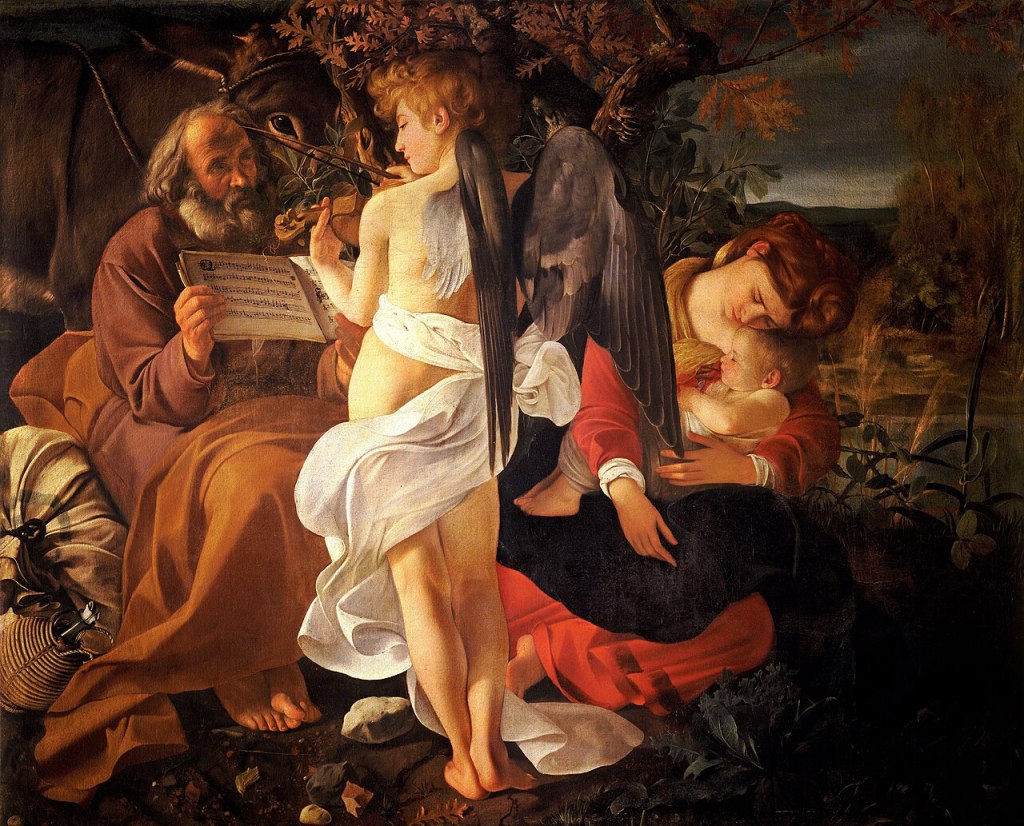
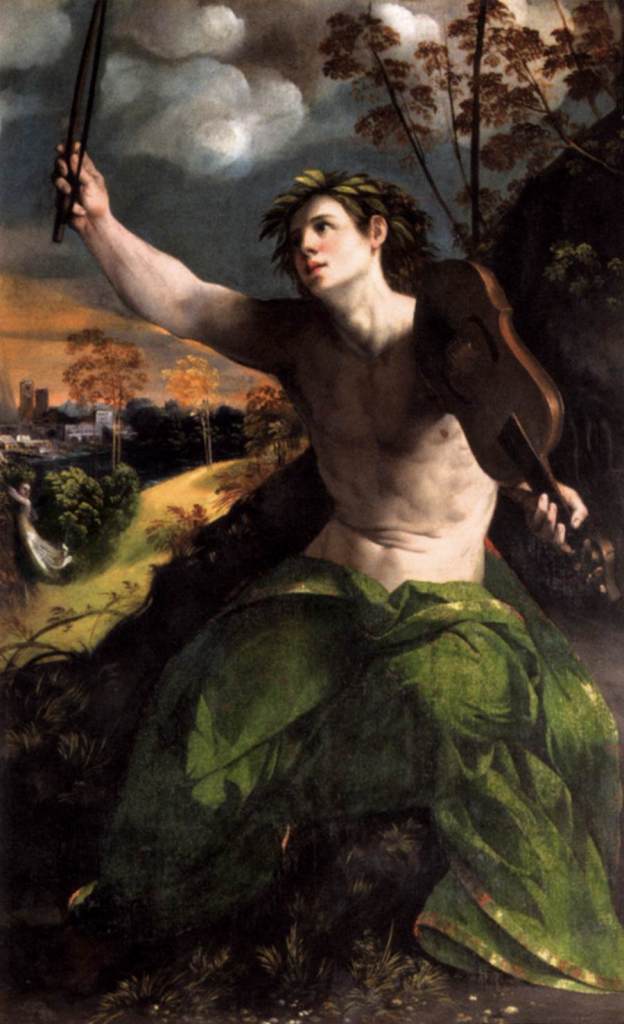
(Credit: Wikimedia Commons).
In the case of Rest on the Flight into Egypt, Vodret observes that “The Rest is a highly complex conceptual and compositional elaboration, which departs from the simpler scenes painted up to that moment.” She adds, “It may be the result of an initial contact with more demanding stimuli and requests, and perhaps with a more refined circle of patrons.” Seen beside Apollo, these remarks underline how, in both cases, the sophisticated expectations of patrons encouraged inventive and elusive compositions capable of surprising and engaging the viewer. In Dosso’s painting, this context is certain: he was working for the highly cultivated tastes of Alfonso I d’Este in the context of the Ferrarese court. In Caravaggio’s case, the influence of a refined patron is less certain, though plausible. Across both works, however, the pressures of discerning patronage seem to have fostered a sensitivity to experimentation and a refusal of easy resolution.
Staying with the comparison to Caravaggio, Peter Humfrey observes that Dosso’s late works display Caravaggesque qualities in the sharply lit still-life objects. For example, the brightly illuminated objects on the foreground parapet of the Allegory of Hercules (c. 1540–1542) and the cornucopia of fruit and grain in the Allegory of Fortune (c. 1535–1538) appear to prefigure early works by Caravaggio, such as The Boy with a Basket of Fruit (c. 1593, Galleria Borghese, Rome) and Bacchus (c. 1596, Galleria degli Uffizi, Florence). Humfrey further notes that these elements in Dosso’s work may also be seen as suggestive of developments in 17th-century Spanish still-life painting.
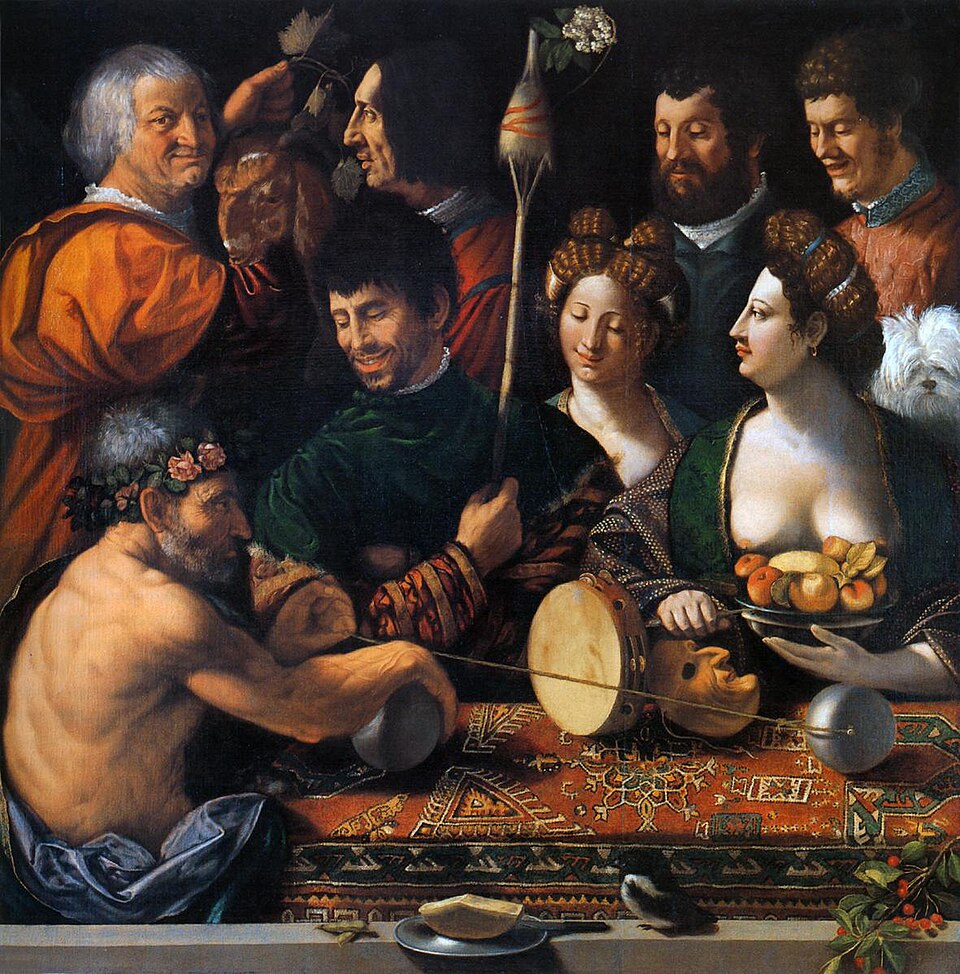
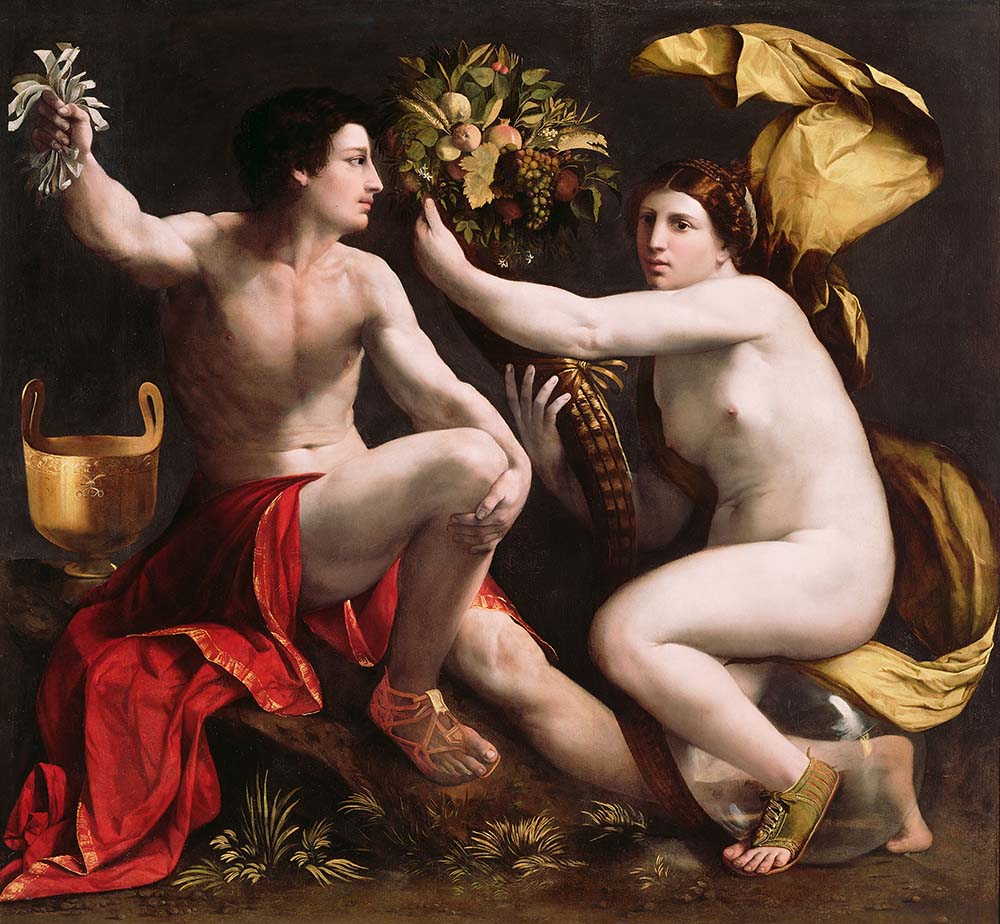
(Credits: Wikipedia and Mag Arte).
The comparison with Caravaggio functions in an oblique way to highlight Dosso’s originality, as seen in his Apollo. In a sense, it offers an indirect means of affirming the painting’s striking inventiveness and its resistance to rhetorical closure. The work sustains a mood of indeterminacy and delights in the staging of sensation, inviting comparison not only with its contemporaries but also with later moments of artistic innovation. Even a viewer attuned to a Baroque aesthetic—and predisposed against the geometric serenity often stereotypically ascribed to early Renaissance art—may find themselves unexpectedly engaged. Dosso proves at once theatrical, imaginative, and poetic; yet these qualities are disciplined within a composition that remains graceful, if unconventional.
For many art lovers, Dosso remains a marginal and secondary figure. However, Andrea Bayer offers a convincing and lucid corrective. She notes that Alfonso I d’Este, Dosso’s principal patron, had “secured the promise of a painting from Michelangelo, received gifts of drawings and cartoons from Raphael, and enjoyed the sustained attention of Titian for an entire decade.” Bayer emphasizes that this same Alfonso d’Este “recognized Dosso’s imaginative powers, his canny understanding of the innovations of his great contemporaries, and his gifts as a painter of nature.” She also underscores the rich artistic heritage Dosso inherited by quoting an exuberant passage by Roberto Longhi at length. This elevated prose refers to Dosso and some of his North Italian contemporaries and describes artists who “seemed to rise in a great smoke from the violet ashes of Giorgione’s funeral, ready to mix with the damp fog of the Po valley, which, so often churned up by the north wind blowing from the expressionists north of the Alps, grew clear under the lucid rays of that ancient rhythmic classicism of central Italy that shone fixedly off to the south.”
Dosso’s stature as an artist has also been reconsidered after research suggested that the Costabili Altarpiece (Ferrara, Pinacoteca Nazionale), a work of Dosso with the collaboration of Garofalo, was most likely completed as early as 1513–14. The altarpiece is a bold work that shows the influence of Giorgione in its mastery of nocturnal lighting and atmospheric landscape. Quite how significant this development was is summarised by Penny and Mancini in the National Gallery of London Catalogue, The Sixteenth Century Italian Paintings. They argue that if the dating of 1513–14 is accepted, it reveals something extraordinary about Dosso: “This conclusion, if accepted, reveals something curious, indeed extraordinary, about Dosso. He was not an artist of the stature of Titian, and yet the bravura handling of The Costabili Altarpiece precedes any equivalent boldness in Titian. He may indeed have influenced Titian, as well as being influenced by him. This may be difficult to believe, but it is no less remarkable that Raphael must have been so impressed by Dosso’s new style of landscape painting that he either let Dosso paint the background of The Madonna di Foligno (Pinacoteca Vaticana, Rome) or chose to imitate Dosso’s style himself in that part of the picture.”
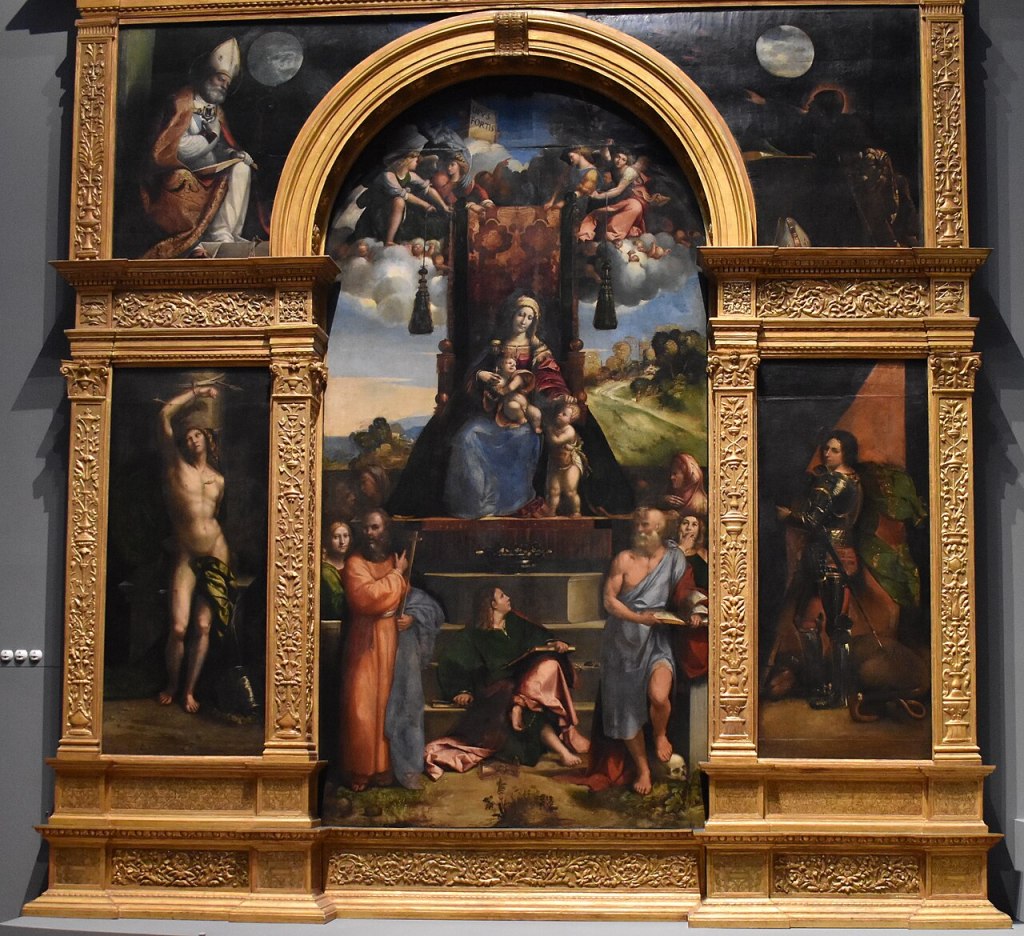
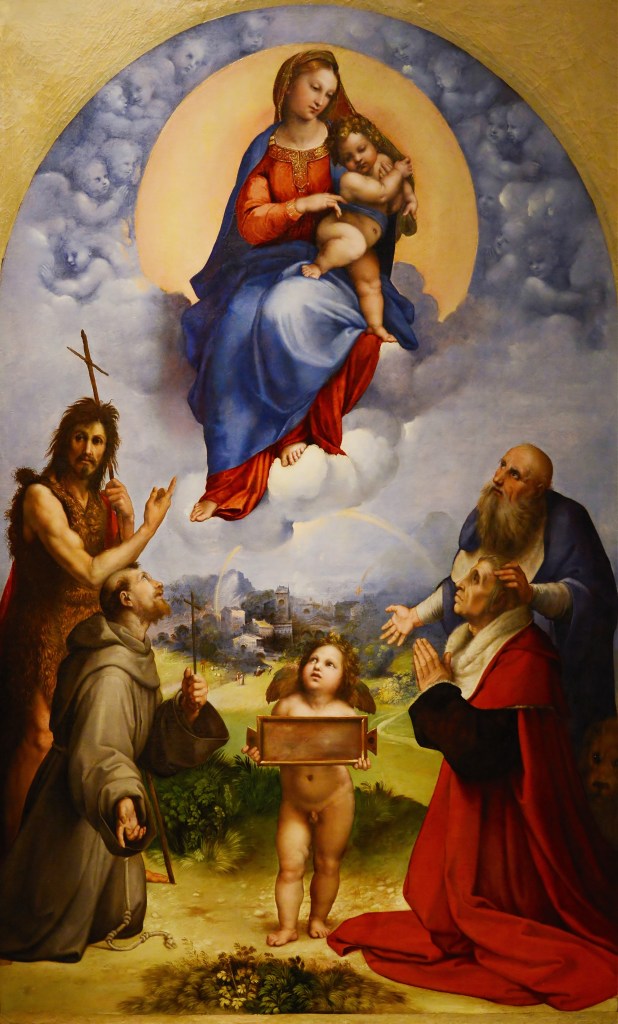
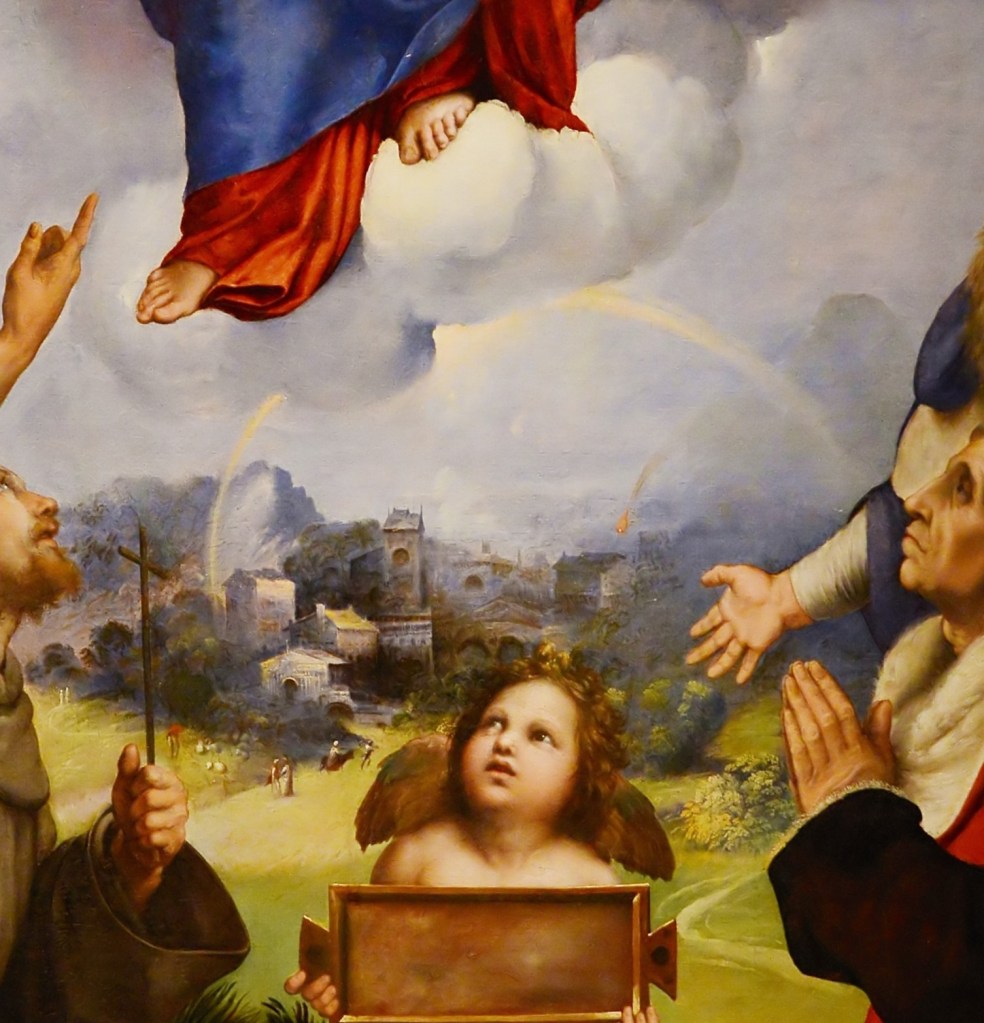
(Credits: Wikimedia Commons and Wikipedia).
Influences from the Venetian tradition, German art, local Ferrarese artists, and Rome all converge in Dosso’s work, and these currents are evident in his Apollo. The painting presents a subjective, mysterious landscape, marked by a restricted yet expressive palette that conveys both richness and luminosity, and a heroic, monumental figure whose mass and plasticity are gracefully balanced by the poetic setting.
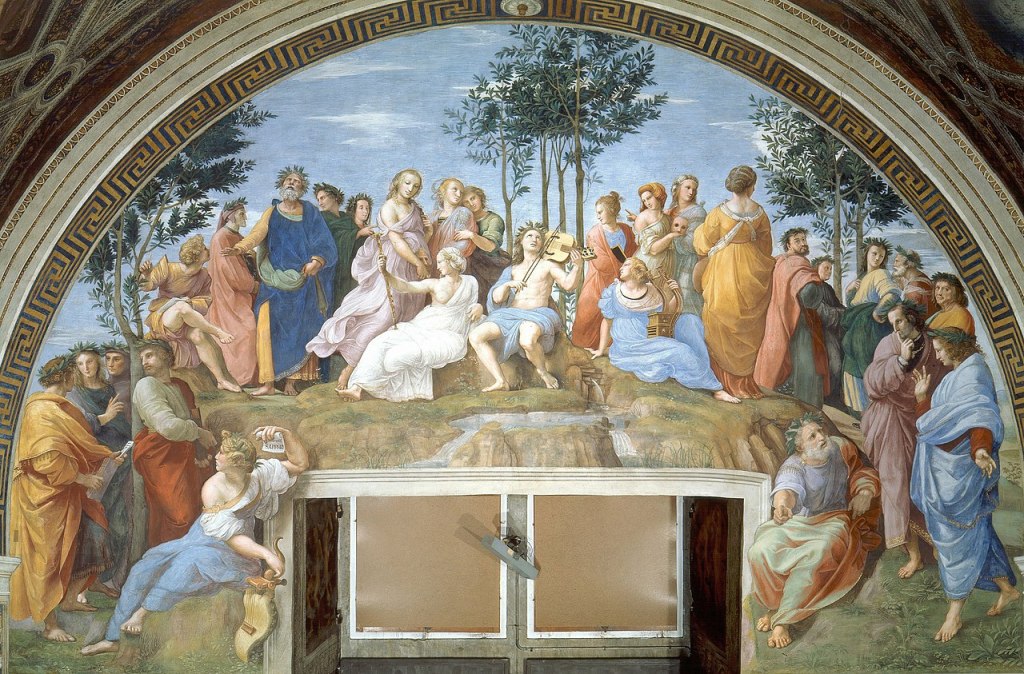
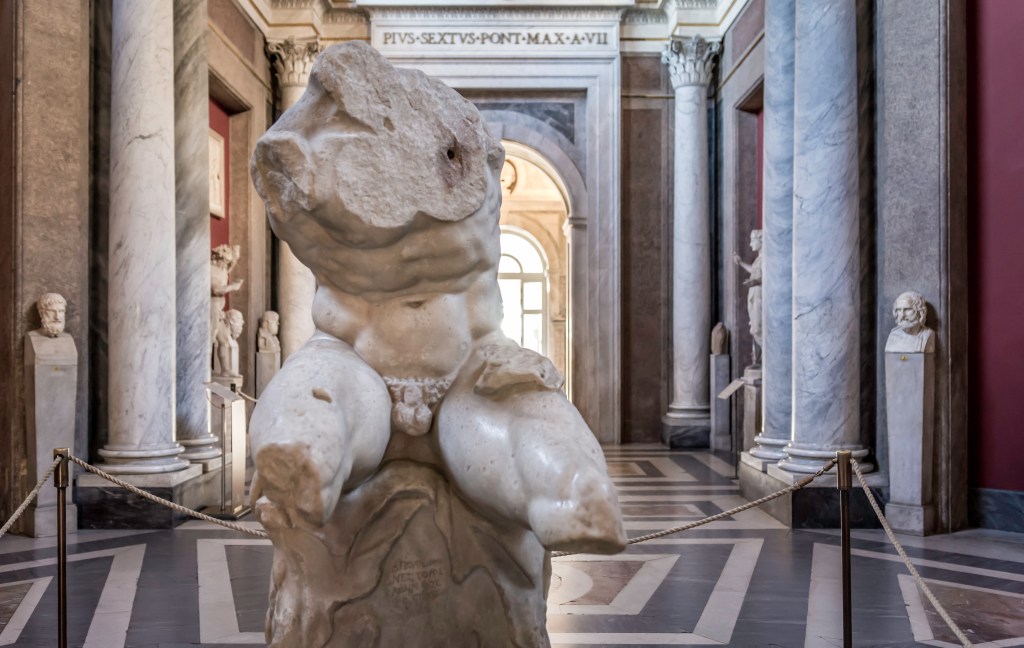
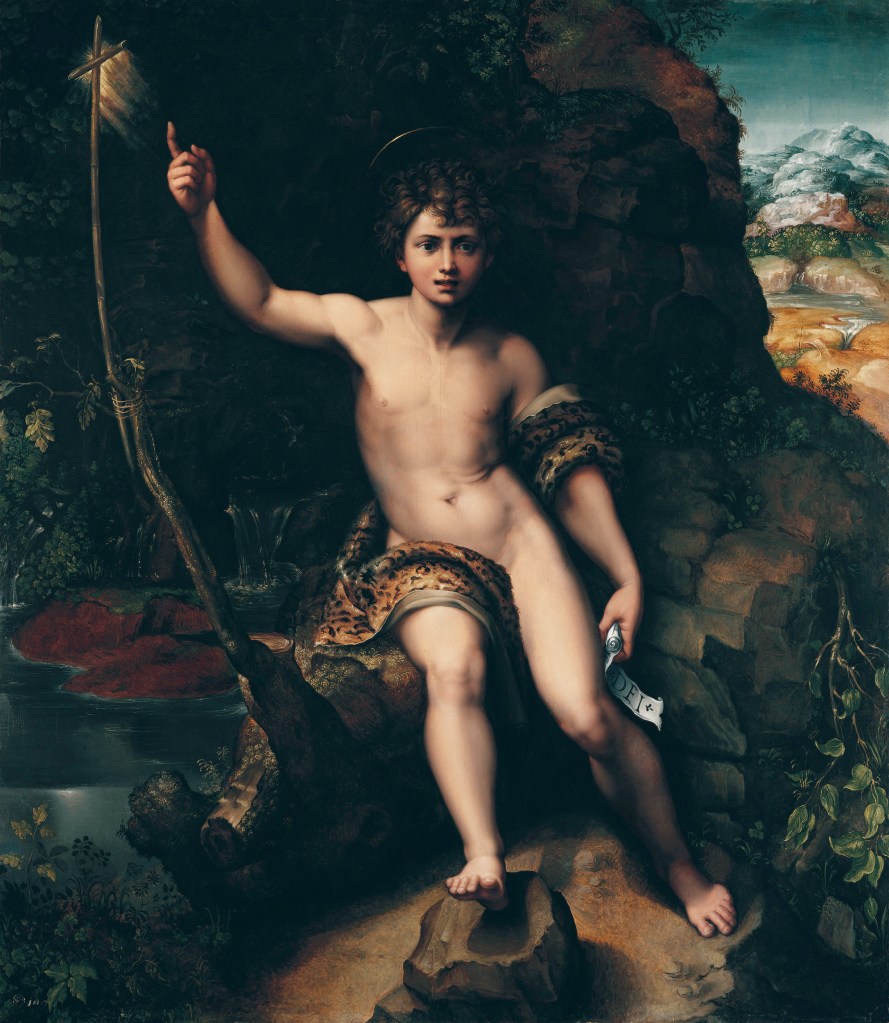
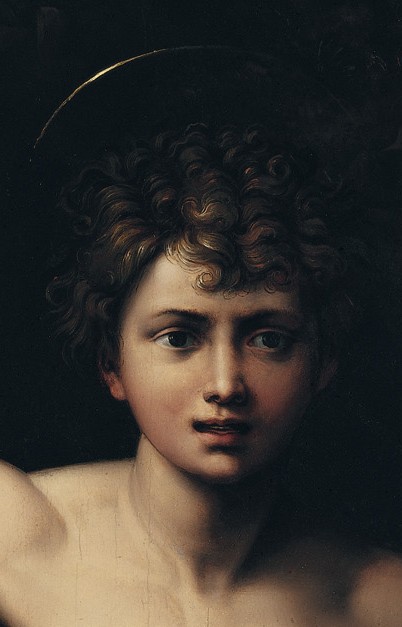
The most immediately apparent influences in the painting are the Apollo in Raphael’s Parnassus in the Stanza della Segnatura in Rome and the Belvedere Torso in the Vatican Museums. As Kathleen Wren Christian has observed, the Torso became “a supreme demonstration of the body in motion” and was “endlessly reinventable”; as such, its influence is inseparable from Michelangelo’s engagement with antique sculpture. In more subtle terms, Peter Humfrey discerns in Apollo “a new refinement in handling, which is particularly evident in the treatment of the god’s hair.” In such refinement and in the contrasts of light and shade, he sees the influence of late Raphael and, as suggested by Ballarin, of Raphael’s former pupil Giulio Romano. We should add that the fine attention Dosso paid to Apollo’s hair is essential to the representation of the god, as in Ovid’s Metamorphoses the god says: “As I, with my hair that is never cut, am eternally youthful, so you, with your evergreen leaves, are for glory and praise everlasting.”
(Credits: Wikipedia and Web Gallery of Art).
Dosso’s juxtaposition of two separate elements of a narrative in Apollo—the transformation of Daphne set beside Apollo finishing a song—finds a parallel in Raphael’s realisation of dramatic scenes made more intense through narrative compression. In the Transfiguration (1516–1520), Raphael unites the revelation on Mount Tabor with the desperate scene of the possessed boy below, collapsing sequential events into a single heightened pictorial moment. Even earlier, in the Oddi Altarpiece (c. 1502–1504), he combined the earthly gathering at the Virgin’s empty tomb with her heavenly coronation, presenting distinct phases of a sacred narrative simultaneously within one carefully structured composition. Yet whereas Raphael organises such compression through clear hierarchical division and theological clarity, Dosso’s fusion is more atmospheric and elusive. Raphael sought to conceal the join between registers, through such elements as colour and gesture, but Dosso emphasises difference and contrast. The narrative elements in Apollo do not occupy separate vertical registers but coexist within a landscape charged with tonal contrast and movement. Their simultaneity generates a poetic tension that resists definitive resolution.
Lighting plays an important role in the narrative of Dosso’s Apollo. At the centre of a rich but restricted tonal range, a brightly lit triangular section breaks through brooding cloud and shadow, illuminating the incline down which Daphne is fleeing. The light reflects from her back and heightens the sense of motion in the scene, assisted by the downward trajectory of her movement and by the trees, which bend under the influence of a wind that aids her flight. The composition organises its variety into diagonal and triangular sections. The diagonal within which Apollo resides produces an effect redolent of Giorgione. As Tom Nichols has noted, Giorgione used foreground detail to partially occlude the distant landscape—in works such as the Tramonto and the Three Philosophers—creating a type of anti-landscape and a contre-jour effect. A similar technique adds a dramatic and theatrical element to Dosso’s Apollo.
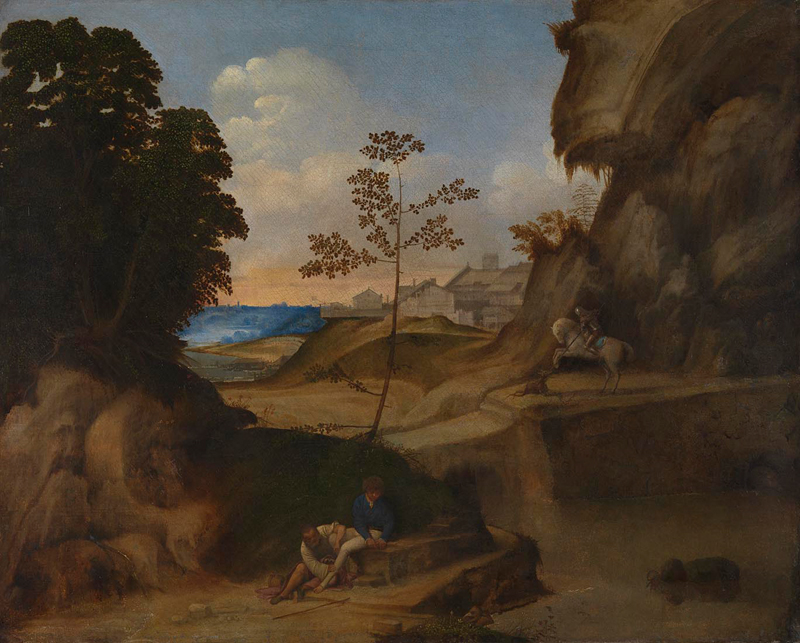
Il Tramonto (The Sunset)
1506-10
Oil on canvas, 73.3 x 91.4 cm
Bought, 1961
NG6307
https://www.nationalgallery.org.uk/paintings/NG6307
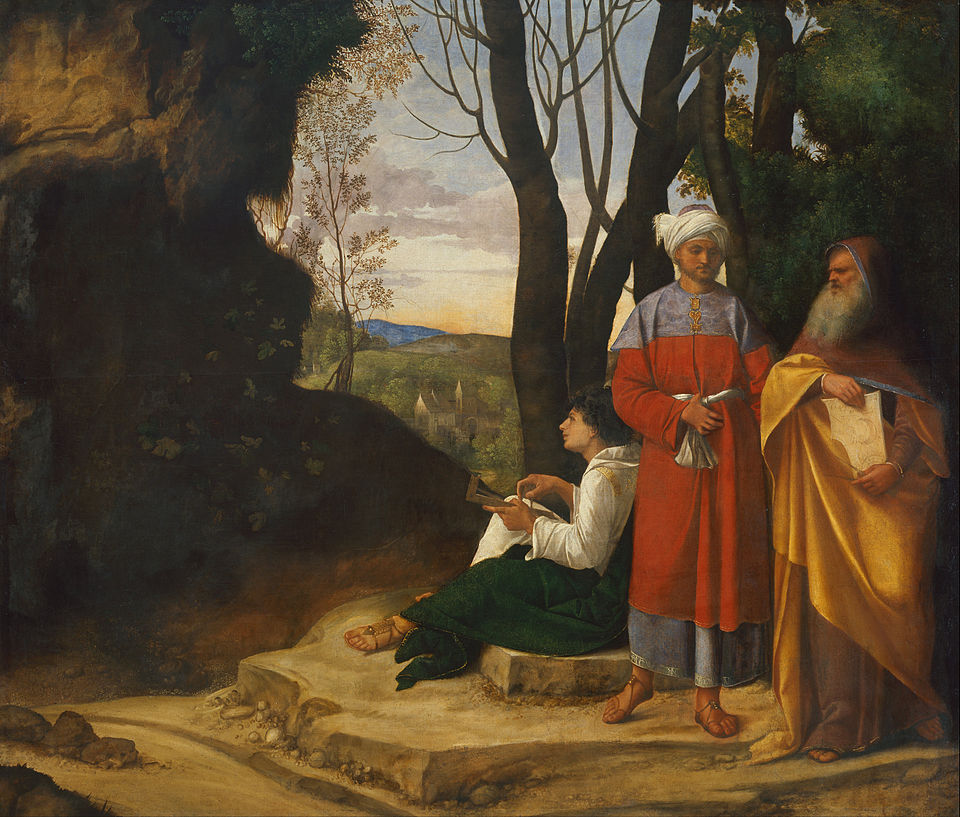
(Credits: NG London and Wikipedia).
That Dosso’s figure of Apollo was often mistaken for Orpheus can be easily explained. Orpheus, like Apollo, was a musician whose wife Eurydice was lost to the Underworld, even after he had rescued her. In this painting, it is easy to mistake Daphne for Eurydice: her figure is small, and the evidence of her transformation into a laurel tree is subtle. The river near her could be interpreted as the Styx, and the glow over the city in the background might suggest Hades. Moreover, Apollo is not in active pursuit of the fleeing nymph. Whether by intention or accident, the composition presents an unstable amalgamation of two mythic characters—one an Olympian god, the other a heroic human.
It is tempting to think that Dosso deliberately permitted such a double reading. Orpheus’s music had the power to charm animals and wild creatures, move human beings and stir emotion, affect inanimate nature, and soften the hearts of the rulers of the underworld. His music enabled him to bridge worlds, exerting a persuasive and transformative force over both living and non-living things. This sense of enchantment accords closely with Dosso’s pictorial world.
We see Apollo in a state of suspension. He appears to have just finished a song; his bow is raised in a flourish, his face thoughtful, his gaze fixed into the distance, and his lips slightly parted. The fingers of his left hand remain on the fingerboard of his instrument. The raised bow is cropped by the picture frame, a compositional choice that emphasizes the figure’s heroic scale and proximity to the viewer. Like Raphael’s Apollo, Dosso’s figure gazes upwards, and his instrument is a lira da braccio rather than an antique lyre. The choice of instrument may carry a personal association, as Alfonso I d’Este was an accomplished player of the lira da braccio, suggesting a subtle connection between the god and the cultivated prince. The court of Ferrara, before, during, and after Alfonso’s reign, was renowned for its patronage of music and musicians. While we know little of the instrumental repertoire for Alfonso’s reign, there was a cosmopolitan mixture of choral polyphony, madrigals and frottole.
The figure of Apollo is both monumental and lyrical, a mixture of gravity and vulnerability. The emerald-green drapery with a gold-threaded border that covers his lap adds intensity of colour and connects with the green of his laurel crown and the surrounding vegetation, linking the god to a magical pastoral landscape, as well as to the symbol of intellectual and military virtue. At the same time, the laurel may carry a more personal resonance: by 1524, a few years after the death of Alfonso I’s wife Lucrezia Borgia in 1519, the duke was involved with his long-term mistress Laura Dianti. In this light, the crown could subtly allude to Laura herself, entwining the classical language of triumph and poetic inspiration with the realities of Alfonso’s courtly and private life.
In Alfonso I d’Este’s Ferrara, the boundary between imagined nature and cultivated gardens was not sharply defined. His management of the estate ran parallel to the idea of creating an earthly paradise, an Arcadia made manifest. He oversaw the cultivation of the Belvedere gardens, their wooded groves, feats of topiary, and orchards of fruit trees. In reshaping the landscape, taming the wild and suffusing it with myth and antiquity, princely governance and classical imagination converged.
In the opening lines of Scipione Balbo’s Calliopsis, the river Po—the principal river of the Este territories—is invoked by its ancient name, Eridanus, explicitly linking it to mythic origins. According to the ancient story, Phaeton, unable to control the chariot of the sun, was struck down by Jupiter and plunged into the river long associated with the Po. His sisters, overcome with grief, were transformed into poplar trees and wept tears of amber along its shores. In parallel, in the myth of our painting, Daphne becomes a laurel tree. Such mythic transformations arguably elevated the status of the palace grounds, marking them as a cultivated and culturally charged environment. In Apollo, mythology and Alfonso’s landscape appear to merge. Perhaps the song of Apollo could be discerned there, and perhaps Daphne’s beating heart could be felt through one of the trees.
Landscapes were central to the poetry of Ariosto. For instance, in the Orlando Furioso, the sorcerer Atlante’s enchanted castle is set within a forested and gardened landscape that both conceals and protects it, creating magical obstacles for heroes such as Orlando and Rinaldo. The landscape here is simultaneously a site of adventure, a mirror of inner trials, and a space of aesthetic delight—a cultivated, ordered, and imagined world. In Alfonso I’s Ferrara, the Belvedere gardens and groves could operate in a similar way, reflecting not only classical myth but also the chivalric imagination that pervades Ariosto’s verse. If we want to see a work by Dosso in which an enchanting landscape dominates the scene and envelopes his figures, we can view his Three Ages of Man (c. 1515).
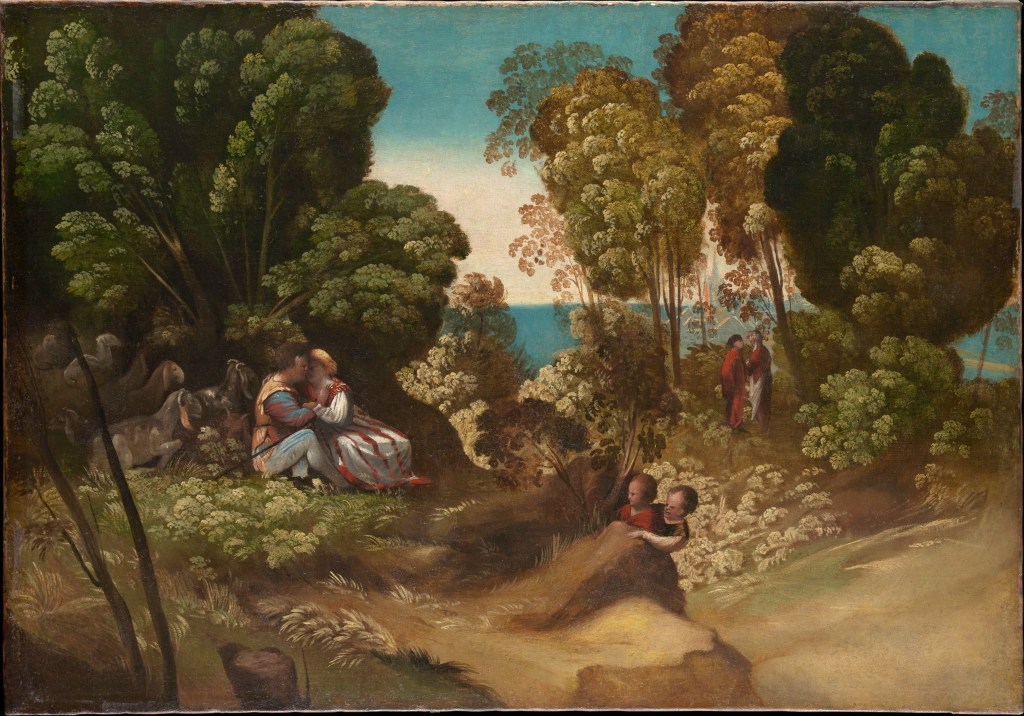
(Credit: Wikimedia Commons).
Given the singular character of Dosso’s approach, it is not surprising that both contemporary and modern critics have offered divergent assessments of his style. Ludovico Dolce and Giorgio Vasari disparaged what they perceived as the clumsy, and unpraiseworthy qualities of some of his work. Equally, the elusive, magical, and idiosyncratic world of Dosso continues to divide opinion.
A related field of judgment concerns the management of apparent artifice. As Castiglione observed in The Book of the Courtier, “True art is what does not seem to be art.” By this measure, some viewers might perceive Dosso as trying too hard in his application of wit and invention. However, Renaissance theorists, from Alberti to Vasari, equally argued that qualities most prized in poetry—intellectual invention (invenzione), imaginative vivacity (fantasia), and poetic production (poesis)—could also be exercised in painting. In the context of the Paragone debate exploring the relative merits of painting and poetry, demonstrating these shared qualities served to elevate the status of painting, showing it capable of the same intellectual and imaginative achievements as a literate art.
In Dosso’s Apollo, the heroic figure anchoring the composition, the inventive staging of gesture, and the dramatic interplay of light exemplify a painter fully embodying these humanist ideals, producing a work that is at once intellectually compelling and visually imaginative. Yet, despite his richly inventive style, Dosso also demonstrates compositional restraint and visual clarity. In Apollo, the painting’s underlying structure provides a particularly compelling example, as Apollo’s statuesque figure dominates and simplifies the foreground, even as a storm of invention and fantasia swirls around and plays across it.
Around a decade later, Giovanni Girolamo Savoldo, in his Mary Magdalene (1535–1540), also places the principal figure prominently in the foreground, with light playing decisively across her satin robes. Unlike Dosso, however, Savoldo reduces the space devoted to landscape: the Venetian lagoon is suggested only minimally, partially enclosed by a walled boundary—a study of still life and texture in itself. The composition relies on colour that is paradoxically rich and cool: the palette is desaturated, yet the modulation of tones offers a restrained sumptuousness, in contrast to the luxuriant effects found in Dosso. While the connection to Dosso is subtle, Savoldo’s work demonstrates a refined, virtuosic handling of colour and light, producing an intimate, focused atmosphere—poetic in its mood and softly echoing Dosso, particularly in the prominence of the large foregrounded figure and the careful orchestration of light and colour.
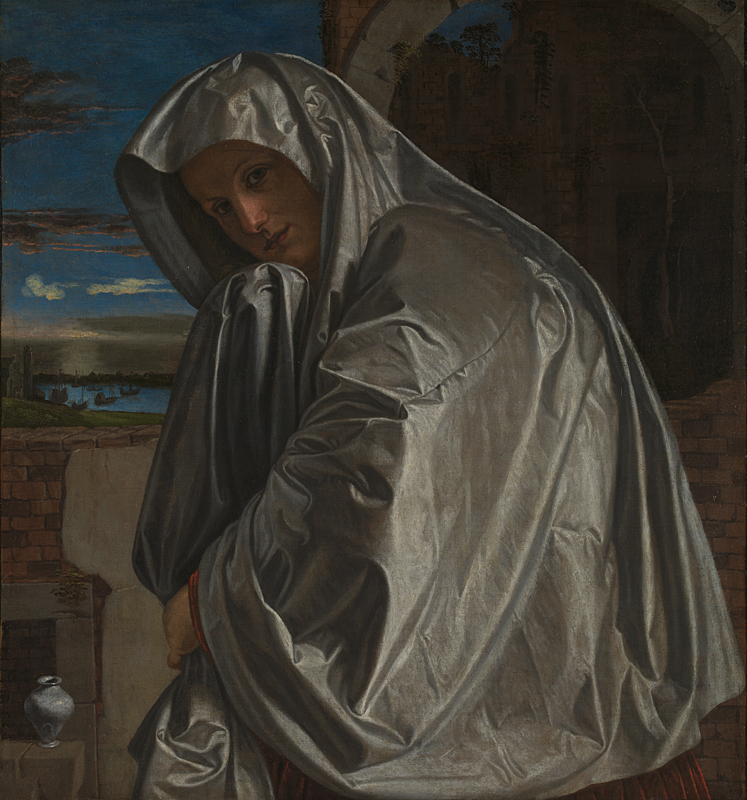
Mary Magdalene
about 1535-40
Oil on canvas, 89.1 x 82.4 cm
Bought, 1878
NG1031
https://www.nationalgallery.org.uk/paintings/NG1031
(Credit: NG London).
On the topics of balance and restraint, it is worth returning to the unusual representation of Apollo. As noted, Dosso compresses two elements of a narrative scene. One way of reading his approach is to see the god’s representation as asynchronous with Daphne’s transformation into a tree: the chase has been omitted, and we do not see Apollo pursuing her. Instead, he is engaged in a later, more dignified activity—having just completed a song, likely reflecting on the preceding events.
By editing out the chase, the composition focuses on a more sober aspect of Apollo, also described in Ovid: one who holds mastery over the oracles of Delphi, Claros, Tenedos, and Patara, and, by implication, mastery over past, present, and future. In this way, Apollo’s freedom from immediate compulsion becomes legible: Daphne is still transforming, while he has already sung. The scene signals both the successful sublimation of desire and the possibility for a new state of balance to hold sway.
Representing Apollo in reflective composure, Dosso moves closer to an image of princely virtue. In the mirror-of-princes tradition, authority rested upon mastery of the emotions and measured comportment. In Ovid’s account, Apollo most memorably succumbs to desire and the ‘healer of all’ has no herb to cure the illness of his love: his flaw lies in the private realm of desire—hardly a domain worthy of a stoic ruler. Here, he appears self-possessed. The mythological figure is transformed from one driven by passion into a model of disciplined mastery, reflecting ideals expected of a prince.
Apollo’s reflective stillness avoids any disapprobation. The close alliance between affect and bodily movement made such matters particularly sensitive within Renaissance concepts of beauty. Sharon Fermor explains why:
“The system of thinking about the body derived from Plato shared with the Aristotelian tradition the idea that movement was the index of the soul and of moral and social stature. As such, movement was seen as something to be rigorously controlled and scrupulously observed. While almost all writers on movement stressed that rigidity in the body should be avoided, an excess of movement was considered to be far more problematic. Depending on its nature, excessive and uncontrolled movement could indicate a range of different vices, including anger, effeminacy, lack of self-restraint, sycophancy, servility, licentiousness, affectation, untrustworthiness, or deceitfulness.”
Of course, this did not mean that dramatic action could not be represented with dignity, even in the literal pursuit of love. Rather, it required careful calibration. The redeeming concept in such cases is leggiadrìa—movement imbued with lightness, harmony, posture, and grace. We see leggiadrìa in an Apollo and Daphne from about fifty years earlier, as well as in one from roughly a century later. In the works of Piero del Pollaiuolo and Gian Lorenzo Bernini, the very moment of Apollo’s embrace and Daphne’s transformation is rendered with consummate mastery of grace and movement.
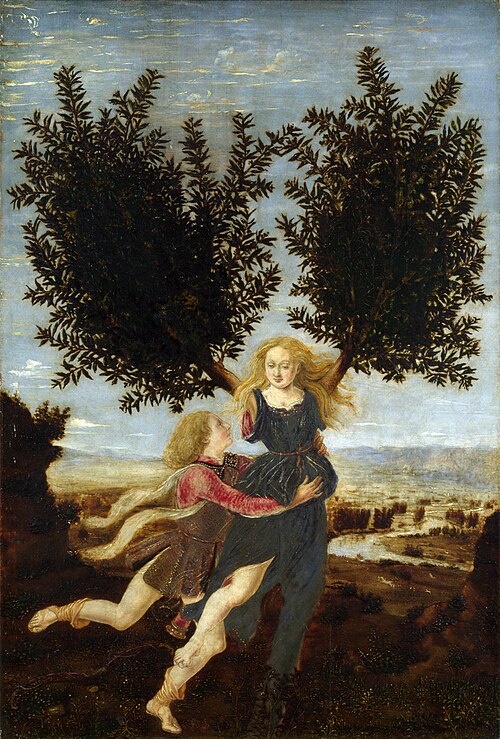
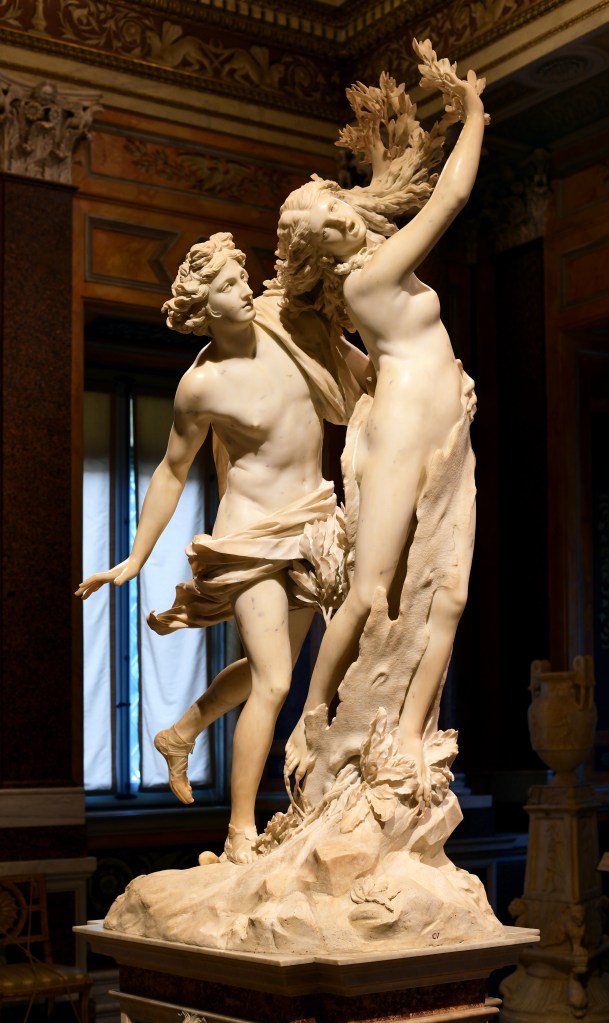
(Credits: NG London and Wikipedia).
Coda
Ovid’s Legacy
“Now I have finished my work, which nothing can ever destroy, not Jupiter’s wrath, nor fire or sword, nor devouring time. That day which has power over nothing except this body of mine may come when it will and end the uncertain span of my life. But the finer part of myself shall sweep me into eternity, higher than all the stars. My name shall never be forgotten.”
—Ovid, Metamorphoses, Epilogue, translated by David Raeburn.
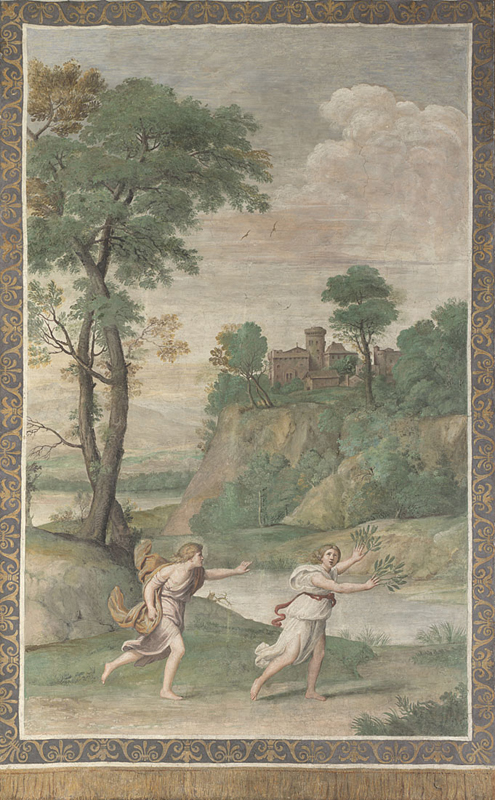
Apollo pursuing Daphne
1616-18
Fresco, transferred to canvas and mounted on board, 311.8 x 189.2 cm
Bought, 1958
NG6287
https://www.nationalgallery.org.uk/paintings/NG6287
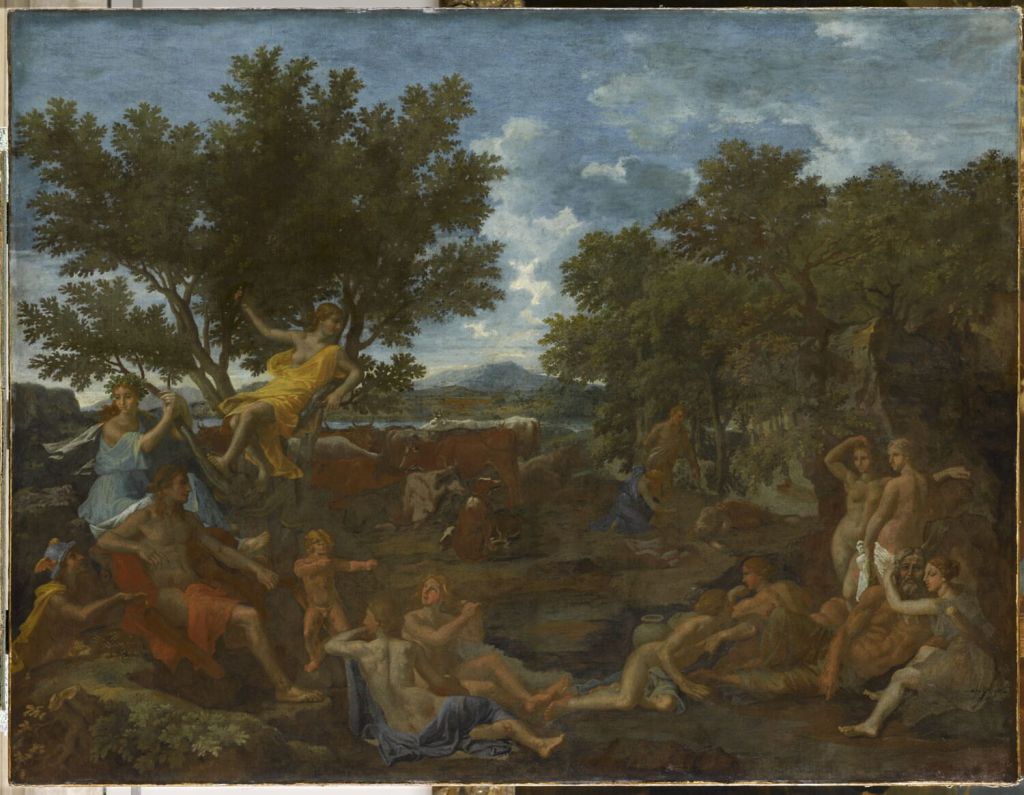
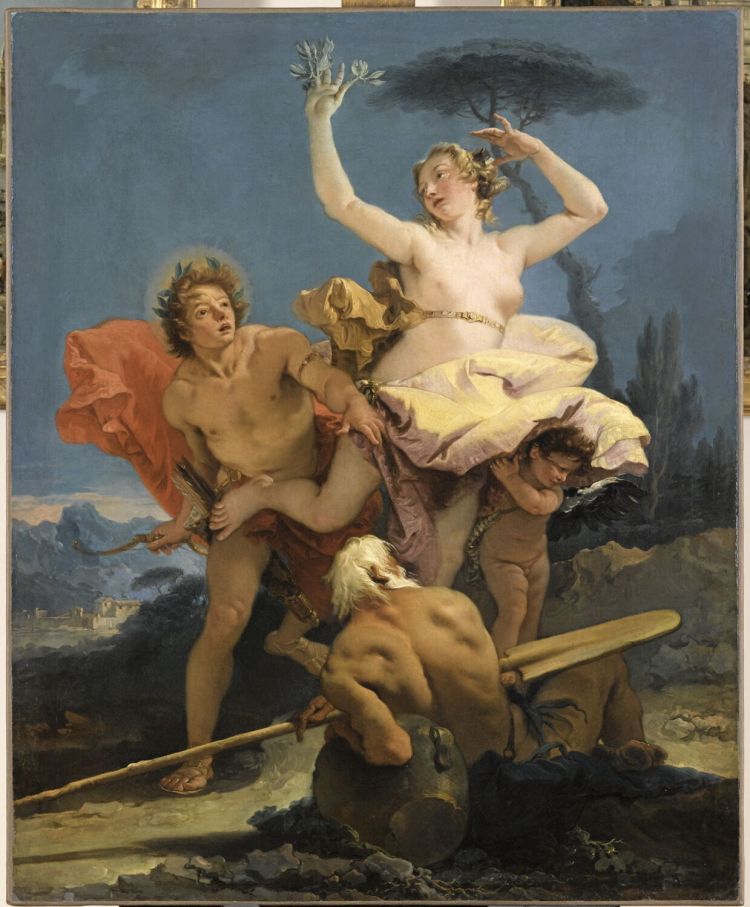
(Credit: NG London and The Louvre Museum).
[Producing these essays requires care, time, research, and resources. Contributions to help sustain this exploration would be greatly appreciated.]
https://donorbox.org/inner-surfaces-resonances-in-art-and-literature-837503
Any errors or infelicities are mine alone. Those wishing to research further can begin with the bibliography below.
Bibliography
Beck, James, Raphael: The Stanza della Segnatura, New York, 1993.
Bentini, Jadranka, “Fra sentimento e favola. La pittura a Ferrara dal Cinquecento al Seicento,” in Un Rinascimento singolare: La corte degli Este a Ferrara, Ferrara, 2004, pp. 235–278.
Bentini, Jadranka & Grazia Agostini (eds.), Un Rinascimento singolare: La corte degli Este a Ferrara, Ferrara, 2004.
Christian, Kathleen Wren, Empire Without End: Antiquities Collections in Renaissance Rome, c. 1350–1527, New Haven & London, 2010.
Fabbri, Paolo, “Gli Este e la musica,” in Un Rinascimento singolare: La corte degli Este a Ferrara, Ferrara, 2004, pp. 59–71.
Fermor, Sharon, “Poetry in Motion: Beauty in Movement and the Renaissance Conception of Leggiadrìa,” in Concepts of Beauty in Renaissance Art, Aldershot, 1998, pp. 124–133.
Fiorenza, Giancarlo, Dosso Dossi: Paintings of Myth, Magic, and the Antique, University Park, PA, 2008.
Freedberg, S. J., Painting in Italy, 1500 to 1600, New Haven & London, 1993.
Henry, Tom & Paul Joannides (eds.), Late Raphael, London, 2013.
Humfrey, Peter, The Altarpiece in Renaissance Venice, New Haven & London, 1993.
Humfrey, Peter & Mauro Lucco (eds.), Dosso Dossi: Court Painter in Renaissance Ferrara, New York, 1998.
Mancini, Giorgia & Nicholas Penny (eds.), National Gallery Catalogues: The 16th Century Italian Paintings, Volume III: Bologna and Ferrara, London, 2016.
Marlow, Tim (ed.), In the Age of Giorgione, London, 2016.
Nichols, Tom, Giorgione’s Ambiguity, London, 2020.
Ovid, Metamorphoses, translated by David Raeburn, London, 2004.
Rogers, Mary & Frances Ames‑Lewis (eds.), Concepts of Beauty in Renaissance Art, Aldershot, 1998.
Turner, Richard, The Vision of Landscape in Renaissance Italy, Princeton & London, 1974.
Vodret, Rossella, Caravaggio, 1571–1610, Turin, 2021.
 Inner Surfaces