Introduction
John Sell Cotman occupies a distinctive place in the history of British landscape painting. Celebrated above all for the extraordinary formal clarity of his early watercolours, he was also an accomplished painter in oils whose later work reveals a restless appetite for experiment. His landscapes combine close observation with imaginative reconstruction, transforming familiar scenery through the organisation of form, colour and light. The apparent simplicity of his finest compositions conceals an exceptionally deliberate artistic intelligence.
Born in Norwich, Cotman moved to London in 1798, entering an artistic world being transformed by Thomas Girtin and J. M. W. Turner. His association with Girtin and the circle of Dr Thomas Monro encouraged an approach to landscape that went beyond conventional topographical representation. Sketching journeys to Wales and, especially, Yorkshire culminated in the celebrated watercolours of 1803–05, in which natural forms were brought into remarkably balanced relationships.
Returning to Norwich in 1806, Cotman established himself as a drawing master while continuing to paint and exhibit. In 1812 he moved to Great Yarmouth, where he enjoyed the patronage of Dawson Turner, a wealthy banker, botanist and antiquary. Turner became a longstanding friend and supporter, encouraging Cotman’s architectural studies, which took him to Normandy in 1817, 1818 and 1820. These journeys also provided fresh inspiration for his landscape painting, while the sea and commercial life of Yarmouth furnished subjects that would engage him for decades. He returned to Norwich in 1823 and, in 1834, became drawing master at King’s College School in London, remaining there until his death.
Cotman’s professional life was complicated by financial anxieties, physical ill health and recurrent periods of psychological distress. His temperament could alternate between intense enthusiasm and profound despondency. Yet the familiar picture of an artist defeated by neglect has been challenged by Paul Oppé, who demonstrated that he enjoyed considerable patronage and contemporary recognition. His later work, once commonly regarded as inferior to the restrained watercolours of his youth, has also attracted renewed appreciation for its expressive colour and technical inventiveness.
The paintings and watercolours considered here concentrate on the 1820s and 1830s, a period in which Cotman explored the possibilities of landscape with remarkable freedom.
Dutch Boats off Yarmouth
Cotman’s years at Great Yarmouth, from 1812 to 1823, brought him into contact with the maritime life of the Norfolk coast. The harbour, fishing vessels and changing conditions of the North Sea offered subjects quite different from the architectural antiquities that occupied so much of his professional activity. His familiarity with shipping was not confined to observation from the shore: he owned a boat and regularly ventured out to sea.
Dutch Boats off Yarmouth, Prizes during the War (c. 1823) is among the most ambitious oils associated with this period. Probably exhibited at the British Institution in 1823, it appeared at the Norwich Society of Artists the following year. Andrew W. Moore identifies its starting point as a small pencil sketch made on Yarmouth Sands, looking northwards across the Denes towards Gorleston. In developing the composition, Cotman retained the principal arrangement of vessels while introducing additional flags and mastheads.
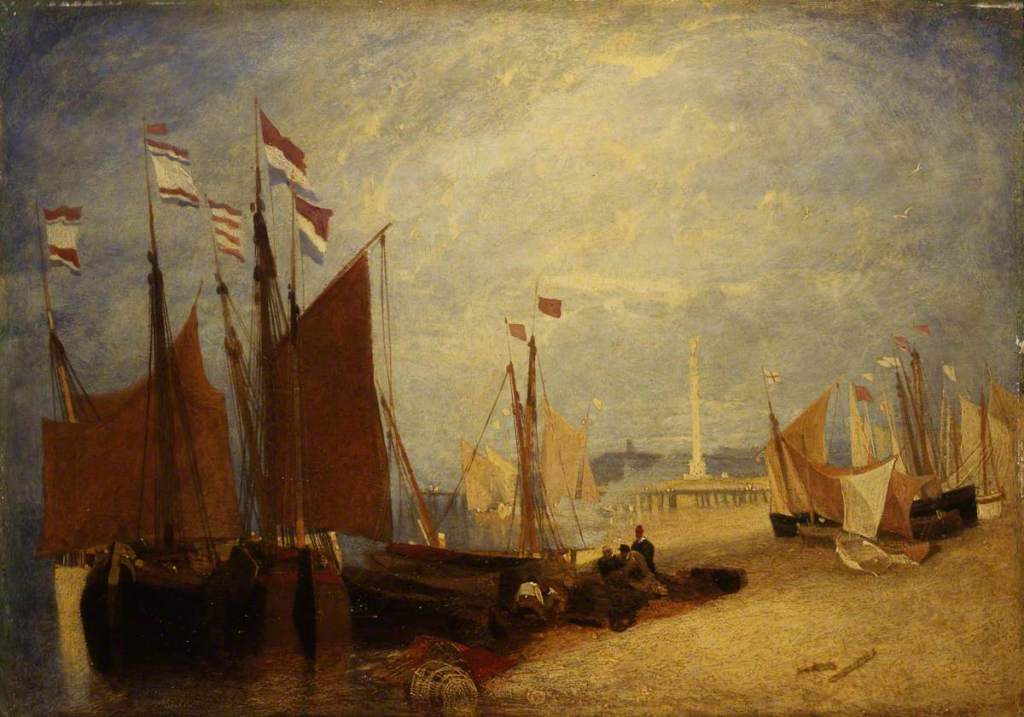
The title refers to Dutch ships captured during the wars with Britain, recalling the naval conflict that culminated in the Battle of Camperdown in 1797. Dutch vessels occupy the left of the composition, with Yarmouth yawls to the right, while Nelson’s Monument rises in the distance. David Blayney Brown relates the painting to the patriotic associations of the monument, erected between 1817 and 1819, and suggests a possible connection with George Vincent’s Dutch Fair on Yarmouth Beach (1821). The historical subject is thus incorporated into a marine landscape whose interest extends beyond the commemoration of naval victory.
The painting attracted considerable admiration when exhibited at Norwich in 1824. A reviewer in the Norfolk Chronicle praised Cotman’s management of composition, colour and light, comparing his achievement with the marine paintings of Willem van de Velde and Ludolf Bakhuizen. The same critic nevertheless wished that he had attempted the subject on a larger scale and brought it to a higher degree of finish. Such reservations were to recur in the contemporary reception of Cotman’s paintings, whose breadth of handling did not always accord with prevailing expectations.
The picture was purchased by the London collector John Bridgman, who also commissioned A View from Yarmouth Bridge, Looking towards Breydon, Just after Sunset. The connection between the two paintings provides a useful indication of Cotman’s success in attracting patrons for his maritime subjects during the early 1820s.
A View from Yarmouth Bridge, Looking towards Breydon, Just after Sunset
The second painting acquired by John Bridgman, A View from Yarmouth Bridge, Looking towards Breydon, Just after Sunset (c. 1823–25), offers a contrasting treatment of the same maritime environment. Where Dutch Boats off Yarmouth is animated by the activity of shipping and its historical associations, the later composition is concerned principally with the effects of evening light. The vessels, distant shoreline and broad expanse of water are brought together beneath a sky whose subdued illumination establishes the character of the scene.
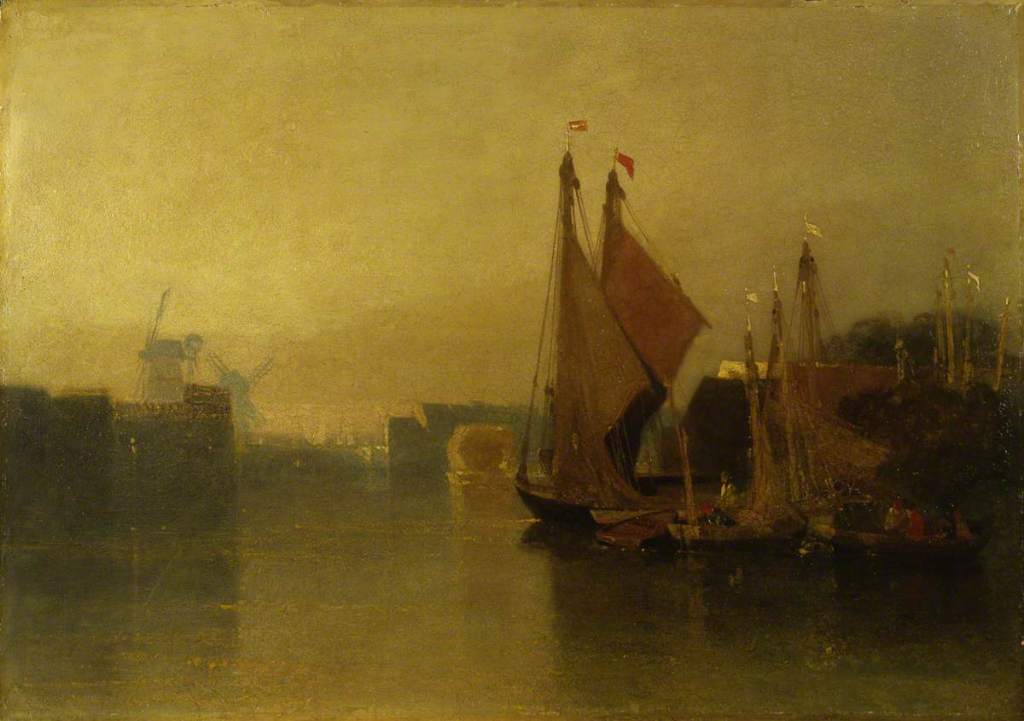
The painting was exhibited at the Norwich Society of Artists in August 1824, although it was apparently still unfinished. A reviewer in the Norfolk Chronicle admired Cotman’s choice of subject and his representation of the light immediately after sunset, but regretted that he had not carried the picture to a more complete state. Andrew W. Moore suggests that this criticism may reflect a failure to appreciate the breadth of Cotman’s handling. The painting’s relatively simplified forms and atmospheric unity were evidently at odds with expectations of more detailed finish. Another contemporary reviewer, writing in the Somerset House Gazette, praised its classical character, describing it as Claudian.
A revealing document survives in a letter from Bridgman to Cotman dated 1 July 1825, written after the collector had received the finished painting. Although pleased with the composition, particularly its distant space and foreground shipping, Bridgman expressed reservations about the sky. He recalled that Cotman had originally intended to show rays of sunlight breaking through the clouds near the centre of the picture and felt that this would have produced a more brilliant effect. He suspected that difficulties encountered during execution had led the artist to abandon the idea. Nevertheless, he acknowledged the harmony between the completed sky and the foreground, while regretting that the clouds lacked the grandeur he admired in Turner.
The letter offers a rare insight into the relationship between Cotman and his patrons. Bridgman was sufficiently knowledgeable to discuss the painting’s development and to compare its atmospheric effects with those of a leading contemporary. Yet his preference for a more dramatic sky also reveals a difference between the collector’s expectations and the restrained conception Cotman ultimately adopted. As David Blayney Brown observes, the painting has affinities with Turner’s treatment of light and space, but its quiet organisation of horizontal forms gives it a character of its own.
Executed in oil on millboard, the painting demonstrates Cotman’s ability to achieve a broad atmospheric effect without sacrificing compositional discipline. Its apparent simplicity is the result of careful adjustment, and Bridgman’s correspondence reminds us that the finished image was not necessarily the one first envisaged by the artist.
Silver Birches
In the middle years of the 1820s, Cotman renewed his interest in oil painting, producing a group of landscapes in which trees and woodland scenery became subjects for increasingly adventurous experiments with colour and texture. Silver Birches (c. 1824–28), now in Norwich Castle Museum, is among the most admired of these works. Laurence Binyon considered it one of Cotman’s finest achievements, while subsequent scholarship has drawn attention to the complexity of its technique and the independence of its conception.
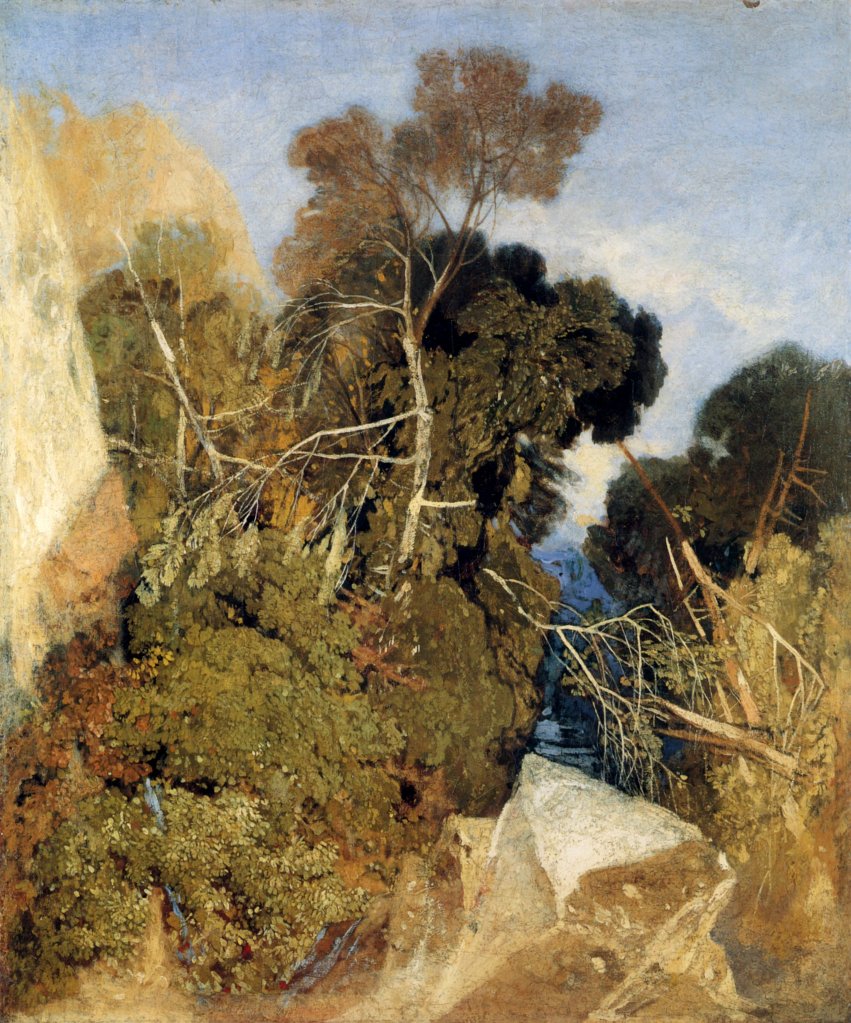
Cotman’s treatment of trees had nevertheless been a source of considerable dissatisfaction to him. In November 1826, he planned a visit to London to examine paintings by Dutch masters from the collection of George IV, hoping to improve his understanding of their methods. Writing to Dawson Turner, he complained of his inability to draw or paint trees satisfactorily. Such self-criticism is striking in an artist whose work had already demonstrated an exceptional command of natural forms. David Blayney Brown notes that Silver Birches, despite Cotman’s admiration for Dutch painting, shows relatively little direct dependence on those models.
The painting is organised around the pale trunks and branches of the birches, whose intricate rhythms are set against richly coloured foliage. Brown contrasts Cotman’s deliberate arrangement of these forms with the more naturalistic treatment of trees associated with John Crome. The vigorous application of paint and brilliant colour also distinguish the picture from the restrained watercolours of Cotman’s early career. Yet the complexity of the woodland scene is held together by a firm underlying structure.
Technical examination has revealed another aspect of Cotman’s inventiveness. Rose Miller suggests that some of the effects resembling fissures in the birch bark may have resulted from the deliberate manipulation of drying paint. Her research into Cotman’s oils demonstrates his willingness to exploit the physical behaviour of his materials, allowing surface texture to contribute directly to the representation of natural forms.
The painting belonged to the family of Dawson Turner and was traditionally said to have been presented as a wedding gift to his daughter Harriet, who married the Reverend John Gunn in 1830. The precise circumstances remain uncertain. Paul Oppé challenged the suggestion that Turner’s acquisition of Cotman’s oils was merely an act of benevolence, emphasising his genuine interest in landscape painting. Silver Birches thus provides evidence of Cotman’s continuing artistic ambitions and of the appreciation his work could command among discerning patrons.
Boats off the Coast, Storm Approaching
By 1830, Cotman was exploring a more dramatic treatment of maritime subjects, accompanied by experiments that considerably extended the possibilities of watercolour. Boats off the Coast, Storm Approaching (1830), now in the Metropolitan Museum of Art, brings together his longstanding interest in shipping, his admiration for Dutch marine painting and his increasingly adventurous use of materials.
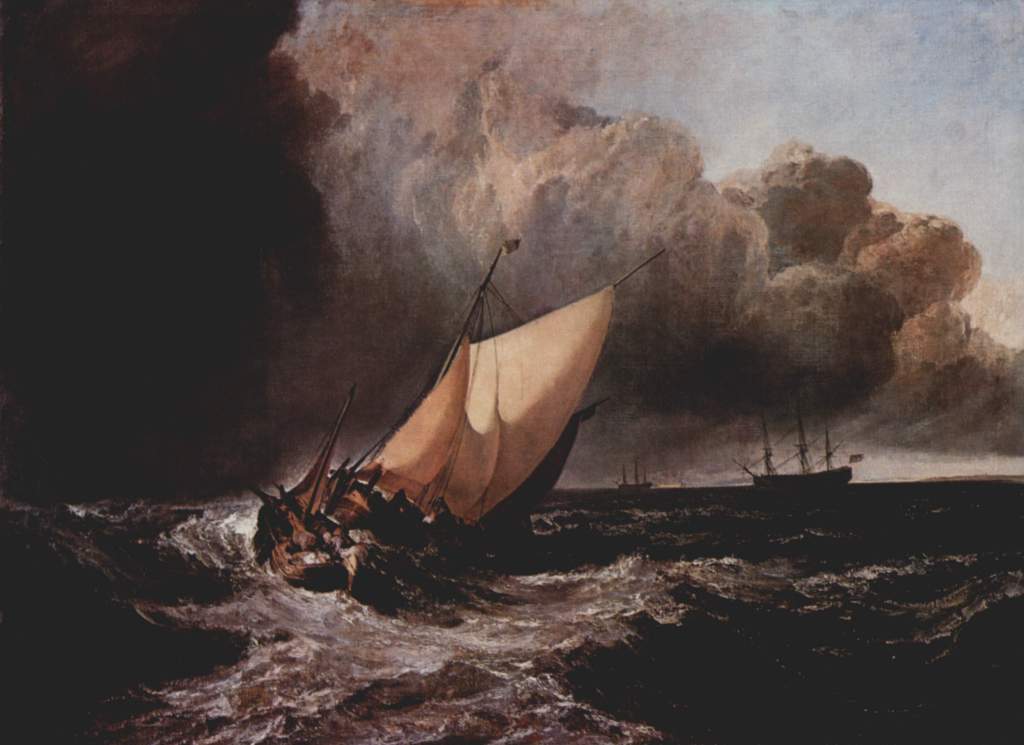
The Metropolitan Museum’s catalogue identifies a relationship with J. M. W. Turner’s Dutch Boats in a Gale (1801), now in the National Gallery, London. Both works feature a fishing vessel sharply inclined beneath the pressure of the wind, with golden sails, distant shipping and threatening clouds. Cotman’s composition may be understood as an acknowledgement of Turner’s achievement, although its formal organisation and handling remain distinctly his own.
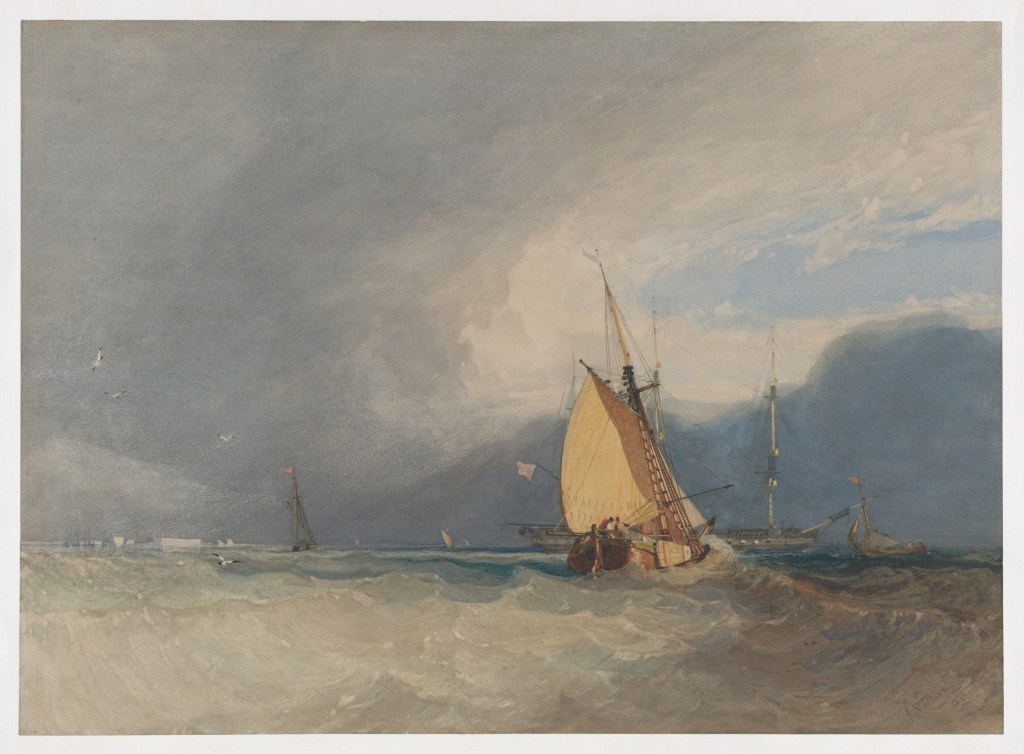
The technical innovations are central to the painting’s effect. Cotman employed watercolour over graphite, supplemented by gouache, gum arabic and techniques involving the removal or displacement of pigment. Scratching out allowed him to recover lighter passages by removing colour from the painted surface, while stopping out protected selected areas from subsequent washes. Most significantly, he experimented with flour paste as a medium, producing semi-opaque colour that remained workable for longer than conventional transparent washes. Martin Hardie’s study of Cotman’s technique explains how the addition of paste enabled the artist to move and lift pigment while it remained moist, allowing greater control over texture. In Boats off the Coast, the modified paint contributes to the opaque, milky appearance of the breaking waves, an effect specifically identified in the Metropolitan Museum’s catalogue.
The departure from the transparent, carefully superimposed washes of Cotman’s early career is considerable. Yet it would be misleading to regard the change simply as an abandonment of formal discipline in pursuit of spectacular effects. David Thompson’s interpretation of Cotman as a Romantic classicist is relevant here: the representation of turbulent natural forces remains subject to deliberate pictorial organisation.
The Metropolitan Museum also suggests that the threatened vessel might allude to Cotman’s own troubled circumstances. Such a reading is possible, but there is no documentary evidence that he intended the picture as a personal allegory.
Storm on Yarmouth Beach
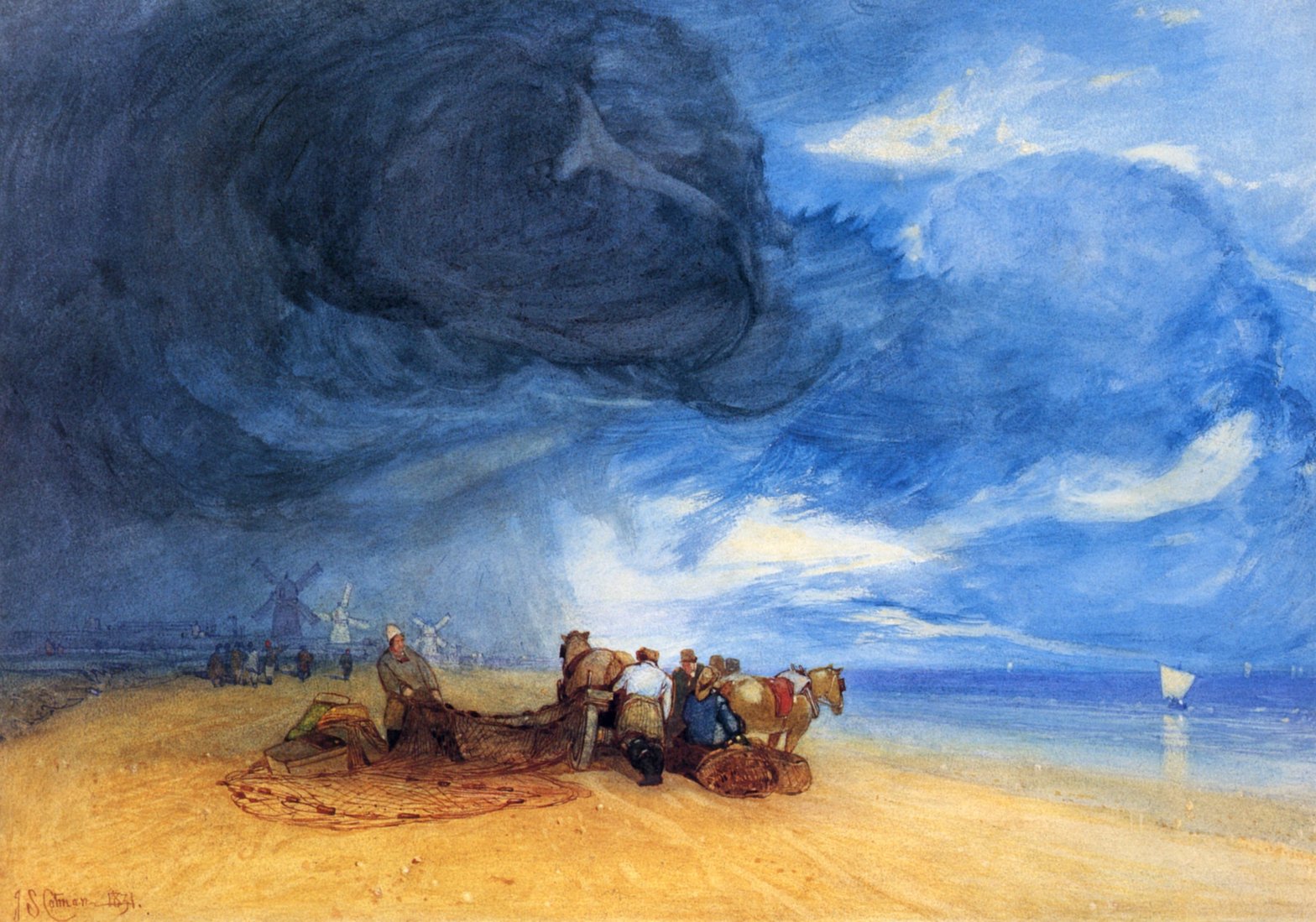
In Storm on Yarmouth Beach (1831), now in Norwich Castle Museum, Cotman returned to the coastal scenery that had occupied him during his years at Great Yarmouth. The watercolour depicts a group of fishermen gathering their nets onto carts as a storm approaches. Their activity takes place beneath an immense expanse of turbulent sky, whose dramatic movement and contrasting colours dominate the composition. The three windmills on the distant left horizon provide a reminder of the familiar landscape from which Cotman developed this imaginative treatment of the subject.
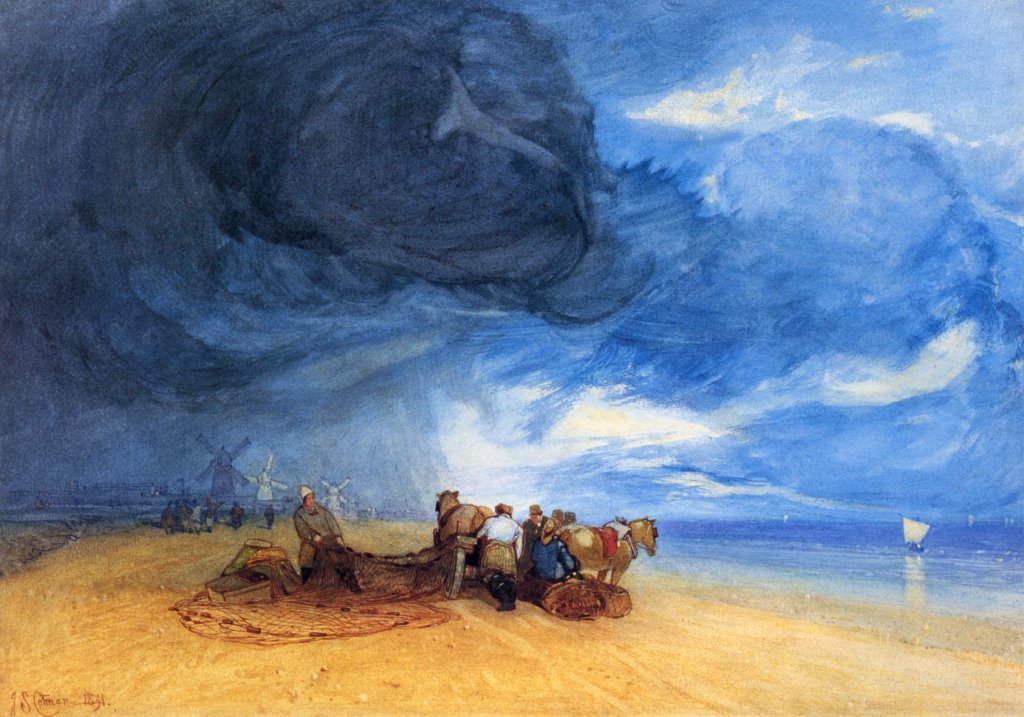
The windmills are probably those represented in an earlier drawing now in Norwich Castle Museum. They also occur in copies from the circulating portfolio of drawings that Cotman established in 1809 for his teaching practice. As the catalogue of Romantic Landscape: The Norwich School of Painters (2000) explains, Cotman continued to use this portfolio throughout his career. The recurrence of these motifs illustrates how observations made many years earlier could be incorporated into new compositions, allowing him to revisit familiar scenery without simply repeating his earlier representations.
The watercolour is among the most striking examples of Cotman’s technical experimentation during the early 1830s. By mixing his pigments with a thickening agent, probably flour or rice paste, he obtained a semi-opaque medium that remained moist on the paper for longer than conventional watercolour. This allowed colour to be wiped, dragged and otherwise manipulated to produce a greater variety of textures. In Storm on Yarmouth Beach, the technique contributes to the remarkable intensity of the storm-filled sky. The juxtaposition of strong blues and golden yellows, characteristic of several of Cotman’s later watercolours, is employed here with exceptional dramatic force. Pen and ink and scraping out further extend the range of effects.
Miklós Rajnai’s 1982 exhibition catalogue draws attention to the distance between this work and Cotman’s earlier treatment of stormy weather. Comparing it with The Mars off Cromer, the catalogue contrasts the carefully designed sky of the earlier composition with the theatricality of the later watercolour. The comparison suggests not a weakening of Cotman’s compositional abilities, but a change in the expressive purposes to which he directed them. Where his earlier landscapes often depended upon the controlled relationship of clearly defined forms, Storm on Yarmouth Beach employs heightened colour and atmospheric movement to achieve a more immediate dramatic effect.
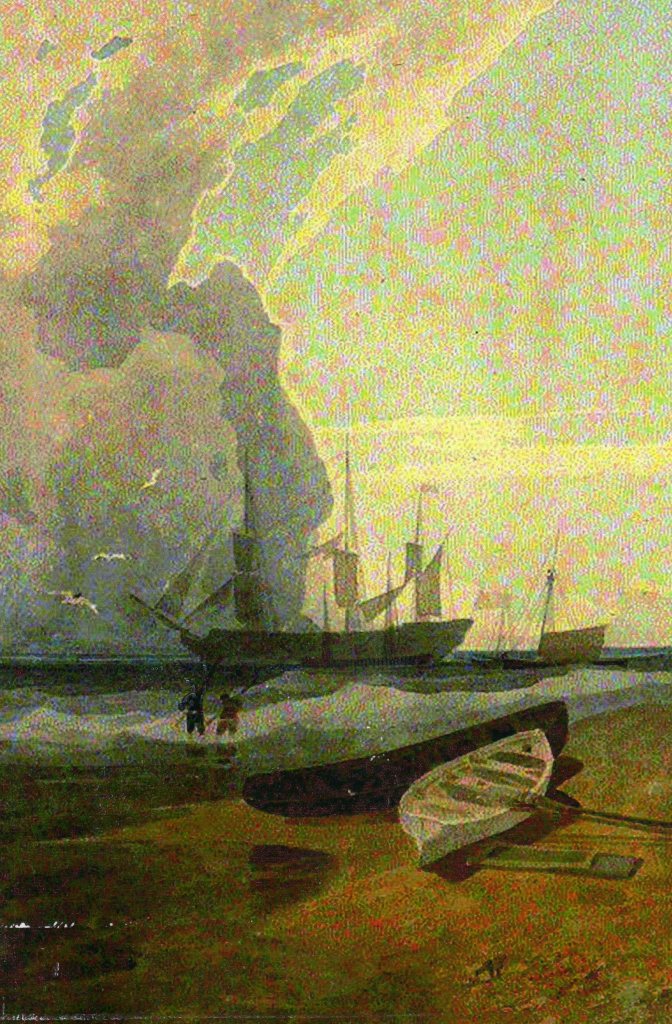
The watercolour does not appear to have been exhibited during Cotman’s lifetime. Rajnai raises the question of how contemporary critics might have received it, recalling the hostile response to the brilliant colouring of another work exhibited in 1831, a version of The Abbatial House, which was condemned as an outrage. Although the comparison cannot establish how Storm on Yarmouth Beach would have been judged, it indicates the extent to which Cotman’s later experiments could challenge prevailing expectations. The painting belongs to a period when his pursuit of more powerful effects was accompanied by considerable uncertainty about their public reception.
St Benet’s Abbey, Norfolk
In St Benet’s Abbey, Norfolk (1831), Cotman returned to a subject that had engaged him for much of his career. The ruined Benedictine abbey stood beside the River Bure, near the Norfolk Broads, and its surviving gatehouse, subsequently adapted to accommodate a drainage windmill, offered a striking combination of medieval architecture and the working landscape. Cotman had recorded the site in an etching published in 1813, but the watercolour of 1831 approaches it with a freedom considerably removed from his earlier antiquarian interests.
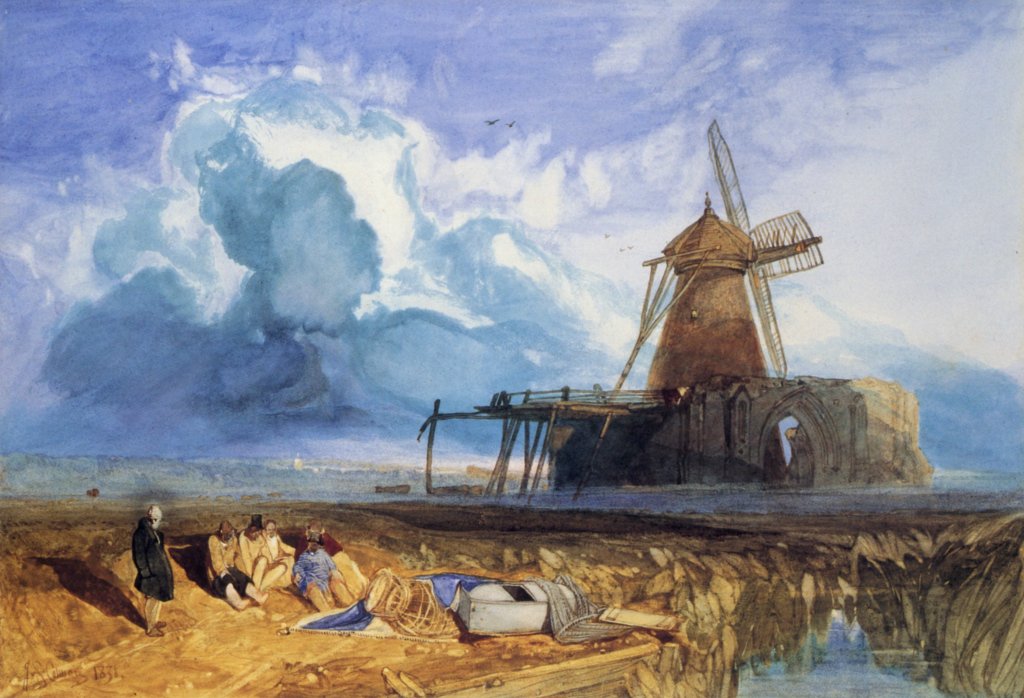
Although the architectural remains are recognisable, the arrangement of the landscape is governed less by the requirements of topographical accuracy than by the demands of the composition. The ruined building, vegetation and surrounding water are brought into a carefully organised relationship, while the treatment of colour gives the familiar subject a character distinct from Cotman’s earlier architectural studies.
The watercolour also demonstrates the range of techniques he had developed by this period. Working over a pencil drawing, Cotman combined transparent watercolour with bodycolour, brown ink and gum arabic, using wiping to modify the effects of the pigment. The blues, yellows and greens of the landscape are intensified by these procedures, while the treatment of clouds and foliage reveals his willingness to manipulate colour after its application. Details of the reeds and figures were reinforced with ink, giving definition to selected passages without imposing the uniform precision of an architectural drawing.
Cotman’s interest in the site continued beyond the execution of this watercolour. A diary kept by Harriet Gunn, Dawson Turner’s daughter, records an excursion to St Benet’s Abbey on 5 July 1832, accompanied by Cotman and his daughter Ann. The visit does not establish that the 1831 composition was based on sketches made on that occasion, but it confirms his continuing attachment to the subject. He also produced an oil painting of the abbey, in which the architecture and landscape were more freely imagined.
The importance of St Benet’s Abbey lies in the relationship between Cotman’s earlier practice as an architectural draughtsman and his later conception of landscape. A subject once approached through the careful recording of historic buildings becomes the basis for a composition in which architecture, natural forms and colour are treated with greater imaginative independence.
Conclusion
Cotman’s reputation has long rested upon the clarity and restraint of his early watercolours, but the works considered here reveal a more varied artistic achievement. His return to familiar subjects during the 1820s and 1830s was accompanied by changes in his treatment of colour, atmosphere and the physical properties of paint. The maritime landscapes, woodland studies and architectural subjects of these years demonstrate an artist unwilling to confine himself to the methods that had brought him his earliest distinction.
The contrast between the controlled harmonies of A View from Yarmouth Bridge and the heightened drama of Storm on Yarmouth Beach is especially revealing. Both emerged from Cotman’s longstanding familiarity with the Norfolk coast, yet their differences show how extensively he could reconsider a subject. Silver Birches and St Benet’s Abbey likewise demonstrate the breadth of his later experimentation.
Cotman’s professional circumstances were more secure in some respects than traditional accounts of his disappointments might suggest, but recognition and patronage did not consistently bring the success he sought as a painter. In all events, his later landscapes represent an imaginative exploration of new expressive possibilities, whose artistic value has become increasingly apparent with time.
Donate to Inner Surfaces here.
Bibliography
Agar, Paris, ‘Teaching Style: Crome and Cotman’, in Giorgia Bottinelli (ed.), A Vision of England: Paintings of the Norwich School (Norwich: East Publishing, 2013), pp. 42–44.
Binyon, Laurence, ‘The Art of John Sell Cotman’, The Burlington Magazine for Connoisseurs, 81, no. 472 (July 1942), pp. 159–60, 163.
Blayney Brown, David, with Andrew Hemingway and Anne Lyles, Romantic Landscape: The Norwich School of Painters (London: Tate Gallery Publishing, 2000).
Hardie, Martin, ‘Cotman’s Water-Colours: The Technical Aspect’, The Burlington Magazine for Connoisseurs, 81, no. 472 (July 1942), pp. 171–76.
Metropolitan Museum of Art, ‘Boats off the Coast, Storm Approaching’, online collection catalogue, accession no. 2017.75.
Miller, Rose, ‘Seeing Through Paintings: The Use of Materials in Cotman and Crome’s Oils’, in Giorgia Bottinelli (ed.), A Vision of England: Paintings of the Norwich School (Norwich: East Publishing, 2013), pp. 35–40.
Moore, Andrew W., John Sell Cotman 1782–1842 (Norwich: Norfolk Museums Service, 1982).
Moore, Andrew W., ‘Cotman, John Sell (1782–1842)’, Oxford Dictionary of National Biography (Oxford University Press, 2004; revised 2008).
Oppé, Paul, ‘Cotman and His Public’, The Burlington Magazine for Connoisseurs, 81, no. 472 (July 1942), pp. 163–71.
Rajnai, Miklós (ed.), John Sell Cotman 1782–1842 (London: Arts Council of Great Britain and Herbert Press, 1982).
Thompson, David, ‘Cotman: Romantic Classicist’, in Miklós Rajnai (ed.), John Sell Cotman 1782–1842 (London: Herbert Press, 1982), pp. 17–20.

