The Farnese Patronage and Annibale’s Arrival in Rome
When Annibale Carracci moved to Rome in November 1595, he was already an established painter whose work, in collaboration with his elder brother Agostino and their cousin Ludovico, had contributed to a transformation of artistic practice in Bologna. Their rejection of the conventions of late Mannerism was grounded in a renewed attention to nature, the study of earlier masters and an experimental approach to drawing. The fresco cycles they had executed together in Palazzo Fava and Palazzo Magnani had also demonstrated their ability to organise complex narratives within ambitious decorative schemes. Rome offered Annibale the opportunity to pursue these investigations in direct confrontation with the achievements of antiquity and the High Renaissance.
His arrival was secured through the patronage of Cardinal Odoardo Farnese (1573–1626), a member of one of Italy’s most powerful ruling families. Odoardo’s father, Alessandro Farnese (1545–1592), had commanded the Spanish armies in the Netherlands, while his elder brother Ranuccio governed the Duchy of Parma and Piacenza. The family’s Roman palace, built during the sixteenth century and associated with the papacy of Paul III, Alessandro’s grandfather, embodied its political standing and artistic ambitions. Although Odoardo was its principal resident, Palazzo Farnese remained a dynastic possession, and commissions undertaken there could serve the interests of the family as a whole.
The relationship with the Carracci had begun through Ranuccio’s court in Parma. According to the testimony of Giovanni Battista Agucchi, Annibale and Agostino had visited Parma while still based in Bologna, studying Correggio’s frescoes in the cathedral and undertaking commissions for Ranuccio Farnese. Their successful work for Ranuccio subsequently helped secure their employment under his brother Odoardo in Rome. Silvia Ginzburg has emphasised the importance of these earlier contacts in explaining their recruitment. The cardinal was not simply inviting an admired Bolognese painter to Rome. He was drawing upon artists already associated with the cultural interests of the Farnese court.
The original commission had little to do with the mythological decoration that would eventually make Annibale famous. Odoardo intended to celebrate his father’s military achievements in a cycle of frescoes for the palace’s Sala Grande. In a letter to Ranuccio dated 21 February 1595, he referred to his decision to employ the Carracci for this purpose and requested the material needed to represent Alessandro’s campaigns. The project formed part of a larger commemorative undertaking that also included the sculptor Simone Moschino, summoned to produce a monumental statue of Alessandro crowned by Victory. Preparations had begun as early as 1593, but the projected fresco cycle was repeatedly postponed and ultimately abandoned.
The change in direction opened the way for two very different decorative undertakings: the Camerino, a relatively small room decorated with mythological exempla of virtue, and the much larger Gallery, whose vaulted ceiling would be devoted to the loves of the gods. Their precise chronology remains disputed. The generally accepted sequence places the Camerino around 1595–1597, before the Gallery was begun, probably in 1597. Ginzburg has proposed a different reconstruction, placing the beginning of work in the Gallery in 1598 and the Camerino in 1599, during an interruption to the larger commission. Her argument challenges the identification of activity recorded in the palace during 1595 with the Camerino and consequently questions its customary position as an artistic prelude to the Gallery.
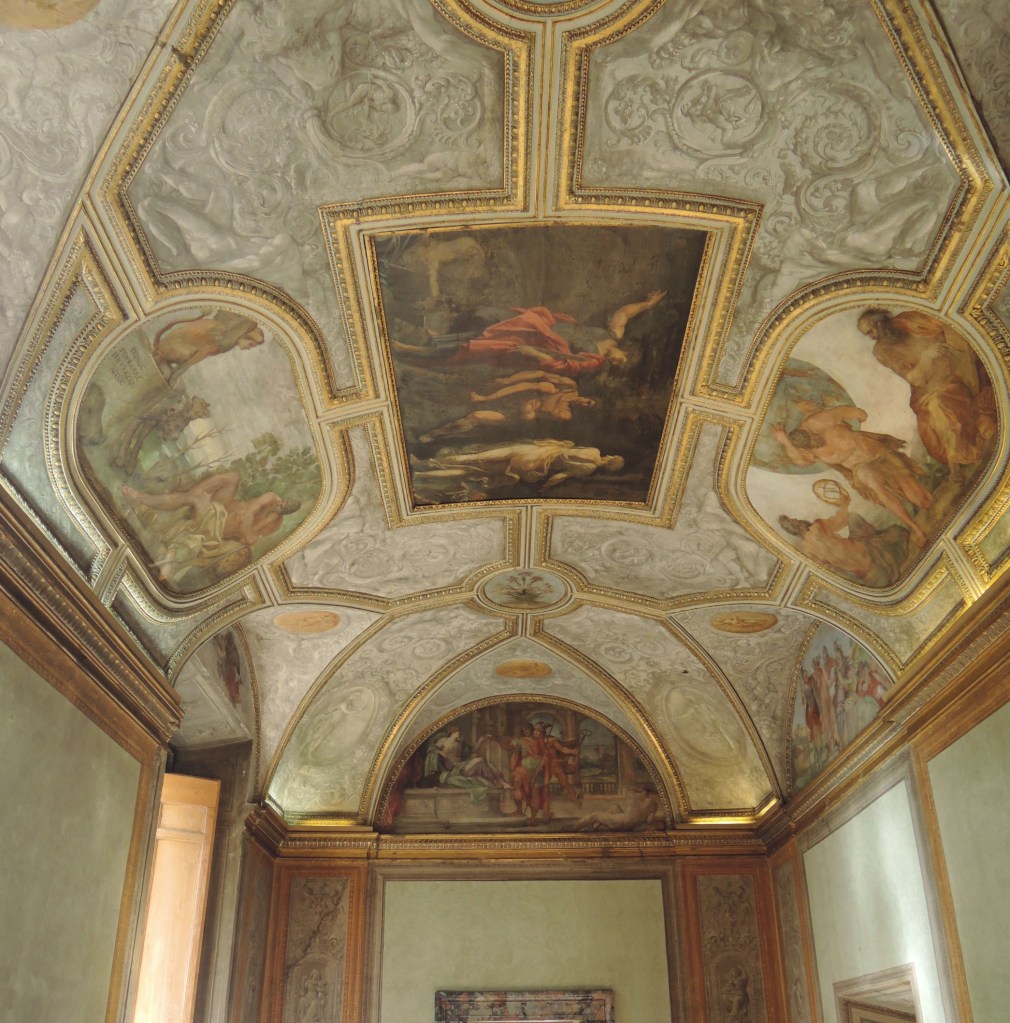
The cardinal’s patronage was shaped by a marked preference for the painting of Emilia, especially Correggio and Parmigianino. Original works by Correggio and copies after his paintings were present in Palazzo Farnese, while members of Odoardo’s circle, including Gabriele Bombasi, encouraged this regional allegiance. Yet the significance of these preferences extended beyond personal taste. As Ginzburg argues, the cultivation of Emilian painting helped the Farnese assert the distinction of their own cultural territory within Rome.
For Annibale, however, the artistic possibilities were considerably broader. Rome offered him new opportunities to develop the synthesis already pursued by the Carracci, drawing upon the achievements of different Italian artists and regional traditions.
The relationship between patron and painter was not without its difficulties. A contemporary letter from Annibale’s young pupil Bonconti describes the painter’s heavy workload, cramped accommodation in the palace and modest remuneration. Odoardo’s demands extended across a wide range of commissions, from altarpieces and independent paintings to the decoration of rooms and galleries. Nevertheless, the Farnese Gallery offered Annibale an artistic undertaking of exceptional ambition, providing opportunities for invention that extended far beyond the immediate demands of his patron.
A Sculpture Gallery and a Ceiling of Divine Loves
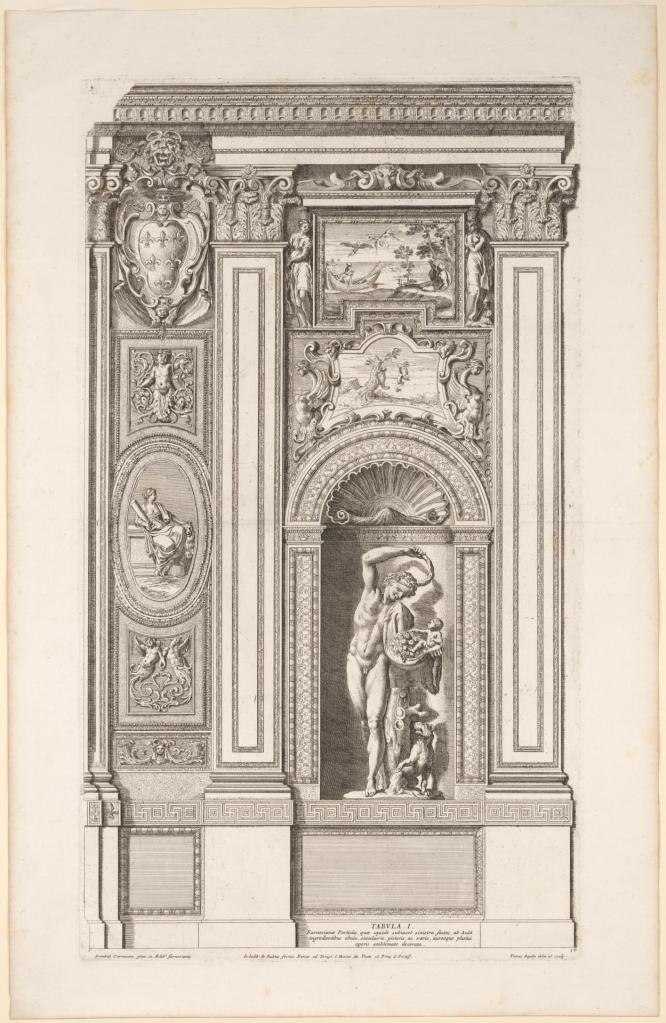
The Gallery occupied a long, narrow room on the principal floor of Palazzo Farnese, covered by a steep barrel vault. Its architectural arrangement had been established before Annibale began work. Sixteen niches along the walls were intended to accommodate ten full-length antique statues and six busts, forming a display of classical sculpture appropriate to the family’s distinguished collection. A drawing by Cherubino Alberti, a specialist in illusionistic architectural decoration, dating from around 1594–1595, records this arrangement, although the sculptures themselves were installed after the ceiling decoration had been completed. The room’s intended function as a place for the contemplation of art would have a decisive bearing on Annibale’s conception of its painted interior. The arrangement of the niches and their relationship to the surrounding architectural decoration can be seen in Pietro Aquila’s engraving of 1674, which records the Gallery as it appeared after the completion of the painted scheme.
The problem was considerably more complex than the decoration of a conventional ceiling. The room’s elongated proportions and sharply curving vault required a scheme that could accommodate numerous mythological subjects without losing its architectural coherence. Annibale’s eventual solution was to transform the vault into an imaginary gallery of paintings and sculptures. Gilded frames surround narrative compositions presented as quadri riportati, paintings apparently mounted within the architectural setting. Simulated stone supports, sculptural figures and bronze medallions establish an elaborate framework, while painted cornices and architectural divisions appear to continue the structure of the room below.
As Donald Posner has explained, the essential achievement lay in the relationship between these elements. The great painted supports, or atlantes, correspond to the architectural divisions of the walls and seem to carry the entablature above them. Framed pictures occupy spaces defined by this imaginary construction, while seated nude youths, putti and satyrs inhabit its ledges and openings. These apparently living figures are placed alongside imitations of sculpture, some represented with chipped or broken surfaces. Even the bronze medallions appear to possess the patina of ancient objects. The spectator encounters a series of shifting distinctions between actual architecture, simulated architecture, painted sculpture and figures endowed with the appearance of life.
The decorative system developed from several traditions familiar to Annibale. His earlier work in Bologna, especially the friezes of Palazzo Magnani, provided experience in coordinating narrative scenes with architectural divisions. Pellegrino Tibaldi’s ceiling in the Sala d’Ulisse at Palazzo Poggi offered a more ambitious example of framed compositions extending across a vault. Yet the decisive precedent was Michelangelo’s Sistine Chapel ceiling, whose imaginary architecture, seated ignudi and simulated sculptural elements had established a monumental system of decoration. Annibale adapted these resources to a different setting, constructing a fictive space that seemed to extend the Gallery’s actual architecture rather than simply cover its surface.
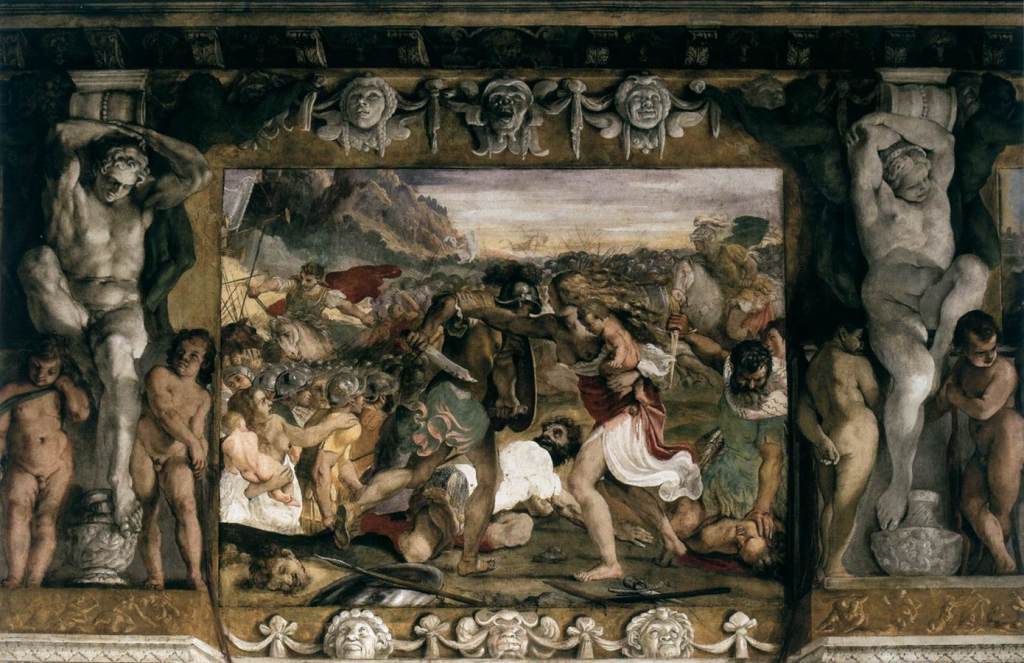
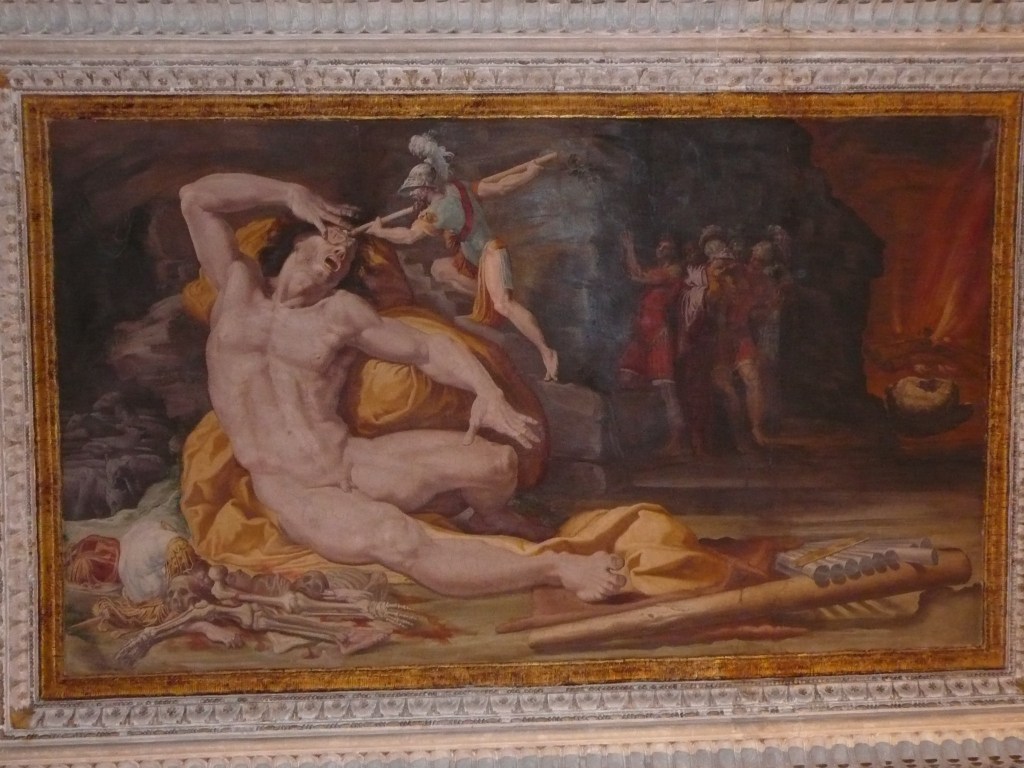
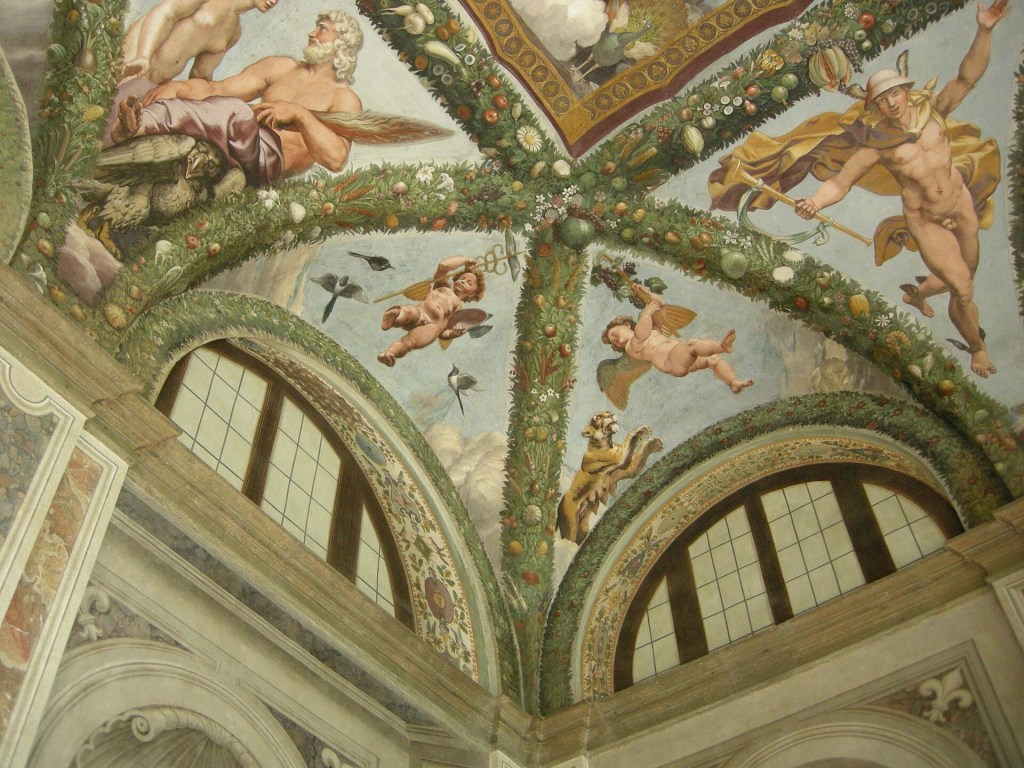
Raphael’s Roman decorations supplied another important point of reference. The Vatican Stanze offered examples of monumental composition and the organisation of figures within architectural settings, while the Loggia di Psiche at the nearby Villa Farnesina provided an especially relevant treatment of classical mythology. The Farnese had acquired the Farnesina in 1579, and its association with their Roman palace gave Annibale’s engagement with Raphael’s achievement a further significance. Charles Dempsey has interpreted the Gallery as a conscious artistic rivalry with the great Roman decorations of the High Renaissance, in which familiar forms and subjects were reworked with a new freedom and inventiveness.
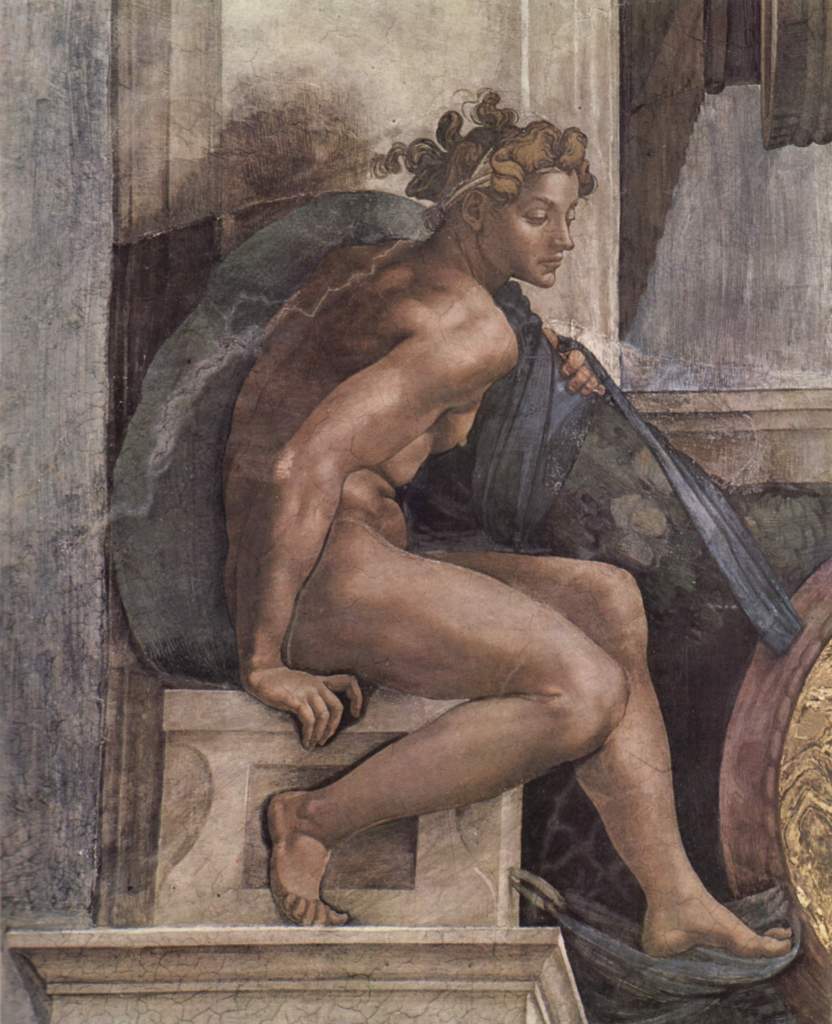
The antiquities displayed in Palazzo Farnese were no less important. Rather than regarding the collection simply as a source of individual models, Posner understood the ceiling as an extension of the room’s purpose. The sculptures below acquired a fictive counterpart above, while the framed mythological scenes suggested a collection of paintings displayed within an imaginary architectural interior. The Gallery thus became a place in which art represented and reflected upon its own forms. Gail Feigenbaum has similarly emphasised the importance of this environment for Annibale’s engagement with the classical past, involving not only the study of ancient objects but the reconstruction of subjects and pictorial inventions known through classical literature.
The intellectual culture surrounding the Farnese household also deserves consideration. Fulvio Orsini, the family’s learned librarian and antiquarian, possessed an extensive knowledge of ancient literature, sculpture and inscriptions. His involvement in the programme of the Camerino is supported by correspondence with Odoardo, although the precise extent of his contribution remains uncertain. He has also been proposed as an adviser for the Gallery, but there is no secure evidence establishing him as the author of its mythological programme. Annibale’s designs suggest a process in which artistic and literary invention developed together, rather than the straightforward illustration of a predetermined sequence of subjects.
The imagery itself centres upon the power of love over gods and mortals. Hercules, the embodiment of heroic strength, submits to Iole, relinquishing his club and lion skin while taking up a tambourine, in a playful reversal of their customary roles. Diana, goddess of chastity, descends to the sleeping Endymion, while Venus approaches the mortal Anchises. At opposite ends of the vault, Polyphemus appears first as the lovesick admirer of Galatea and then as a figure of destructive jealousy. Love overcomes strength, chastity and even the distinction between divine and mortal existence, while its consequences range from pleasure and tenderness to humiliation and violence.
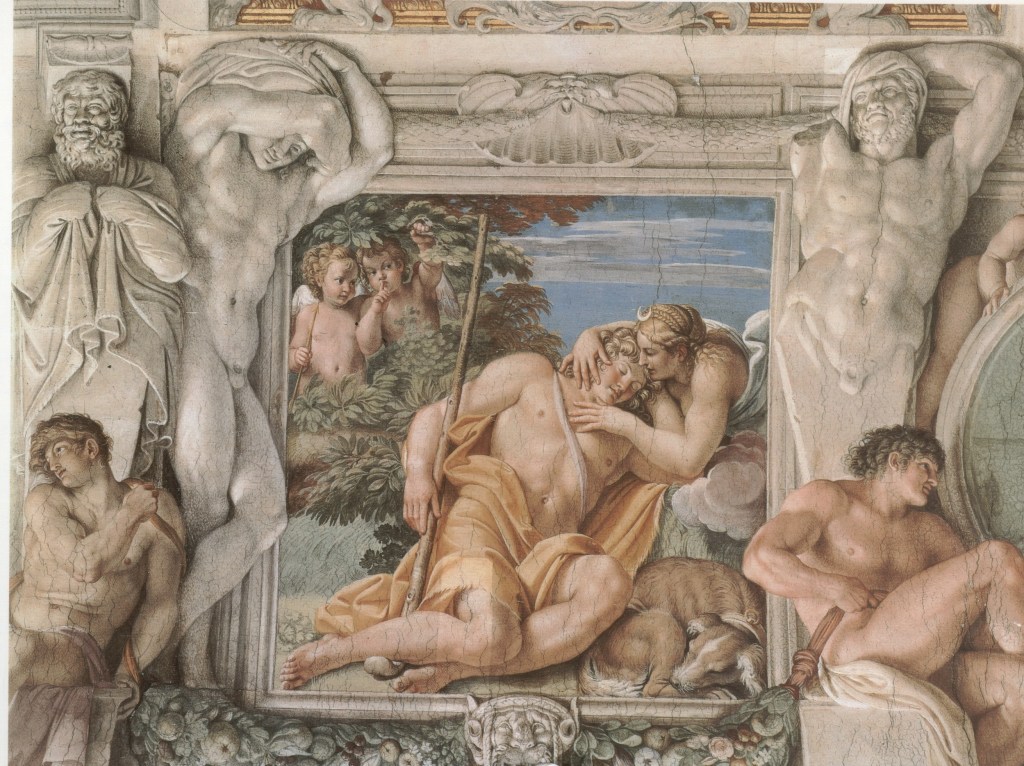
The simulated bronze medallions introduce further variations upon these themes, including the pursuits of Pan and Syrinx and Boreas and Orithyia, while Cupid’s victory over Pan evokes the Virgilian declaration omnia vincit amor, love conquers all. Above the cornice, pairs of winged Loves wrestle, compete and embrace. Their significance has been much debated, but their presence reinforces the centrality of love to the decoration. At the crown of the vault, the Triumph of Bacchus and Ariadne occupies the commanding position, bringing the mythological celebration into its most expansive pictorial form.
Love, Interpretation and the Question of Marriage
Although the Farnese Gallery’s mythological programme has generated considerable scholarly disagreement, its dominant theme is widely recognised as the power of love. The difficulty lies in determining what kind of love is being celebrated, whether the episodes constitute a coherent philosophical argument, and how far their meanings were shaped by the circumstances of the commission. The distinction between sensual pleasure, mutual affection and a higher spiritual ideal has been central to these discussions.
An influential early interpretation was provided by Giovanni Pietro Bellori in his Vite of 1672. Bellori understood the decoration through the opposition between celestial and earthly love, identifying the pairs of winged figures above the cornice with the struggle between higher and lower affections. In this reading, the government of passion by reason provides the ceiling with a moral and philosophical significance. Yet Bellori’s account presents a difficulty, since his descriptions of the individual mythological scenes repeatedly acknowledge the power of sensual desire rather than its defeat.
Charles Dempsey challenged this interpretation in his influential study of 1968, arguing that the vault celebrates love’s universal dominion without requiring an overarching moral allegory. His reconsideration of the winged figures was central to the argument. Rather than treating them as celestial and vulgar love engaged in perpetual conflict, he identified them as Eros and Anteros, love offered and love returned. Their wrestling, competition and embraces represent the rivalries and rewards of reciprocal affection. Dempsey supported this reading through Renaissance mythographic literature and related works attributed to Agostino Carracci, in which Anteros rewards faithful love and punishes its betrayal.
The resulting interpretation gives greater prominence to the decoration’s humour and sensuality. The gods are not presented as remote embodiments of virtue, but as beings susceptible to the same passions as mortals. Their authority, strength and dignity are repeatedly compromised by desire. Dempsey associated this treatment with ancient epigrammatic poetry and the conventions of comic and erotic literature, in which elevated subjects could become occasions for learned wit. The grandeur of Annibale’s pictorial language is essential to the effect, since heroic forms and prestigious artistic precedents are brought into contact with the pleasures and humiliations of love.
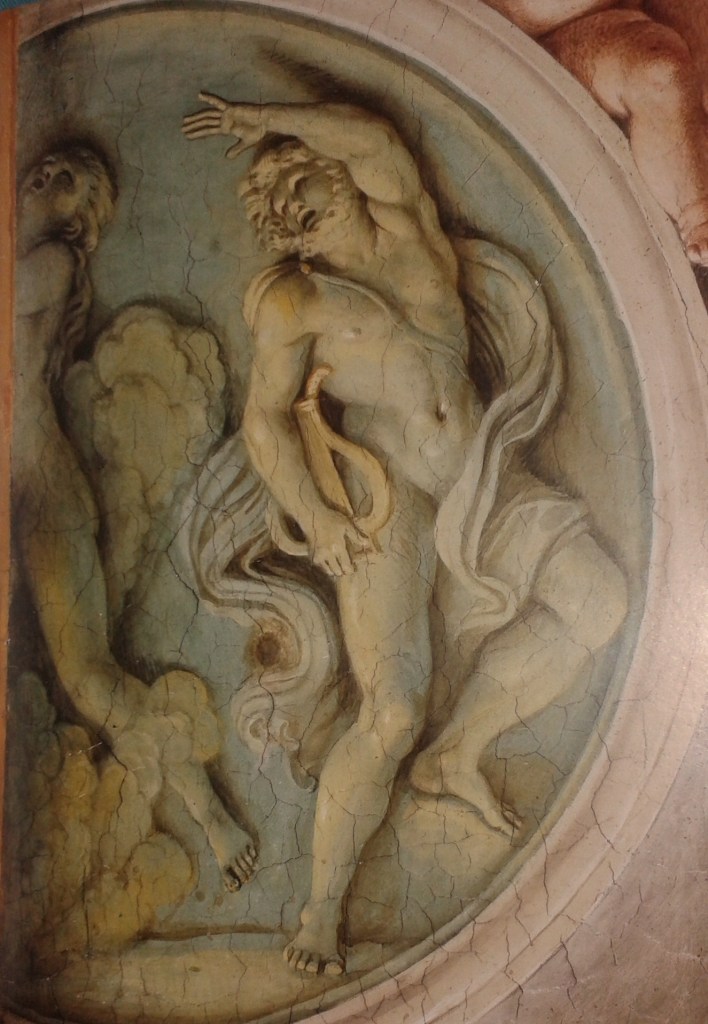
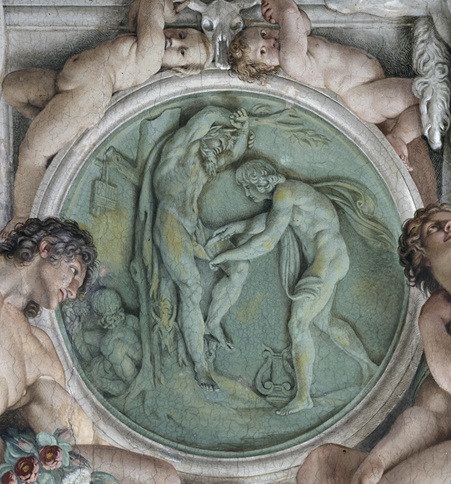
Such an interpretation does not, however, resolve every episode with equal ease. The simulated bronze medallion depicting Apollo and Marsyas is a case in point. The myth concerns a musical contest and the terrible punishment inflicted upon Marsyas for challenging the god, rather than an immediately recognisable manifestation of erotic desire. Dempsey incorporated the scene into his argument through Olympus, the pupil and lover of Marsyas, identifying the reclining river figure with the tears shed in grief for his death. This provides a possible connection with love, but one dependent upon a more specialised literary association than those governing many of the larger paintings. The example suggests that love may provide a dominant theme without necessarily accounting for every subject through an equally direct or consistent relationship.
Silvia Ginzburg has offered a different emphasis, interpreting the central fresco as a double triumph in which Bacchus and Ariadne, on the one hand, and Silenus and his female counterpart, on the other, are associated with celestial and earthly love respectively. Rather than presenting these forms of affection as irreconcilable opposites, she interprets their conjunction as an image of harmony between sensual appetite and spiritual attachment. Ginzburg has suggested a possible relationship with the philosophical ideas of Melchiorre Zoppio, a member of the Bolognese Accademia dei Gelati, to which Agostino Carracci also belonged.
Gail Feigenbaum has argued for a more flexible understanding of the decoration’s meanings. Its lyrical and comic treatment of mythological subjects need not exclude philosophical significance, since Renaissance viewers were accustomed to interpreting the same narrative on several levels. The abduction of Ganymede, for example, could evoke the god’s desire for a beautiful youth while also suggesting, within Neoplatonic thought, the ascent of the mortal soul towards the divine. Such possibilities complicate a strict division between sensual and spiritual readings without requiring every scene to conceal an equivalent allegory.
The possible connection with Ranuccio Farnese’s marriage to Margherita Aldobrandini, niece of Pope Clement VIII, in 1600 has introduced another dimension to the debate. Dempsey proposed that the vault might be understood as a painted epithalamium, a celebration of marriage informed by classical nuptial poetry. The festive character of the Bacchic procession, the repeated encounters between lovers and the decoration’s learned erotic humour would be appropriate to such an occasion. He also drew attention to the date MDC, or 1600, inscribed beneath one of the Polyphemus scenes and to literary precedents in which weddings were celebrated through exuberant mythological imagery.
Donald Posner regarded this interpretation as plausible, but the evidence is not conclusive. According to the conventional chronology, work on the Gallery began around 1597, whereas the agreement for Ranuccio’s marriage was not finalised until 1599, the year before the wedding. Gail Feigenbaum has also drawn attention to the Farnese family’s decision, during preparations for the marriage and an anticipated visit by Pope Clement VIII, to revive the earlier Sala Grande project celebrating Alessandro Farnese’s military achievements. Work on the Gallery was interrupted while attention returned to this dynastic commission. These circumstances complicate the suggestion that the wedding provided the original occasion for the Gallery’s decoration, although the marriage may have influenced the selection or development of subjects already under consideration.
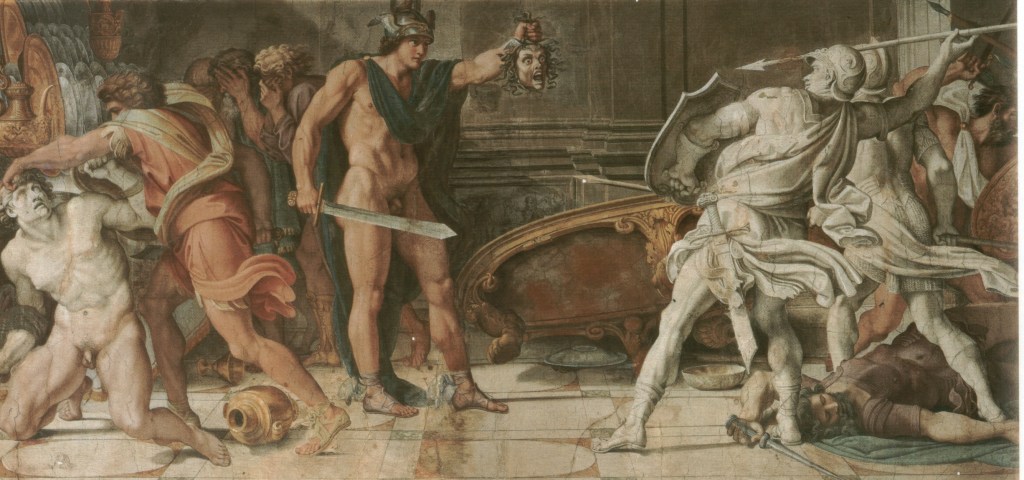
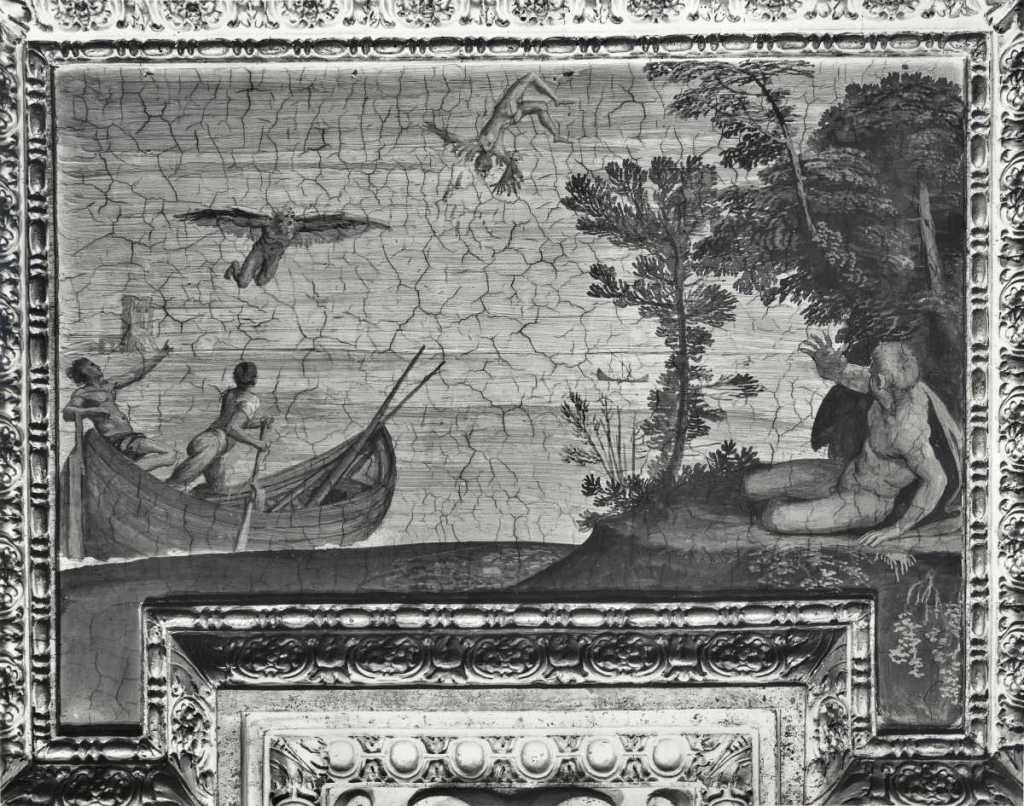
The chronology of the decoration presents a further complication. Annibale’s vault was substantially completed around 1600–1601, whereas the painted decoration of the walls proceeded later, largely through members of his workshop, during the opening years of the seventeenth century. The wall paintings introduced figures of the Virtues and heroic episodes from the story of Perseus, giving the finished room a more explicitly moral and dynastic character. Dempsey suggested that Bellori’s interpretation had assimilated these later additions into a single programme, extending their moral significance retrospectively to the ceiling. Feigenbaum likewise recognised the distinction between the two campaigns, while allowing that the completed ensemble could acquire meanings not fully envisaged at the beginning.
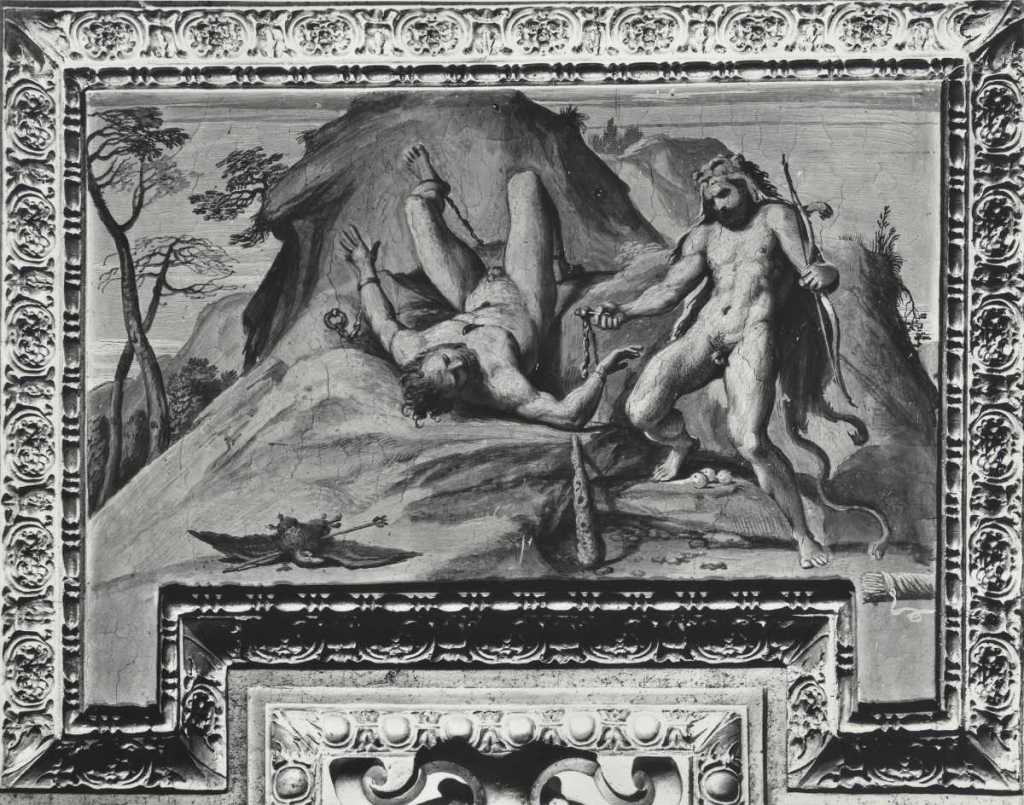
The distinction between the successive campaigns also raises the question of how far the Gallery’s mythological programme was determined in advance. Posner proposed that the selection and distribution of subjects developed alongside Annibale’s changing decorative designs, with a literary adviser contributing specialised knowledge as the scheme evolved. This remains a reconstruction rather than a documented account of the working process. Dempsey’s comparisons with the poetry of Giambattista Marino, notably the Adone of 1623, likewise illuminate the learned culture of love and artistic invention without establishing a direct literary source for the earlier frescoes.
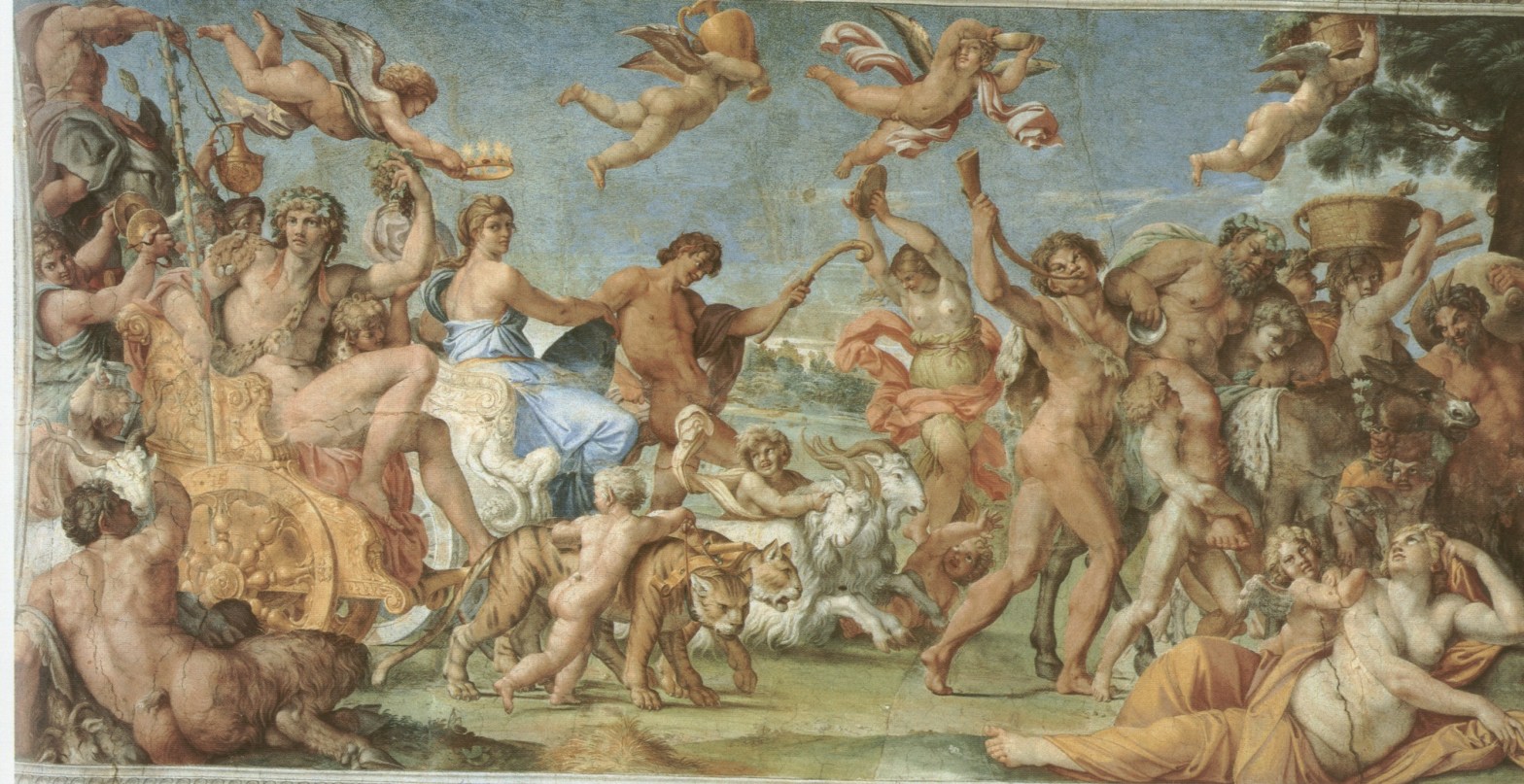
The central Triumph of Bacchus and Ariadne brings many of these questions into focus. Its ceremonial grandeur, exuberant mythological imagery and complex relationships between the principal figures have supported contrasting interpretations of sensuality, reciprocal affection and marriage. The painting also provides the fullest demonstration of Annibale’s ability to transform a wide range of antique and Renaissance precedents into a coherent pictorial invention.
The Triumph of Bacchus and Ariadne
At the centre of the Farnese vault, the Triumph of Bacchus and Ariadne occupies the largest and most commanding of its mythological compositions. Unlike the surrounding quadri riportati, enclosed within simulated gilded frames, the Triumph is bordered by an architectural cornice imitating marble. Silvia Ginzburg has observed that this gives the fresco the appearance of a great window opening above the spectator, through which the procession seems to pass. This distinction is central to its effect. Rather than presenting a mythological episode as a painting displayed within the Gallery, Annibale creates the impression of an event unfolding in an apparently continuous space beyond the ceiling.
The subject is the triumphant return of Bacchus from India, accompanied by Ariadne, whom he has encountered after her abandonment by Theseus. The god rides in an elaborately ornamented golden chariot drawn by tigers, while Ariadne follows in a silver chariot drawn by goats. Around them gathers a procession of satyrs, maenads, musicians, children and animals, with an elephant recalling the eastern conquests of Bacchus. On the other side of the composition, the drunken Silenus advances precariously upon a donkey, supported by attendant fauns. A reclining woman, identified by Bellori as earthly Venus, occupies the foreground, while winged cupids carry vessels and offerings above the moving crowd.
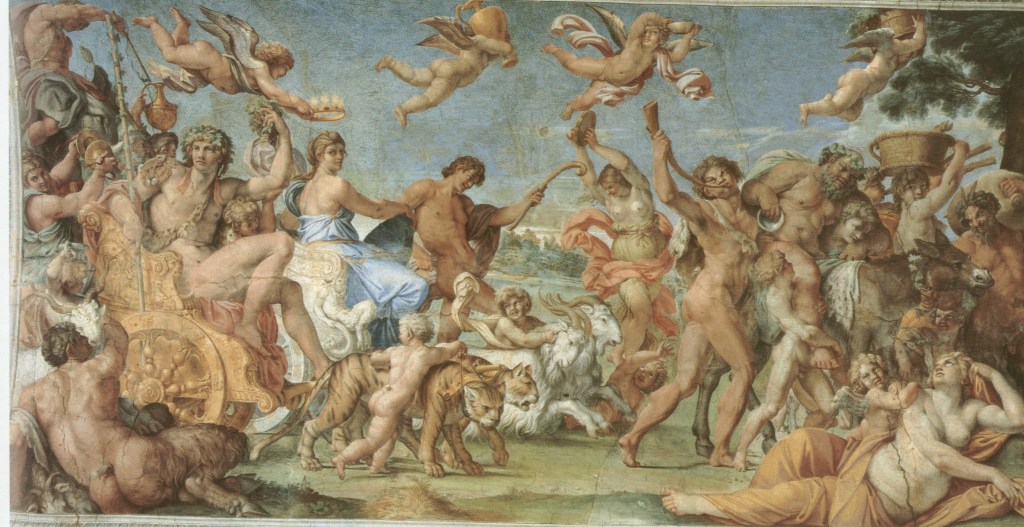
Annibale’s treatment draws upon the ancient tradition of the Bacchic triumph, a subject frequently represented on Roman sarcophagi. The procession offered a setting in which divine figures, animals and attendants could be assembled in an extended narrative, with the ceremonial dignity of a triumphal entry enlivened by the pleasures and excesses of Dionysiac celebration. Clare Robertson has emphasised the importance of these antique reliefs in determining the composition’s organisation. Yet Annibale’s relationship with antiquity was not simply antiquarian. The sculptural precedents supplied a repertory of forms and gestures which he transformed into a more expansive conception of movement, bodily presence and pictorial space.
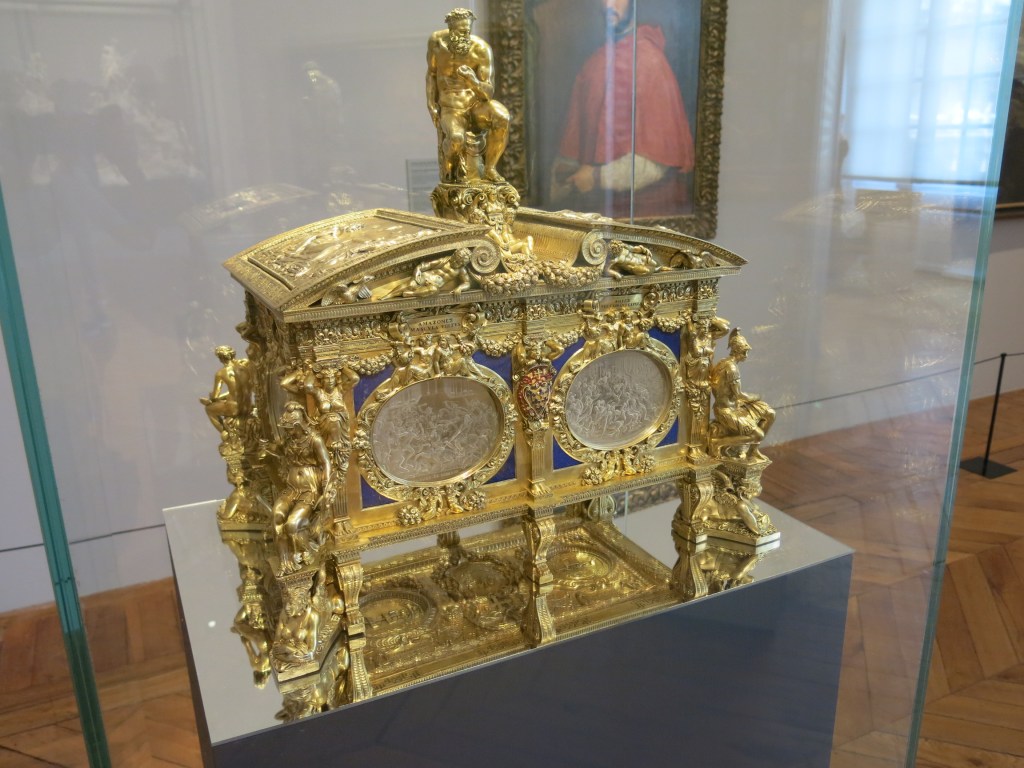
An earlier Farnese commission offered another, more immediate source. In the mid-sixteenth century, Giovanni Bernardi da Castelbolognese had engraved a Bacchic procession in rock crystal for the celebrated Farnese Casket, following a design by Perino del Vaga. Ginzburg identifies this earlier double procession as a significant precedent for Annibale’s invention. Robertson goes further in specifying Perino’s preparatory drawing, now in the Louvre, as the immediate model through which Annibale encountered the composition. She also points out that the casket itself had already left Palazzo Farnese, having been presented to Maria of Portugal as a wedding gift. The surviving drawing therefore provides a more secure basis for comparison than an assumption that Annibale studied the finished object in the palace.
Perino del Vaga, The Triumph of Bacchus, Louvre
Annibale’s arrangement combines monumental figure groups with the crowded incident and variety characteristic of ancient Bacchic reliefs. Ginzburg draws attention to the way figures and animals suggest that the procession continues beyond the painted frame. Within one group, the elephant, a satyr and a woman carrying a decorated golden vessel offer sharply differentiated expressions and responses. Ginzburg distinguishes the elephant’s astonished gaze, the gentle animal character of the satyr and the woman’s attentive expression, momentarily caught by the changing light.
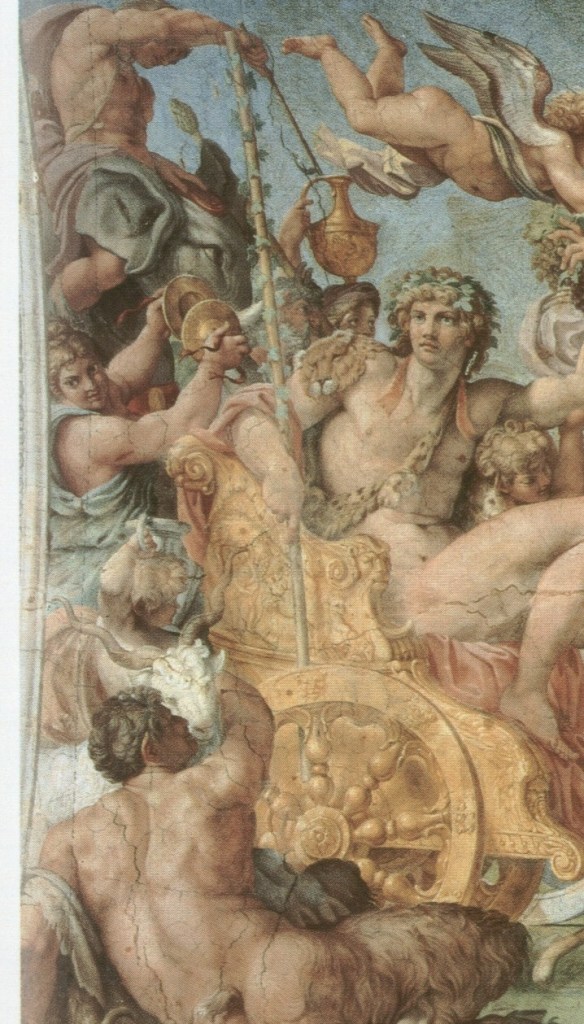
These passages exemplify Annibale’s ability to animate an inherited decorative subject through closely observed distinctions. The procession includes figures who participate actively in the celebrations and others whose presence registers through gesture, expression or momentary attention. Even the ornamental details contribute to this abundance. Ginzburg describes the minute figures decorating Bacchus’s chariot, where putti climb among vines, a goat attempts to nibble a plant and a satyr rides a he-goat carrying grapes. Such inventions, barely distinguishable from the Gallery floor, recall the elaborate silver tableware designed by Annibale and Agostino Carracci for Cardinal Odoardo Farnese, including cups and a ceremonial basket decorated with similarly exuberant Bacchic imagery.
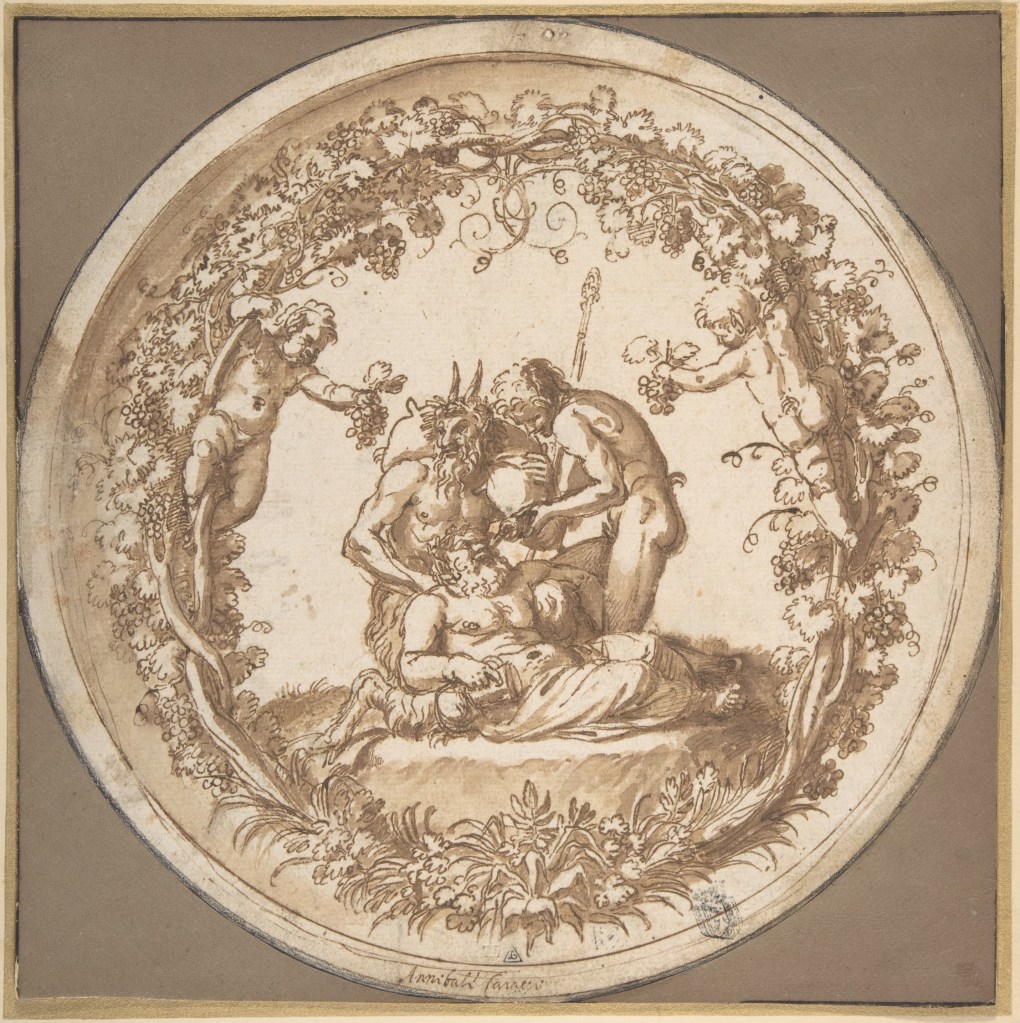
The god himself possesses a grandeur informed by the artistic models Annibale encountered in Rome. Ginzburg relates the attitude of Bacchus to one of Michelangelo’s seated nude youths beside Jeremiah on the Sistine ceiling. The comparison concerns the organisation of the body rather than the repetition of an identical pose. In Donald Posner’s account, the Gallery marks a decisive transformation in Annibale’s conception of the human figure. The bodies acquire greater volume, more coherent weight and an equilibrium that allows them to move convincingly through three-dimensional space. Raphael, Michelangelo and ancient sculpture provided the principal models for this development, but their example was assimilated through Annibale’s sustained investigation of living form.
The monumental conception does not exclude comedy. Dempsey describes Bacchus as visibly intoxicated, his gaze unfocused and his grasp upon the grapes slackened, while a small attendant supports his raised arm. Such details qualify the ceremonial grandeur of his triumph. The victorious god is himself subject to the pleasures he celebrates, and the familiar language of heroic conquest is redirected towards intoxication and desire. Dempsey consequently understands the fresco as an exercise in learned mock-epic, in which the elevated conventions of triumphal imagery are applied to the bodily appetites of gods and mortals.
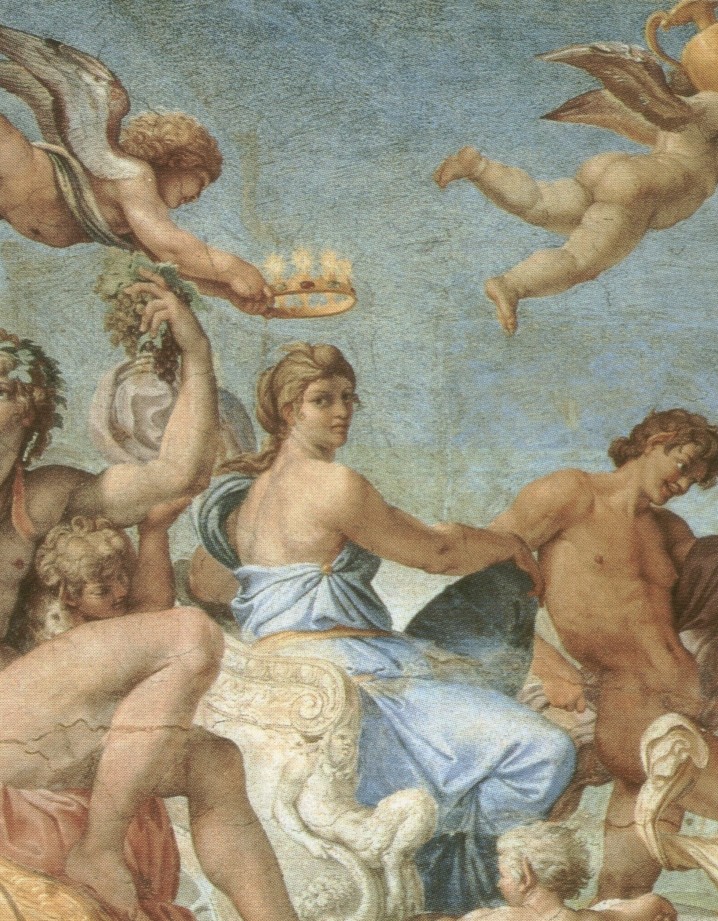
Ariadne provides a different centre of attention. Travelling in a separate chariot beside Bacchus, she appears serene and composed as a cupid holds a crown of stars above her head. The stars anticipate her translation into the heavens as the constellation Corona, introducing an event that belongs to a later moment of her story. Dempsey regards this anticipation as part of the fresco’s playful handling of mythological time. Ginzburg, however, places greater emphasis upon Ariadne’s divinity. Her blue drapery, solemn bearing and celestial crown support Ginzburg’s identification of her with heavenly Venus, forming one element of the proposed reconciliation between celestial and earthly love. She also connects the stars with the Aldobrandini arms and the marriage of Ranuccio Farnese to Margherita Aldobrandini, although that dynastic interpretation remains dependent upon the disputed relationship between the fresco and the wedding.
On the opposite side of the composition, Annibale introduces a variation upon the familiar theme of Bacchus’s discovery of the sleeping Ariadne. Silenus, heavy with drink, struggles to maintain his position upon the donkey while young fauns support his limbs. He turns towards the woman reclining nearby, whom Bellori identified as earthly Venus. On Roman sarcophagi, Ariadne ordinarily lies asleep as the god and his followers approach. In Annibale’s fresco, Ariadne instead rides in a chariot of her own, while another woman occupies the reclining position.
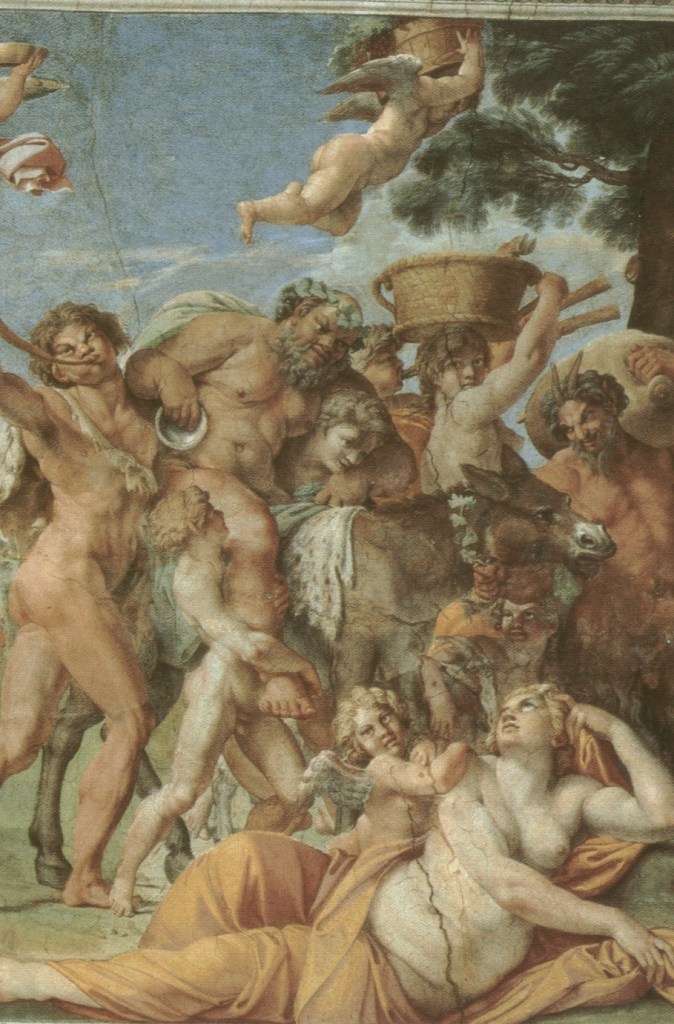
For Dempsey, this rearrangement is central to the fresco’s humour. In the antique compositions, Bacchus discovers the sleeping Ariadne; in Annibale’s fresco, the lovers are already united in the triumphal procession, while Silenus approaches a reclining woman who recalls Ariadne’s traditional pose. The encounter is thus repeated in a more openly sensual and comic form, with Silenus and earthly Venus providing a counterpart to Bacchus and his bride.
Ginzburg likewise emphasises the double structure of the procession, although she interprets its significance differently. For her, Bacchus and Ariadne, together with Silenus and earthly Venus, form complementary groups associated with celestial and profane love. Their simultaneous triumph expresses the possibility of harmony between spiritual affection and sensual pleasure. The arrangement admits such a reading, but Dempsey’s interpretation places the emphasis upon visual wit and the comic displacement of an antique model. The distinction is worth preserving, since the compositional correspondences themselves do not establish a single philosophical meaning.
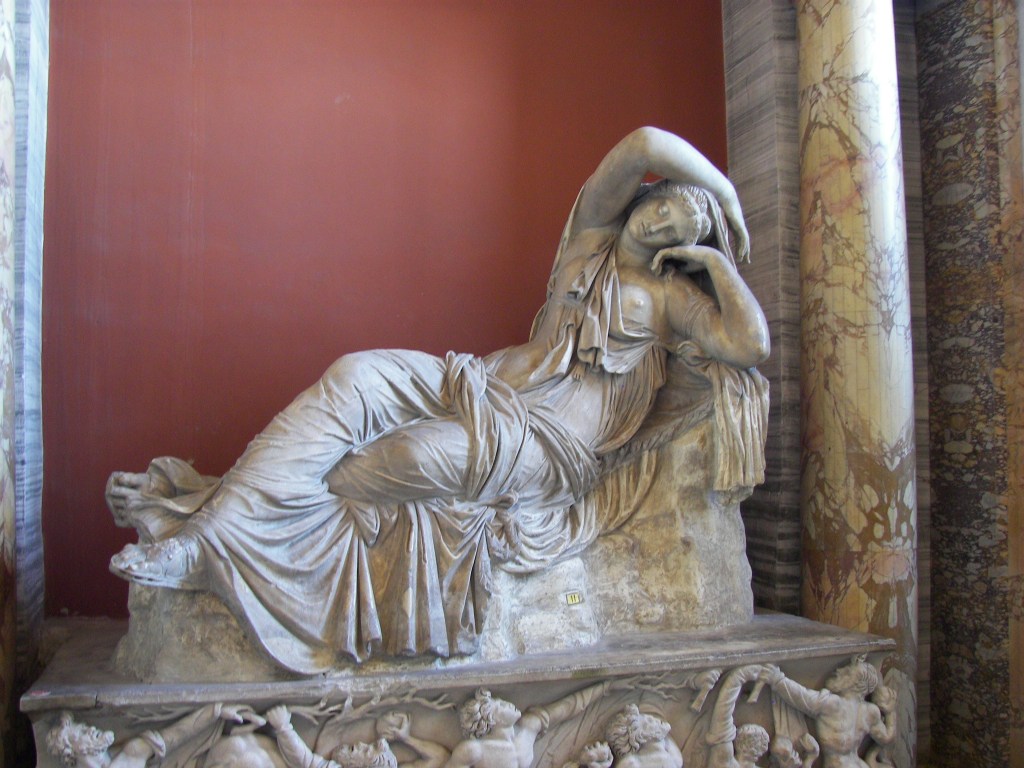
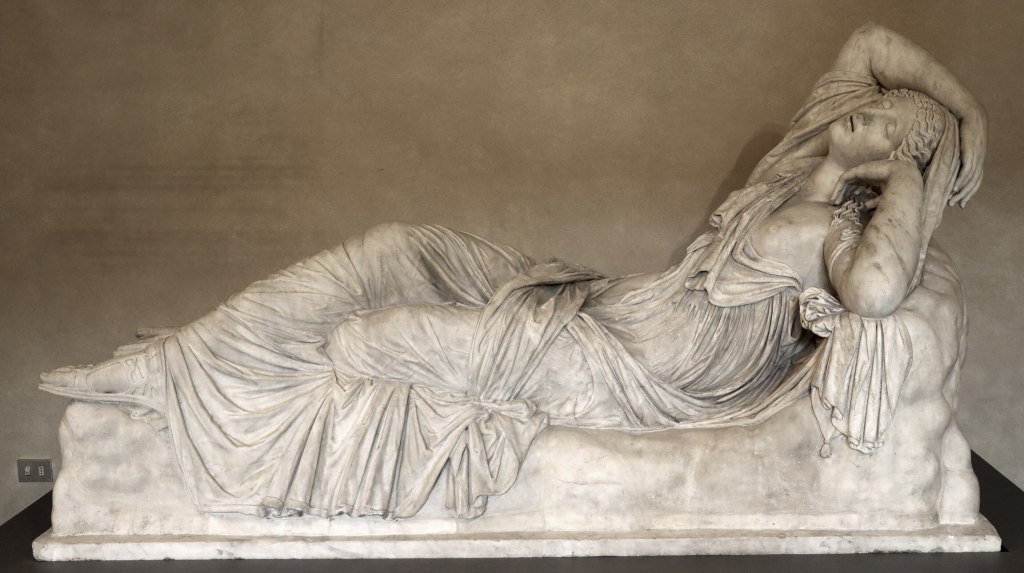
The reclining figure also reveals the complexity of Annibale’s engagement with ancient sculpture. Robertson associates her with the celebrated antique Cleopatra, now generally identified as the Sleeping Ariadne, in the Vatican collections. Ginzburg discusses an antique Sleeping Ariadne traditionally known as Cleopatra in Florence. Both scholars thus relate the figure to the reclining Ariadne type, although they identify different sculptural precedents. The transformed figure exemplifies Annibale’s capacity to draw upon a familiar antique conception while adapting its bodily organisation and narrative function to a new setting.
The two halves of the procession are connected through the movement of dancers and musicians at the centre. Here Annibale opens a passage between the crowded groups, allowing the spectator’s gaze to travel towards a distant horizon. Ginzburg compares this compositional device with Raphael’s Expulsion of Heliodorus in the Vatican Stanze, where the disposition of figures similarly creates an opening into depth. In the Triumph, the device permits the crowded procession to retain its continuity without becoming an impenetrable accumulation of bodies. A dancing faun and a bacchante carrying a drum connect the two groups, while the goats passing through the centre knock over a child. Ginzburg relates the child’s sudden movement to Raphael’s Transfiguration, finding in the comparison another instance of Annibale’s transformation of an established model.
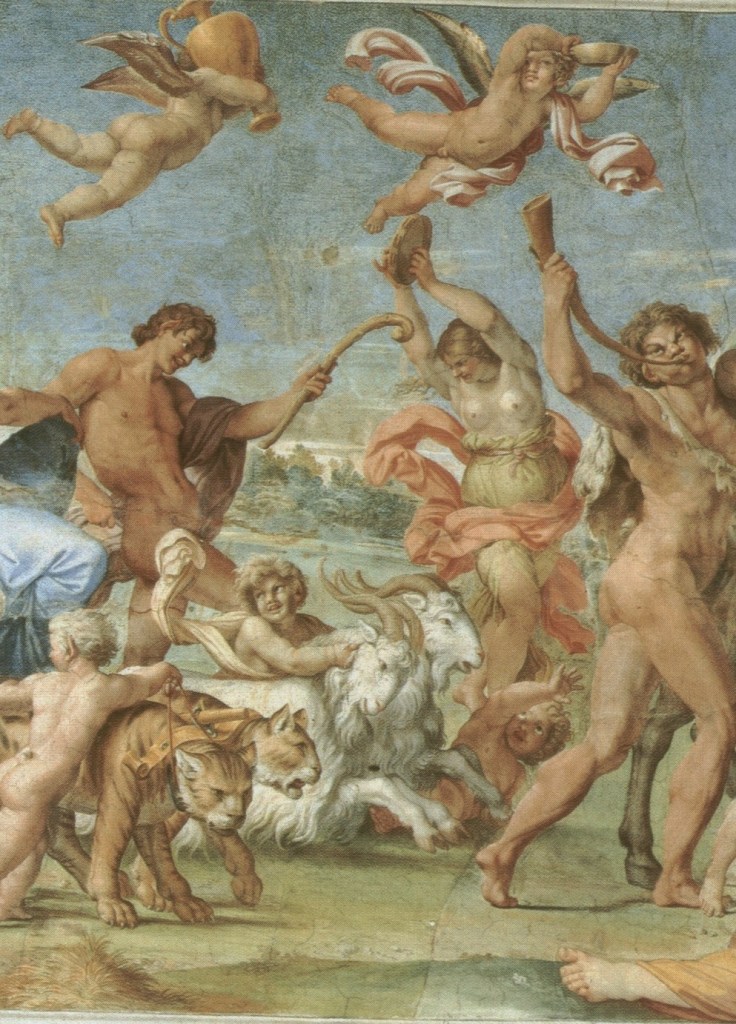
Posner has analysed the procession in terms of its alternating rhythms and the distribution of bodily movement. Figures turning, advancing, reclining or momentarily resisting the movement of the crowd contribute to an organisation in which individual actions remain intelligible within the larger ensemble. The bodies possess a weight and coherence that distinguish them from the more angular forms of Annibale’s earlier painting. Their monumentality is inseparable from the practical challenge of organising a large composition across the vault, where the relationship between figures must remain persuasive from different positions in the room.
Colour and illumination bring another dimension to this synthesis. Dempsey has emphasised Annibale’s ability to unite monumental forms with a naturalistic treatment of light, drawing upon the achievements of Correggio and Venetian painting. Ginzburg examines the luminous modulation of the sky, the pink drapery carried through the air and the modelling of the flying cupids. One cupid’s raised arm casts a shadow across his face, while reflected light and delicate transitions of tone maintain the unity of the figure. Above Ariadne, the stars of her crown appear to illuminate the cheeks of the cupid who carries it. Such effects allow the painter to suggest different sources and qualities of light without sacrificing the consistency of the imagined scene.
Titian’s Bacchanals for Alfonso d’Este provide an especially relevant comparison. His Bacchus and Ariadne and The Bacchanal of the Andrians entered Cardinal Pietro Aldobrandini’s collection in Rome in 1598, where Annibale could have encountered them through his connections with Giovanni Battista Agucchi. Dempsey identifies more specific relationships, including Ariadne’s celestial crown and the reclining female figure, whom he considers a comic transformation of Titian’s nude in The Andrians. Robertson is more cautious, suggesting that Titian’s influence was principally atmospheric rather than dependent upon the quotation of particular motifs. She also notes that Annibale may already have known the Ferrarese paintings during a visit in 1592, so their arrival in Rome cannot by itself determine the date of the Triumph.
The resulting fresco brings together the ceremonial organisation of ancient reliefs, the monumental figure construction of Roman painting and sculpture, and the naturalistic resources of Annibale’s Emilian and Venetian inheritance. Yet these relationships are most revealing when considered through the particular transformations they produce. The antique procession becomes a spacious and animated gathering; Michelangelesque form is subjected to the effects of intoxication; Raphael’s compositional devices accommodate the unruly movement of a Bacchic crowd; and familiar images of Ariadne are redistributed to establish new correspondences between the protagonists. The Triumph is therefore neither a straightforward reconstruction of antiquity nor an assemblage of prestigious artistic quotations. Its achievement rests upon the sustained revision of inherited forms into an invention whose pictorial coherence can accommodate both monumental dignity and comic disorder.
From Drawing to Fresco: The Making of the Triumph
The extensive surviving body of preparatory drawings for the Triumph of Bacchus and Ariadne offers an exceptionally revealing account of Annibale’s working methods. A selection of these sheets, ranging from rapid compositional sketches to carefully developed studies of individual figures and the monumental cartoon used in preparing the fresco, allows us to follow successive stages of invention and revision. Their importance extends beyond the reconstruction of a sequence of artistic decisions. They demonstrate how Annibale’s engagement with antique and Renaissance models was mediated through drawing, and how the composition continued to evolve as its figures acquired their final positions, proportions and relationships.
The earliest designs also qualify the assumption that the Triumph was always intended to occupy the commanding position it eventually received. As Gail Feigenbaum observed in the 1999 Washington exhibition catalogue, an early scheme for the vault, preserved in a Louvre drawing (inv. 8048), places the Bacchic procession within a subsidiary compartment while leaving the elongated central field empty. Victor Hundsbuckler, writing in the catalogue of the Louvre’s 2025 exhibition devoted to the making of the Farnese Gallery, likewise identifies an initial arrangement in which the Bacchic subject formed part of a narrative frieze rather than an independent central composition. Other early studies suggest that portions of the procession may originally have been distributed among separate compartments. Its eventual prominence was therefore the outcome of a developing decorative scheme, not an arrangement demonstrably fixed from the beginning.
Overall Design for the Decoration of the Farnese Gallery Vault (inv. 8048)
A small pen-and-ink drawing in the Royal Collection at Windsor (RCIN 902155) illustrates this exploratory stage. Annibale sketches the procession within an architectural setting that includes swags, a cartouche, a mask and supporting figures. The drawing establishes not only the principal participants but also the relationship of the narrative to its proposed decorative framework. Its swift notation allows the figures to be distinguished through a remarkably economical use of line. Feigenbaum draws attention to a dancing maenad whose forward movement and backward turn serve to connect the two parts of the procession in this early design. Another figure directs attention towards the reclining Ariadne, presented here as the woman encountered by the Bacchic company.
As Feigenbaum explains, the Windsor drawing incorporates the discovery of Ariadne: a figure points towards her as she reclines in a leafy setting beside the Bacchic procession. A more elaborate study in the Albertina likewise retains the sleeping Ariadne in the foreground. Feigenbaum traces the subsequent development through drawings in which Ariadne is first placed in Bacchus’s chariot and eventually given a chariot of her own. In the completed fresco, the reclining female figure survives as earthly Venus, preserving an allusion to the abandoned episode of discovery. Although the precise sequence of the early drawings remains uncertain, they document a substantial transformation in Annibale’s treatment of the myth.
The Albertina study (inv. 23370) offers evidence of a different kind. Executed in pen and brown ink, with wash and white heightening on prepared paper, it possesses a degree of finish that Feigenbaum regarded as appropriate to a presentation drawing. The figures are organised across a shallow space, and the emphatic contrasts of light and shade evoke the appearance of sculptured relief. Bacchus, still overcome by intoxication, requires the assistance of attendants, while Silenus is similarly supported on his donkey. Ariadne remains asleep in the foreground. The drawing therefore brings together the triumphal procession and the discovery of Ariadne without yet arriving at the final relationship between their protagonists.
Its position in the sequence remains uncertain. Feigenbaum entertained the possibility that this apparently developed composition preceded some of the more fragmentary explorations of the subject within separate frieze compartments. The sophistication of a drawing’s finish cannot therefore be taken as a reliable indication that it represents a late stage of invention. The sheet also raises an important question of attribution. While the Washington catalogue attributed it to Annibale, Hundsbuckler’s 2025 catalogue assigns it to Agostino. This reassessment complicates an account of the Gallery’s preparation centred exclusively upon Annibale, although attribution alone cannot establish how the brothers divided responsibility for the invention.
Hundsbuckler’s reconstruction of the early compositional development brings further evidence of the scheme’s changing character. A rapid pen study in the Louvre (inv. 7185), which he attributes to Agostino, explores the right-hand portion of the procession, while other sheets investigate the relationship between Bacchus, Ariadne and their attendants.
The Procession of Bacchus and Ariadne, Louvre, inv. 7185 recto, attributed to Agostino Carracci.
A Louvre drawing (inv. 7183) assigned to Annibale presents Bacchus in a more composed attitude, and a study in the Albertina (inv. 2144), attributed to Agostino, gives Bacchus and Ariadne separate chariots. Another Albertina sheet (inv. 2148), whose attribution remains uncertain between the brothers, investigates figures associated with Bacchus and Silenus.
Study Sheet: Bacchus on His Chariot and Studies of Angels, Albertina, Vienna, inv. 2148.
Hundsbuckler interprets these successive arrangements as a redistribution of the procession’s emphasis. Although the development was not entirely linear, the studies suggest a changing balance between the two figures, with Silenus becoming the more conspicuously intoxicated, while Bacchus retains signs of drunkenness.
The participation of Agostino is consequently of interest beyond the question of individual attributions. His intellectual formation and membership of the Accademia dei Gelati have already entered scholarly discussions of the Gallery’s programme. The drawings offer a more immediate and tangible field in which to consider collaboration between the brothers. Nevertheless, the precise division of artistic and intellectual responsibilities remains uncertain.
Once the broad arrangement had been established, Annibale developed its individual participants through drawings of a very different character. A large study of a faun blowing a horn, preserved in the Louvre (inv. 7316), demonstrates the attention devoted to a figure whose place within the composition was already substantially determined. Executed in black chalk heightened with white on paper originally blue, the sheet concentrates upon the faun who helps to support Silenus. Earlier compositional drawings show related figures holding double pipes, but the Louvre study develops the horn player in greater anatomical and expressive detail.
Annibale Carracci, A Faun Dancing or Blowing a Horn — Musée du Louvre, inv. 7316
Feigenbaum observes that Annibale repeatedly adjusted the disposition of the legs, initially placing them farther forward. The resulting contours preserve the search for a convincing balance between the figure’s movement and the physical effort of supporting Silenus. The drawing also takes account of the overlap that would occur in the finished composition: the shoulder terminates abruptly where Silenus’s arm was intended to conceal it. This is not an autonomous study of a figure subsequently inserted into the fresco. It is an investigation conducted with a clear understanding of the figure’s immediate pictorial surroundings.
The handling of light is equally deliberate. Closely worked hatching and cross-hatching establish the modelling of the limbs and the articulation of the musculature, while white chalk defines the illuminated surfaces. Feigenbaum also draws a comparison with an antique sculpture of a faun carrying the infant Bacchus, belonging to the Farnese collection. Although the poses are different, she identifies similarities in their strongly defined musculature, suggesting that Annibale’s study of antique sculpture informed his treatment of the living body. The drawing thus combines careful observation of anatomical form with the requirements of movement, illumination and compositional placement.
Another Louvre drawing, the Woman Carrying a Basket on Her Head (RF 610), reveals a comparable process of transformation. The figure ultimately appears beside Silenus’s donkey, carrying the ritual basket associated with Bacchus. Her ancestry can be traced to Perino del Vaga’s design for the Farnese Casket, but Annibale substantially changes the earlier invention. Where Perino represents the woman in profile, Annibale turns her towards the spectator and develops the ascending movement of her body beneath the weight of the basket.
Annibale Carracci, Bacchante Carrying a Basket on Her Head, Louvre, RF 610 recto.
The drawing is notable for the amount of the figure that Annibale worked out, including portions subsequently concealed by the donkey’s head. Feigenbaum also questions whether the study was executed from a female model, pointing to the powerful musculature of the shoulder and arm, the conventional treatment of the breast and the generalised modelling. She considers it possible that Annibale developed the figure principally through imagination and his knowledge of antique sculpture. The suggestion complicates any simple opposition between drawing from life and drawing from remembered artistic models. In this instance, the form of the body appears to have emerged through their assimilation rather than through the faithful transcription of a single source.
Hundsbuckler’s account provides a broader context for this procedure. He distinguishes between drawings made to resolve individual figures and details, and more general studies through which Annibale developed a repertoire of forms inspired by antique sculpture. The latter need not have been conceived for a particular position in the fresco. His discussion also emphasises the movement from the observed body towards an idealised figure, achieved through successive adjustments rather than through the adoption of a ready-made classical formula. The relationship between the living model and antique precedent was therefore an active part of invention, not merely a choice between two alternative sources.
A study of a woman’s head in the Louvre (inv. 7377) has also been associated by earlier scholars with the reclining earthly Venus in the Triumph, on account of similarities in the inclination of the head and certain facial characteristics. Feigenbaum acknowledges these resemblances but considers them insufficient to establish a direct preparatory relationship. She relates the drawing instead to Annibale’s study of the antique Niobid sculptures, whose forms and expressive qualities he absorbed without copying any particular figure. The sheet thus illustrates a broader aspect of his working practice, in which the study of ancient sculpture furnished a repertoire of forms that could inform several different paintings.
Annibale Carracci, Head of a Woman Looking Upwards, Louvre, inv. 7377 recto.
The relationship between the basket-bearing woman and the finished fresco is especially well documented because a large part of Annibale’s full-scale cartoon survives. Now in the Galleria Nazionale delle Marche at Urbino, this immense drawing preserves the right-hand portion of the Triumph, including the procession of Silenus. Executed in black chalk heightened with white on more than fifty joined sheets of paper, it measures approximately 3.45 by 3.32 metres. Its scale brings the preparatory process into direct relation with the physical dimensions of the painting.
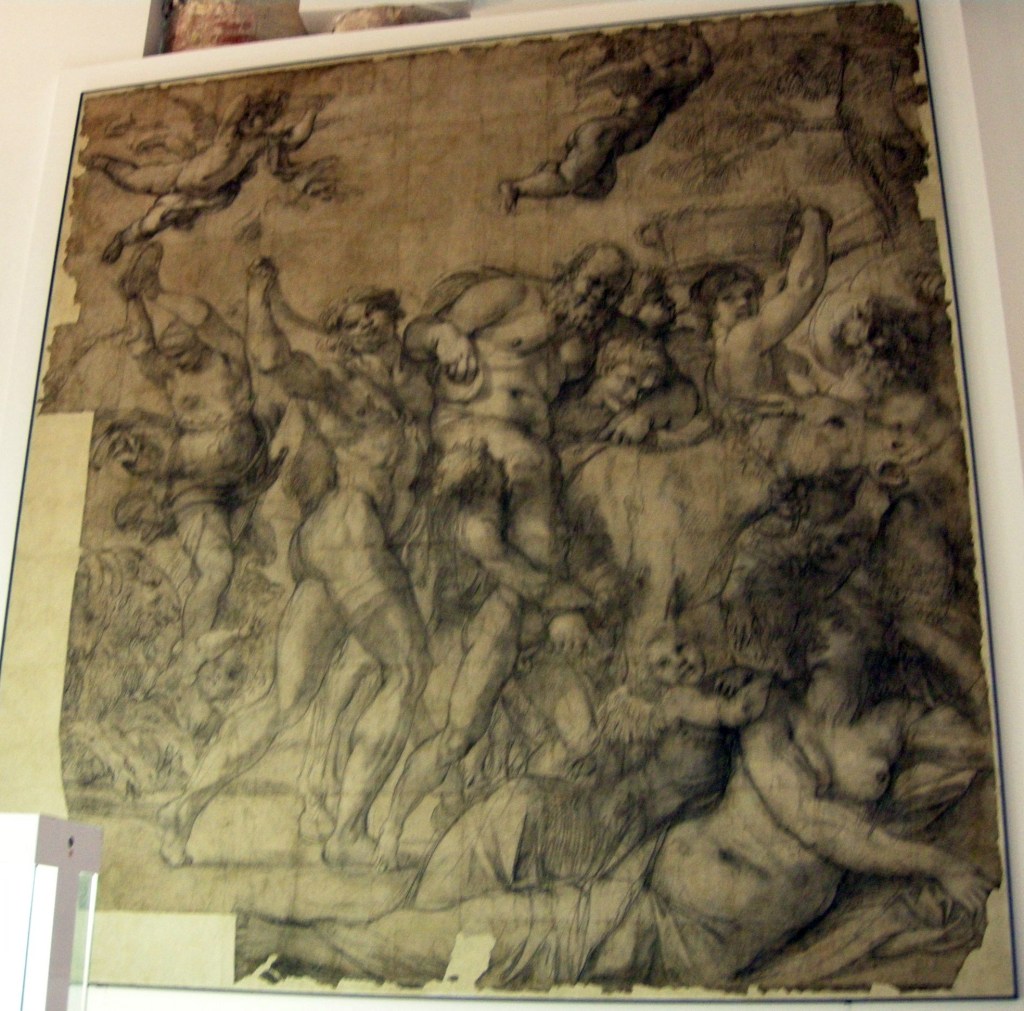
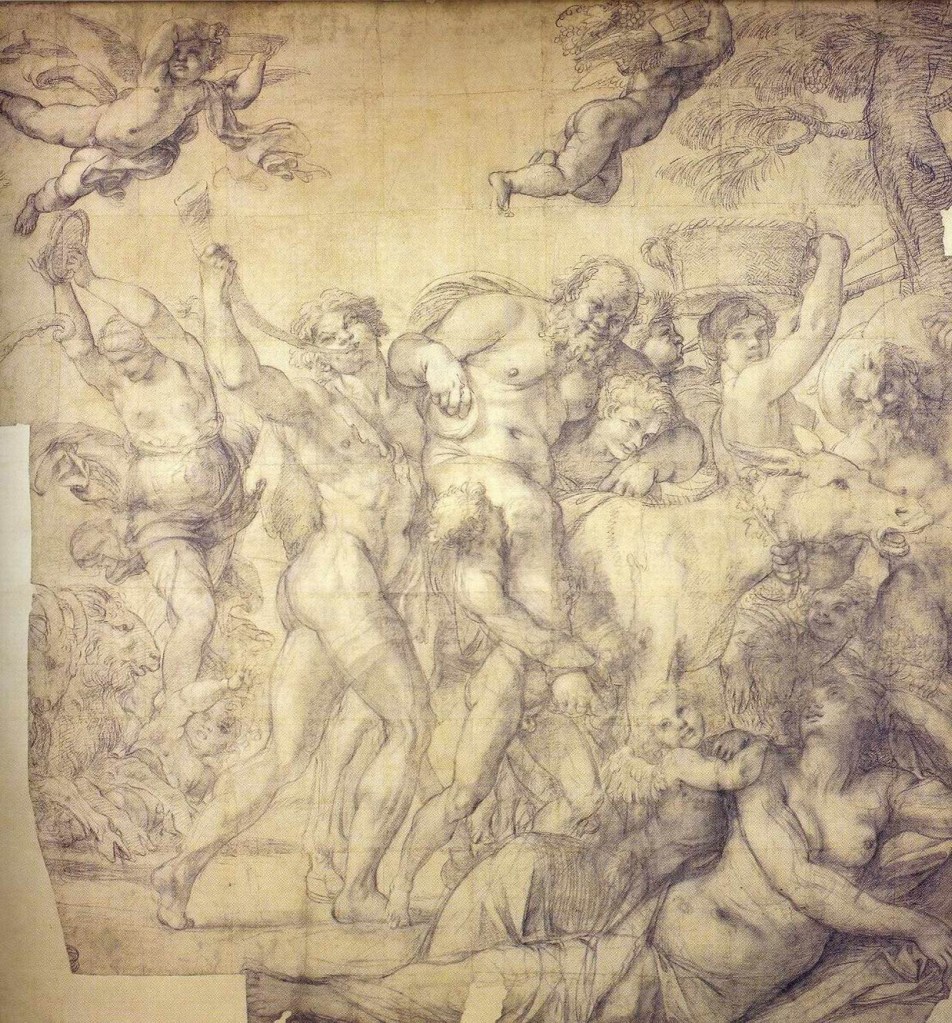
As Margaret Morgan Grasselli explained in the Washington catalogue, the cartoon provides evidence that invention did not cease when Annibale moved from individual studies to the final enlargement. The basket-bearing woman corresponds closely to the Louvre drawing, but the contour of her breast was reconsidered in the cartoon, and the alteration was retained in the fresco. Ginzburg interprets changes of this kind in relation to the optical adjustments required by the spectator’s view from below. The enlargement of a design was therefore not simply a mechanical operation. It afforded another opportunity to test the proportions and relationships of the figures within their intended setting.
Other differences between the Urbino cartoon and the painting concern drapery, the tree at the right, Silenus’s head, a child holding a goat and the contents of the basket. Some may have been introduced directly during the painting of the fresco, while others could have involved additional drawings or subsidiary cartoons that have not survived. Ginzburg and Hundsbuckler also draw attention to a change in Silenus’s leg, made more vertical and more persuasive in perspective as the figure approached its final form. Such adjustments demonstrate the continuing importance of apparently modest revisions within a composition whose broad structure was already established.
The cartoon’s material history offers further insight into the execution of the fresco. Its outlines are partially pricked, indicating that the design was transferred by pouncing, a procedure in which powdered pigment was passed through small holes to reproduce the contours on another surface. Nevertheless, Grasselli observes that the surviving drawing was not divided into sections corresponding to the eighteen giornate, or daily areas of fresh plaster, identifiable in the right half of the fresco. She therefore concludes that it was probably used to transfer the design onto a second cartoon, subsequently cut into manageable portions for direct application to the ceiling.
This reconstruction explains how the Urbino cartoon could have survived while the working material used during execution was lost. Its preservation is itself remarkable. Ginzburg traces it through the collections of Domenichino, his pupil Francesco Raspantino and Carlo Maratta, in whose possession Bellori and Vincenzo Vittoria admired it during the seventeenth century. By then it was already described as a fragment, containing only the right-hand part of the original composition. Its later history reflects the esteem in which Annibale’s drawings were held, independently of the frescoes for which they had been made.
The technique of fresco imposed a discipline quite different from that of drawing on paper. The painter had to work within the time allowed by the setting of the fresh plaster, coordinating the preparation of the surface with the division of the design into successive working areas. Yet the evidence of the cartoon and the completed Triumph resists any suggestion that such procedures reduced execution to the passive reproduction of an established image. Annibale continued to reconsider contours, expressions and details as the work advanced. Grasselli accordingly emphasises the vitality of the cartoon’s drawing, in which searching outlines remain visible despite the advanced stage of preparation.
Throughout this process, the study of nature and the assimilation of earlier art remained closely connected. Antique sculpture and Renaissance models supplied forms that Annibale continually reconsidered through observation, drawing and revision. This interaction continued from the first compositional sketches through the studies of individual figures to the final adjustments made during execution.
Seen together, these drawings disclose the extent of the invention underlying the apparent spontaneity of the Bacchic procession. The shift from the discovery of Ariadne to the double encounter in the final fresco was accompanied by changes in the placement and character of its protagonists. Figures derived from antique reliefs and Renaissance designs were reconsidered through drawing, while their final proportions and relationships remained open to adjustment even at the stage of transfer to the vault. Together, the sheets offer a valuable insight into how Annibale’s final conception emerged through successive stages of experimentation and revision, even where the order of decisions and the respective contributions of the two brothers cannot be established securely.
Annibale’s Legacy
The Farnese Gallery established Annibale Carracci as one of the decisive figures in the transformation of Roman painting around 1600. Its achievement lay not simply in the recovery of the monumental language of Raphael and Michelangelo, but in the freedom with which Annibale adapted that inheritance to new expressive purposes. The Triumph of Bacchus and Ariadne exemplifies a conception of history painting in which classical dignity coexists with humour, sensuality and the observation of nature. Its apparent exuberance is sustained by an elaborate process of invention, while the relationships between its figures remain open to meanings that exceed any single allegorical explanation.
The Gallery also provided a point of departure for the generation of painters who would shape the Roman Baroque. Through Annibale’s pupils and collaborators, notably Domenichino and Giovanni Lanfranco, its lessons in monumental composition, expressive movement and the integration of painting with architecture entered a wider artistic vocabulary. Later painters would develop these possibilities in different directions, sometimes departing considerably from the measured organisation and bodily coherence that distinguish Annibale’s achievement.
Yet the significance of the Triumph is not confined to its influence. Its imaginative vitality belongs to the encounter between a painter formed in the experimental culture of Bologna and the artistic resources of Rome. In the Farnese Gallery, Annibale created a language capable of accommodating the authority of antiquity and the immediacy of lived experience, opening possibilities that would occupy Roman painting for much of the following century.
Donate to Inner Surfaces here.
Bibliography
Dempsey, Charles. ‘“Et Nos Cedamus Amori”: Observations on the Farnese Gallery’. The Art Bulletin, 50, no. 4 (December 1968), pp. 363–374.
Dempsey, Charles. Annibale Carracci: The Farnese Gallery, Rome. New York: George Braziller, 1995.
Feigenbaum, Gail. ‘Annibale in the Farnese Palace: A Classical Education’. In The Drawings of Annibale Carracci, exhibition catalogue, National Gallery of Art, Washington, 1999, pp. 108–121.
Feigenbaum, Gail. Catalogue entries 42–46. In The Drawings of Annibale Carracci, exhibition catalogue, National Gallery of Art, Washington, 1999, pp. 156–167.
Ganz, Kate. ‘Annibale’s Rome: Art and Life in the Eternal City’. In The Drawings of Annibale Carracci, exhibition catalogue, National Gallery of Art, Washington, 1999, pp. 200–207.
Ginzburg, Silvia. ‘Al servizio del cardinale Odoardo Farnese’. In Annibale Carracci, edited by Daniele Benati and Eugenio Riccomini, exhibition catalogue, Bologna and Rome, Naples: Electa Napoli, 2006, pp. 294–297.
Ginzburg, Silvia. La Galerie Farnèse: Les fresques des Carrache à l’ambassade de France à Rome. Translated by Ida Giordano; photographs by Zeno Colantoni. Paris: Gallimard, 2010.
Grasselli, Margaret Morgan. Catalogue entry 47, ‘A Bacchic Procession with Silenus’. In The Drawings of Annibale Carracci, exhibition catalogue, National Gallery of Art, Washington, 1999, pp. 169–170.
Hundsbuckler, Victor. Dessins des Carrache: La fabrique de la galerie Farnèse. Paris: Musée du Louvre / Lienart Éditions, 2025.
Posner, Donald. Annibale Carracci: A Study in the Reform of Italian Painting around 1590. 2 vols. London: Phaidon, 1971.
Robertson, Clare. The Invention of Annibale Carracci. Milan: Silvana Editoriale, 2008.
Related reading on Inner Surfaces
For a further discussion of Agostino Carracci’s draughtsmanship, see Agostino Carracci: Drawing and Invention – Inner Surfaces

