Agostino and the Carracci
Agostino Carracci (1557–1602) belonged to one of the most influential artistic families of late sixteenth-century Italy. Together with his younger brother Annibale (1560–1609) and their cousin Ludovico (1555–1619), he participated in the renewal of Bolognese painting that would have far-reaching consequences for Italian art. The three artists shared a commitment to the study of nature, drawing from life and sustained engagement with the achievements of earlier painters. Their collaboration, both in the studio and on major decorative commissions, occupied an important place in Bolognese artistic life during the 1580s and 1590s.
Agostino’s contribution was distinctive. Trained as an engraver, he acquired a formidable technical command of printmaking and produced reproductive engravings after artists including Titian, Tintoretto and Veronese. Travel, especially to Venice, gave him opportunities to study works by painters he admired. He was also a painter, a teacher and a man of considerable learning, with interests extending to literature, mathematics and the intellectual culture of his time. His contemporaries recognised both his technical accomplishments and the breadth of his knowledge.
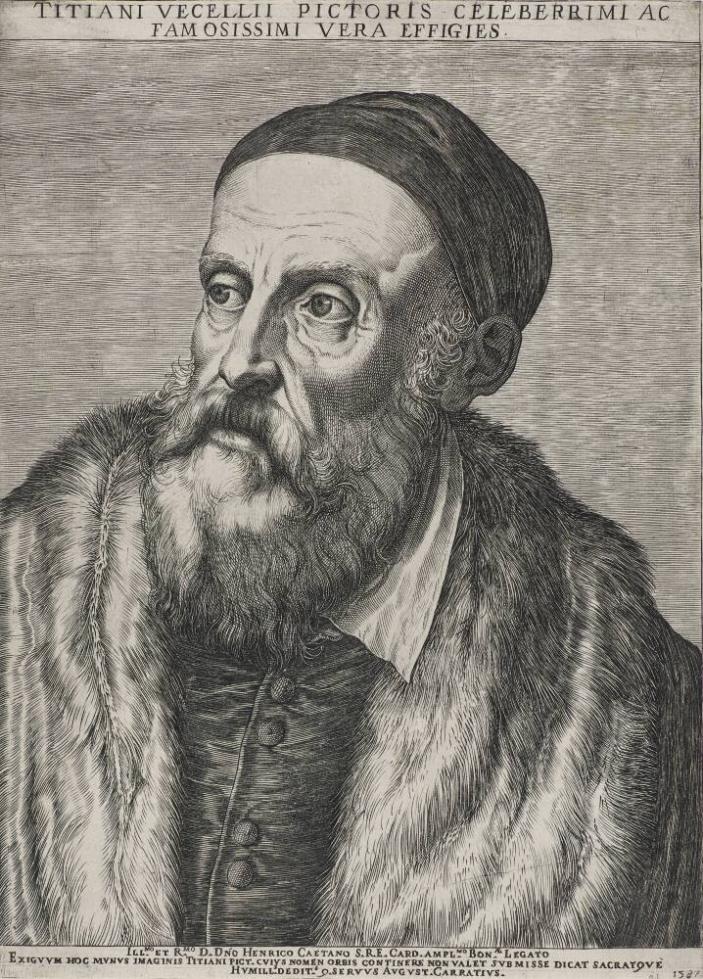
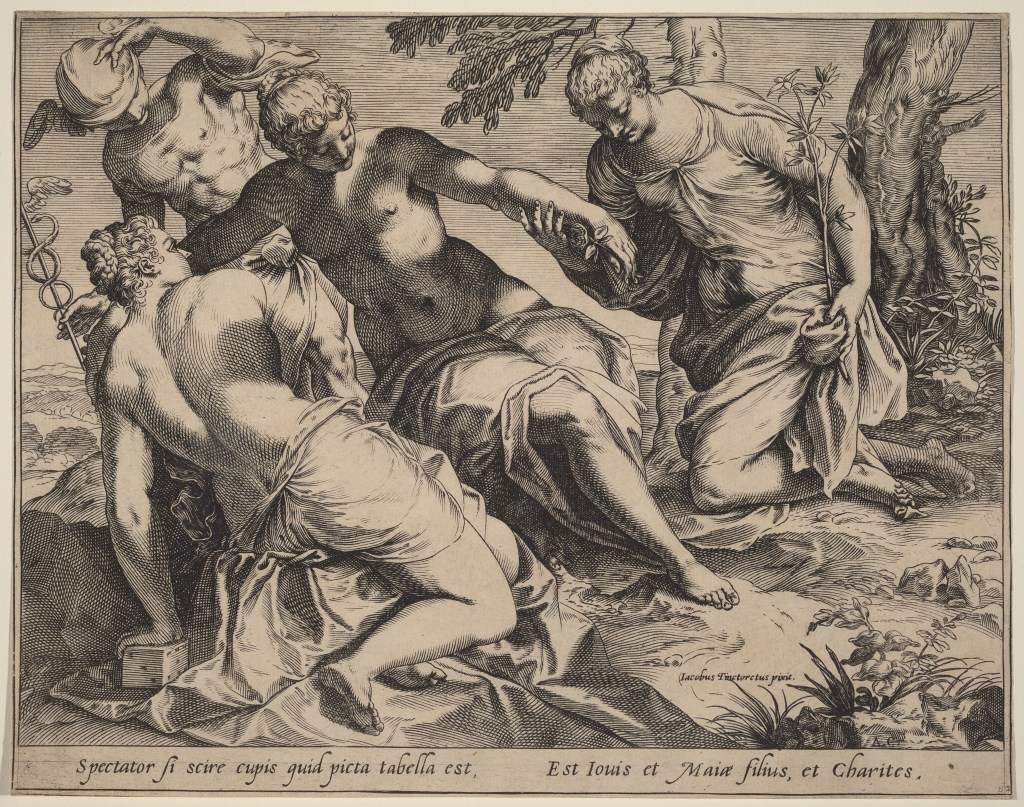
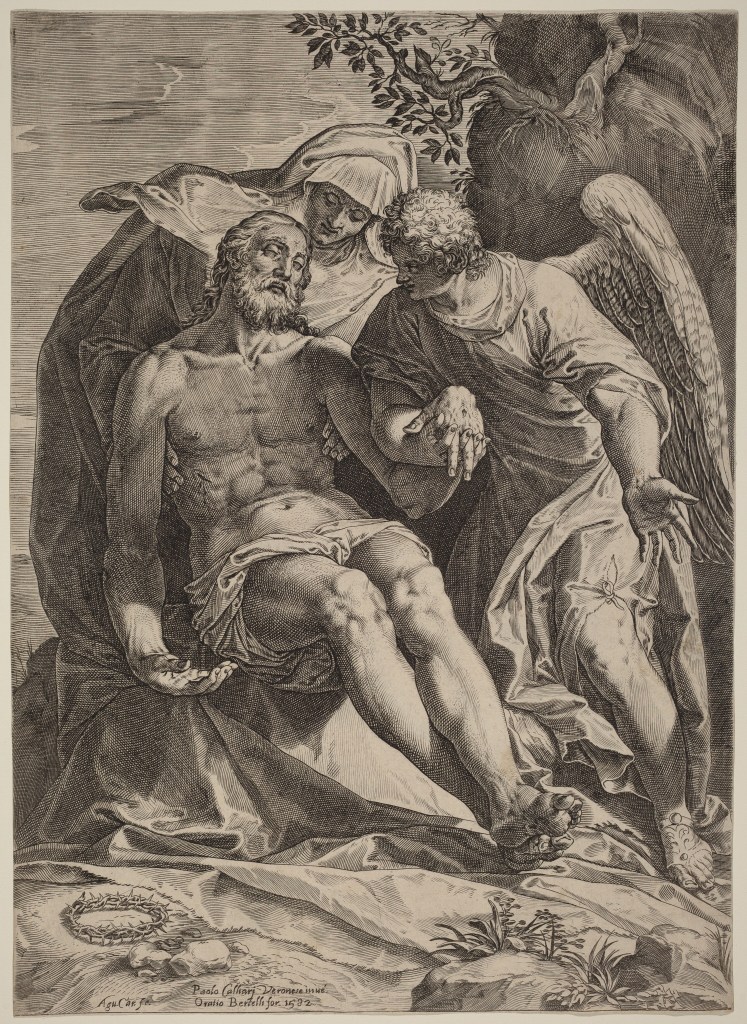
Drawing occupied a central place in these activities. For Agostino, it was not simply a preliminary stage in the production of paintings or engravings, but a means of studying the human figure, developing compositions and testing visual ideas. His surviving sheets encompass studies from life, preparatory sketches, decorative designs and elaborate pen drawings.
Engraving and the Practice of Drawing
Agostino’s early career was closely associated with engraving, a discipline that required exceptional control of line and a thorough understanding of the works being reproduced. He trained in Bologna with the engraver Domenico Tibaldi and subsequently developed his skills through the study of paintings by leading Italian masters. By the early 1580s he had established himself as a prolific printmaker, producing engravings after works by artists including Federico Barocci, Paolo Veronese and Tintoretto. His engravings helped disseminate celebrated compositions beyond their original locations.
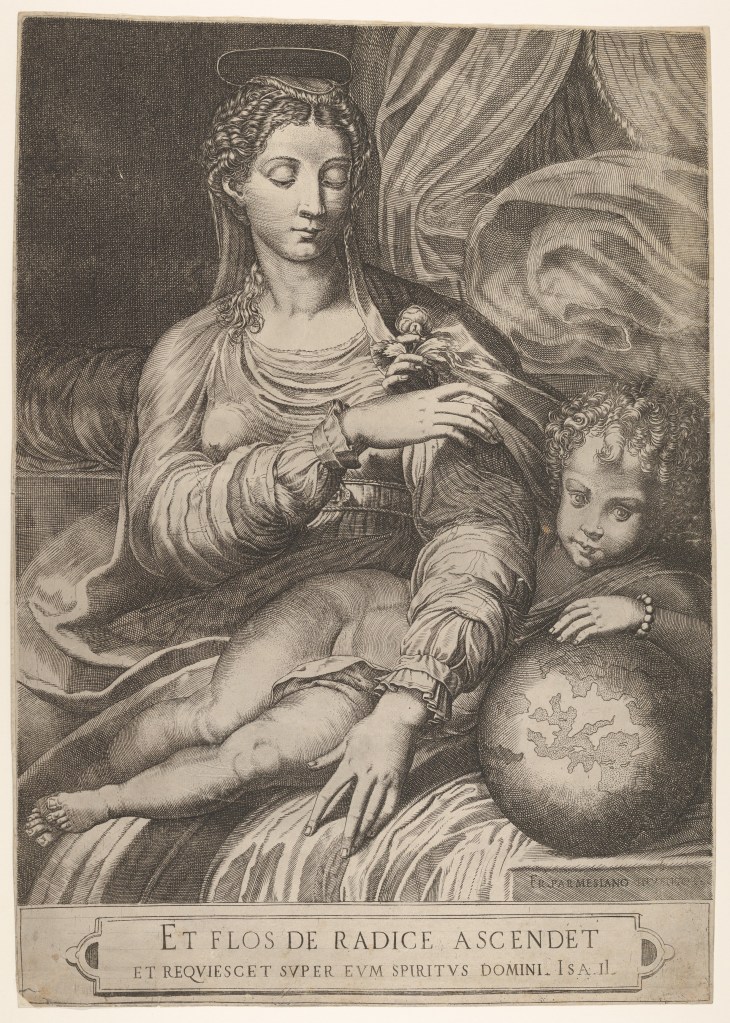
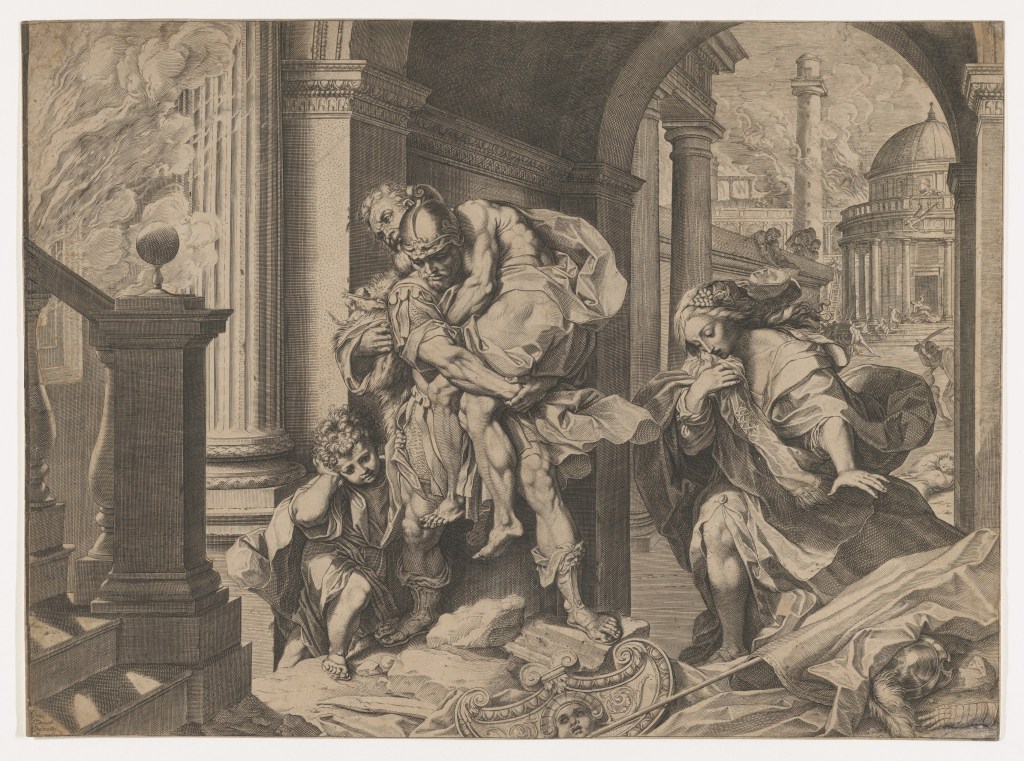
The translation of painting into engraving involved more than the accurate transcription of contours. Agostino had to find graphic equivalents for differences of tone, texture and illumination, using systems of hatching and closely controlled lines to convey the effects of colour and brushwork. His experience as a printmaker contributed to a highly developed command of graphic technique, although his drawings reveal methods considerably more varied than the disciplined execution of his finished prints.
Drawing was equally fundamental to the educational programme developed by the Carracci in Bologna. Their academy, generally dated to the early 1580s, encouraged direct observation, life drawing, anatomical study and the examination of earlier art. Students worked from the living model and explored the expressive possibilities of different media. The Carracci also cultivated informal exercises, including caricature and rapid sketches, alongside the more systematic preparation of paintings and decorative schemes.
Agostino brought his technical expertise and scholarly interests to this environment. Contemporary accounts associate him with the teaching of perspective and other aspects of artistic theory. His practice encompassed studies of individual figures, compositional inventions and ornamental designs, sometimes combining several kinds of enquiry on a single sheet.
Drawing from Life and the Human Figure
The study of the human figure was central to the Carracci’s artistic education. Their practice combined observation of the living model with anatomical study and the examination of earlier masters. Agostino participated in this programme both as a draughtsman and as a teacher, alongside his activities as an engraver. His surviving drawings include studies of heads, limbs and complete figures, using a range of media that includes chalk, pen and ink, and wash.
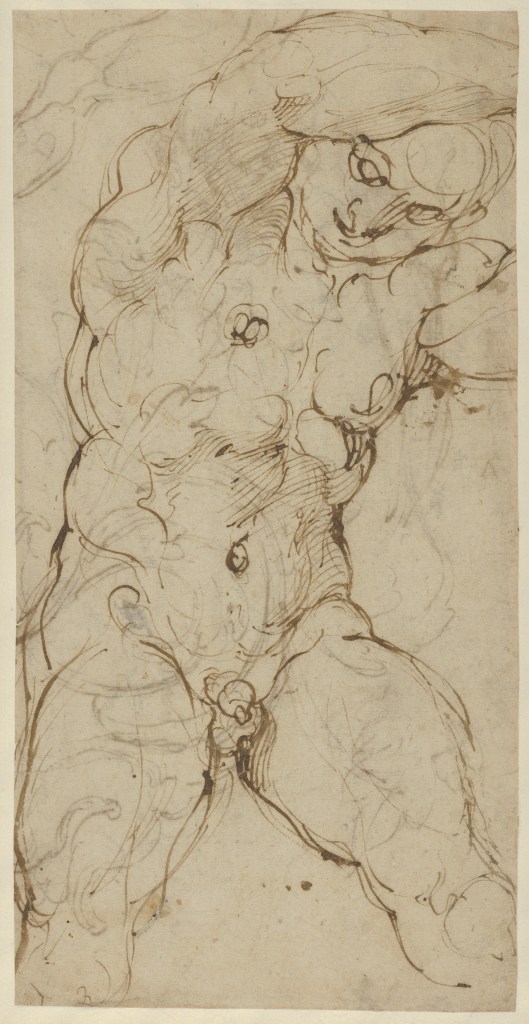
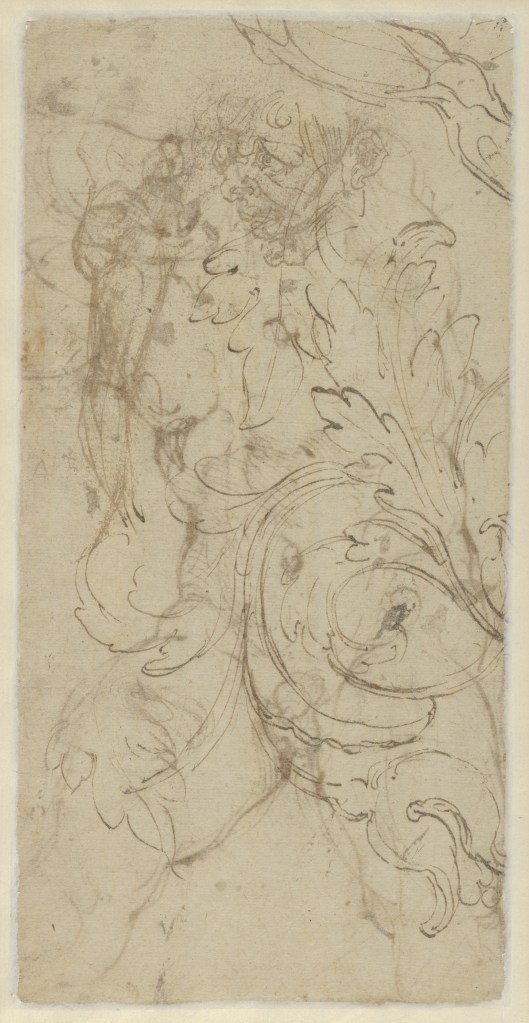
The drawings were not all made for the same purpose. Some served the preparation of paintings or engravings, while others allowed the artist to investigate a pose, an anatomical detail or the movement of a figure without committing himself to a finished composition. The variety of these exercises is evident in a double-sided sheet at the Metropolitan Museum of Art, Seated Nude Male Figure; Ornamental Designs, a Grotesque Head, and a Leg, dated to around 1590–93. Studies of the body appear alongside decorative motifs, bringing different aspects of Agostino’s graphic practice together on a single support.
Chalk offered other possibilities. Agostino used red and black chalk for studies of individual figures and heads, sometimes in preparation for large decorative projects. Drawings associated with the Carracci frescoes at Palazzo Fava and Palazzo Magnani have helped scholars distinguish his working methods from those of Annibale and Ludovico. Mary Vaccaro’s research has drawn attention to Agostino’s sharply defined, sometimes angular contours and his use of parallel and intersecting strokes of chalk to model the figure. She contrasts these features with the smoother outlines and more delicate shading found in Annibale’s red-chalk studies of the same period.
The Carracci’s exercises also allowed room for exaggeration, humour and the invention of unfamiliar forms. Contemporary accounts associate their academy with caricature and playful graphic exercises, activities that provided opportunities to explore the expressive possibilities of the human face and figure.
Drawing and Compositional Invention
Agostino’s preparatory drawings reveal a methodical approach to the development of compositions, although the surviving examples vary considerably in their degree of finish. Some record an initial idea in rapidly drawn lines; others establish the relationships between figures, architectural settings and decorative elements with greater precision. The degree of finish depended partly on a drawing’s purpose. A drawing made for the artist’s own use could remain provisional, while a design intended for an engraver or for execution by another painter required a more fully developed composition.
Ann Sutherland Harris has examined Agostino’s methods of invention through a series of pen-and-ink studies associated with identifiable commissions. One example is a drawing in the Städel Museum, Frankfurt, showing the Holy Family resting during the Flight into Egypt. Harris identifies it as an early study for a composition that was subsequently engraved, around 1595, by Francesco Brizio, a younger artist who trained with the Carracci and worked closely with Agostino as an engraver. The composition underwent considerable alteration: Joseph and the donkey disappeared, and the position of the Christ Child changed, although the Virgin’s distinctive pose was retained. The Frankfurt sheet appears to record an early stage in the development of a print for which Agostino supplied the invention and Brizio executed the engraving.
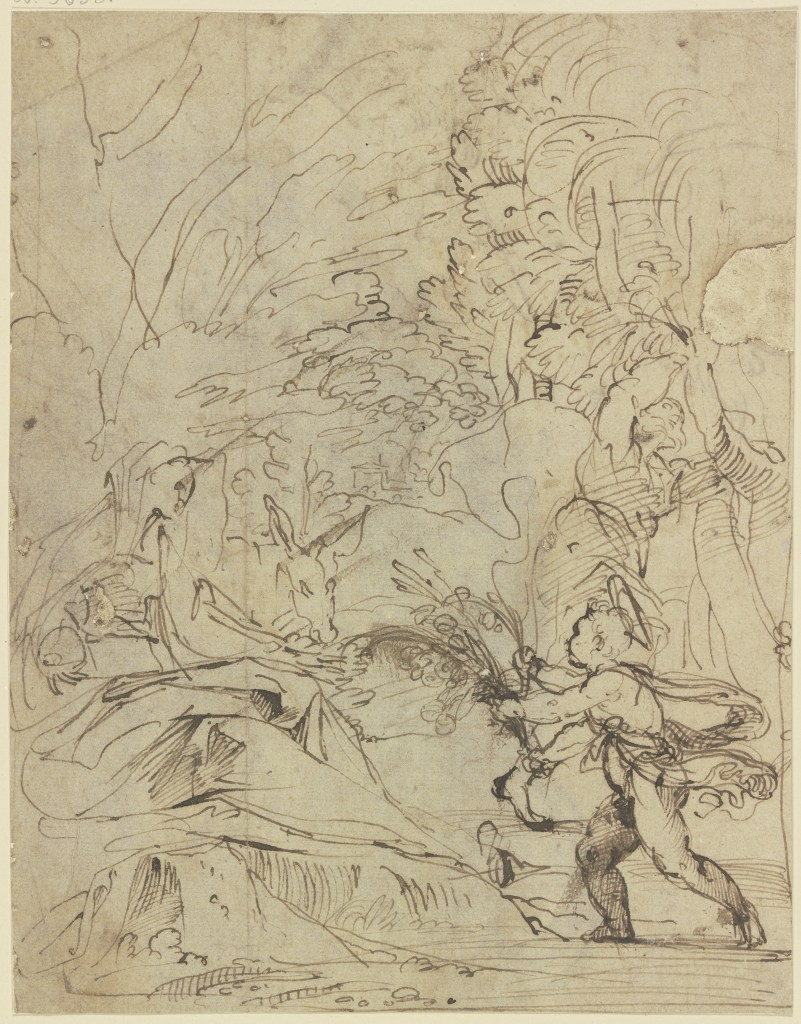
Francesco Brizio, The Virgin Nursing the Christ Child in a Landscape
The preparation of paintings could involve a similarly sustained examination of individual figures and their relationships within a composition. Several drawings survive for Agostino’s Last Communion of St Jerome, painted for the Carthusian monastery of San Girolamo della Certosa in Bologna and now in the Pinacoteca Nazionale. Mario Di Giampaolo has discussed a double-sided sheet on which a study of the priest administering the sacrament appears opposite a composition of Cupid Subduing Pan, related to Agostino’s decoration of Palazzo Magnani. Other surviving studies for the altarpiece include individual figures and anatomical details, principally executed in black chalk.
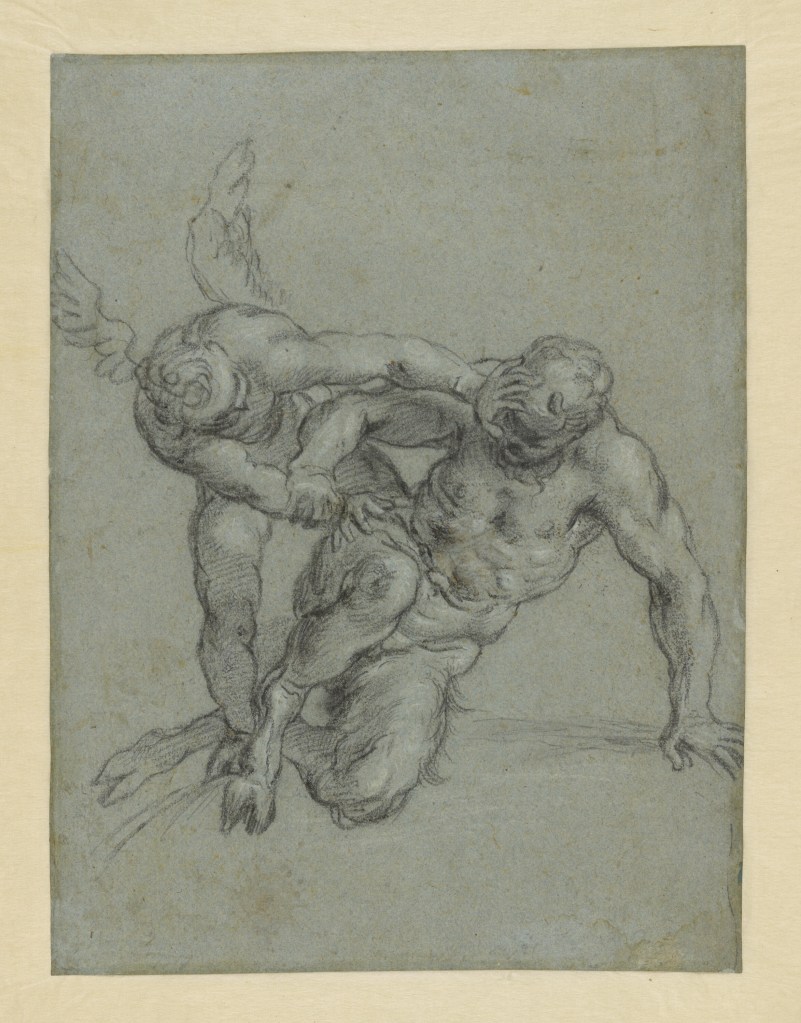
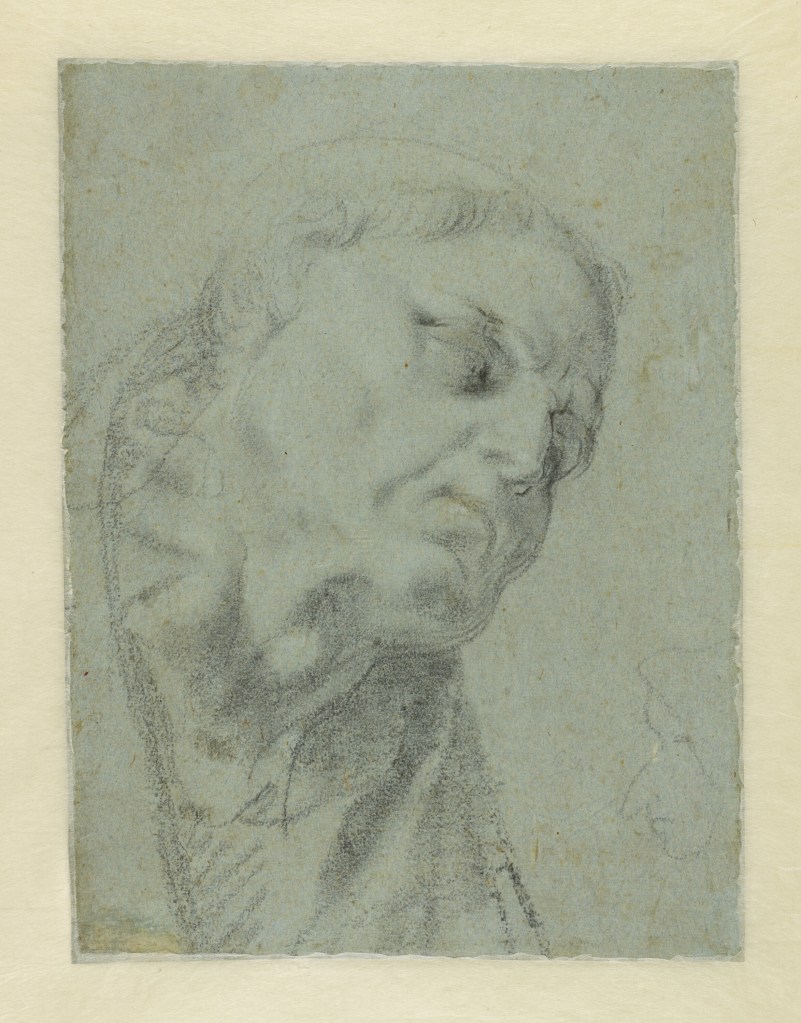
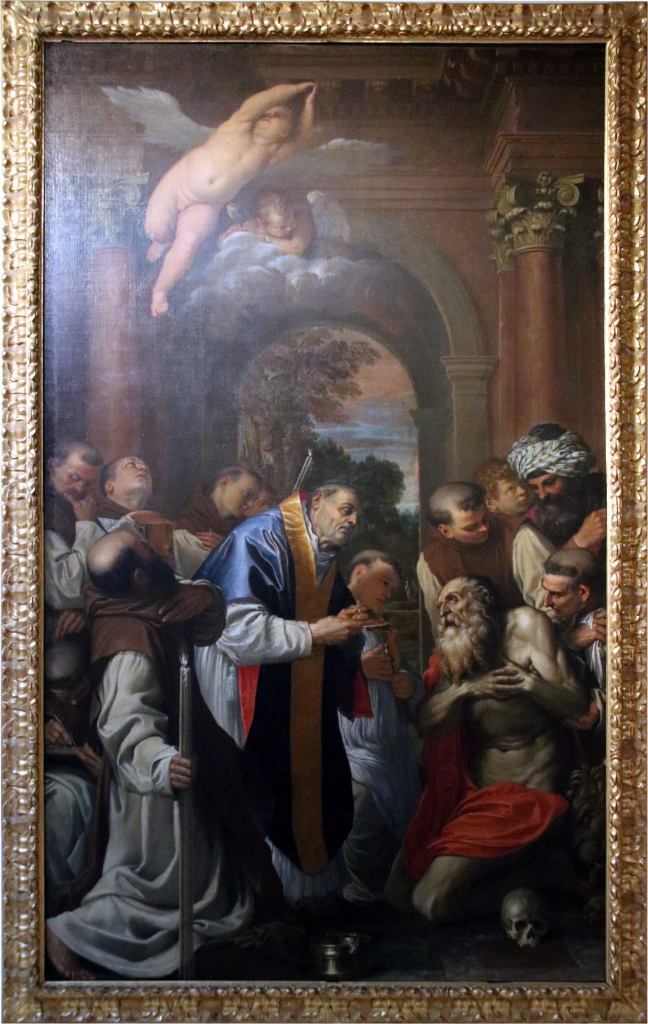
The Last Communion was among Agostino’s most important achievements as a painter. Its preparations illustrate the attention he gave to the figures who would participate in a complex religious narrative. They also belong to a period in which his familiarity with Venetian painting informed his treatment of large-scale compositions. Di Giampaolo discusses the influence of Veronese on Agostino’s religious paintings and compares the effects of illumination in a preparatory drawing for the Adoration of the Shepherds with those of Jacopo Bassano.
Agostino Carracci, The Adoration of the Shepherds, c. 1592–94
The Later Pen Drawings
During the 1590s, Agostino developed an increasingly elaborate manner of drawing in pen and ink. Ann Sutherland Harris has traced a movement from the comparatively rough and economical sketches of his earlier career towards drawings characterised by flowing contours, emphatic hatching and a more calligraphic handling of line. His experience as an engraver remained evident in the control and variation of his strokes, although the pen offered greater freedom than the burin used to cut lines into a copper plate.
Harris has suggested that the Dutch engraver Hendrick Goltzius, who visited Bologna in 1590–91, may have contributed to this development. Goltzius was celebrated for his command of line and his ability to suggest volume through elaborate systems of swelling contours and hatching. Agostino’s drawings for Amor Vincit Omnia, engraved in 1599, and Venus, Vulcan and Cupid demonstrate a comparable interest in the expressive possibilities of penwork. In these sheets, the manipulation of line becomes an accomplished graphic performance as well as a means of preparing a composition.
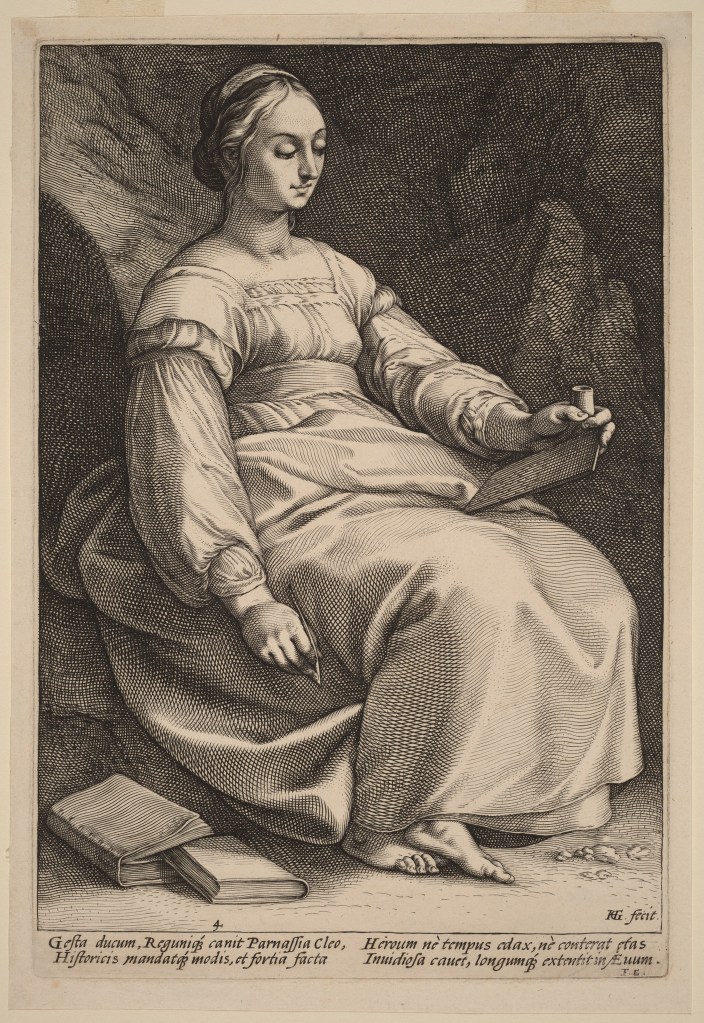
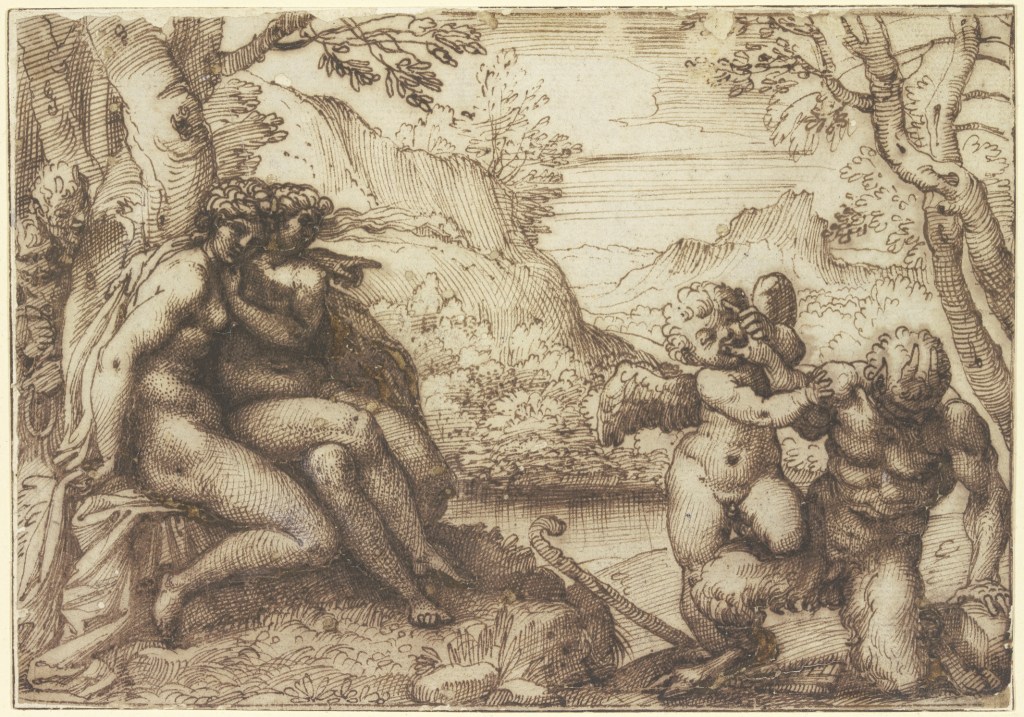
Agostino Carracci, Venus, Vulcan and Cupid, late 1590s
Having worked with Annibale on the decoration of the Farnese Gallery in Rome, Agostino left for Parma in 1600, following tensions between the brothers. There he entered the service of Duke Ranuccio Farnese and undertook mythological frescoes depicting the story of Peleus and Thetis in the Palazzo del Giardino. The project remained unfinished when Agostino died in February 1602.
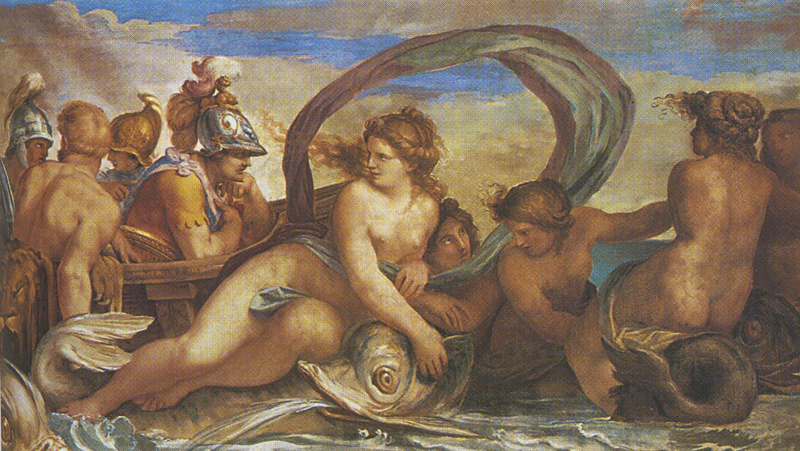
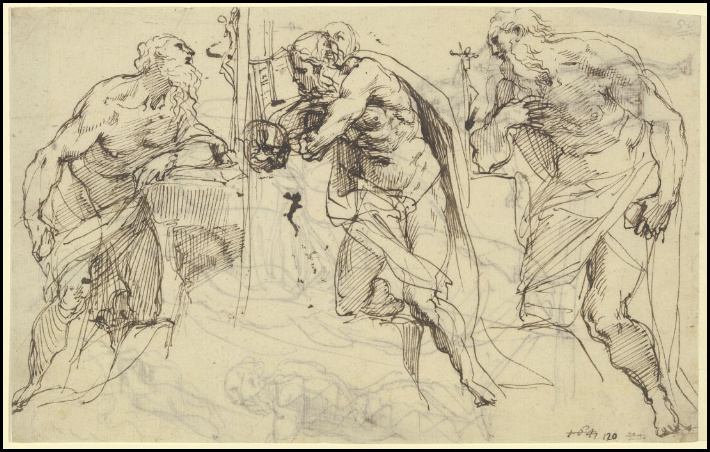
Drawings associated with the Parma decorations display the fluency and variety of his late pen technique. A sheet in the Hamburger Kunsthalle contains several alternative studies for Thetis riding a sea creature, together with anatomical studies and other figures. The repetition of poses and the juxtaposition of different subjects recall the working sheets discussed earlier, although the handling of the pen is more expansive. Other drawings from this period survive at Windsor Castle, including studies of legs and feet, figures in movement and exercises in perspective.
Agostino Carracci, studies for Thetis Riding a Sea Creature, c. 1600–02
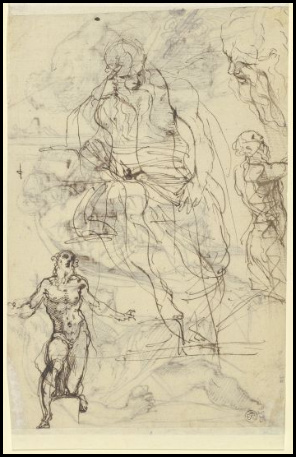
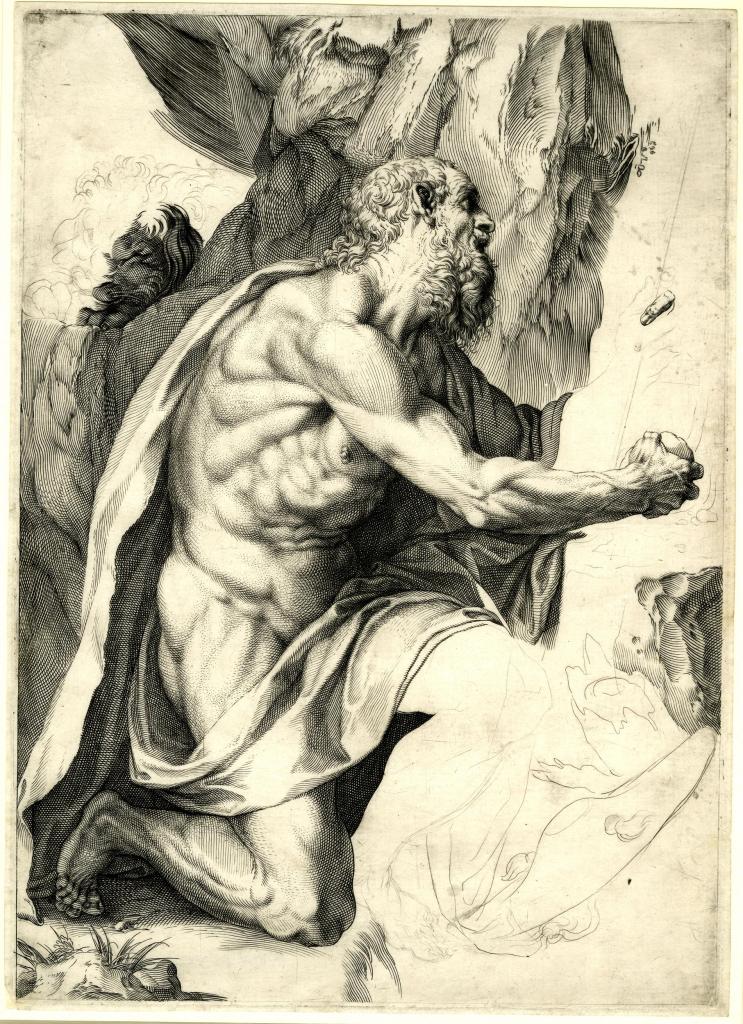
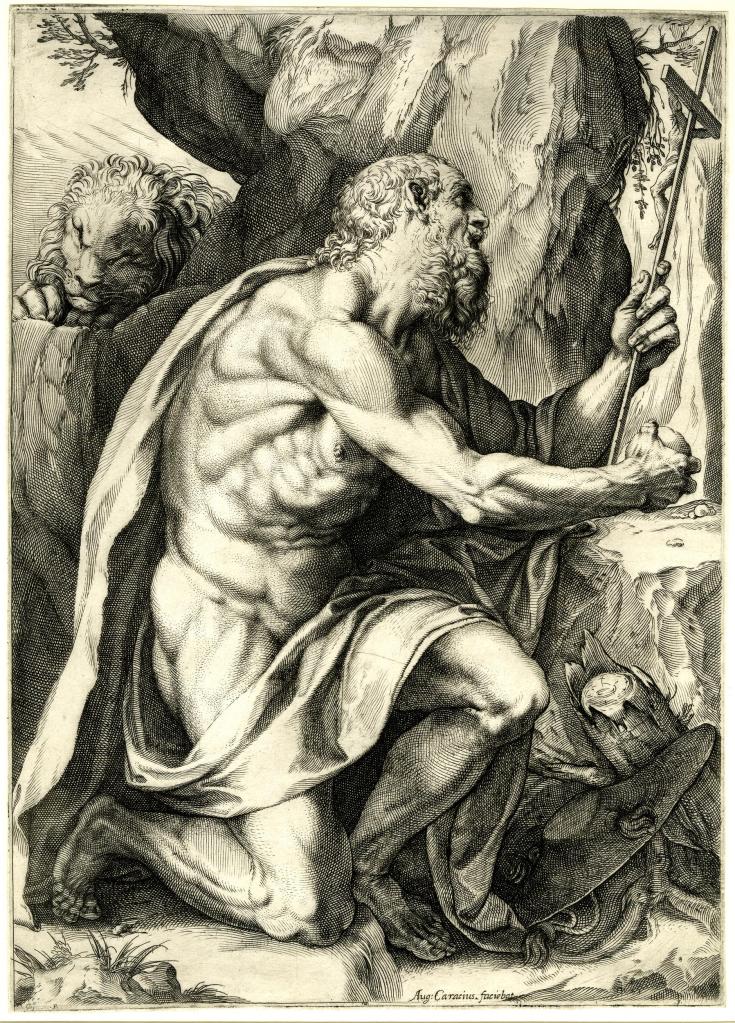
Recent research by Mary Vaccaro has supplied additional evidence for dating some of these drawings. In an article published in 2026, she identifies a watermark found on several Windsor sheets and on drawings in other collections, connecting the paper with material used in Parma around the time of Agostino’s employment at the Farnese court. Her findings support the attribution of a group of energetic pen studies to the artist’s final years, rather than to the earlier period of teaching and experimentation in Bologna. Among the related works is a sheet in Frankfurt containing studies for an engraving of the penitent St Jerome, left unfinished at Agostino’s death.
Collaboration and Artistic Identity
The fresco cycles at Palazzo Fava and Palazzo Magnani had depended upon close collaboration between the three Carracci, who exchanged ideas and sometimes contributed to the same compositions. Carlo Cesare Malvasia, writing in the seventeenth century, recalled their collective attitude to authorship in the declaration L’abbiam fatta tutti noi (‘We all did it’). Their close working relationship has also made it difficult for later scholars to distinguish their individual contributions, particularly among the surviving preparatory drawings.
Agostino’s involvement extended beyond the execution of designs conceived by his relatives. His preparations for the frescoes at Palazzo Fava, including drawings for narrative figures and decorative ornament, demonstrate his participation in developing the compositions themselves. Mary Vaccaro has argued that several studies formerly attributed to Annibale should instead be recognised as Agostino’s work. The proposed reattributions also suggest how ideas could develop through an exchange between the brothers, whose respective contributions were not always confined to separate stages of production.
Attributed to Agostino Carracci, Studies for Decorative Consoles, c. 1585
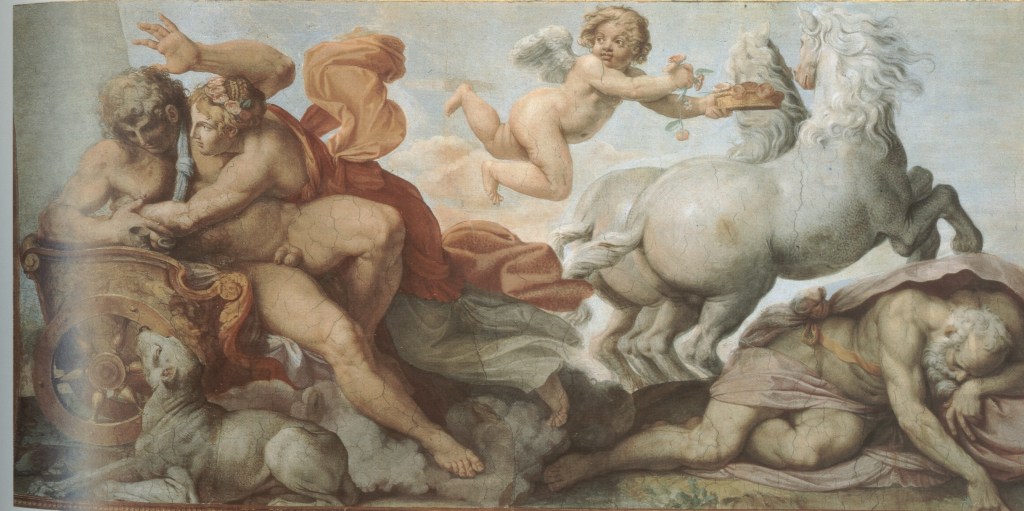
The same collaborative practice continued in Rome, where Agostino assisted Annibale with the decoration of the Farnese Gallery. He was responsible for two of the large mythological scenes on the vault, including Aurora and Cephalus. Diane De Grazia has examined the surviving preparatory drawings and cartoons, arguing that Agostino devised these compositions while Annibale subsequently introduced alterations to individual figures. Her research gives greater prominence to Agostino’s participation in the invention of the Gallery’s decoration, although the division of responsibilities remains a subject of scholarly discussion.
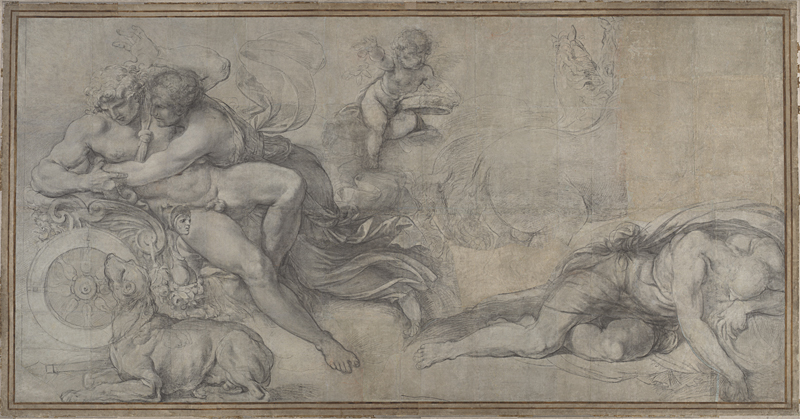
Cephalus carried off by Aurora in her Chariot
about 1599
charcoal and white chalk on paper, 202.5 × 398.8 cm
Presented by Lord Francis Egerton, 1837
NG147
https://www.nationalgallery.org.uk/paintings/NG147
Agostino’s reputation among his contemporaries rested upon a combination of artistic skill and intellectual accomplishment. His knowledge of literature, mathematics and artistic theory distinguished him within the Carracci circle, while his activities as an engraver, painter, draughtsman and teacher gave his career an unusual breadth. His drawings preserve something of that range, from the study of individual figures to the preparation of engravings, paintings and large decorative schemes.
Donate to Inner Surfaces here.
Bibliography
De Grazia, Diane, ‘L’altro Carracci della Galleria Farnese: Agostino come inventore’, in Les Carrache et les décors profanes: Actes du colloque de Rome (2–4 octobre 1986), Rome: École française de Rome, 1988, pp. 97–113.
Di Giampaolo, Mario, ‘Da Venezia a Bologna: un importante disegno di Agostino Carracci’, Prospettiva, nos. 57–60 (1989–90), pp. 153–55.
Harris, Ann Sutherland, ‘Agostino Carracci’s Inventions: Pen-and-Ink Studies, 1582–1602’, Master Drawings, 38, no. 4 (Winter 2000), pp. 393–423.
Robertson, Clare, ‘The Carracci as Draughtsmen’, in Clare Robertson and Catherine Whistler, Drawings by the Carracci from British Collections, Oxford: Ashmolean Museum, 1996, pp. 27–35.
Vaccaro, Mary, ‘Two Red Chalk Drawings in the Uffizi by Agostino (not Annibale) Carracci’, Master Drawings, 54, no. 2 (Summer 2016), pp. 225–34.
Vaccaro, Mary, ‘Towards a Study of Watermarks on Carracci Drawings at Windsor Castle and Elsewhere’, The Burlington Magazine, 168, no. 1483 (October 2026), pp. 950–59.

