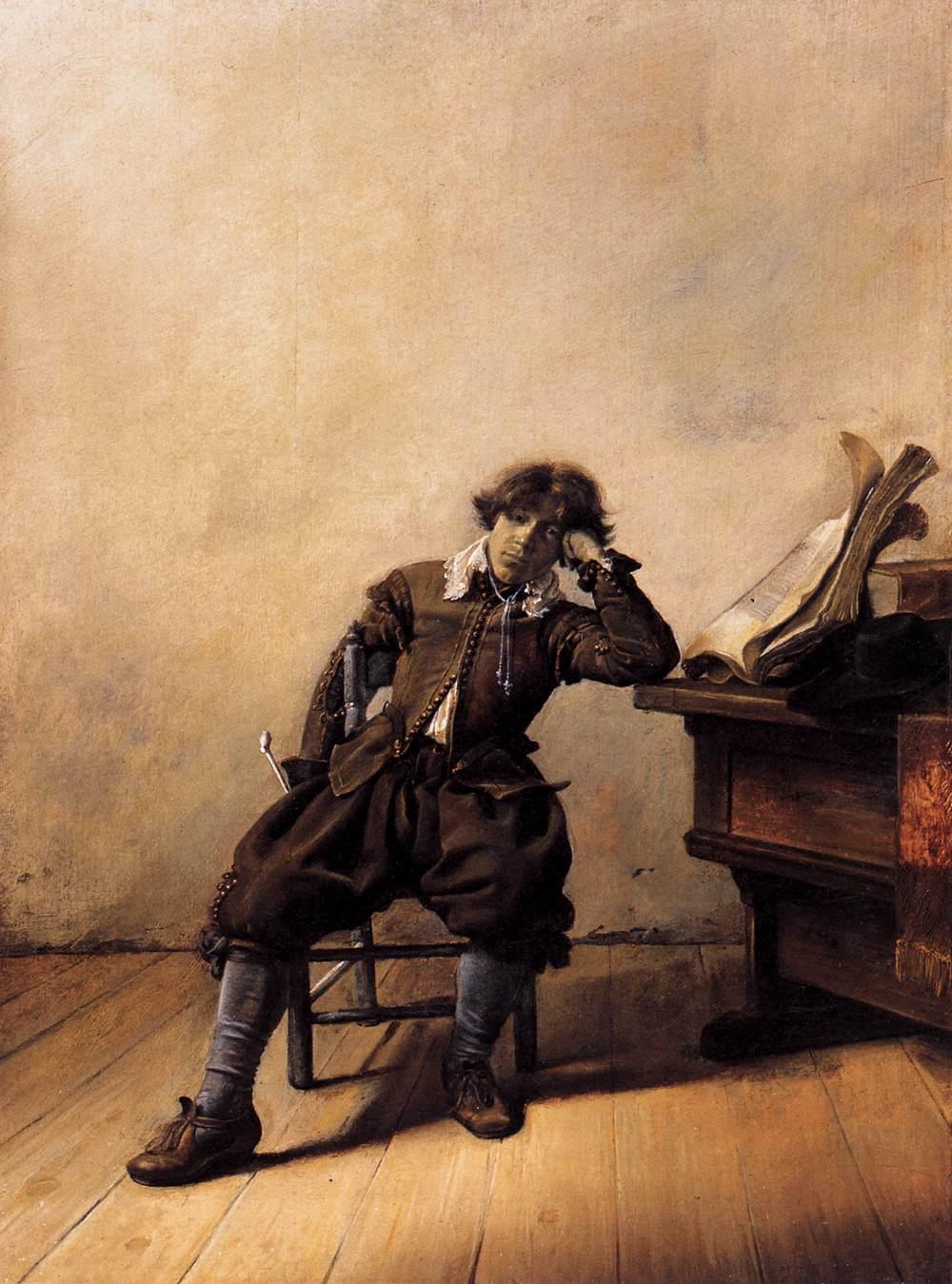
Pieter Codde (1599–1678) is principally remembered for his paintings of fashionable company, musical gatherings and domestic interiors, subjects that occupied a prominent place in Dutch genre painting during the first half of the seventeenth century. His Young Man with a Pipe, in the Musée des Beaux-Arts, Lille, belongs to a less familiar aspect of his work. Painted around 1630, it depicts a solitary young man seated at a table, his head supported by one hand, with books and other personal possessions beside him. The informality of his posture and the individuality of his expression give the figure something of the immediacy of a portrait, although the painting is generally understood as a genre subject rather than the likeness of an identifiable sitter.
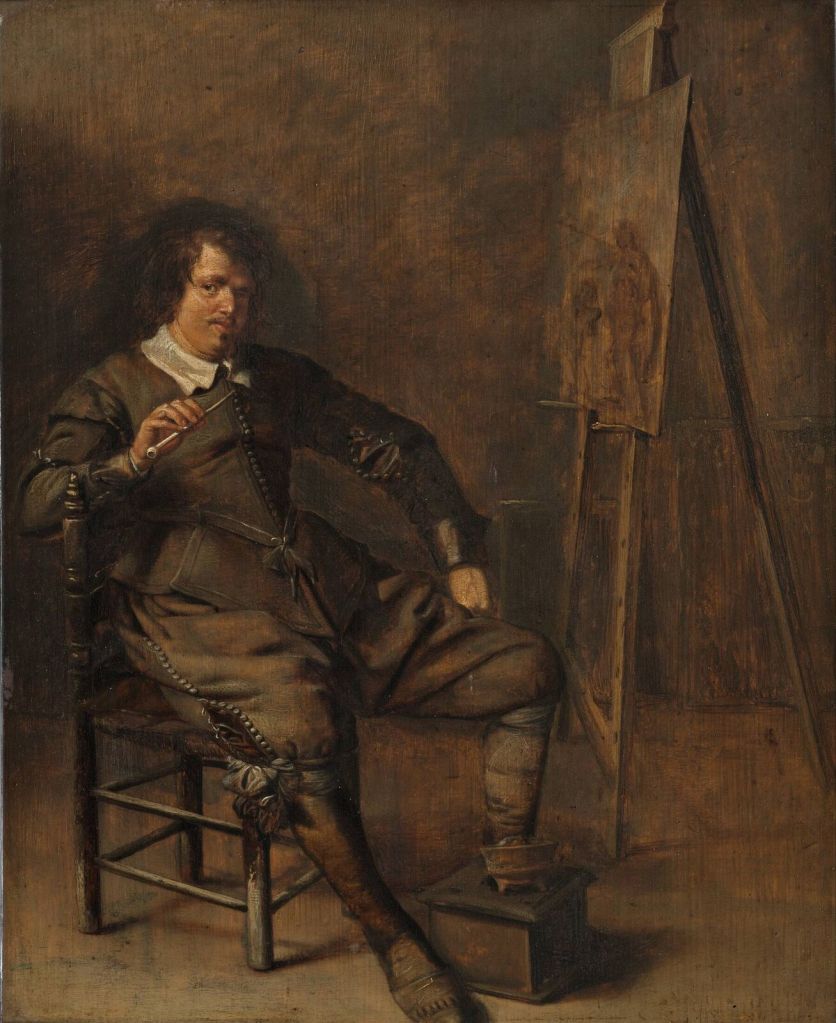
Codde’s Portrait of a Painter, sometimes identified as a self-portrait, provides a useful comparison. The two pictures differ in their subjects, yet both concentrate attention on a single figure. Set beside this more explicitly portrait-like work, the Lille painting demonstrates how the distinctive presence of an individual can be conveyed without recourse to the conventions of formal portraiture.
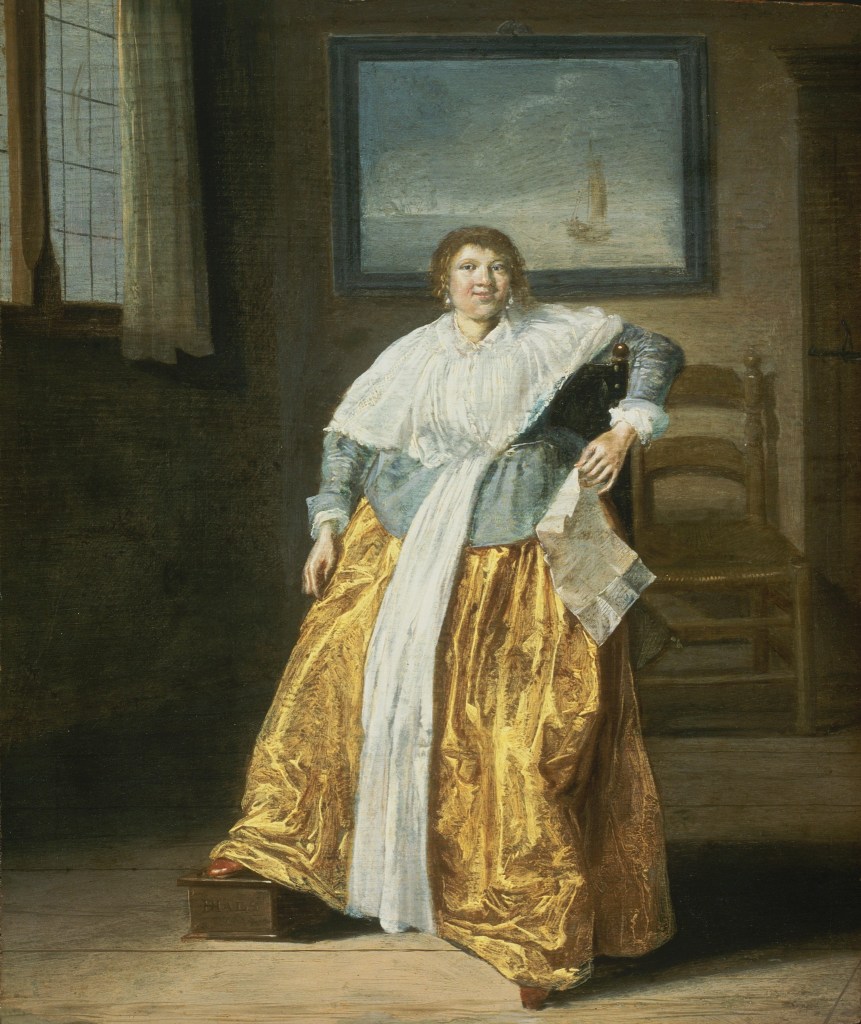
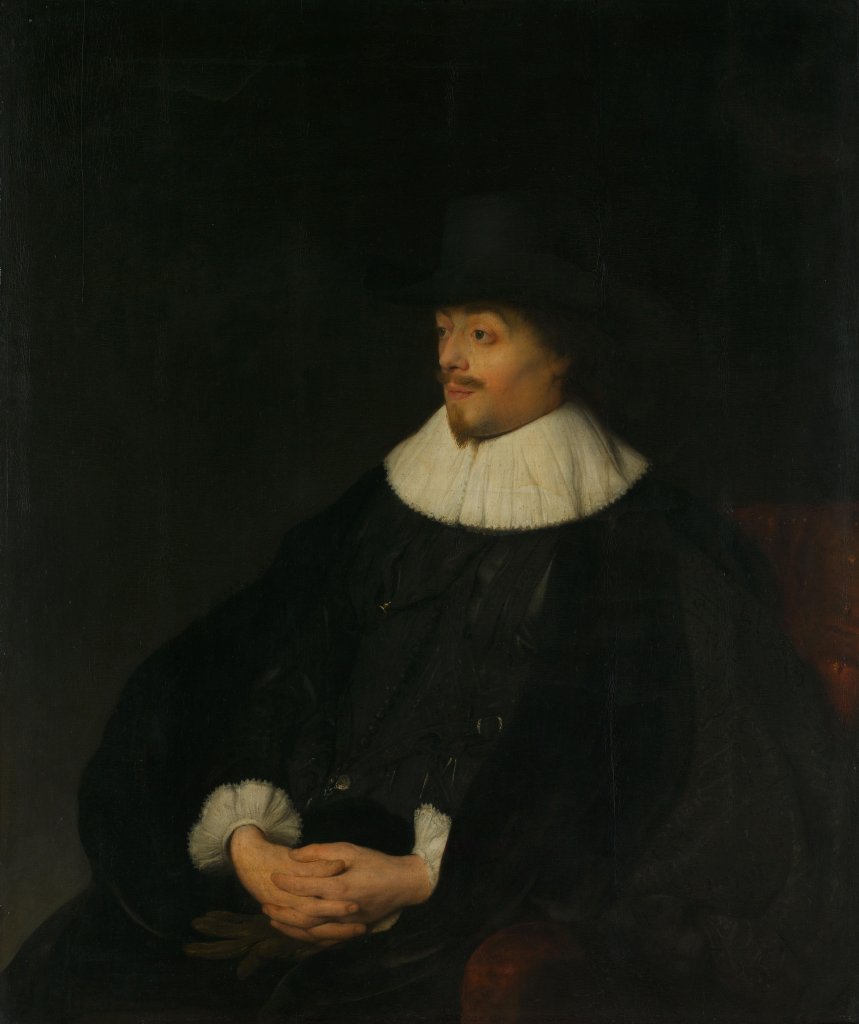
Walter Liedtke places the Lille picture in the context of developments in both genre painting and portraiture around 1630. Among genre painters, Dirck Hals’s Seated Woman with a Letter (1633) offers an example of the growing interest in solitary figures and simplified interiors; Judith Leyster also explored such subjects. Meanwhile, the subtle characterisation found in contemporary portraiture can be seen in Jan Lievens’s Portrait of Constantijn Huygens. Codde’s Young Man with a Pipe stands between these approaches: a recognisable genre subject whose apparent individuality encourages us to look at him as we might a portrait sitter.
The painting’s apparent simplicity owes much to the restraint of its colouring. Codde employs a limited range of silver-greys, ochres and muted browns, with subtle gradations of light and shade. Peter C. Sutton has associated this palette with the emergence of tonal painting in the Netherlands during the late 1620s, when the brighter colours of earlier company scenes increasingly gave way to a more unified treatment of light and atmosphere.
Within this narrow tonal range, Codde develops a remarkably varied treatment of surfaces. The extensive area of plaster wall, seemingly plain at first glance, reveals delicate irregularities of texture, fine cracks and small illusionistic nails. The wooden floorboards and furniture, the folds of the young man’s clothing and the creases of his stockings invite a similarly close examination. Indeed, the economy of the setting makes these distinctions more conspicuous. Sutton draws attention to the rendering of the bare wall and its trompe-l’œil details, identifying qualities that would reappear in the work of Vermeer.
The composition is no less carefully considered. The figure occupies the principal area of activity, while the books, hat and other objects are gathered towards the right. The extended leg introduces a diagonal movement that finds a visual counterpart in the shadows across the floor. Against these elements, the broad expanse of relatively unoccupied wall establishes a sense of spatial clarity.
The young man’s attitude has nevertheless invited a wide range of interpretations. Over the years, the painting has been known as The Reader’s Repose, The First Pipe, The Student and Melancholy, titles which suggest how readily its subject can accommodate different meanings. The head supported by one hand is a familiar motif in representations of melancholy, most famously Albrecht Dürer’s Melencolia I of 1514. Yet the association does not necessarily imply sadness or despair. In seventeenth-century literature and imagery, solitude and contemplation could equally suggest intellectual independence, creative absorption or contentment with modest pleasures.
In his 1984 catalogue entry, Peter C. Sutton explored these possibilities through contemporary literary and emblematic sources. He referred to an emblem by Jacob Cats, published in 1618, in which Cupid offers pipes to a seated smoker, and discussed Kurt Bauch’s interpretation of Codde’s figure as a young man satisfied with the simple comforts of his existence. Sutton also drew attention to an anonymous engraving of a student in his room, accompanied by verses celebrating the freedom of scholarly life and its indifference to material wealth. Such comparisons place Codde’s picture within a wider tradition in which the contemplative individual might be understood as fortunate rather than discontented.
Other interpretations have been less sanguine. The young man has been described as dejected, lovesick or simply unhappy, while the related Man Seated at a Table of 1628 by Jan Davidsz. de Heem, now in the Ashmolean Museum, presents a comparable figure in a scholarly interior. Sutton regarded De Heem’s treatment as more readily suggestive of boredom and disillusionment. The resemblance between the two paintings is striking. Together they demonstrate how a familiar pose and setting could sustain different shades of psychological interpretation.
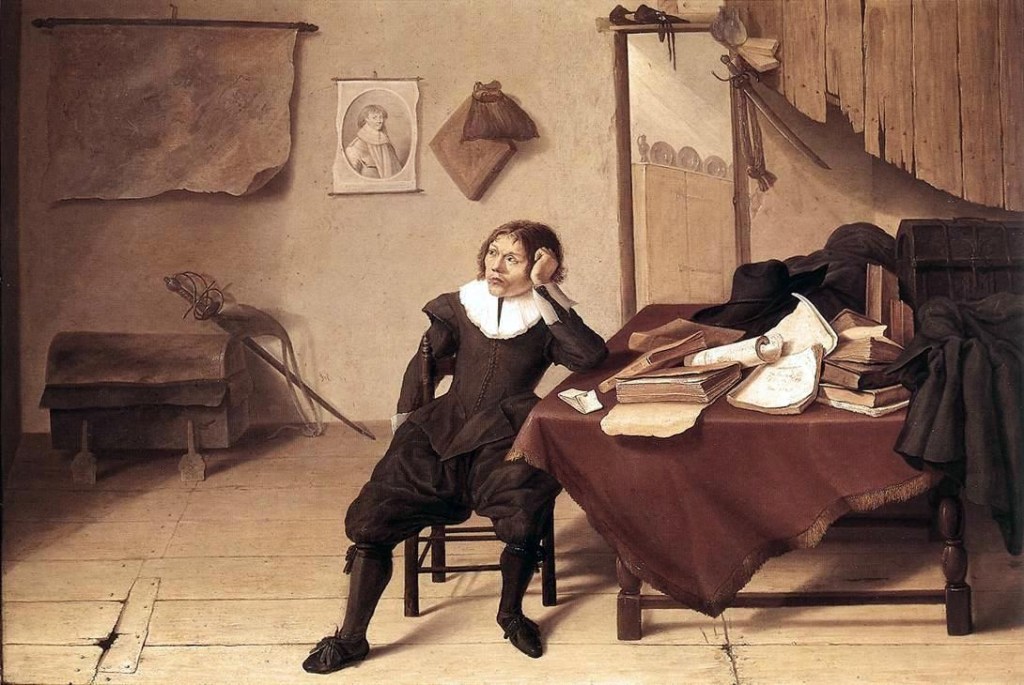
Walter Liedtke approached the question from a somewhat different perspective in his 1992 catalogue entry. While acknowledging the conventions underlying Codde’s composition, he was more concerned with the painting’s capacity to suggest an individual consciousness. He recognised in the young man’s attitude something of the familiar frustration of youth, an interpretation rather removed from the traditional gravity of melancholy.
For Liedtke, however, this apparent spontaneity was itself an achievement of artistic invention. The painting is so persuasive in its suggestion of a moment observed from life that we might imagine Codde working directly from a model in his studio. Yet the figure belongs to an established pictorial tradition, and the seeming naturalness of his expression is no less a product of artistic construction. As Liedtke observed, “his thoughts, whatever they might be, reveal that there is more to everyday experience than the bare facts of one’s physical environment or the knowledge acquired from large and learned tomes.”
Donate to Inner Surfaces here.
Bibliography
These are the sources. Any errors are mine.
Sutton, Peter C., with contributions by Cynthia von Bogendorf-Rupprath et al. Masters of Seventeenth-Century Dutch Genre Painting. Exhibition catalogue. Philadelphia Museum of Art; Staatliche Museen Preussischer Kulturbesitz, Berlin; Royal Academy of Arts, London. Philadelphia: Philadelphia Museum of Art, 1984, pp. 174–175.
Liedtke, Walter. Masterworks from the Musée des Beaux-Arts, Lille. New York: Metropolitan Museum of Art, 1992, catalogue no. 13, pp. 99–102.
Meijer, Fred G. Jan Davidsz. de Heem (1606–1684). Doctoral dissertation, University of Amsterdam, 2016, vol. I, p. 21; vol. II, catalogue no. A 008.

