Antonio Mancini (1852–1930) was celebrated during his lifetime for the extraordinary vitality of his painting, his command of colour and light, and the unconventional methods through which he achieved his effects. His reputation rested initially upon the paintings of Neapolitan street children, the scugnizzi, and young performers, among them the much-depicted Luigiello. Later, his portraits attracted an international clientele, while the increasingly substantial applications of pigment and unusual materials employed in his mature work became objects of fascination in their own right. Yet the emphasis frequently placed upon Mancini’s instinctive gifts and technical brilliance has sometimes obscured the breadth of his artistic culture.
Cinzia Virno has challenged the longstanding characterisation of Mancini as an intellectually unsophisticated artist, drawing attention to his extensive correspondence, notebooks and personal relationships. His writings, frequently composed on whatever paper came to hand, reveal a sustained preoccupation with pictorial problems and a close interest in the work of other painters. Although their often agitated and ungrammatical language can make them difficult to interpret, they provide considerable evidence of his artistic thinking. Mancini was especially concerned with the representation of observed reality through relationships of colour, tone and light. Fidelity to nature did not mean the mechanical transcription of appearances, but their organisation into a convincing pictorial whole.
His artistic education began in Naples, where he studied drawing with the sculptor Stanislao Lista before entering the academy and becoming a pupil of Domenico Morelli, for whom he retained profound admiration. The city’s churches and collections also afforded opportunities to study Caravaggio and the seventeenth-century Neapolitan painters, notably Jusepe de Ribera, Massimo Stanzione and Mattia Preti. Their treatment of the human figure and the dramatic possibilities of illumination formed part of the artistic inheritance upon which Mancini drew. His knowledge of this tradition was not confined to formal instruction: he repeatedly sought out paintings that interested him and examined their methods of execution.
A journey to Venice in 1872, undertaken with Albert Cahen d’Anvers, made a particularly strong impression. Mancini admired Titian’s tonal painting and Tintoretto’s colour, writing to his parents that he had encountered an exceptional collection of pictures at the Accademia and regretting that he had not seen them before beginning his training. His admiration for Titian persisted. Ugo Ojetti later recalled Mancini’s fascination with Titian’s Portrait of Pope Paul III, which he had attempted unsuccessfully to copy when young. He continued to study its drawing, modelling, brushwork, tonal relationships and glazes, regarding it as an unsurpassed achievement.
Mancini’s artistic horizons widened further through his meeting with Mariano Fortuny in Naples in 1874 and his visits to Paris in 1875 and 1877–78. He encountered contemporary French painting and knew Edgar Degas, although Virno cautions against attributing too much of his development to French influence. In Rome, his interests extended to Rubens, Frans Hals and Flemish painting, while Diego Velázquez became an especially important point of reference. Mancini reflected upon Velázquez’s Portrait of Innocent X, in the Galleria Doria Pamphilj, admiring the apparent freedom of its execution, the subtle organisation of chiaroscuro and the extraordinary harmony achieved through passages of paint that could seem almost accidental when viewed closely. At the proper distance, these individual touches resolved into a unified image. He contrasted Velázquez’s directness with the laborious imitation of Old Master techniques by painters preoccupied with elaborate procedures of glazing.
Such observations illuminate Mancini’s own conception of painting. The distinction between the physical appearance of brushwork and its effect upon the spectator, the relationship between spontaneity and preparation, and the capacity of colour to establish form were recurring concerns throughout his career. They also help to explain why his apparently unorthodox procedures were accompanied by sustained reflection on the practical and expressive possibilities of his medium.
Mancini’s artistic culture provides a starting point for this exploration of his world as a painter. The essay concentrates upon the studio and its arrangements of models, costumes, paintings, sculptures and other objects; upon his representations of artistic activity; upon the materials and techniques through which he developed his distinctive pictorial language; and upon the self-portraits in which he reflected upon his own identity and profession. This particular focus leaves other important aspects of his achievement in the background, notably his extensive production of drawings and pastels and his landscapes, to which he returned with renewed interest in his later years.
The Studio, Models and Artistic Invention
The studio occupied a central place in Mancini’s artistic practice. Although he insisted upon direct observation, his paintings frequently emerged from carefully arranged settings in which models, costumes, fabrics and miscellaneous objects were brought together for their pictorial possibilities. Cinzia Virno emphasises the preparation that preceded his apparently spontaneous execution. Mancini selected and dressed his models, established their poses, arranged the lighting and assembled the objects surrounding them. Once these conditions were settled, he generally worked rapidly, translating his observations directly into paint.
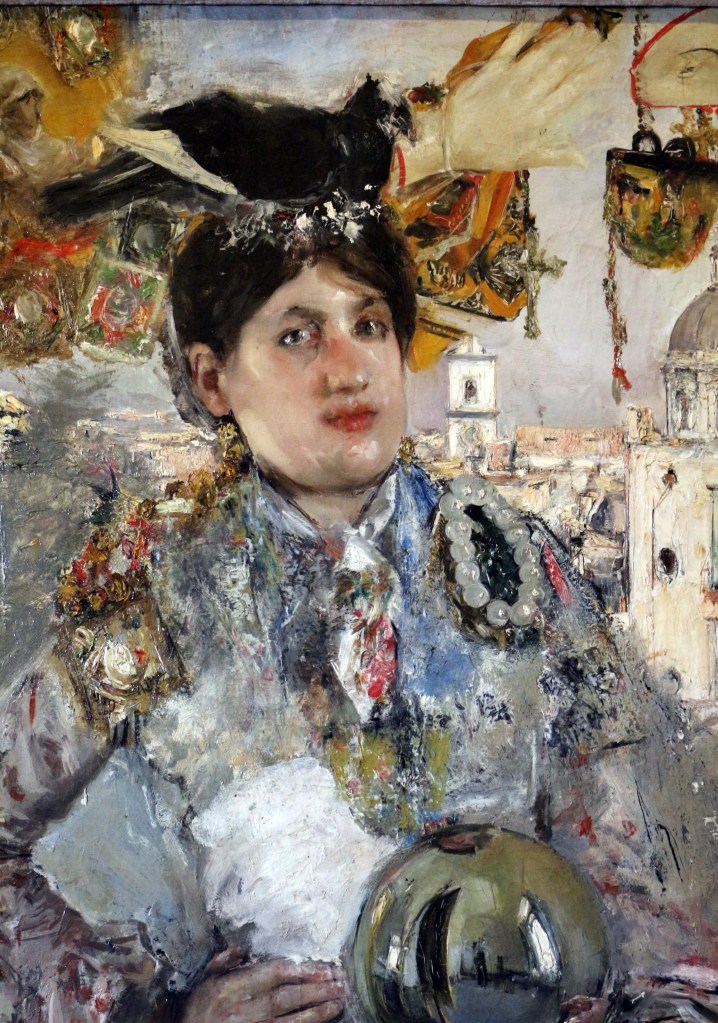
The environments he constructed could be extraordinarily elaborate. In La Corallaia, a young woman appears among an assortment of colourful objects, including a glass sphere that Virno associates with Mancini’s knowledge of Jan van Eyck. In I poveri si divertono con le gioie dei ricchi (1873), the heads of Luigiello and a young girl emerge from an arrangement of puppets, playing cards, a sword, fabrics and other possessions. Describing Mancini’s studio around 1920, the critic Cipriano Efisio Oppo recalled an accumulation of frames, theatrical ornaments, sculptural busts, prints, photographs, reproductions, books, mirrors and textiles. These materials supplied the painter with an extensive repertory from which to construct his settings.
In La modella (1878–79), Mancini brought the female model and the activity of painting together within a single composition. The picture retains something of the French artistic atmosphere he had encountered during his recent stay in Paris. Virno dates its execution to late 1878, shortly after his return to Naples in October. The small figure of a painter in the background was formerly identified as Mancini himself, but Virno cites the testimony of the artist’s nephew Alfredo, who recognised the figure as Mancini’s younger brother Angelo. The painting thus brings a member of the artist’s family into a representation of the working studio.
View La modella (1878–79), reproduced on Fine Art America.
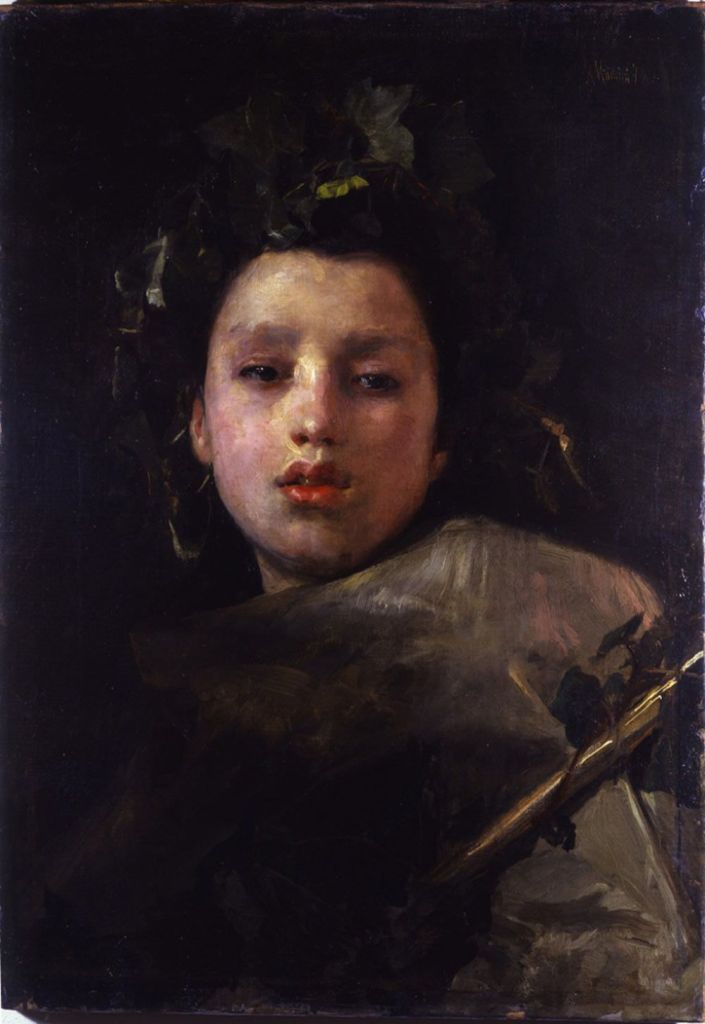
Mancini’s models frequently assumed identities quite different from their everyday circumstances. His early paintings of the saltimbanchi drew partly upon childhood memories of travelling performers who had stayed at his family’s inn in Narni. Luigiello subsequently appeared in several such roles, while other boys were represented as seminarians or religious figures. In Bacco fanciullo (1877), the familiar model becomes a youthful Bacchus, in a composition that Virno relates to Caravaggio and the Neapolitan seventeenth-century tradition. Costume, gesture and setting enabled Mancini to transform an individual sitter into a character, while retaining the particularity of the observed model.
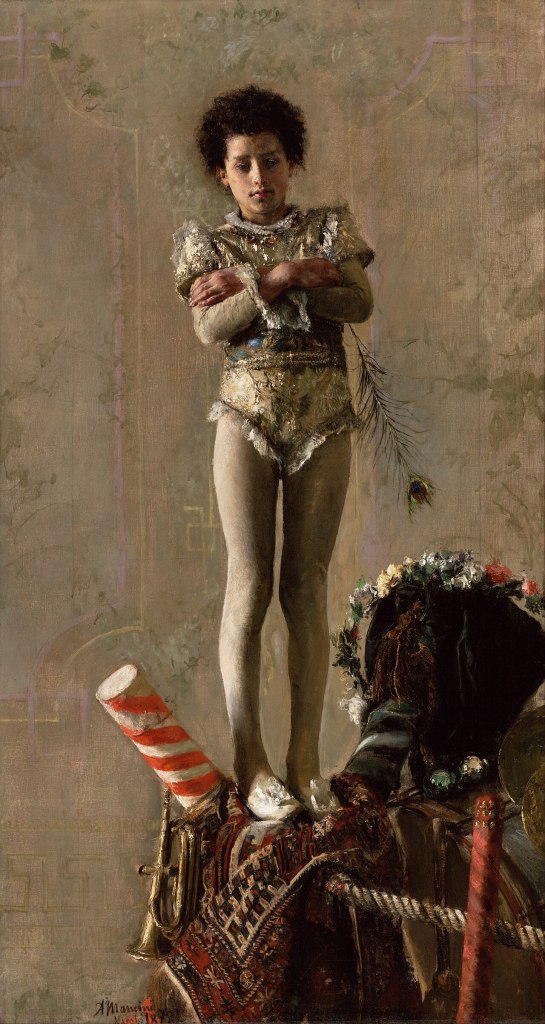
This practice continued into his maturity and was not confined to professional models. Mancini repeatedly represented his father Paolo in different guises, among them a fruit seller, a musician, an antiquarian and an elderly warrior. His association with the German collector Otto Messinger likewise encouraged paintings incorporating historical dress, weapons, sculpture and antique furnishings. Works such as Guardia svizzera vaticana and Il brindisi brought together elaborate costumes and studio objects whose contrasting colours and textures became important elements of the compositions.
See Il brindisi and Guardia svizzera, illustrated in Cinzia Virno’s article on About Art Online (figs. 31 and 33).
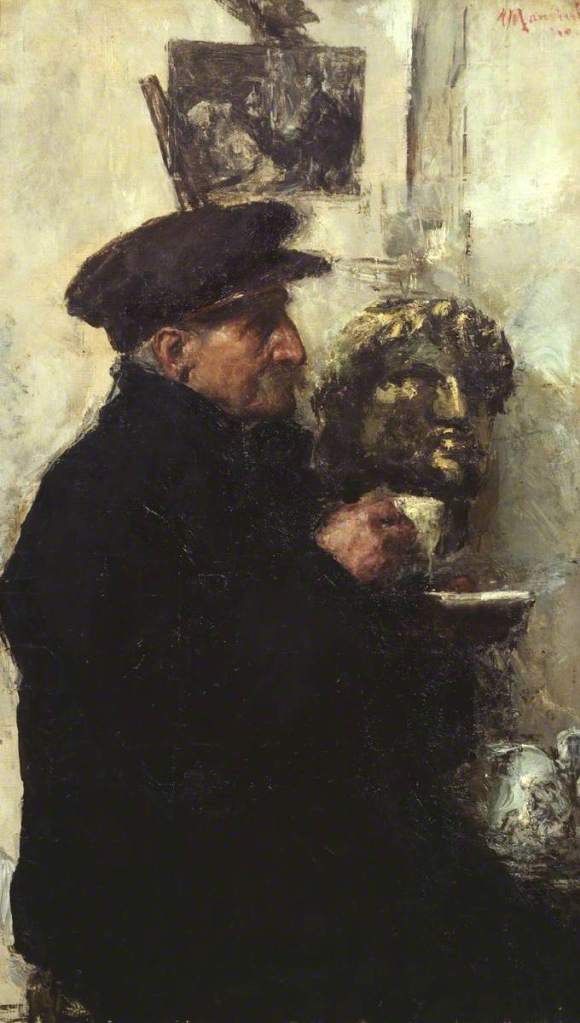
Sculpture had a particular place within this environment. Mancini’s earliest artistic training had taken place in the studio of Stanislao Lista, where he and Vincenzo Gemito drew from plaster casts and sculptural models. Later, sculpted heads and figures appeared among the objects assembled for his paintings. In Il venditore di statue, the human model shares the composition with numerous small sculptures, while the portrait of Mancini’s father now in the Tate collection includes an antique sculpted head. A contemporary reviewer, writing in The Illustrated London News in 1905, contrasted the father’s composed, good-humoured expression with the severe, almost sphinx-like appearance of the antique bronze behind him.
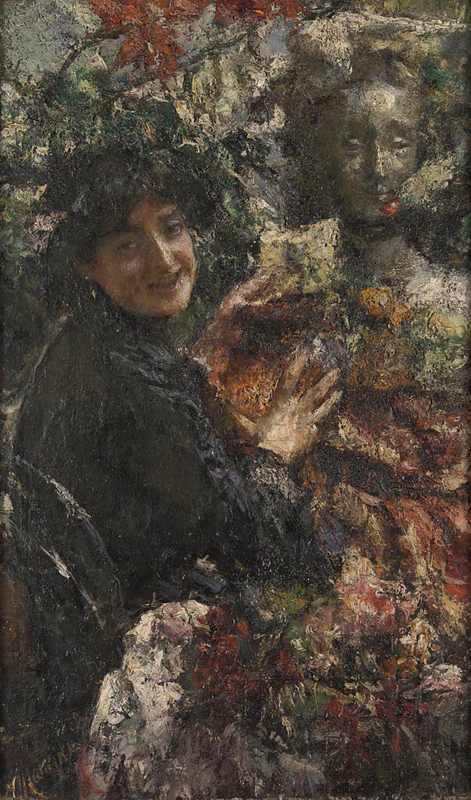
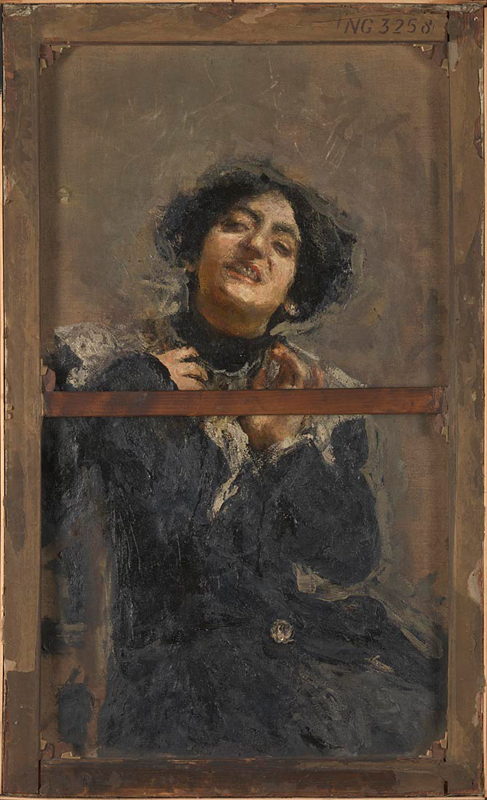
In Aurelia (1906), now in the National Gallery, London, Mancini returned to one of his favourite models, Aurelia Ciommi, known as La Cornacchia (the Crow). She appears among flowers, fabrics and a sculpted female bust, possibly recalling the Renaissance sculptures of Francesco Laurana. Virno emphasises the importance accorded to these surrounding objects, whose pictorial treatment approaches that of the model herself. Mancini also painted a less finished portrait of Aurelia on the reverse of the canvas, showing her in a different pose, without the elaborate arrangement of studio objects.
Pictures within Pictures
Among Mancini’s most inventive subjects are paintings in which pictures themselves become objects of display, exchange or artistic activity. The motif appeared during his final years in Naples and continued into his early Roman period. These works extend his practice of assigning different roles to familiar models, but introduce a further element: the models handle paintings, present them to spectators or assume the occupation of the artist.
An early example was Si vende (1882), exhibited at the Naples Promotrice, where it was purchased by Giuseppe Tipaldi, the society’s vice-secretary. The painting, subsequently destroyed during the Second World War, represented a young woman offering a picture for sale. Its title, For Sale, made the commercial transaction part of the subject, while the circumstances of its exhibition provide a documented instance of Mancini’s own efforts to find purchasers for his work. In correspondence with Tipaldi, he expressed gratitude for the purchase but also complained about the public’s tendency to misunderstand artistic merit and favour fashionable or conventional painting.
The critic Francesco Netti devoted an extended discussion to Si vende, paying particular attention to Mancini’s handling. Netti admired the painter’s ability to convey the girl’s presence and expression through brushwork that could appear irregular, summary or insufficiently finished by conventional standards. His response distinguished pictorial accomplishment from the careful completion of details, recognising considerable artistic control in the apparent roughness of the execution. The painting thus prompted contemporary consideration of the very qualities of Mancini’s work that were increasingly attracting critical attention.
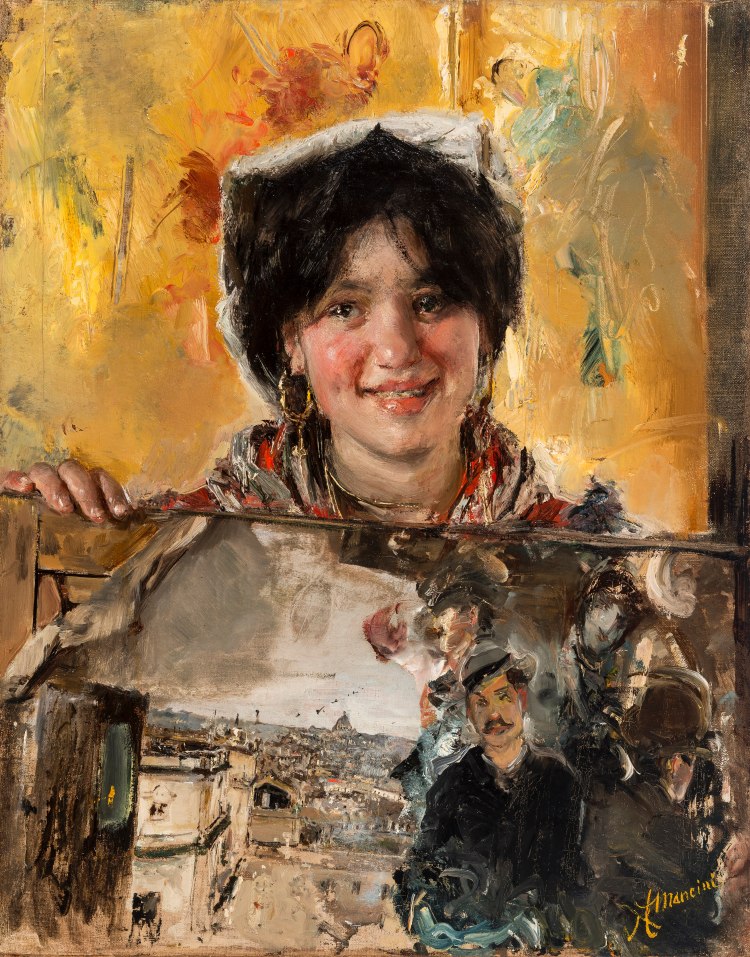
A related invention appears in Ciociara, also known as Ragazza che espone un quadro (c. 1884), painted after Mancini’s move to Rome. Virno identifies the model as a young woman of Ciociarian origin, recognisable through her shawl and large round earrings. She holds a painting depicting a view of Rome, with the dome of St Peter’s visible in the distance. Unlike the picture presented in Si vende, this small canvas rests against the girl’s shoulder, forming part of the arrangement of the figure. Virno remarks upon the greater breadth and assurance of Mancini’s handling and relates the model to the young woman represented in La modellina pittrice, whom she considers slightly older.
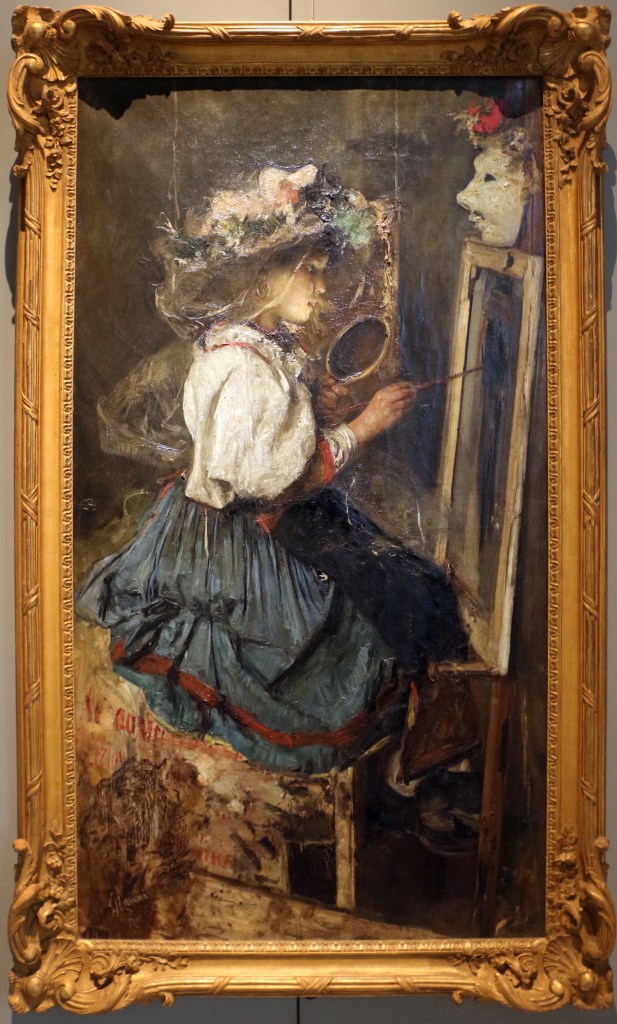
In La modellina pittrice (1884), now in the Museo Civico Ala Ponzone, Cremona, the relationship between model and painting becomes more elaborate. The young woman has taken up the painter’s equipment and attempts to make her own portrait while looking into a mirror. Contemporary reviewers explained the scene as an episode in which the model, taking advantage of her master’s absence, tries her hand at painting. Their accounts establish that the reversal of roles was central to the picture’s original reception. The person ordinarily observed and represented by the painter has become an artist engaged in representing herself.
The work was exhibited at the Turin Promotrice in 1884. Mancini had initially approached Adolphe Goupil for assistance in arranging its submission, but eventually relied upon Giuseppe Bottero, a painter and naval officer then in Turin, to present it to the exhibition committee. In a letter of 3 March, Mancini gave instructions concerning its delivery and specified a price of 1,500 lire. The contemporary reception was mixed, although some reviewers praised the originality of the subject, the model’s pose and the painter’s execution. The surviving correspondence also reveals Mancini’s close attention to the practical business of exhibiting and selling his pictures.
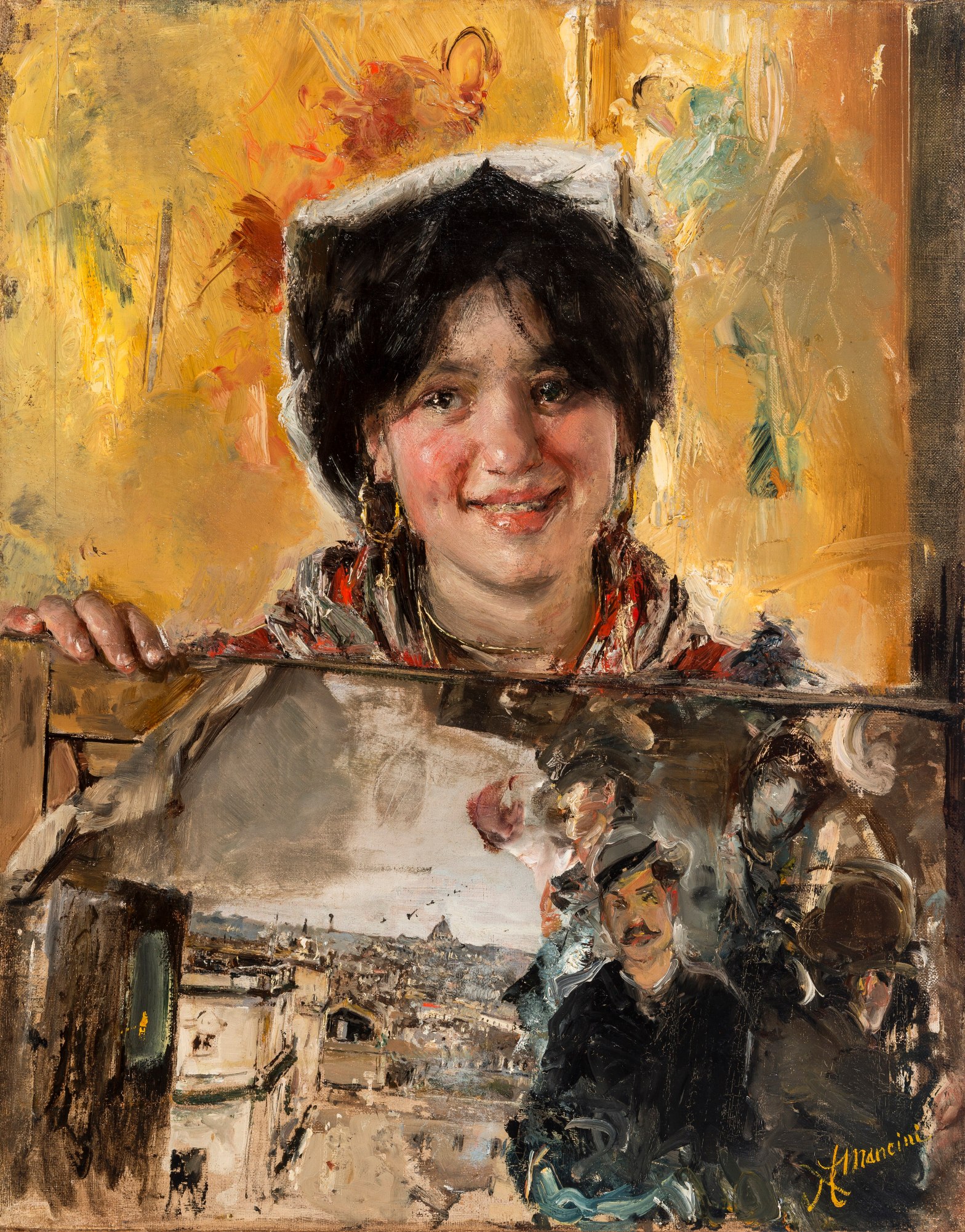
A different form of pictorial play appears in Dispetto di modella, also known as Capriccio di modella, which Virno assigns to Mancini’s first Roman period. Here a smiling young woman dressed as a gypsy appears to emerge from a canvas, with her head and hand projecting through its surface. She supports the canvas with one hand and holds a painter’s brush in the other. Mancini placed his signature in miniature upon the handle of that brush, introducing another reference to artistic authorship. Virno describes the invention as particularly ingenious, comparing its handling and colour with those of Pastorello in ciocie.
The picture differs from La modellina pittrice in its more playful treatment of the relationship between the represented figure and the painting itself. The girl’s apparent emergence through the canvas disrupts the conventional boundary between pictorial illusion and the physical support, while the brush bearing Mancini’s signature introduces a further joke about artistic authorship. There is something distinctly modern in this self-conscious manipulation of the conventions of representation, achieved with an irreverence that gives the composition much of its character.
View Dispetto di modella in the Fondazione Federico Zeri photographic archive.
The Material Practice of Painting
Mancini’s treatment of paint became increasingly distinctive over the course of his career. His early practice was founded upon direct observation and an approach he himself described as alla prima, establishing forms through colour without an elaborate preparatory drawing. Virno relates this method to his study of Caravaggio and seventeenth-century Neapolitan painting. In his early works, Mancini generally began with the background, indicating the contours of the figure in a few strokes before developing the composition in paint. The apparent immediacy of the execution depended upon a precise understanding of colour, light and tonal relationships. He believed that excessive retouching could compromise the unity of the original impression.
Technical investigations undertaken by Fabio Frezzato, Gianluca Poldi and Maria Letizia Amadori, published in 2021, have provided further evidence of his working procedures. Their examination of thirty-five paintings, representing different periods of his career, revealed relatively limited preliminary drawing and comparatively few alterations during execution. In Autoritratto con filo di paglia, painted around 1880, infrared examination disclosed a small number of graphic indications beneath the paint, including a contour subsequently adjusted as the hand was modelled. The researchers emphasise that Mancini’s rapid execution was accompanied by considerable forethought and an exceptional command of his materials.
His methods became more elaborate through the development of the graticola, a system of two corresponding grids of threads, one positioned before the model and the other against the canvas. Virno traces experiments with this apparatus to the first half of the 1880s, although its use became more regular after 1890, particularly in large-scale portraiture. The intersecting threads supplied reference points through which Mancini could establish the proportions and positions of different parts of the composition. They did not constitute a rigid mechanical framework: he could add further divisions as work progressed, and the arrangement remained subordinate to his observation and artistic judgement.
The system was closely connected with Mancini’s practice of working at a considerable distance from his subject. He would study the sitter, advance rapidly towards the canvas to apply paint, and retreat to inspect the effect. Lady Gregory, who sat for him in Ireland in 1907, left a vivid account of this procedure. She watched Mancini construct an increasingly intricate network of threads, adding new divisions as the portrait developed. He repeatedly withdrew to the far end of the room before approaching the canvas, sometimes applying his brush at the last moment between the threads. The physical exertion involved was considerable, yet the method allowed him to preserve his sense of the composition as a whole.
For Mancini, viewing distance was fundamental to pictorial effect. His admiration for Velázquez, discussed earlier, was closely related to the capacity of individual strokes of colour to achieve coherence when seen from an appropriate position. In a letter to Ralph Curtis, he explained that the grid helped him maintain proportional relationships, but insisted that measurements alone could never establish the truth of a painting. Light, colour and expression remained matters of artistic judgement. The system also left traces upon the works themselves. Mancini sometimes removed the threads while the paint was still sufficiently soft to retain their impressions, and these marks could remain conspicuous in the finished surface. Ritratto del marchese Giorgio Capranica del Grillo (1889) was among the early large portraits in which Virno identifies a particularly developed use of the apparatus.
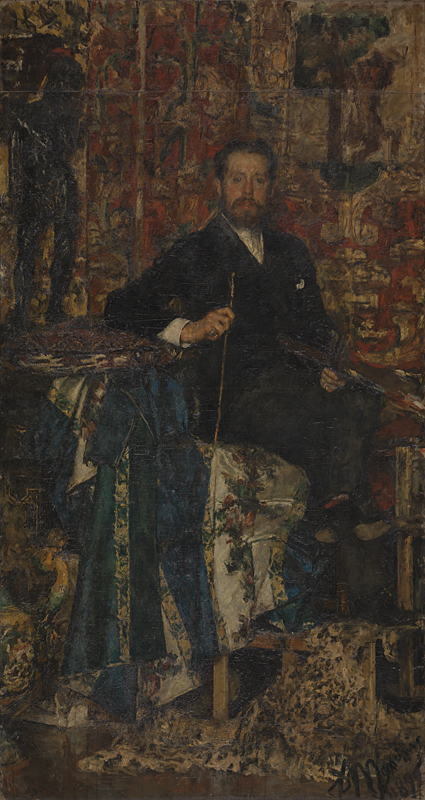
The physical substance of pigment became an increasingly prominent feature of Mancini’s painting. Smooth passages could coexist with thick accumulations of colour projecting from the surface. The technical investigations by Frezzato, Poldi and Amadori document changes in the thickness and construction of his paint layers, particularly from the 1880s onwards. His palette was already substantially established during the 1870s, but the ways in which he applied and combined his materials continued to change. Virno records his particular interest in the expressive possibilities of black, including its capacity to establish warm shadows and intensify adjacent colours. Discussing the Ritratto di Otto Messinger, the critic Ugo Fleres admired Mancini’s ability to employ extensive passages of black without sacrificing the brilliance of the surrounding colour.
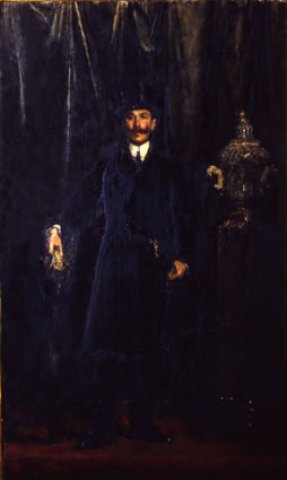
Mancini also introduced materials that were not conventionally part of oil painting. His relationship with the Dutch painter and collector Hendrik Willem Mesdag, who provided a comparatively regular market for his work, enabled him to undertake increasingly ambitious experiments. Glass, fragments of mirror, paper, fabric, lace and buttons could be incorporated into the paint itself. Mancini explained that, when seeking to reproduce the sparkling effect of white silk, he inserted a curved fragment of mirror at the point where the brightest highlight occurred. Frezzato, Poldi and Amadori identify the incorporation of silvered and gilded papers, glass and mother-of-pearl as particularly striking features of his technique. These materials extended the means through which he could represent light and texture, while giving the painted surface an increasingly pronounced physical presence.
The expenditure of paint could be extraordinary. During Mancini’s visit to Dublin in 1907, Hugh Lane supplied his artistic materials, and Lady Gregory recalled Lane’s alarm at the quantities consumed. According to her account, Lane occasionally scraped surplus pigment from Mancini’s pictures in his absence, returning it to the palette in the hope that it might be used again. During the years at Frascati, from 1911 to 1917, when the collector Du Chêne de Vère supplied canvases, colours, models and other materials, Mancini’s experimentation became especially extensive. His procedures included painting with his fingers and incorporating a widening variety of substances into the surface.
Mancini’s handling attracted admiration and bewilderment among his contemporaries. The visible impressions of the graticola, the density of the impasto and the inclusion of unexpected materials exposed aspects of the painter’s working process that more conventional techniques might conceal. His pursuit of pictorial truth nevertheless remained closely tied to the observation of colour and light. Paint could imitate the appearance of an object, but its thickness, texture and reflective properties could also contribute directly to the effect he sought.
Self-Portraiture and Artistic Identity
Self-portraiture occupied Mancini throughout much of his career, providing opportunities to experiment with pictorial technique, explore changes in his appearance and present himself in relation to his profession. Cinzia Virno has described the succession of self-portraits as an autobiografia di stati psichici in pittura, an autobiography of psychological states expressed through painting. Their character varied considerably, from the troubled images of his early adulthood to the more playful and confident representations of his later years. Several also incorporate works of art, painting implements or inscriptions, making his artistic identity part of the subject.
An early example is Autoritratto nello studio, also known as Doppio autoritratto (1878), now in the Galleria d’Arte Moderna di Palazzo Pitti, Florence. The small panel is divided into two contrasting compositions, resembling a diptych. On the left, Mancini represents himself in a brightly illuminated studio surrounded by fragments of sculpture and graphic studies. On the right, he appears in profile against a dark background, holding a plate of fruit. Virno identifies a deliberate reference to Caravaggio in the latter image, particularly in the treatment of illumination and the presentation of the fruit. The two representations bring together the painter’s working environment and his engagement with an earlier pictorial tradition.
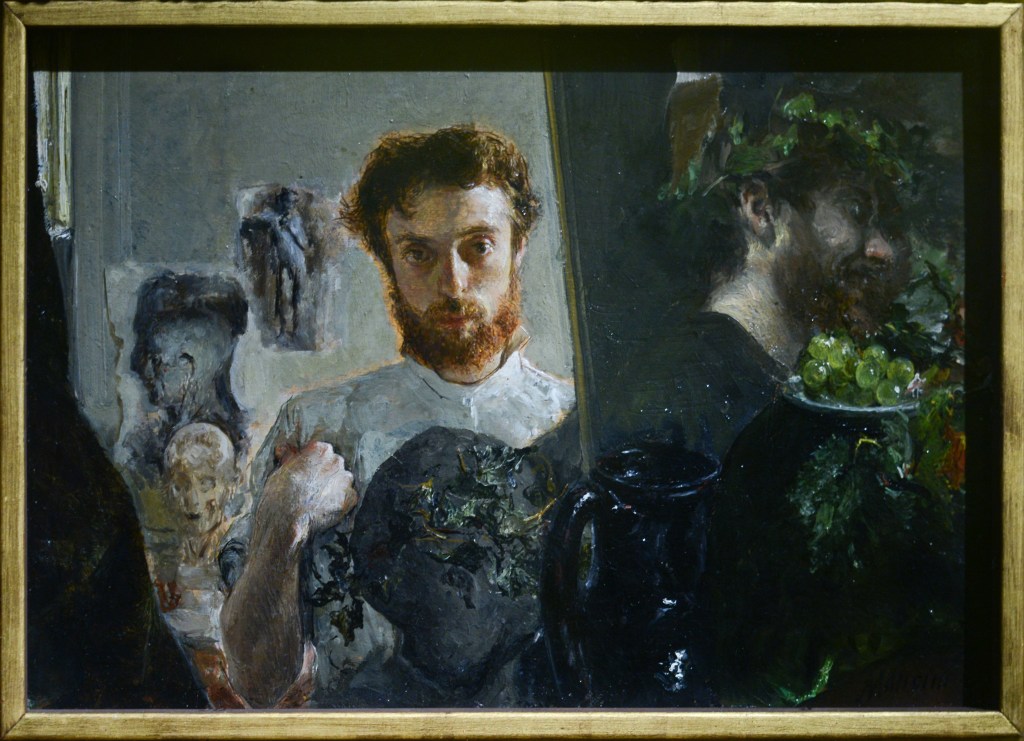
Another statement of artistic interests appears in Autoritratto con filo di paglia, dated by Virno to around 1880. Here, in the image behind Mancini, she identifies several works of art and representations of figures important to his intellectual and artistic formation. These include a portrait of Alessandro Manzoni, a miniature depiction of Vincenzo Gemito’s bust of Mariano Fortuny, and an image of Domenico Morelli as the dead Christ. Mancini also holds another small painting, possibly a view of the Villa Comunale in Naples that he had painted around the same period. Virno suggests that the brush accompanying the little picture may emphasise his authorship. Although some of these identifications remain tentative, the accumulation of references gives the self-portrait a distinctly autobiographical character, encompassing literature, sculpture, painting and personal artistic relationships.
Autoritratto con filo di paglia in bocca (5th image)
The painting belongs to the years preceding Mancini’s hospitalisation in Naples from November 1881 to February 1882. During this period of psychological disturbance he produced numerous self-portraits, often in restricted colours and with exaggerated or unsettling expressions. Some carried inscriptions relating to his distress. Virno records that Mancini continued to draw and paint during his confinement, when his own reflection provided a readily available subject alongside the hospital’s doctors and attendants. In Autoritratto con piatto (1882–83), he presents one of the decorated ceramic plates that he produced and sometimes exchanged for meals. The plate bears a painted head, making the image another representation of the artist displaying his own work. Virno associates the portrait’s expression with the earlier troubled self-portraits, while drawing attention to the accomplishment of its economical brushwork.
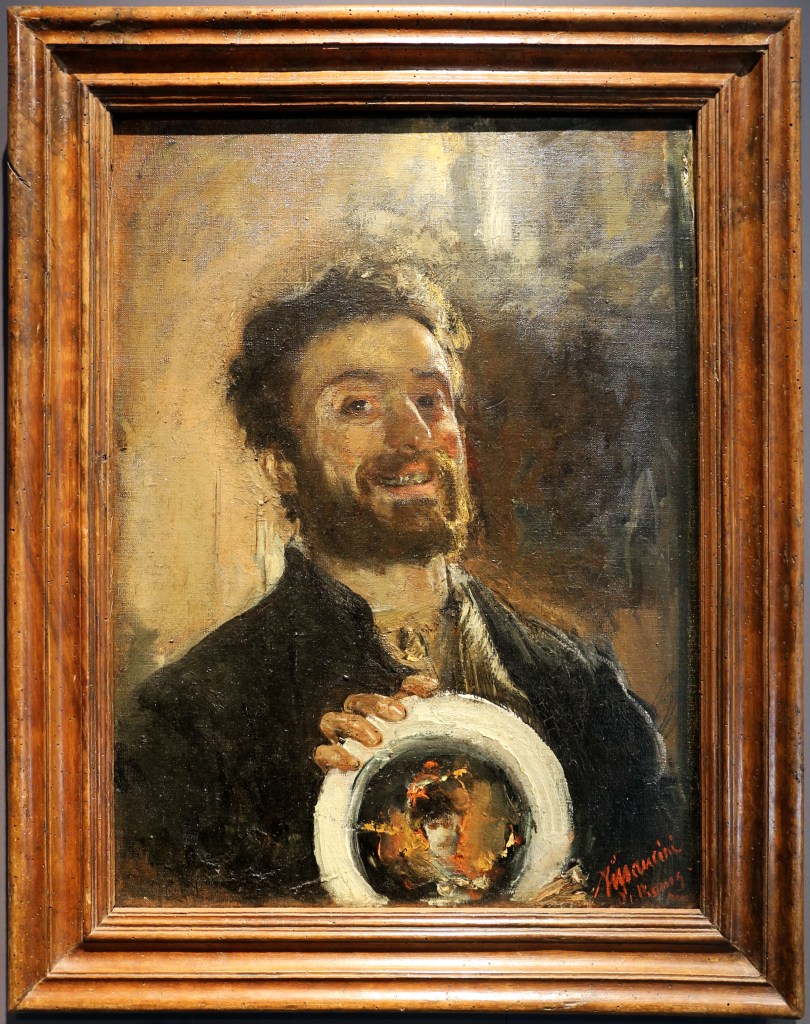
After the 1880s, Mancini’s production of self-portraits became less continuous as he increasingly undertook commissioned portraits. His international reputation and growing financial security were accompanied by changes in his presentation of himself. In the 1920s he frequently adopted the familiar attributes of the painter, appearing with brushes, palette or canvas, sometimes smiling broadly. Elsewhere he assumed theatrical identities through costume, representing himself as a soldier, pilot or historical warrior. Virno contrasts the professional confidence of many of these later images with the distress expressed in the self-portraits of his earlier years.
Among his most unusual experiments is Autoritratto sullo specchio, painted during the Frascati period. Mancini used a mirror as the support, placing his painted likeness in a relatively small area at the lower right while leaving much of the reflective surface exposed. Virno emphasises the playful character of the invention, in which the spectator and the surrounding environment can enter the composition through their reflections. The work also relates to Mancini’s wider experiments with mirrors and reflective materials, although here the mirror becomes the support for the image itself. The relationship between painted representation and the physical object acquires a particularly direct form.
View Autoritratto allo specchio (1915–17), illustrated in Cinzia Virno’s article in About Art Online (fig. 40).
Mancini returned to self-portraiture in 1929, the year before his death, with two markedly different paintings. In Autoritratto con turbante rosso, also known as Autoritratto in extremis, he concentrated upon his aged appearance, using broad handling and a dark background. Virno reproduces later critical comparisons with Rembrandt, although these belong to the painting’s reception rather than establishing a particular work by Rembrandt as Mancini’s source. The image presents an elderly painter confronting the physical signs of age, in contrast to the more expansive professional self-representations of the preceding decade.
In Autoritratto-biografia (1929), Mancini combined his likeness with an extensive handwritten account of his life. Executed in his studio in Via delle Terme Deciane, Rome, the painting places the aged artist at the lower right of a canvas largely occupied by inscriptions. Among the people named are Domenico Morelli, Filippo Palizzi, Vincenzo Gemito, Edgar Degas, John Singer Sargent, Lady Gregory and Otto Messinger, together with members of Mancini’s family. The writing also recalls places associated with his career, including Naples, Rome, Paris, London and Dublin.
See Cinzia Virno’s article on Autoritratto-biografia, illustrated in About Art Online.
Virno reproduces documentation in which Mancini describes himself indicating the inscriptions with one hand while holding his painter’s tools with the other. The written account is therefore accompanied by an image of its author explicitly identifying himself through his profession. Dario Cecchi, whose response Virno records, recognised that the inscriptions were integral to the composition rather than supplementary biographical information. Mancini’s professional relationships, travels and personal history occupy the same pictorial field as his self-portrait.
The arrangement invites comparison with Autoritratto sullo specchio. In the earlier work, the unpainted mirror admits the spectator’s reflection into the image; in Autoritratto-biografia, the surrounding space is filled with Mancini’s own recollections. The latter is an exceptionally personal work, but its written record also returns us to the artistic culture that occupied him throughout his life. The painter who had studied the works of Titian, Caravaggio and Velázquez, cultivated relationships with contemporary artists and continually experimented with the materials of painting now assembled the people and experiences of his career around his own image, incorporating the history of his profession into the final account of himself.
Producing these essays requires care, time, research, and resources. Contributions to help sustain this exploration would be greatly appreciated.
Donate to Inner Surfaces here.
Bibliography
I consulted these sources. Any errors are mine.
Carrera, Manuel, Fernando Mazzocca, Carlo Sisi and Isabella Valente (eds), Antonio Mancini e Vincenzo Gemito, Cinisello Balsamo: Silvana Editoriale, 2023.
Frezzato, Fabio, Gianluca Poldi and Maria Letizia Amadori, ‘Antonio Mancini. Evoluzione tecnica di un realista visionario’, in Teresa Perusini (ed.), Tecnica della pittura in Italia fra Ottocento e Novecento, Padua: Sargon Editore, 2021, pp. 37–58.
Hiesinger, Ulrich W., Antonio Mancini: Nineteenth-Century Italian Master, Philadelphia: Philadelphia Museum of Art, in association with Yale University Press, 2007.
Virno, Cinzia, Antonio Mancini: Catalogo ragionato dell’opera, 2 vols, Rome: De Luca Editori d’Arte, 2019.
Virno, Cinzia, ‘L’evoluzione artistica: tecnica, modelli, soggetti’, in Antonio Mancini: Catalogo ragionato dell’opera, 2 vols, Rome: De Luca Editori d’Arte, 2019, vol. 1, pp. 1–31.
Virno, Cinzia, ‘Va all’asta “Autoritratto biografia”, l’opera più “iconica” di Antonio Mancini (che dovrebbe essere acquistata dallo Stato)’, About Art Online, 1 December 2024.
Virno, Cinzia, ‘“Antonio Mancini (1852–1930). Il successo internazionale e i suoi mecenati”: la vita e l’opera del grande Maestro in un evento on line alla Galleria Berardi’, About Art Online, 13 September 2026.

