From Piedmont to Rome
Giovanni Battista Beinaschi was born in Fossano, Piedmont, in 1636. His earliest years are imperfectly documented, although Bernardo de’ Dominici, writing in the eighteenth century, records that he initially studied with the portraitist known as Monsù Esprit Grandjean, who was active in Turin during the 1640s. According to the same biographer, the young painter also benefited from the protection of Christina of France, Duchess of Savoy. By about 1651, Beinaschi had travelled to Rome, where he continued his education under Pietro del Po, a painter and engraver who had himself studied with Domenichino and Giovanni Lanfranco.
Beinaschi arrived in a city whose artistic character had been transformed by the achievements of the Carracci and their successors. Annibale Carracci’s frescoes in the Farnese Gallery were among the works he studied, while Domenichino’s carefully organised compositions provided another important example. Through Pietro del Po, Beinaschi encountered an artistic inheritance in which drawing, the construction of the human figure and the intelligible arrangement of complex narratives remained fundamental.
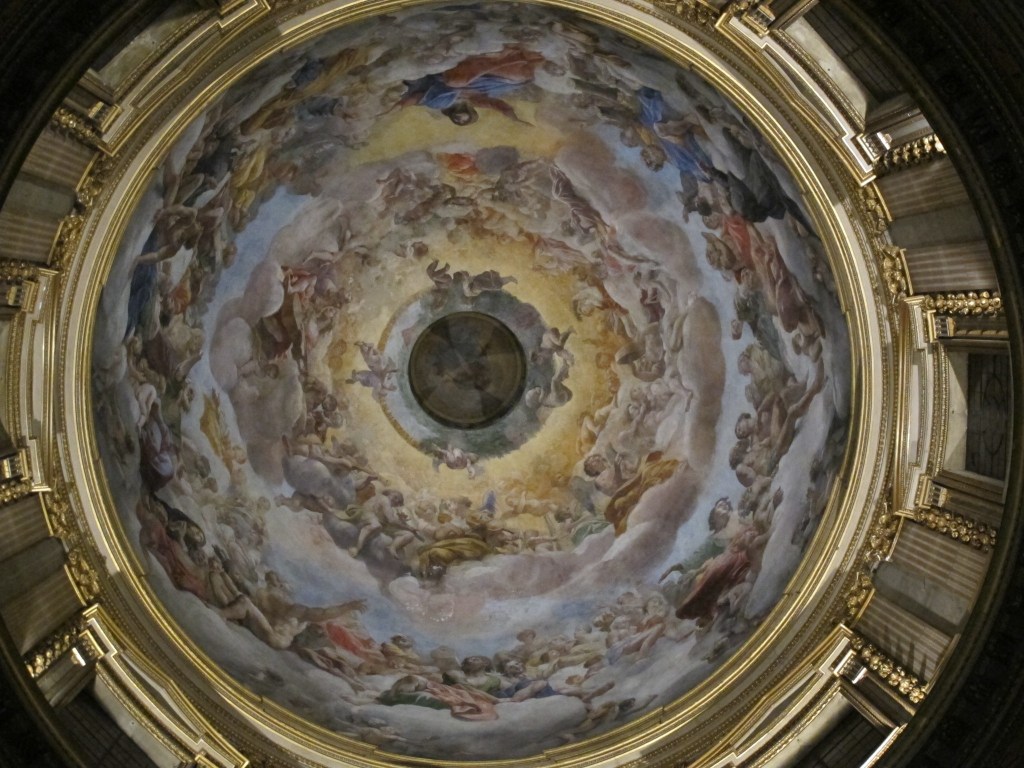
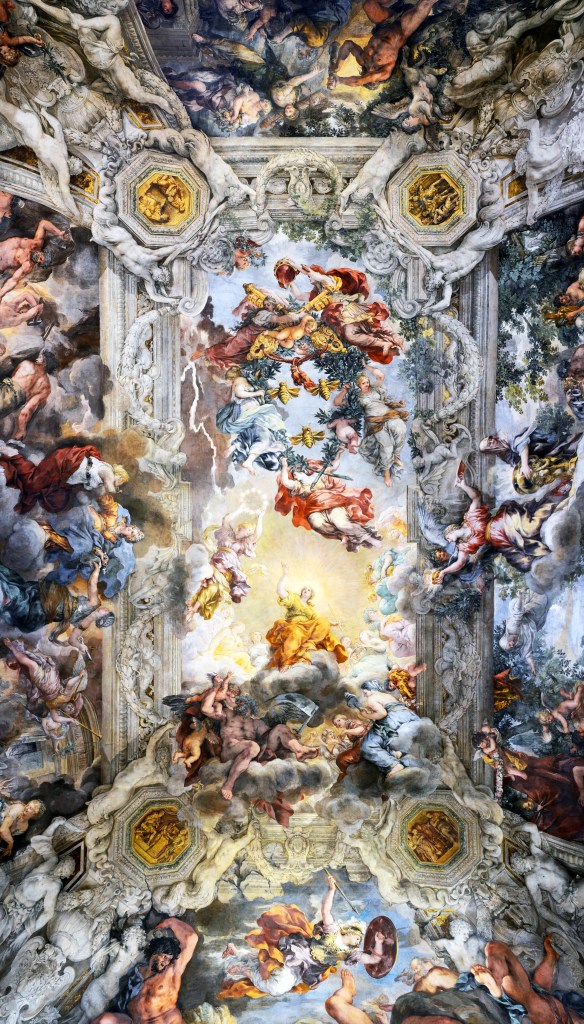
The influence of Lanfranco was still more pronounced. Although Lanfranco had died in 1647, his decorations in Sant’Andrea della Valle and San Carlo ai Catinari remained among the most ambitious achievements of Roman fresco painting. Their expansive compositions, populated by figures seen in daring foreshortening, offered Beinaschi an example of how painting could transform the apparent boundaries of architectural space. De’ Dominici subsequently described him as Lanfranco’s pupil, despite the chronological impossibility of such an apprenticeship. The association was nevertheless understandable, given Beinaschi’s sustained attachment to his predecessor’s manner. De’ Dominici also recounts a journey to Parma to study Correggio’s celebrated cupolas, although independent documentary confirmation of the visit is lacking.
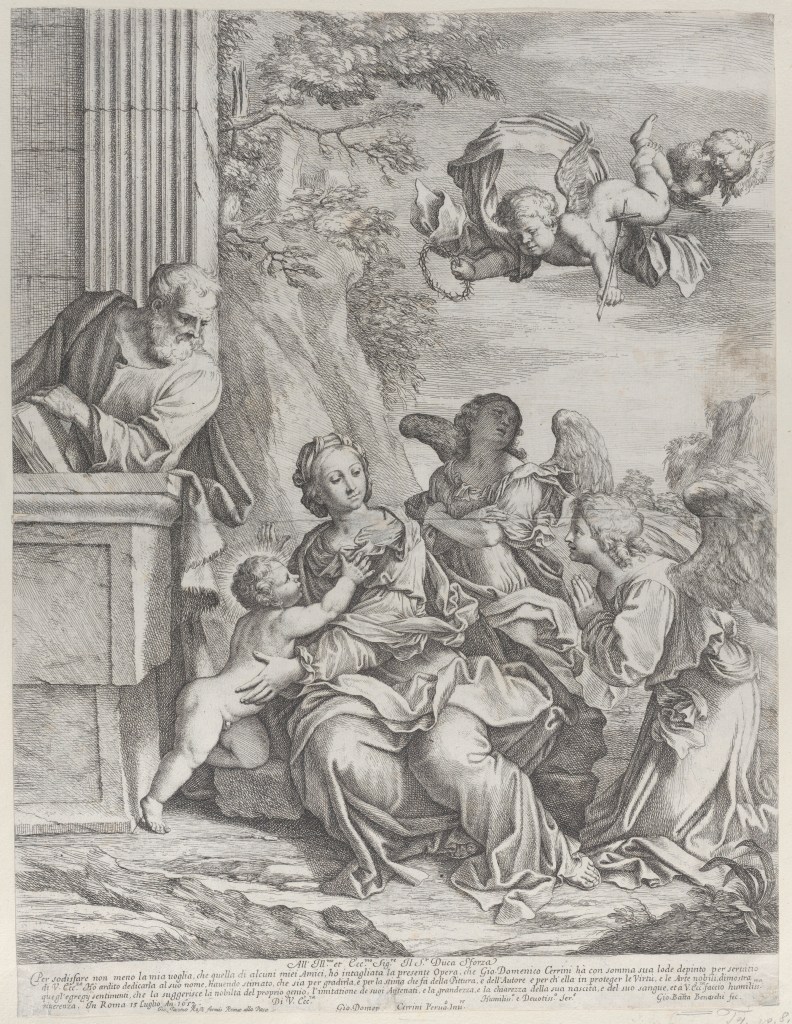
Beinaschi’s early interests were not confined to monumental decoration. An engraving of 1652 after Gian Domenico Cerrini’s Rest on the Flight into Egypt, dedicated to Duke Sforza, provides firm evidence of his engagement with another contemporary Roman painter. Mario Alberto Pavone has emphasised Cerrini’s importance in Beinaschi’s formation, especially the combination of expressive lighting with substantial, clearly articulated figures. Drawing was central to his education, and the numerous studies associated with his subsequent career testify to the continuing importance he attached to graphic invention.
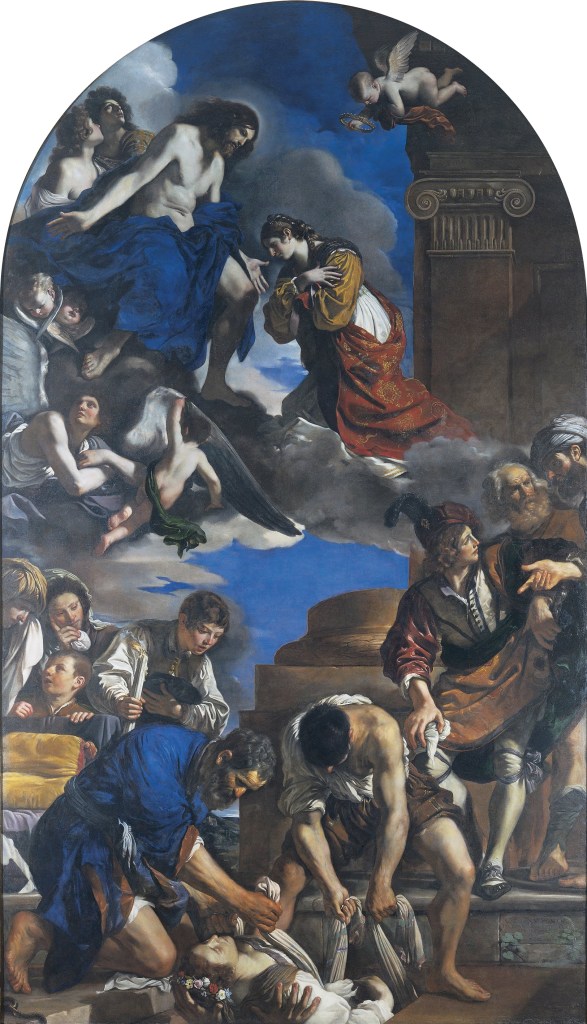
Pavone has also identified Guercino as an important source for Beinaschi’s treatment of the human figure. Guercino’s biblical and religious paintings offered models of powerful characterisation in which carefully modulated light gave substance to bodies and expressive force to gesture. Among the works Pavone considers significant is the Burial of Saint Petronilla, now in the Capitoline Museums, Rome, together with Guercino’s numerous representations of elderly men, saints and biblical protagonists. This inheritance offered Beinaschi possibilities distinct from Lanfranco’s expansive decorative manner, especially in the treatment of individual figures within dramatic narratives.
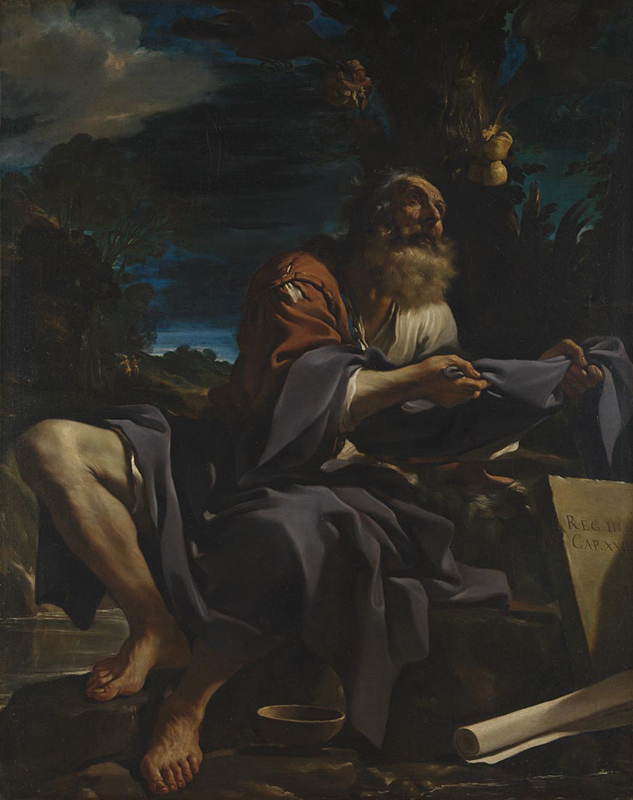
Elijah fed by Ravens
1620
Oil on canvas, 195 x 156.5 cm
Bought, 2009
NG6612
https://www.nationalgallery.org.uk/paintings/NG6612
Beinaschi’s early artistic interests were thus shaped principally by the Emilian painters, especially Carracci, Domenichino, Lanfranco and Guercino. Pietro da Cortona’s example became increasingly important in his subsequent work, notably in the treatment of movement and crowded compositions.
Among the relatively few mythological canvases associated with Beinaschi is Venus and Adonis, a large painting generally dated to around 1660–65. Known through earlier scholarship, it reappeared on the art market in 2025 after several decades during which its whereabouts had been uncertain. Drawn from Ovid’s Metamorphoses, the subject offered an opportunity for the treatment of the human figure outside the devotional and ecclesiastical contexts that would dominate much of Beinaschi’s subsequent production. The painting has been related to the example of Lanfranco and Guercino, while its pronounced contrasts of light and shadow also suggest affinities with the naturalistic tendencies of southern Italian painting.
Beinaschi Venus and Adonis – Wannenes Lot 188
Around 1663–64, Beinaschi moved to Naples, where substantial opportunities for fresco decoration coincided with an artistic environment shaped by the legacy of Jusepe de Ribera and the increasingly influential work of Mattia Preti and Luca Giordano.
Naples: Naturalism and Monumental Ambition
Naples had suffered the devastating plague of 1656, but major ecclesiastical commissions continued to attract painters and provide opportunities for ambitious decorative programmes. The naturalism associated with Jusepe de Ribera remained an important presence, while Mattia Preti, who had worked extensively in Naples during the 1650s, had brought a new dramatic intensity to religious painting. Luca Giordano, meanwhile, was developing a remarkably versatile manner that drew upon both Venetian colourism and the Neapolitan tradition. Beinaschi entered this environment with a firm grounding in Roman painting and an established command of drawing.
His first documented Neapolitan commission was a cycle illustrating the life of Saint Nicholas in the church of San Nicola alla Dogana, completed in December 1664. Although the frescoes have been destroyed, preparatory drawings associated with the project survive in several collections, including the Louvre, the Albertina in Vienna and Düsseldorf. Fausta Navarro draws attention to their rapid, fluent handling, which gives some indication of Beinaschi’s approach to designing extensive narrative decorations. Further commissions followed in the later 1660s, among them the Cappella Seripando at Santi Apostoli and the Cappella Venata d’Aquino at Santa Maria la Nova.
The encounter with Neapolitan painting is especially apparent in the Martyrdom of Saint Erasmus, a large canvas measuring 202 × 280 cm, now in the Museo Diocesano at Salerno. Formerly associated with the collection of the Marchese Ruggi d’Aragona, it was donated to Salerno Cathedral in 1873 and attributed to Beinaschi by Raffaello Causa. Nicola Spinosa dates the work shortly after 1666, identifying connections with Giacinto Brandi’s Crucifixion at Gaeta, which itself recalls Nicolas Poussin’s celebrated Martyrdom of Saint Erasmus in Rome.
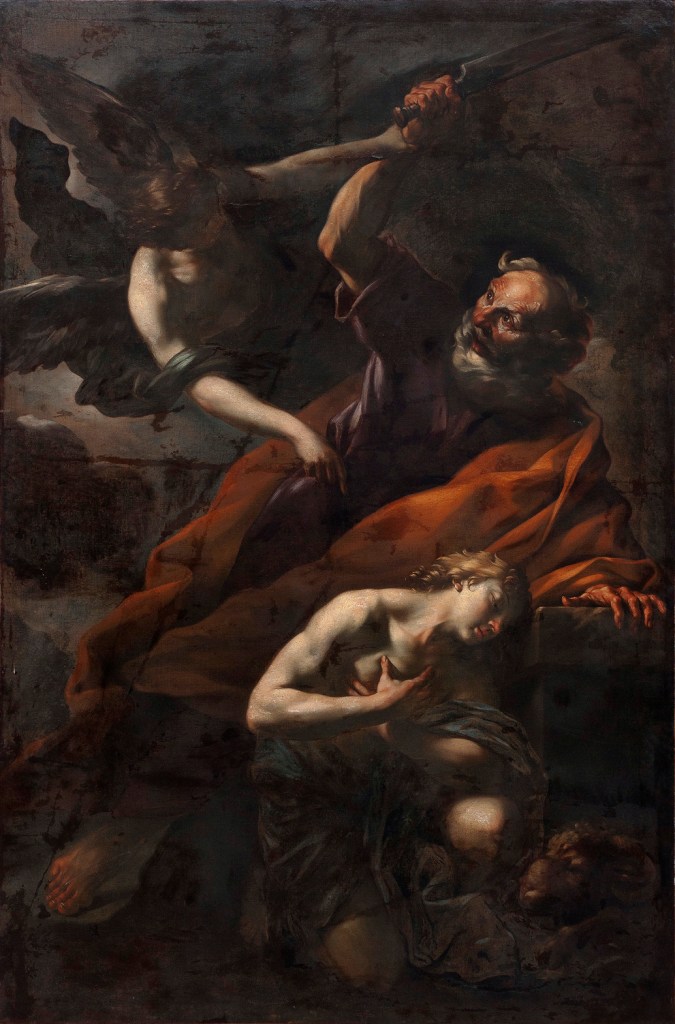
Fausta Navarro places greater emphasis on Mattia Preti’s influence. The painting’s forceful contrasts of illumination, vigorous treatment of the human figure and broad handling of paint recall the dramatic religious compositions Preti had produced in Naples. Navarro describes an execution approaching that of an enlarged oil sketch, in which the immediacy of the handling contributes to the violence of the episode. Spinosa similarly recognises the impact of Neapolitan naturalism, although he also identifies the continued importance of Beinaschi’s Roman models. Another canvas, The Sacrifice of Abraham, now in the Musée des Beaux-Arts at Brest, belongs to the same broad field of expressive biblical painting. Patricia Rubens associates its powerful chiaroscuro and treatment of bodily emotion with the example of Preti.
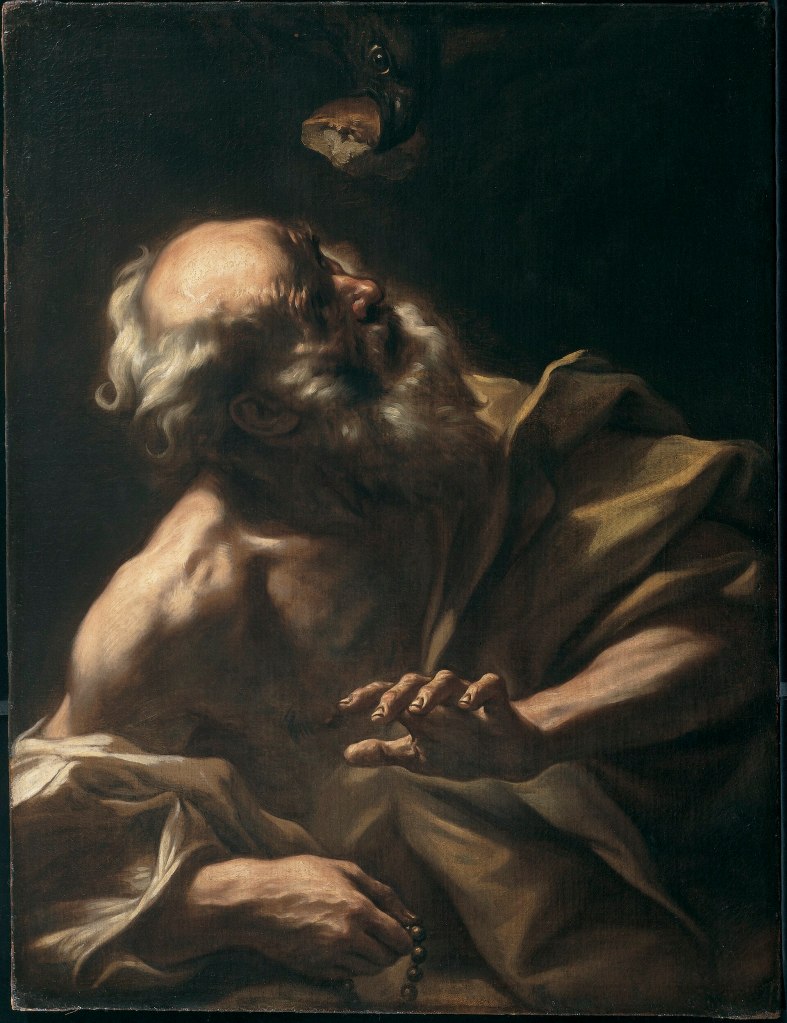
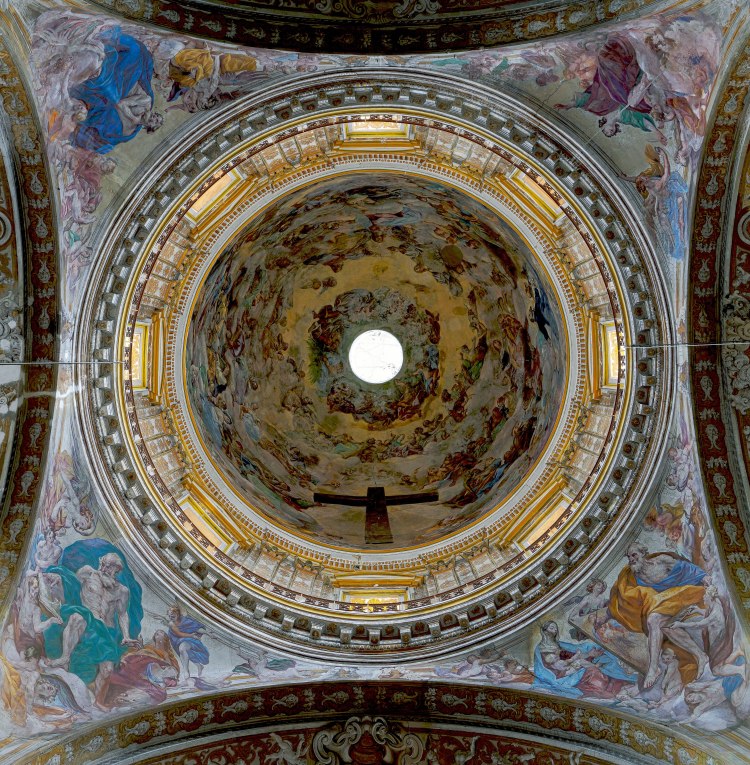
Another painting associated with Beinaschi’s early Neapolitan years is Saint Paul the Hermit, dated to around 1665 and now in the Hood Museum of Art, Dartmouth College.
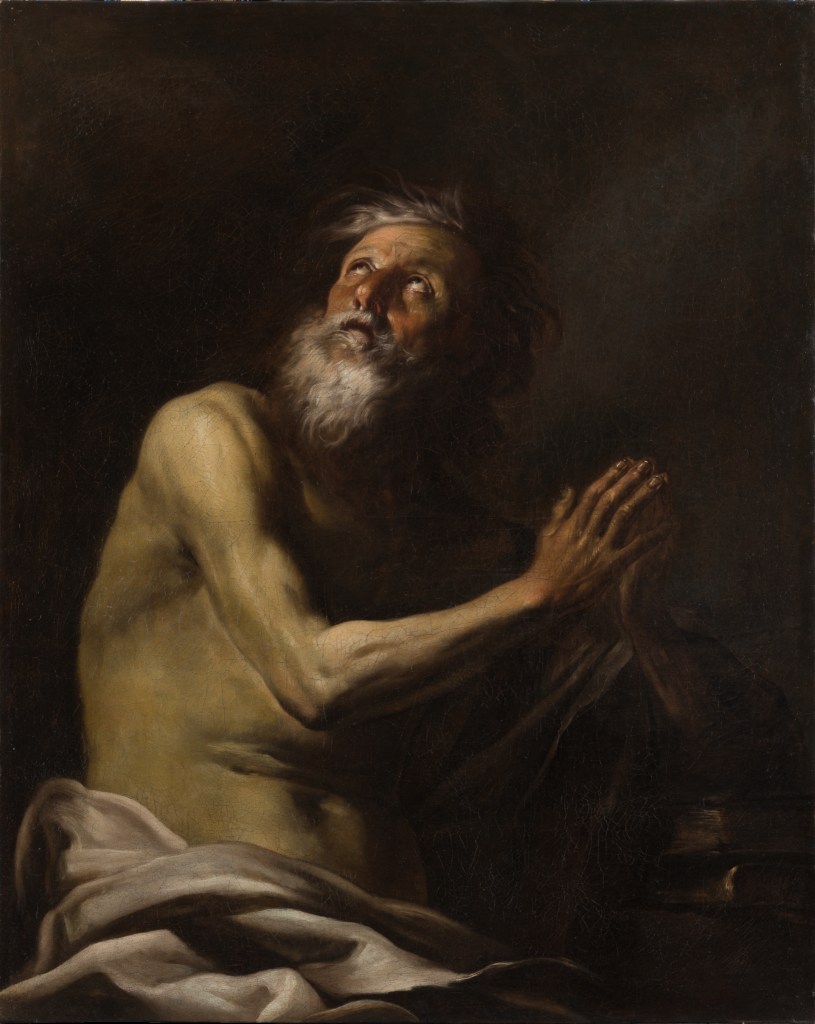
The demands of monumental decoration occupied an increasing proportion of Beinaschi’s activity. Between 1668 and 1673 he undertook substantial work at Santa Maria degli Angeli a Pizzofalcone, a church whose decorative programme would engage him again in subsequent years. His contributions eventually extended across the vaults, transept walls, counter-façade, tribune, pendentives and cupola. Francesco Petrucci has emphasised the importance of this enterprise in establishing a form of monumental Baroque painting in Naples that could build upon Lanfranco’s achievements while responding to the city’s more recent artistic developments.
A canvas of Saint John the Baptist Preaching, rediscovered and discussed by Petrucci in 2025, provides an instructive connection with the Pizzofalcone frescoes. Dated approximately 1668–73, it corresponds to a composition on the right transept wall. Petrucci suggests that it may have served either as a preparatory model or as a painted record of the completed fresco. Its precise function has not been established, but the relationship between the two works supplies evidence of the close interaction between Beinaschi’s practice as a painter of canvases and his activity as a monumental decorator.
Saint John the Baptist Preaching, illustrated in the Dorotheum auction catalogue (2024).
Among his most ambitious independent paintings from the period is Joshua Halting the Sun, now in the Musée d’arts de Nantes. The elongated canvas, approximately 132 × 269 cm, illustrates the episode in the Book of Joshua in which the Israelite leader commands the sun and moon to stand still while his forces pursue their enemies. The painting belonged to the collection of François Cacault, which was acquired by the municipality of Nantes in 1810. Formerly attributed to Pietro da Cortona, it was restored to Beinaschi by Roberto Longhi.
Giovanni Battista Beinaschi, Joshua Halting the Sun, oil on canvas, Musée d’arts de Nantes.
Patricia Rubens places Joshua Halting the Sun within the tradition of seventeenth-century Roman battle painting, drawing comparisons with Poussin and Cortona, including the latter’s Battle of Arbela and Victory of Joshua over the Amalekites. She emphasises the extraordinary concentration of figures and the physical violence of the encounter. Joshua’s commanding gesture invokes divine intervention, while the combatants are caught in a succession of forceful movements and contorted poses. Rubens observes that the apparent disorder is controlled by an underlying compositional structure, recalling the arrangement of figures in antique relief sculpture. She is less persuaded by the landscape at the left, which she considers inadequately integrated into the scene.
Spinosa extends the comparisons to the battle paintings of Jacques Courtois, known as Borgognone, and Salvator Rosa. Beinaschi’s familiarity with these painters helps situate the canvas within a wider tradition of military subjects, although Spinosa stresses the individuality of its composition. The combination of crowded action, emphatic diagonals and strongly modelled bodies demonstrates the painter’s ability to translate the movement associated with monumental decoration into the more restricted space of an easel painting.
Rubens also identifies a revealing correspondence between an agonised figure in the Nantes painting and Beinaschi’s Death of Abel, now in the Real Academia de Bellas Artes de San Fernando, Madrid. She relates the expressive treatment of dying bodies to developments in Neapolitan painting after the plague, particularly the works of Preti and Giordano devoted to the city’s suffering and deliverance. In Joshua, the subject’s military violence becomes an opportunity for the heightened physical expression that characterises so much of Beinaschi’s painting. Rubens assigns the canvas to the 1670s, during his first Neapolitan period.
By this time Beinaschi was receiving commissions from several of Naples’s religious institutions. His work at Santa Maria la Nova included the decoration of the Chapel of San Giovanni della Marca, where Navarro identifies further evidence of his engagement with Preti. The activity of the early 1670s was accompanied by continuing exchanges with Roman painting, and in the second half of the decade Beinaschi returned to Rome, where his association with Giacinto Brandi would acquire a more direct professional importance.
The Return to Rome
Beinaschi’s second period of activity in Rome, generally placed between about 1675 and 1680, brought him into renewed contact with Giacinto Brandi, whose painting had already contributed to his artistic development. The two artists shared an interest in emphatic figural expression and strongly contrasted illumination, although Brandi’s work was more closely associated with easel painting and altarpieces than with the extensive decorative programmes in which Beinaschi had distinguished himself.
Their professional relationship is documented in 1678, when Brandi commissioned Beinaschi to execute allegorical frescoes in the church of Santi Ambrogio e Carlo al Corso, usually known as San Carlo al Corso. Representing virtues including Religion, Fortitude, Purity and Chastity, the frescoes formed part of the church’s extensive decorative programme. A final payment was recorded on 15 October of that year.
Another significant undertaking was the decoration of San Bonaventura al Palatino, where Beinaschi supplied paintings including an Annunciation, a Crucifixion and Saint Michael the Archangel. Mario Alberto Pavone dates the principal canvases to shortly after 1677, linking them with the establishment of the Spanish Reformed Franciscans at the convent. He identifies a more concentrated treatment of light and a greater solidity in the construction of figures, qualities he relates to Beinaschi’s renewed encounter with Brandi. The Annunciation is especially important in Pavone’s account of this period, demonstrating the painter’s interest in combining substantial bodily forms with a more controlled distribution of illumination.
The decoration of San Bonaventura also provides an early indication of the activity of Beinaschi’s daughter, Angela Maria, who was born in 1666 and subsequently worked as a painter and draughtswoman. A Deposition in the church bears her signature, and the possibility of her participation in other works associated with her father has attracted scholarly attention. Her contribution to the family workshop would become more significant as Beinaschi’s commissions multiplied.
At Santa Maria del Suffragio, Beinaschi undertook another group of paintings and decorations, including the Resurrection of Lazarus, Daniel in the Lions’ Den and frescoes in the vault of the apse. Pavone assigns these works to the second Roman residence, noting that the church was completed around 1675 and consecrated in 1680. He compares their treatment of the human figure with several canvases attributed to Beinaschi, identifying connections between the representation of Christ in the Resurrection of Lazarus and figures in Christ and the Adulteress.
The latter painting, a substantial canvas measuring approximately 155 × 210 cm and formerly in a private collection at Nocera Inferiore, has occasioned disagreement over its chronology. Pavone places it in the early 1680s, shortly after Beinaschi’s return to Naples from his second Roman residence, whereas Nicola Spinosa favours a date around 1670, during the painter’s first Neapolitan period. Its attribution also has a complicated history. Previously associated with Mattia Preti and Giacomo Farelli, the painting was recognised as Beinaschi’s by Raffaello Causa, an attribution also supported by Ferdinando Bologna.
Pavone’s analysis of Christ and the Adulteress is especially extensive. He identifies affinities with Guercino’s treatment of elderly figures, the expressive naturalism of Ribera and the strongly directed illumination associated with Preti. The treatment of the figures also invites comparison with Beinaschi’s Roman paintings, particularly those at Santa Maria del Suffragio. The different dates proposed by Pavone and Spinosa therefore reflect a genuine difficulty in distinguishing successive phases of the painter’s development. Although we need not resolve the disagreement, the painting provides evidence of the continuing relationships between works produced in Rome and Naples.
During these years Beinaschi also encountered the decorative innovations of Giovanni Battista Gaulli, known as Baciccio, whose work was transforming Roman fresco painting. Gaulli’s compositions, with their abundant figures, luminous colouring and dramatic effects of movement, offered possibilities that differed from the more forcefully outlined forms characteristic of Beinaschi’s earlier paintings. Pavone regards the experience of Gaulli’s work as an important element in Beinaschi’s subsequent development, especially in the greater mobility of colour and illumination that emerged in his later Neapolitan decorations.
His Roman activity was not without opposition. According to the account transmitted by Lione Pascoli, Beinaschi encountered hostility from painters associated with the classicising circle of Carlo Maratti. Pavone considers that such opposition may have contributed to his decision to return to Naples, notwithstanding the favourable reception of his paintings at Santa Maria del Suffragio. The episode belongs to the biographical tradition and cannot be treated as a fully documented explanation of his departure. By about 1680, however, Beinaschi had resumed his Neapolitan career, taking up some of the largest decorative commissions of his life.
The Later Neapolitan Commissions
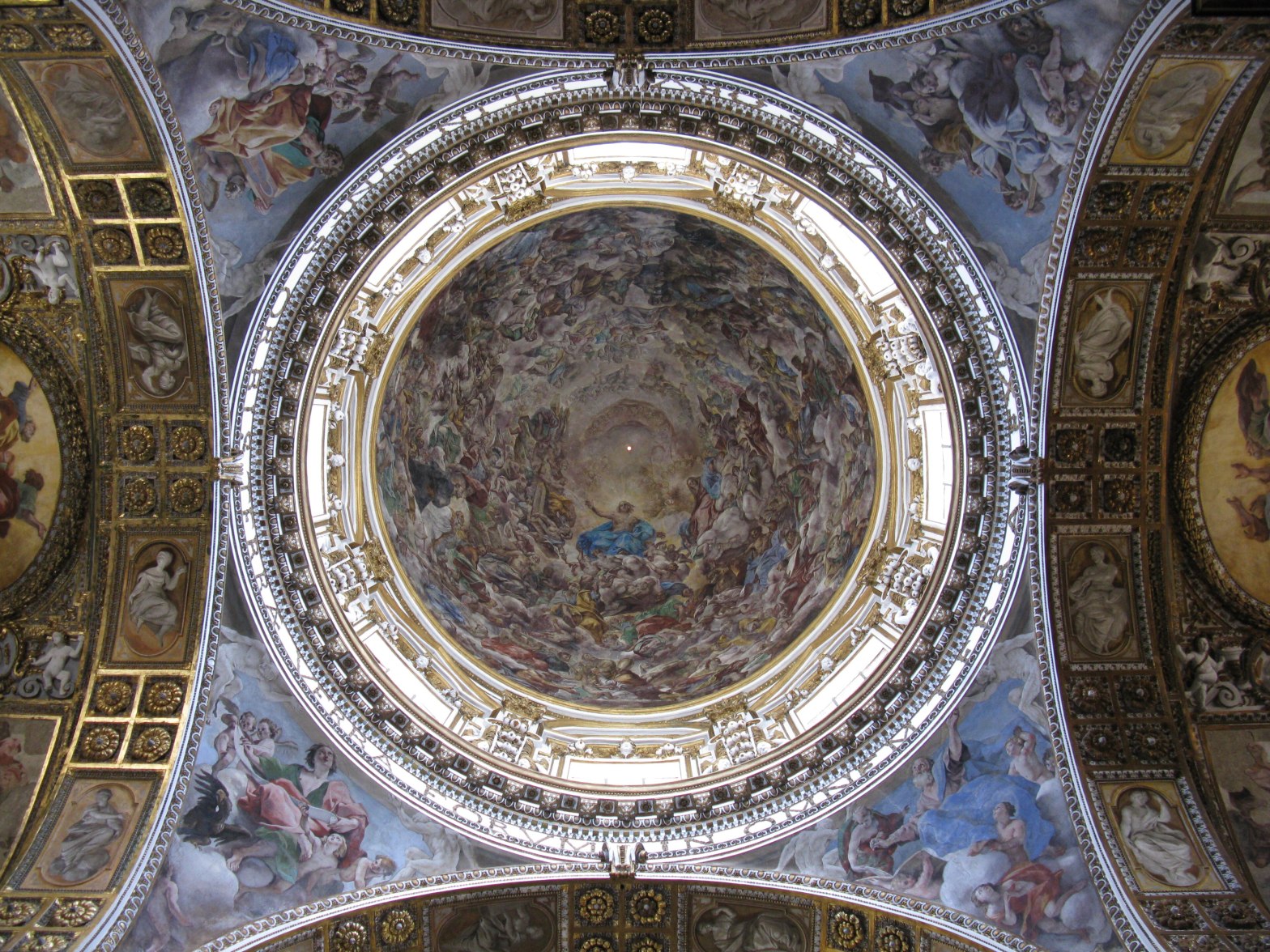
Around 1680, Beinaschi undertook the decoration of the cupola of Santi Apostoli, one of the most ambitious commissions of his career. The church had already been the setting for an extensive decorative programme by Giovanni Lanfranco, who left Naples in 1647 before completing the work. More than thirty years later, Beinaschi was entrusted with the unfinished portions, including the cupola and pendentives. According to Nicola Spinosa, he probably worked with reference to Lanfranco’s surviving designs and the requirements of the Theatine fathers, adapting an inherited scheme to the artistic circumstances of the 1680s.
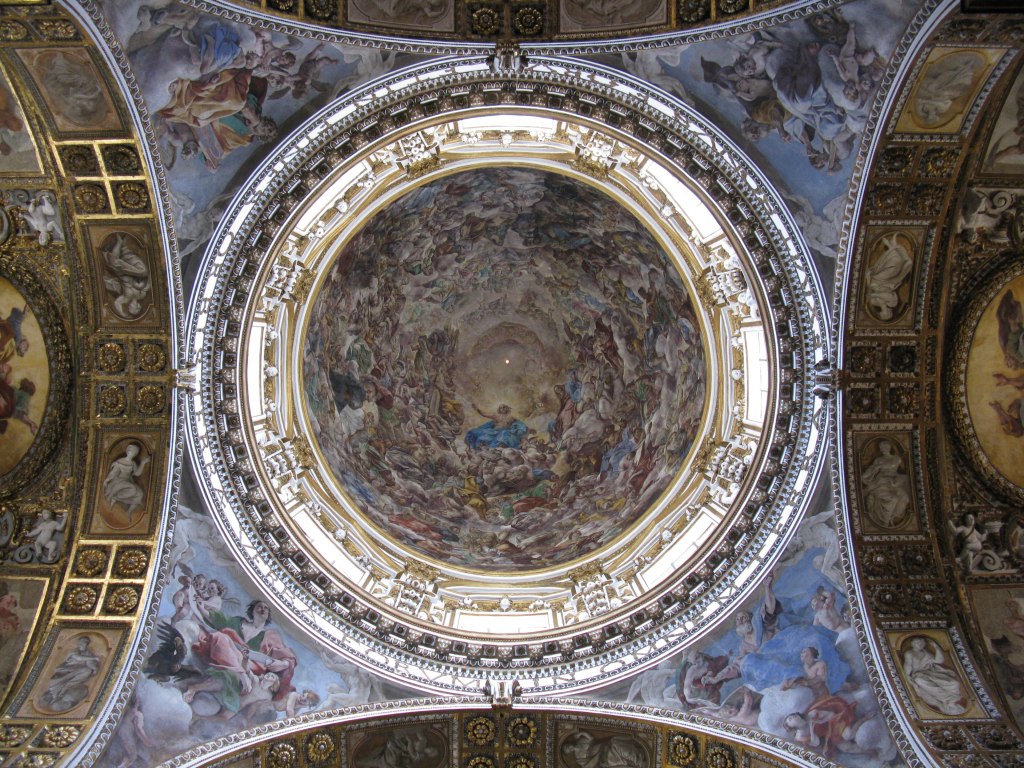
The resulting Paradise, executed around 1680–82, established Beinaschi’s command of large-scale illusionistic decoration. Its crowded assembly of heavenly figures required an organisation capable of accommodating individual groups within the continuous space of the cupola. Spinosa identifies a change in the painter’s handling of colour and light, with a richer palette and more luminous effects than in his earlier work. The example of Giovanni Battista Gaulli, encountered during the second Roman residence, had become important in this respect. Beinaschi’s more freely painted forms and expansive use of illumination modified the monumental conception he had inherited from Lanfranco.
The figure of God the Father recurs in Beinaschi’s paintings. A canvas sold at Sotheby’s in 2024, probably dating from his final years, has been related to Lanfranco’s treatment of the subject and to several other versions recorded in the Pacelli–Petrucci catalogue.
Giovanni Battista Beinaschi, God the Father, Sotheby’s, 10 April 2024, lot 23.
The commission also illuminates the extent of Beinaschi’s preparatory work. A drawing of Saint Stephen, discussed by Francesco Grisolia, has been identified as a study for the corresponding figure in the Paradise. Executed in black and white chalk on blue paper, it demonstrates the energetic construction of the figure through emphatic contours and the selective application of white heightening. Related drawings associated with the decoration survive at Windsor, Ottawa and Düsseldorf.
Research on the Düsseldorf collection has shown that Beinaschi generally prepared his compositions through successive stages, beginning with multi-figure sketches in wash and proceeding to more detailed studies of individual figures. The vigorous execution of his frescoes was thus preceded by a substantial process of graphic preparation. The participation of assistants, among them Orazio Frezza at Santi Apostoli, made the organisation of this work especially important.
Two canvases now in the Real Academia de Bellas Artes de San Fernando, Madrid, offer a different perspective on Beinaschi’s mature painting. The Death of Abel and Adam and Eve Mourning Abel, both approximately 116 cm square, belong to a group of compositions concerned with the earliest consequences of human violence. Although their precise dates are uncertain, Spinosa assigns them to the painter’s advanced maturity, noting their incisive treatment of the figures and comparatively restrained chiaroscuro. The paintings were already attributed to Beinaschi by 1819 and may originally have belonged to the Premonstratensian convent of San Norberto in Madrid, as suggested by Alfonso E. Pérez Sánchez.
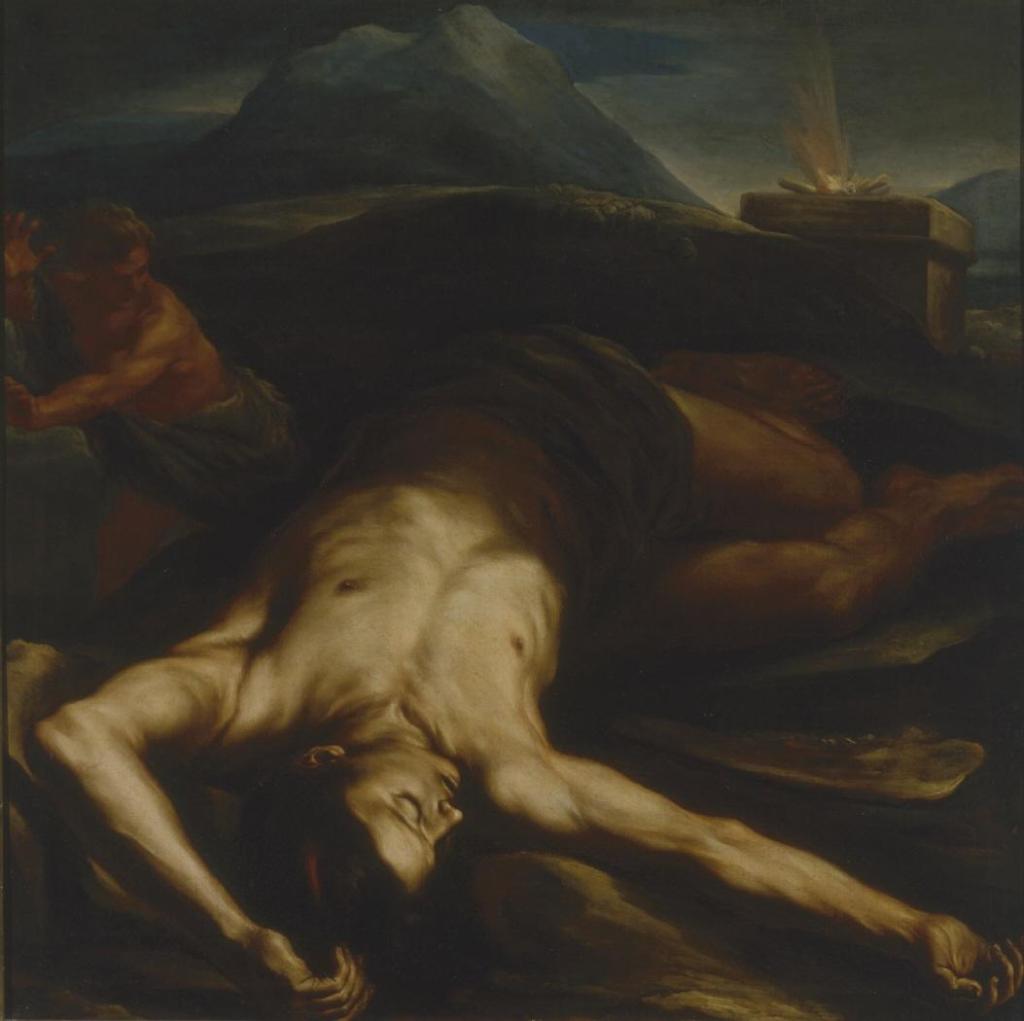
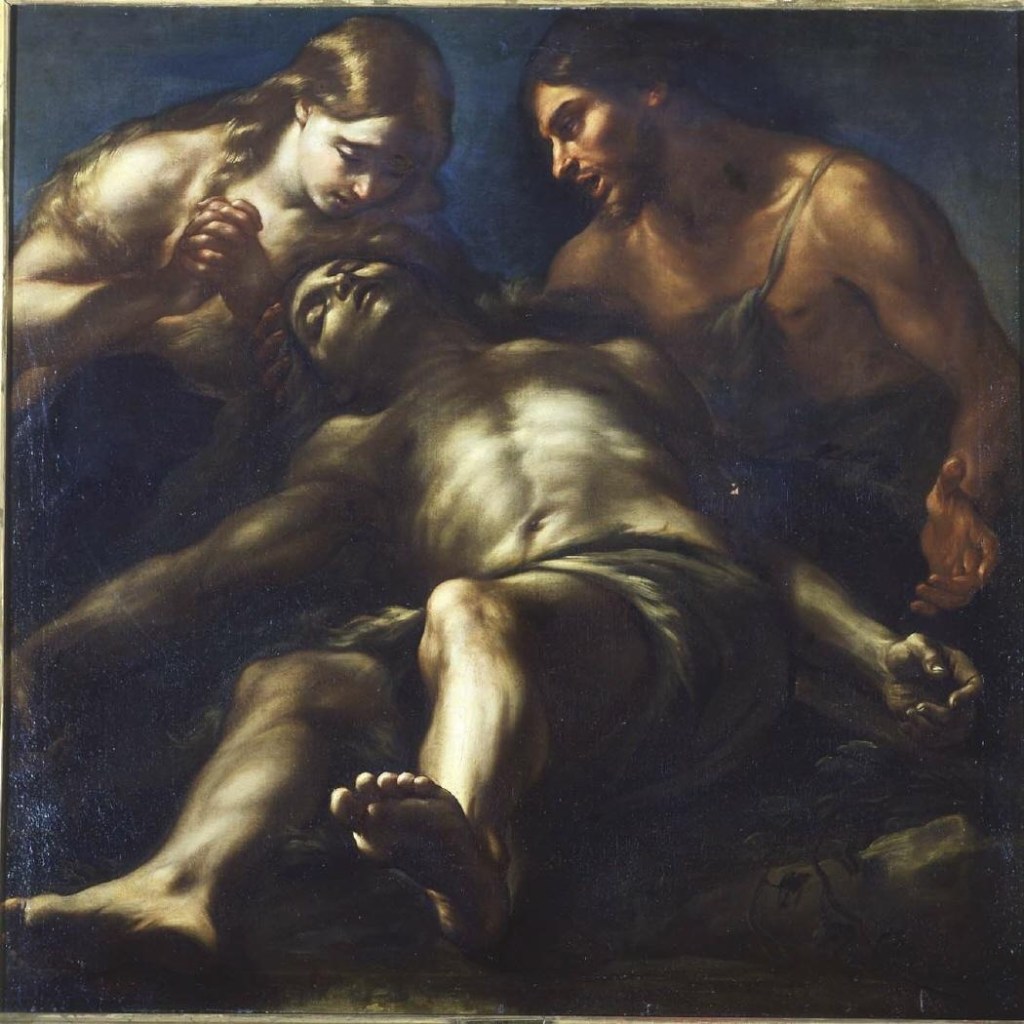
The two subjects are complementary. The death of Abel introduces the first murder into the biblical narrative, while the mourning of Adam and Eve concerns its consequences for the first human family. Their association allows Beinaschi’s interest in violent action and bodily expression to be considered alongside the representation of grief. As mentioned earlier, Patricia Rubens has compared an agonised figure in Joshua Halting the Sun with The Death of Abel, while Fausta Navarro identifies affinities between the Madrid paintings and the works associated with San Bonaventura al Palatino in Rome. The possible involvement of Angela Maria Beinaschi in Adam and Eve Mourning Abel has also been considered, although the extent of any collaboration remains uncertain.
Meanwhile, Beinaschi’s Neapolitan commissions continued to multiply. In 1681 he worked at the Girolamini, where frescoed figures of Mary Magdalene, Saint John the Baptist and Saint Augustine formed part of the church’s decoration. Further work followed at Santa Maria dei Miracoli, including scenes from the life of the Virgin, and at the Gesù Nuovo, where the decoration of the Chapel of the Crucifix is documented by a payment in April 1685. He also continued his extensive involvement at Santa Maria degli Angeli a Pizzofalcone, whose decorations had occupied him intermittently since the late 1660s.
The largest undertaking of these years was the decoration of Santa Maria delle Grazie a Caponapoli, carried out between approximately 1681 and 1686. The programme included extensive frescoes and large canvases, among them an Annunciation and a Visitation associated with the high altar. Spinosa also records a Madonna delle Grazie in Glory in the apse. In these works he recognises the increased luminosity and richness of colour characteristic of Beinaschi’s final period, together with the continuing importance of monumental figure construction.
The scale of the Caponapoli commission required the participation of assistants, including Orazio Frezza and Giuseppe Castellano. Spinosa suggests that Beinaschi may have maintained responsibility for the designs while entrusting substantial portions of their execution to collaborators. Angela Maria’s activity belongs within the same workshop environment. Recent research on the Düsseldorf collection has tentatively attributed more than sixty drawings to her, including studies copied after works by her father. If accepted, these attributions would considerably enlarge her surviving oeuvre and provide valuable evidence of artistic training and collaboration within the Beinaschi workshop.
Much of the decoration at Caponapoli has subsequently been destroyed or severely damaged. Francesco Petrucci, who visited the neglected church with Vincenzo Pacelli in 2010, recalls photographing Beinaschi’s funerary inscription there. The inscription records his death on 28 September 1688, preserving a tangible connection between the painter and the church that occupied so much of his final working life.
Donate to Inner Surfaces here.
Bibliography
These are the sources consulted. Any errors are mine.
Bean, Jacob, and Walter Vitzthum, ‘Disegni di Lanfranco e del Beinaschi’, Bollettino d’arte, 46 (1961), pp. 106–122.
De Dominici, Bernardo, Vite de’ pittori, scultori ed architetti napoletani, vol. III (Naples, 1844), pp. 534–539.
Ferrari, Oreste, ‘Beinaschi, Giovan Battista’, in Dizionario Biografico degli Italiani, vol. 8 (Rome, 1966), pp. 170–171.
Grisolia, Francesco, «Famoso disegnatore». I disegni di Giovan Battista Beinaschi nella collezione della Kunstakademie Düsseldorf al Kunstpalast (Petersberg: Michael Imhof Verlag, 2019).
Navarro, Fausta, catalogue entries 2.7–2.8, in Civiltà del Seicento a Napoli, exhibition catalogue (Naples: Electa Napoli, 1984), pp. 191–192.
Navarro, Fausta, ‘Giovan Battista Beinaschi’, in Mina Gregori and Erich Schleier (eds), La pittura in Italia: Il Seicento, vol. II (Milan: Electa, 1989), pp. 630–631.
Pacelli, Vincenzo, and Francesco Petrucci (eds), Giovan Battista Beinaschi: Pittore barocco tra Roma e Napoli (Rome: Andreina & Valneo Budai Editori, 2011).
Pascoli, Lione, Vite de’ pittori, scultori ed architetti moderni, vol. II (Rome, 1736), pp. 223–234.
Pavone, Mario Alberto, ‘Per Giovan Battista Beinaschi’, Prospettiva, 46 (July 1986), pp. 31–41.
Petrucci, Francesco, ‘Pittura barocca da Roma a Napoli, e viceversa’, in Francesco Petrucci (ed.), Genesi e divenire del Barocco tra Roma e Napoli: Dipinti da Palazzo Chigi in Ariccia e dalla collezione Koelliker, exhibition catalogue (Rome: De Luca Editori d’Arte, 2025), pp. 29–35.
Rubens, Patricia, ‘Giovanni Battista Beinaschi’, in Seicento: le siècle de Caravage dans les collections françaises, exhibition catalogue (Paris: Éditions de la Réunion des musées nationaux, 1988), pp. 128–129.
Spinosa, Nicola, Pittura del Seicento a Napoli: Da Mattia Preti a Luca Giordano. Natura in posa (Naples: Arte’m, 2011), pp. 146–155.
Tostmann, Oliver, review of Die Zeichnungen des Giovan Battista Beinaschi aus der Sammlung der Kunstakademie Düsseldorf am Kunstpalast, edited by Sonja Brink and Francesco Grisolia, The Burlington Magazine, 163 (June 2021), pp. 556–557.

