Alberti, Lucian and the Transformation of a Story
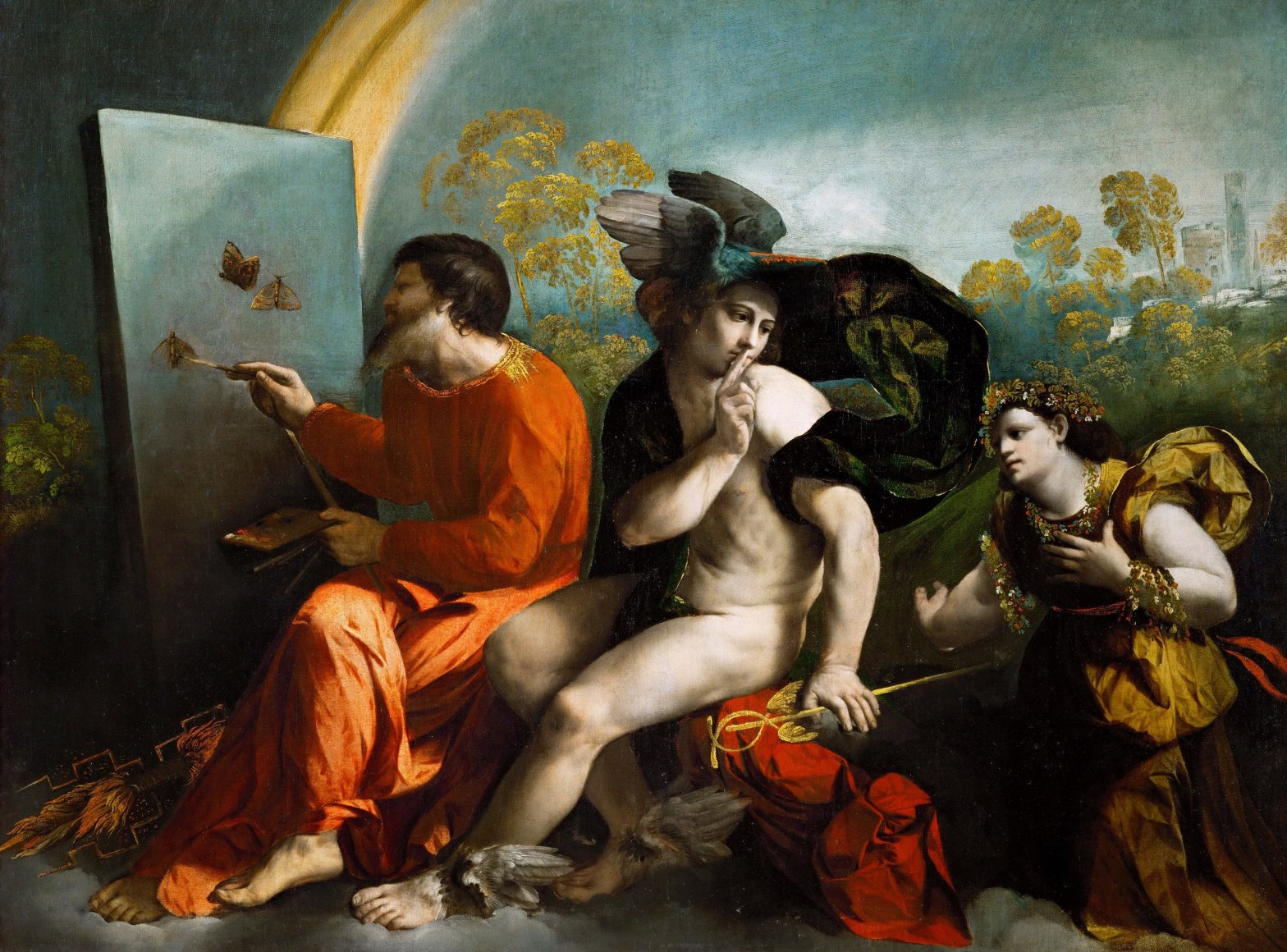
Dosso Dossi’s painting begins with an improbable occupation for the ruler of the gods. Jupiter sits before an easel, palette, brushes and mahlstick in hand, while butterflies appear on the blue surface before him. His thunderbolts lie unused at his feet. Mercury, seated beside him on the same bank of cloud, turns towards an approaching woman and raises a finger to his lips. She is richly dressed, crowned and garlanded with flowers. Behind them the landscape is caught in uncertain weather, with wind, changing light and an arc across the sky. The combination is sufficiently strange that the picture has generated more than a century of attempts to identify both its literary source and its precise subject.
The earliest interpretation to acquire lasting authority was proposed by Julius von Schlosser in 1900, following seventeenth-century descriptions by Marco Boschini and Giustiniano Martinioni. Both writers connected the picture with a dialogue then attributed to Lucian of Samosata. The text is in fact Leon Battista Alberti’s Virtus, one of the Intercenales, the short prose pieces he composed during the 1430s. The dialogue circulated under Lucian’s name and continued to be treated as a Lucianic work long after Dosso’s lifetime. The confusion is significant because the dialogue belongs to a Renaissance culture in which antique forms could be imitated, displaced and refashioned with considerable freedom. Alberti’s Intercenales were conceived for convivial reading, yet their humour could carry serious reflections on human conduct. The combination of play and argument, serio ludere, is already close to the tone often sensed in Dosso’s painting.
In Virtus, the personification of Virtue attempts to gain admission to Jupiter after being assaulted and humiliated by Fortune. She has been beaten, stripped and left in the mud. When she reaches the gods, Mercury prevents her from obtaining an audience. Virtue complains that the Olympians always have some excuse for avoiding her: they are occupied with making gourds flower at the proper time or ensuring that the wings of butterflies are beautifully painted. Even after the gourds have flowered and the butterflies are flying, the gods continue to neglect her. Jupiter ultimately refuses to intervene against Fortune.
The connection with Dosso is unmistakable, but so are the differences. Alberti never describes Jupiter sitting at an easel, nor does he say that the god personally applies colour to butterfly wings. The woman in Dosso’s picture is not naked, dirty or desperate. She appears in costly contemporary dress and is adorned with flowers. Mercury does not merely deny her entry but turns towards her with a gesture of silence. Fortune, who drives Alberti’s narrative, is absent altogether. Jupiter, scarcely present as a character in the dialogue, becomes the dominant figure of the painting.
The contrast is particularly clear when Dosso’s invention is compared with the later treatment of the same story in the Camera del Camin Nero at the Castello del Buonconsiglio in Trent. There Dosso Dossi represented a seminude, dishevelled Virtue approaching the gates of Olympus while Mercury bars her way. The fresco remains much closer to Alberti’s description. The Kraków painting therefore cannot be explained simply as an illustration of Virtus. Its departures from the text are too substantial and too deliberate.
That does not make Alberti irrelevant. The phrase about the gods attending to the beautifully painted wings of butterflies offered a remarkably suggestive conceit, and Dosso could convert it into something that Alberti had not imagined: Jupiter himself as painter. Fiorenza has discussed this transformation in terms of aemulatio, the humanist practice of taking an admired model as a point of departure while altering and attempting to surpass it. In Renaissance discussions of imitation, including those associated with Poliziano, Pico, Erasmus and Celio Calcagnini, invention did not depend upon reproducing a single authority faithfully. A writer might draw upon several voices and transform what had been inherited. Dosso’s relation to Alberti can be understood in similar terms without requiring the painting to correspond point by point with the dialogue.
The Lucianic attribution adds another layer to that process. Alberti himself had written in a mode indebted to Lucian, combining antique gods, satire and moral argument. At Ferrara, genuine and pseudo-Lucianic material circulated within an unusually receptive humanist culture. By the early sixteenth century Lucian’s dialogues were available in Latin translation, and a complete Greek edition appeared in Venice in 1522. The apparent antiquity of Virtus would therefore have enhanced rather than diminished its usefulness at court. What Dosso received was not simply a story but an already hybrid literary object: a Renaissance dialogue written in imitation of an ancient author and subsequently taken for an ancient text.
The comic disproportion at the centre of the painting also survives from this literary culture. The supreme god has laid aside the thunderbolt in order to concern himself with butterflies. Schlosser compared the effect with Ariosto’s mock-heroic manner, and the comparison is worth retaining even if his interpretation does not explain every feature of the painting. The humour does not destroy Jupiter’s authority. It depends upon it. The greater the power attributed to the god, the more striking his absorption in so delicate and apparently inconsequential an activity becomes.
Dosso’s changes to Alberti consequently open several possibilities at once. The butterflies retain their literary ancestry, but Jupiter’s new occupation places painting itself at the centre of the image. Mercury’s gesture acquires a prominence it does not possess in the dialogue, while the transformation of Virtue into an elegant, flower-covered figure allows later interpretations of her as Flora, Eloquence or another personification to arise. Alberti provided the initial conceit, but Dosso’s invention begins where the correspondence with the text starts to loosen.
Painting and Pictorial Eloquence
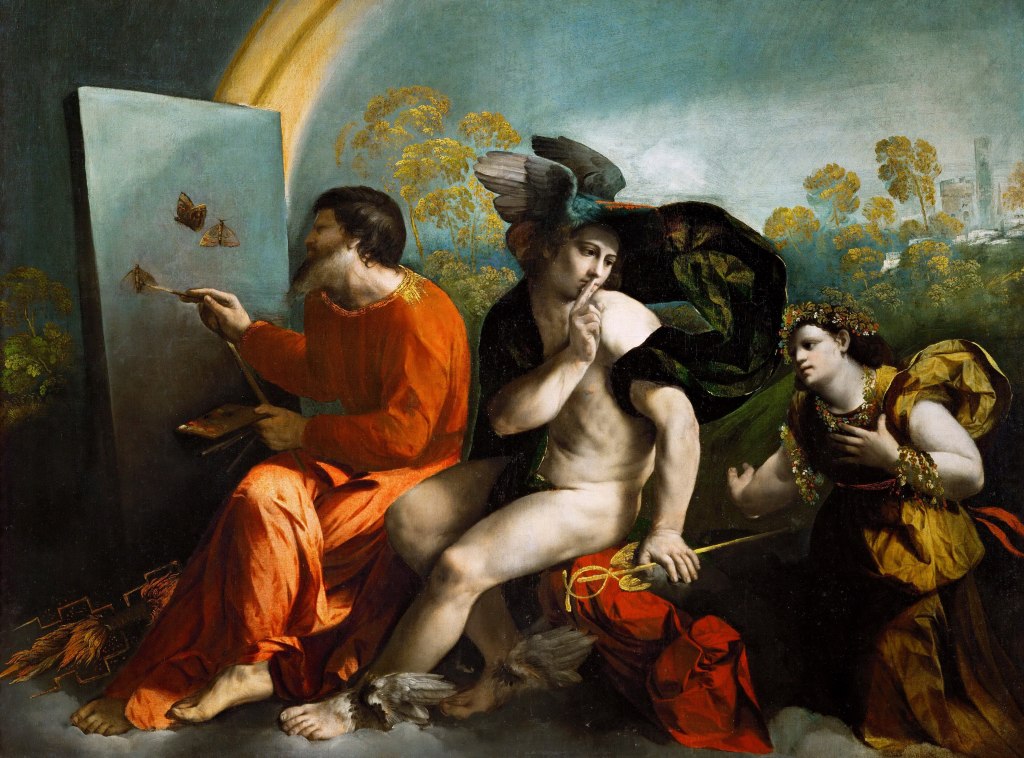
If Alberti supplied the conceit, Dosso made painting itself one of the principal subjects of the picture. Peter Humfrey identifies the art of painting as central to the work, while Vincenzo Farinella develops the theme through Philostratus’s Imagines. In the proem to that text, painting is placed beside poetry and described as an invention worthy of the gods: the Seasons colour the earth, while celestial phenomena adorn the heavens. Farinella relates Dosso’s Jupiter to this conception of divine artistry. The god does not simply govern the natural world but appears to participate in its colouring.
The fiction is sustained by the relation between Jupiter’s canvas and the world around it. He paints against a field of blue that recalls the sky beyond, while the picture itself displays effects of colour, moisture and changing light. Giancarlo Fiorenza treats the rainbow, flowers and butterflies as part of this larger demonstration of colorito: Jupiter’s act of painting nature becomes an analogue for Dosso’s own ability to represent it. The conceit is particularly apt because the objects involved are fragile or transitory. Butterfly wings, moving air, atmospheric light and passing weather offer painting an opportunity to arrest effects that cannot remain still.
Farinella connects Jupiter’s activity more closely with Alfonso I d’Este. Alfonso was not simply a collector and patron. He took a practical interest in making things, including metalwork, wood-turning and work in clay and ceramics, and Farinella also considers the possibility that he painted. In 1493, when he was seventeen, Alfonso wrote to Venice asking for pigments of the finest quality, including ultramarine. Such evidence makes the image of a ruler absorbed in manual artistic activity particularly suggestive at the Ferrarese court. Jupiter need not be a literal portrait of Alfonso for the association to operate. The god can retain his mythological identity while evoking a prince whose cultivation of the arts extended beyond patronage.
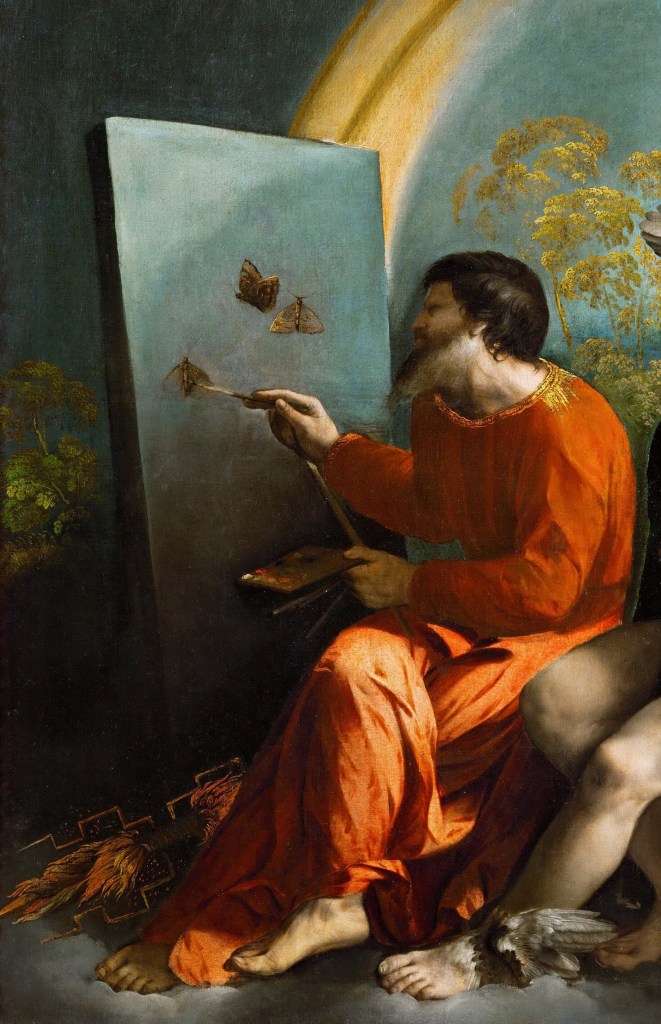
The technical examination of the painting gives this interest in artistic process an unusually concrete dimension. When the canvas was relined in 1964, a rapidly executed underdrawing for all three principal figures was found to have penetrated the unprimed support and become visible on the reverse. X-radiography shows that Dosso subsequently revised the composition extensively. Mercury’s head, headdress, hand and right knee were altered; Jupiter’s brush and mahlstick were shortened; the butterflies were changed; and the silhouettes of all three figures were adjusted. The woman underwent the most substantial revision. X-radiography shows that she was initially conceived with bare legs and in a different pose; at an intermediate stage her dress was slit high at the side, before Dosso arrived at the fully clothed kneeling figure visible today.
Humfrey notes an especially pointed detail. Jupiter himself paints the butterflies directly, without underdrawing, holding his brush loosely about halfway along the handle. His procedure is therefore closer to Dosso’s own relatively free handling than to the more fully planned practice associated with Central Italian painting. The god who paints within the picture does so in a manner that recalls the painter who made the picture.
The physical surface was itself carefully differentiated. Dark preparation lies beneath much of the background and probably the sky; Jupiter’s red garment is painted over a white-lead preparation, while Mercury’s green-yellow costume rests on a yellow ground, probably containing lead-tin yellow. Thick, sharply textured paint occurs in Mercury’s staff, the woman’s flower wreath and red sash, Jupiter’s collar and the thunderbolt. Humfrey associates some of these dense passages with an oil-tempera emulsion. The differentiated preparations, textured passages and revisions reinforce the picture’s sustained attention to the material process of painting.
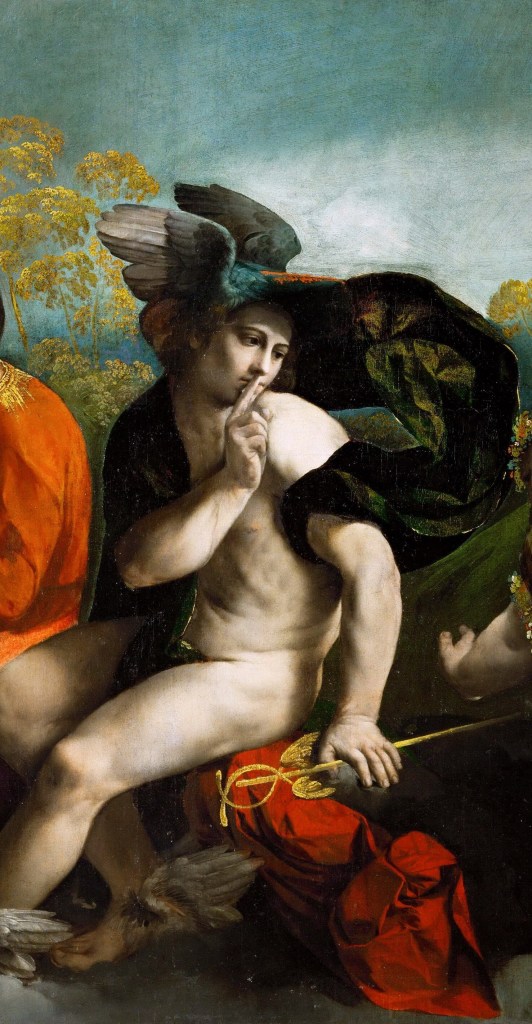
The relation between pictorial and verbal eloquence enters the interpretation most clearly through André Chastel. He proposed that the approaching woman is not Virtue but Eloquence or Rhetoric, while Mercury assumes the role of Harpocrates, the god of silence. On this reading, rhetoric is checked while Jupiter remains absorbed in the silent activity of painting. Humfrey describes the implication as a comparison between the sister arts in which painting achieves through images what rhetoric achieves through words.
It is better to regard this as a possible paragone between verbal and pictorial eloquence than to make the picture into a formal statement of artistic theory. Even so, the suggestion is attractive in a work whose starting point lies in literary culture but whose invention departs so markedly from its textual source. Fiorenza approaches the question from another direction through Mercury’s gesture and Celio Calcagnini’s Descriptio silentii. Silence itself could possess rhetorical force, while painting was traditionally capable of being understood as a form of mute eloquence. Dosso’s image therefore allows the claims of painting and rhetoric to meet without requiring one to be a simple translation of the other.
Fiorenza also places the work within Ferrarese discussions of ingegno and vivid representation. Ancient accounts of painters able to render difficult or fleeting phenomena remained pertinent, above all Pliny’s praise of Apelles. Dosso’s choice of butterflies, atmospheric effects and unstable weather belongs naturally to such a conception of pictorial skill. The joke of Jupiter attending to butterfly wings can therefore retain its lightness while carrying a more serious claim for what painting is able to do.
Otium, Princely Identity and the Belvedere
The setting in which such an image could acquire political meaning was Alfonso I d’Este’s Belvedere, the delizia created from 1513 on an island in the Po beside Ferrara. Biagio Rossetti’s surviving letter of November that year records the early planning of the site, later known as the Belvedere, Pulcher visus or Calliopsis. Trees were cleared and reordered; fields, an oak grove, poplars and elms were incorporated into the grounds; a walled garden was laid out; and the island housed deer, goats, rabbits, peacocks, ostriches and other unusual animals. Its position offered views towards Ferrara and its fortifications while allowing withdrawal into greenery and the cooler air of the river. By 1516 the principal building campaign was substantially complete.
The literary descriptions of the Belvedere emphasise its character as a place apart from ordinary court business. Ariosto evokes it in Orlando Furioso as a garden capable of surpassing the islands of the Phaeacians, the Hesperides and Circe, and imagines Venus removing there with Cupid and the Graces. Other Ferrarese texts similarly present the island as a locus of refreshment, cultivation and imaginative freedom. Dosso himself was repeatedly employed there. Payments document work on the chapel from 1518, further activity in 1519 and 1522, and decorative work during the later 1520s. The exact original destination of Jupiter Painting Butterflies is not documented, but its association with the Belvedere has considerable contextual force.
The relevant form of leisure was otium, not simple inactivity. At court it could designate a withdrawal from negotium, the pressures of government and public affairs, in which study, conversation, artistic activity and cultivated pleasure restored the mind. Farinella connects this conception with later Ferrarese descriptions of Alfonso’s habits and surroundings. Giraldi could speak of otio honestissimo in negotio, while the Ciceronian model of Scipio, “never less idle than when idle, never less alone than when alone”, was explicitly associated with Alfonso. The same tradition appears in the decoration of the duke’s studio dei marmi in the Via Coperta, where inscriptions and imagery gave intellectual withdrawal a place within the exercise of rule.
Seen against that background, Jupiter’s discarded thunderbolt acquires particular force. The emblem of his sovereign power remains immediately available, but it is not being used. His attention is given instead to the delicate work before him. Farinella reads the scene as an image of the ruler protected from interruption while engaged in a form of restorative and intellectually legitimate leisure. If the approaching woman remains Virtue, her presence need not reproduce Alberti’s abused and neglected personification literally. She can stand more broadly for claims upon the ruler which are temporarily held at a distance while Mercury guards the interval of otium. The polarity between leisure and obligation is therefore spatially embodied without requiring either term to be condemned.
The same balance appears in Alfonso’s devices. The duke’s best-known martial emblem commemorated the battle of Ravenna in 1512: a flaming mortar or explosive projectile accompanied by the motto Loco et tempore, “in the right place and at the right time”. Ariosto used a related formulation, À lieu et temps. The device celebrated not violence in itself but the disciplined employment of force at the proper moment. The ruler’s virtue lay partly in possessing power and partly in knowing when to withhold it.
At the Belvedere this imagery was paired with the butterfly. Balbo’s description of the site refers to gilded triple-flame globes and butterflies decorating the architecture, while later accounts record enormous butterflies associated with triple flames on its railings and pinnacles. Traces of the same decorative scheme survive in a tapestry designed by Battista Dossi and woven by Nicholas Karcher around the middle of the century. Fiorenza and Farinella both attach considerable importance to this conjunction. The heavy, destructive object and the weightless insect formed an opposition between force and delicacy, martial preparedness and cultivated repose.
Ancient emblematic traditions offered another way of understanding the pairing. The crab and butterfly associated with Augustus conveyed the principle later expressed as festina lente, “make haste slowly”: decisive action controlled by deliberation. Farinella relates the Belvedere imagery to this tradition of concordia discors, the reconciliation of apparently opposed qualities within a ruler. The butterfly does not cancel the artillery device; the two depend upon each other. The prince capable of defending his state is also the prince capable of suspending action and giving his attention to art.
Fiorenza develops the same material through the language of prudence and political timing. Alfonso’s devices and the picture alike concern the ability to judge the appropriate moment. Jupiter sits at ease with the thunderbolts close at hand. His apparent effortlessness is not impotence but controlled capacity. The image can therefore be related to a broader speculum principis tradition in which mastery of oneself precedes mastery of circumstances. Strength has value because it can be governed.
The Belvedere itself offered an architectural equivalent. Alfonso had transformed a comparatively barren river island into a productive and pleasurable environment of gardens, orchards, woodland and cultivated fields. Ferrarese writers praised that intervention in terms that associated good rule with the ordering of nature. Fiorenza brings this material into relation with Cicero’s De natura deorum, where human cultivation creates a natura altera, a “second nature”, through agriculture, building and the controlled use of the landscape. The prince who reshapes the island and the Jupiter who attends to nature through painting can consequently occupy related conceptual territory.
This was also a dynastic landscape. The Po, identified with the ancient Eridanus, carried associations with Ferrara’s legendary past and with Este claims to a renewed golden age. Humanists around Alfonso repeatedly turned the river, its fertility and its mythology into material for political praise. Giovanni Battista Balbo’s Pulcher visus celebrates the Belvedere as a place where the spirit could recover after martial exertion. Giulio Cesare Scaliger’s Elysium Atestinum recasts the Po landscape as an Este Elysium in which divine favour, fertility and Alfonso’s rule converge. In related court poetry the alternation between warfare and peace, exertion and refreshment, becomes part of the image of successful government.
The butterfly and the thunderbolt compress much of that material into two forms. One belongs to ephemerality, colour and the pleasures of painting; the other to Jupiter’s authority and Alfonso’s artillery. Between them lies the question posed by loco et tempore: not whether the ruler possesses power, but when and how he chooses to exercise it.
Season, Weather and Transition
Fiorenza gives the landscape and weather a more active role than interpretations centred primarily on Alberti or princely otium. In his account, the painting represents not a fixed moment but a seasonal transition. The woman is identified as Flora, goddess of spring, while Mercury mediates the passage towards summer. Jupiter presides over the change as a deity of weather and seasonal order.
The identification of the woman as Flora rests first on her appearance. Her flower garlands accord more readily with descriptions of Flora than with Alberti’s humiliated Virtue, and Fiorenza draws upon Ovid’s Fasti as well as later mythographic traditions. Flora belongs to the season of flowering, but in Dosso’s picture the flowers are already passing their fullest bloom. Her position at the right therefore becomes part of a temporal sequence rather than merely an iconographic identification.
Mercury occupies the centre of that sequence. Fiorenza draws attention to his associations not only with eloquence and mediation but also with wind and seasonal change. In Virgilian tradition Jupiter can send Mercury as leader of the winds, while the month of May, Maia and the Pleiades provided further connections with the god. The later part of spring was also the period in which storms subsided and navigation became safer. Mercury’s gesture of silence can therefore be read not only as an instruction to the woman but as an image of cessation: the turbulent weather of late spring is being quietened as the season changes.
The landscape supports that reading. Fiorenza describes a passing storm, wind moving through the figures’ clothing, humid air, lightning and the coloured arc crossing the sky. He interprets the arc as a rainbow and notes that X-radiography shows it originally extended further across the composition. The combination of storm and clearing weather places the scene between meteorological states. Jupiter, traditionally tonans et fulgens, the god who thunders and flashes with lightning, sits with his thunderbolts at his feet while the atmosphere changes around him.
Classical texts supplied a wider framework for such an image. Hesiod and Ovid associated Jupiter with the ending of the perpetual spring of the Golden Age and the institution of the seasons. Fiorenza also invokes agricultural and philosophical writing in which Jupiter governs rain, fertility and the ordered processes of nature. In Cicero, Jupiter belongs to the administration of the natural world; in Virgil’s Georgics, weather can appear as both disruptive force and necessary condition of cultivation. Dosso’s god is therefore able to occupy the role of ruler not only of Olympus but of seasonal process.
The horizontal structure of the picture becomes especially important here. Fiorenza reads it from the woman at the right, through Mercury, towards Jupiter at the left. Flora belongs to the fading spring; Mercury marks the threshold; Jupiter introduces summer. The composition itself becomes a movement through time. Fiorenza compares this kind of seasonal organisation with the imagery of the months at Palazzo Schifanoia and, more cautiously, with Mercury’s role in Botticelli’s Primavera, where he also stands at the edge of a garden world and appears to regulate atmospheric conditions.
Such a reading also brings the Belvedere back into view. The island was most fully experienced in spring and summer, when its gardens, orchards, woodland and riverside setting could serve the pleasures of courtly retreat. Ferrara’s Festa del Maio, with its branches, regattas and the figure of the Regina del Po, gave the arrival of the season a civic and courtly form. Fiorenza relates these festivities to the broader Este habit of linking seasonal renewal with dynastic and political order. In the frescoes of Palazzo Schifanoia, the months likewise combine agricultural time, courtly pleasure and princely government.
The seasonal argument also sharpens the relation between painting and nature. The effects that indicate change of season are the same effects through which Dosso displays his command of colour and atmosphere. Wind is made visible through drapery; humidity through tonal modulation; passing rain through the darkened sky; clearing weather through changing light. The landscape does not simply illustrate a season but makes transition itself available to painting.
This is also where the interpretation of the coloured arc becomes significant. Fiorenza treats it as a rainbow belonging to a passing storm and to the wider meteorological structure of the picture. Marcin Fabiański later rejects that identification, arguing that the arc is instead the yellow light of dawn and part of a scene in which Mercury restrains Aurora from waking Jupiter. His reading depends upon a much more elaborate reconstruction, but the disagreement is useful because it reveals how much weight can rest on a single atmospheric feature. Whether understood as rainbow or dawn, the arc marks a change in light and helps prevent the landscape from settling into a single stable condition.
Fiorenza’s seasonal interpretation does not require every element to carry one meaning. Mercury remains the eloquent god who can impose silence even while he governs a change in the weather; Jupiter remains painter and ruler while also presiding over seasonal order. The woman’s identification as Flora is more debatable, but the larger emphasis on spring, summer and transition draws support from the flowers, butterflies, weather and the temporal structure of the composition.
The Woman at the Right
The most persistent iconographic difficulty concerns the woman approaching from the right. Alberti’s Virtus makes Virtue the obvious starting point, and the traditional title Jupiter, Mercury and Virtue preserves that identification. Dosso’s figure, however, bears little resemblance to Alberti’s naked, dirty and humiliated personification. She is richly dressed, crowned and garlanded with flowers, and her bearing contains none of the desperation described in the dialogue.
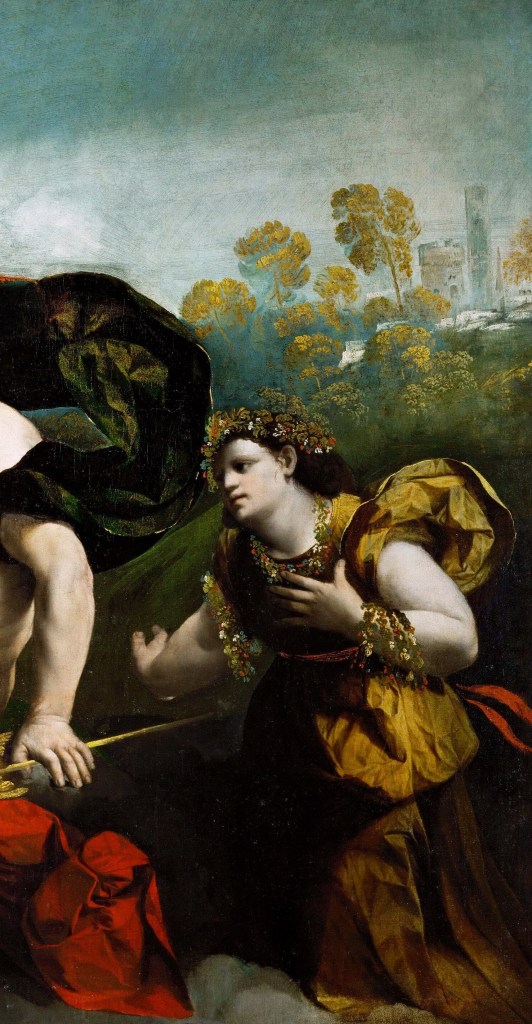
Farinella retains Virtue but argues that Dosso has transformed her function. Rather than representing Alberti’s abused petitioner literally, she may stand for the claims of public responsibility upon the ruler. Mercury prevents those claims from interrupting Jupiter’s otium, allowing the Alberti source to remain active while its narrative is reshaped for a courtly context. This has the advantage of keeping the woman within the original literary framework without requiring her appearance to conform to Alberti’s description.
Fiorenza instead identifies her as Flora. The flower garlands are central to the proposal, which he supports through Ovid’s Fasti and other descriptions of the goddess. Flora belongs to spring, and her presence allows the composition to be read in seasonal terms, with Mercury mediating the movement towards summer. The identification therefore forms part of a wider argument about flowers, butterflies, weather and changing light rather than depending on costume alone.
Chastel offers a different solution by identifying the woman as Eloquence or Rhetoric. Mercury’s gesture of silence then acquires a pointed relation to her identity: verbal eloquence is held at bay while Jupiter remains occupied with painting. The proposal connects naturally with the picture’s concern with artistic making and with the Renaissance notion of painting as a form of mute eloquence. It also helps to explain why a richly dressed and dignified woman might replace Alberti’s distressed Virtue.
The extensive alteration of the figure during execution, discussed earlier, adds a further reason for caution in treating her final appearance as the straightforward transcription of a fixed literary type. What can be said with greater confidence is that Dosso substantially recast the female petitioner supplied by Alberti. Whether he intended that transformed figure to remain Virtue or to evoke Flora or Eloquence is much harder to establish.
Conclusion
The continuing attraction of Jupiter Painting Butterflies lies partly in its refusal to settle easily into one interpretation. Its central themes are clearer than its individual identifications: painting, princely otium, controlled power, seasonal change and the relation between verbal and pictorial eloquence all recur with some consistency across the scholarship. The woman at the right remains harder to name, and even Jupiter’s activity is not entirely secure. Marcin Fabiański’s emphasis on the god’s closed eyes has reopened the possibility that the scene is not simply one of painting but of dream, although his larger reconstruction of Aurora, Flora and the Kraków epithalamium is considerably more speculative. The fact that such proposals continue to arise is part of the picture’s fascination. Its beauty is bound up with an elusiveness that has repeatedly drawn scholars back to the same small group of gestures, objects and atmospheric effects.
Producing these essays requires care, time, research, and resources. Contributions to help sustain this exploration would be greatly appreciated.
Donate to Inner Surfaces here.
Bibliography
Alberti, Leon Battista. Intercenales. Edited by Franco Bacchelli and Luca D’Ascia. Bologna: Pendragon, 2003.
Fabiański, Marcin. ‘L’iconografia del Giove pittore di farfalle di Dosso Dossi, ossia il sogno di primavera di Alfonso d’Este’. Artibus et Historiae 36, no. 71 (2015): 113–124.
Farinella, Vincenzo. Dipingere farfalle. Giove, Mercurio e la Virtù di Dosso Dossi: un elogio dell’otium e della pittura per Alfonso I d’Este. Florence: Polistampa, 2007.
Fiorenza, Giancarlo. Dosso Dossi: Paintings of Myth, Magic, and the Antique. University Park, PA: Pennsylvania State University Press, 2008.
Humfrey, Peter, and Mauro Lucco. Dosso Dossi: Court Painter in Renaissance Ferrara. Edited by Andrea Bayer, with contributions by Andrea Rothe, Andrea Bayer, Dawson Carr, Jadranka Bentini and Anna Coliva. New York: Metropolitan Museum of Art, 1998. See especially Peter Humfrey, catalogue entry 27, ‘Jupiter, Mercury, and Virtue’, pp. 170–173.

