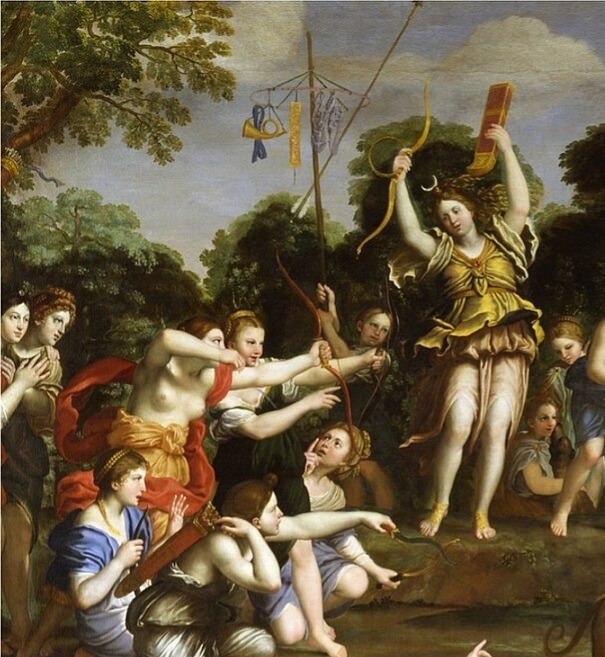
“Anyone, however, who considered only his lengthy contemplation of things might easily have judged him to be slow and lacking a natural gift, but when he was resolved in his mind and his art, then, with the muses leading him by the hand, he ascended to the sublime heights of laurels and of Parnassus.”
Giovan Pietro Bellori.
Domenico Zampieri, known as Il Domenichino (1581–1641), was born in Bologna and trained there, first with Denis Calvaert, before leaving his studio to enter the Accademia degli Incamminati under Ludovico Carracci. Within this environment, shaped by the Carracci’s reform of painting, which sought to unite disegno and colour through the study of nature and the example of the High Renaissance, he emerged as one of its most intellectually rigorous exponents.
By the early seventeenth century he had moved to Rome, where he worked alongside Annibale Carracci; he was within Annibale’s circle in the period following the decoration of the Palazzo Farnese. His Roman career brought him significant ecclesiastical commissions, among them The Last Communion of Saint Jerome (1612–14) for San Girolamo della Carità, which established his reputation as a painter of grave and concentrated devotional scenes.
His art is distinguished by clarity of composition, measured expression, and a sustained engagement with classical models—qualities admired by contemporaries such as Poussin and later codified by Bellori. Alongside altarpieces and fresco cycles, including the decoration of Sant’Andrea della Valle in Rome, he also produced mythological works of refined lyricism, such as The Hunt of Diana (1616–17), in which the same principles of order and expressive restraint are applied to secular subject matter.
In the later phase of his career he worked in Naples, where he was engaged on the decoration of the Cappella del Tesoro di San Gennaro. His final years there were marked by difficulty and rivalry, and he died in 1641.
The following pages approach Domenichino’s work through a deliberately limited selection, focusing on two of his most celebrated paintings, one sacred and one secular. The Last Communion of Saint Jerome, conceived for the high altar of San Girolamo della Carità, is shaped by a context of institutional devotion and doctrinal affirmation. The Hunt of Diana, by contrast, belongs to a more courtly and pastoral sphere, associated with the patronage of Cardinal Pietro Aldobrandini and later acquired—under pressure—by Scipione Borghese, who recognised in it a work essential to his collection.
Despite this contrast in subject and setting, the two paintings reveal a consistent artistic method: a scrupulous process of preparation, a clarity of compositional design, a refined use of colour, and a close attention to the relationships between figures. In both, Domenichino reshapes established models into unified and highly concentrated forms, in which narrative is ordered around a single governing idea.
The Last Rites of Saint Jerome: Domenichino’s Last Communion
The scene of Jerome’s final communion rests not on secure biography but on a later accretion of legend. A set of spurious letters, circulating from the early fourteenth century and attributed to figures within his circle, elaborated the circumstances of his death, presenting him as an extreme ascetic whose body had been reduced by privation and who summoned his remaining strength to receive the sacrament. Although their unreliability was exposed by scholars such as Desiderius Erasmus and Cesare Baronio, these apocryphal accounts—circulating in letters attributed to Eusebius and others—proved pictorially decisive, fixing the image of the aged saint, emaciated and supported by his followers, at the threshold between life and death.
At the same time, more familiar elements of Jerome’s legend—most notably the lion—persist within the scene, so that different narrative traditions are held together within a single, concentrated moment. The subject had already been treated by artists including Sandro Botticelli and, more pointedly, Agostino Carracci in his Last Communion of Saint Jerome (c. 1592, originally for the Certosa di San Girolamo, Bologna, now Pinacoteca Nazionale di Bologna), whose formulation of the dying saint surrounded by attendants provides a clear precedent. Domenichino’s painting emerges from this context not as an invention ex nihilo, but as a reorganisation of an already established image.
During a return to Bologna in 1612, Domenichino studied Carracci’s painting in the Certosa and resolved to adopt it as a model. This decision can be understood in light of a classical theory of imitation, articulated by Quintilian, according to which artistic practice depends not only on invention but on the emulation of successful precedents. His engagement with Carracci thus reflects both homage to his Bolognese masters—renowned for their union of colour and disegno—and an intention to refine that example within a disciplined and creative conception of imitation.
Domenichino’s Last Communion of Saint Jerome (San Girolamo della Carità, Rome, 1612–14) was commissioned for the high altar of the church closely associated with Filippo Neri, where he lived and first gathered the community that became the Oratory. The programme formed part of a renewal of the church in anticipation of Neri’s beatification in 1615, and Domenichino was asked to represent a relatively rare episode derived from texts attributed to the so-called pseudo-Eusebius of Cremona, describing Jerome receiving communion shortly before death. Begun in 1612 and preceded by an extensive series of preparatory drawings—more than forty survive—the painting was completed and signed two years later.
In reworking Carracci’s composition, Domenichino reduces the number of narrative episodes and produces a more unified structure. The figure of Eusebius recording Jerome’s final words disappears, and the varied reactions of the companions to the angels are suppressed; instead, all the figures are drawn into a shared concentration on the central, earthly event. This clarity of temporal focus distinguishes his treatment from the more episodic structure of Carracci’s composition, in which multiple strands of narrative unfold simultaneously.
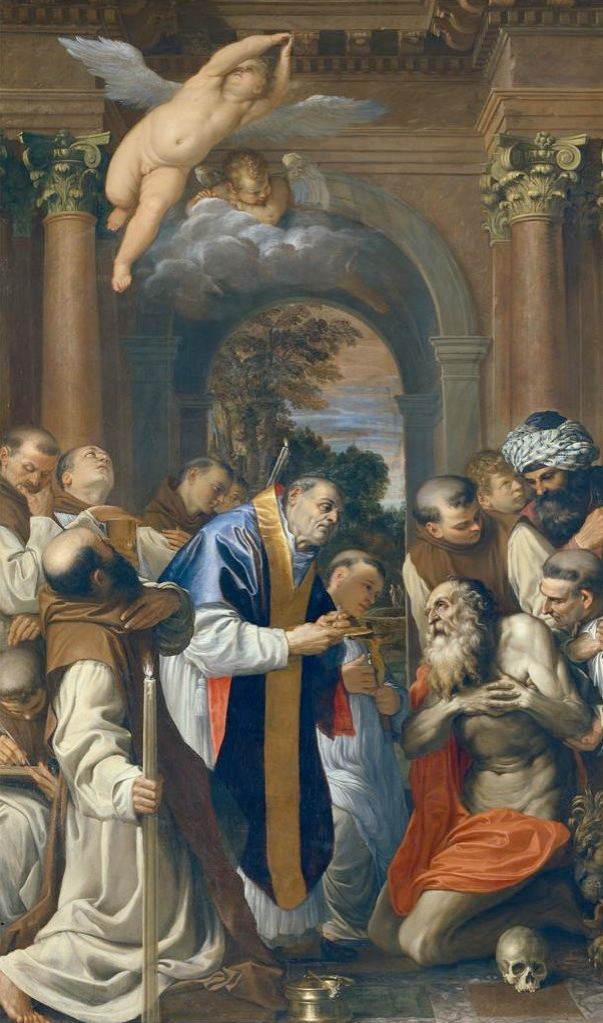
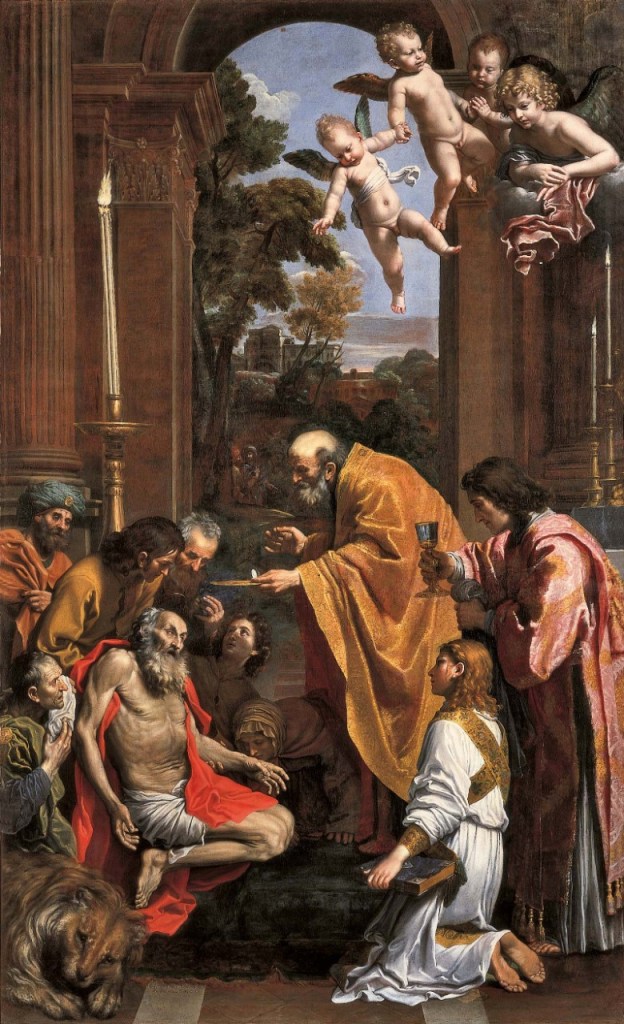
(Credits: Wikipedia).
The most immediate transformation is the reversal of the composition, from which many further adjustments follow. The movement of the eye now runs from the more agitated figures at the left toward the stillness of the clergy at the right, concentrating attention on the act of administering communion. A clearer separation is established between the space of the ritual and that of the putti, whose presence is set apart by the increased height and verticality of the architecture.
This reorganisation is reinforced by the perspectival structure. In Carracci’s painting, the space remains relatively compressed, and attention gathers around the Host through gesture and proximity. In Domenichino’s reworking, by contrast, the recession of the pavement and entablature helps to clarify the composition and draw the eye toward the priest, whose illuminated head is set against the darker ground beyond. Without substantially altering his position, Domenichino isolates and defines the priest’s role within the scene. Set against a landscape suffused with the light of the setting sun, he comes to dominate the central space. His gesture marks a precise moment in the rite, holding the wafer between thumb and forefinger while the other hand extends in a measured, suspended motion.
At the same time, Jerome remains the emotional centre. Supported by an attendant, his weakened body is carefully framed; his arms fall inert, and only his lips remain active in receiving the sacrament. The surrounding figures are more clearly grouped and reduced in number, allowing the eye to rest on him without distraction. Light plays a central role in this concentration, isolating Jerome’s body, articulating the expressions of the attendants, and binding the composition as a whole. His red and white robes stand out against the richer tones of the surrounding figures, while details such as the trailing drapery of a winged putto above introduce a more fluid handling of colour.
To the right, three ecclesiastics—a priest, a deacon, and a subdeacon—turn toward Jerome, while at the left he is accompanied by his lion and surrounded by six lay figures. Their responses are varied but contained. Some are absorbed in private grief: a man wipes his eyes with a cloth, reworking a motif from Carracci, while a turbaned figure behind him gazes forward in a more withdrawn state. Nearby, an older man looks down at a kneeling woman who kisses the saint’s hand. Only two younger attendants exchange glances, creating a small circuit of shared emotion that binds the group more closely to the saint.
The composition is carefully balanced. The richly vested clergy occupy the right, while Jerome’s extended body is framed at the left by a cluster of expressive heads. His attendants are enclosed within their own network of gestures, and only the priest crosses the central axis, linking the two halves of the painting. Around this axis, Domenichino establishes a measured equilibrium between the ordered space of the church and the more intimate space of the dying man and his companions.
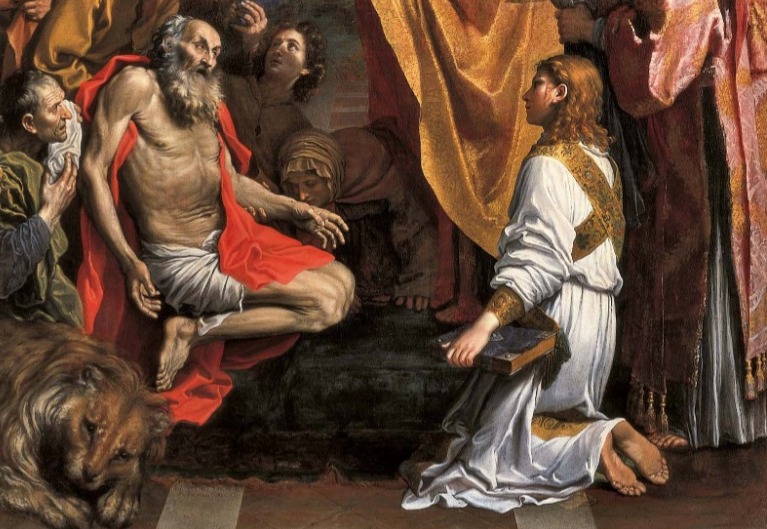
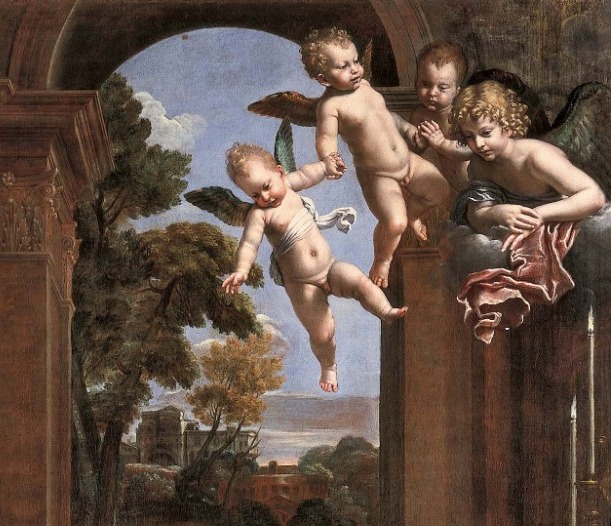
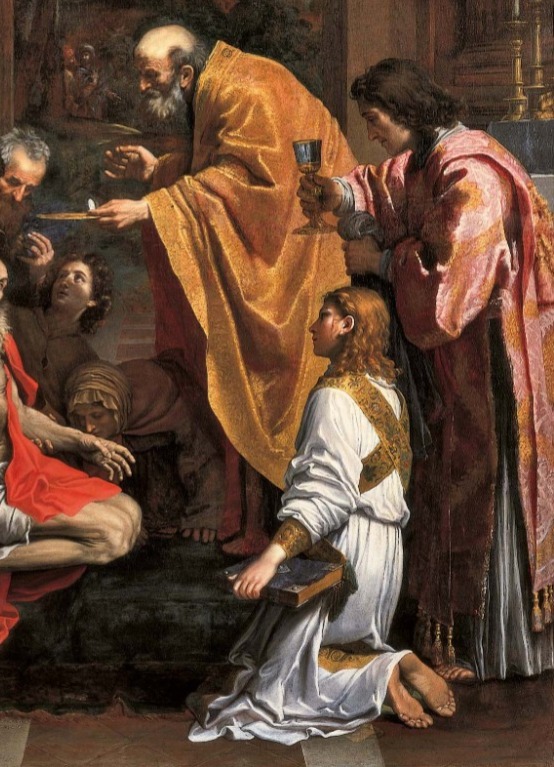
The scene is suspended at a precisely defined instant, poised between anticipation and fulfilment: Jerome kneels at the step of the altar, gazing toward the Host, his mouth already open as he prepares to receive it. The next moment leads directly to communion and death.
The theological emphasis of the painting is equally clear. The priest offers the unleavened Host of the Western Church, a detail noted by Giovan Battista Passeri and consistent with post-Tridentine emphasis on the doctrine of the real presence.
In the seventeenth century, San Girolamo della Carità was believed to stand on the site of the house of Paula of Rome, the Roman noblewoman who had sheltered Jerome. The confraternity associated with the church was devoted to charitable works, including the care of the poor, the sick, and the dying, and its membership included both men and women. This context helps to explain the prominence of the lay figures, whose varied responses—grief, devotion, attentive care—reflect a shared ethos of piety and charity.
As Elizabeth Cropper has suggested, some of these figures may be understood in relation to the confraternity itself. The kneeling woman has been associated with Paula, while also standing more generally for female participation within the community. Other figures may similarly occupy a double role, functioning both within the narrative and as reflections of the group for whom the painting was made. By contrast, the clergy at the right belong to the officiants of the ritual; their vestments and hierarchical arrangement correspond to the structure of a high mass, lending the scene a heightened ceremonial gravity.
Domenichino studied individual figures in a series of preparatory drawings, exploring variations in posture, gesture, and drapery, while further studies examined different ways of representing Jerome himself—collapsed, supported, or more upright—before arriving at the final configuration.
Giovanni Pietro Bellori particularly admired the subtle use of light that sustains the emotional tenor of the scene, from the compassion of the clergy to the pathos of the saint’s hollowed and yearning face.
When unveiled on the feast of Saint Jerome, 30 September 1614, the painting was immediately praised, as recorded in an avviso written the following day. It was soon regarded by artists such as Nicolas Poussin and Andrea Sacchi, and by Giovanni Pietro Bellori, as comparable only to Raphael’s Transfiguration.
Not all responses were favourable. In the 1620s, Giovanni Lanfranco—who was in direct competition with Domenichino for major Roman commissions, notably at Sant’Andrea della Valle—circulated an engraving of Carracci’s composition in Rome, seeking to demonstrate that Domenichino had appropriated its design. The resulting charge of plagiarism became one of the most noted episodes in seventeenth-century art criticism.
Yet the debate also helped to define a theory of imitation. Poussin, drawing on Torquato Tasso, argued that novelty lies less in new subjects than in new arrangements and expressions; Bellori likewise maintained that Domenichino’s figures differ so markedly in action and emotion that any shared idea should be understood not as theft, but as legitimate imitation.
The painting’s standing rests less on such controversies than on the clarity with which Domenichino unites close observation of human expression with a sustained engagement with established artistic models.
Arcadia in Motion: The Hunt of Diana by Domenichino
(Credit: Wikimedia Commons).
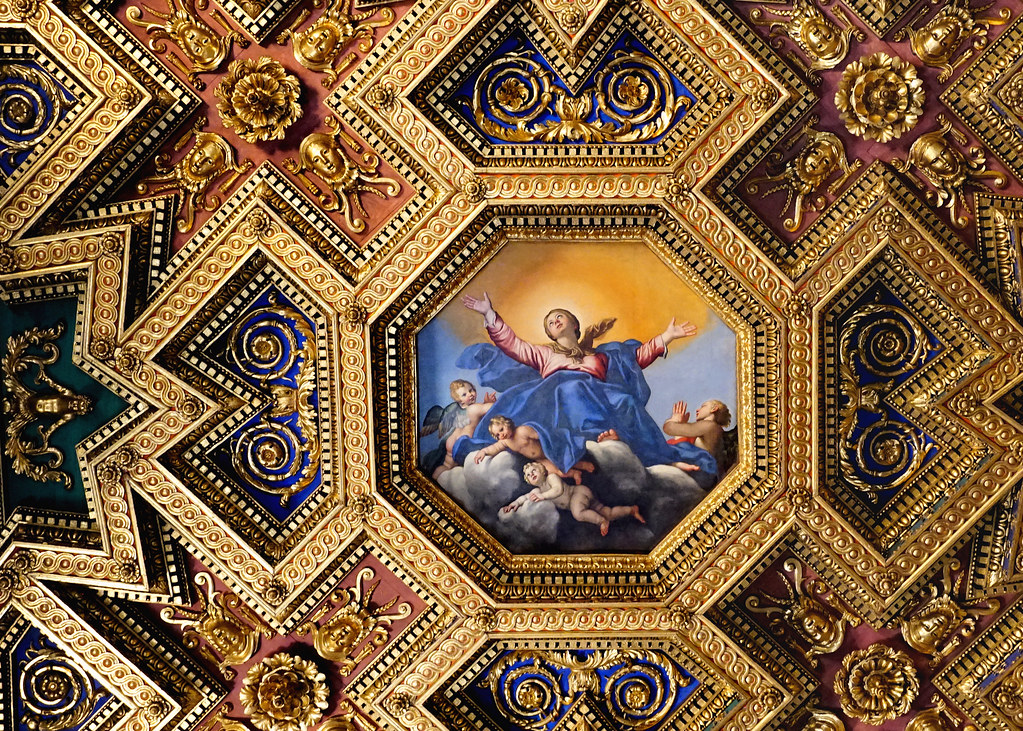
According to Giovan Battista Passeri (1610–1679), The Hunt of Diana was originally commissioned by Cardinal Pietro Aldobrandini. At the time Domenichino was working extensively for the cardinal, executing the fresco cycle at the Aldobrandini Villa Belvedere in Frascati (1616–1618) and undertaking other important Roman commissions, including the coffered ceiling with the Assunzione della Vergine in Santa Maria in Trastevere, also commissioned by Aldobrandini and completed in 1617. Passeri recounts that Cardinal Scipione Borghese, having heard of the painting, requested that it be given to him. When Domenichino refused on the grounds that the work had been made for Aldobrandini, Borghese had it forcibly removed from the painter’s house and even ordered that the artist be detained in prison for several days.
(Credit: Slices of Light (flickr.com)).
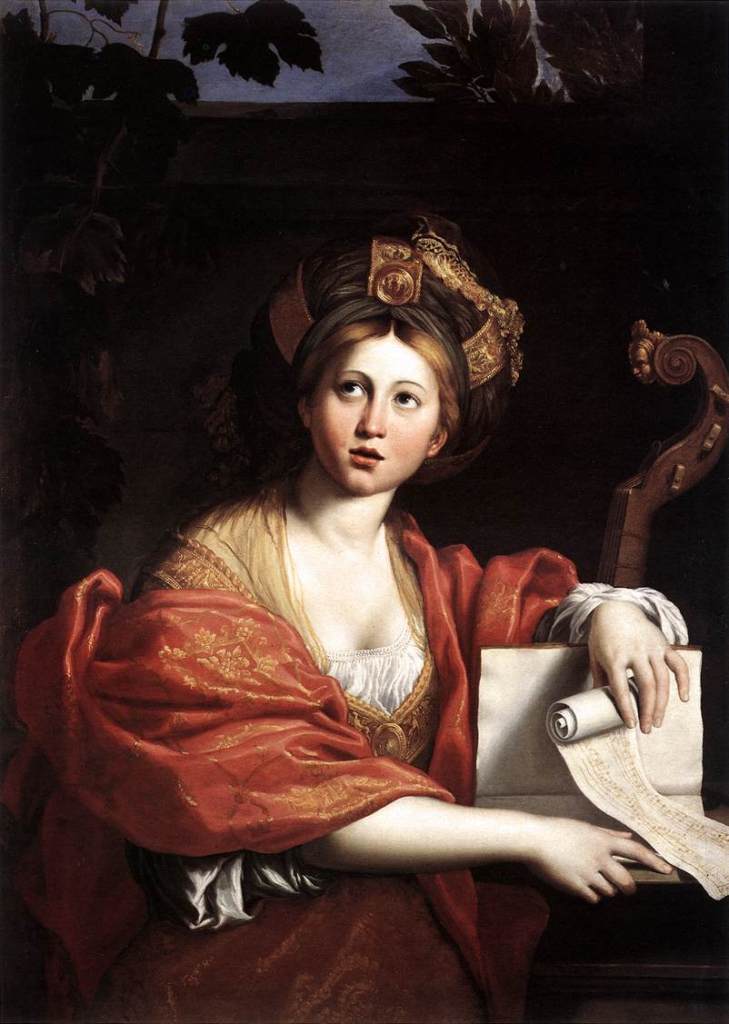
The circumstances of the acquisition are reflected in the unusually low payment associated with the work. A payment of 150 scudi to Domenichino in April 1617 is documented for two paintings, The Hunt of Diana and the Cumaean Sibyl.
(Credit: Wikimedia Commons).
Passeri nevertheless records that the painter himself later claimed to have received only forty scudi for the large Diana canvas. Even the documented sum appears modest by contemporary standards: only a few years earlier Domenichino had received about 240 scudi for the altarpiece The Last Communion of St Jerome (1614, Pinacoteca Vaticana). Borghese’s intervention therefore not only deprived the Aldobrandini of a major commission but also removed the painting from the context for which it had been conceived. As Anne Sutherland Harris has observed, the Aldobrandini collection already included celebrated mythological paintings by Giovanni Bellini, Titian and Dosso Dossi brought from Ferrara after the devolution of the Este duchy in 1598. Domenichino’s canvas may thus have been intended as a modern poesia that would complement this distinguished group and evoke, in a Roman key, the mythological splendour of the Camerino d’Alabastro created by Alfonso I d’Este in Ferrara.
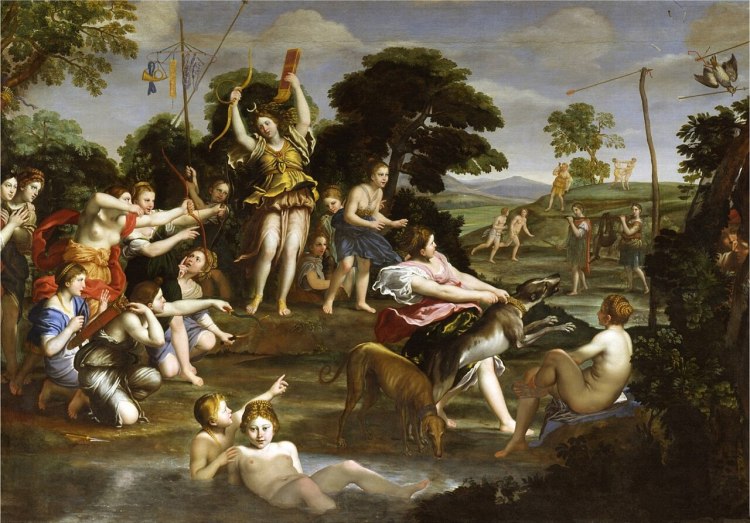
The principal narrative episode represented in The Hunt of Diana derives from the Aeneid, Book V (vv. 485–518), where Virgil recounts an archery contest among the companions of Aeneas. In this episode the competitors attempt to strike a dove tied to the mast of a ship: the first arrow hits the mast, the second severs the cords that bind the bird’s foot, and the third pierces the dove as it flies free, while a fourth, shot into the sky, flares into a miraculous sign. Domenichino adapts this sequence with remarkable fidelity in its principal actions, showing the competitors in the act of drawing arrows from their quivers. At the same time, the painter transforms the scene in a decisive way by transferring the contest from Trojan warriors to the mythological sphere of Diana and her virgin nymphs. This transposition, perhaps suggested by Giovanni Battista Agucchi, allowed the episode to be integrated into a broader Arcadian vision centred on the goddess, the celebrated archer and twin sister of Apollo. By 1620 the painting was already known under the title Il trionfo delle ninfe (The Triumph of the Nymphs). In her analysis of the painting, Kristina Herrmann Fiore situates the work within a revived antique genre described by Pliny the Elder, who attributed to the Augustan painter Ludius the invention of landscapes animated by small figures engaged in rural activities such as hunting, fishing, walking or travelling by boat. Domenichino transforms this decorative landscape tradition by introducing the goddess Diana and her nymphs, thereby elevating scenes of rustic activity into an Arcadian vision of ideal beauty consistent with the artistic theory of Agucchi, who urged painters to move beyond the simple imitation of nature toward the contemplation of ideal form.
Although The Hunt of Diana has often been interpreted as a neo-Venetian mythological scene, the question of its colouristic sources remains open to debate. The painting has frequently been associated with the Venetian tradition of mythological poesia, not least because Domenichino’s patron Pietro Aldobrandini owned celebrated mythological works by Giovanni Bellini and Titian brought from Ferrara after the devolution of the Este duchy in 1598. Within this context the painting has sometimes been understood as a modern response to that Venetian tradition. Yet Domenichino does not pursue a direct imitation of Venetian painterly handling. The brushwork is comparatively smooth and controlled, and the palette more uniform than the exploratory surfaces typically associated with Venetian painting.
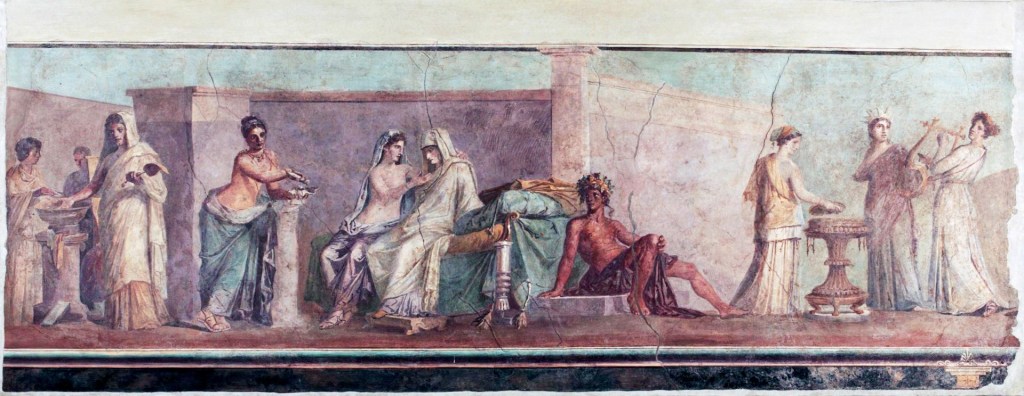
At the same time, comparisons have been drawn with the colouring of ancient Roman painting. The fresco known as the Aldobrandini Wedding (late 1st century BC, Vatican Museums), discovered on the Esquiline Hill in Rome in 1601 and long preserved in the Aldobrandini collection, quickly became one of the most celebrated surviving examples of antique painting. Its pale tonality and delicate modelling offered early modern artists a rare glimpse of classical pictorial practice. The luminous atmosphere and pale bluish tonalities of The Hunt of Diana have sometimes been compared with those of this ancient fresco, particularly in the way light entering the scene casts shadows that articulate the relief of the figures.
(Credit: Wikipedia).
The overall effect of Domenichino’s painting is one of notable luminosity and atmospheric clarity. Fiore has proposed that this quality should be understood less as a borrowing from Venetian colourism than as part of a broader engagement with contemporary Roman discussions of aerial perspective. She relates Domenichino’s treatment of colour and atmosphere to the theories of the Theatine scholar Matteo Zaccolini, whose writings developed a distinctive account of colour perspective based upon ideas derived from Leonardo da Vinci.
In this interpretation the painting’s silvery luminosity arises from a systematic gradation of colour and density across the pictorial field. The canvas was prepared with pale grounds and built up in successive stages—background, vegetation and finally figures—so that the modelling of the figures could be calibrated against the surrounding atmosphere. The density of paint diminishes progressively with distance: foreground figures are rendered with rich, dense brushwork, while distant forms dissolve into thin, translucent layers. This progressive attenuation corresponds to Zaccolini’s theory of turchino, the bluish tone produced when light and shadow mingle in the atmosphere and colours lose intensity through distance.
Fiore also stresses the importance of Domenichino’s sustained engagement with classical sculpture. The figure of Diana echoes ancient statues of the goddess formerly in the Borghese Collection and now preserved in the Louvre Museum. Other figures draw upon antique prototypes such as statues of Aphrodite, figures that recall antique types of running female figures, conventionally identified as Atalanta, and reliefs depicting hunters with dogs. These models were not copied mechanically but served as points of departure for new inventions suited to the narrative rhythm of the composition. In this way Domenichino synthesised a range of antiquarian sources into a pictorial language that appears at once classical and vividly animated.
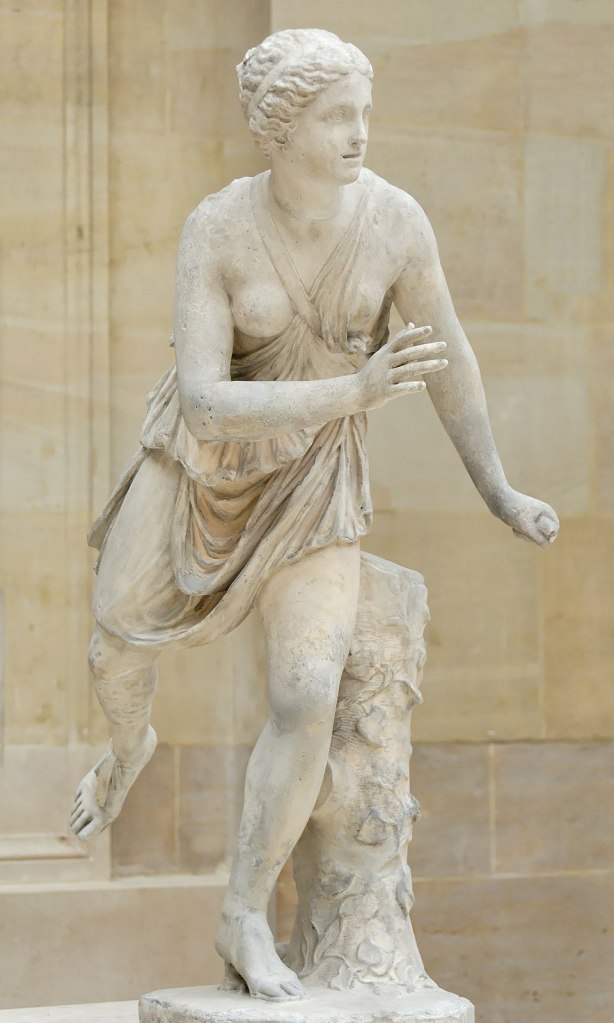
French sculptor, Atalanta (after the antique), 1703–1705, marble, copy of a Roman sculpture after a Hellenistic original formerly in the Mazarin collection, Musée du Louvre, Paris
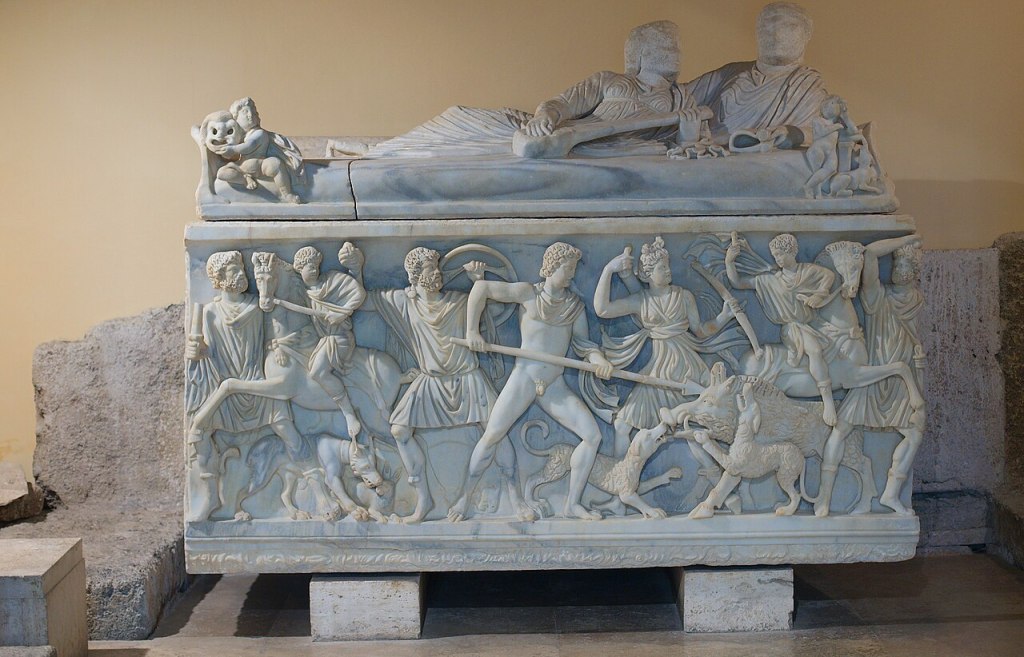
Roman artist, Sarcophagus with the Calydonian Hunt (MC 917), 2nd century AD, marble relief, Musei Capitolini, Palazzo dei Conservatori, Rome
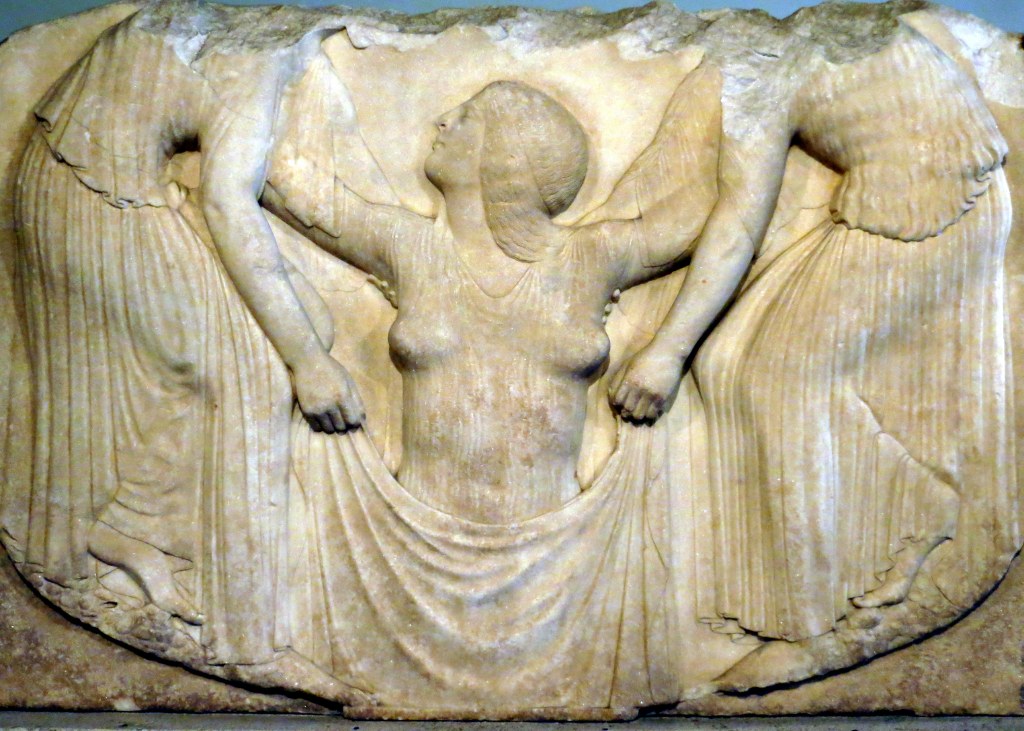
Greek artist, Central relief panel of the Ludovisi Throne (Aphrodite emerging from the sea), c. 460–450 BC, marble relief, Museo Nazionale Romano (Palazzo Altemps), Rome
(Credits: Wikimedia Commons).
The painting reveals the exceptional care with which Domenichino constructed his compositions. Fiore notes that twenty-six preparatory drawings for The Hunt of Diana survive, many now preserved in the Royal Collection at Windsor Castle, the Real Academia de San Fernando in Madrid and the Williams College Museum of Art in Williamstown, Massachusetts. These studies demonstrate the artist’s methodical experimentation with poses, gestures and expressions.
https://www.rct.uk/collection/search#/1/collection/901220/diana-at-the-chase
Technical examination of the painting has also revealed numerous pentimenti, showing that Domenichino continued refining the composition directly on the canvas. Arms, legs and draperies were repeatedly adjusted in order to achieve a harmonious relation among the figures. In one case the arm of a seated nymph was altered to avoid an overly rigid alignment of vertical forms, while the leg of a bathing nymph was modified so that the curve of her body would better connect the foreground figures with the surrounding landscape.
The structure of the composition itself is organised through a carefully balanced geometric arrangement of the figures. At its centre one may discern a clearly defined rhomboidal quadrilateral formed by the principal actors of the scene, whose collective movement presses toward the right. This dynamic grouping is stabilised by figures placed at the outer angles of the configuration: two women at the obtuse angles turn outward, while another at the acute angle looks toward the left, guiding the circulation of the viewer’s gaze.
The painting is also structured around acts of looking. Two women at the left observe the contest, while figures concealed among the bushes at the right watch the scene from hiding. These onlookers—sometimes identified with Actaeon, though perhaps more plausibly understood as shepherds—participate in a triangulation of gazes across the image that culminates in the foreground bather. The bathing nymph and her companion function as visual “hooks”, recalling Alberti’s notion of paired figures that first attract and hold the spectator’s attention before directing it toward the deeper meaning of the scene. Domenichino treats this device with a touch of humour and irony. The bathing nymph appears largely indifferent to the agitated signals of her companion.
Giovanni Pietro Bellori admired the vivid contrast between the impetuous molossian hound and the dog quietly drinking from the spring. The composition ultimately achieves what has been described as an arte ritmica, in which gestures and draperies echo one another across the painting. Domenichino, who was himself known to be a skilled musician, appears to organise the figures with something akin to a musical sensibility, allowing movements to repeat and vary across the pictorial field. Even the distribution of open spaces—the reflective pool in the foreground, the clear air at the centre of the composition and the distant landscape—functions like pauses within a musical structure.
A further question concerns the original format of the painting. In Virgil’s account of the archery contest one of the arrows flies upward and disappears into a cloud, an ominous sign interpreted as a portent of future misfortune. Some scholars, including Fiore, have suggested that Domenichino may originally have included this episode in the composition. In the engraving by Giovanni Francesco Venturini, the scene appears slightly wider at the right edge and includes a fourth arrow corresponding to Virgil’s narrative. Although Giovanni Pietro Bellori does not mention such a detail in his description of the painting, faint traces observed during restoration have led some historians to speculate that the canvas may once have extended further to the right. If so, the lost portion would have introduced an additional narrative element drawn from Virgil, subtly suggesting the fragility of the Arcadian harmony celebrated in the scene.
In this way Domenichino transformed Virgil’s episode of competitive archery into a richly layered Arcadian allegory. Classical sculpture, literary invention, rhetorical metaphor and optical theory converge within a composition whose rhythms of gesture and colour celebrate the harmonious triumph of Diana’s nymphs while carrying traces of the traditions from which the image itself emerged.
La fine
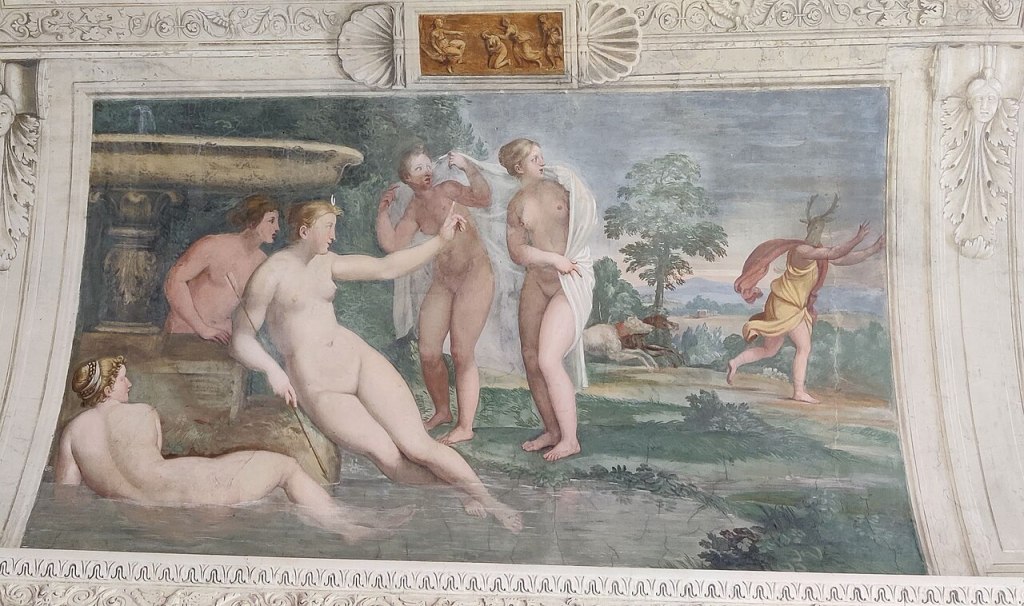
From the Camerino di Diana, Bassano Romano.
(Credit: Wikimedia Commons).
[Producing these essays requires care, time, research, and resources. Contributions to help sustain this exploration would be greatly appreciated.]
https://donorbox.org/inner-surfaces-resonances-in-art-and-literature-837503
Bibliography
Any errors in this introduction are mine alone: the secondary texts consulted are listed below.
Bellori, Giovan Pietro, The Lives of the Modern Painters, Sculptors and Architects, Cambridge, 2005.
Brown, Beverly Louise (ed.), The Genius of Rome 1592–1623, exh. cat., London, Royal Academy of Arts, 2001.
Coliva, Anna (ed.), Domenichino 1581–1641, exh. cat., Milan, 1996.
Fiore, Kristina Herrmann, “La caccia di Diana: genesi del dipinto, la questione dell’antico e del colore in rapporto alla teoria di padre Matteo Zaccolini”, in Anna Coliva (ed.), Domenichino 1581–1641, Milan, 1996.
Negro, Emilio and Massimo Pirondini (eds.), La scuola dei Carracci e i seguaci di Annibale e Agostino, Modena, 1993.
Puglisi, Catherine R., Francesco Albani, New Haven and London, 1999.
Spear, Richard E., Domenichino, New Haven and London, 1982.
Spear, Richard E., cat. no. 26, in Anna Coliva (ed.), Domenichino 1581–1641, Milan, 1996.
Turner, Nicholas and Beverly Louise Brown (eds.), The Age of Correggio and the Carracci: Emilian Painting of the Sixteenth and Seventeenth Centuries, exh. cat., Washington, National Gallery of Art, 1986.
Wittkower, Rudolf, Art and Architecture in Italy 1600–1750, vol. I: The Early Baroque, New Haven and London, 1999.
Zaccolini, Matteo, Prospettiva di colore e altre scritture sulla pittura, Rome, 1992.
 Inner Surfaces