Introduction – Vincenzo Gemito and Mathilde Duffaud
Mathilde Duffaud, la parigina, was Gemito’s first love—the first profound adult attachment of a foundling child. He met her in 1873 while living with his adoptive parents in the Palazzo del Mojariello in Capodimonte. Mathilde lived on the floor above with the French antiquarian Duhamel. Already known as a model for Antonio Mancini, she was initially approached by Gemito for the same purpose. In time, however, their relationship evolved into a deep mutual affection.
Mathilde was a serene beauty, nine years his senior, with brown hair, large black eyes, and a sweet smile. He, by contrast, was a mercurial young artist in his early twenties, already displaying the emotional intensity that would later overwhelm him—un artista folle of great talent.
According to the scholar and biographer Ottavio Morisani, Mathilde exerted a benevolent influence on both Gemito’s character and his career, encouraging him to pursue further artistic development in Paris. He moved there in March 1877, and she joined him in August. Their time in Paris, however, was marked by hardship—financial difficulties and the worsening of Mathilde’s health. She suffered from a serious illness—possibly a tumour or tuberculosis, as reported in different secondary sources—and eventually required emergency surgery.
In 1880, the couple returned to Naples for good. The following year they relocated to the Villa Galante in Herculaneum, hoping that the healthier environment might aid her recovery. Despite these efforts, Mathilde died there in 1881.
Gemito’s drawings and sculptures of Mathilde offer a rare opportunity to explore the intersection of profound personal feeling and artistic creation. They also serve as an introduction to the early phase of one of the most important Italian artists of the late nineteenth and early twentieth centuries. Referring to a group of drawings from the Minozzi collection, two scholars—writing independently—observe that the studies were “not made for financial gain.” This same sincerity and personal investment runs through all the works that will be considered here.
Two profiles to begin with…
(Credit: see below.)
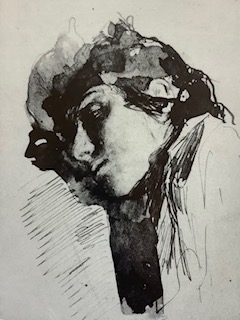
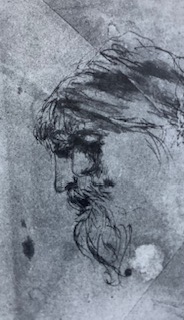
In the introduction to the exhibition catalogue Temi di Vincenzo Gemito, there is a small reproduction of a drawing by the artist that shows his profile alongside that of Mathilde. The profiles are arranged so that they are very slightly staggered—like the edges of two playing cards shifted between thumb and fingers. The faces of the two lovers remain visible as distinct entities, separated by only the slightest difference. A reverse movement might momentarily align them in perfect tessellation, before one image dissolves into the other.
The exhibition’s curator, Bruno Mantura, offers another metaphor for this delicate boundary between individuality and mutual absorption: the lineaments of the couple, he suggests, seem to “emerge, as if out of a process of distillation.”
Love Lost.
(Image credit: Gallerie d’Italia, Napoli.)
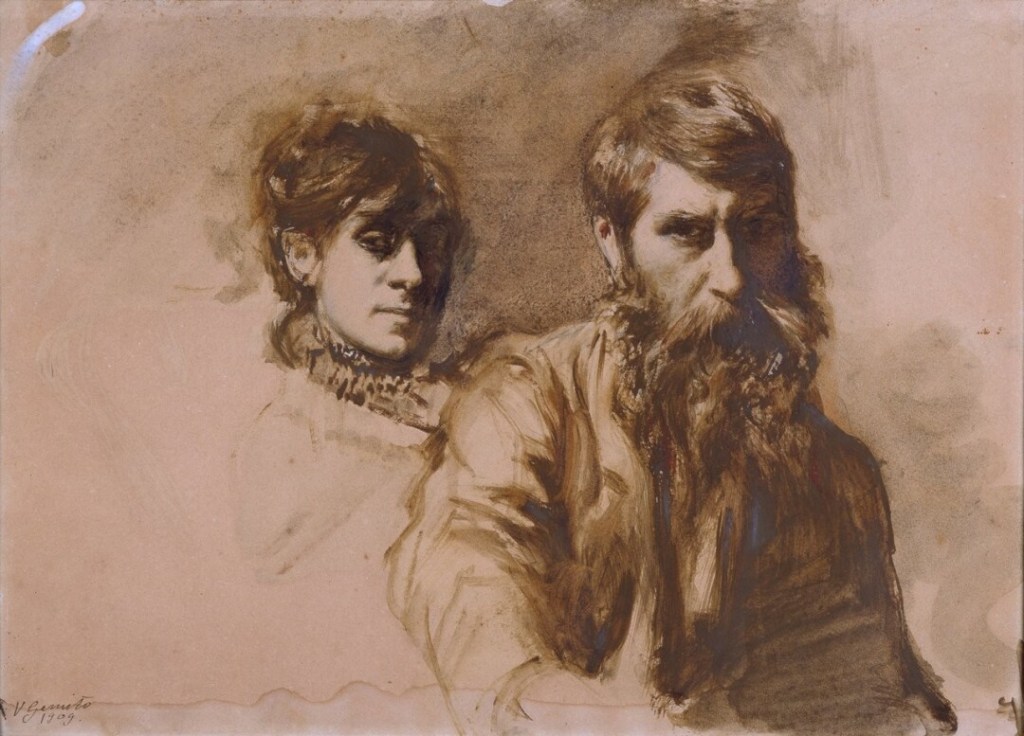
Gemito’s powerful and haunting Self-portrait with Mathilde Duffaud commands attention like no other representation of her. The biographer Ottavio Morisani (1936) interpreted the mood of the drawing as one in which Gemito appears “inert,” while Duffaud is “no longer woman nor flesh,” having become something inspirational—an “ideal.” Once we are aware of the biographical context, the drawing conveys an unmistakable sense of loss.
Though Gemito signed and dated the front of the drawing in 1909, this is almost certainly a later addition made for the art market. Supporting this, the reverse of the sheet bears the inscription: In Ercolano / 1881 Villa Galanti / Palazzo Sforzi. Gemito. Catalogue entries by Isabella Valente (2023) and Rosanna Naclerio (2009) both suggest 1880–1881 as the most likely period of execution, with Valente favouring 1880 as closer to Mathilde’s death.
There is some variation in the literature regarding the materials used. Some catalogue entries describe it as pen and watercolour, while others specify red chalk and watercolour (sanguigna acquerellata). In either case, Gemito achieves striking emotional and atmospheric impact through the combination of a red or sepia warmth with tenebrous chiaroscuro and delicate sfumato effects.
Even a viewer unfamiliar with the drawing’s context would likely be struck by the energy of the scene. Gemito appears as an intense figure, marked by a guarded detachment that discourages intrusion. There is a sense that his calm holds something taut and volatile—an inner unrest. Behind him, Mathilde appears elevated and serene. Only her head and high collar are rendered, which enhances her sense of aloofness and self-possession, as our gaze is drawn upward. The absence of her torso is compensated by dark shading to the right of her head; the right side of her face merges into this shadow. The blank space flanking the figures compresses the scene, magnifying the emotional intensity of their portraits.
Though Mathilde is placed behind Gemito in the composition, her presence is not diminished. On the contrary, she seems to possess a graceful air of authority. Her look encompasses more, enveloping both her partner and any viewer who might be watching. Gemito almost certainly used a mirror to make this drawing, and with that in mind, we realise that the couple are not only looking out—they are also looking at each other. Even if Mathilde’s likeness was rendered after her death, her gaze can still be read as looking back at him.
The couple appear intertwined and self-contained, facing the world as one. While Mathilde is the more composed of the two, she shares something of Gemito’s dark charisma: she is part of it—and, by extension, they are part of each other.
Gemito’s right shoulder is angled forward dynamically, as if his drawing hand is about to re-engage with the paper while he watches himself in the mirror. If the drawing was created after Mathilde’s death, it nonetheless radiates a powerful magnetism. Its realisation may have been sustained by heartfelt memory, supported by earlier drawings and terracotta sculptures.
There is a strange, oneiric vitality to this work, and the intimacy of their bond is palpable.
Drawings from the Minozzi Collection
What kind of observer was Gemito?
Most of the drawings of Mathilde from the Minozzi collection are in pen and ink, or pen and ink and watercolour. Some were realised with very rapid strokes and many seem to have been completed quickly, as if Gemito was trying to capture the essence of a moment. Morisani describes the obsessive way in which he watched and documented Mathilde, suggesting that he had the ‘cruel curiosity of a surgeon’ and portrayed her in ‘continuous’ and ‘insistent’ studies. He suggested that all this was in the search for a ‘definitive form’ of her.
After reading these words of Morisani, it is hard to look at the vigorous drawings in the Minozzi collection without recalling Gemito’s notorious temper. Pen and ink lines can be severe and sharp, especially when the use of watercolour is minimal. They can seem more wire than flesh and appear like some electrical storm of creativity.
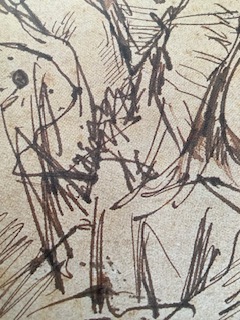
(Detail of Gemito’s energetic hatching, credit: see below.)
This sense of sharpness is increased when we remember Gemito’s ruthless capacity to document realistic detail. His pencil drawing of Anna Cutolo (whom he married after Mathilde’s death), named in catalogues as Anna Morente, is a case in point. The picture shows Anna looking like a weak and wounded animal. She has an abdomen swollen with liquid, the consequence of a sarcoma, and yet she is being asked to sit as a model. Bruno Mantura felt that Gemito, in this context, may have followed Anna’s decline with the ‘attention of a cold and angry observer.’ In this situation, it is not so much the fact that Anna is ill, but the uncomfortable position she is in—a pose that strips her of dignity and exposes the full extent of her condition.
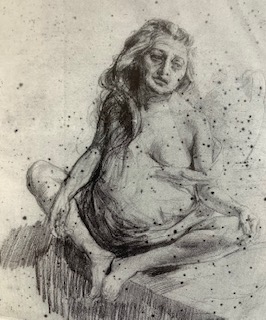
(Credit: see below.)
Looking back to the seventeenth century, a pen and ink drawing attributed to Rembrandt, A Sick Woman Lying in Bed, Possibly Saskia (Petit Palais, c. 1635–40), offers another intensely personal and realistic study of the illness of a loved one. The work directly conveys the dejected and weary nature of the subject, though in a more compassionate way. While there is an inevitable sense of detachment—as the artist observes rather than shares in the experience—the woman’s distress is primarily expressed through her facial features and the position of her hands. At the very least, she is shown lying down, covered, and as comfortable as possible.
Coincidentally, in a drawing of 1886, Gemito portrayed Anna in a reclining pose and also added white—though to her face. However, current scholarship suggests that Anna was not ill in this work, and that her pallor in the portrait may have been due to Gemito’s mental state at the time, as well as his own personal artistic taste. (See Cat. 24 in Carrera et al. (2023).)
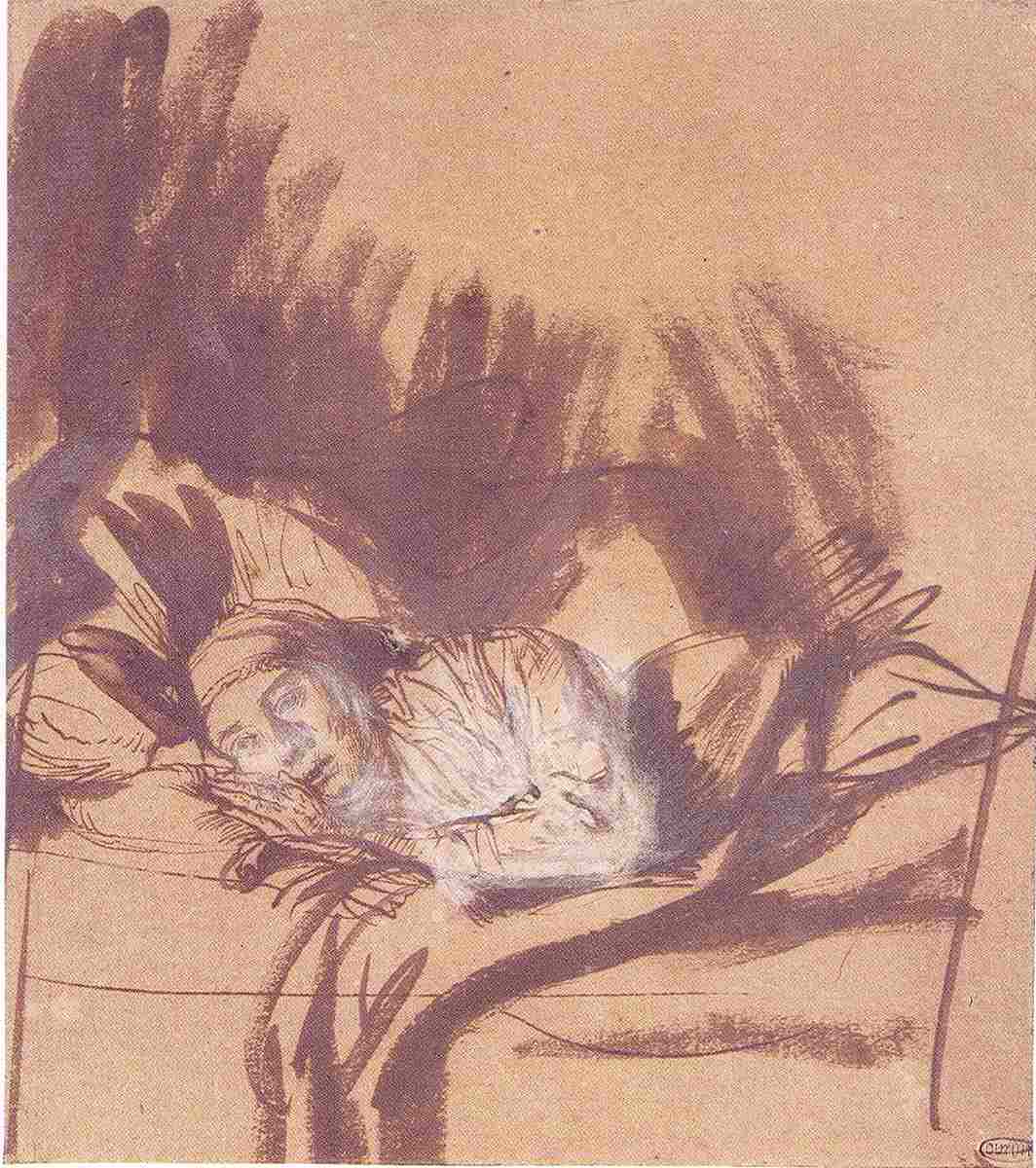
(Credits: Wikimedia Commons.)
Gemito was a man of extremes and his numerous drawings of Mathilde might testify to his intense and obsessive nature. Although it was Anna who cared for him during the darkest periods of his mental illness, his volatility must also have been evident during his relationship with Mathilde. His difficult temperament extended to his friendships as well. In an 1878 letter, the painter Antonio Mancini accused him of taking the best from their relationship while giving back only an “impossible character.” One account from Schettini, cited by Hiesinger (2007), even claims that Gemito physically assaulted Mancini, attempting to strangle him, after which Mancini feared being left alone with him. The altercation reportedly stemmed from Mancini breaking a mutual agreement: they had pledged not to sell works without each other’s approval, nor at low prices. Mancini, however, had sold some paintings to buy food—for himself and his companions.
While it seems reasonable to intuit (or at least project) traces of agitation and irascibility in some of the leaner, and more tempestuous of the Minozzi drawings, this should not be taken too far. Gemito brings a softness and sensitivity into some of the pictures of Mathilde through the use of shading, as well as through the inclusion of finely rendered detail and psychological and emotional elements. Beyond this, we have one or two works in pencil which bring us closer to the realisation of a rounder and more tactile quality which can be found in his terracotta busts of Mathilde.
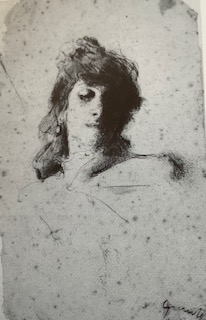
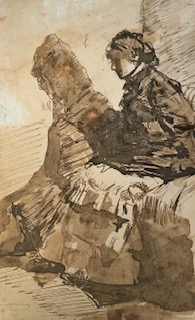
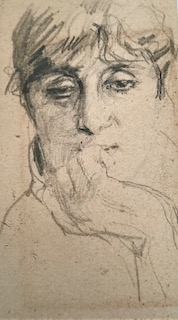
(Credits: see below.)
The drawings selected above are among the most atmospheric in the collection; they are acutely sensitive and seem to capture Gemito’s fascination and love for Mathilde very well. The work on the far right is in pencil.
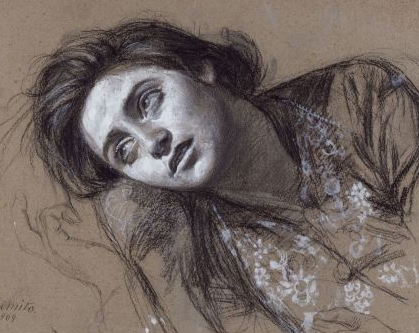
The inspiration for the use of pen, ink and wash must have come from the influence of Morelli and Mariano Fortuny. Looking at the works below, we can see similarities of approach in all three artists, in the style of the hatching and the massing out of darker areas with blots, brushes or smears of ink.
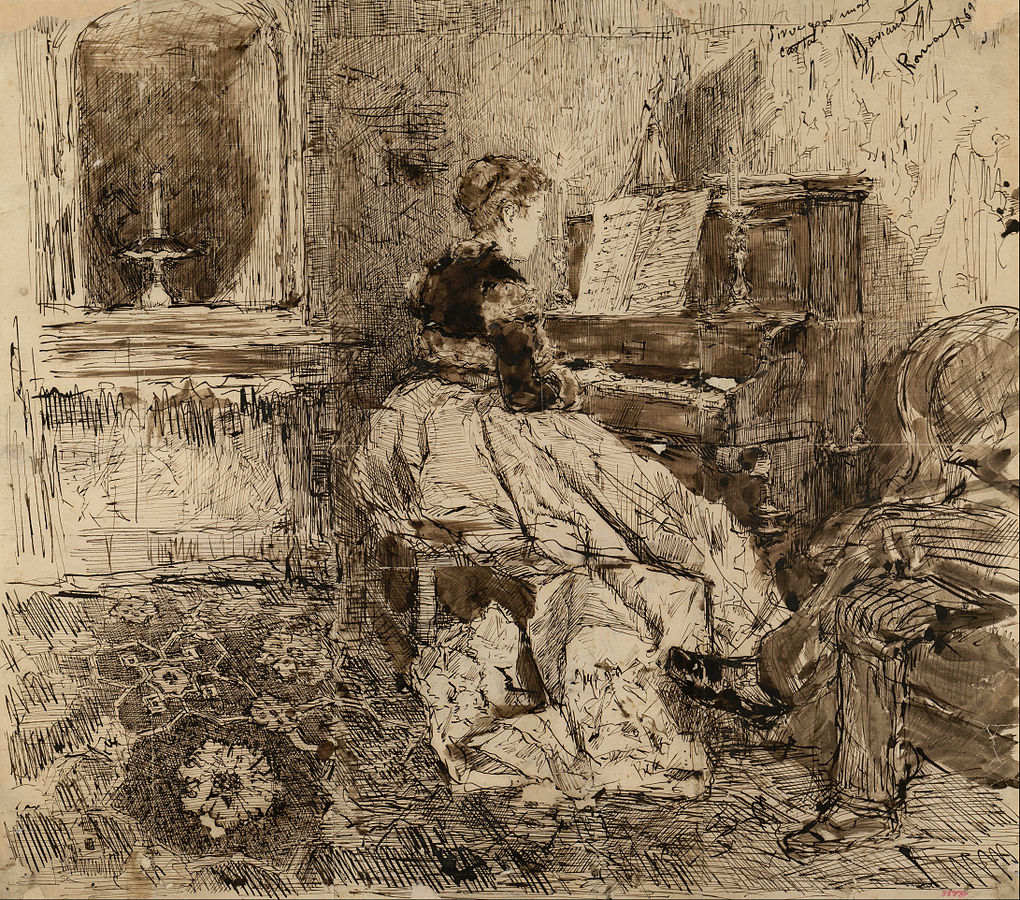
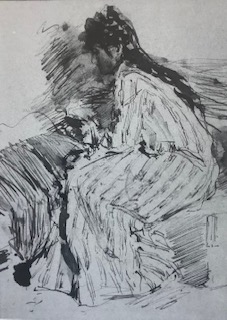
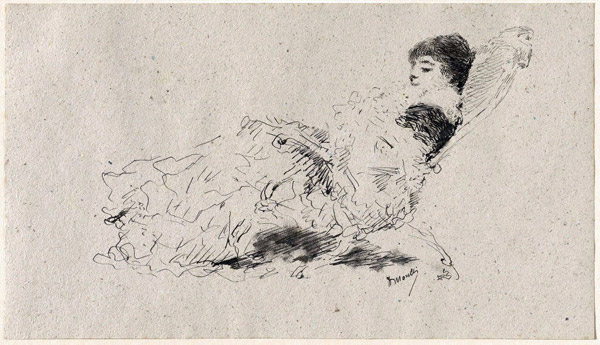
[Image credits: Left Mariano Fortuny, Cecilia de Madrazo Playing the Piano (Wikimedia commons)/ Centre: Vicenzo Gemito, Mathilde Seated (see below)/ Right: Domenico Morelli, The Artist’s Daughter Eleonora Reclining on a Chaise Longue (Wikimedia Commons).]
However, Fortuny’s work is more finely wrought and complete, both in composition and in the realization of detail. In contrast, Gemito and Morelli appear to have worked more quickly, aiming for a rapid overall impression and focusing closely only on selected areas of particular interest. In their drawings more generally, some parts tend to taper off or are left entirely void. While this is, of course, a limited comparison, it does suggest that Morelli was more attuned to immediacy than to Fortuny’s control and finesse—and that Gemito adopted a similar approach to drawing.
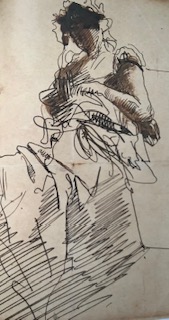
While Gemito’s drawings confirm Morisani’s assertion that he studied Mathilde frequently and relentlessly as she went about her life, many seem to sketch out her overall presence, rather than pursuing specific detail. For example, if she is drawn engaged in an activity, then the dynamics or detail of that activity may not be clearly defined, but rather lost in a tangle of suggestive lines and shading: we can see this in the work below, Mathilde al lavoro (GDS 2826).
(Credit: see below.)
Gemito’s overall artistic legacy contains many drawings which study energy and anatomy, especially those made in his classicising phase. As such, they also resemble the investigations of master draftsmen from the Renaissance and Baroque periods. However, these drawings of Mathilde are profoundly personal and seem to be concerned with recording her presence and its fascination, rather than trying to capture a specific physical dynamic, or perfect aspects of anatomical detail. The overall feeling is intimate and domestic.
It is possible, if not likely, that these drawings contributed to an overall awareness of Mathilde that served his sculptures of her. Notwithstanding this, they are not serial preparatory drawings which investigate details of physiognomic representation, or even study arrangements in composition, for a final project. To a large extent she is both the subject and the goal. He wants to capture her presence in time, for himself.
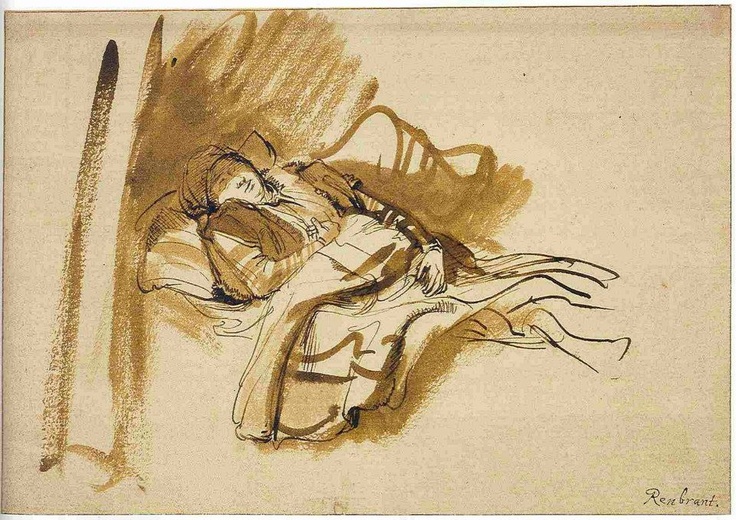
As suggested by an earlier comparison, we find ourselves in emotional territory reminiscent of Rembrandt’s pen and ink drawings of Saskia—such as Saskia Asleep in Bed, housed in the Ashmolean Museum, Oxford. Rembrandt’s drawings of Saskia, like Gemito’s drawings of Mathilde, document a private world, and a relationship within that world, which is passing ineluctably.
(Credit: Wikimedia Commons.)
In an essay by John Berger, Go Ask the Time, there is an analogy that parallels the nature of these domestic studies. Although it concerns storytelling, it also speaks to the character of the drawings:
Everyone knows that stories are simplifications. To tell a story is to select. Only in this way can a story be given a form and so be preserved. If you tell a story about somebody you love, a curious thing happens. The storyteller is like a dressmaker cutting a pattern out of cloth. You cut from the cloth as fully and intelligently as possible. Inevitably there are narrow strips and awkward triangles which cannot be used – which have no place in the form of the story. Suddenly you realize it is those strips, those useless remnants, which you love most. Because the heart wants to retain all.
These drawings are not honed projects—they are fragments which are valuable in themselves. Like the remnants in Berger’s analogy, they are the carefully chosen pieces cut from a larger, ungraspable whole. What they preserve is partial, shaped by affection and attention, and by the limits of what can be held onto. In their quiet specificity, they offer not the full story, but something more intimate: a sense of what it means to try to hold on to a life as it constantly moves beyond reach.
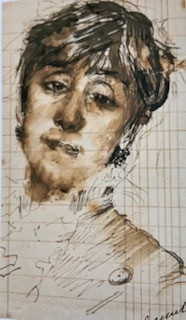
Another interesting aspect of the Minozzi drawings is the paper upon which they are drawn and some light on this subject has been shed by Simonetta Funel, see (Capobianco and Mamone, 2014). Among the published reproductions of his drawings listed below are drawings on squared (account book) paper, lined paper and a page from the Bible, The Epistles to the Hebrews, XI. The Minozzi collection has a number of drawings of Mathilde on pages from the Bible and the possible connotation of devotion derived from associating the paper with its subject cannot be easily dismissed.
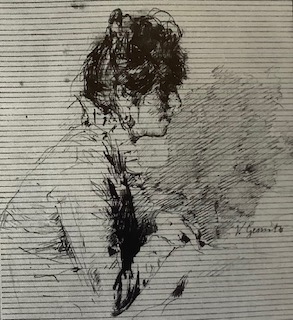
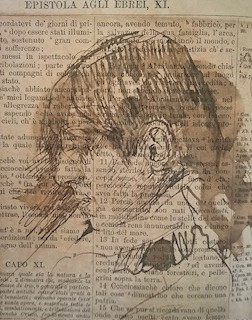
(Credits: see below.)
The incorporation of such a variety of types of paper opens up some obvious questions. We wonder whether he was economising, or laying his hands upon whatever was available when he felt the need to draw. While this might have been the case in some instances, it certainly could not have been the rule. The reason we know this is that some of the sheets he used were rare and selected for the quality associated with their age. For example, his famous drawing Scorfano, in the Gallerie d’Italia of Naples, was on manuscript paper from the 18th century.
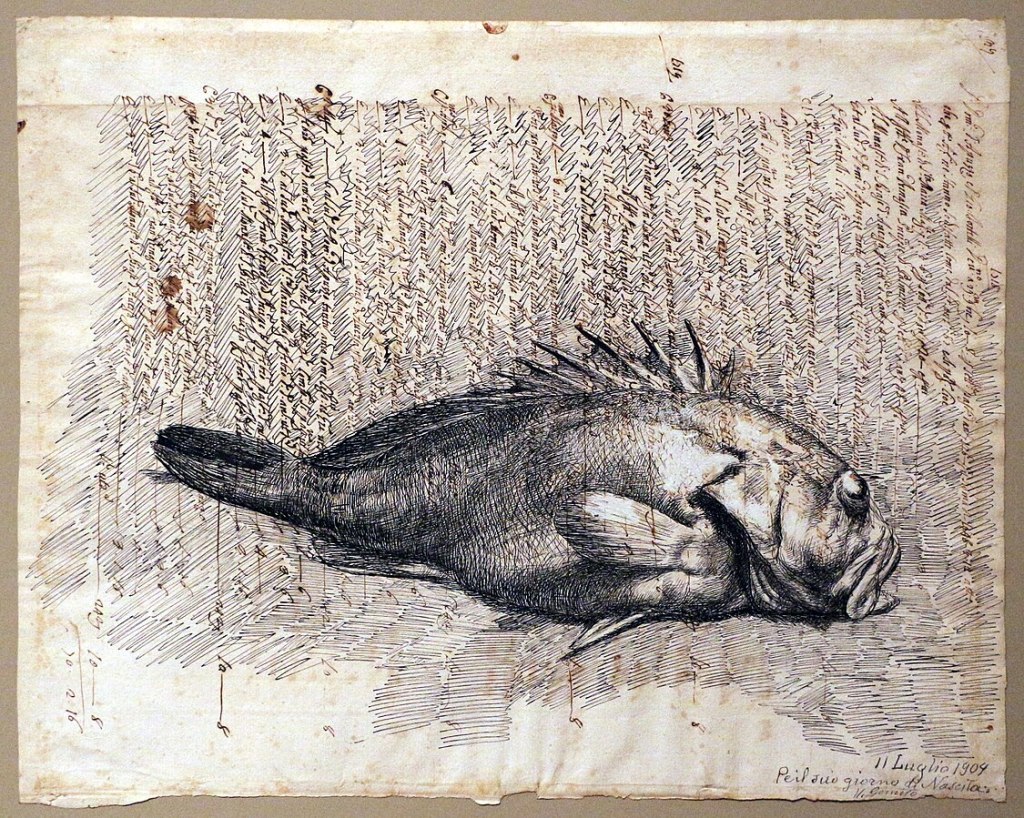
(Credit: Wikimedia Commons.)
Once we see one element of choice at work, we are entitled to speculate whether he even liked the way that more everyday types of paper responded to ink. The safest approach is probably to assume that a mixture of accident and design played a part in the process of selection. In terms of intentional connection, Simonetta Funel found a photograph of a drawing of Anna, portrayed as Trinacria, on a geographical map of Sicily from 1770.
There is an accidental consequence to seeing that Gemito exercised his talents on everyday paper: when an artist creates something extraordinary on the most ordinary surface, it serves as a reminder that true talent comes from within. Such skill can be summoned wherever and whenever it is needed, as long as the artist’s energy and skill endure. Clare Robertson has noted how Annibale Carracci often offered small studies as payment in kind, even to people of humble origins. One example is his Head of an Old Woman (early 1590s) in the Fitzwilliam Museum, Cambridge, which was painted on a sheet of old accounts—visible beneath the thin layer of paint. Similarly, Carlo Siviero recounts how Gemito, finding himself in the Villa Farnesina without paper, spontaneously made sketches after Raphael on lottery slips, demonstrating the same kind of improvisation and resourcefulness.
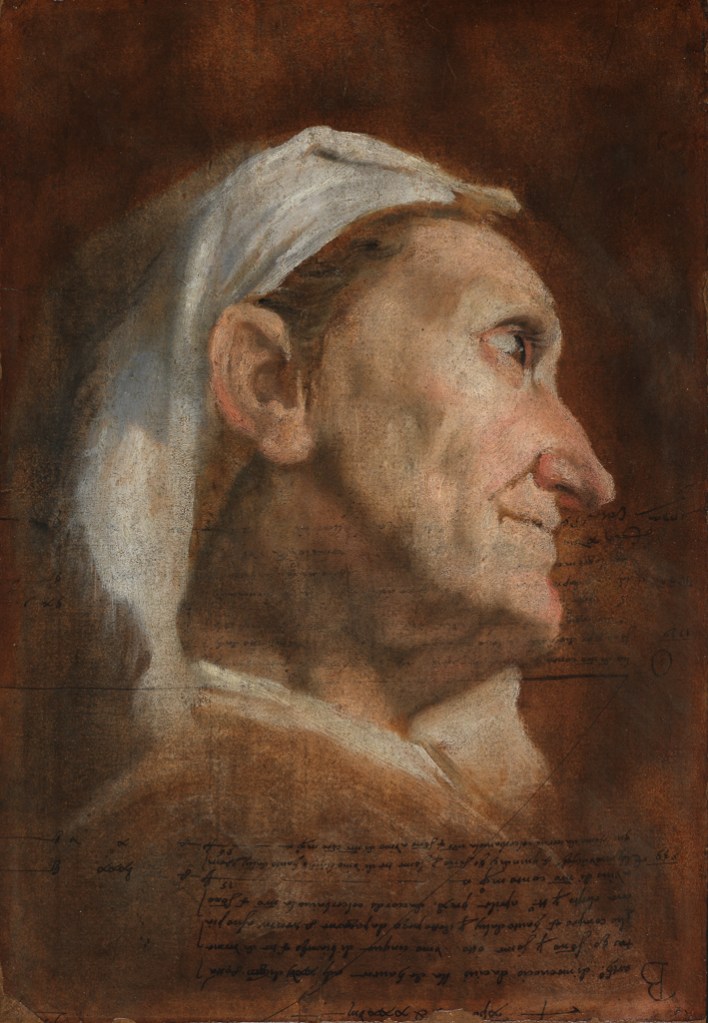
(Credit: The Fitzwilliam Museum.)
Gemito ‘in pieces’ over Mathilde?
There are two small bronze heads of Mathilde by Gemito which, while tenderly rendered, are disturbing in their suggestion of decapitation. One of the two bronze sculptures is set on a bronze cushion which has simulations of creases and bumps to create an air of realism. The other is perched on a marble plinth.
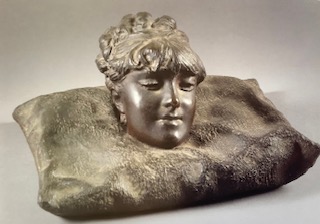
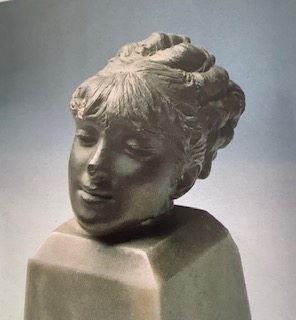
(Image credits: see below.)
We can attempt to explain away the sense of brutal severance evident in such shoulder-less, and practically neckless, representations through an appeal to cultural allusions and precedents. As the catalogue entry for Gemito (2009) has suggested, artists traditionally focused on anatomical fragments, or made plaster casts, in preparation for sculptures and paintings, as well as working on them as studies in their own right.
One example might be Géricault’s Study of Feet and Hands (Musée Fabre), cited below. Similarly, Rodin used plaster casts in preparation for his sculptures and also created finished studies of paired hands to explore their expressive potential. A bronze cast of Rodin’s The Cathedral is also included below.
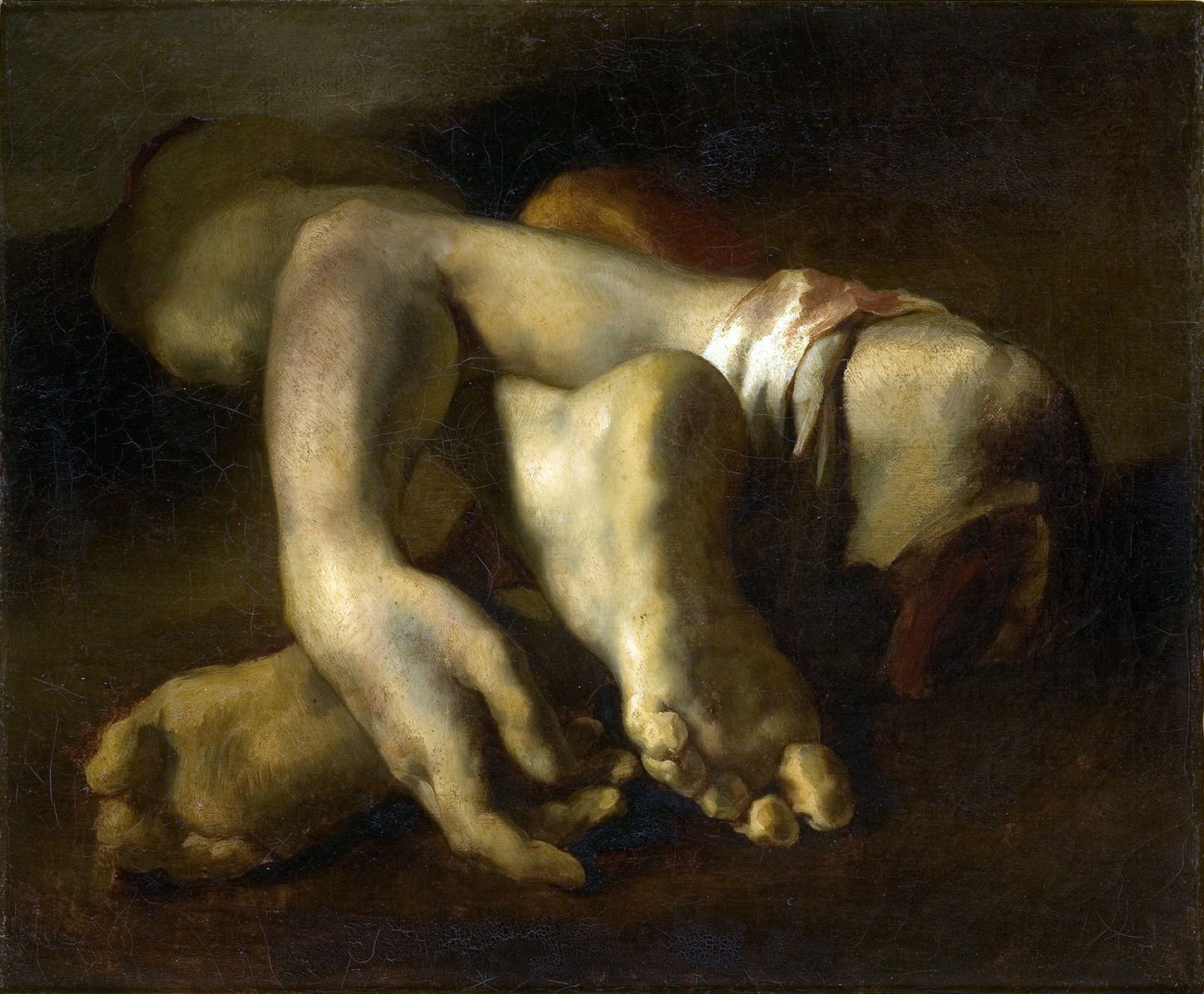
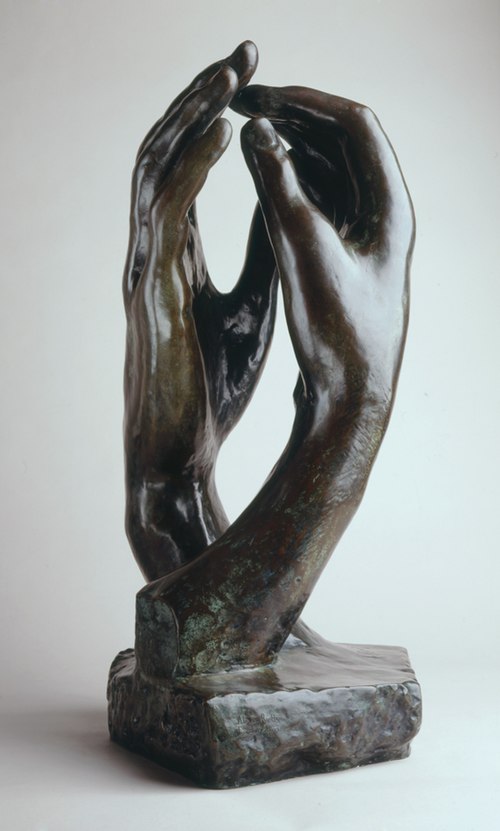
(Credits: Gericault – Web Gallery of Art/ Rodin – Wikipedia.)
Italian religious art has a tradition of depicting headless saints. In a different but thematically related context, 19th century drama and opera also explored scenes of decapitation—for example, Schiller and Donizetti, both of whom visited Naples, dramatised the fates of Mary Stuart and Anne Boleyn.
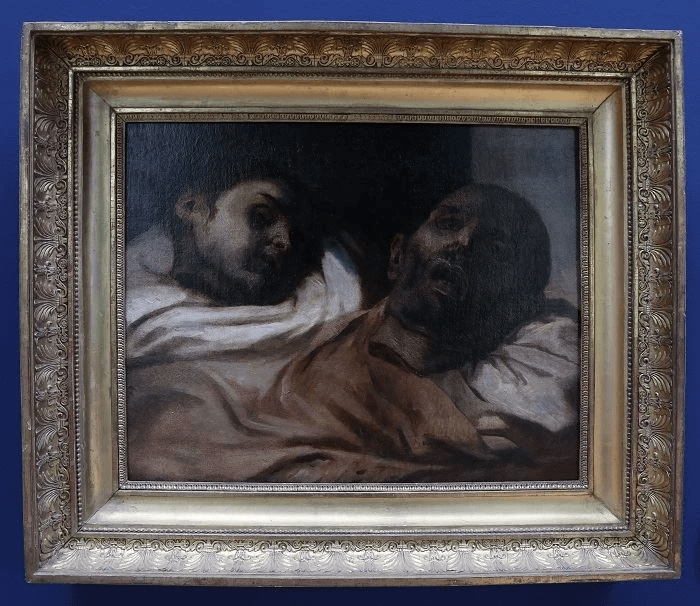
Appealing to cultural tradition does not, however, diminish the possibility that intense emotion influenced this choice. In her study The Body in Pieces, Linda Nochlin explores how bodily fragmentation preoccupies Western art from the 18th to the 20th centuries. When discussing Gericault’s Severed Heads of 1818, she observes that they “foreground…the absolute abjectness of these subjects.”
(Credit: Benjamin Blake Evemy.)
This insight can be applied, with some modification, to Gemito’s small bronze heads of Mathilde. Unlike Gericault’s heads, which convey abject poverty, suffering, and execution, Mathilde’s expression is tender rather than tormented. This contrast underscores the tragic and premature nature of her death, expressing the abjectness of losing someone beautiful and beloved too soon.
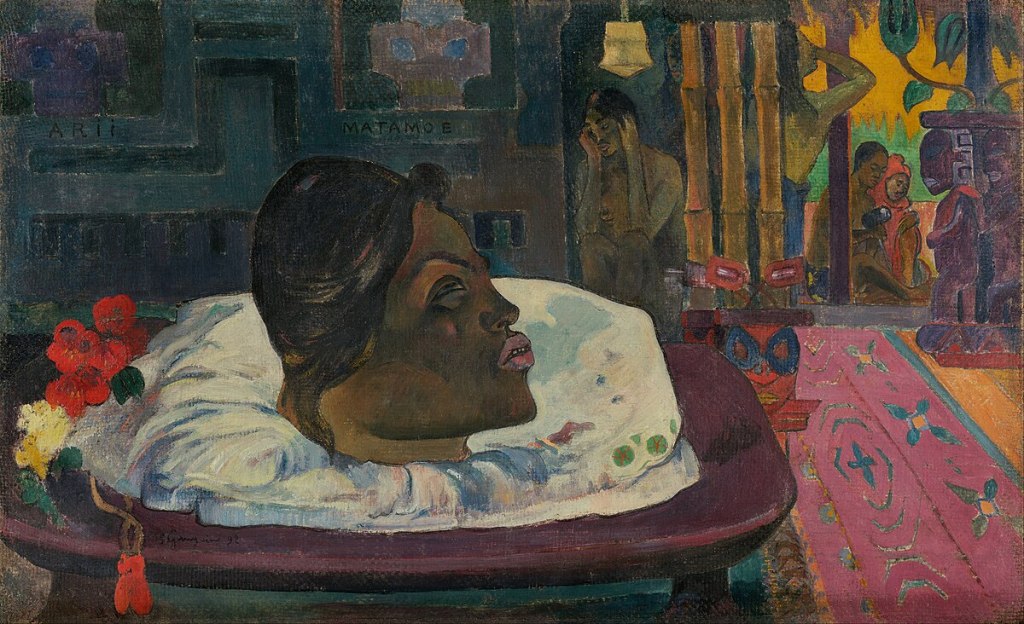
Another work that shares this macabre subject is Paul Gauguin’s 1892 painting Arii Matamoe (The Royal End). Although this work post-dates Gemito’s sculpture and therefore could not have influenced him, it may have been inspired by Gauguin witnessing an execution in Paris as a youth. The use of the guillotine in France was frequent in the 1850s and 1860s and had a widespread impact on the European psyche; moreover, this gruesome method of administering justice endured for decades. The last public execution by guillotine in France occurred in 1939, the last execution in France took place in 1977, and the death penalty was only abolished in 1981. In any case, the dramatic impact of Gauguin’s work is captured well by Elizabeth Childs: “The visage is as horrific as it is legible, for it is a severed head placed on a white pillow that sets it off with shuddering clarity” (see Homburg and Riopelle eds. Ottawa, 2019, p.146).
(Credit: Wikimedia Commons).
Returning to the particular nuances of our subject, the tender repose of Mathilde’s half-closed eyes and the human warmth captured in her face and hairstyle are cruelly contrasted by her bodiless state, which transforms her into an image of lifelessness and irrevocable loss. As Nochlin observes, the vertical form represents the “axis of beauty,” and to lose this verticality is, symbolically, to lose dignity. Reducing the human form to a horizontal fragment is de-sublimatory. In these small sculptures, love, beauty, bitter loss, and haunting memory coexist simultaneously, creating a poignant tension that lingers with the viewer.
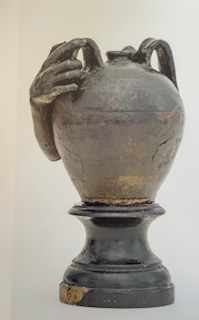
Another work by Gemito seems to reinforce this interpretation. After Anna Cutolo’s death, he sculpted a Neapolitan water jug, a mummara, with a disembodied hand reaching around its handle. This domestic object, likely symbolizing everyday life and nurture, bears two inscriptions: on the front, “Nannina,” and on the back, “so’ lacreme d’ammore e nun e acqua” (“these are tears of love, not water”). Arguably, all three sculptures are powerful expressions of lacerating grief and loss—they are sculture strazianti.
(Image credit: see below)
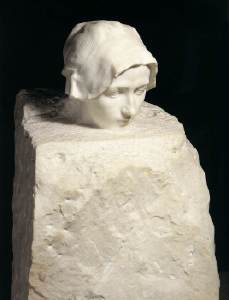
The extreme isolation of Mathilde’s head may also serve an idealising function, akin to Rodin’s sculpture Thought (c. 1895), which portrays the head of his student and fellow sculptor Camille Claudel. Originally titled Thought Emerging from Matter, Rodin’s work emphasised the idea that carving reveals an intuitive form latent within the material—and, by extension, within the artist. Similarly, Gemito’s focus on Mathilde’s head perhaps highlights it as the most expressive site of her inner life. This emphasis on the ‘seat of thought’ aligns with the purpose of a memorial: to capture not just physical likeness, but a more enduring, abstract presence.
Claudel later suffered from mental illness, and it is possible that the sculptures of both Rodin and Gemito emerged from a shared atmosphere of psychological intensity—marked by turmoil, loss, and perhaps even remorse. In Rodin’s case, the sense of loss stemmed not from bereavement, as with Gemito and Mathilde, but from the breakdown of his romantic relationship with Claudel.
(Image credit: Web Gallery of Art.)
Gemito often plays with the tension between completeness and incompleteness in his sculpture. His Mask of the Emperor Alexander loses the upper part of Alexander the Great’s head, including the characteristic hairstyle (l’anastolé) associated with his representation. This fragmentary treatment gives the statue a feeling of authenticity, although, ironically, his likely sources—the Rondanini sculpture and the Alexander as Helios from the Musei Capitolini—both have complete heads.
Conversely, in a study of Psyche, Gemito adds the upper part of the cranium, which was missing from his antique model, and masterfully includes flowing hair tied at the back of the head. Similarly, in a terracotta bust of his wife Anna, a Hellenistic vein is accentuated by leaving a broken finish on the left side of the base. As Cinzia Virno has observed, this detail lends the piece an air of antiquity.
The nature and degree of finish were, therefore, deliberate elements of Gemito’s artistic repertoire. Even a cursory glance at his portrait sculptures reveals variations in the length of his subjects’ necks, the style, angle, and definition of their shoulders, and the extent of broken-edged finishes. However, none of the works I have encountered are as severely cropped as the small sculptures of Mathilde’s head. These fragmented portraits, at the very least, arrest the viewer’s attention, disrupt the expectation of a complete form, and compel us to pause.
Feeling whole…
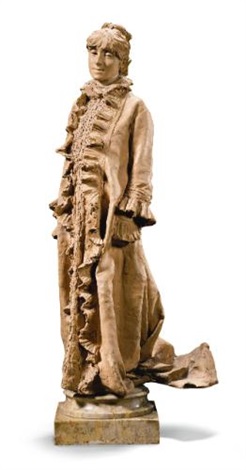
As a counterbalance to the proto-modernist rhetoric of fragmentation, we can look at some of the very human and tactile terracotta works that Gemito made of Mathilde. One terracotta portrait from 1879 depicts her in what appears to be a peignoir, with an elaborate appliqué dress underneath. The graceful vertical line of her robe is accentuated by the lace trim lining the gown’s closure. This work showcases Gemito’s skill in rendering surface texture, fine detail, and flow in sculpture. Mathilde’s face here is extremely gentle and slightly wistful.
(Credit: Artnet.)
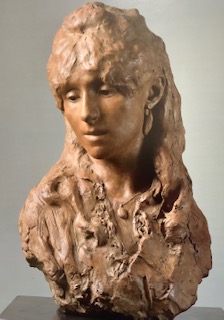
A terracotta bust of Mathilde from 1872 conveys a similar wistfulness, enhanced by the hollowing of the eyes and the slightly open mouth. Here, her face emerges in smooth clarity from the undulating surfaces of her hair and dress, which blend defined elements with areas that seem to recede into an undefined organic texture.
(Credit: see below.)
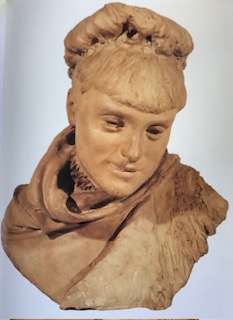
Another bust, dated 1877, shows Mathilde with a smile that seems to mask physical strain. The curve of the smile echoes other traversing lines—such as that of her shawl—and coordinates with the slight tilt of her head. Once again, skilful hollowing and shaping create chiaroscuro effects and recreate textures, notably the lace detail in her high collar. The swirl of her shawl adds a note of realism, giving the impression of a very personal, intimate moment.
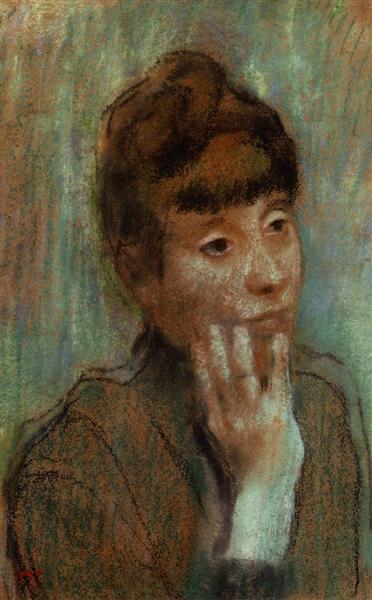
A pastel by Degas, Portrait of a Woman Wearing a Green Blouse (c.1884), while completed seven years later, makes for interesting comparison; it captures a gentle melancholy, which is similar to Gemito’s sculptures of Mathilde.
(Credits: Gemito, see below/ Degas, Artchive.)
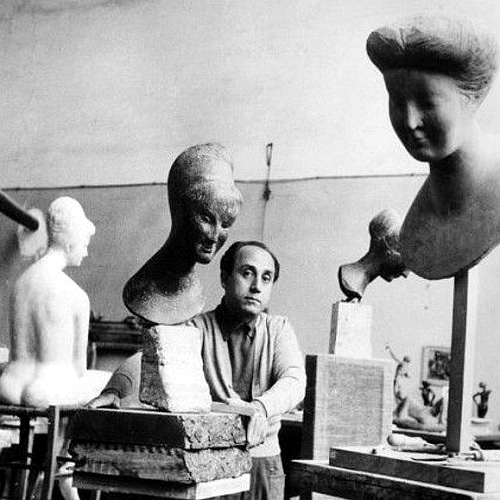
To conclude, I would like to share a quotation from Conversation with My Sculpture (Colloquio con la mia scultura), a poem by the Sicilian artist Emilio Greco (1913–2013). Its delicate evocation of captured beauty and timelessness aligns with Gemito’s tender and intimate portrayals of Mathilde:
I have stopped this moment of your beauty
To have you alone with me, companion of my thoughts
It seems you have flown out from the depths of the earth,
Like a spring,
And the path of the centuries has barely brushed
Your cheeks…
Emilio Greco in his studio.
(Credit: Edarcom Europa.)
Producing these articles requires care, time, research, and resources. Contributions to help sustain this exploration would be greatly appreciated.
https://donorbox.org/inner-surfaces-resonances-in-art-and-literature-837503
(General note on image credits – where there were no online reproductions available, I made photographs from books. The published images of Mathilde that I have consulted in research, and in some instances have photographed, are listed beneath the bibliography. I hope that these citations and the educational/not-for-profit status of the article suffice, otherwise I can make amendments as necessary.)
Bibliography
Bellenger, S. (ed.) Napoli Ottocento. Milano, 2024.
Berger, J., Go Ask the Time: https://granta.com/go-ask-the-time/ (accessed, Wed 4 June, 2025.)
Carrera, M. (et al.) Antonio Mancini/ Vicenzo Gemito. Milano, 2023.
Capobianco, F. and Mormone, M. (eds.) Vincenzo Gemito – dal salotto minozzi al museo capodimonte. Napoli, 2014.
Di Giacomo, S., Gemito: la vita, l’opera. Napoli, 2023.
Esposito, D. and Panzetta, A. (eds.) Gemito e la scultura a Napoli tra Otto e Novecento. Naples, 2012.
Farge, C. (et al.) Rodin and the Art of Ancient Greece. London, 2018.
Hiesinger, U., Antonio Mancini, 19th Century Master. Philadelphia, 2007.
Homburg, C. and Riopelle, C (eds.) Gaugin Portraits. Ottowa, 2019.
Mantura, B., Temi di Vincenzo Gemito. Roma, 1989.
Marasco, W., Il Genio dell’Abbandono. Vicenza, 2015.
Martorelli, L. and Mazzoca, F. (eds.) Da De Nittis a Gemito. Genova, 2017.
Morisani, O., Vita di Gemito. Napoli, 1936.
Nocentini, G., Vincenzo Gemito – sculture e disegni. Pesaro, 2001.
Pagano, M., Gemito. Milano, 2009.
Robertson, C., The Invention of Annibale Carracci. Milano, 2008.
Virno, C. (ed.) Vincenzo Gemito: la collezione. Roma, 2014.
(NB. The text of poem by Greco, Colloquio con la mia scultura, was photographed by me, at Greco’s permanent exhibition in Catania.)
Illustrations of Gemito’s pictures of Mathilde available in books:
Minozzi drawings – Capobianco and Mormone (2014).
Mathilde in giardino: inchiostro e acquerello, GDS 2836, p.46.
L’ombra di Mathilde: inchiostro a penna e aquerellato, GDS 2617, p.48.
Mathilde che legge: inchiostro a penna e acquerellato, GDS 2618, p.48.
Mathilde sofferente, firmato ‘V.Gemito’: inchiostro a penna e acquerellato, GDS 2778, p.49.
Mathilde allo specchio: inchiostro a penna e acquerellato, 2811, p.101.
Mathilde al Lavoro: inchiostro a penna e acquerellato, GDS 2826, p.109.
Mathilde, firmato ‘Gemito’: inchiostro a penna e acquerellato su carta quadrettata, GDS 2825, p.110.
Mathilde: matita, GDS 2822, p.112.
Mathilde di profilo: inchiostro a penna e acquerellato, GDS 2671, 117.
Mathilde di profilo: inchiostro a penna e acquerellato su carta stampata, GDS 2852, p.120.
Mathilde di profilo, firmato ‘Gemito’: inchiostro a penna e acquerellato, GDS 2637, p.128.
Mathilde in campagna: inchiostro a penna, GDS 2876, p.136.
Mathilde seduta: inchiostro a penna e acquerellato, GDS 2818, p.137.
Mathilde: inchiostro a penna e acquerellato, GDS 2909, p.141.
Mathilde: bronzo, OA 8972, p.144.
Mantura (1989).
Gemito e Mathilde, profili, p.15.
Testina di Mathilde sul cuscino (cat.54).
Testina di Mathilde (cat.53).
Mathilde al tavolo (cat.56).
Testa di Mathilde (cat.60).
Ritratto di Mathilde ammalata (cat.62).
Mathilde che ricama (cat. 57).
Pagano (2009).
Autoritratto con Mathilde, sanguigna e acquerellata, firmato ‘V. Gemito 1909,’ p.255.
Testina di Mathilde sul cuscino, bronzo, p. 232.
Busto di Mathilde, terracotta (Milano) pp.124-125.
Mathilde che legge/Mathilde in poltrona/ Mathilde sofferente/ Mathilde in giardino/ L’ombra di Mathilde, pp. 229-231.
Martorelli and Mazocca (2017).
Busto di Mathilde, terracotta (Monaco) p.170.
Ritratto di Mathilde, terracotta (Collezione privata) p.61.
Carrera (2023)
Autoritratto con Mathilde, sanguigna e acquerellata, firmato ‘V. Gemito 1909,’ pp. 122-123.
 Inner Surfaces