In January 2018, the art historian Enrico Maria Dal Pozzolo delivered a lecture on Lorenzo Lotto at the Prado Museum in Madrid, as part of a series entitled The Age of Geniuses: From Michelangelo to Arcimboldo. He began with a provocative distinction. Lotto belonged among the great talents of the Renaissance, yet, unlike Titian, Raphael or Michelangelo, he was «un perdente», a loser. Dal Pozzolo spoke with evident affection for an artist whose remarkable gifts had not brought him lasting success, and whose career was marked by repeated journeys, periods of disappointment and an increasingly urgent search for spiritual peace.
His account was deliberately personal and rhetorical, but its warmth was inseparable from his appreciation of the human dimensions of Lotto’s achievement. It offers an inviting way into the life of a painter whose work could be tender, inventive, disconcerting and psychologically penetrating. Dal Pozzolo delighted as much in Lotto’s humour and imaginative freedom as in his capacity to represent sorrow, vulnerability and religious feeling. His account was not simply a story of failure, but of an artist whose extraordinary gifts repeatedly found expression amid changing fortunes.
What follows is an elliptical and, in some respects, sentimental journey through the places and phases of Lotto’s life, guided in part by Dal Pozzolo’s affectionate account. It makes no attempt at a comprehensive biography, but offers, through a selection of paintings and episodes, an introduction to this singular artist.
Venice and Treviso: Portraying the Body and the Soul
Lorenzo Lotto was born in Venice around 1480, at a time when the Republic was among the wealthiest and most powerful states in Europe. We are invited to imagine the young artist entering a city crowded with painters, sculptors, poets, musicians and scholars, its workshops producing books for readers throughout Europe. Venetian painting was undergoing a period of remarkable development, with Giovanni Bellini at the height of his powers and the achievements of Antonello da Messina, who had visited the city in 1475–76, still exercising a considerable influence.
Little is known with certainty about Lotto’s apprenticeship. Bernard Berenson believed that he trained with Alvise Vivarini, the Murano-born painter whose work had been deeply affected by Antonello’s example. As Francesca Cortesi Bosco observes, no documentary evidence of the apprenticeship survives. Nevertheless, the influence of Vivarini, Bellini and Antonello provides an important context for Lotto’s early painting. Antonello’s psychological penetration, his ability to convey the individuality of a sitter through the concentrated observation of a face emerging against a dark background, offered an example that Lotto would develop in his own way.
By the opening years of the sixteenth century, Lotto was working in Treviso, where he is securely documented between 1503 and 1506. The city possessed an active humanist culture, centred partly upon its bishop, Bernardo de’ Rossi, a member of a distinguished family from the Parma region. Among those associated with his circle were the poet and scholar Giovanni Aurelio Augurelli and the antiquarian Girolamo Bologni. Lotto’s reputation was already considerable: in April 1505, a Trevisan notary described him as pictor celeberrimus, a celebrated painter.
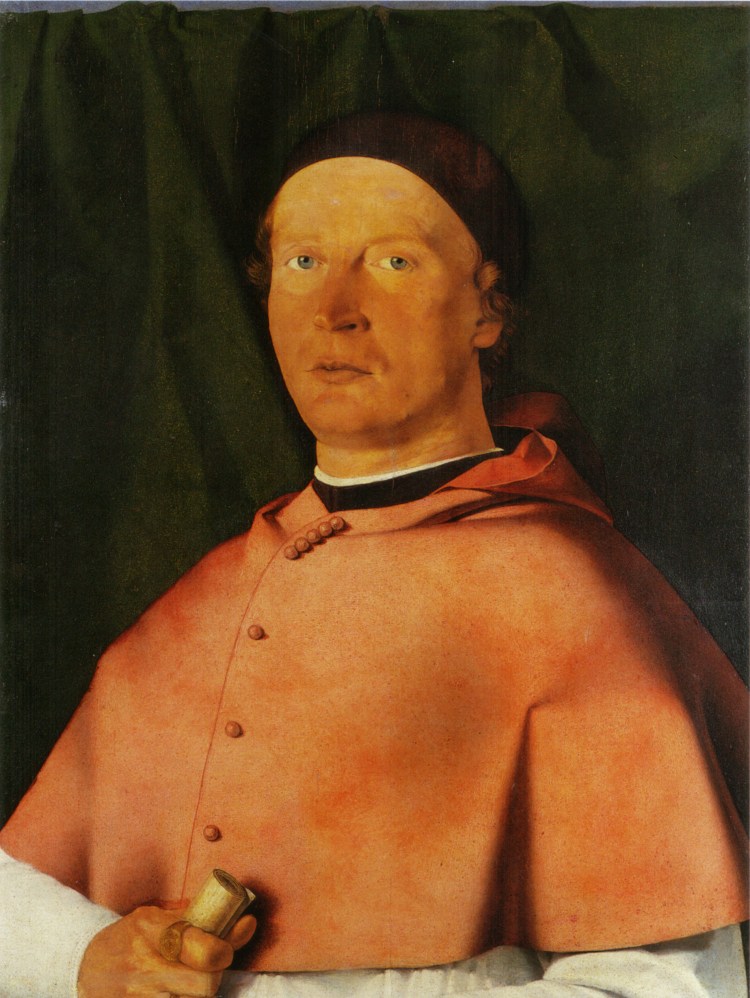
One of the most revealing works of these years is Lotto’s Portrait of Bernardo de’ Rossi (1505), now in the Museo di Capodimonte, Naples. The bishop confronts the spectator with a formidable physical presence. His broad face, penetrating eyes and firmly compressed mouth convey a personality that seems accustomed to authority. The painting owes much to Antonello and Bellini, but its forceful character also suggests Lotto’s possible acquaintance with northern European portraiture. There is little attempt to soften the sitter’s appearance or accommodate it to an ideal of ecclesiastical dignity. The painter’s attention is directed towards the particular character of the man before him.
Yet the portrait was only one part of Lotto’s conception. It was originally concealed behind a painted wooden panel, his Allegory of Virtue and Vice, now in the National Gallery of Art, Washington. The allegorical panel probably slid within grooves in the portrait’s frame, allowing it to be removed to reveal the bishop’s likeness. The two paintings were subsequently separated and are now preserved in different collections.
The Allegory presents a landscape divided between contrasting moral possibilities. On one side, a satyr reclines among overturned vessels, while a ship founders in the stormy sea beyond. On the other, a young figure attends to his instruments beneath a tree whose broken trunk has produced new growth. A path ascends towards a mountain illuminated by light, its summit concealed by cloud. The opposition between the two sides suggests different courses open to the human soul, with the mountain offering an image of spiritual aspiration.
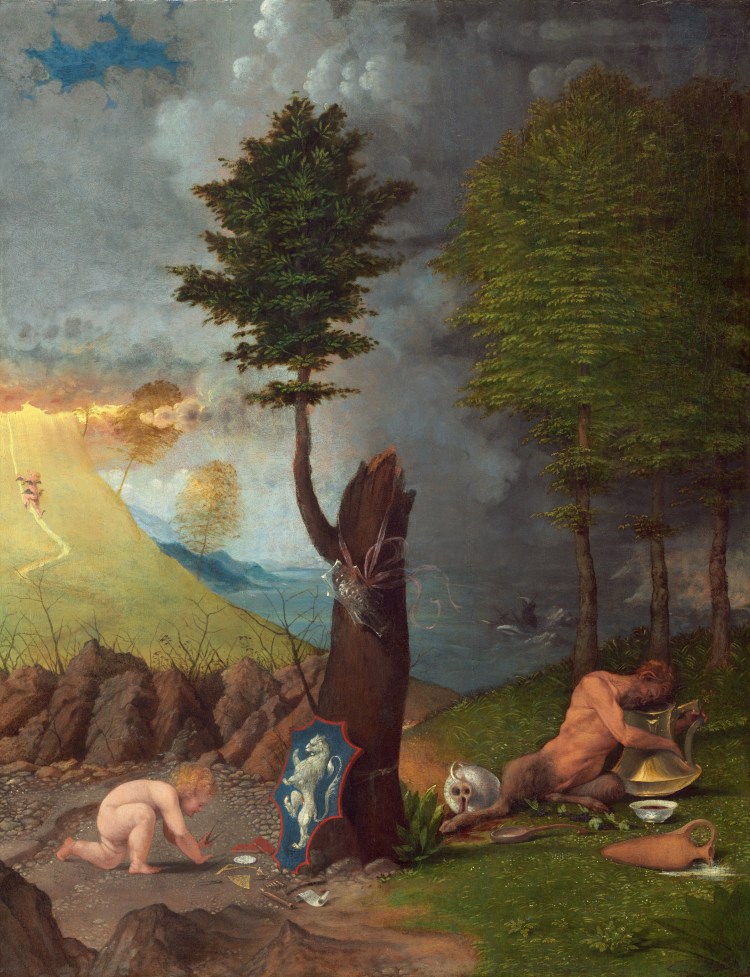
Francesca Cortesi Bosco connected the imagery with medieval philosophical and devotional texts known within the bishop’s intellectual circle. The relationship between the two paintings exemplifies what Dal Pozzolo calls «ritrarre il corpo e ritrarre l’anima», to portray the body and the soul. The portrait records Bernardo’s physical appearance, while the allegorical cover explores the moral and spiritual dimensions of his identity. The act of removing the cover to reveal the portrait must itself have contributed to the experience of the work, bringing the outward likeness into a relationship with the symbolic landscape.
Already in this early commission, Lotto was exploring possibilities that would remain central to his art. A portrait could do more than record physical resemblance or proclaim social standing. It might also suggest something of a person’s inward life, whether through expression, gesture, allegory or the objects surrounding the sitter. In the de’ Rossi paintings, the two aspects are given separate but complementary forms.
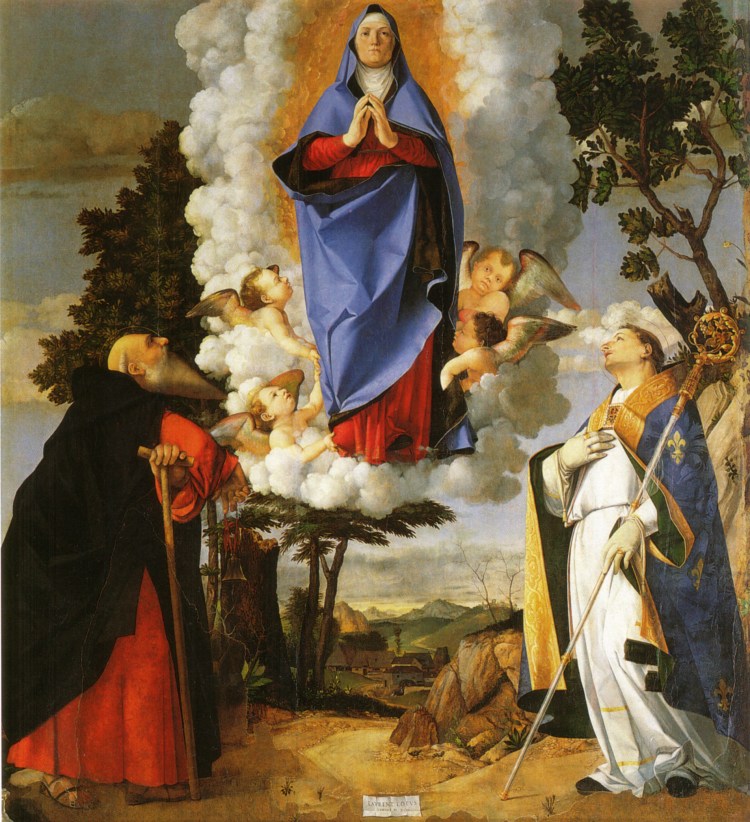
Lotto’s early achievements were not confined to portraiture. By May 1506, he had completed an altarpiece for Santa Cristina al Tiverone, near Treviso, and in the same year he painted an Assumption of the Virgin for Asolo, where Caterina Cornaro, the former Queen of Cyprus, maintained her court. Dal Pozzolo has suggested that the Virgin’s strikingly individualised features may constitute a disguised portrait, or crypto-portrait, of Caterina herself. Lotto’s reputation was carrying him beyond the immediate surroundings of Venice and Treviso. In June 1506, he contracted to paint a major polyptych for the Dominican church of San Domenico at Recanati, on the Adriatic side of the Marches.
Recanati and Rome: Triumph and Disappointment
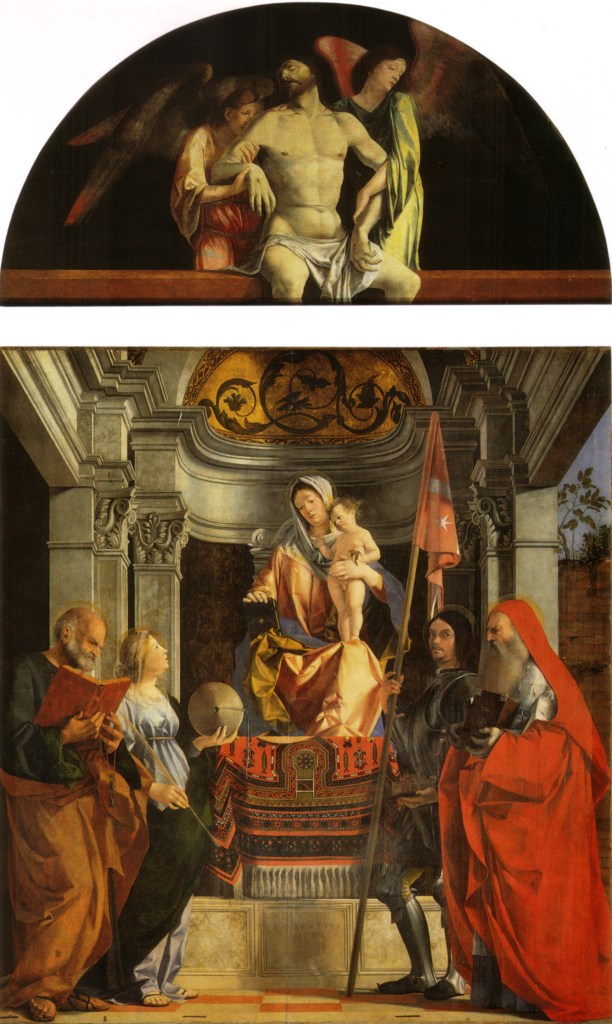
The Recanati polyptych, completed in 1508, was among the most ambitious undertakings of Lotto’s early career. Its elaborate structure, with a large central image of the Virgin and Child surrounded by panels of saints, belongs to an established tradition of altarpiece painting. Yet the richness of Lotto’s invention, the precision of his observation and the expressive character of the figures make it a remarkable achievement.
Dal Pozzolo calls it «uno dei quadri più belli del mondo», one of the most beautiful paintings in the world, praising its «miracolo di equilibrio e perfezione». These are extravagant expressions of admiration, but the painting invites precisely the kind of attentive looking that inspires them. Every panel contains passages of exquisite description, in which the textures of clothing, the features of the saints and the minute particulars of their surroundings have been rendered with extraordinary care. The fidelity to visible appearances recalls Dürer, while the composition retains something of the harmonious idealism associated with Lotto’s Venetian formation.
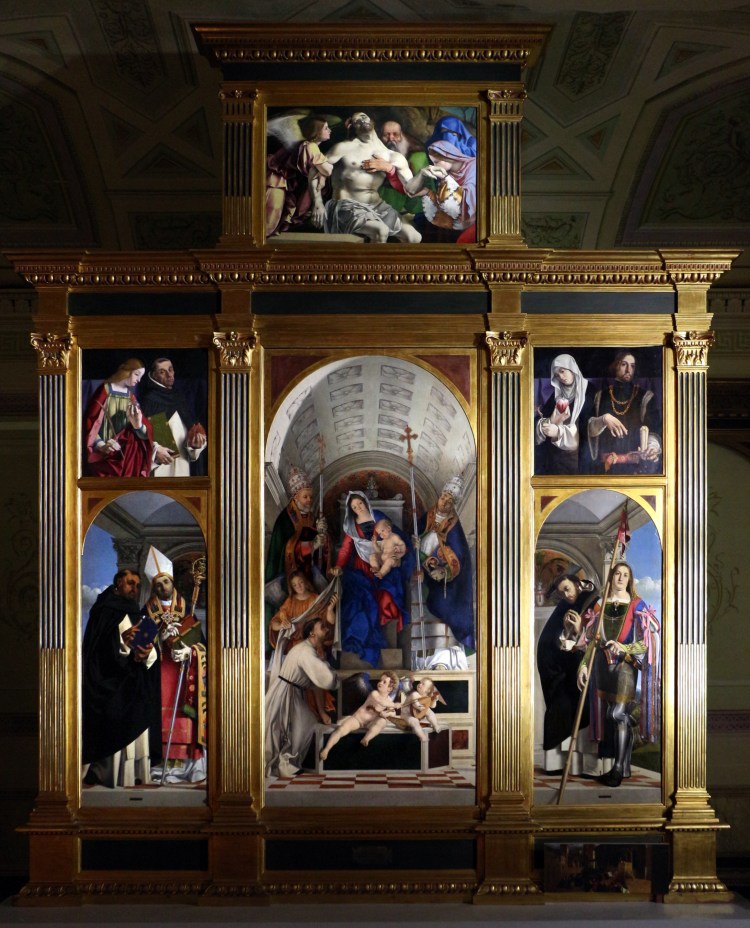
Lorenzo Lotto, Recanati Polyptych, 1506–08. Oil on panel, approximately 307 × 242 cm overall. Museo Civico Villa Colloredo Mels, Recanati. Photograph: Sailko / Wikimedia Commons, CC BY 3.0.
The emotional character of the painting is no less striking. In the panel depicting the dead Christ supported by an angel, the lifeless body is presented with a powerful physical presence. Mary Magdalene bends to kiss his hand, while Joseph of Arimathea supports his head with a fixed, concentrated gaze. Another holy woman covers her face in grief, a gesture that closes her off from the spectator even as it makes her sorrow apparent. These figures give the familiar religious scene the immediacy of a human tragedy, each responding differently to the death before them.
It is worth dwelling on such details because they reveal how Lotto’s imaginative gifts operated within the inherited structures of religious painting. The polyptych may be conventional in its general arrangement, but its individual figures are allowed considerable expressive freedom. Gesture and attention create relationships between them that are not fully contained by the boundaries of the panels. The work combines formal composure with an alertness to human feeling that would remain characteristic of the painter.
An opportunity to establish himself at the centre of Italian artistic life soon followed. Lotto was summoned to Rome, where Pope Julius II was gathering leading artists to decorate the Vatican apartments. On 7 March 1509, a papal payment records 100 ducats for Lotto’s work, and further payment followed in September. The commission was subsequently overtaken by Julius’s decision to entrust the decoration of the rooms to Raphael.
Rome presented Lotto with a different conception of artistic greatness. Here the monumental remains of classical antiquity provided models for painters and sculptors seeking to recover the achievements of the ancient world. The recently discovered Laocoön, the Belvedere Torso and the surviving monuments of Roman architecture offered examples quite different from the refined pictorial traditions within which Lotto had trained. There was an almost feverish enthusiasm for antiquity, «una sorta di ossessione» in Dal Pozzolo’s words, with artists studying, copying and adapting its forms.
One painting that may be associated with this experience is Lotto’s Saint Jerome in Penitence, now in the Museo Nazionale di Castel Sant’Angelo, Rome. The saint’s powerful, muscular body appears in a landscape that includes a recognisable view of Castel Sant’Angelo itself. Far from presenting Jerome as a frail ascetic, Lotto gives him a heroic physical presence. Dal Pozzolo describes him as «un San Girolamo trionfante nella sua penitenza», a Saint Jerome triumphant in his penitence. The monumental treatment of the torso suggests an encounter with classical sculpture, while the extended arm may reflect Lotto’s exposure to the art of Michelangelo, although this remains conjectural.
The painting presents a fascinating moment in Lotto’s development. His Saint Jerome is still recognisably a figure of penitence, immersed in the landscape and accompanied by the familiar attributes of the saint, but his body possesses a sculptural authority absent from many earlier Venetian treatments of the subject. Lotto could respond to the artistic possibilities offered by Rome without wholly abandoning the expressive character of his own painting.
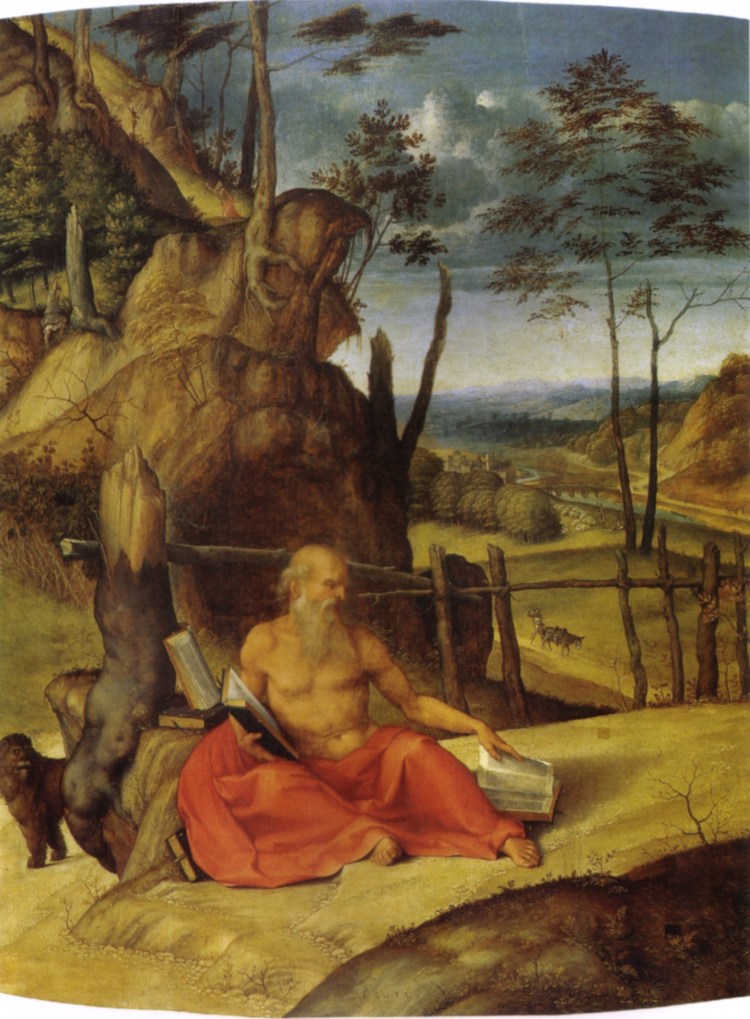
Lorenzo Lotto, Saint Jerome in Penitence, c. 1509–10. Oil on panel, approximately 85 × 61 cm. Museo Nazionale di Castel Sant’Angelo, Rome. Image: Wikimedia Commons, public domain.
The replacement of Lotto’s work in the Vatican by Raphael’s decoration must nevertheless have been a serious disappointment. Dal Pozzolo imagines Lotto leaving Rome professionally defeated, confronted by the ascendancy of an artistic language quite different from his own. However, the painter’s personal response is undocumented, and Francesca Cortesi Bosco has suggested that he may have continued to engage with Roman artistic developments after Raphael took over the commission. The paintings of the following years certainly reveal a dialogue with what Lotto had encountered in Rome.
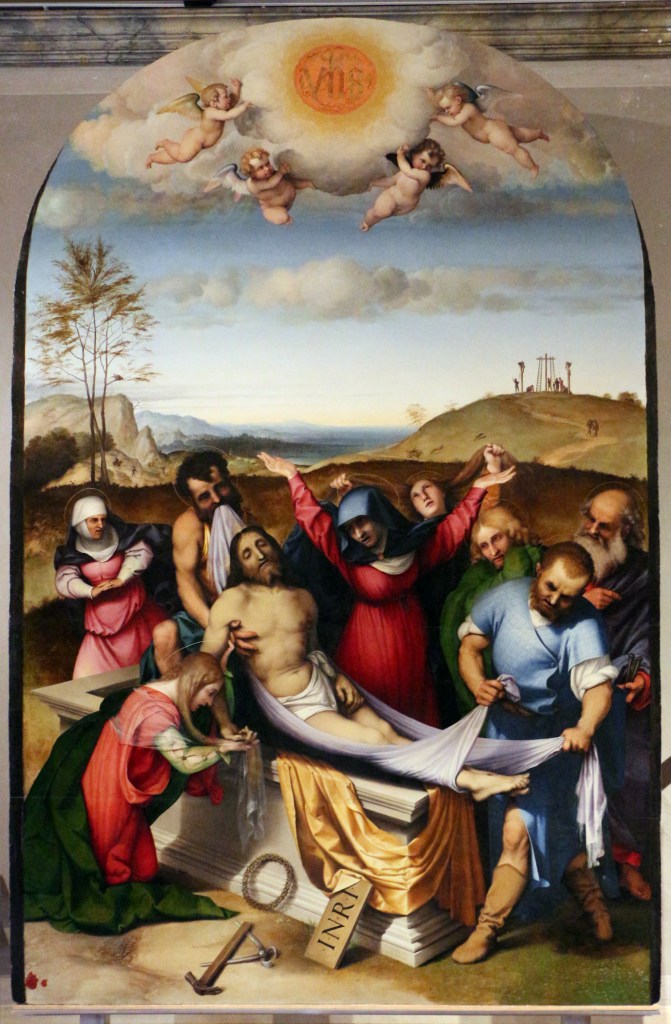
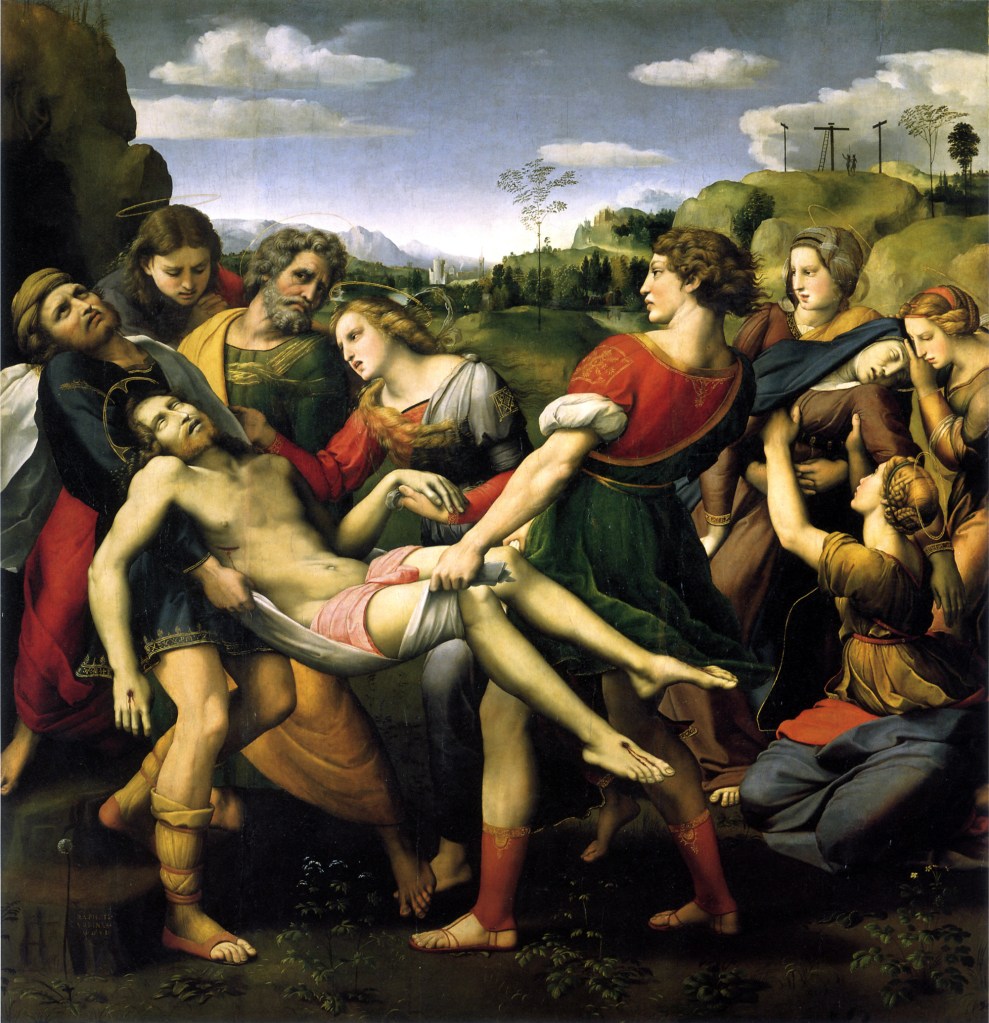
The Deposition for Jesi, commissioned in 1511 and completed in 1512, has been compared with Raphael’s Entombment, painted for Atalanta Baglioni in Perugia. Lotto takes Raphael’s model in a more expressionistic direction, heightening the gestures and emotional agitation of the figures. The measured classical balance of Raphael’s composition gives way to an insistence upon the physical and psychological strain of carrying the dead Christ.
Another work of these years, the Transfiguration at Recanati, offers a striking contrast with the polyptych of 1508. The earlier painting had displayed an almost miraculous equilibrium, its figures arranged within a carefully ordered structure. In the Transfiguration, conventional spatial depth is compressed, while the apostles in the foreground appear to tumble towards the spectator. Their bodies and gestures create a sense of instability, as though the extraordinary event on the mountain has unsettled the space in which they stand.
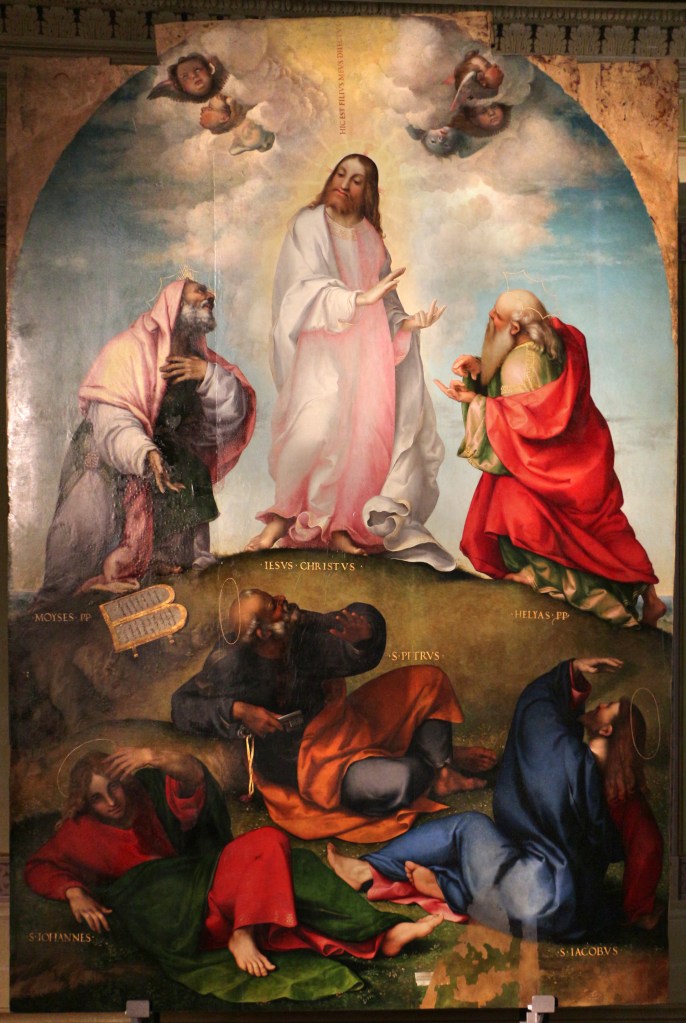
The contrast is sufficiently marked for Dal Pozzolo to describe the Lotto who emerged from the Roman experience as «un uomo in crisi», a man in crisis. The phrase is characteristic of his interpretation of Lotto’s career, but it need not be taken as a diagnosis. What the paintings reveal is an artist reconsidering his means of expression in the light of powerful new experiences. He had encountered Raphael’s achievement and the monumental language of Roman painting, yet continued to favour emphatic gestures, emotional immediacy and a willingness to disturb conventional arrangements of figures and space.
For Lotto, the Roman episode had brought both opportunity and disappointment. It had also enlarged the range of artistic possibilities available to him. Further commissions followed in the Marches, before he moved across Italy once again, this time towards Bergamo. There he would enter one of the most productive and inventive periods of his career, finding patrons willing to embrace the individuality of his painting.
Bergamo: Invention and Success
Lotto’s move to Bergamo brought a welcome change in his fortunes. In May 1513 he secured the commission for a large altarpiece financed by Alessandro Martinengo Colleoni, a descendant of the celebrated condottiere Bartolomeo Colleoni. By the summer of 1514 he had settled in Bergamo, where he would remain for much of the following decade. The city was under Venetian rule, but its artistic circumstances differed from those of Venice itself. Wealthy merchants and established families were eager to commission paintings for their churches and homes, and Lotto found patrons receptive to his gifts.
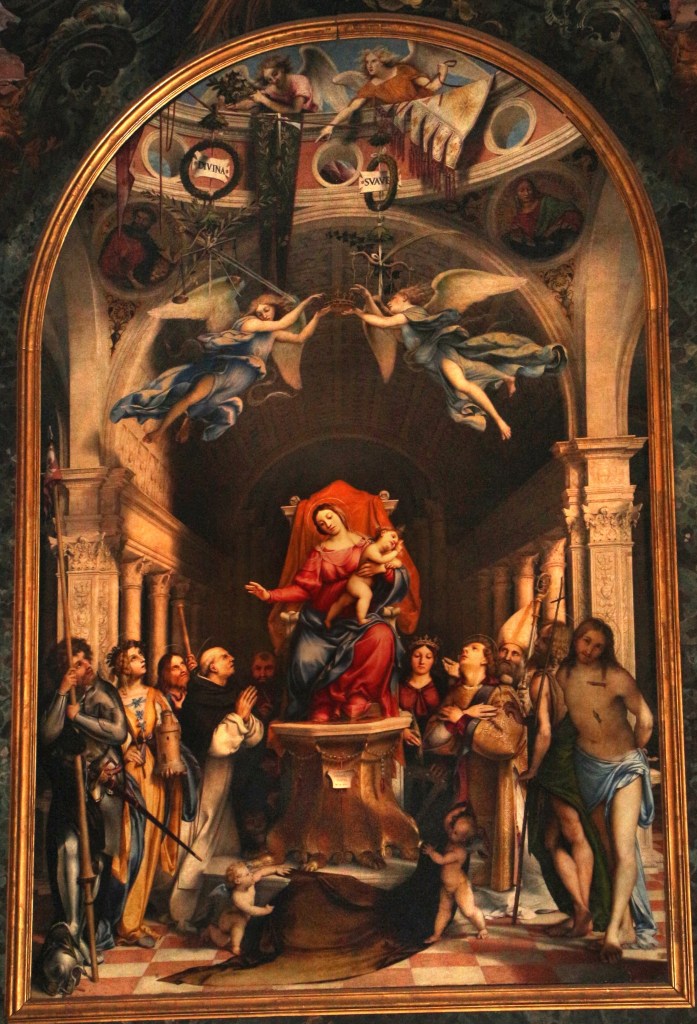
The Martinengo Altarpiece, completed in 1516, was the largest painting of his career. The Virgin and Child are enthroned within a magnificent architectural setting, accompanied by saints who occupy the foreground and gather around the throne. Above them, two angels fly beneath the vaulted ceiling, their movements introducing a note of freedom into the grandeur of the composition. The elaborate architecture, rich colour and variety of human figures reveal Lotto working on a scale worthy of the opportunities he had once hoped to find in Rome. Yet the painting retains a liveliness of gesture and incident that gives individual character to its sacred assembly.
It was in portraiture, however, that some of his most engaging inventions emerged. During the Bergamo years, Lotto painted members of prosperous merchant families whose ambitions were not confined to conventional displays of wealth and status. His portraits frequently involve the spectator in an unfolding action or invite the interpretation of objects and gestures. They make us curious about the people before us, and about the relationships in which they participate.
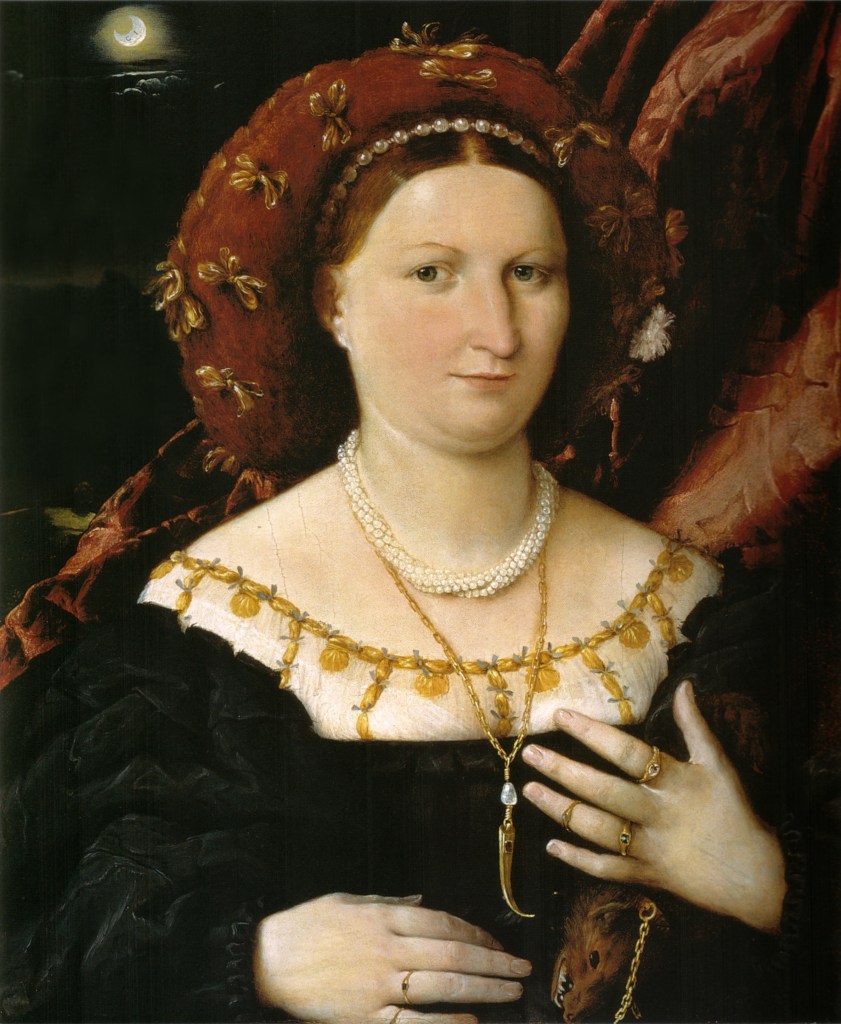
The Portrait of Lucina Brembati, painted around 1521–23, shows a richly dressed woman adorned with jewellery, rings and an elaborate headdress. Her appearance is recorded without conventional idealisation, but the dignity of her bearing and the splendour of her clothing proclaim her position in Bergamasque society. Lotto has also introduced a small visual puzzle. Against the dark background, a crescent moon is intersected by the letters CI, forming a rebus of her name: Lu-CI-na. The conceit is characteristic of his pleasure in joining exact description to wit and symbolic invention.
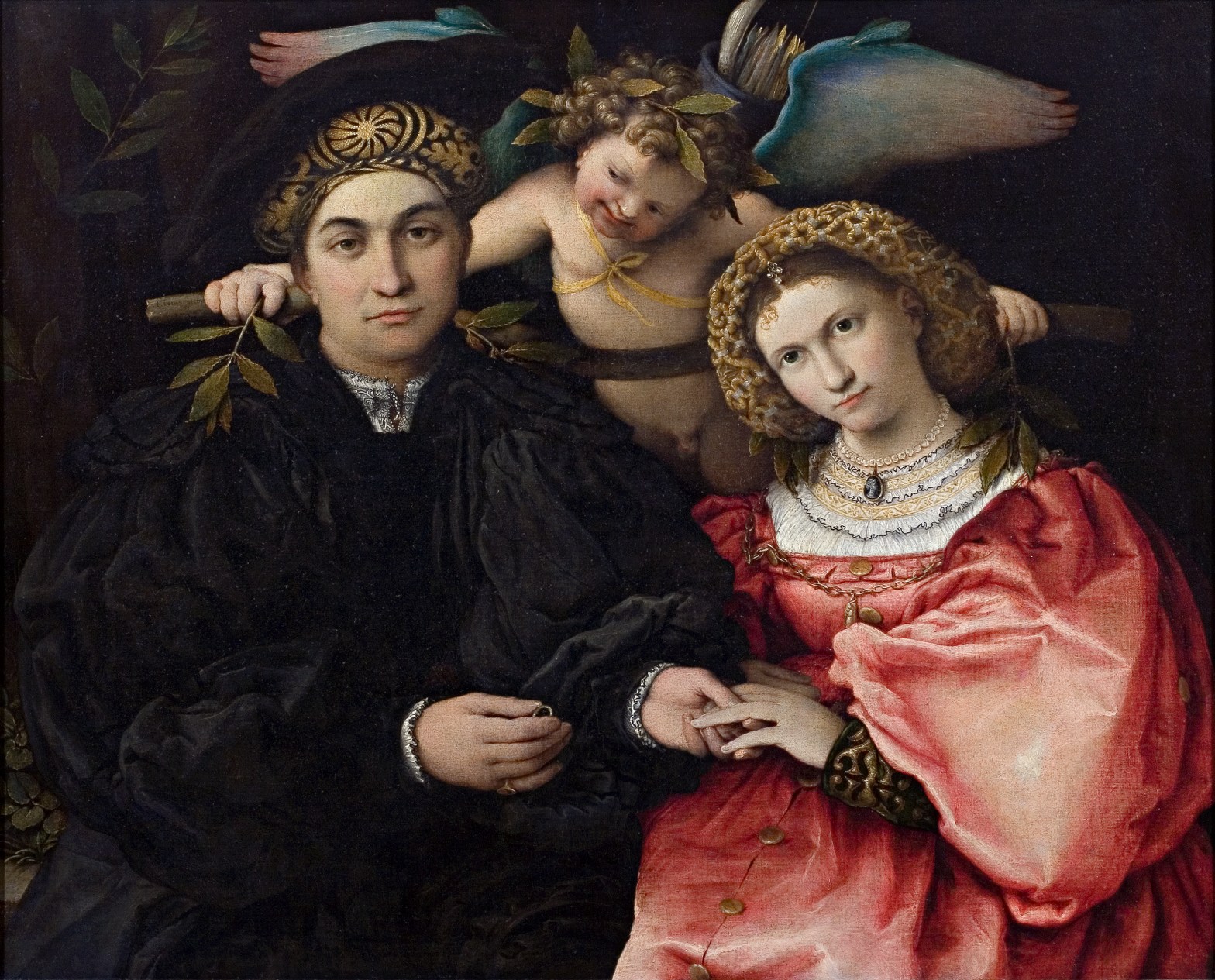
An even more striking departure from conventional portraiture appears in Marsilio Cassotti and His Wife Faustina, dated 1523, now in the Prado. Rather than presenting husband and wife as separate, motionless figures, Lotto represents a moment of action. Marsilio places a wedding ring on Faustina’s finger as she extends her hand towards him. Behind them, Cupid prepares to lower a yoke across their shoulders, a playful allusion to the bonds of marriage. The yoke is made of laurel, carrying associations of virtue as well as suggesting the obligations of married life.
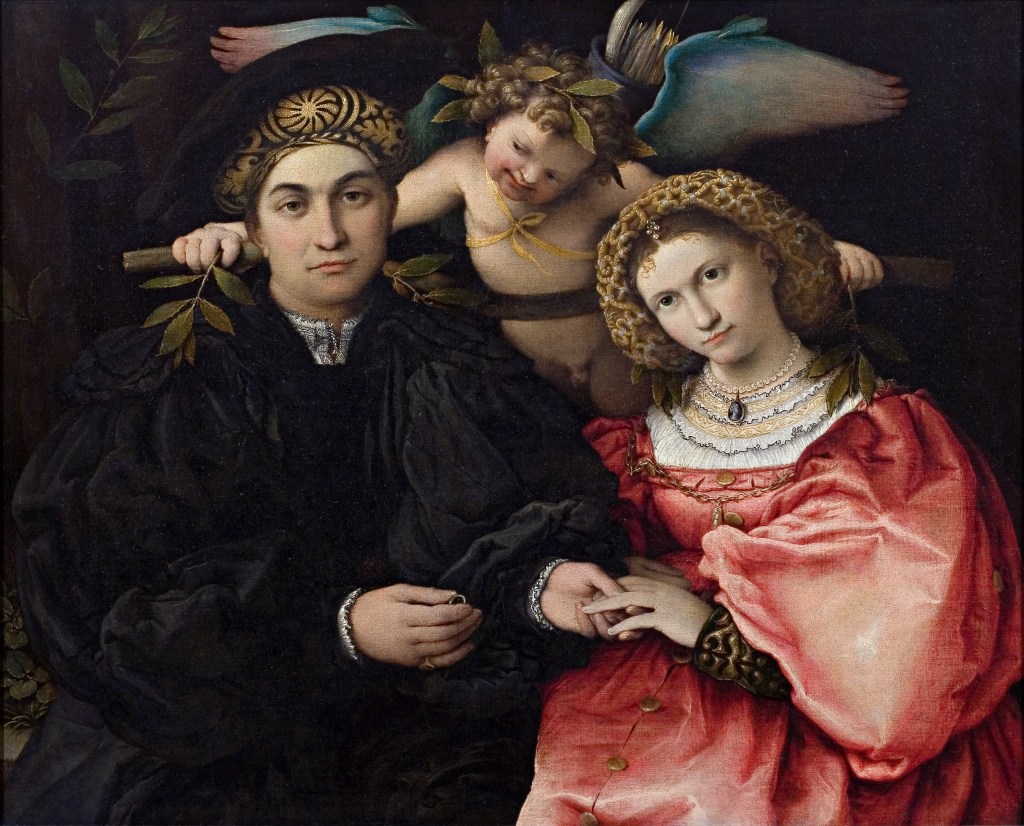
Dal Pozzolo recalls Berenson’s observation that Lotto could represent «le dolcezze e le nevrosi di un matrimonio», the sweetness and neuroses of marriage. The phrase catches something of the painting’s mixture of tenderness, formality and humour. Marriage is celebrated, but its responsibilities are quite literally poised above the couple. The ceremony becomes an event unfolding before our eyes, with a small divine participant who introduces a note of gentle comedy. Lotto has turned a double portrait into a narrative about human attachment, its promises and its constraints.
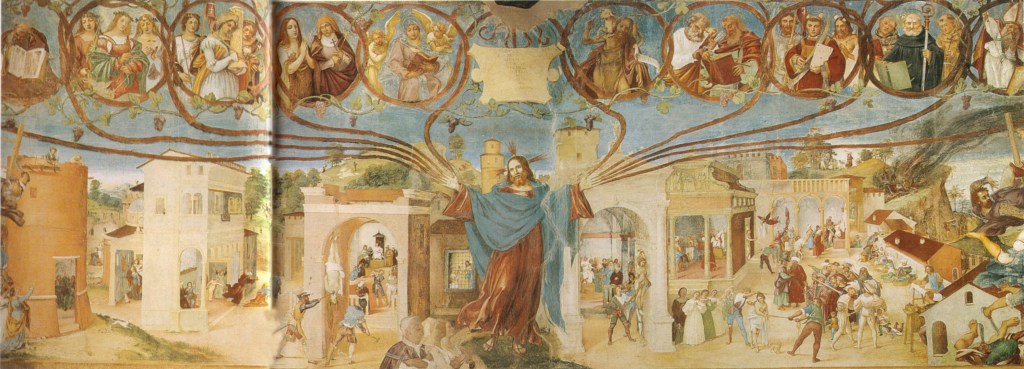
His freedom of invention was equally apparent in religious painting. At the Suardi Chapel in Trescore Balneario, decorated in 1524, he devised an extensive fresco cycle in which biblical allegory and episodes from the lives of saints unfold across the walls. The most arresting invention is the transformation of Christ into a vine, recalling his words in the Gospel of John: ‘I am the vine, ye are the branches’ (John 15:5). The vine spreads across the composition, with saints appearing among its branches and figures identified as heretics attempt to climb towards the faithful, only to be repelled by Saints Jerome and Ambrose.
The imagery is complex, yet its imaginative force is immediately apparent. Christ’s body becomes the living source of an elaborate pictorial structure, in which the faithful are joined to him through the spreading branches. The attempts of the heretics to reach the faithful introduce movement and conflict into an allegory of religious unity. Lotto gives a theological idea a physical form that can be explored through the actions of its participants.
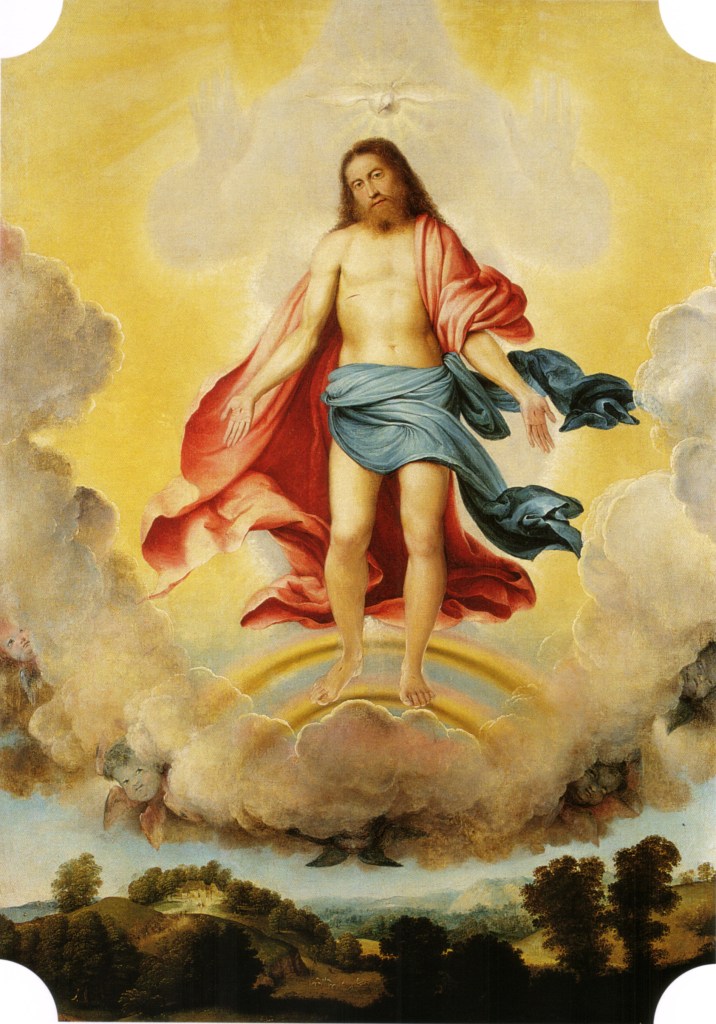
Another painting from these years, the Trinity, presents the problem of representing the invisible. Christ appears in human form and the Holy Spirit as a dove, while God the Father is suggested through a luminous, shadowy presence emerging among clouds. The painting exemplifies Lotto’s willingness to reconsider the visual conventions of sacred subjects, seeking forms appropriate to mysteries that resist ordinary representation.
The Bergamo years offered Lotto opportunities to exercise his imagination across an extraordinary range of subjects, from monumental altarpieces and elaborate religious allegories to portraits of merchants and their families. The wit of the marriage portrait, the visual play of Lucina Brembati’s name and the visionary imagery of the Suardi Chapel reveal different aspects of an artist who could move between the familiar circumstances of human life and the mysteries of religion without surrendering his delight in invention.
In 1525 Lotto began preparing to return to Venice. He left Bergamo with a considerable body of work behind him, and with an established reputation among patrons who had valued the individuality of his painting. Whether that reputation would serve him equally well in his native city remained to be seen.
Venice: An Artist Out of Step
When Lotto returned to Venice in 1525, he came back to a city whose artistic character had changed considerably during his absence. Titian had become the dominant figure in Venetian painting, commanding an international reputation and the patronage of powerful men. Lotto brought with him the achievements of his Bergamasque years and a confidence in his powers of invention, but the distinctive qualities that had won him admirers elsewhere did not necessarily accord with the tastes prevailing in his native city.
His Portrait of Andrea Odoni, signed and dated 1527, is among the most ambitious works of this period. Odoni was a wealthy Venetian merchant of Milanese descent, with a passion for classical antiquities. Lotto represents him surrounded by sculptures, fragments and coins, in a setting that evokes the world of the Renaissance collector. Yet this is no conventional portrait of a man displaying his possessions. Odoni seems to inhabit a world of images and objects whose meanings are as important as their beauty.
He turns towards the spectator, holding out a small statuette of Diana of Ephesus, the many-breasted goddess associated with fertility and abundance. His other hand rests against his chest, partly concealing a cross. The juxtaposition invites a distinction between the attractions of the ancient world and the claims of Christian faith. Dal Pozzolo relates the statuette to Odoni’s desire for an heir, while the Royal Collection has interpreted the gesture towards the cross as an indication that Christianity takes precedence over pagan antiquity. Neither reading need exclude other meanings within a composition so densely furnished with allusions.
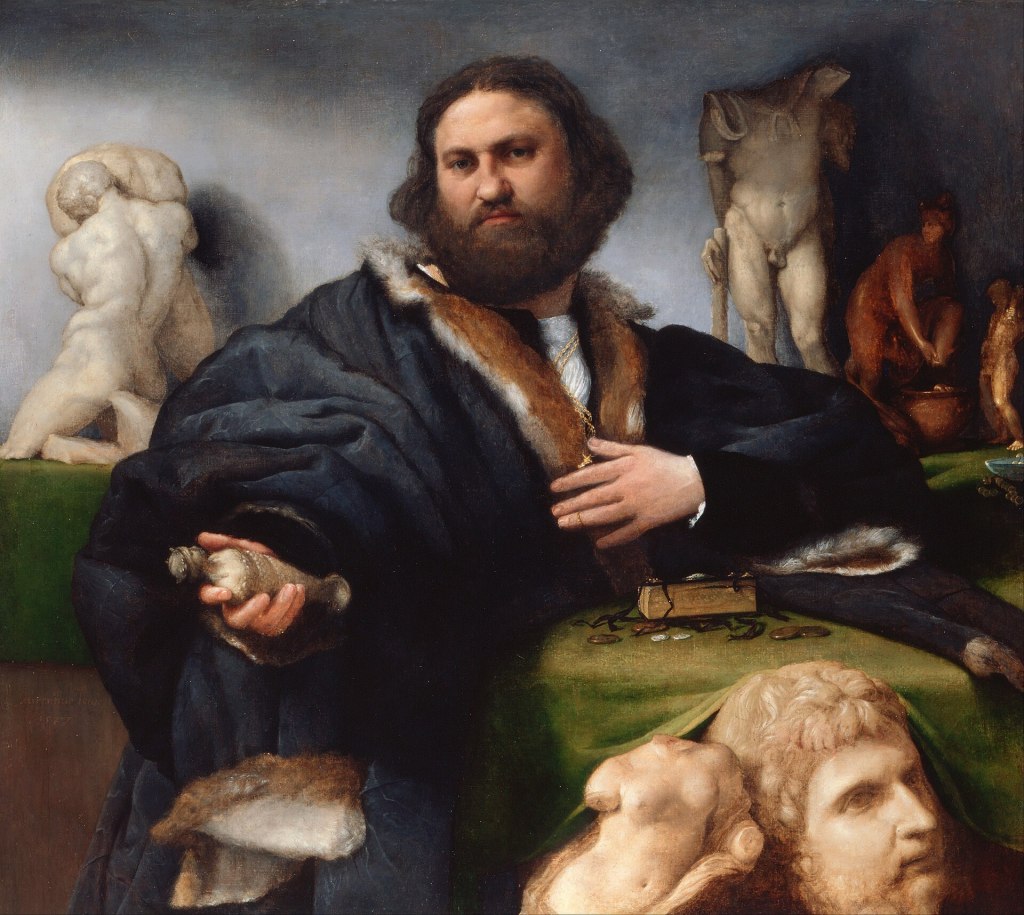
There is something theatrical about Odoni’s presentation. The movement of his hands, the turn of his head and the varied positions of the sculptures establish a lively relationship between the sitter and the spectator. The collection of antiquities does more than proclaim learning or wealth. It invites the eye to move from one object to another, while Odoni himself appears to offer us a choice between different kinds of value.
In this respect, Lotto’s earlier concern with portraying the inner life of his sitters has taken a more elaborate form. The physical likeness is inseparable from the objects surrounding it. As in the portrait of Bernardo de’ Rossi, outward appearance and inward identity are brought into a relationship, though here they occupy a single pictorial space rather than two separate panels. The result is a portrait of considerable intellectual ambition, capable of standing beside the achievements of Titian without simply imitating them.
Lotto also sought to establish himself through commissions for Venetian churches. In 1527 he received an important commission from the merchants’ confraternity associated with Santa Maria dei Carmini, producing the Saint Nicholas in Glory with Saints John the Baptist and Lucy, completed in 1529. The painting presents St Nicholas enthroned upon clouds above an extensive landscape, accompanied by angels, while the two standing saints occupy the foreground.
The altarpiece is distinguished by its cool, luminous colouring and the expansive landscape beneath the heavenly apparition. Its forms possess a clarity quite different from the rich tonal harmonies associated with Titian. Even while responding to the achievements of his celebrated contemporary, Lotto retained his preference for sharply differentiated colour and a more individual arrangement of figures and space.
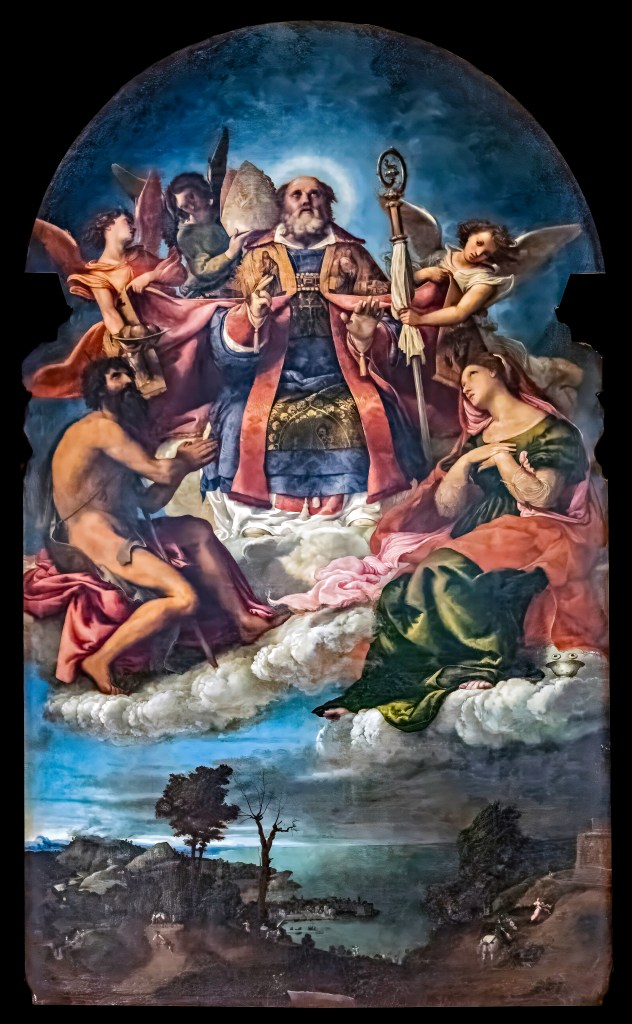
The painting did not establish the position in Venice that Lotto might have hoped for. He received relatively few public altarpiece commissions in his native city, despite the quality of his work. Later criticism would find fault with his colouring, measuring his achievements against the increasingly authoritative example of Titian. Dal Pozzolo treats this period as the beginning of a slow erosion of Lotto’s professional confidence, a process he likens to the modern experience of being systematically undermined.
The language is forceful, and the historical circumstances were more complicated than a simple opposition between a successful Titian and an unsuccessful Lotto. Yet the painter’s own correspondence reveals genuine anxiety. In a letter from these years he described his mind as troubled by «varie et strane perturbatione», various strange disturbances. He also expressed a desire to withdraw from the world, «potersi sequestrare al mondo». Such remarks give Dal Pozzolo’s account of the artist’s vulnerability a documentary foundation, although they cannot explain every development in his painting.
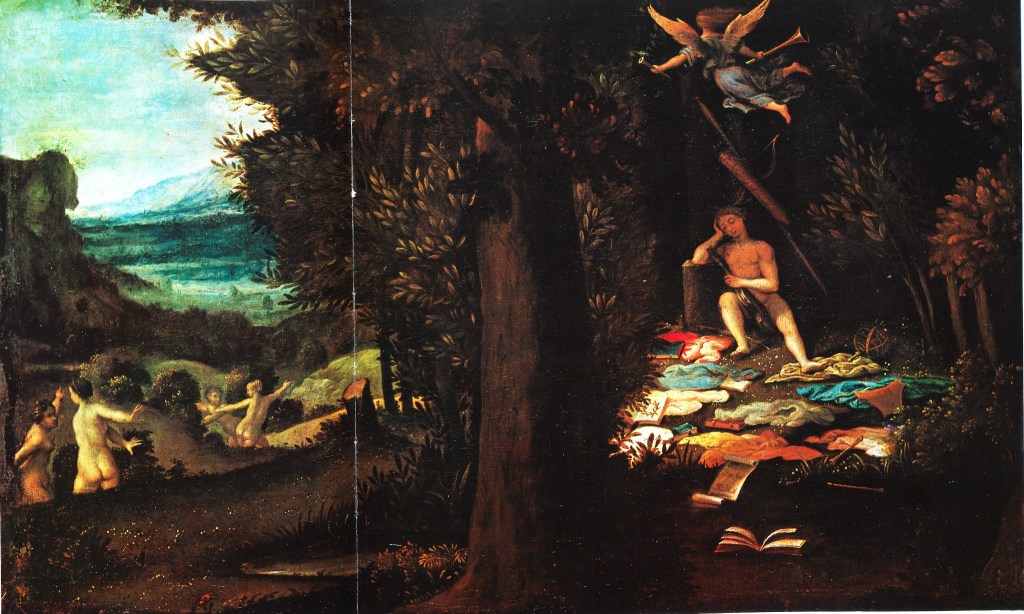
Lotto’s inventiveness had certainly not deserted him. In the Apollo Asleep with the Muses Departing, which Francesca Cortesi Bosco places in these years (although the Budapest museum dates it to around 1549), the god of poetry and music sleeps while the Muses abandon him. The reversal of the familiar image of Apollo presiding over the arts is striking. Dal Pozzolo tentatively suggests that the sleeping god, deprived of his companions and apparently unaware of their departure, might reflect something of Lotto’s own predicament. There is an irony in the suggestion: Lotto’s powers of invention are nowhere more apparent than in this image of inspiration taking its leave.
During these years Lotto continued to work for patrons outside Venice, particularly in the Marches. His career had never been confined to a single city, and his relationships with patrons across the Adriatic remained important. By 1533 he had returned to the Marches, where he would once again find opportunities for religious painting. The move was another stage in a life marked by repeated departures and returns, but it also brought him back to a region in which some of his most memorable works would be created.
The Marches: Devotion and Imagination
Lotto returned to the Marches in 1533, following a period in Venice marked by professional uncertainty and a growing desire for withdrawal. His connections with patrons in the region had never been broken. Now, rather than working for the Marches at a distance, he was once again living among the towns where his paintings were commissioned and displayed. The religious works of these years reveal an imagination still alert to the intimate, sometimes disconcerting ways in which the sacred enters human experience.
The Recanati Annunciation offers a particularly memorable example, although its date remains disputed. Peter Humfrey places it around 1534–35, after Lotto’s return, whereas Francesca Cortesi Bosco associates it with paintings sent from Venice in 1527. In the Virgin’s chamber, Gabriel approaches from behind Mary, who turns towards the spectator with raised hands and an expression of alarm. A frightened cat darts across the floor. The curtained bed, carefully arranged furnishings and garden beyond establish a domestic tranquillity suddenly disturbed by the arrival of the angel. Lotto gives the miraculous event the immediacy of a startling encounter. It is a painting to which we will return at greater length.
Other commissions carried Lotto through the towns of the Marches during the decade. Yet it is the Madonna of the Rosary, painted in 1539 for the Confraternity of the Rosary at Cingoli, that offers the fullest opportunity to appreciate the continuing richness of his invention. The Virgin and Child are enthroned among saints, while above them fifteen medallions represent the mysteries of the Rosary, arranged against a luxuriant rose garden. The whole is an elaborate structure of devotion, bringing episodes from the lives of Christ and the Virgin into a single pictorial field.
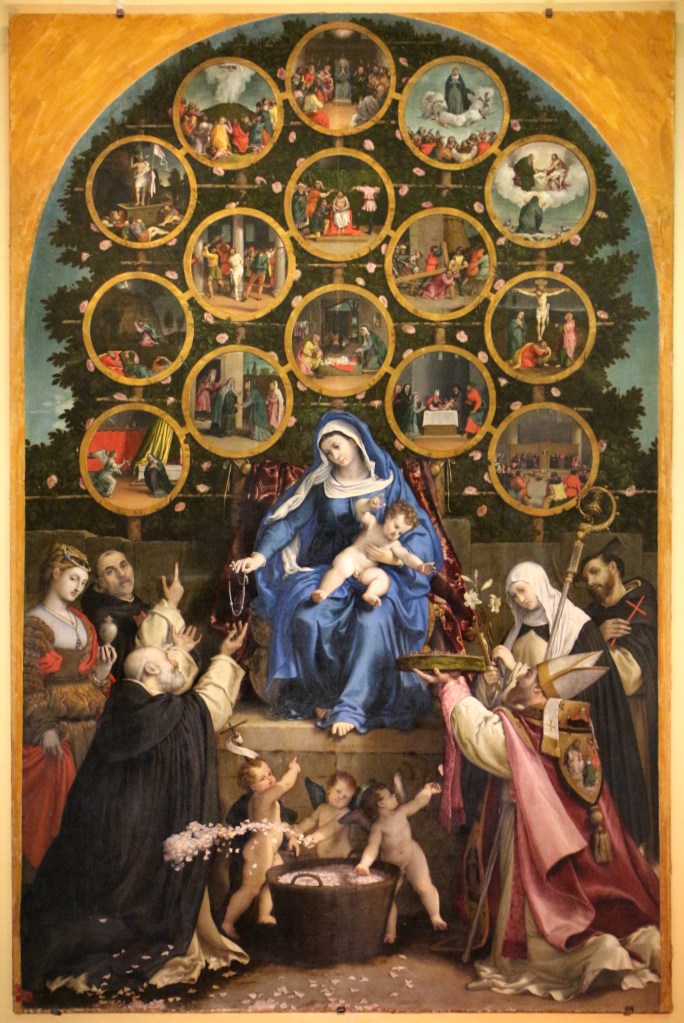
The individual mysteries reward close attention. Their small scale invites the spectator to move from one scene to another, following an unfolding sacred history within the larger image. The saints below, meanwhile, inhabit a different order of space, gathered around the Virgin and Child. Lotto allows these different modes of representation to coexist: the meditative sequence of the Rosary above and the immediate presence of the sacred figures below.
Perhaps the most captivating invention appears near the bottom of the composition. Three little angels gather around a basin filled with white rose petals. Two of them scatter the petals outwards, towards the space occupied by the spectator. The detail delighted Dal Pozzolo, who drew attention to Lotto’s enduring ability to surprise and amuse. The children seem entirely absorbed in their activity, introducing movement and play into the formal gathering of saints.
The scattered petals also bring the devotional imagery into a more direct relationship with the spectator. The Rosary’s associations with the rose are present throughout the painting, but Lotto gives them tangible form through the children’s gestures. Their playfulness belongs to the religious meaning of the work without becoming merely an illustration of it. Francesca Cortesi Bosco identified the shower of petals as an expression of Lotto’s poetic imagination nourished by close observation of life.
By the end of 1539, Lotto was preparing to leave the Marches once more. From Macerata he pressed for payment for the Cingoli altarpiece, explaining that he wished to depart the province and return home. The move would take him back to Venice, where the surviving Libro di spese diverse, begun in 1540, allows us to follow his working life in exceptional detail. Its record of paintings, payments, materials and debts brings us closer to the practical circumstances behind his art, as the last phase of his career unfolds.
Venice and Treviso: The Truth of Portraiture
Lotto’s return to Venice around 1540 brought him once again into a city where his artistic gifts had not secured the position he might have hoped for. He was now approaching sixty. For a time he lived with his nephew Mario d’Armano, a lawyer who welcomed him into his household, while maintaining a workshop near the Rialto. His surviving Libro di spese diverse records the practical details of his existence, from the purchase of pigments and the payment of debts to the commissions through which he attempted to sustain himself. It also reveals a man dependent upon friendships, loans and the generosity of those willing to offer him a home.
One of his most substantial religious commissions was the Alms of Saint Antoninus, painted between 1540 and 1542 for the Dominican church of Santi Giovanni e Paolo. The saint, Archbishop of Florence, appears seated high above the scene, receiving petitions from those who seek assistance. Below him, intermediaries distribute alms to a crowd of poor men, women and children who have gathered beneath the architectural setting.
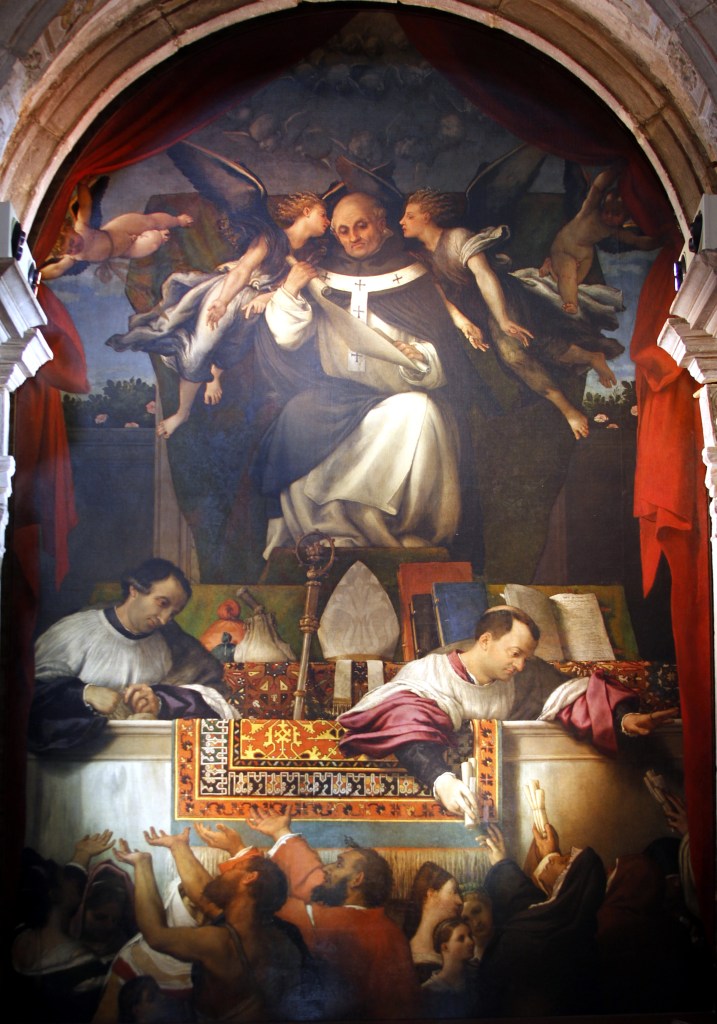
The painting gives visible form to an organised system of charity, with the saint presiding over the distribution and others carrying out his instructions. Yet Lotto’s attention is drawn towards the individual people seeking help. Their faces, gestures and attitudes convey different experiences of need. Some press forward, others wait, and the varied movements of the crowd suggest the disorder of human circumstances within the orderly administration of charitable assistance.
The painting was intended to communicate a particular understanding of the duties of Christian charity, but its humanity resides partly in the way Lotto has represented the recipients. Dal Pozzolo draws attention to the painter’s sympathy for those whom society might otherwise overlook: «i poveri, i mendicanti, le vedove», the poor, the beggars and the widows. Such figures were rarely the subjects of independent portraits, yet Lotto gives them an individuality that makes their presence felt. The painting becomes not simply an illustration of charity, but an image of human vulnerability.
Dal Pozzolo also suggests that Lotto may have included his own likeness among the recipients of charity. The figure at the centre of the crowd, with his arms spread open, has been interpreted as a possible self-portrait. If so, the painter has placed himself among those in need, adding a personal dimension to an already moving representation of Christian charity.
Some of the money due to Lotto for this commission was left to the Dominican friars to provide for his funeral and burial. It was an arrangement consistent with his longstanding religious attachments, but it also offers an intimate glimpse of an ageing painter increasingly concerned with the circumstances of his own death.
In October 1542, Lotto moved to Treviso, where he hoped to lead a quieter life. He was welcomed into the household of Giovanni dal Savon, an old acquaintance whose family offered him companionship and affection. The move returned Lotto to one of the cities in which he had first established his reputation, nearly forty years earlier. There he found commissions among families whose connections with him reached back to his youth.
The portraits of these years are among the most penetrating of his career. In the Portrait of a Gentleman with Gloves, now at Brera, an elderly man stands against a dark background, dressed with restrained elegance. His face is sober and reflective, marked by age but retaining a commanding presence. The gloves, held in his hands, become a focus of attention through their delicately observed material and the quiet precision with which the fingers grasp them.
Dal Pozzolo recalls an encounter with the elderly Venetian painter Luigi Tito (the son of Ettore Tito), who, on hearing that he was studying Lotto, immediately remembered «quel guanto di Lorenzo Lotto nel ritratto di Brera», that glove in Lotto’s portrait at Brera. The recollection says something about the power of a seemingly minor detail. The glove is an object of extraordinary pictorial refinement, but its importance is inseparable from the person who holds it. Lotto’s attention to the material world becomes a means of intensifying the presence of the sitter.
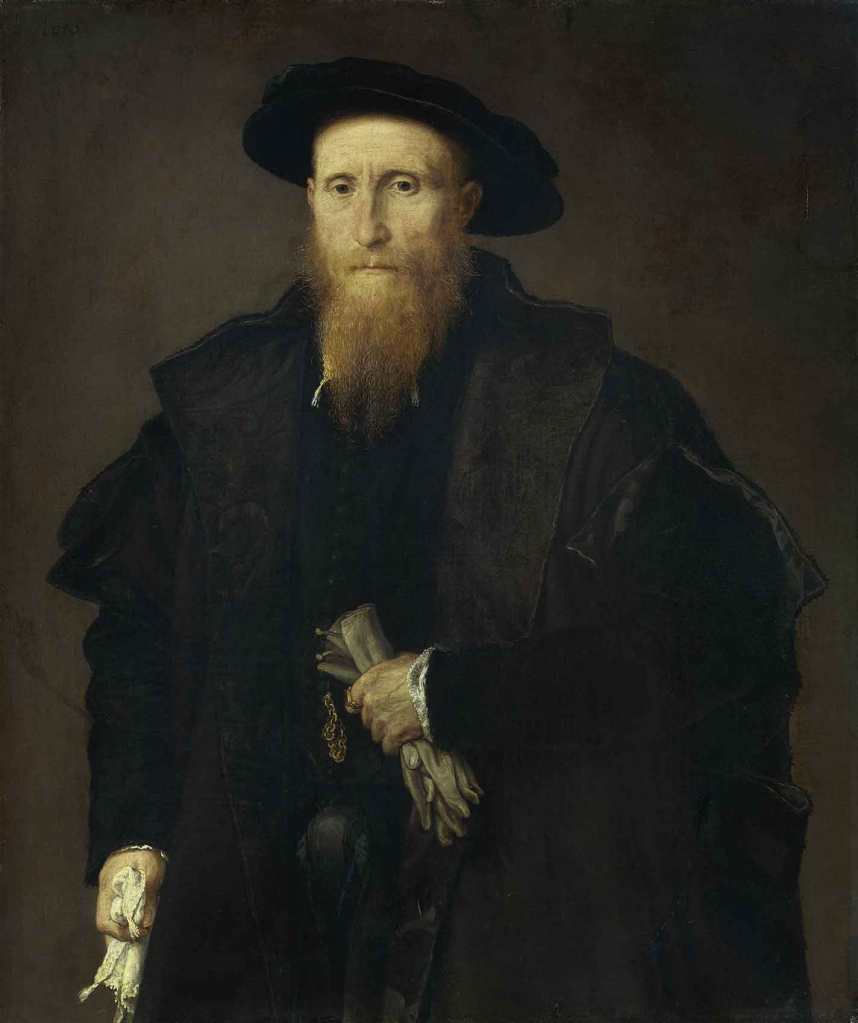
Dal Pozzolo describes the portraits of these years as «ritratti veri, intensi, troppo veri», true, intense portraits, almost too true. The phrase recalls the psychological penetration that had distinguished Lotto’s earliest likenesses, but the emphasis has shifted. There is less of the youthful delight in riddles and elaborate allegorical invention, and more attention to the difficult, sometimes melancholy circumstances of human existence.
The paired portraits of Febo da Brescia and Laura da Pola, painted in 1543–44 and now also at Brera, offer a revealing comparison with the marriage portrait of Marsilio Cassotti and Faustina from the Bergamo years. Febo and Laura are presented separately, each surrounded by the signs of wealth and social standing. Febo’s elegant dress and assured bearing convey the dignity of a prosperous citizen, while Laura, considerably younger than her husband, sits amid luxurious furnishings, holding a feather fan and displaying her jewellery.
The contrast between the two sitters is suggestive. Febo’s bearing appears confident, while Laura’s expression is more reserved, giving little away about her feelings. Dal Pozzolo sees a change from the exuberant happiness of the earlier marriage portrait to «un velo di tristezza e di paura, come un’ombra di malinconia», a veil of sadness and fear, like a shadow of melancholy. This is an imaginative response to the paintings rather than evidence about the couple’s marriage, but it registers something of the difference between Lotto’s treatment of the two relationships.
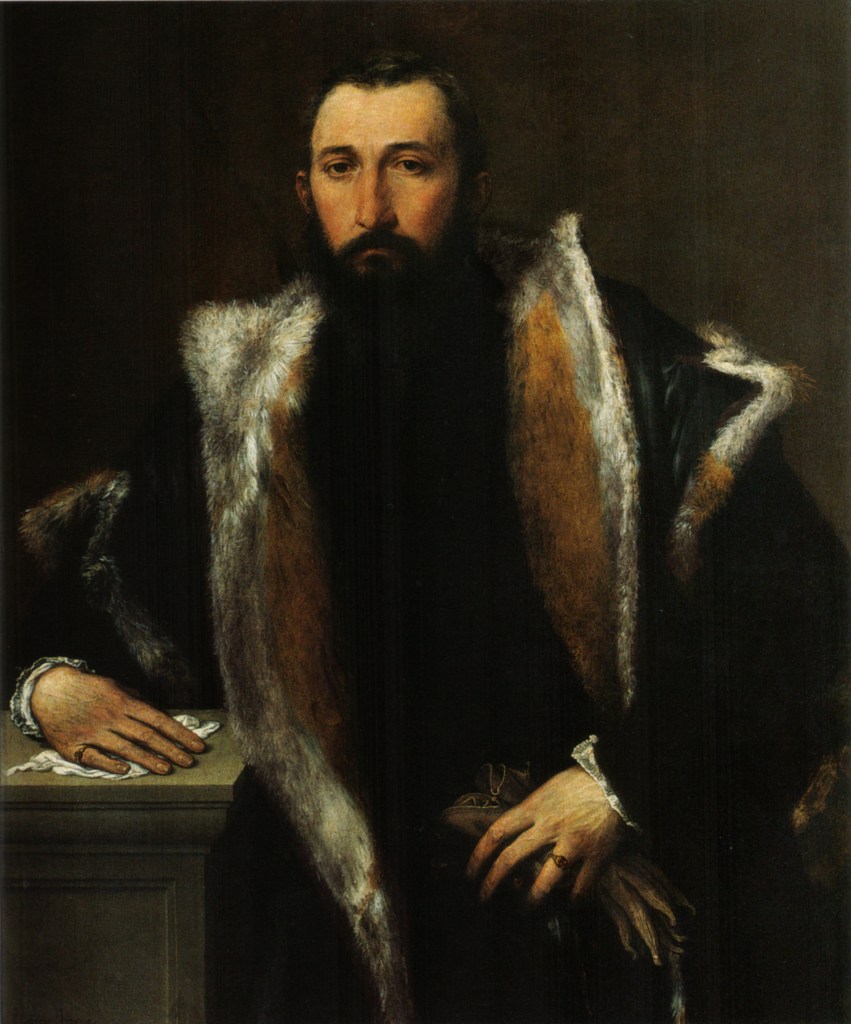
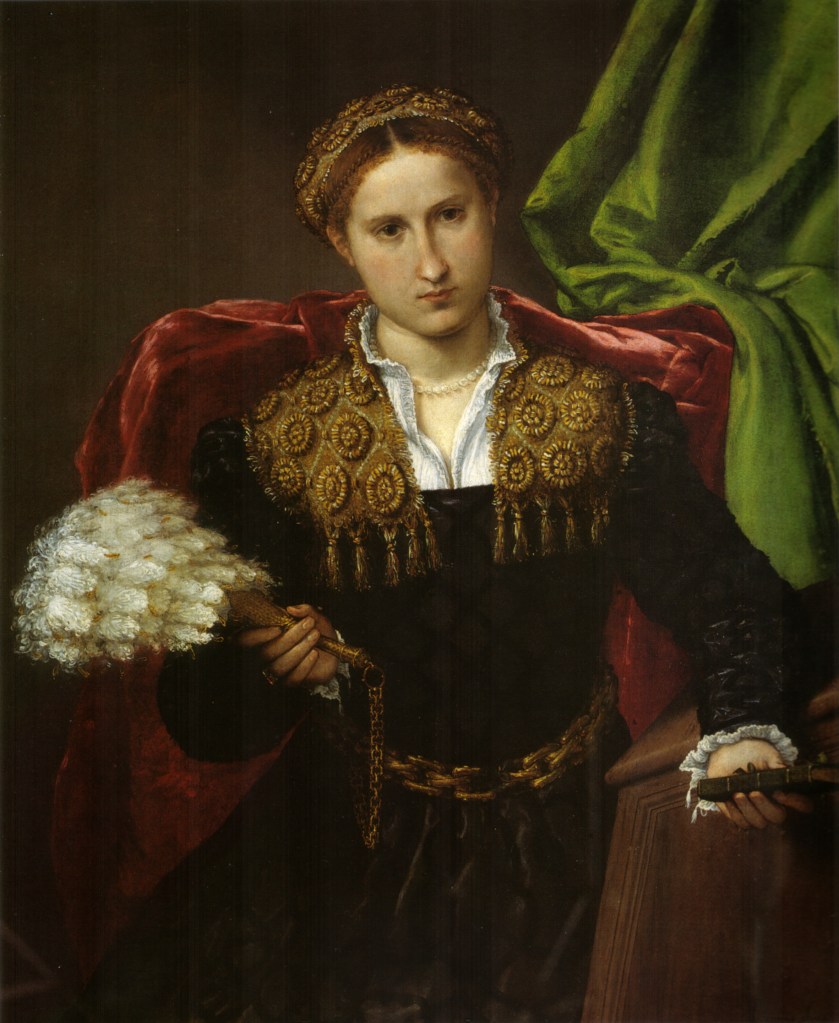
The youthful Marsilio and Faustina had been united within a single composition, with Cupid lowering his playful yoke above their shoulders. By contrast, Febo and Laura occupy separate spaces, their outward dignity accompanied by a greater sense of emotional distance. The paintings reveal Lotto’s continuing fascination with marriage, social identity and the uncertain relationship between appearance and feeling.
An even more haunting image of loss appears in Lotto’s Portrait of a Gentleman, now in the Galleria Borghese, Rome. Its date remains disputed, with proposals ranging from the late 1520s to the early 1540s, although Peter Humfrey favours around 1535. The sitter, dressed in black, stands in a sparsely furnished interior. One hand rests against his body, while the other touches a small accumulation of rose and jasmine petals on a table, among which lies a miniature skull. Two wedding rings are visible on his little finger. Through a window in the background, St George confronts the dragon.
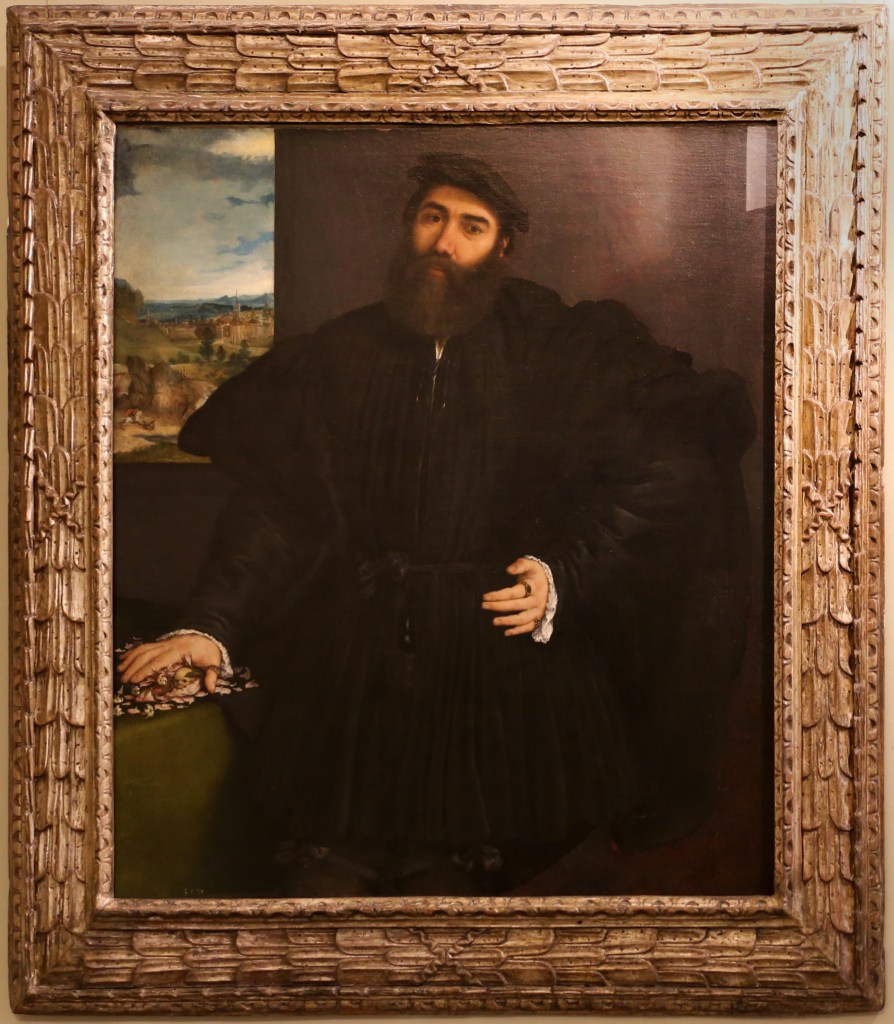
The painting has been associated with the military commander Mercurio Bua, whose life was marked by bereavement, although the identification is far from certain. The rings, the flowers and the skull suggest mourning and the transience of life, but Lotto leaves the precise circumstances of the sitter’s grief unresolved. His expression is restrained, almost withdrawn, while the objects before him give tangible form to thoughts of mortality. Here the psychological intensity of Lotto’s portraiture is inseparable from a delicately observed still life. The painting invites us to contemplate a private sorrow without claiming to disclose it entirely.
These were years of considerable activity, but also of persistent financial anxiety. Lotto’s account book records commissions that were poorly paid, payments that had to be pursued and portraits that patrons did not always accept. His determination to record the individuality of his sitters, including features they might have preferred to conceal, could bring him into conflict with those who expected a more flattering likeness. Dal Pozzolo suggests that this commitment to psychological truth, accompanied by a more personal vulnerability to criticism and rejection, may have contributed to the difficulties of Lotto’s professional life.
By December 1545, Lotto had returned to Venice. He was still working, still forming attachments and still seeking commissions, but his circumstances remained precarious. The following years brought further portraits and religious paintings, together with periods of illness and continuing anxiety about money. His position stood in painful contrast to that of Titian, whose reputation extended across Europe and whose presence at the imperial court offered an example of the worldly success that Lotto had never achieved.
In April 1548, Pietro Aretino wrote to Lotto with greetings from Titian, then in Augsburg in the service of Charles V. The letter praised Lotto’s personal goodness and religious virtue, but its compliments concealed an uncomfortable distinction. Titian enjoyed the favour of the great and the rewards of artistic fame; Lotto, Aretino suggested, might look instead towards the greater glory awaiting him in heaven.
Dal Pozzolo hears in this letter a note of cruelty, a reminder that Lotto’s spiritual qualities were being praised precisely where his artistic standing was being diminished. The interpretation is characteristic of his affectionate account of the painter’s disappointments. Yet the contrast between the two artists was real enough. Titian had secured a commanding place in the artistic world of his time, while Lotto, despite the originality and intensity of his work, continued to struggle for the recognition and security he desired.
The journey was approaching its final stage. Once again, Lotto would turn towards the Marches, and eventually towards Loreto, where his search for a quieter existence would acquire a more explicitly spiritual meaning.
Ancona and Loreto: Finding Peace
In 1549, Lotto left Venice for the last time. He was approaching seventy, and the difficulties that had accompanied his later career were becoming increasingly burdensome. His destination was Ancona, where he had obtained a commission for a large Assumption of the Virgin for the church of San Francesco alle Scale. The journey returned him to the Marches, a region where he had worked repeatedly since his early successes at Recanati.
The Assumption, completed around 1550, shows that Lotto’s capacity for large-scale religious invention had survived his professional disappointments. The Virgin rises towards heaven, surrounded by angels, while the apostles below respond to her disappearance with an extraordinary variety of gestures. Some raise their arms, others turn towards their companions, and the group is animated by a sense of collective astonishment. The miracle takes place before witnesses whose movements and expressions register the difficulty of comprehending what they have seen.
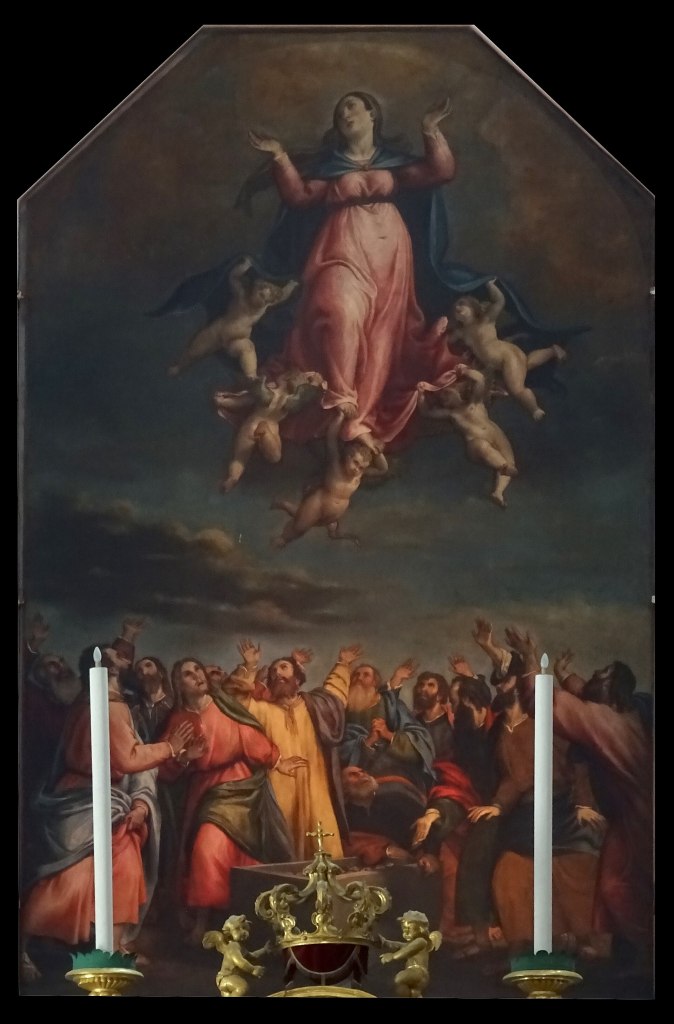
Lotto had returned many times to the problem of representing the miraculous through human responses. The startled apostles in his earlier Transfiguration at Recanati had almost tumbled out of the pictorial space. Here, too, the gestures of the figures give the event its emotional immediacy. The religious subject retains its grandeur, but the people gathered beneath the Virgin are neither passive spectators nor merely ornamental participants. Their bewilderment is part of the painting’s imaginative life.
Lotto’s circumstances in Ancona were nevertheless far from secure. His account book records his efforts to obtain payments, dispose of unsold paintings and find further commissions. In 1551 he organised a lottery to sell paintings that remained in his possession. The undertaking met with disappointing results. There is something poignant in the spectacle of an artist whose work had once attracted distinguished patrons attempting to find purchasers through such an expedient. Dal Pozzolo gives this episode a particular place in his account of Lotto’s disappointments, although the painter continued to work and to maintain relationships with patrons and acquaintances.
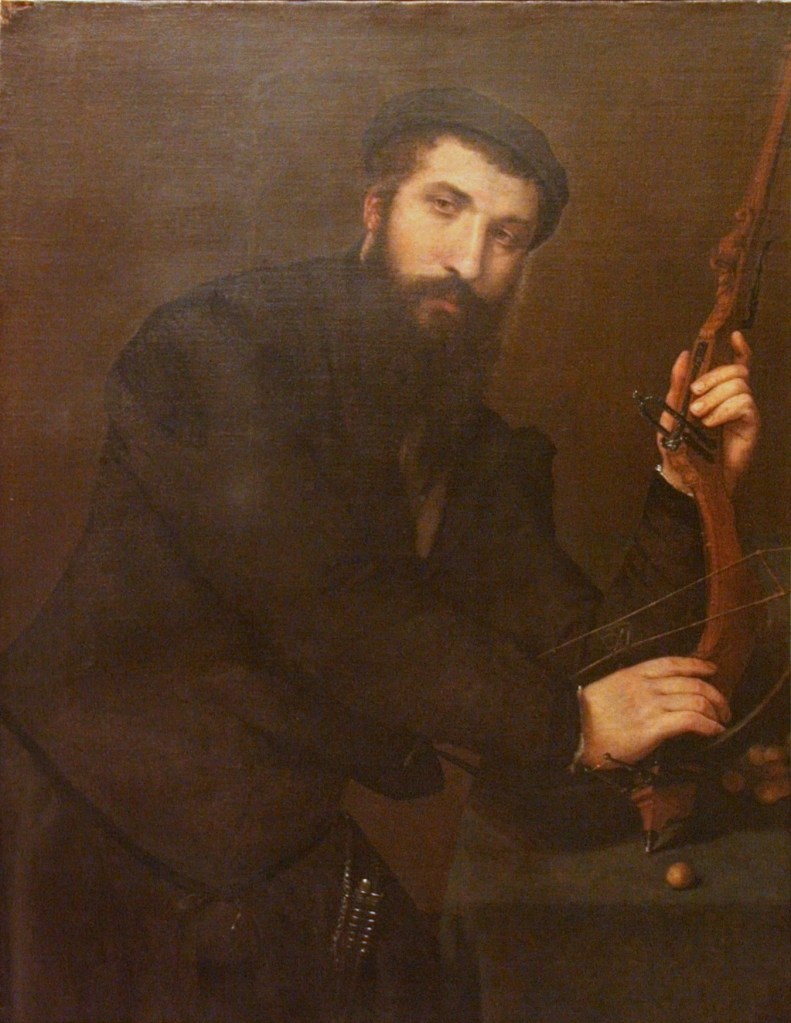
Among his final portraits is the Portrait of a Crossbowman, now in the Musei Capitolini, Rome, painted around 1551. The sitter, generally identified as Mastro Battista of Rocca Contrada, was a carpenter with whom Lotto had dealings during his years in the Marches. He appears with his crossbow, an object that declares an aspect of his identity without diminishing the individuality of his face or bearing.
The portrait is a reminder that Lotto’s curiosity about people had never been restricted to the wealthy or powerful. From Bernardo de’ Rossi to the merchants of Bergamo and the troubled figures of his later years, he had pursued the particularities of human appearance and character. Here the sitter’s occupation and personal identity coexist without ceremony. The painting possesses the quiet dignity of an encounter between the artist and someone known to him through the ordinary business of life.
In the summer of 1552, Lotto moved to Loreto, the great Marian sanctuary overlooking the Adriatic. The Holy House, believed to be the dwelling of the Virgin brought miraculously from Nazareth, had long attracted pilgrims from across Europe. For a painter whose religious commitments had deepened over the years, Loreto offered the possibility of withdrawal from the anxieties of professional life without requiring him to abandon his art.
His decision eventually took formal shape on 8 September 1554, when he became an oblate of the Santa Casa. In explaining his choice, Lotto wrote: «per non andarmi avolgendo più in mia vechiaia … ho voluto quetar la mia vita in questo sancto loccho», expressing his wish to cease wandering in old age and to quiet his life in that holy place. The words acquire particular force after a career spent moving between Venice, Treviso, Recanati, Rome, Bergamo and the towns of the Marches. What had once been the restless search for commissions and opportunity had become a desire for stability and peace.
Lotto continued to paint at Loreto. For the sanctuary’s choir, he adapted several earlier canvases and produced new religious works. The final group included scenes from the life of Christ, among them the Presentation in the Temple, generally dated to around 1555 and often regarded as his last surviving painting.
The Presentation is a moving and rather enigmatic work. Mary brings the infant Christ before the priest, while other figures gather around the ceremony. The arrangement is complex, with the sacred action unfolding beneath an architectural setting that includes a space resembling the choir of the sanctuary itself. The figures appear in groups whose movements and expressions are more hesitant than ceremonious. Lotto has not transformed the biblical event into an occasion for idealised grandeur. Instead, the participants retain something of the vulnerable humanity that had distinguished his religious painting throughout his career.
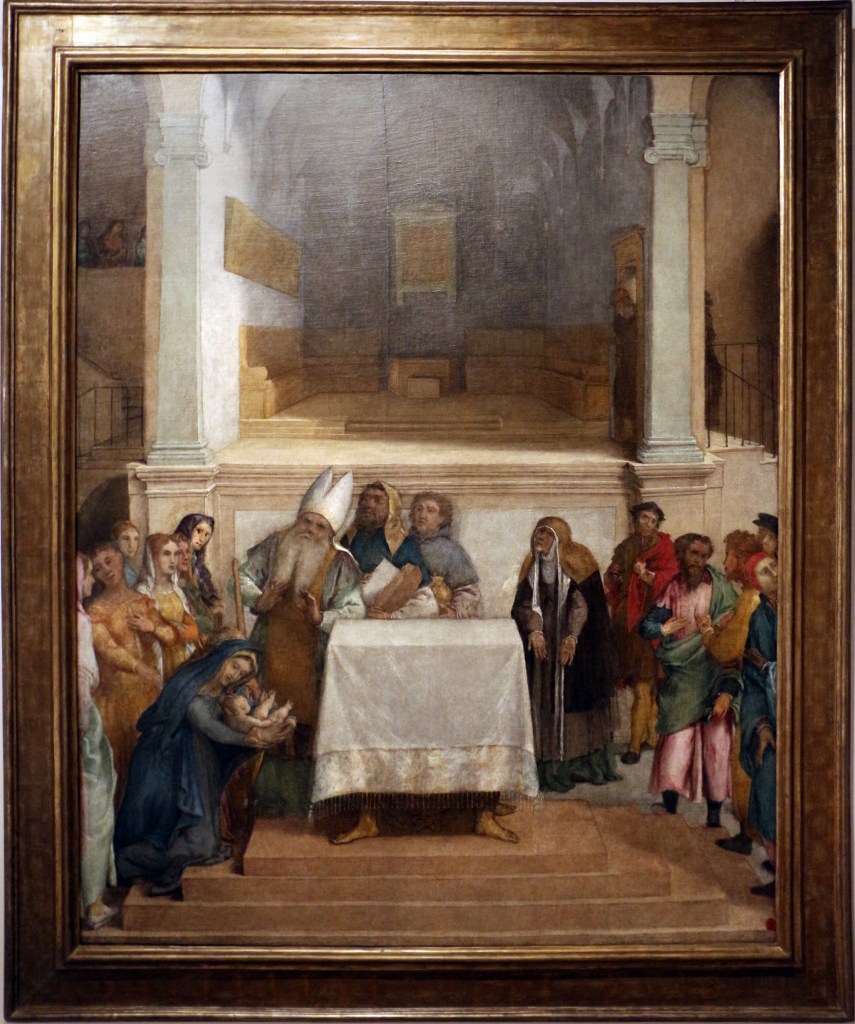
At the right of the architectural setting, an elderly bearded man appears in a doorway, looking towards the scene. He has sometimes been identified as Lotto himself, although the suggestion cannot be established with certainty. If the identification is accepted, the painter has placed his own ageing presence at the threshold of the sacred event. The possibility is moving, particularly when considered alongside his earlier interest in representing himself among the recipients of charity in the Alms of Saint Antoninus.
The painting is generally thought to have remained unfinished. Its incomplete passages have contributed to the impression of a work suspended between artistic intention and the limitations of old age. Yet its emotional force does not depend upon treating every irregularity as evidence of physical decline. There is still invention in its spatial organisation, and still an attentive interest in the varied responses of human figures to a sacred mystery. The painter who had once brought such extraordinary vitality to the Recanati polyptych and the frescoes at Trescore continued to seek ways of making religious experience visible.
Lotto died at Loreto in the final months of 1556. His last surviving writings include a small payment promised towards the marriage of a young woman who had cared for him during illness. Even in these final records, the ordinary circumstances of human relationships remain present: gratitude, practical obligation and affection.
Dal Pozzolo closes his account with the image of a brilliant star disappearing into silence. It is an affectionate and deliberately poignant ending, consistent with his portrayal of Lotto as an artist whose exceptional gifts had brought neither lasting worldly success nor freedom from disappointment. Yet the paintings offer something richer than the story of a defeated man. Across the changing circumstances of his life, Lotto preserved an extraordinary responsiveness to human feeling, from the forceful presence of Bernardo de’ Rossi and the humour of the Bergamasque marriage portraits to the grief, bewilderment and devotion of his religious figures.
Coda: The Annunciation at Recanati
We shall close this journey with a closer look at one of Lorenzo Lotto’s most celebrated and memorable paintings, the Annunciation in the Musei Civici at Recanati. The picture is generally dated by Peter Humfrey to around 1534–35, during Lotto’s second period of activity in the Marches, although its chronology remains disputed. Earlier scholars, including Bernard Berenson, placed it in the late 1520s, and Francesca Cortesi Bosco has also favoured an earlier date. Whatever its precise position in Lotto’s career, the painting provides a compelling example of his ability to make a familiar religious subject startlingly immediate.
The Annunciation was among the most frequently represented episodes in Renaissance art. Gabriel’s appearance before the Virgin, announcing that she would conceive and bear the Son of God, offered painters an opportunity to explore the meeting of the human and divine. Its essential elements were familiar: the angelic messenger, the Virgin interrupted in prayer or reading, the descent of the Holy Spirit and the setting of Mary’s chamber or an adjoining portico. Yet Lotto approaches this established subject with a freedom that makes the encounter seem almost unprecedented.
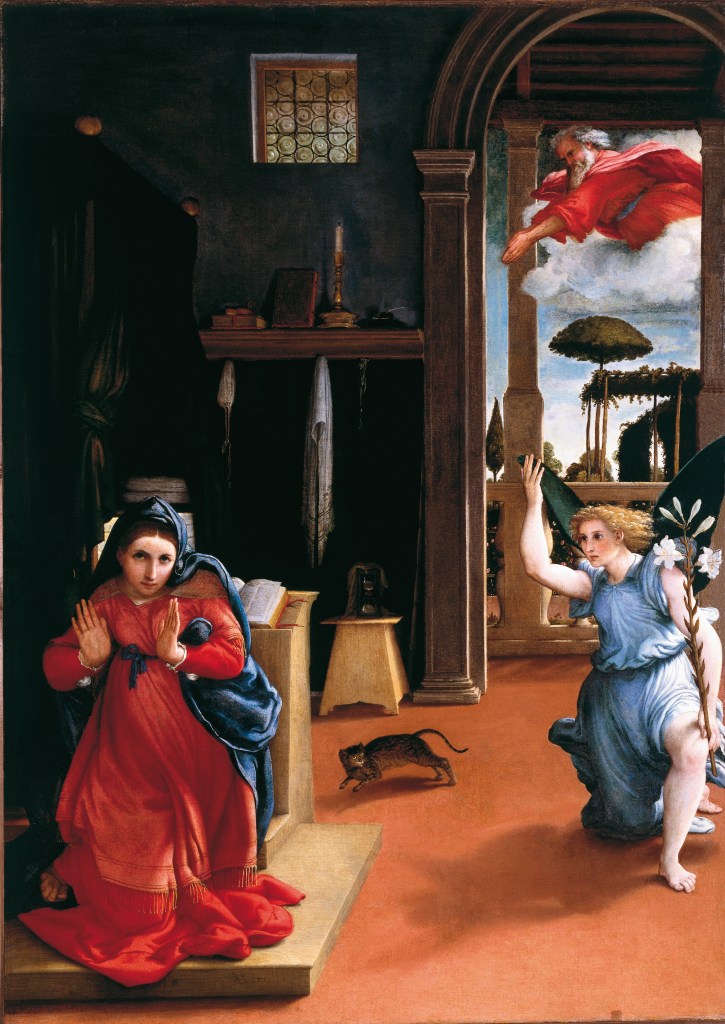
The painting brings us into a modest domestic interior, furnished with meticulous care. A curtained bed occupies part of the room, while an assortment of everyday objects rests upon a shelf nearby. Books, a candle, an hourglass and a towel belong to the familiar circumstances of Mary’s life. Beyond the open doorway is a carefully cultivated garden, with its ordered paths and luxuriant vegetation. The house appears peaceful, its contents arranged with the quiet precision of a place ordinarily protected from disturbance.
Into this tranquillity comes Gabriel, his arrival accompanied by a sudden illumination of the chamber. Mary turns away from the angel and towards the spectator, raising both hands in astonishment. Her eyes are wide and her expression troubled. A startled cat arches its back and flees across the floor. Beyond the room, God the Father appears among clouds above the garden, while Gabriel gestures towards him.
The emotional character of this scene has attracted considerable attention. Pietro Zampetti described the angel’s arrival as a violent interruption of the room’s tranquillity. Mary’s fear is not simply conveyed by her expression but by the abrupt movement of her arms and the turning of her body. The cat’s instinctive reaction intensifies the disturbance, making the supernatural event palpable within a recognisable domestic environment. In a composition of extraordinary imaginative freedom, Lotto has made the announcement of the Incarnation seem like something that has happened without warning, in a room where ordinary life was proceeding uninterrupted.
The painting is nevertheless attentive to the Gospel narrative. Luke 1:29 describes Mary as troubled by Gabriel’s greeting and uncertain what his words might mean. Rather than depicting the Virgin’s eventual acceptance of the divine message, Lotto concentrates upon this earlier moment of bewilderment. The distinction is important. Mary’s alarm belongs to the unfolding of the biblical event, not to a rejection of her appointed role. Her response conveys the difficulty of comprehending a revelation whose significance has not yet become clear.
Gabriel himself contributes to the scene’s emotional complexity. His forward movement is purposeful, but his posture is not entirely assured. Humfrey has described the angel as almost diffident, as though the extraordinary importance of his mission has left him uncertain how to approach the young woman before him. This slightly awkward messenger and the frightened Virgin give the encounter a human immediacy quite different from the ceremonial dignity of many Renaissance Annunciations.
The arrangement of the figures has significant precedents. Humfrey draws attention to Dieric Bouts’s Annunciation of around 1450, now in the J. Paul Getty Museum, whose composition may have been known in Venice. The angel approaches from behind the Virgin, an arrangement subsequently adopted in Titian’s Annunciation for Treviso Cathedral, painted in 1520. Lotto’s composition belongs within this broader history of Venetian responses to northern European painting, but his interpretation is markedly different.
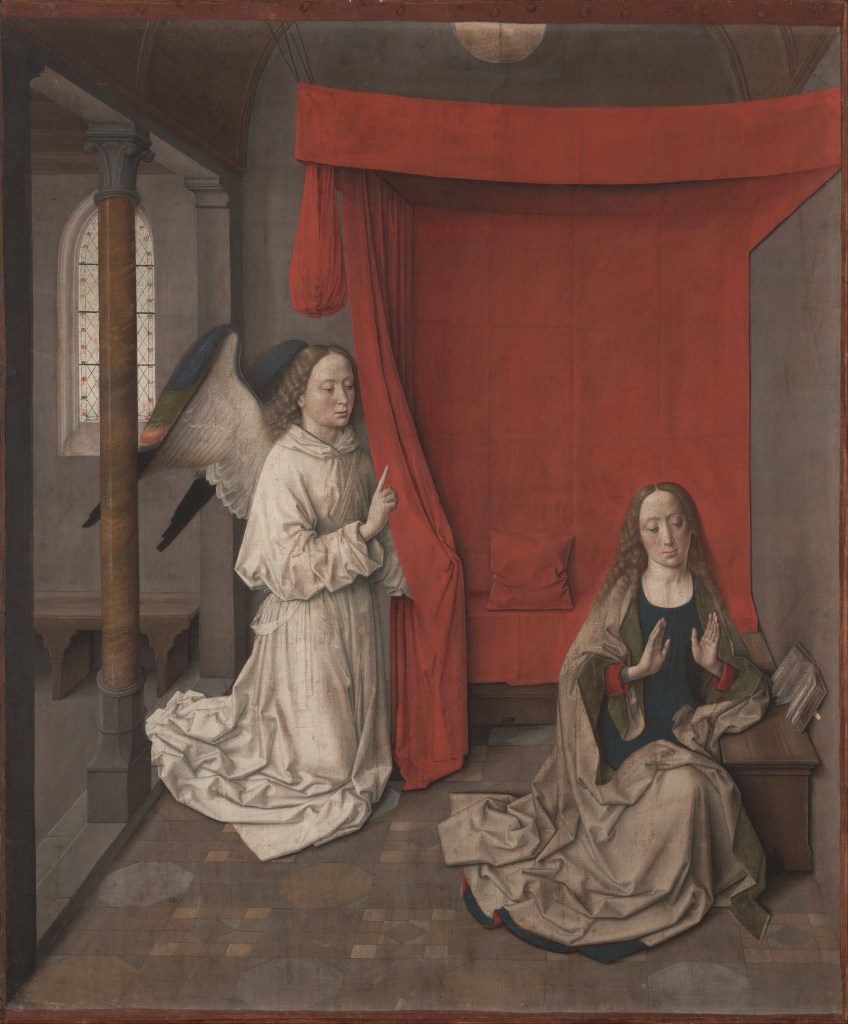
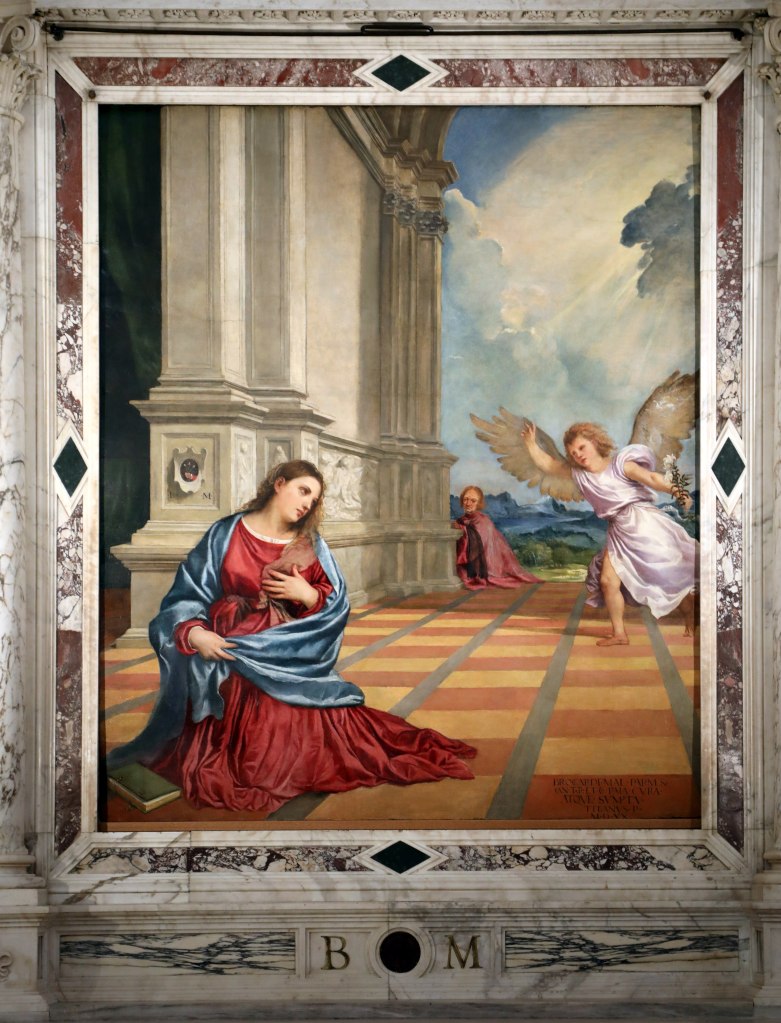
In Titian’s painting, the Virgin is placed prominently in the foreground, turning towards Gabriel as he approaches from behind. She is presented, however, with greater composure and monumental dignity, within an architectural setting enriched by classical decoration. Lotto replaces this grandeur with the familiar surroundings of a private chamber. His Virgin responds with an immediacy that is almost disconcerting. The comparison reveals not a difference in the basic narrative arrangement, but in the emotional character that each painter gives to the sacred event.
Lotto’s interest in Netherlandish painting is also apparent in the close observation of domestic objects. The furnishings are not merely incidental details intended to establish a convincing setting. Their careful description encourages the spectator to attend to the ordinary material circumstances within which the miraculous occurs. David Ekserdjian has drawn attention to the remarkable accumulation of objects in the chamber, which approaches the independent descriptive interest of still-life painting.
These particulars also belong to established devotional traditions. The curtained bed may evoke the thalamus Virginis, the Virgin’s chamber understood through the imagery of spiritual marriage, while the enclosed garden beyond the doorway recalls the hortus conclusus, traditionally associated with Mary’s purity. Yet Lotto does not present these elements as abstract symbols detached from ordinary experience. They form part of a recognisable household, whose stillness and order make the interruption all the more affecting.
Another possible source was much closer to Recanati. Andrea Sansovino’s marble relief of the Annunciation, executed in the early 1520s for the sculptural enclosure of the Holy House at Loreto, includes details that Humfrey has compared with Lotto’s painting, notably the curtained bed and the cat. The proposed relationship suggests that Lotto’s imaginative treatment of the scene may have developed through his familiarity with a major work of contemporary religious sculpture. It also connects the painting with the Marian devotional culture of the Marches, to which Lotto would eventually devote the final years of his life.
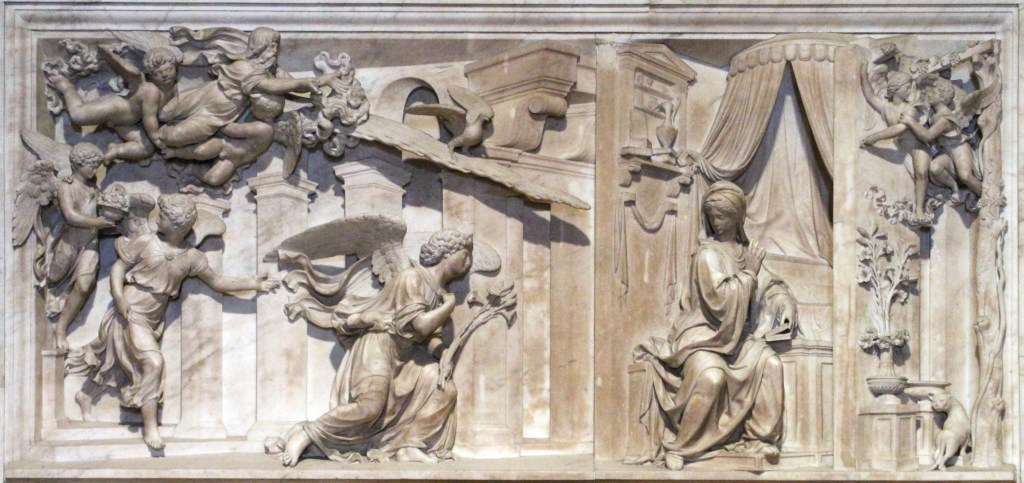
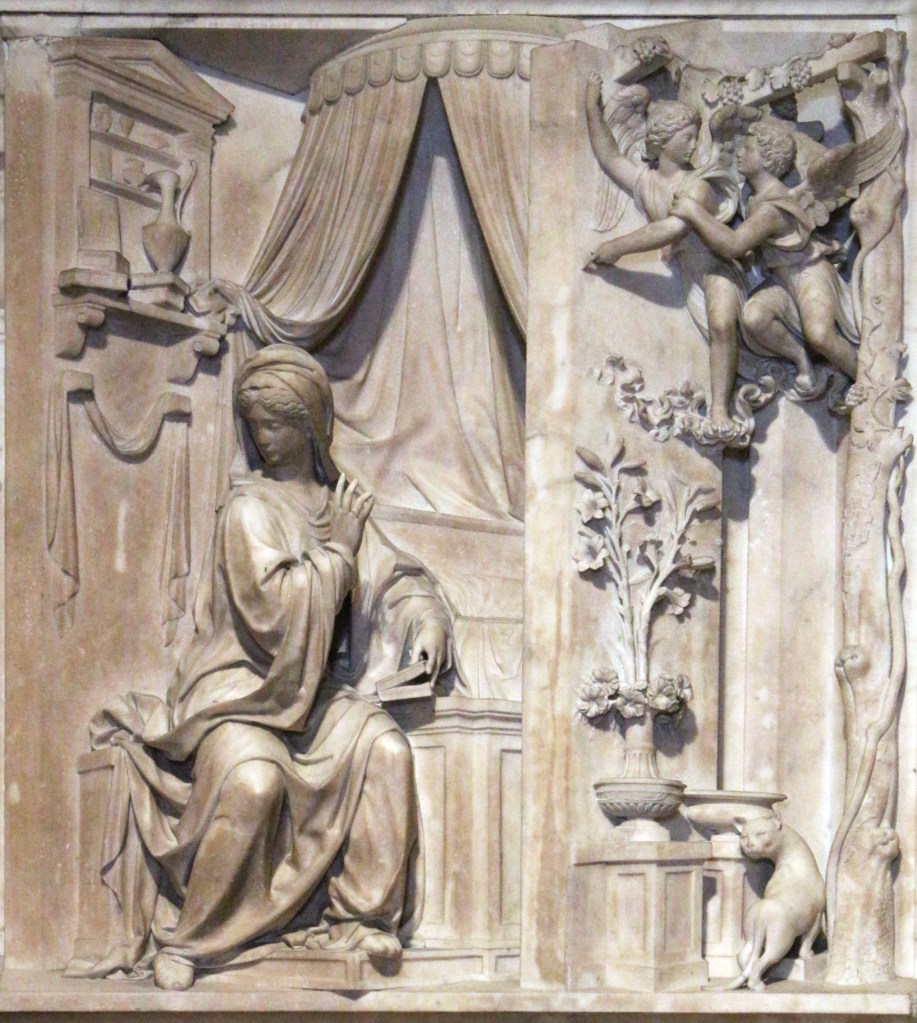
The cat is perhaps the detail for which the picture is best known. It has sometimes been interpreted as a symbol of evil driven away by the arrival of the divine messenger. That reading belongs to a wider tradition of religious symbolism, but the animal’s role within the narrative is no less important. Its sudden movement belongs to the same disturbance that makes Mary recoil and Gabriel advance. The cat responds instinctively to a presence beyond its understanding, bringing a note of humour and affectionate observation into a scene of profound religious significance.
Such details reveal something of Lotto’s distinctive religious imagination. He does not diminish the mystery of the Incarnation by placing it amid ordinary furnishings or allowing its participants to display fear and uncertainty. Rather, he gives the event emotional force through the immediacy of their responses. The Virgin’s startled expression, Gabriel’s earnest approach and the fleeing animal bring the sacred narrative into contact with experiences that the spectator can recognise.
In the Annunciation at Recanati, the meeting of the human and divine becomes an encounter charged with uncertainty, movement and feeling. The painting exemplifies Lotto’s independence from the ideals of classical composure that shaped so much Renaissance religious art. His interest lies not only in the grandeur of a sacred event, but in the extraordinary circumstances of its reception by an individual human being.
Acknowledgement
The narrative of Lotto’s life and travels in this essay draws substantially on Enrico Maria Dal Pozzolo’s lecture at the Museo del Prado in January 2018. His affectionate and engaging account of the painter’s changing fortunes offered an irresistible narrative arc that combined authority with warmth.
Donate to Inner Surfaces here.
Bibliography
These are my sources. Any errors are mine.
Brown, David Alan, Peter Humfrey and Mauro Lucco (eds.), Lorenzo Lotto: Rediscovered Master of the Renaissance. New Haven and London: Yale University Press, 1997.
Cortesi Bosco, Francesca, ‘Lotto, Lorenzo’, in Dizionario Biografico degli Italiani, vol. 66. Rome: Istituto della Enciclopedia Italiana, 2006, pp. 200–215.
Dal Pozzolo, Enrico Maria, Le stelle di Lorenzo Lotto, lecture delivered at the Museo Nacional del Prado, Madrid, 16 January 2018, as part of La era de los genios: De Miguel Ángel a Arcimboldo. YouTube recording, titled Lorenzo Lotto, published by the Museo Nacional del Prado, 13 October 2020 (Spanish-dubbed version).
Ekserdjian, David, Still Life Before Still Life. New Haven and London: Yale University Press, 2018.
Humfrey, Peter, Lorenzo Lotto. New Haven and London: Yale University Press, 1997.
Humfrey, Peter, ‘Annunciation’, in David Alan Brown, Peter Humfrey and Mauro Lucco (eds.), Lorenzo Lotto: Rediscovered Master of the Renaissance. New Haven and London: Yale University Press, 1997, pp. 192–193.
Humfrey, Peter, ‘Annunciazione’, in Mauro Lucco (ed.), Lorenzo Lotto a Recanati: «Nel cor profondo un amoroso affetto». Venice: Marsilio, 1998, pp. 57–59.
Paraventi, Marta, ‘Annunciazione’, catalogue entry IX.25, in Enrico Maria Dal Pozzolo (ed.), Lorenzo Lotto: Il richiamo delle Marche. Luoghi, tempi e persone. Milan: Skira, 2018.
Zampetti, Pietro, ‘L’Annunciazione’, in Paolo Dal Poggetto and Pietro Zampetti (eds.), Lorenzo Lotto nelle Marche: Il suo tempo, il suo influsso. Florence: Centro Di, 1981, pp. 310–312.

