Ettore Cumbo: Natura morta con uva
Ettore Cumbo is a painter whose career sits slightly to one side of the usual regional narratives of nineteenth-century Italian art. He was born in Messina in 1833, but Gioacchino Barbera, in his entry for the Dizionario Biografico degli Italiani, describes him as Roman by adoption. He lived in Rome from childhood, studied at the Collegio della Sapienza in Perugia, and initially moved towards mathematics, architecture and engineering. In 1857, however, he abandoned engineering and devoted himself to painting, studying landscape with Alessandro Castelli, a Roman painter formed between academic training, romantic landscape and direct observation of nature.
Cumbo’s later life was shaped by politics as well as art. Barbera records his patriotic sympathies and his activity against the papal government, which led to his exile in Florence in 1859. He settled there permanently, and Florence remained the base of his career until his death in 1899. Yet he does not seem to have become fully absorbed into the artistic arguments of the city. Luigi Giacobbe, in his catalogue entry for Natura morta con uva, notes his friendships with Stefano Ussi, Nicolò Barabino and Vittorio Matteo Corcos, but also stresses the independence of his path. Nadia Marchioni, writing in Carlo Sisi’s La pittura di paesaggio in Italia. L’Ottocento, makes the point still more directly: Cumbo did not show a marked interest in the innovative researches of the Macchiaioli.
This makes him an interestingly displaced figure. He was Sicilian by birth, Roman by upbringing, Florentine by exile and residence. His work later entered private collections in Italy and abroad, especially in England and Germany. The dispersal of his paintings has made his artistic personality difficult to reconstruct. A retrospective exhibition was held in Florence in 1910, but his reputation then receded into the more fragmentary history of private ownership, auction catalogues and scattered references.
From the early 1870s Cumbo established himself as a painter of landscapes and still lifes. He exhibited in London in 1874, at the regional horticultural exhibitions in Palermo in 1886 and 1887, and at the National Exhibition of Palermo in 1891–92. In 1893 he was elected accademico di merito of the Accademia di San Luca. His Paesaggio sull’Appennino, then in the Banco di Sicilia collection, won a silver medal at Palermo in 1891–92. The award is a useful reminder that landscape was an important part of Cumbo’s exhibited work, and that Natura morta con uva belongs within a broader practice of close observation and careful descriptive painting.
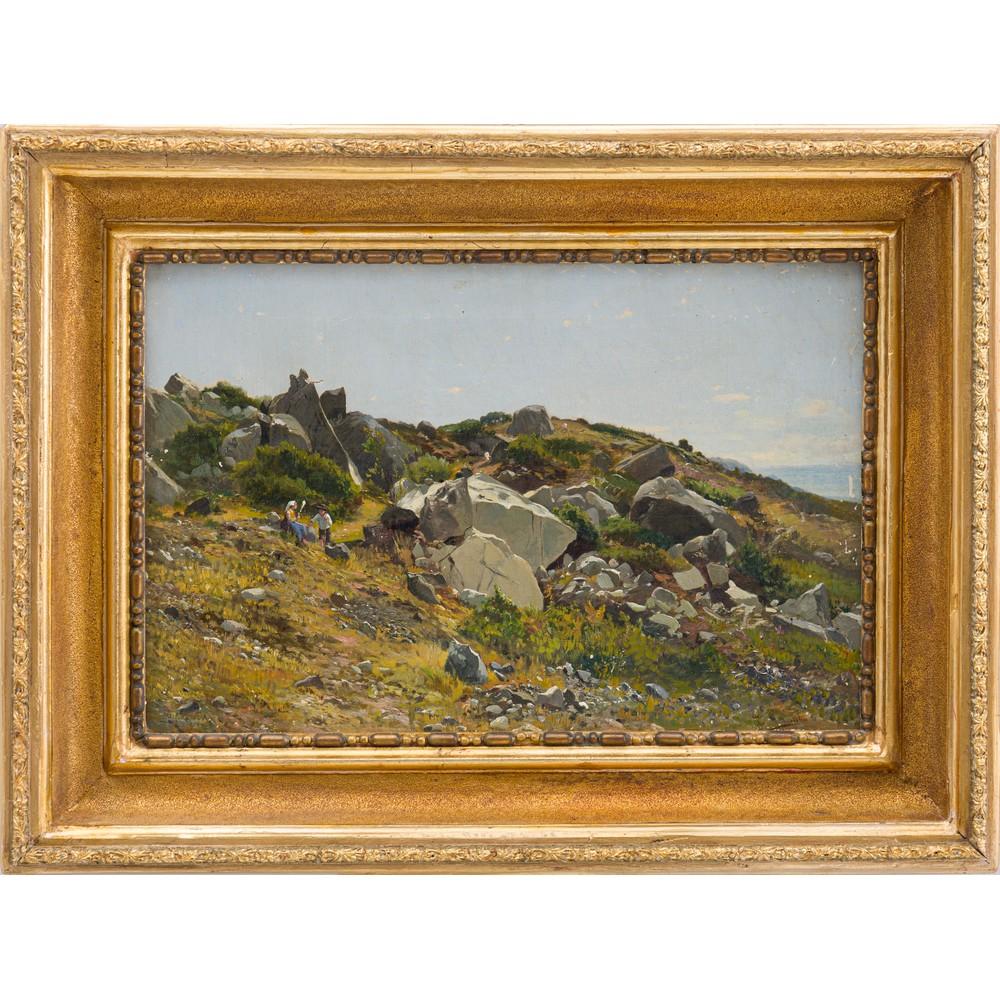
Marchioni’s discussion of Paesaggio sull’Appennino helps to clarify Cumbo’s strengths as a landscape painter. She presents it as the work of an artist drawn to an almost excessively realistic interpretation of nature, and singles out the foreground, where the rocky terrain is described with extreme precision. A similar judgement had already been made by the contemporary critic A. Lo Forte Randi, writing about Cumbo’s Paese at the Palermo exhibition. Lo Forte Randi admired the foreground as a “real perfection”, but felt that the more distant planes were less successfully harmonised and became tiring to the eye. The criticism is useful because it identifies both Cumbo’s gift and his limitation: he was especially responsive to close description, precise surfaces and the immediate presence of things, but less assured in organising the full breadth of landscape space.
Credit: image reproduced from Invaluable / Benedetto Trionfante Casa d’Aste.
That judgement gives a useful way into Natura morta con uva. If Cumbo’s strength lay in detailed observation, still life offered a genre in which that strength could become central. Grapes, leaves, cloth and table edge do not require the same orchestration of recession and distance as a large landscape. They ask instead for the careful description of surface, colour, weight and condition. In this sense, Cumbo’s still lifes should not be treated as accidental by-products of his landscape practice. They may have been especially well suited to his gifts.
Credit: Galleria Pananti Casa d’Aste s.r.l., Florence. Image reproduced from pananti.com.
Credit: Galleria Pananti Casa d’Aste s.r.l., Florence. Image reproduced from pananti.com.
Still life was not especially common in nineteenth-century Sicilian painting. Giacobbe notes exceptions such as Gennaro Pardo and Luigi Lojacono, but presents Cumbo as a distinctive case, particularly after a substantial group of his works appeared on the antiquarian market between 2002 and 2006. These included landscapes, portraits and, above all, still lifes with fruit and flowers, apparently from works preserved by the painter’s heirs in Florence. The genre also belonged naturally to the world in which Cumbo’s paintings survived: private houses, inherited collections, auction catalogues and cultivated domestic taste.
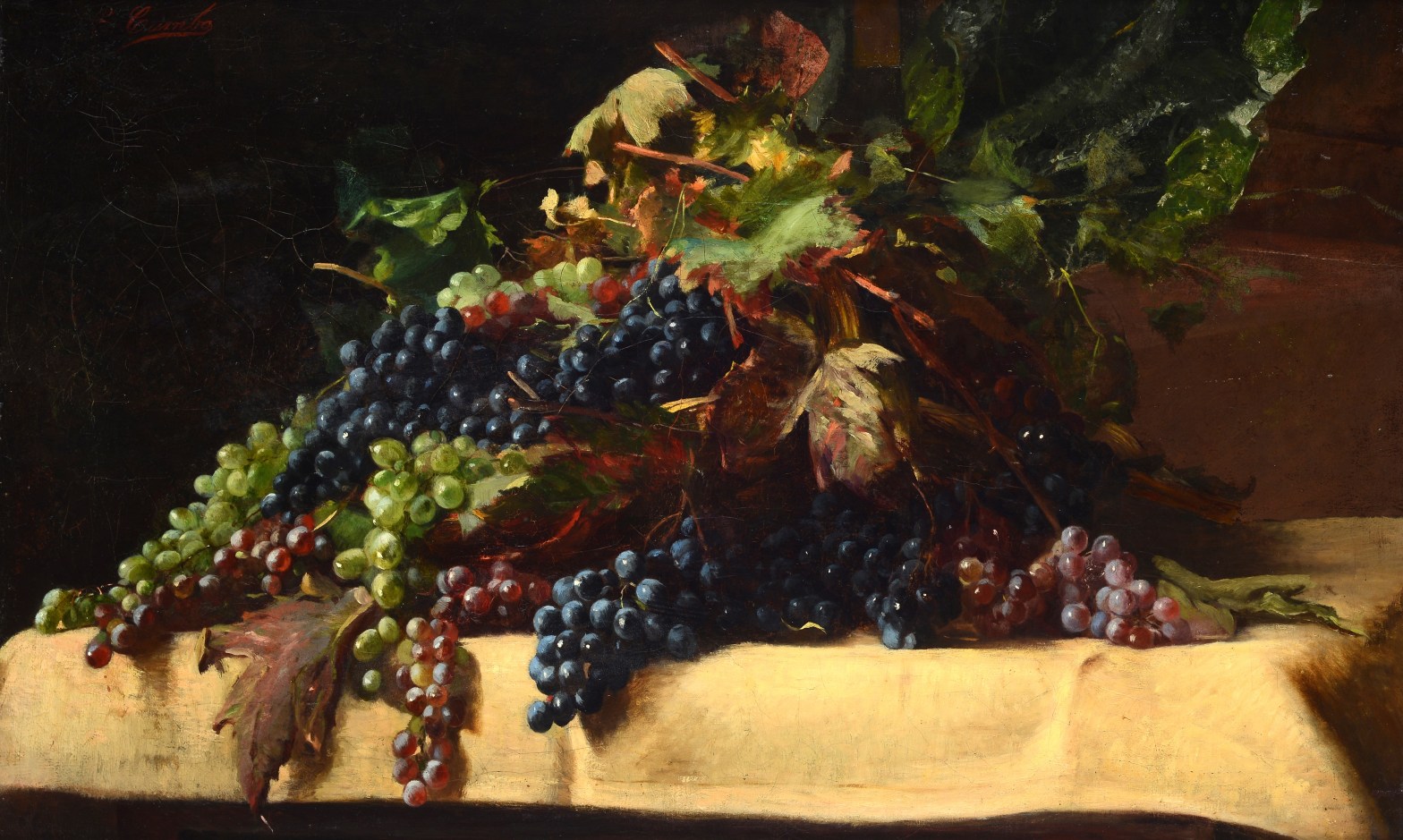
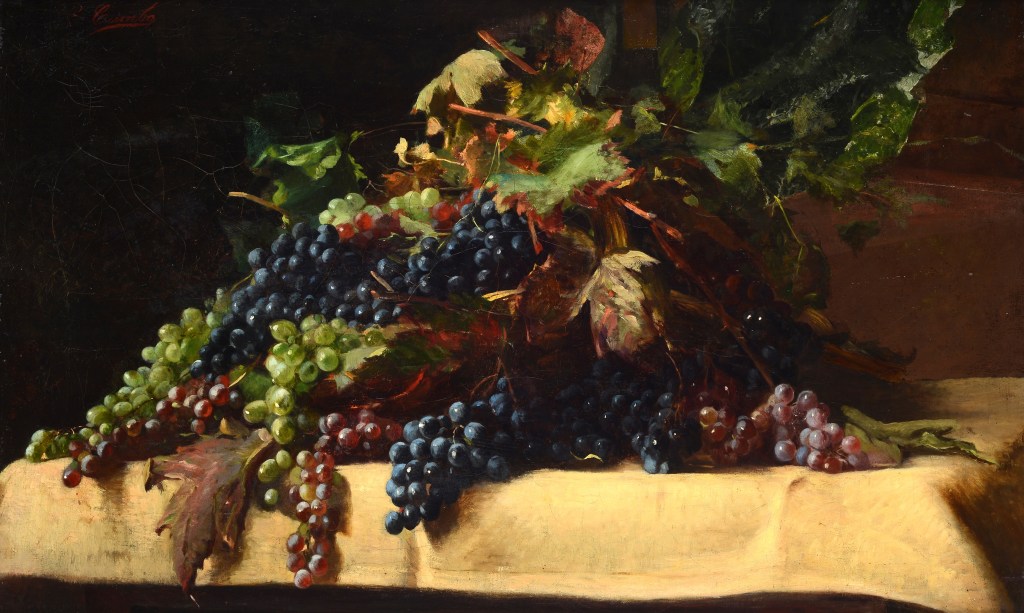
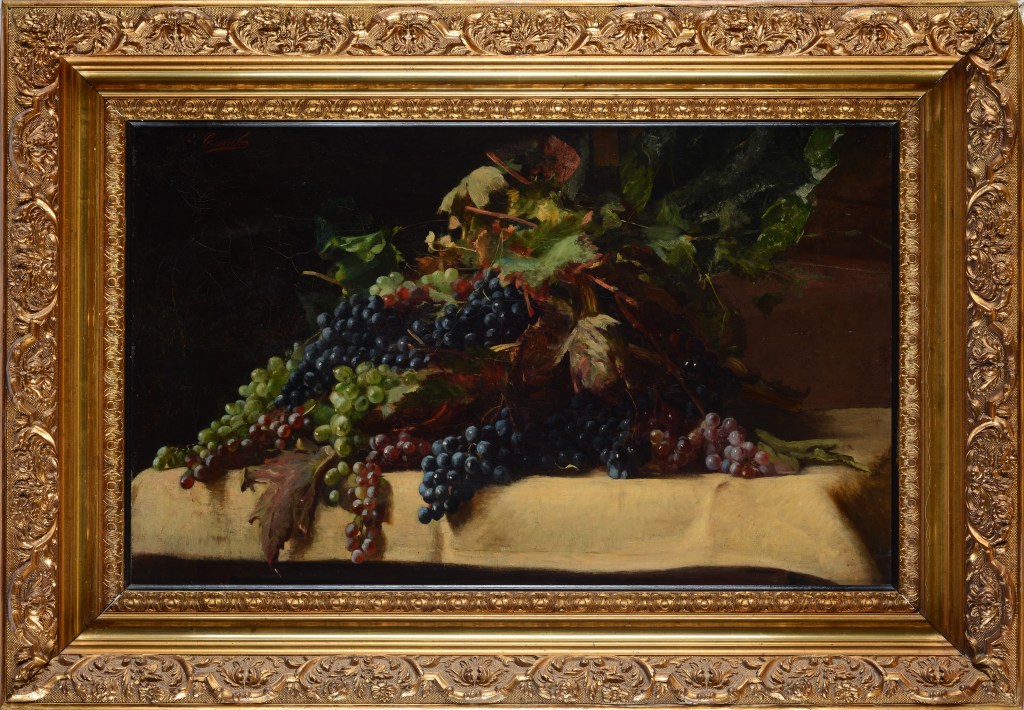
Natura morta con uva, dated to about 1878, is an oil on canvas measuring 55 by 79 cm, signed at the upper left “E. Cumbo”. Giacobbe suggests that it is probably the painting mentioned by Maria Accascina in 1939 under the title Uva, then in Casa Foligno in Florence. He also considers it plausible that the same work appeared in several nineteenth-century exhibition catalogues: at the Esposizione Solenne in Florence in 1878, at the Società di Belle Arti in Florence in 1891–92 and 1896–97, and at the Esposizione degli Amatori e Cultori in Rome in 1889. The identification cannot be absolutely proved, but it gives the painting a plausible exhibition history and supports a date by 1878.
The strongest description of the painting remains Giacobbe’s. He sees a possible recollection of Caravaggio’s Canestra di frutta in the way the leaves and bunches of black, pinkish and white grapes slide beyond the edge of the supporting plane, creating a perspectival effect. The comparison should be understood as compositional rather than dramatic. Cumbo is not reviving Caravaggio’s intensity. He is using the edge of the table or ledge to make the still life project gently towards the viewer.
The rest of the painting depends on small distinctions of colour and condition. Giacobbe notes the torn and dried vine leaves, the flashes of intense green that indicate shoots still full of vigour, and the changing gradations of colour across the grapes, which suggest different degrees of ripeness. The whole arrangement rests on a sober, slightly folded cloth. Nothing here is spectacular. The painting’s appeal lies in refinement: in the relation between fruit, leaves, cloth and edge; in the quiet movement from one kind of colour to another; and in the concentration of attention on a modest domestic subject.
Cumbo should not be inflated into a major forgotten master. Barbera’s judgement is more measured: he presents him as a good draughtsman and capable colourist, calm, diligent and somewhat conventional, but rich in decorative taste. That seems the right scale. Natura morta con uva is valuable not because it transforms the genre, but because it preserves, with unusual clarity, the qualities of a displaced but cultivated painter. Cumbo stood at the edge of several histories: Sicilian by birth, Roman by adoption, Florentine by exile, and with an international afterlife through the later dispersal of his works. His grapes and vine leaves offer a compact survival from that uncertain career, and from a nineteenth-century culture in which careful painting, private collecting and domestic refinement could still meet around the simplest of subjects.
[Producing these essays requires care, time, research, and resources. Contributions to help sustain this exploration would be greatly appreciated.]
Donate to Inner Surfaces here.
Bibliography
The sources used for this essay are as follows. Any errors are mine.
Gioacchino Barbera, “CUMBO, Ettore”, in Dizionario Biografico degli Italiani, vol. 31, Rome, Istituto della Enciclopedia Italiana, 1985.
Luigi Giacobbe, catalogue entry on Ettore Cumbo, Natura morta con uva, in Poliorama pittoresco. Dipinti e disegni dell’Ottocento Siciliano, Agrigento, Fabbriche Chiaramontane, 2007–08.
Nadia Marchioni, “Ettore Cumbo”, in Carlo Sisi, ed., La pittura di paesaggio in Italia. L’Ottocento, Milan, Electa, 2003, p. 166.
Maria Accascina, Ottocento siciliano. Pittura, Palermo, 1939.

