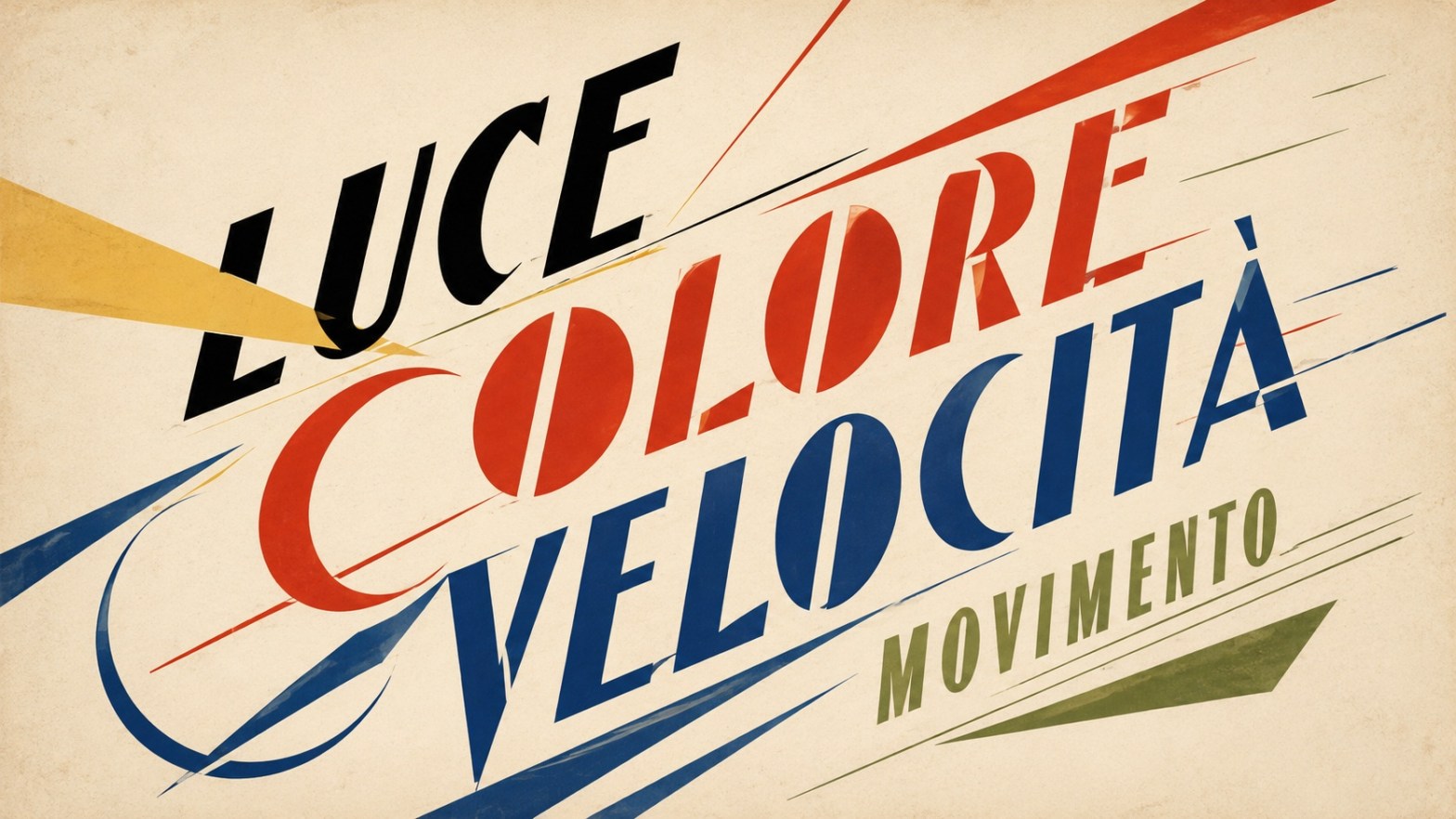
A note on images
For reasons of copyright, I have not reproduced most of the works discussed in the text. Instead, each article is followed by a short gallery of selected works, with links to museum, collection or institutional pages where images can be viewed. Other works mentioned in the essay may also be found online, but I have limited these suggestions to sources that seem reliable, stable and clearly identified. The bibliography is at the end of Part Four.
Futurism: light, speed and force
Balla’s Futurism does not abandon the optical, photographic and Divisionist research of the previous decade; it changes the terms of that research. Reality is still observed, but the emphasis shifts from the recording and construction of appearances to the translation of light, movement, sound and speed into forces. Artificial illumination, bodily motion, vibration, mechanical energy, patriotic noise, crowd agitation, invisible radiance and cosmic motion all become material for lines, rhythms, waves, wedges, repeated forms, colour-sequences and abstract equivalents.
The years 1910–12 are transitional rather than a clean conversion. Benzi stresses that Balla’s signing of the Manifesto tecnico della pittura futurista between late April and early May 1910 did not mean that his pictorial language was already fully Futurist. He had been close to the younger painters who were moving towards Futurism, especially Boccioni, Severini and Sironi, but his own work still stood between Divisionist observation and the new language of speed and dynamism. Between 1910 and 1912 he produced relatively few works for an artist normally so productive. This scarcity has a practical meaning: Balla was looking for a language that could answer Futurist demands without simply adopting Boccioni and Severini’s more Cubist-influenced direction.
Lampada ad arco condenses Balla’s passage from Divisionist light-study to Futurist modernity. The painting presents the electric streetlamp not just as a modern object but as an artificial sun, outshining the small crescent moon. It belongs to the rhetoric of Marinetti’s Uccidiamo il chiaro di luna!, but its pictorial language still grows from Balla’s long attention to nocturnal light, gaslight, streetlamps, Paris illumination and the modern city at night. The point is not that the painting suddenly invents Futurist light from nothing. It turns Balla’s earlier nocturnes and artificial light studies into a more aggressive emblem of modernity.
Lampada ad arco is therefore best treated not as a simple prophecy of Futurism in 1909, but as a threshold work. Balla dated the painting 1909, a date that usefully allowed him to present the electric lamp as anticipating Marinetti’s attack on romantic moonlight. Yet MoMA gives the work as c. 1910–11, while noting the date inscribed on the canvas, and Benzi places its execution more specifically in the second half of 1911, while allowing that the first idea may have arisen earlier. Fossati’s caution is still sharper: the date 1909 may be polemical and emblematic rather than a secure record of execution. What matters is not simply whether the painting belongs to 1909 or 1911, but that it gathers two phases of Balla’s development into one image. The subject grows out of his long pre-Futurist attention to nocturnal illumination, street lamps, electric spectacle and the optical behaviour of light. Its Futurist meaning, however, belongs to the moment when artificial light ceased to be merely something observed and became an emblem of technological modernity. The fact that Lampada ad arco was listed for the 1912 Futurist exhibition in Paris but apparently not shown only reinforces this ambiguity: the painting stands between private experiment, retrospective self-mythology and public Futurist statement.
In Lampada ad arco, light is no longer merely perceived; it becomes aggressive. Silk’s reading clarifies what changes from Divisionism to Futurism. The electric lamp does not simply replace moonlight. The lamp’s field of dots and vectors becomes almost an assault on the old romantic night. Divisionist luminosity begins to harden into rays, points, force-lines and artificial energy. The painting still depends on the analysis of light, but the light has become ideological: urban, technological, anti-romantic and Futurist.
The Düsseldorf stay of late 1912 is decisive, but it should not be made into a simple origin story for the Compenetrazioni iridescenti. Balla travelled there to work for Arthur and Margarete Löwenstein, but the documented commission was more limited than is sometimes implied. Earlier accounts had tended to speak vaguely, or expansively, of Balla decorating the Löwenstein house. Benzi argues instead that the evidence points essentially to one room. Balla’s letters mention a sala, four paintings intended for its furnishing, and work with a carpenter on the boiserie. The room itself is now lost, but two photographs record its general character. It was a carefully organised modern interior, with furniture, boiserie, painted views and a black geometric structure. Around the walls ran a frieze of city views, divided into units like successive photographic frames. This was a modern conception of the interior, but its modernity lay in order, framing and visual control rather than in Futurist dynamism.
That distinction is important because it prevents the Düsseldorf room from being confused with the Compenetrazioni. Benzi rejects the familiar idea that the iridescent studies were simply preparatory designs for the Löwenstein decoration. The room was based on furniture, wall structure and framed views of the city; the Compenetrazioni belong to a different enquiry into light, colour and optical abstraction. The two lines of work meet in Düsseldorf, but they should not be reduced to a single project.
Seen in this way, the surviving evidence around the Düsseldorf stay is best treated in separate layers. One layer is the lost room itself, known from the photographs and from Balla’s letters. Another is Finestra a Düsseldorf. In Maurizio Fagiolo dell’Arco’s 1987 catalogue Balla: The Futurist, a broad survey organised as a “biography in images”, the painting is placed within Balla’s analysis of light: misty northern illumination, the reflected window and the binoculars as an emblem of vision. Benzi, looking more closely at the Düsseldorf material, considers the painting in relation to the lost frieze of city views. He suggests that it may have been made in a similar manner to the painted panels, and possibly even preserves something of that dispersed decorative ensemble.
Balla’s work on movement forms another layer of the Düsseldorf material. In the letter of 18 November 1912 he describes a study of Arthur Löwenstein’s hand playing the violin, shown in different positions and in the continuous passage of the bow. This was not part of the room decoration, but a separate experiment in the representation of motion.
Düsseldorf, then, does not mark a sudden abandonment of observation. It is the moment at which several forms of observation overlap: the designed interior, the framed city view, reflected northern light, and the sequential movement of the violinist’s hand. At the same time, Balla’s letters to Gino Galli and to his family record the first emergence of the iridescent studies, which he described through the language of iride and of repeated “tests and re-tests”. That material belongs to the next stage of the argument, because it shows how these Düsseldorf experiments in looking began to open onto a more abstract investigation of light, colour and perception.
In Benzi’s reconstruction, the Compenetrazioni iridescenti begin at the end of 1912, during Balla’s second stay in Germany. The dating rests on letters to Gino Galli and to Balla’s family, where the artist describes a new group of works produced through repeated “tests and re-tests”. He calls them “un tipo di IRIDE”, and then, more playfully, “iriduccio”, but the playfulness of the word does not make the experiment casual. Iride names the rainbow or spectrum, and also the coloured iris of the eye. The term therefore brings together light, colour and vision: not colour as decorative surface, but colour as something seen, divided and reconstructed. This is why the letters are so important. Balla writes that the study will bring changes to his painting. The Compenetrazioni are not presented as finished decorations for the Löwenstein interior, but as the beginning of a new pictorial method.
The Compenetrazioni reduce the effects of light and movement to geometric schemes of coloured triangles. MART’s entry for Compenetrazione iridescente n. 4 (Studio della luce) dates the work to 1912–13 and gives its medium as oil and pencil on canvas-backed paper. The modest medium supports this reading because it supports the idea of experimental study rather than monumental public declaration. The relevant field is not just colour harmony but the decomposition of light, the prism, the iris, reflection, wave motion and the relation between perception and abstraction.
Benzi gives the strongest formulation of their significance: the Compenetrazioni are experiments in making invisible forces visible. They belong to a world of optical science, wave theory and electromagnetic light, with possible affinities to theosophical ideas, rather than to pattern-making alone. His comparisons are deliberately wide-ranging, but they point in the same direction. Some concern the behaviour of light as it passes through matter: the spectrum produced by a crystal, or the colours revealed by polarised light in stressed glass. Others belong to the scientific analysis of colour and vibration: rotating colour discs associated with Newton, Helmholtz and Maxwell, electromagnetic waves, and even the registered trace of noise in a spectrograph. The point is not that Balla was illustrating any one of these phenomena. It is that his abstraction tries to give pictorial form to forces normally beyond direct sight: light, movement, vibration and energy.
The distinction between representing the appearance of speed and representing the forces that make speed possible is crucial. Benzi sees the Compenetrazioni as preparing the later Velocità astratte. They do not depict a car or a moving body. They isolate the optical and energetic conditions from which a later language of speed can emerge. Balla does not jump from portraiture to machines in one leap. He passes through light, wave, sequence, optical experiment and invisible motion.
The chronology of the Compenetrazioni requires caution. Benzi argues that although the first idea belongs to late 1912, the bulk of the early cycle probably belongs between February and September 1913, not entirely to the Düsseldorf stay. He also stresses that Balla did not exhibit them prominently during the Futurist period. At the Ridotto del Teatro Costanzi in February 1913, the catalogue listed Bambina x balcone, Dinamismo di un cane al guinzaglio, Le mani del violinista and Lampada ad arco, but not a Compenetrazione. They were still studies of light and abstract motion, not yet public Futurist statements of dynamism.
The later history of the Compenetrazioni also has to be handled precisely. Benzi notes that the title Compenetrazione iridescente is not documented before the postwar period: it first appears in April 1951, at Balla’s exhibition at the Galleria Origine in Rome. This is not a small terminological point, because the works were then being rediscovered in a new climate, when Balla was increasingly valued as a precursor of abstraction. Benzi therefore treats the later state of the series with suspicion, especially the larger, more polished oils on canvas or canvas-backed paper, which he assigns to the late 1940s or early 1950s rather than to 1912–13. The crucial evidence is the back of Compenetrazione iridescente n. 14, a small oil on panel measuring 32.5 × 19.5 cm. On the verso is an internal inventory of the series, recording numbers, measurements and the position of the signature. It lists nine works out of fourteen, and corresponds only partly with later published inventories. For Benzi, this makes it a rare studio document from within Balla’s own working record, and a means of separating the small, early, experimental works from later additions or reprises. The cycle remains essential to Balla’s passage towards abstraction, but its later history is not neutral. It was reshaped at a moment when the ageing artist, his family and postwar critics were all helping to construct Balla’s position as one of the origins of European abstraction.
A second route towards abstraction, running alongside the Compenetrazioni, can be followed through the works in which Balla analysed movement in 1912. Dinamismo di un cane al guinzaglio, Bambina x balcone and La mano del violinista still begin from visible bodies and objects. They dynamise rather than erase the figure. The dog’s legs, the woman’s feet, the leash, the child’s body, the balcony railing, the violinist’s hand and bow remain recognisable. But these bodies no longer occupy a single stable moment. They are broken into repeated positions, successive instants and overlapping rhythms. Balla is still tied to observation, but the observed thing is no longer a stable object. It is movement unfolding in time.
Dinamismo di un cane al guinzaglio was painted in May 1912 while Balla was visiting the Contessa Nerazzini at Montepulciano. The Buffalo AKG account notes the skittering dachshund, the staccato steps of the owner, the repeated leash and dog’s body, and the vibrating streaks of pink and green in the background, said to suggest the white dust of the Tuscan countryside under summer sun. Balla enhances speed through diagonal ground lines and places his signature and date at a dynamic angle. The rhythm continues into the frame, which both contains and extends the composition. As in the painted frame of La giornata dell’operaio, the boundary of the picture is not inert. The frame participates in the movement of the image. With Dinamismo di un cane al guinzaglio, Balla is still analysing an everyday observed event, almost comic in subject, but the dog walk becomes a test case for the Futurist claim that moving objects multiply themselves. The repetition of legs, tail, leash and feet makes movement visible by refusing the single instant.
Bambina x balcone belongs to the same research. The work depicts Balla’s eldest daughter, Luce, running along the balcony of the family home on Via Parioli, now Via Paisiello. The museum account places it in a trilogy with Dinamismo di un cane al guinzaglio and I ritmi dell’archetto, marking Balla’s turn towards Futurism in 1912. The painting underwent a long process of elaboration from the summer of 1912 to the end of that year or early 1913, before being presented at the Teatro Costanzi in Rome. The child’s movement is rendered through sequential steps, the repetition of the figure from left to right, and the interpenetration of the balcony railing with the body. The brushstrokes loosen the contour, so that the figure is completed only through the coming together of different colours.
The fact that Bambina x balcone was painted on a reused canvas, with a rural landscape of 1896 or 1897 on the other side, is a small but revealing continuity. The Futurist child running across the balcony is literally painted over an earlier landscape. This is not just a practical reuse of material; it gives a physical form to the transition from early nature and landscape studies to the analysis of motion, sequence and bodily rhythm.
La mano del violinista, now in the Estorick Collection, makes movement almost acoustic. During the Düsseldorf stay, Balla wrote to his family that he was finishing a study of Arthur Löwenstein’s hand as he played the violin, shown “in movement”, in different positions, and with the continual motions of the bow. The subject is therefore not a generic musician, but a figure from the Löwenstein household. The material history of the canvas reinforces that connection. In 2015 it was discovered that Balla had painted the work over a study for one of the lost panels of the Löwenstein frieze; infrared examination revealed a view of Düsseldorf beneath the Futurist image, with the spire of St Lambert’s church at its centre. The finished painting belongs to Balla’s new analysis of movement, but its support still carries the trace of the Düsseldorf room.
The same Estorick account emphasises the relation to Marey’s chronophotography and to the Bragaglia brothers’ photodynamism, both concerned with trajectories through space and time. The hand, sleeve, cuff, violin and bow are repeated vertically, while light breaks and intensifies the perception of motion. Tosini Pizzetti gives the acoustic implication its full importance: Balla does not simply depict a musician; he tries to make the movement of playing visible, and almost audible. The hand’s rhythm becomes sound translated into form.
Balla’s own musical background gives this passage some depth. Simona Tosini Pizzetti presents him not as a musical theorist in the manner of Kandinsky or Malevich, but as an artist whose visual imagination was shaped by music, sound, rhythm and verbal noise. He had learned the violin as a child, sung in the choir of San Filippo Neri in Turin, and appears in family photographs with a guitar. This does not make him a systematic theorist of synaesthesia, but it helps explain why the Futurist Balla could translate sound, word, rhythm and movement into colour and form.
The wider Futurist musical context is Russolo’s elevation of noise. The barrier between musical sound and mechanical or urban sound was broken down. In Balla, this does not lead primarily to musical theory but to images in which motion becomes rhythm, rhythm becomes colour, and colour approaches sound. The movement from La mano del violinista to later works such as Linea di velocità + forme + rumore and Forme grido Viva l’Italia turns visual observation into acoustic equivalent.
Boccioni and Bragaglia create important tensions around these experiments. Anton Giulio Bragaglia’s photodynamism offered a way of thinking about the trace of movement and the interval between fixed positions. Balla’s Dinamismo di un cane al guinzaglio, Bambina x balcone and La mano del violinista clearly belong to this climate. Yet Boccioni turned sharply against Bragaglia in 1913 and wanted the Futurists to distance themselves from photodynamism. Benzi reads this as part of the pressure on Balla to move beyond photographic or chronophotographic devices. Sironi’s letter to Boccioni in October 1913, describing Balla as making splendid progress but still caught between abstraction and verism, captures the transitional difficulty. The automobile works, including the Velocità astratte, emerge from this unresolved passage.
The automobile sequence marks the shift from movement to speed. In the 1912 works, figures and objects remain recognisable even when multiplied. In the automobile works of 1912–13, the real object begins to dissolve. Negri stresses that the starting point was still concrete: studies from life of a stationary Bianchi type C motorcar of 1909, 20–30 horsepower, seen from different angles, with and without a chauffeur. Balla does not begin from an abstract idea of speed alone. He studies a real machine and then transforms it.
In Velocità di automobile + luci, the car speeding through the night becomes a synthetic Futurist image. The acute wedges pierce the atmosphere; the moving tyres become linked semicircular forms; a headlight high in the centre spreads its glare in widening circles. Negri gives particular attention to direction. Balla reverses the car’s movement, making it run against the normal left-to-right movement of the eye, increasing the sensation of resistance and impact. The “luci” of the title lead back to the idea of placing the car before an illuminated shop window in Via Veneto. The automobile, the shop window and the city become graphic force, luminous reflection and abstract rhythm.
This process is not simple machine worship. Balla’s car is a concrete object, but it becomes less and less visible as a vehicle. In the later automobile works, naturalistic parts disappear into wedges, arcs, speed-lines, vortices and luminous atmosphere. The machine is important because it reveals a grammar of force. Speed becomes visible as disturbance, compression, wave, trajectory and spatial deformation.
Abstract Speed + Sound helps to clarify Balla’s turn from the analysis of visible movement to the abstract representation of automobile speed. In late 1912 and early 1913 he moved from the splintering of light to the movement and speed of racing automobiles, beginning an important series of studies in 1913–14. The Guggenheim suggests that Abstract Speed + Sound may have formed the central section of a triptych showing the transformation of landscape by the passage of a car through the atmosphere. Indications of sky and landscape remain, but the car’s passage is registered differently in each panel. In Abstract Speed + Sound, crisscrossing motifs evoke sound, while the number of lines and planes multiplies. The original frames were painted with continuations of the forms and colours of the compositions, implying that the painting’s reality extends beyond the panel and into the spectator’s space.
The painted frame is again significant. The automobile does not simply move inside the picture; its effects appear to cross the boundary of the painting. Sound, speed and landscape expand outward. The frame turns the work into an event rather than a contained view. This links the automobile works to Balla’s later wish to move beyond the canvas, but it first belongs to the effort to make speed occupy visual space.
The Rondini series belongs to the same exploration of movement and force, but it approaches the problem through flight rather than the speed of the motorcar. Fagiolo describes more than twenty experiments, beginning with simple studies of swallows in flight and gradually complicating the movement by setting it within space. In Linee andamentali + successioni dinamiche, the flight of the birds is overlaid with static details from the place of observation, including a gutter and a shutter. These fixed elements are drawn into the movement by luminous, sinuous lines. The lines suggest the flight of the swallows, but also Balla’s own movement along the long terrace of Via Paisiello as he follows them. In the later titles, the swallows themselves are no longer always named. The result is a more abstract structure in which external movement, the artist’s trajectory as observer and the real setting of the experience are fused.
The Rondini series is important because it shows that, for Balla, speed was not only mechanical. His Futurism cannot be reduced to the automobile, even if the motorcar gave him one of his most powerful modern subjects. In the studies of swallows, movement is produced by flight, by changes of position in space, by the shifting viewpoint of the observer and by the movement of attention itself. Balla’s subject is no longer simply the bird as a visible form, just as in the automobile works it is no longer simply the car as a machine. In both cases he is trying to give pictorial form to the forces generated by movement: trajectories, vibrations, intervals, directions and rhythms. The range of his Futurist subjects is therefore wider than a narrow cult of speed might suggest. Animal movement, childhood movement, musical movement, mechanical speed, flight, light, sound and celestial motion all become ways of testing how reality can be transformed into dynamic structure.
The Mercurio che passa davanti al sole series extends the same logic to astronomy. Balla was an amateur astronomer, and in 1914 he observed the passage of Mercury before the sun, probably through a telescope with smoked lenses. The Philadelphia Museum of Art describes its large Futurist drawing as part of a series of a dozen or more paintings and drawings made after Balla’s observation of the event on 7 November 1914. The larger yellow mass of the sun is crossed by the smaller orb of Mercury, with diagonal rays of white light, segments of blue sky and greens and blacks of uncertain optical origin. This is no longer landscape or mechanical speed, but cosmic perception. Optical observation becomes abstract dynamism.
Benzi treats Mercurio che passa davanti al sole as a major advance beyond Lampada ad arco. In Lampada, artificial light still battles the moon as a symbolic modern subject. In the Mercurio works, by contrast, optical effects observed through smoked glass are transformed into an original language of light, dynamism and geometric propagation. The work is not merely an astronomical transcription. It attempts to render the movement and radiance of a celestial event as visual energy.
Matitti’s essay on Balla and Theosophy helps to place this development within a wider culture of invisible forces, without reducing Balla’s painting to an illustration of Theosophical doctrine. Theosophy forms part of a broader context in which artists believed that painting might give visible form to forces beyond ordinary perception. Around 1900, science and esoteric speculation were often closely entangled: electromagnetism, X-rays, radioactivity, chronophotography, wireless transmission, spirit photography, the fourth dimension, thought-forms and auras all contributed to an expanded sense of invisible reality.
The Roman Theosophical context gives this a concrete setting. General Carlo Ballatore, president of the Rome Theosophical Group, becomes important because Balla’s interest in Theosophy is not inferred only from the appearance of the works. There is testimony that in 1916 he was interested in psychic phenomena, attended meetings of a Theosophical society led by Ballatore, took part in séances, and made works connected with this interest, including Trasformazione forme spiriti. The group had existed from 1897 and published the journal Ultra from 1907 to 1930. It was interested in the fourth dimension, radioactivity, invisible forces, the aura and psychic phenomena.
Theosophical writing treated thoughts and emotions as visible forms and colours. Besant and Leadbeater’s Thought-Forms and Man Visible and Invisible belong to the wider field of abstraction because they presented inner states as coloured structures in space. Matitti places Balla alongside other artists affected by occult or esoteric thought, including Kupka, Kandinsky, Mondrian and Malevich. The point for Balla is that his abstract works concerned with light, transformation, irradiating forms and states of mind belong to a culture in which invisible forces could be imagined as pictorial subjects.
This helps to keep the Compenetrazioni, the Velocità astratte, Mercurio and later spiritual works from being reduced to formal design. Balla’s abstraction is often built from optical, scientific or observed phenomena, but it also participates in a wider fascination with what cannot be directly seen. Light waves, electromagnetic radiance, thought, sound, atmosphere, celestial motion and psychic energy all belong to the same enlarged field of the invisible.
The interventionist works of 1915 translate force into political and patriotic form. In this context, interventionism means the campaign to bring Italy into the First World War. Italy had remained neutral in 1914, but Futurists and other nationalist groups pressed for military intervention, attacking neutralism as timidity, compromise and attachment to the old political order. Antonello Negri’s account of Sintesi futurista della guerra shows how Balla’s vocabulary of wedges, circles and force-lines enters the graphic language of this agitation. The manifesto’s central image is the collision of a wedge and a circle: wedge as attack, motion, Futurism; circle as stasis, passatismo and the Austro-German world. Balla’s own Velocità di automobile + luci of 1913, with its wedge entering a circle, oblique and vertical directives, semicircular forms and concentric rings, is formally close to this war graphic, though without the same explicit ideological content.
The political context should not be softened. Futurist interventionism was aggressively nationalist and militarist. The same movement that had explored light, movement, sound and speed now translated force into war rhetoric, public demonstration and patriotic agitation. Marinetti’s glorification of war as the “only hygiene of the world” cannot be softened. Balla’s interventionist works belong to this atmosphere, but they do not simply illustrate political events. They convert the experience of demonstrations, flags, shouts, crowds and civic monuments into abstract or semi-abstract equivalents.
Giacomo Balla’s Manifestazione patriottica of 1915, in the Museo Nacional Thyssen-Bornemisza, Madrid, gives a concrete institutional example of this interventionist phase. The painting belongs to a series devoted to the demonstrations staged in Rome to urge Italy to enter the war, a decision finally made in May 1915. It is not a descriptive record of a crowd so much as a translation of collective agitation into colour and movement. Green, white and red Italian flags envelop a compact mass of demonstrators, while the national colours are swept into a dynamic structure of spirals and intersecting forces. The political motif is therefore inseparable from the formal language: the flag becomes movement, the crowd becomes pressure, and patriotic demonstration becomes an abstract equivalent of public noise and energy.
The exact demonstration represented is uncertain. A preliminary study includes the expression “Morte Giolitti”, which led Christopher Green to suggest the protest outside Rome station on 9 March 1915 against the arrival of the neutralist politician Giovanni Giolitti. Another possibility is the demonstration organised by D’Annunzio in Piazza Quirinale on 21 March 1915, when Vittorio Emanuele appeared on the balcony of the royal palace and shouted “Viva l’Italia!” Either identification keeps the work close to the interventionist street politics of 1915, but the uncertainty is also significant. Balla is not simply illustrating one event. He is converting demonstrations, flags, shouts, crowds and civic space into a pictorial field of patriotic force.
Tosini Pizzetti’s account of Forme grido Viva l’Italia develops the same idea in still more synaesthetic terms. In the work, the dynamic effect of moving flags becomes the sound of fluttering and the uproar of demonstration. This sensation is amplified by the inscription recently discovered on the reverse of the canvas, written by Balla himself in capitals: “SVOLVERBIANROSSSSSISSSSIL’ITALIAZZURR”. The compressed parolibero sequence fuses colour, movement, sound and patriotic cry: the green, white and red of the flags, the blue of Italy, and the hiss and rush of public agitation. In these works, Balla’s earlier investigations of movement, vibration and sound enter the language of interventionism.
The diagnostic material from Un universo di luce adds another layer to Forme grido Viva l’Italia. The painting’s surface is not simply flat Futurist design. Its convex forms are pushed out by a glossy, enamel-like finish, while concave areas are made opaque through a granular substance that scatters light. Radiography reveals a female figure beneath the painted surface, linked in the Parma exhibition material to an earlier image of Elisa, probably the preparatory study for Balla’s 1908 Nudo controluce. The interventionist Futurist work therefore contains, materially, an earlier bodily image. The result is formally inventive, but politically compromised in a way that the painting’s own physical structure makes unusually vivid: abstract patriotic dynamism is laid over the remains of an intimate figurative image.
Negri’s reading of Bandiere all’altare della Patria gives a particularly clear example of “abstract equivalents”. The real monument, inaugurated in 1911 for the fiftieth anniversary of Italian unification, becomes a white monolithic form with asymmetrical projections, a compressed synthesis of its much more elaborate architecture. The flags become a vortical white, red and green motif pointing towards the altar. The agitation of the crowd is translated into grey and black directional lines wrapping around and converging on the white mass, suggesting the muffled noise of the crowd interrupted by shouts. Monument, flag, crowd and sound become forces.
The December 1915 Esposizione fu Balla e Futurista at the Sala d’arte Angelelli marks another point in Balla’s self-reinvention. The “old” Balla had already been symbolically killed in the 1913 sale of works by the “fu Balla”. Negri sees the years 1913–18 as Balla’s most radical period of self-renewal: movement gives way to speed; painting opens into clothing, objects, theatre, cinema and environment; pre-war lines of speed become abstract equivalents of experience. The rhetoric of rupture is real, but the forms still develop from earlier optical, photographic and analytical habits.
The 1915 manifesto Ricostruzione futurista dell’universo, written with Depero, expands the logic of force beyond painting. Balla and Depero propose to reconstruct the universe by finding abstract equivalents for all forms and elements and combining them into moving plastic complexes. The complessi plastici dinamici, now lost but photographically documented, were made from wire, wool, silk, cotton, coloured glass, cardboard, tissue paper, celluloid, mirrors, metal sheets and other materials. They were intended to move, rotate, decompose, make sounds and noises, and appear or disappear almost magically. Their crucial quality, in Negri’s account, is autonomy: they resemble nothing already existing, but only themselves.
These developments point forward to the later section on total art and everyday life, especially the anti-neutral suit, furniture, interiors, objects and Casa Balla. But for Futurism: light, speed and force, the relevant point is that force becomes three-dimensional and environmental. Balla understands the flat canvas as insufficient for the dynamic volume of speed. The line of velocity must enter space, material, object, light and sound. The complesso plastico is not an illustration of force; it is an attempt to build a form that behaves like force.
The anti-neutral suit can be introduced briefly at this point because it extends the same passage from pictorial dynamism to lived behaviour. Balla’s Vestito antineutrale was a 1914 Futurist proposal for a new kind of male clothing: brightly coloured, asymmetrical, variable, aggressive and anti-bourgeois, conceived in direct opposition to the dark, static, neutral “good taste” of conventional dress. The manifesto presents clothing not as a matter of elegance, but as a means of altering conduct: “Si pensa e si agisce come si veste” — one thinks and acts as one dresses. In Negri’s account, Balla’s design for Cangiullo’s suit does not invent a separate language for clothing, but transfers into dress the forms already developed in the automobile pictures: wedges, acute angles, arcs and force-lines. The garment is therefore not simply decorative or theatrical. It proposes a way for Futurist form to act on the body itself. Static line, symmetry, neutral colour and conventional good taste are rejected; in their place the wearer is to become aggressive, agile, dynamic, joyful, illuminating, asymmetrical and changeable. A full treatment of Futurist clothing belongs later, but the anti-neutral suit is relevant here because it shows the migration of Balla’s speed-lines beyond painting, onto the moving human body. Clothes become behavioural Futurism.
Feu d’artifice brings light, music, geometry and stage space together. Balla’s 1917 scenographic realisation of Stravinsky’s short orchestral piece for Diaghilev’s Ballets Russes was presented at the Teatro Costanzi in Rome in April 1917. It was not a ballet in the usual sense. Rather than dancers, plot or character, it offered a spectacle of geometric constructions made from wood, fabric and coloured paper, animated by electric lights. Margherita Sarfatti recalled that forms, lights and shadows “danced” in relation to the music, producing changing emotional states in the spectator. The surviving lighting scheme, discovered by Fagiolo dell’Arco at Casa Balla in 1967, shows how carefully this effect was planned. It sets out musical bars, repetitions, variants, illuminations, transparencies and commutators, treating the stage almost as an electrical score. Its final instruction, to remove the theatre and switch on the switches, suggests the moment at which the conventional theatrical apparatus gives way to the activation of light itself. The later Castello di Rivoli reconstruction, made in 1997 by Elio Marchegiani from Balla’s surviving plans for the exhibition Sipario / Staged Art, preserves this central idea of Feu d’artifice: light, rather than the dancer’s body, becomes the performer.
La macchina tipografica, devised by Balla in 1914 in honour of Diaghilev, shows another kind of embodied force. Twelve performers act before a canvas bearing the word “tipografica”: six stand in a row with outstretched arms, miming pistons, while six form a rotating wheel. The movements are repeated with mechanical precision. Virgilio Marchi later explained that Balla arranged the performers according to geometric figures, so that each embodied the “soul” of a part of the rotating machine. The action was accompanied by onomatopoeic sound, including the emphatic syllable “STA”. This is not merely synaesthesia but the mechanisation of the performer, a translation of typographic, bodily and acoustic energy into live form.
The relation between sound and visual form also returns in works such as Linea di velocità + forme + rumore and Abstract Speed + Sound. In these works, the sound of a speeding motorcar becomes a weave of signs, volumes, planes and harsh colours. The landscape is still present in traces, but it has been altered by the passage of a car through the atmosphere. The work is not simply about a car; it is about the sensory after-effect of speed.
The October 1918 exhibition at the Casa d’arte Bragaglia in Via Condotti closes this phase. In the invitation-catalogue Balla published a Manifesto del colore, restating his conviction that painting should abandon the reproduction of visible reality now that photography and cinema exist. What remains specifically pictorial is colour. Painting should become an explosion of colour: joyful, bold, aerial, electric, dynamic, violent, interventionist, a painting “a scoppio”, a painting of surprise. Among the forty works shown were three titled Colpo di fucile domenicale. An illustration of one was so abstract in appearance that it was published upside down.
Negri treats Colpo di fucile domenicale as the closure of the 1913–18 trajectory. Although the title might suggest war, the word “domenicale” shifts the subject into a private and almost festive world ending in accident. The work refers to Balla’s uncle Gaspare Melchiorre Balla, a royal gamekeeper who had welcomed him on his arrival in Rome and had lost a hand during a hunting accident. In the version from the private Giuseppina Antognini collection discussed by Negri, lines of flight converge towards the right, the point from which the projectile starts, while the target is on the left. The red wedge becomes an abstract equivalent of both blood and the speed of the shot; the greys evoke the dry crack of the gun and echoing explosion; the green countryside and blue-pink sky remain only as abstract equivalents of setting. Here the pre-war lines of speed become fully abstract.
Across this section, the sequence is not simply from reality to abstraction, but from observed reality to light, speed and force. Balla begins with light and movement still attached to things: a lamp, a dog, a child, a violinist, a car, a swallow, a planet, a flag, a crowd, a gunshot. Gradually those things become less important than the energies they reveal. Light becomes wave, spectrum and radiance. Movement becomes repeated phase, trajectory and continuum. Sound becomes crisscrossing line and vibration. Speed becomes wedge, arc, vortex and painted frame. Public demonstration becomes flag-colour, shouted form and crowd rhythm. The world remains present, but as a set of forces to be translated into colour, line, light, motion and abstract equivalence.
[Producing these essays requires care, time, research, and resources. Contributions to help sustain this exploration would be greatly appreciated.]
Donate to Inner Surfaces here.
Gallery of Selected Works
Giacomo Balla, Google Arts & Culture
A broad Google Arts & Culture page gathering works, stories and related image resources for Giacomo Balla.
Giacomo Balla, Mart / Google Arts & Culture
An online exhibition from Mart, with images of Balla’s Divisionist, Futurist and applied work, including material related to movement, light, theatre, furniture and domestic objects.
Giacomo Balla, Lampada ad arco / Street Light, c. 1910–11, dated 1909 on the painting
Oil on canvas, 174.7 × 114.7 cm
The Museum of Modern Art, New York
Page title: “Giacomo Balla. Street Light. c. 1910–11 (dated on painting 1909)”
Source: The Museum of Modern Art
Link: https://www.moma.org/collection/works/78382
Giacomo Balla, Compenetrazione iridescente n. 4 (Studio della luce), 1912–13
Oil and pencil on canvas-backed paper
Mart, Museo di arte moderna e contemporanea di Trento e Rovereto; deposit from a private collection
Page title: “Compenetrazione iridescente n. 4 (Studio della luce) – Giacomo Balla”
Source: Google Arts & Culture / Mart
Link: https://artsandculture.google.com/asset/compenetrazione-iridescente-n-4-studio-della-luce-giacomo-balla/CgHO9HAIyGRpUg
Giacomo Balla, Dinamismo di un cane al guinzaglio / Dynamism of a Dog on a Leash, 1912
Oil on canvas, 89.8 × 109.8 cm
Buffalo AKG Art Museum, Buffalo
Page title: “Dinamismo di un cane al guinzaglio (Dynamism of a Dog on a Leash) – Giacomo Balla”
Source: Google Arts & Culture / Buffalo AKG Art Museum
Link: https://artsandculture.google.com/asset/dinamismo-di-un-cane-al-guinzaglio-dynamism-of-a-dog-on-a-leash-giacomo-balla/hgHNbIYiNCz5xw
Giacomo Balla, Bambina x balcone / Girl Running on the Balcony, 1912
Oil on canvas, 125 × 125 cm
Galleria d’Arte Moderna, Milan
Page title: “Bambina x balcone (Girl Running on the Balcony) – Giacomo Balla”
Source: Google Arts & Culture / Galleria d’Arte Moderna di Milano
Link: https://artsandculture.google.com/asset/bambina-x-balcone-girl-running-on-the-balcony-giacomo-balla/mQHFDDFhlSOVYg
Giacomo Balla, La mano del violinista / The Hand of the Violinist, 1912
Oil on canvas, 62 × 84.5 × 8 cm
Estorick Collection of Modern Italian Art, London
Page title: “The Hand of the Violinist, 1912”
Source: Estorick Collection
Link: https://www.estorickcollection.com/the-collection/the-hand-of-the-violinist-1912
Giacomo Balla, Abstract Speed + Sound / Velocità astratta + rumore, 1913–14
Oil on millboard, in artist’s painted frame
Peggy Guggenheim Collection, Venice
Page title: “Abstract Speed + Sound”
Source: Peggy Guggenheim Collection
Link: https://www.guggenheim-venice.it/en/art/works/abstract-speed-sound/
Giacomo Balla, Swifts: Paths of Movement + Dynamic Sequences, 1913
Oil on canvas, 96.8 × 120 cm
The Museum of Modern Art, New York
Page title: “Giacomo Balla. Swifts: Paths of Movement + Dynamic Sequences. 1913”
Source: The Museum of Modern Art
Link: https://www.moma.org/collection/works/79347
Giacomo Balla, Manifestazione patriottica / Patriotic Demonstration, 1915
Oil on canvas, 101 × 137.5 cm
Museo Nacional Thyssen-Bornemisza, Madrid
Page title: “Patriotic Demonstration – Balla, Giacomo”
Source: Museo Nacional Thyssen-Bornemisza
Link: https://www.museothyssen.org/en/collection/artists/balla-giacomo/patriotic-demonstration
Giacomo Balla, Dimostrazione interventista – Bandiere all’Altare della Patria, 1915
Painting, 100 × 100 cm
Galleria Nazionale d’Arte Moderna e Contemporanea, Rome
Page title: “Dimostrazione interventista – Bandiere all’Altare della Patria – Giacomo Balla”
Source: Google Arts & Culture / La Galleria Nazionale d’Arte Moderna e Contemporanea
Link: https://artsandculture.google.com/asset/dimostrazione-interventista-bandiere-all%E2%80%99altare-della-patria-giacomo-balla/jQHp3h2iEitTmQ
Giacomo Balla, Feu d’artifice, 1917
Reconstruction of Balla’s scenographic light environment for Stravinsky’s Feu d’artifice
Castello di Rivoli Museo d’Arte Contemporanea, Rivoli-Turin
Page title: “Feu d’artifice – Giacomo Balla”
Source: Google Arts & Culture / Castello di Rivoli Museo d’Arte Contemporanea
Link: https://artsandculture.google.com/asset/feu-d-artifice-giacomo-balla/dAEHPscVRRsuIA
Giacomo Balla, Sketch for Macchina tipografica, 1914
Ink on paper
Library and archive of the Museo Teatrale alla Scala, Milan
Page title: “Sketch for Macchina tipografica – Giacomo Balla”
Source: Google Arts & Culture / Teatro alla Scala
Link: https://artsandculture.google.com/asset/sketch-for-macchina-tipografica-giacomo-balla-18-july-1871-%E2%80%93-1-march-1958/aQGVHjzaBJOCAQ
Giacomo Balla, Colpo di fucile domenicale, 1918
Oil on canvas, 66 × 80 cm
Banca d’Italia Art Collection
Page title: “Giacomo Balla, Colpo di fucile domenicale”
Source: Collezione d’arte Banca d’Italia
Link: https://collezionedarte.bancaditalia.it/web/guest/-/giacomo-balla-colpo-di-fucile-domenicale

